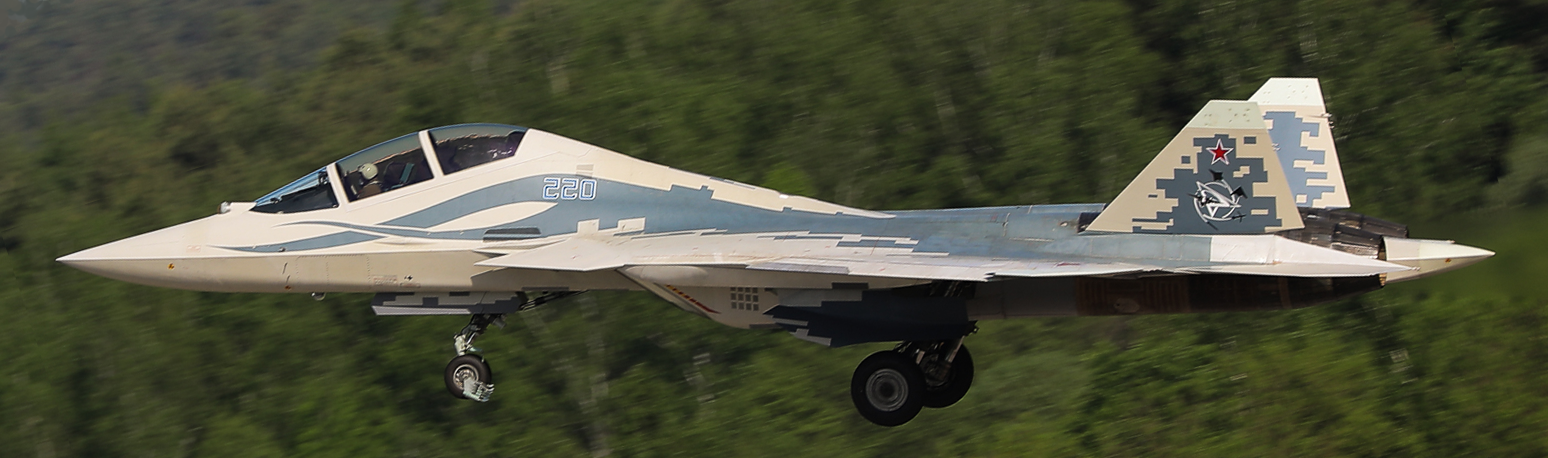
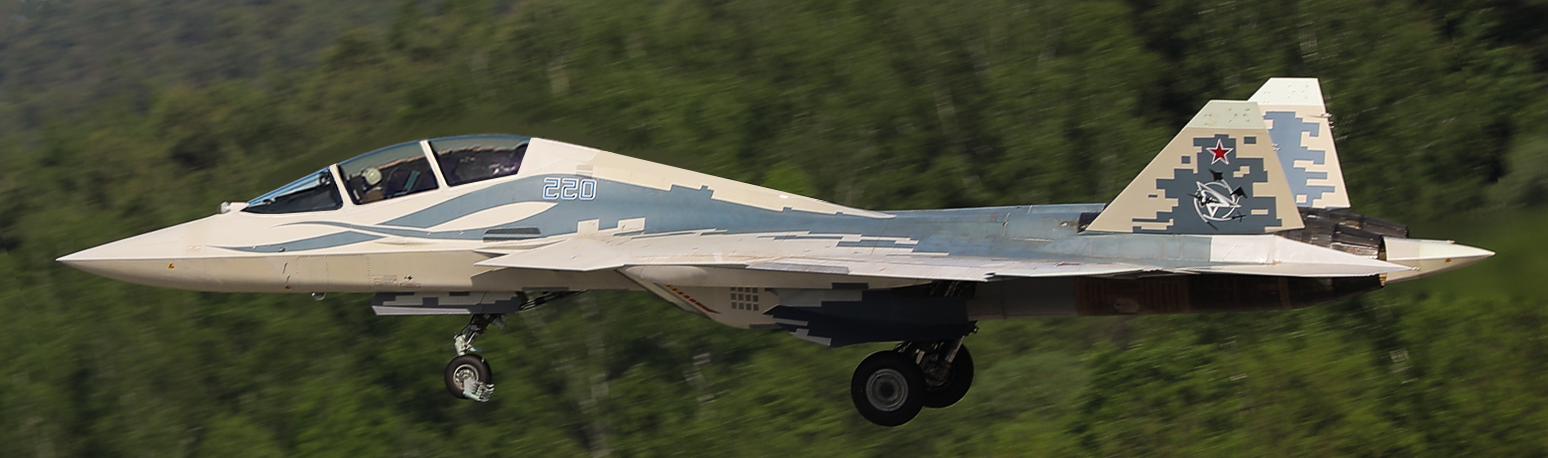
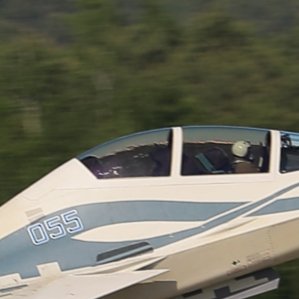
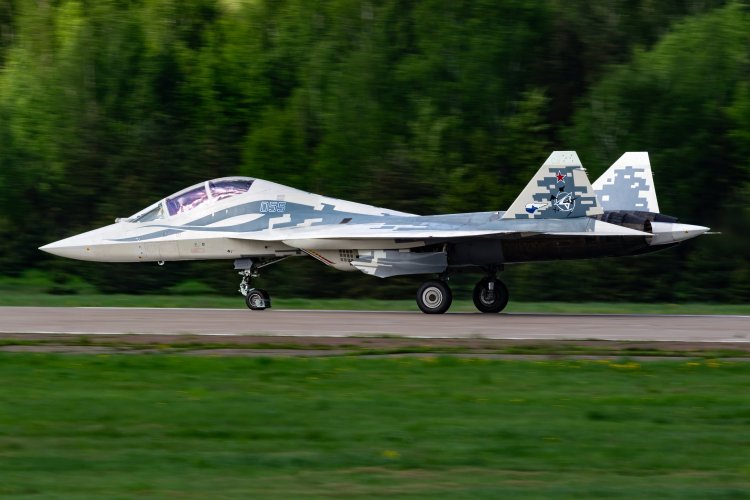
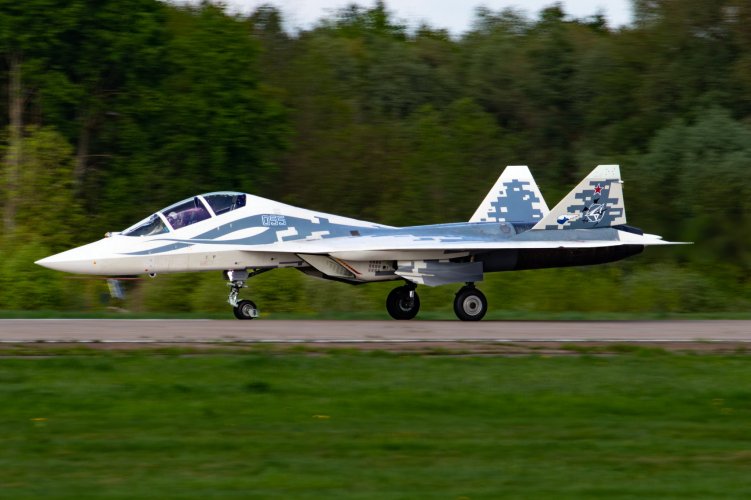
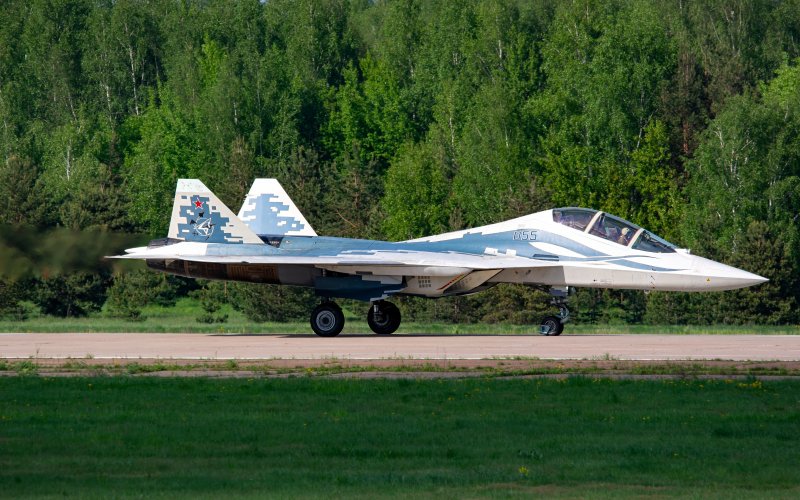
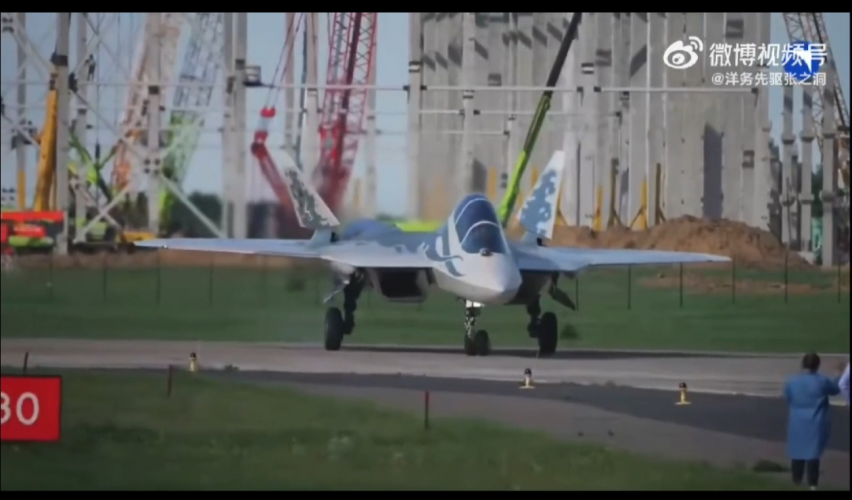
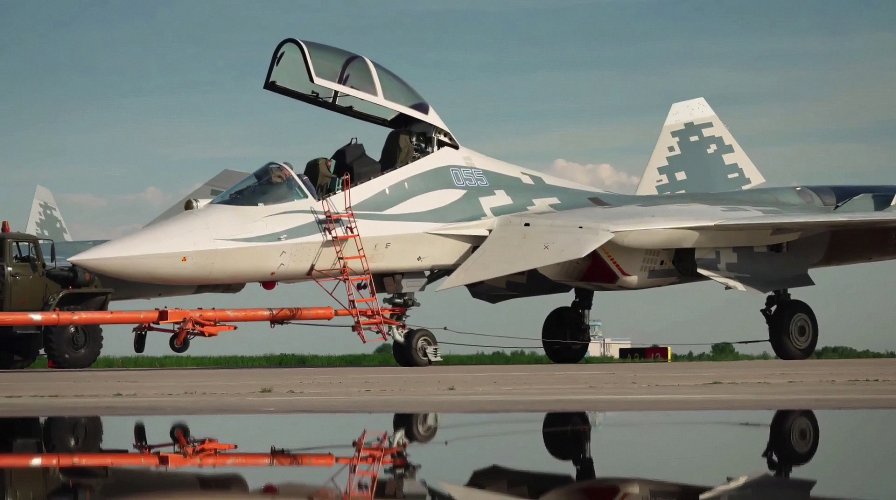
Prettier than the single seat version, but it "Flanker"-fies it a bit.

The high seat position gives good forward view, but also minimizes second seat intrusion into the existing fuselage volumr. A lower canopy position would have needed a plug to lengthen the fuselage I think.

As it is, the length looks unchanged and the front fuselage up to the windshield looks the same.
 
Don't want to go on a tangent too much, but what indian AESA for Su-57 are we even talking about? Afaik there is not one single indian AESA fighter radar operational on any IAF fighter, they are still testing Uttam and Virupaksha is not even flying on Su-30 yet. So the talk of an indian AESA for Su-57 is wishful thinking even right now, let alone in the 2010s.
Me neither, because the Indians wanted to put a foreign (presumably Israeli) radar on the FGFA among various other in depth changes the Russians would have to pay for. This was ultimately, in sum, unacceptable to the Russians.
 
Prettier than the single seat version, but it "Flanker"-fies it a bit.

The high seat position gives good forward view, but also minimizes second seat intrusion into the existing fuselage volumr. A lower canopy position would have needed a plug to lengthen the fuselage I think.

As it is, the length looks unchanged and the front fuselage up to the windshield looks the same.

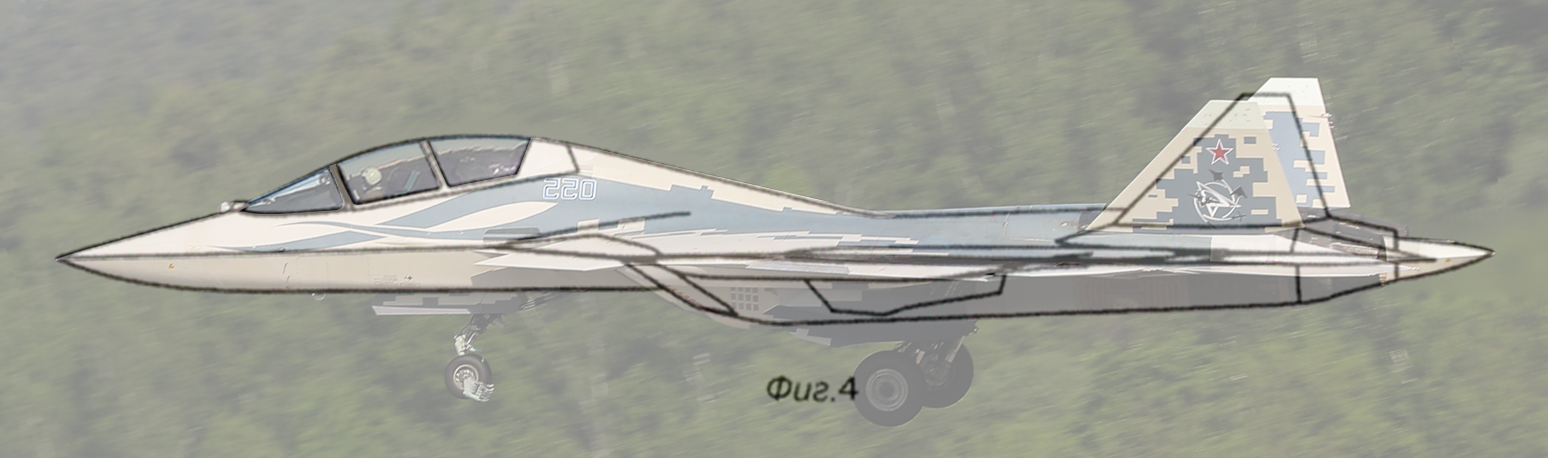
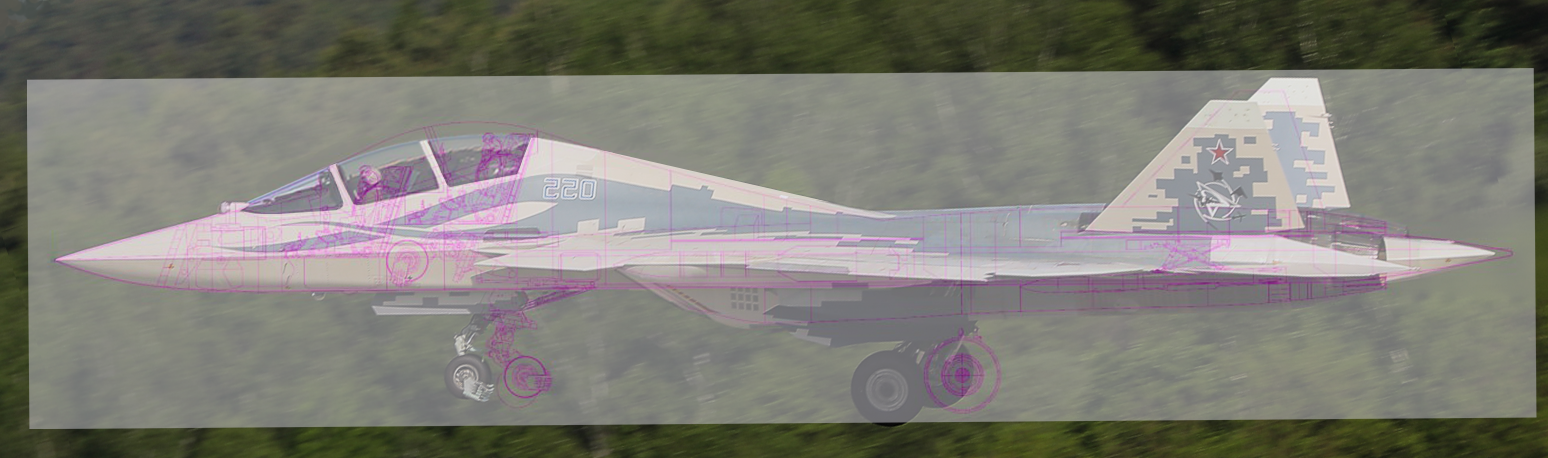
Something would have to be done with the forward landing gear. An attempt was made to make an overlay with the dual-seater patent and paralay's projection (shout-out), the landing gear bay seems to be the main reason the second seat is so high up and I'm not sure what can be done about it bar reworking the gear or half the frame.
 

Attachments

  • overlay 1.png
    overlay 1.png
    907 KB · Views: 200
  • overlay 2.png
    overlay 2.png
    899.4 KB · Views: 115
  • overlay 3.png
    overlay 3.png
    755.2 KB · Views: 115
  • overlay 4.png
    overlay 4.png
    801.2 KB · Views: 125
The high seat position gives good forward view, but also minimizes second seat intrusion into the existing fuselage volumr. A lower canopy position would have needed a plug to lengthen the fuselage I think.

As it is, the length looks unchanged and the front fuselage up to the windshield looks the same.
It makes sense, as a twin seat version was already considered fairly early into the development of the aircraft. And the chosen layout, already known from the Su-30, is not only easier to implement with a given base aircraft, it's also less costly and time intensive compared to the rework that would have been required for a Su-34 style layout.

As for looks, it's certainly pretty, I'm unsure if I actually prefer it over the Su-57S. I'll have to see it in service camouflage first, because that paintjob feels too artsy for my taste.
 
One other thing how different is India's radar compared to the standard Russian Su-57 radar interms of range? It cannot be all that different in terms of modern technology?

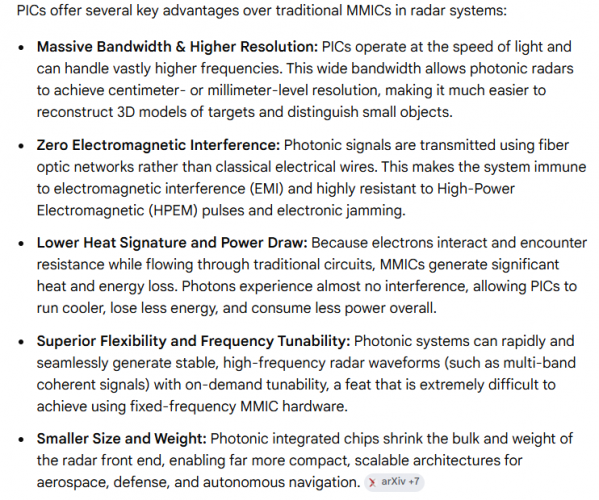
The node requirements for radars in general they do not need to be Taiwan level in terms of downsizing chips. The gate lengths for radar MMICs are generally 250nm to 150nm. They have the 350nm down but plan for 130nm production the end of this year. The actual concern is would Russia even bother selling radars based on PICs instead of MMICs to customers or keep that to themselves.

1779242133610.png
electromagnetic interference screws with the signal to noise ratio which limits radar detection range, offering zero electromagnetic interference might significantly increase radar detection. I also wonder what exact higher frequencies such radars can handle and if stealth would still apply to such higher frequencies?
 
Last edited by a moderator:
What are the chances it will be in this year's Zhuhai Air Show? Will the unpiloted systems featured on the rudder be there as well?
 
Last edited by a moderator:
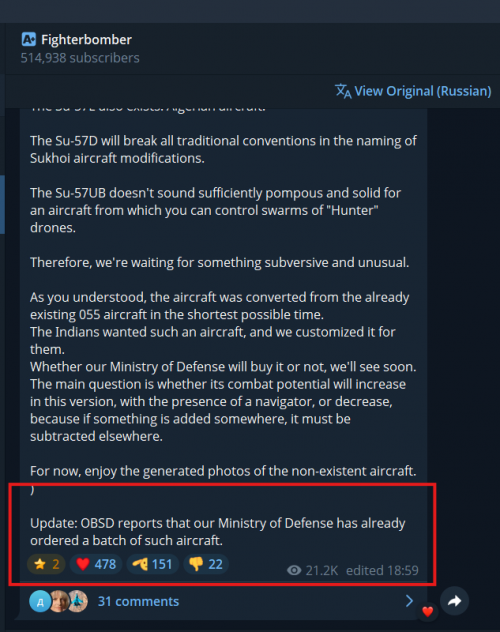
I don't know how that's a surprise to some. Of course they were going to order several of these, for one because it lends itself more to the complex command and control functions that will arise with increased usage of higher end unmanned systems, many of which centered around the Su-57, like the S-71 and S-70. But also because the oldest Su-30s will eventually need a replacement as well. I can imagine the Russian Navy may be interested to pick these up to supplement their Su-30SM and SM2s.

In short, there was never the question of "if" but rather "when". I assume much the same will be the case with T-75.
 
Indeed, George said the VMF is more likely to order these compared to the VKS.
Exactly. It's worth keeping in mind that T-75 will offer a dual seater as well. Although I think the Su-57D will lend itself more to battlefield C² than it's single engine cousin. So there's still a usecase for the VKS.
 
Presumably that's D for Двухместны or "double" as UB Учебно-Боевой ('combat trainer") is not appropriate.
Indeed, the nomenclature has some precedence though. MiG-35D was after all the dual seat version (although the single seat retained the same canopy and general airframe) and on varioüber expos the three variants of the T-75 have been labled T-75S (single seat), T-75D (two seat) and T-75B (unmanned).

Consequently UB was never an option, quite frankly, as there's no need for a trainer Version.
 
I don't know how that's a surprise to some. Of course they were going to order several of these, for one because it lends itself more to the complex command and control functions that will arise with increased usage of higher end unmanned systems, many of which centered around the Su-57, like the S-71 and S-70. But also because the oldest Su-30s will eventually need a replacement as well. I can imagine the Russian Navy may be interested to pick these up to supplement their Su-30SM and SM2s.

In short, there was never the question of "if" but rather "when". I assume much the same will be the case with T-75.
Feels much more like an expored-oriented vehicle for eventual replacement of Su-30MK/MKK/MKA/MKM/MKI/SM. Naturally, marketing it would be easier if it was "accepted into service" domestically. But I suppose time will tell.

While putting WSO into an fifth gen aircraft might sound appealing for loyal wingman reasons, what it also does is cutting down on flight perfomance, increases operational consts, while also increasing technical debt for future system development, while the global trend is on increased automation, AI assistants and optionally manned platforms. With emergence of mesh-networks and further development of sattelite constellations, I think there it is an option to "untie" WSO from the aircraft itself, which can function as a relay or to get rid of WSO at all, relying on automation instead.
 
Last edited:
I think they raised the cockpit that high to install an extra fuel tank behind it to increase the fighter´s range.
 
Range has plagued Russian twin seat fighters in the past, whenever they installed a second cockpit whether for training or otherwise range suffered as a result so it is good that they have installed an extra fuel tank to get over that issue.
 
Range has plagued Russian twin seat fighters in the past, whenever they installed a second cockpit whether for training or otherwise range suffered as a result so it is good that they have installed an extra fuel tank to get over that issue.
To be fair, usually additional fuel doesn't really overcome added drag.
 
All in all, conception of the dual-seater is as we can see completely the same as of Su-27UB.Seat in the rear cabin is higher 20-30 cm with that 'HUD' just like in the rear cabin of the Su-27UB. That is ideal for the instructor. It was strange to see only one crew member during the first test flight but who knows ,maybe there are really double controls,we will see.

Some Russian sources mentioned that there is no need for the Su-30SM and Su-35S pilots to be trained in dual-seaters to fly on Su-57.OK ,they have very sophisticated simulators which can be connected between each other like Su-35S sims.They even have special centrifuge where capsule is in fact Su-57 cockpit.

From 03:00

https://my.mail.ru/video/embed/496204366345154570?autoplay=1&wmode=opaque
 
From the Patent Doc. :

МНОГОФУНКЦИОНАЛЬНЫЙ ДВУХМЕСТНЫЙ МАЛОЗАМЕТНЫЙ САМОЛЕТ

MULTI-PURPOSE TWO-SEAT STEALTH AIRCRAFT

The possibility of using a two-seater multifunctional aircraft as an airborne command post, with the ability to ensure interaction between aviation and military formations in solving combat missions, analyzing information received from its own systems and external information sources with the subsequent issuance of recommendations to the crew and commands to the group's aircraft, as well as a control post for unmanned aerial vehicles, is achieved through a wide range of communication means, including satellite communications, equipment for group transmission of information, equipment for transmitting information over long distances and a high-speed communication channel for receiving and transmitting audio, photo, video, text, voice and telecode information and a specialized command and information field of the rear cockpit (which, in comparison with the front cockpit, has the following differences: an expanded panoramic aviation indicator and an additional indicator for increasing the operator's working field, controls are installed to transfer control priority from one cockpit to another and also excludes control bodies that do not require control by a second crew member), which makes it possible to promptly receive information from various external sources (both aviation and land and sea), analyze it on board the aircraft and issue recommendations or commands to perform a combat mission to the group's aircraft, taking into account their fuel reserves and combat equipment.


The increase in range and flight duration is achieved by increasing the fuel tanks by 10% compared to the prototype with a change in the geometric contours of the airframe, due to the placement of the second crew member as well as when placing fuel tanks in the cargo compartments of an aircraft.

( If I remember well ,there was some news about the additional fuel tanks which can be attached inside of the two FWC's ? )

The aircraft's communications suite enables communication between subscribers using a wide range of communication modes, operating in both open and encrypted modes. The multifunctional two-seat aircraft's communications suite operates in the following bands and modes:

- centimeter wavelengths - for transmitting photos and video images;
- shortwave wavelengths - for transmitting voice information over long distances;
- ultra-shortwave wavelengths - for transmitting voice and telecode information in air-to-air mode;
- using a group action terminal - for group transmission of voice and telecode information between subscribers of a group of aircraft;
- using satellite space communications - for transmitting voice and telecode information via satellites.

The availability of these operating modes for the communications system allows the multifunctional two-seater aircraft to command a group of different types of aircraft (both manned and unmanned) to ensure flexibility in combat use when solving airborne command post tasks in any weather conditions and when jammed by the enemy.


https://fips.ru/cdfi/fips.dll/ru?ty=29&docid=2807624


About the comm complex of the Su-57 ,there is some interesting data from 2018 :

Некоторые характеристики комплекса средств связи (КСС) С-111 самолёта Су-57

Some characteristics of the S-111 communications system (CS) of the Su-57 aircraft


https://ak-12.livejournal.com/91286.html

https://cyberleninka.ru/article/n/p...iya-aviatsiey-putem-adaptatsii-kanalov/viewer


Translation of the complete 'Patent Doc' and this article would require more time but with the help of others,we can have complete material in English.Then we will better understand tactical and technical requirements for the dual-seater by the VKS.

 
An interesting development, the Su-57D as an airborne command post. Much like what the MiG-31 is currently doing.
 
It's not really comparable to the MiG-31 in that regard and it certainly isn't suitable as an interceptor. MiG-31 will remain in service until PAK DP enters service.

The Su-57D has it's own role in the larger picture of tactical russian aviation.

The Su-57 can carry the same class of missiles as the Mig-31, with a better radar and networking ability, and do so at a similar range. There is no reason why the Su-57 can't take over the old interception and patrol roles.

The only thing it can't do is carry the Kh-47!
 
An interesting development, the Su-57D as an airborne command post. Much like what the MiG-31 is currently doing.

I do wonder if the commander needs forward visibility... I always thought it'd make more sense for low observability/survivability reasons to fair the second pilot in behind the pilot (similar to the Mig-31 cockpit). It matches the patent though! I suppose one additional rational for the high cockpit would be to avoid having to substantially reduce the internal fuel capacity?
 
an expanded panoramic aviation indicator and an additional indicator for increasing the operator's working field

I'm gathering that "indicator" in this context means "display"? So it's sounds like it's getting some of the big flat panel displays/touchscreens that are the fashion these days.
 
The Su-57 can carry the same class of missiles as the Mig-31, with a better radar and networking ability, and do so at a similar range. There is no reason why the Su-57 can't take over the old interception and patrol roles.

The only thing it can't do is carry the Kh-47!
Define "better radar", yes the N036 is vastly more modern and is able to handle more difficult tasks with regards to tracking a multitude of individual targets, jamming resistance, as well as the advantages that arise with the two fairly large sub-arrays at either side (widening coverage). But the upgraded Zaslon simply brings high peak power and a huge aperture to the table.

Aside from that the MiG-31BM has greater range and most importantly a far greater service ceiling, launching VLRAAMs and ALBMs at over 25km altitude is simply something the Su-57 can't do, doesn't need to do. Because it's not an interceptor and wasn't meant to be one in the russian interpretation of that role. That's why the Su-57 was developed under the program for a "prospective frontline aviation complex" while the MiG-31s mantle will be taken up by a "prospective long range interception complex". Because the tactical multirole stealth fighter is meant to address different needs and fulfill different roles. The interceptor role in Russian doctrine is a specialized one, always has been, and just because an aircraft is by itself capable doesn't mean it's suitable for that role.

Or to address the underlying notion that I think is the driver behind such ideas, just because the US ditched thoroughbred interceptors and uses their tactical fighters for air space policing and patrols, doesn't mean that the Russians, which have fundamentally different needs, can replace their specialized high performance interceptors with tactical fighters. Because for the Russians an interceptor does so much more than escort strategic bombers out of their air space. It's an integral part of their overarching multidomain air and missile defense apparatus which goes from the venerable A-135 all the way down to the lowliest of Strela-10s. And when the Su-27 and Su-35 already couldn't usurp the interceptor role, the Su-57 won't do it either.
 
I wonder how much use is mig-31bm(2), given that even it's core model threat is now b-21 and LRSO.
It isn't really inconceivable that B-21 can fend them off without interfering with it's mission.

And that's before the emerging mass connected drone world.

Su-57 shouldn't be that much help v broadband VLO either though(nor against massed drones), neither is rest of the system (S-500, A-100, etc).
You just need a new defensive concept and plane, there's no way around. Technology moves forward.
 
I wonder how much use is mig-31bm(2), given that even it's core model threat is now b-21 and LRSO.
It isn't really inconceivable that B-21 can fend them off without interfering with it's mission.

And that's before the emerging mass connected drone world.

Su-57 shouldn't be that much help v broadband VLO either though(nor against massed drones), neither is rest of the system (S-500, A-100, etc).
You just need a new defensive concept and plane, there's no way around. Technology moves forward.
The US doesn't field drones in large numbers and it's to be seen if they'll be able to afford a multitude of intricate designs like China does. The Russian IADS is meant to address cold war style strategic warfare. Meaning strike fighters, strategic bombers and ballistic missiles.

Massed drones do not exist in the hands of their adversaries, probably won't for several decades and aren't what the general air and missile defence is addressing, for the most part as this threat is still emerging and because Russia simply favors deploying large numbers of drones themselves, makes sense given that they're the largest drone force in continental europe

B-21 and LRSO is a concern for ground based radars, SAM systems and PAK DP from the mid to late 2030s onwards. As B-21 hasn't even entered service yet and needs time to become an integrated part of the US bomber fleet, which for the forseeable future are B-1, B-2 and B-52, aircraft which the MiG-31BM was meant to deal with, while for the B-21 it simply won't be up to the task anymore after decades of service and being in essence a mid cold war design. Although realistically the checkmate to US long range aviation are the SSBNs, road mobile TELs and Silos with their intercontinental missiles, which make the medium weight strategic bomber also somewhat obsolete in that overarching context. I.e. the point is becoming somewhat moot.

We're going off topic though. This isn't about the MiG-31 or PAK DP but about the Su-57. And to conclude, no it won't replace the MiG-31 and no, while it's capable, it's not a satisfying substitute for a true next generation interceptor for the Russian military.
 
I think you are making a few leaps here. Do we have any real evidence that the Su-57 has a lower ceiling than the Mig-31? It certainly has good engines and it also has a lower wing-loading than the Mig-31. The Mig-31 is a half century old by now after-all. I wouldn't be surprised if the Su-57 ends up replacing the Mig-31 in non-ballistic missile carrying roles. I think a PAK-DP would have been intended to have higher performance than the Mig-31 - but I'm not sure that is really needed (if it happens it might be a way to get some 6th gen features and a Su-34/Tu-22 replacement airframe - but that would be going beyond the Mig-31's current capabilities).
 
The rear of the aircraft is more worn out than the front fuselage; I think this is a recycled airframe to build the two-seater.
 
They had to do it this way for packaging reasons because the nose gear well would've been in the way of placing the WSO any lower
 

Similar threads

Back
Top Bottom