Admiral Hipper with 7,48 inch(19cm) cannon?

Zero_Ver2123

ACCESS: Restricted
Joined
5 April 2024
Messages
3
Reaction score
0
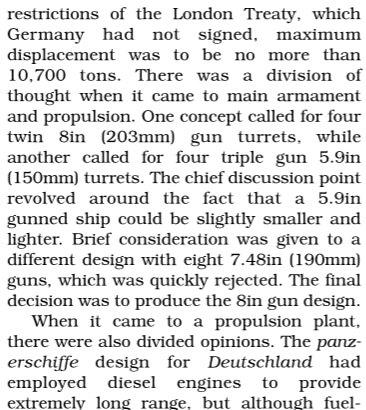
Hello friends! I'd like to know if any development work has been done on the Admiral Hipper's 190mm guns. I've come across information about the Admiral Hipper's 190mm guns before, but I've never found any comprehensive information about them. Why was such a non-standard caliber chosen? Was there any work done (development of specifications or preliminary design work) or any discussions about it?

Below is a quote from the article "ShipCraft 16"

photo_2026-05-19_15-34-30.jpg
 
According to M.J Whitley it was a compromise choice between performances of 15cm and 20.3cm and German were concered about the weight of gun turrets early on, but after several calculations shows the weight differences between 4x2 19cm and 20.3cm (+stowed ammuntions) are very minimal so they end up go with 20.3cm guns instead.
 
According to M.J Whitley it was a compromise choice between performances of 15cm and 20.3cm and German were concered about the weight of gun turrets early on, but after several calculations shows the weight differences between 4x2 19cm and 20.3cm (+stowed ammuntions) are very minimal so they end up go with 20.3cm guns instead.
Why didn't they choose 17cm guns? They had old designs from pre-dreadnought battleships. And were there any technical requirements for 19cm guns?
 
Why didn't they choose 17cm guns? They had old designs from pre-dreadnought battleships. And were there any technical requirements for 19cm guns?
Interesting question, the old, heavy, slow-firing 17cm guns would likely have been unacceptable, but they likely had the lathes and such to make new design guns. I agree this would be an interesting option.
 
Interesting question, the old, heavy, slow-firing 17cm guns would likely have been unacceptable, but they likely had the lathes and such to make new design guns. I agree this would be an interesting option.
In 1941, Germany managed to develop a 17cm gun with excellent ballistics and high muzzle velocity with a relatively "light" projectile. So I think they could have developed something like that. Although... I heard a story that they wanted to gain dominance over the Soviet Baltic light cruisers, which were armed with 180mm guns. Perhaps they wanted to maintain their superiority without switching to "heavy" cruisers?
 
Why didn't they choose 17cm guns?
There was proposal for M-class light cruiser to carry them in 8 guns but was rejected because of weight and stablity problems.
 
There was proposal for M-class light cruiser to carry them in 8 guns but was rejected because of weight and stablity problems.
Can you please state your interesting source?
 
Until the outbreak of WWII, Germany obeyed, at least officially, the British-German naval agreement. That means, that Bismarck officially was a 35.000 ts ship, the Hipper class were 10.000 ts cruisers, and a cruiser armed with 170 mm guns, would have been counted as a heavy cruiser. Displacement is difficult to see, even from a short distance, gun calibre relatively easy ,,,,
So, arming the Hipper class with 190 mm guns would have had technical reasons only, and as Alexi wrote, the weight advantage against 203 mm was minimal.
 
Why didn't they choose 17cm guns? They had old designs from pre-dreadnought battleships. And were there any technical requirements for 19cm guns?
Drachinifel has talked about this a couple of times in youtube videos*; there are sizes that just don't stick around for technical reasons. Five inch shells are about the maximum weight one person can handle without mechanical assistance; six inch has a rate of fire advantage over larger shells, again because of weight; eight inch was the maximum permitted under the treaty, so for shells between around six and eight inches you have the rate of fire of eight with less weight of shot, so there's no point in not going to eight.

*I can't remember is there is a dedicated one or if it's just answering the question in his Drydock Q&A videos.
 
Five inch shells are about the maximum weight one person can handle without mechanical assistance
Rapidly overtime. Maximum weight one person can handle is 6", actually more like 6.5(pre-ww1 French 164, but also German field 17 cm guns and other 170mm guns which fight to this day). But not for long, or not very fast.
6" is also a normal limit for manual stabilization (roll compensation); but again, it's a bit arbitrary - French(again) managed to extend it all the way to 240.

Largest caliber for manhandling is...7.5 inch (194mm), though with a light shell (for example, Soviet 180 isn't really suitable for man handling). That's exactly how it was chosen.
 
Last edited:

Similar threads

Back
Top Bottom