They trained the AI to recognise targets before the mission. What point is a "programmed flight" during the terminal homing phase when it needs to select the most vulnerable spot on the target (the fuel tanks). The drones were very cheap, so dont expect the AI to be playing chess on such a tiny onboard computer. So of course the pilot will still control it as much as possible, but the AI could have been psyops for Russias benefit lol.

Color me sceptical, My 2 cents , there was no need or benefit for AI at any stage why bother with it , its was manually controlled mission from start to finish. 4g for network like its being done in Ukraine.
AI is a catch phrase being thrown around very lightly and MSM is hardly experts reporting on stuff.


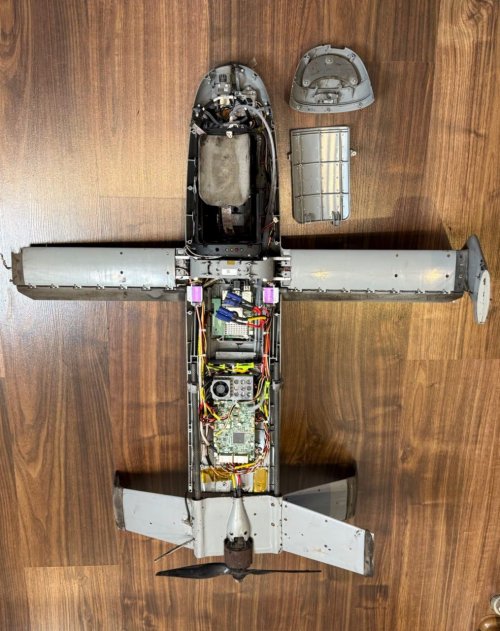
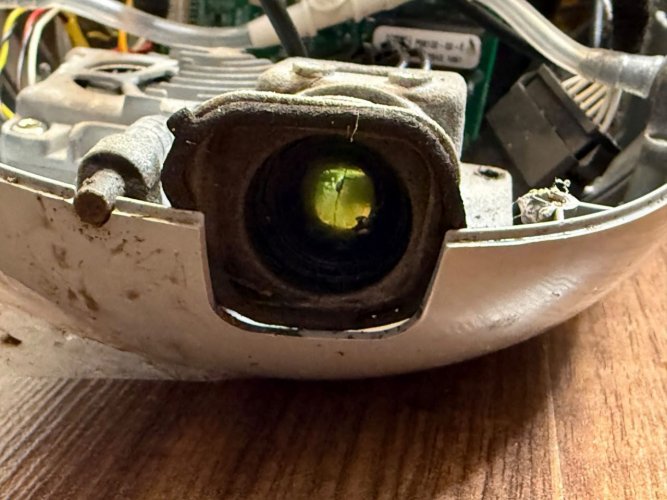
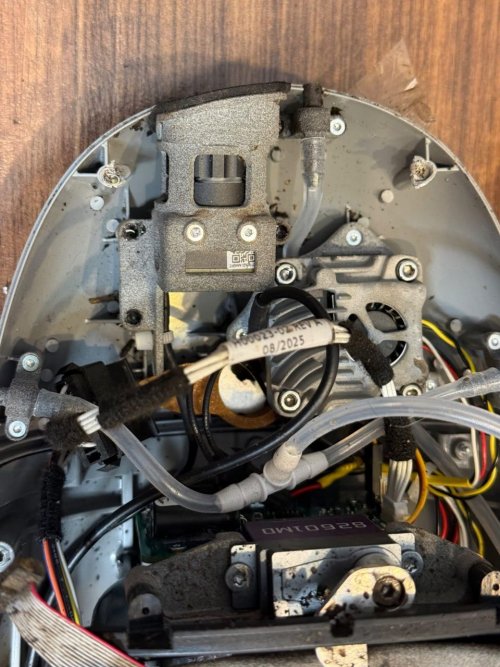
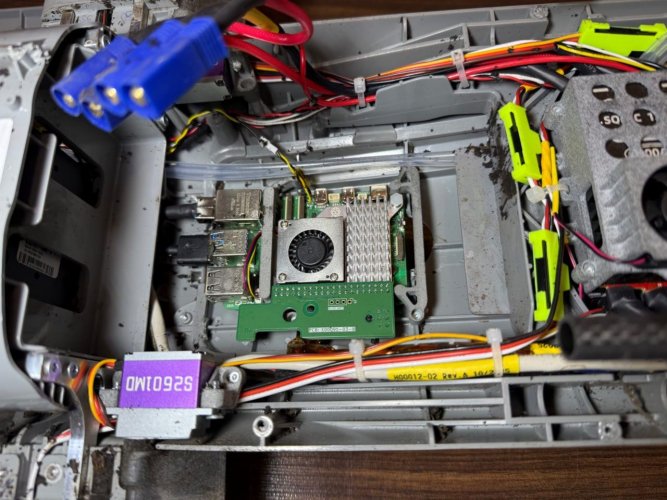
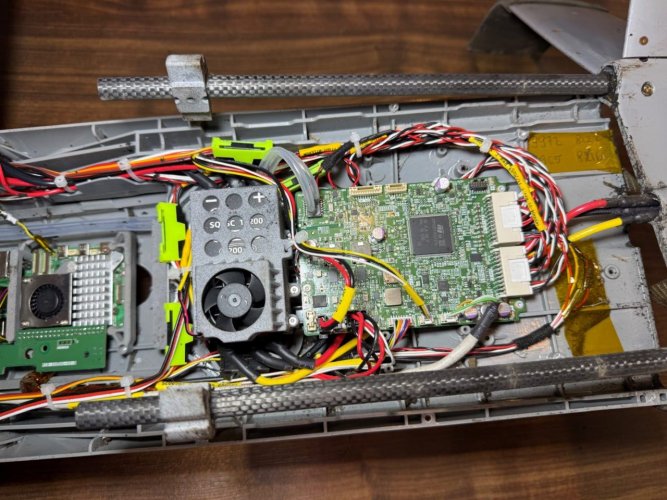
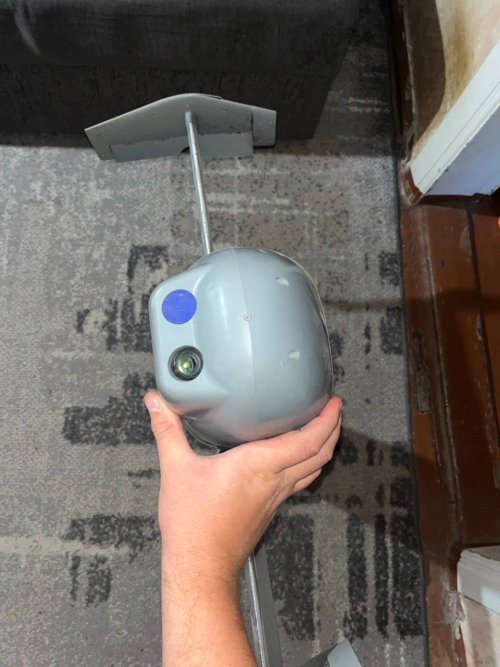
Let take a peek at Ukraine most advanced interceptor drone , AS3 Surveyor developed and manufactured in US and claims to have accounted for 40% of all Ukrainian drone interceptions. Unlike ukrainian 3d printed drones with all Chinese component base this one is made in quite industrial fashion with injection molded components and it looks like this one could actualy support AI

In any case electronics are mostly civilian surprisingly with no shielding anywhere and given its running an Rasberry pie P5 .The only part you cant buy on aliexpress seems to be Ukrainian made frequency hopping datalink. In any case there are bunch of these interceptor remenants on sale in Ukraine for anwhere between 50-200Eur so might buy me one to look at in detail. Sting and other Ukrainan ones are not that interesting as they are quite simple FPV in comparison.

“”
Recovered components indicate the use of a frequency-hopping communications system.
The radio link reportedly uses the B5 module, produced by a company based in Lviv.

Key characteristics include:
• frequency-hopping spread spectrum communications
• operating band between 500–1010 MHz
• improved resistance against electronic warfare and signal interception

Frequency hopping communications are a key feature for UAV operations in contested electromagnetic environments.

They allow:
• rapid switching across frequencies
• reduced vulnerability to jamming
• more resilient command-and-control links


Its kinda impressive on how simple the electronics are ,but also designs refined aerodynamics and structure , enabling future growth without retooling ,5 stars for effort to make it cheap .

Note air defense interceptor drones mostly operate rear of the front lines so need for shielding is much less than for drones operating on front line , also life cycle of an interceptor is short compared to recce drones.

One thing to note , these interceptors are not made to military standards by a long shot , best used within months ,like in war in Ukraine , any long term storage like typical for military gear i would expect failure rates to skyrocket. So i imagine AS-3 procured by Romania,Poland and couple of others will end up either in some warzone or disposed of before long.

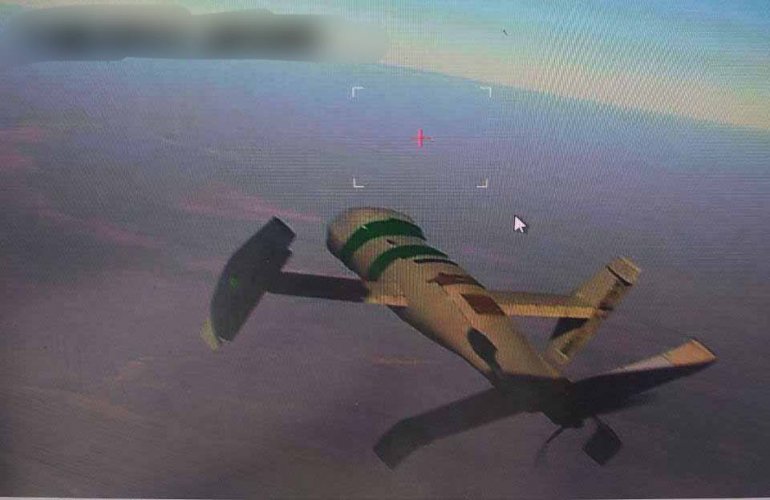
Last photo: Interesting case of interceptor intercepting an AS-3 interceptor.
 

Attachments

  • HFUrVO2a8AYE6V9.jpg
    HFUrVO2a8AYE6V9.jpg
    241.5 KB · Views: 198
  • 1774695807104.jpg
    1774695807104.jpg
    139.6 KB · Views: 195
  • 1774695807723.jpg
    1774695807723.jpg
    202.5 KB · Views: 202
  • 1774695807539.jpg
    1774695807539.jpg
    197.7 KB · Views: 202
  • 1774695807708.jpg
    1774695807708.jpg
    217.8 KB · Views: 212
  • photo_2025-09-16_19-42-38.jpg
    photo_2025-09-16_19-42-38.jpg
    113.8 KB · Views: 226
  • IMG_20250918_160516_936.jpg
    IMG_20250918_160516_936.jpg
    33.2 KB · Views: 233
  • HGIh_mPWsAASC-S.jpg
    HGIh_mPWsAASC-S.jpg
    107.3 KB · Views: 244
Last edited by a moderator:

This is kinda click bait , once you go remote control via internet , like they did a while back with 500km claim distance does not matter much except for latency of internet conection .

Let me illustrate , its kinda like you playing videogames with opponent in same city or in different country , no big deal no progress to be shouting from the rooftops


Estonian Krattworks flew drones intercontinental ,years ago .

''KrattWorks successfully delivered an intercontinental drone operation in May 2022, where a pilot in San Diego, California, operated a drone in Estonia to detect simulated fire hotspots. Using AI-powered machine vision, the drone mapped fire locations in real-time, displaying them via ATAK-CIV in both California and Estonia.''

✅ The operator conducted a demonstration in San Diego, at Aerial Firefighting North America fair.
✅ The operator in California piloted the drone in Estonia, above our simulated fire hotspots.
✅ The drone used machine vision algorithm to detect fire hotspots and we generated a near real-time map with fire locations.
✅ The fire hotspot map was displayed live by ATAK-CIV application: visible in California as well as in Estonia.
The demo event was part of the exhibition "Aerial Firefighting North America 2022", organized by Tangent Link Ltd.
 
Last edited:
This is kinda click bait , once you go remote control via internet , like they did a while back with 500km claim distance does not matter much except for latency of internet conection .

Let me illustrate , its kinda like you playing videogames with opponent in same city or in different country , no big deal no progress to be shouting from the rooftops


Estonian Krattworks flew drones intercontinental ,years ago .

''KrattWorks successfully delivered an intercontinental drone operation in May 2022, where a pilot in San Diego, California, operated a drone in Estonia to detect simulated fire hotspots. Using AI-powered machine vision, the drone mapped fire locations in real-time, displaying them via ATAK-CIV in both California and Estonia.''

✅ The operator conducted a demonstration in San Diego, at Aerial Firefighting North America fair.
✅ The operator in California piloted the drone in Estonia, above our simulated fire hotspots.
✅ The drone used machine vision algorithm to detect fire hotspots and we generated a near real-time map with fire locations.
✅ The fire hotspot map was displayed live by ATAK-CIV application: visible in California as well as in Estonia.
The demo event was part of the exhibition "Aerial Firefighting North America 2022", organized by Tangent Link Ltd.
In teory yes, but the demonstration of practical implementation is important. It raises new posibilities. You can have in the future several centers of drone pilots in safe places and lines of docks with interceptor drones close to the front line. I think that we will see this soon in Ukraine and in the Middle East.
 
Why would you want to fly a $35 interceptor FPV some 1000km away and set up $10000 relay stations.

The amount of autonomy needed to compensate for the latency alone will be enough to displace the operator anyway.

Marketing stunt to fool the common civvi. Literally no one in Ukraine or Russia is using this tech in real combat. They would rather set up heavily fortified positions 20km behind the FLOT to house the GCS, that says enough.
 
Why would you want to fly a $35 interceptor FPV some 1000km away and set up $10000 relay stations.

The amount of autonomy needed to compensate for the latency alone will be enough to displace the operator anyway.

Marketing stunt to fool the common civvi. Literally no one in Ukraine or Russia is using this tech in real combat. They would rather set up heavily fortified positions 20km behind the FLOT to house the GCS, that says enough.
Ukranians not in Ukraine could control them, as could anyone else not in Ukraine for that matter.

View: https://x.com/Osinttechnical/status/2046137009853399298?s=20
 
Last edited:
Why would you want to fly a $35 interceptor FPV some 1000km away and set up $10000 relay stations.

The amount of autonomy needed to compensate for the latency alone will be enough to displace the operator anyway.
Latency isn't an issue, you use the controller to tell the drone where to go/what to target, not to fly it there from microsecond to microsecond. The targets aren't moving fast enough for latency to be an issue.

Exactly the same way drones over Afghanistan and Iraq were controlled by operators sitting in Creech AFB in Nevada going back at least to 2007.
 
Latency isn't an issue, you use the controller to tell the drone where to go/what to target, not to fly it there from microsecond to microsecond. The targets aren't moving fast enough for latency to be an issue.

Exactly the same way drones over Afghanistan and Iraq were controlled by operators sitting in Creech AFB in Nevada going back at least to 2007.
Why have a controller at all then for such cheap "interceptor" drones? Having one thousands of kilometers away really accomplishes nothing other than some free press as if such a thing is remarkable. At least a controller close to the front might have enough awareness of the battlefield where he could avoid intercepting a friendly drone or redirect to an incoming priority target.
 
Last edited:
The drones were very cheap, so dont expect the AI to be playing chess on such a tiny onboard computer.
Why not? It really doesn't take a lot of power or space to make a computer play chess*. Never wrote a chess programme, but I did write a Go programme to run on my BBC B with its 6502 and 32kb of RAM one summer**. And when I got to GEC we were writing HUD OFPs in just the same amount of space with 68000s.

It doesn't take as much power as people think to right functional programmes, and your typical Raspberry Pi (or equivalent) is vastly more powerful than what we were using in the late 80s for the 'computer revolution'.

Raspberry Pi, 1500MIPS, AMD 68000 4.5 MIPS

* Grandmaster level chess is a different beast.
** It wasn't a very good Go player, but neither was I.
 
Latency isn't an issue, you use the controller to tell the drone where to go/what to target, not to fly it there from microsecond to microsecond. The targets aren't moving fast enough for latency to be an issue.
Sure, but it's a STING drone. It's not a Reaper. Manually flown FPV with range below 50km, stocked in the hundreds in a GCS dugout.

I'm cool with Ukrainian companies developing autonomous navigation and attack software addons for it. The issue I have is how they presented it to pander to politicians and NAFOs, which is their job to prop up their game, sure, but there are tens of thousands of ardent war watchers out there that know how both sides operates these. I'm just one of them and I got annoyed.

Better off, shill for stuff like DELTA which could actually be a real game changer for the poorer end of NATO.
 
Why have a controller at all then for such cheap "interceptor" drones? Having one thousands of kilometers away really accomplishes nothing other than some free press as if such a thing is remarkable. At least a controller close to the front might have enough awareness of the battlefield where he could avoid intercepting of friendly drones or redirect to an incoming priority target.
Good situational awareness is probably simpler to arrange for the remote pilot in an air-conditioned control centre than trying to devolve it down to every frontline FPV pilot in a trench.
 
Good situational awareness is probably simpler to arrange for the remote pilot in an air-conditioned control centre than trying to devolve it down to every frontline FPV pilot in a trench.
Maybe but you need folks on site to assemble , charge , arm and handle the FPV drone in the trench these drones might be controllable from 1000km away but have range like 10-15km , so now you are suggesting gang-pressed trench consumable manpower and caviar couch pilots fighting same war. You can only imagine how enthused them 'deplorables' will be to basically servicing the pilots.
 
Maybe but you need folks on site to assemble , charge , arm and handle the FPV drone in the trench these drones might be controllable from 1000km away but have range like 10-15km , so now you are suggesting gang-pressed trench consumable manpower and caviar couch pilots fighting same war. You can only imagine how enthused them 'deplorables' will be to basically servicing the pilots.
Pilots and ground crews have always fought different wars. And this isn't new, Ukraine has had pilots controlling drones via Starlink pretty much since the start of the war, all that's different AFAICS is someone demonstrating it on a shorter-range drone. I don't see the capability as likely to displace frontline drone operators, it's more something that may occasionally be useful.
 
Why would you want to fly a $35 interceptor FPV some 1000km away and set up $10000 relay stations.
If you have USV carrying interceptor FPV, remote control infra is necessary for its use. In the modern tactical environment, I suspect that USV needs interceptors to survive incoming anti-boat drones.

For ground warfare, it is possible to have huge area coverage without humans just by dropping starlink-enabled drone launch pad and only patch it in when opposing drones are detected (via equally unmanned means like sound detection) While stationing a few operators to cover the front isn't impossible, what is likely actually impossible is having enough operators at the right spot to counter a large swarm and more manpower is needed to cover internal areas. Do note that production of low cost drones far exceed drone operator training rates.

And there is also air launched fpvs, as just about any aircraft that can release cargo mid air can carry a bunch and utilize the low cost of the FPV munition with the high speed of the carrier. With networking infra, rapid engagement of large swarms becomes possible as the crew bottleneck is removed.

Then there is a full UGV swarm carrying their own air defense....and so on
 
Maybe but you need folks on site to assemble , charge , arm and handle the FPV drone in the trench these drones might be controllable from 1000km away but have range like 10-15km , so now you are suggesting gang-pressed trench consumable manpower and caviar couch pilots fighting same war. You can only imagine how enthused them 'deplorables' will be to basically servicing the pilots.
Well, you can carry the drones where you need them with basically a bigger drone.
https://breakingdefense.com/2026/04...interceptor-drone-from-usv-to-destroy-shahed/
"Sam Bendett, an unmanned systems expert and close observer of the conflict in Ukraine, said the success of this new sea-air integration setup will create further headaches for Russian kamikaze drones.

“This capability adds another protection layer for Ukrainians against incoming Russian long-range drones – when integrated with the rest of the defensive systems, it makes Shaheds [even] more vulnerable,” Bendett, an advisor on Russian military technology at the U.S.-based Center for Naval Analyses thinktank, told Breaking Defense."
 
In the end guns are likely to be king of CUAS for the foreseeable future. A handful of airbursting 30mm rounds is still much cheaper than an interceptor drone.
Gun on the ground that can't hit threats flying high, is too slow to reposition to interceptor aerial threats or avoid its attacks or even just deal with terrain?

Put the gun on the interceptor drone and everything is better. (Some one just need to figure out the fire control against maneuvering targets)
 
Confronting The Evolving Missile Threat in Europe, IAMD Conference 2026, RUSI

Very much about UAVs in addition to missiles. Presentations only, Q&A off the record. Russian tactical layer (~150 km from the line of contact), strategic/operational level, logistics/production resilience and scalability.

View: https://youtu.be/z9QeN_3WbZs
 
Gun on the ground that can't hit threats flying high, is too slow to reposition to interceptor aerial threats or avoid its attacks or even just deal with terrain?

Put the gun on the interceptor drone and everything is better. (Some one just need to figure out the fire control against maneuvering targets)
What drones are flying too high for an AA gun to shoot down? What drones are flying too fast?

Mk45 has an engagement ceiling of 49k feet.
Bayraktar TB2 has a flight ceiling of 27k feet
I guess the reaper at 50k ft can fly above mk45’s engagement ceiling, but not by much. Creating a 4” sub caliber AAA round would close that gap. I imagine an AAA round for something like paladin could cover well beyond 50k
 
Last edited:
Why not? It really doesn't take a lot of power or space to make a computer play chess*. Never wrote a chess programme, but I did write a Go programme to run on my BBC B with its 6502 and 32kb of RAM one summer**. And when I got to GEC we were writing HUD OFPs in just the same amount of space with 68000s.

It doesn't take as much power as people think to right functional programmes, and your typical Raspberry Pi (or equivalent) is vastly more powerful than what we were using in the late 80s for the 'computer revolution'.

Raspberry Pi, 1500MIPS, AMD 68000 4.5 MIPS

* Grandmaster level chess is a different beast.
** It wasn't a very good Go player, but neither was I.
The Rasberry Pi is probably more powerful than the original mainframe that played chess anyway.
 
https://www.reuters.com/business/ae...erceptors-ukraine-war-gets-closer-2026-04-24/

"Romania and NATO have ‌spent two ⁠weeks trying out interceptor drones, radars, sensors and jamming equipment made by private companies, while putting existing systems through their paces.
Merops, already in use in Ukraine and another of its neighbours, Poland, includes a ground control base, launchers and its Surveyor interceptor drones that can operate autonomously through AI and radar, NATO ⁠sources said.
Defence Minister Radu Miruta described the test as partially successful after an interceptor swerved too quickly at one point and missed its target.
He said he was impressed with the thermal imaging, the radar's precision ⁠and the way it engaged targets.
The system would be able to counter drone threats along the Danube river, Miruta said. "Merops reduces the number of scenarios we cannot handle.""
 
In the end guns are likely to be king of CUAS for the foreseeable future. A handful of airbursting 30mm rounds is still much cheaper than an interceptor drone.

30mm x 173mm programmable rounds are north of $300 per round...thats not proximity fuzed either, they will be far more expensive. These are electrically timed fuzes using induction loops at the muzzle to set the fuze.

A Sting interceptor costs $2,000 according to Wild Hornets...

One of those can fly 40km and intercept at 5,000ft and upwards, and can even be re-used if no engagement occurs...the other....can't and will need multiple rounds to engage...
 
30mm x 173mm programmable rounds are north of $300 per round...thats not proximity fuzed either, they will be far more expensive. These are electrically timed fuzes using induction loops at the muzzle to set the fuze.

A Sting interceptor costs $2,000 according to Wild Hornets...

One of those can fly 40km and intercept at 5,000ft and upwards, and can even be re-used if no engagement occurs...the other....can't and will need multiple rounds to engage...
Umm…ok? And, what’s your point exactly?
 

Similar threads

Back
Top Bottom