They trained the AI to recognise targets before the mission. What point is a "programmed flight" during the terminal homing phase when it needs to select the most vulnerable spot on the target (the fuel tanks). The drones were very cheap, so dont expect the AI to be playing chess on such a tiny onboard computer. So of course the pilot will still control it as much as possible, but the AI could have been psyops for Russias benefit lol.

Color me sceptical, My 2 cents , there was no need or benefit for AI at any stage why bother with it , its was manually controlled mission from start to finish. 4g for network like its being done in Ukraine.
AI is a catch phrase being thrown around very lightly and MSM is hardly experts reporting on stuff.


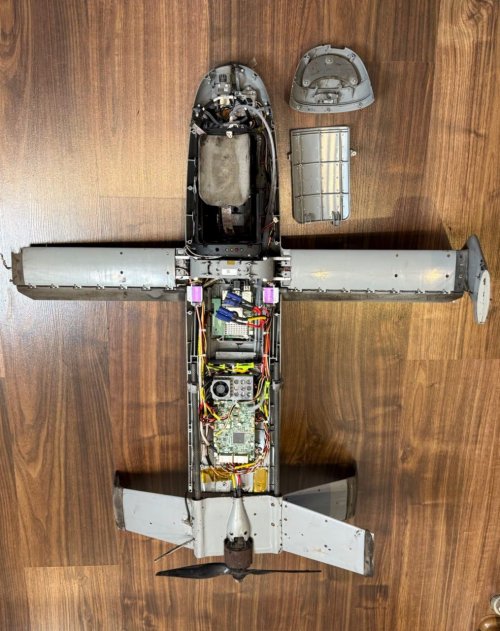
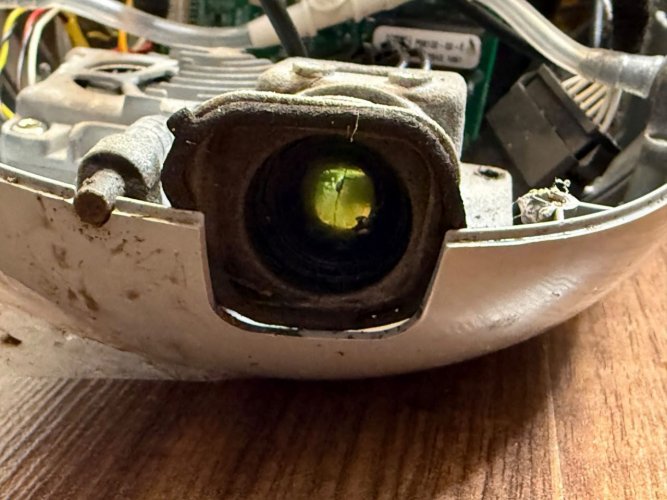
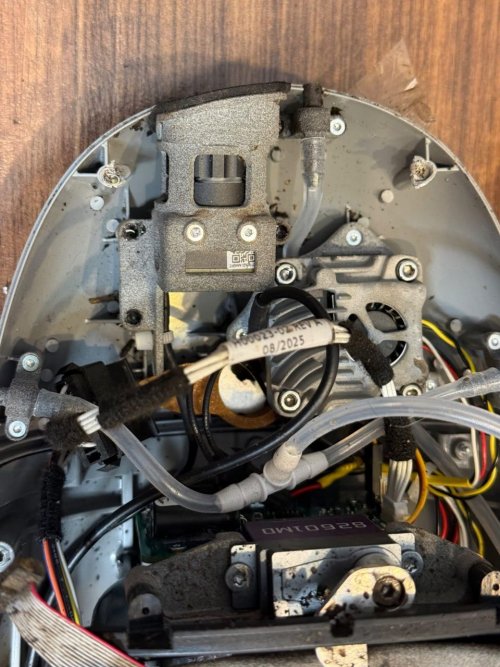
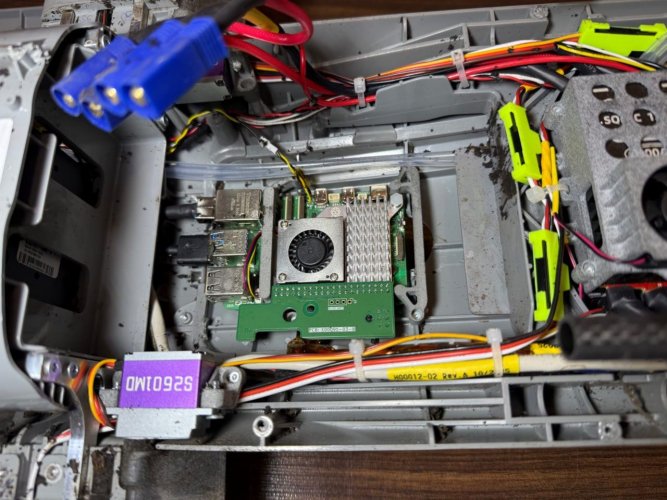
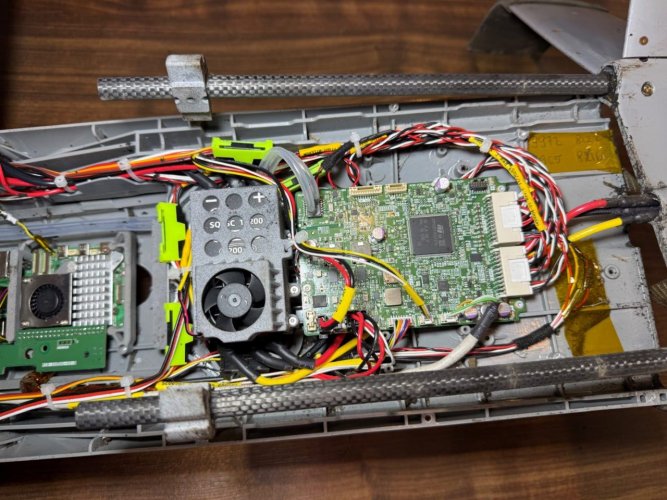
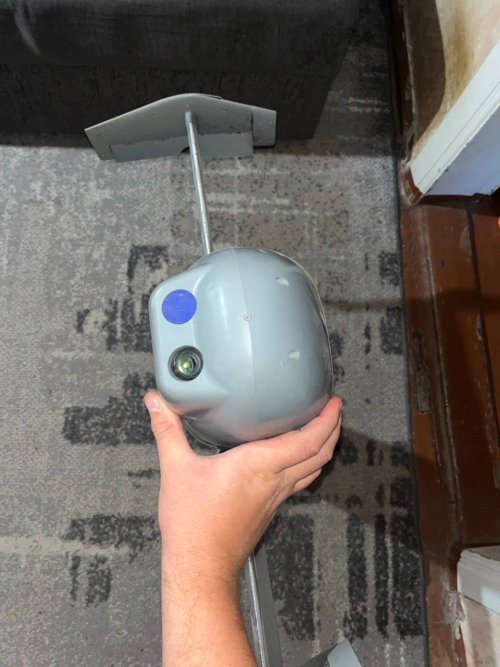
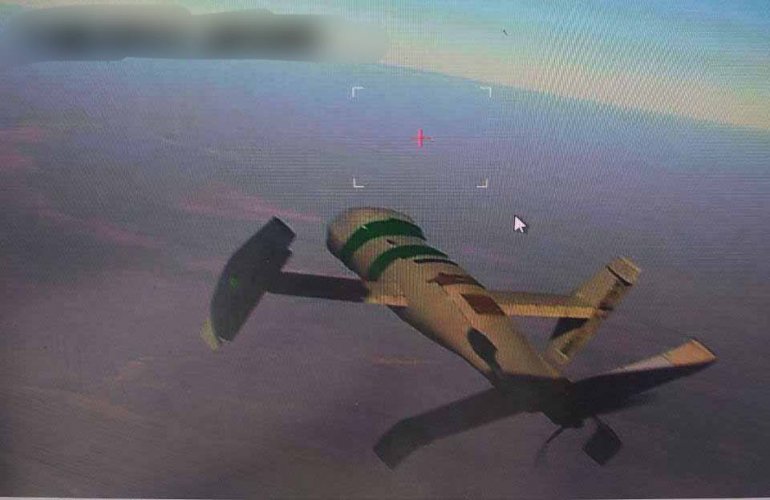
Let take a peek at Ukraine most advanced interceptor drone , AS3 Surveyor developed and manufactured in US and claims to have accounted for 40% of all Ukrainian drone interceptions. Unlike ukrainian 3d printed drones with all Chinese component base this one is made in quite industrial fashion with injection molded components and it looks like this one could actualy support AI

In any case electronics are mostly civilian surprisingly with no shielding anywhere and given its running an Rasberry pie P5 .The only part you cant buy on aliexpress seems to be Ukrainian made frequency hopping datalink. In any case there are bunch of these interceptor remenants on sale in Ukraine for anwhere between 50-200Eur so might buy me one to look at in detail. Sting and other Ukrainan ones are not that interesting as they are quite simple FPV in comparison.

“”
Recovered components indicate the use of a frequency-hopping communications system.
The radio link reportedly uses the B5 module, produced by a company based in Lviv.

Key characteristics include:
• frequency-hopping spread spectrum communications
• operating band between 500–1010 MHz
• improved resistance against electronic warfare and signal interception

Frequency hopping communications are a key feature for UAV operations in contested electromagnetic environments.

They allow:
• rapid switching across frequencies
• reduced vulnerability to jamming
• more resilient command-and-control links


Its kinda impressive on how simple the electronics are ,but also designs refined aerodynamics and structure , enabling future growth without retooling ,5 stars for effort to make it cheap .

Note air defense interceptor drones mostly operate rear of the front lines so need for shielding is much less than for drones operating on front line , also life cycle of an interceptor is short compared to recce drones.

One thing to note , these interceptors are not made to military standards by a long shot , best used within months ,like in war in Ukraine , any long term storage like typical for military gear i would expect failure rates to skyrocket. So i imagine AS-3 procured by Romania,Poland and couple of others will end up either in some warzone or disposed of before long.


HFUrVO2a8AYE6V9.jpg

1774695807104.jpg

1774695807723.jpg

1774695807539.jpg

1774695807708.jpg
photo_2025-09-16_19-42-38.jpg


Interesting case of interceptor intercepting an AS-3 interceptor.


IMG_20250918_160516_936.jpg


HGIh_mPWsAASC-S.jpg
 
Last edited:

This is kinda click bait , once you go remote control via internet , like they did a while back with 500km claim distance does not matter much except for latency of internet conection .

Let me illustrate , its kinda like you playing videogames with opponent in same city or in different country , no big deal no progress to be shouting from the rooftops


Estonian Krattworks flew drones intercontinental ,years ago .

''KrattWorks successfully delivered an intercontinental drone operation in May 2022, where a pilot in San Diego, California, operated a drone in Estonia to detect simulated fire hotspots. Using AI-powered machine vision, the drone mapped fire locations in real-time, displaying them via ATAK-CIV in both California and Estonia.''

✅ The operator conducted a demonstration in San Diego, at Aerial Firefighting North America fair.
✅ The operator in California piloted the drone in Estonia, above our simulated fire hotspots.
✅ The drone used machine vision algorithm to detect fire hotspots and we generated a near real-time map with fire locations.
✅ The fire hotspot map was displayed live by ATAK-CIV application: visible in California as well as in Estonia.
The demo event was part of the exhibition "Aerial Firefighting North America 2022", organized by Tangent Link Ltd.
 
Last edited:
This is kinda click bait , once you go remote control via internet , like they did a while back with 500km claim distance does not matter much except for latency of internet conection .

Let me illustrate , its kinda like you playing videogames with opponent in same city or in different country , no big deal no progress to be shouting from the rooftops


Estonian Krattworks flew drones intercontinental ,years ago .

''KrattWorks successfully delivered an intercontinental drone operation in May 2022, where a pilot in San Diego, California, operated a drone in Estonia to detect simulated fire hotspots. Using AI-powered machine vision, the drone mapped fire locations in real-time, displaying them via ATAK-CIV in both California and Estonia.''

✅ The operator conducted a demonstration in San Diego, at Aerial Firefighting North America fair.
✅ The operator in California piloted the drone in Estonia, above our simulated fire hotspots.
✅ The drone used machine vision algorithm to detect fire hotspots and we generated a near real-time map with fire locations.
✅ The fire hotspot map was displayed live by ATAK-CIV application: visible in California as well as in Estonia.
The demo event was part of the exhibition "Aerial Firefighting North America 2022", organized by Tangent Link Ltd.
In teory yes, but the demonstration of practical implementation is important. It raises new posibilities. You can have in the future several centers of drone pilots in safe places and lines of docks with interceptor drones close to the front line. I think that we will see this soon in Ukraine and in the Middle East.
 
Why would you want to fly a $35 interceptor FPV some 1000km away and set up $10000 relay stations.

The amount of autonomy needed to compensate for the latency alone will be enough to displace the operator anyway.

Marketing stunt to fool the common civvi. Literally no one in Ukraine or Russia is using this tech in real combat. They would rather set up heavily fortified positions 20km behind the FLOT to house the GCS, that says enough.
 
Why would you want to fly a $35 interceptor FPV some 1000km away and set up $10000 relay stations.

The amount of autonomy needed to compensate for the latency alone will be enough to displace the operator anyway.

Marketing stunt to fool the common civvi. Literally no one in Ukraine or Russia is using this tech in real combat. They would rather set up heavily fortified positions 20km behind the FLOT to house the GCS, that says enough.
Ukranians not in Ukraine could control them, as could anyone else not in Ukraine for that matter.

View: https://x.com/Osinttechnical/status/2046137009853399298?s=20
 
Last edited:
Why would you want to fly a $35 interceptor FPV some 1000km away and set up $10000 relay stations.

The amount of autonomy needed to compensate for the latency alone will be enough to displace the operator anyway.
Latency isn't an issue, you use the controller to tell the drone where to go/what to target, not to fly it there from microsecond to microsecond. The targets aren't moving fast enough for latency to be an issue.

Exactly the same way drones over Afghanistan and Iraq were controlled by operators sitting in Creech AFB in Nevada going back at least to 2007.
 
Latency isn't an issue, you use the controller to tell the drone where to go/what to target, not to fly it there from microsecond to microsecond. The targets aren't moving fast enough for latency to be an issue.

Exactly the same way drones over Afghanistan and Iraq were controlled by operators sitting in Creech AFB in Nevada going back at least to 2007.
Why have a controller at all then for such cheap "interceptor" drones? Having one thousands of kilometers away really accomplishes nothing other than some free press as if such a thing is remarkable. At least a controller close to the front might have enough awareness of the battlefield where he could avoid intercepting of friendly drones or redirect to an incoming priority target.
 
The drones were very cheap, so dont expect the AI to be playing chess on such a tiny onboard computer.
Why not? It really doesn't take a lot of power or space to make a computer play chess*. Never wrote a chess programme, but I did write a Go programme to run on my BBC B with its 6502 and 32kb of RAM one summer**. And when I got to GEC we were writing HUD OFPs in just the same amount of space with 68000s.

It doesn't take as much power as people think to right functional programmes, and your typical Raspberry Pi (or equivalent) is vastly more powerful than what we were using in the late 80s for the 'computer revolution'.

Raspberry Pi, 1500MIPS, AMD 68000 4.5 MIPS

* Grandmaster level chess is a different beast.
** It wasn't a very good Go player, but neither was I.
 
Latency isn't an issue, you use the controller to tell the drone where to go/what to target, not to fly it there from microsecond to microsecond. The targets aren't moving fast enough for latency to be an issue.
Sure, but it's a STING drone. It's not a Reaper. Manually flown FPV with range below 50km, stocked in the hundreds in a GCS dugout.

I'm cool with Ukrainian companies developing autonomous navigation and attack software addons for it. The issue I have is how they presented it to pander to politicians and NAFOs, which is their job to prop up their game, sure, but there are tens of thousands of ardent war watchers out there that know how both sides operates these. I'm just one of them and I got annoyed.

Better off, shill for stuff like DELTA which could actually be a real game changer for the poorer end of NATO.
 

Similar threads

Back
Top Bottom