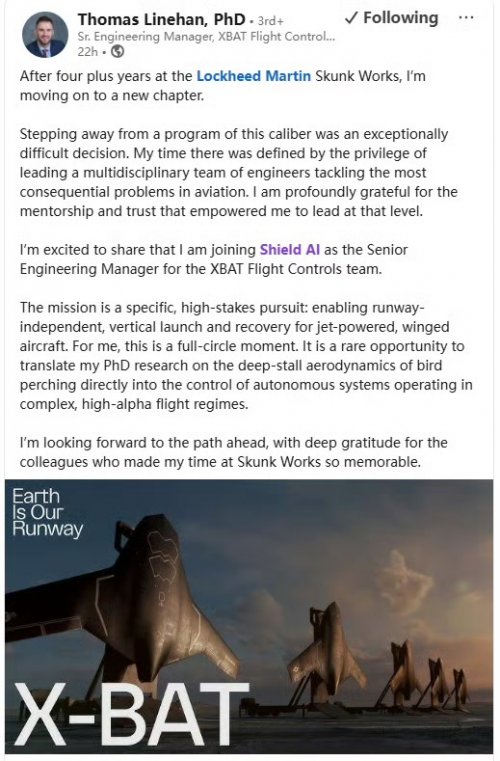
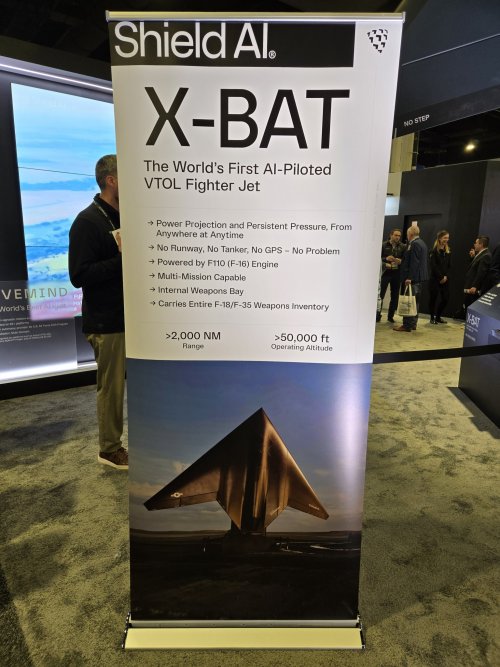
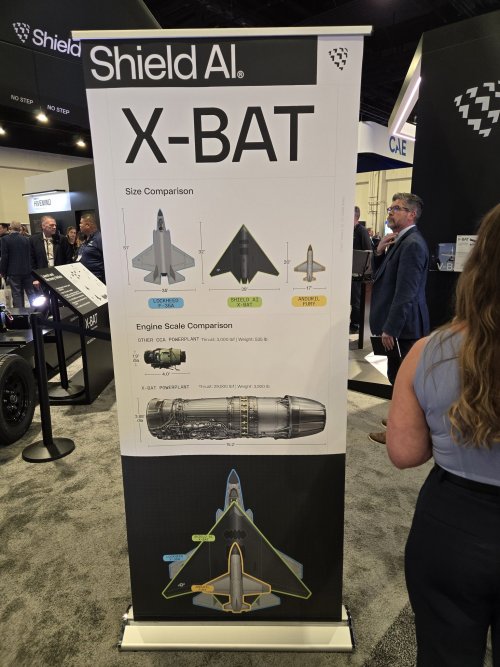
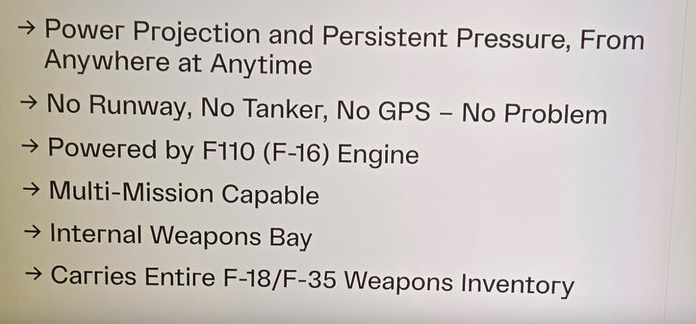
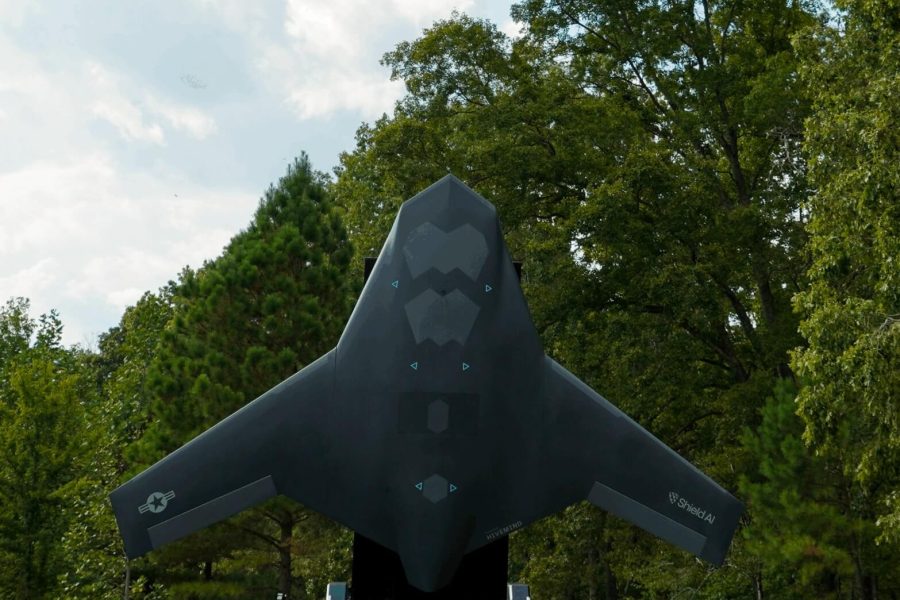
Shield AI X-BAT multirole UCAV

No radar in the nose due to air intake location... how will it detect air targets for its primary mission?
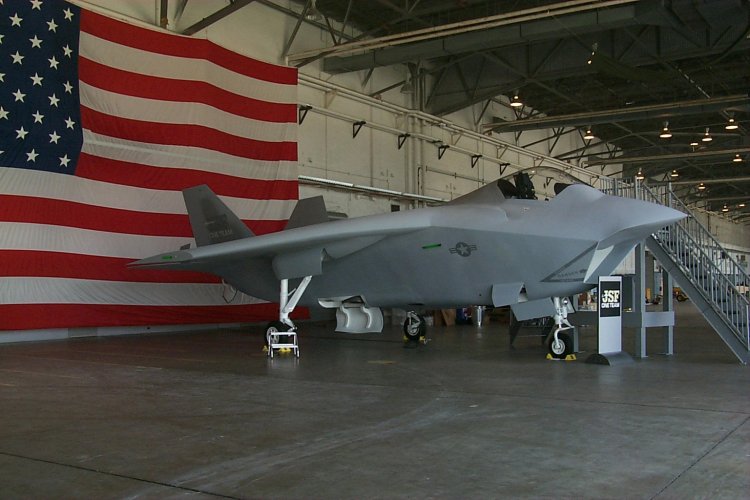
While I agree with the criticism of what's being presented by yet another overhyped start-up, this kind of inlet has been studied by Boeing with their JSF proposal, which was meant to accomodate a radar. It depends a lot on the aircraft size, the volume of where you want to put the radar and the arrangement and dimensions of the intended radar as well.
 

Attachments

  • rare-pics-of-the-boeing-f-32-mock-up-album-v0-r48dgf04cqyc1.jpg
    rare-pics-of-the-boeing-f-32-mock-up-album-v0-r48dgf04cqyc1.jpg
    229.5 KB · Views: 172
Last edited by a moderator:
You absolutely can put fuel in the wings outboard of the folds.
It’s rarely done. The A-6 Intruder is one of the few designs I know that has fuel outboard of the folds (143 gallons per side, 950lbs each).

On a supersonic wing it makes less sense as the wing will be thin and the volume available in the outer section will be limited, especially considering the added complexity and weight, which is not desirable on a VTOL aircraft.
 
The engines aren't vapourware but the rest of the X-Bat design still is.


I don’t think those are even the biggest problem with the X-Bat. The biggest technical problem is the engine inlet distortion and engine performance on landing. I get where these guys are coming from and drawing inspiration from Falcon 9 landings. But landing with rockets is simple compared to trying to do it with a turbojet engine. With rockets you have virtually instant thrust and throttle responses that is only dependent on conditions within the rocket itself. With a turbojet engine, your throttle response will be much slower and your power output will be directly related to the flow quality in the inlet. Worst still poor flow quality induced engine performance lost is unstable and positively reinforce lost of power. Meaning if the flow quality starts to degrade, that degradation is likely to grow extremely large and extremely fast. Couple that problem with a slow throttle response and you’d have an intractable problem.

Traditional jet engine V-TOL doesn’t suffer from these problems as much because the engine inlets are horizontal so you can point the inlets into the wind. The X-Bat is trying to do the same thing with the engine essentially running backwards and (looks to me anyways) lack of ability to land in an arbitrary direction to match the wind. This configuration of VTOL is likely to have large risk of engine exhaust ingestion and poor inlet performance.

You might be able to demonstrate X-Bat’s VTOL capability on a good day out in the desert. But the problem becomes extremely difficult to solve if you have to do a landing in any kind of even light cross or tail (dorsal?) wind. I also wouldn’t read too much into a successful test campaign of their subscale model either. The lag in engine response to throttle commands becomes more difficult as an engine is scaled up due to increasing inertias and square-cube laws. Just because it works at 45% scale, it doesn’t mean it will work at full scale.

This is a very subtle but extremely difficult technical problem to solve. I’m not confident that the folks working on the X-Bat even recognize the gravity of this problem because this problem have no analog from any one with experiences working on the V-Bat nor someone they can poach from SpaceX that had worked on the Falcon 9.

I do hope they succeed because it is a compelling idea. But I wouldn’t bet on this working and I’d hate to be the guy that has to figure out how to get this to work.
 
Last edited by a moderator:
even if the vertical landing part doesnt work i hope they have a backup plan for short EMALS assisted/ support carriers with STOBAR. cause if its a 10 tonne class UAV with a F110 then it has more than enough dry thrust available.
 
Last edited by a moderator:
 

Attachments

  • IMG_2101.jpeg
    IMG_2101.jpeg
    139.8 KB · Views: 68
Its an interesting marketing tactic. The signals coming from the USAF have generally been for lower cost lower capability CCA but Shield are deliberately leaning in to the bigger is better. Obviously being runway independent changes things and makes the X-Bat potentially more survivable than the current tier 1 CCAs through reduced runway reliance but would likely require a great sustainment tail.
 
Shield AI can bid for the next CCA increments with its X-BAT if it has flown and/or demonstrated capability by then. If they are priced out of the requirements they can continue to develop for future requirements hoping that the USAF will raise the CCA cost ceiling by a factor of 3 or 4 to make the X-bat work :)
 
Its an interesting marketing tactic. The signals coming from the USAF have generally been for lower cost lower capability CCA but Shield are deliberately leaning in to the bigger is better. Obviously being runway independent changes things and makes the X-Bat potentially more survivable than the current tier 1 CCAs through reduced runway reliance but would likely require a great sustainment tail.
This is being marketed to ROK, Taiwan, and Japan. IIRC
 
This is being marketed to ROK, Taiwan, and Japan. IIRC
if its VTOL then it could work off even STOBAR carriers or LHDs. Technically even destroyers/frigates but that's unlikely due to a multitude of reasons unless someone gets desperate.
It would be marketed to anyone with a half decent navy
 
IMO it's more like a solution looking for a problem

STOVL aircraft in the likes of F-35B is perfectly sufficient for everyone's pratical need, requiring only very short airfield/the most basic form of flat top LHD to work with

zero-length VTOL is essentially uncalled for, not with the added associated risk and technical trade offs that its unique form warrants

also worth mentioning that unless your airforce is 100% X-BAT only, you still got your regular CTOL manned fighter jet, which largely neutralizes the marketed benefit of runway-indepedence of X-BAT, as you aren't getting rid of your airbase infrastructure in the first place
 
I wonder if CCA requirements do not include a RATO short take off capability. It seems practical to split the difference between XQ-58 and the various YFQs with a couple rocket bottles and a drag chute for relatively short runway operations. In non combat situations they could take off normally without rocket launch, saving that mode for high tempo aster operations.

I have a hard time believing X-BAT ever manages to sell. For A2A, it is getting squeezed be cheaper, lighter platforms, and for A2G it gets squeezed by the huge market of cheap stand off missiles coming online that potentially can be thrown out of cargo lifters. Neither of these have runway independence, but they reduce the dependence sufficiently that I have a hard time believing a bespoke VTOL solution is going to gain traction.
 
Hard believe Bat will sell, stealth features aside. Armed Global hawk and similar drones offer similar advantage. Why Bomber drone when quick launch suicide drone made on the cheap is effective
 
Additional pressure on this market: existing UAVs that use RATO for true vertical take off like XQ-58. Obviously far lower payloads and sortie rates, but in a high intensity conflict, using a bunch more of those with micro PGMs (I think NG Hatchet is like 2kg) and just assuming a lot of them do not come home seems like a better idea. X-BAT still has advantages obviously, but it seems like a pricey way to achieve that capability and flexibility.
 
IMO it's more like a solution looking for a problem

STOVL aircraft in the likes of F-35B is perfectly sufficient for everyone's pratical need, requiring only very short airfield/the most basic form of flat top LHD to work with
Disagree as the X-Bat is, at least current proposed, going to be less costly to operate than an F-35B. While being less capable it provides additional mass that would be significantly more expensive via increased numbers of F-35B.
zero-length VTOL is essentially uncalled for, not with the added associated risk and technical trade offs that its unique form warrants
At this point there is no harm in letting Industry try. If they fail then so be it but if they succeed then it becomes a great capability.
also worth mentioning that unless your airforce is 100% X-BAT only, you still got your regular CTOL manned fighter jet, which largely neutralizes the marketed benefit of runway-indepedence of X-BAT, as you aren't getting rid of your airbase infrastructure in the first place
It becomes easier to defend only a few locations with CTOL compared to many and also provides more tactical flexibility. You can potentially base the CTOL fleet further away and tank them to the conflict while forward deployed vertical launch units can deploy in many more easily relocatable austere locations as long as they can be supplied with weapons and POL.

This is being marketed to ROK, Taiwan, and Japan. IIRC
Sure although there is plenty of marketing material with it showing US markings so I expec they would be happy to sell to the DoD if given the opportunity.

X-BAT-900x600.jpg
 

Preliminary engine work is apparently complete.


Shield AI has completed subscale and full-scale testing of the GE Aerospace F110-GE-129 engine adapted for vertical flight application on its X-BAT autonomous combat drone, a company executive said at the Sea-Air-Space exposition here, with prototype aircraft expected this summer.​

Armor Harris, Shield AI's senior vice president of aircraft engineering, told reporters in the exhibit hall that the company has spent roughly 12 months adapting the F110 for the X-BAT's tail-sitting vertical takeoff and landing configuration -- a flight profile that places unusual demands on the engine because the aircraft spends a significant portion of its launch and recovery phase oriented vertically.

"The F110 engine brings two things -- it brings the thrust we need for takeoff, so we take off on afterburner to get the thrust needed to lift off, and then when we come back to land, we land on mil power," Harris said. "It's basically the takeoff thrust plus the mil thrust that we needed. The F110 is the best thrust-to-weight ratio in this class."

The F110-GE-129 selected for the X-BAT features GE Aerospace's Axisymmetric Vectoring Exhaust Nozzle, which provides thrust vectoring capability for vertical flight and enhanced maneuverability in horizontal flight. GE Aerospace and Shield AI formalized their propulsion collaboration through a memorandum of understanding announced in November 2025, under which GE Aerospace is providing propulsion and testing support for the program.

The X-BAT, unveiled in October 2025, is designed to operate from ships, remote islands, and austere forward bases without conventional runway infrastructure. It features a range of over 2,000 nautical miles and an internal weapons bay sized to match the payload capacity of an F-35. Initial VTOL flight tests are planned for later this year, with full operational validation targeted for 2028 and production in 2029.

 
Worth noting that within the past year or so, there have been a few think tank papers that have recommended runway-independent CCAs. The Mitchell Institute for one, the Hudson Institute for another. However, the recommendation from both is for low-cost runway-independent CCAs. A Mitchell Institute wargame resulted in almost no usage of exquisite CCAs, and the Hudson Institute is recommending that runway-independent counter-air CCAs cost no more than $4M per, including the effectors (this is within a larger context of forward deployed sensors that would integrate with these CCAs).

Thinktankland moves inexorably each year towards "the US must act as an asymmetric insurgent stand-in force in the 1IC to have a chance."
 
Worth noting that within the past year or so, there have been a few think tank papers that have recommended runway-independent CCAs. The Mitchell Institute for one, the Hudson Institute for another. However, the recommendation from both is for low-cost runway-independent CCAs. A Mitchell Institute wargame resulted in almost no usage of exquisite CCAs, and the Hudson Institute is recommending that runway-independent counter-air CCAs cost no more than $4M per, including the effectors (this is within a larger context of forward deployed sensors that would integrate with these CCAs).
Agree and why the USAF has reportedly reversed from a more exquisite Increment 2 set of requirements to one that potentially is less capable/costly than Increment One. Will be interesting to see if X-Bat plays a role or remains a good idea too late to the party.
 
[...] and the Hudson Institute is recommending that runway-independent counter-air CCAs cost no more than $4M per, including the effectors (this is within a larger context of forward deployed sensors that would integrate with these CCAs).
And how exactly do they think that the CCA will only cost ~2-3mil(inflation-adjusted)?
 
The current nozzle doesn’t have low-observable (LO) attributes, but that is something that will be introduced after prototype testing. There is also the possibility of the X-BAT vectoring its nozzle in forward flight to increase its agility. The companies stress that this capability will depend on customer requirements, but the nozzle will be fully vectorable across the flight regime.
 
And how exactly do they think that the CCA will only cost ~2-3mil(inflation-adjusted)?

I am assuming that it will be more of a Long Shot munition with cuing from other sensor platforms than an independent, reusable aircraft at that price point. I think the Mitchell Institute’s theoretical CCA at this level was both air (B-52) and ground launched, used a hundred at a time as a day 1 surge, and suffered extensive losses.

Though 2-3 million also would have to not count the AAMs they would be equipped with. So long as AIM-120 could be carried, there really is no shortage of those in inventory.
 
When Looking at previous comments, it should be noted that kinetic payloads are not the only useful thing a drone can carry or do - even if it may or may not carry a similar payload to an F-35

If it can be stealthy enough, it could do well just performing ISR or EW.
 
What is interesting is that Shield is focused on VTOL when their design is supposed to do a lot of other things they haven't mastered earlier in any of their program.
Let's hope they are reminded that, to the best of our knowledge, the DoD is not looking for an F-110 powered lift for the Pentagon building...

Rationally, they should have a CTOL demonstrator aside of their VTOL attempt. The lack of this is telling us something worth of interest.
 
When Looking at previous comments, it should be noted that kinetic payloads are not the only useful thing a drone can carry or do - even if it may or may not carry a similar payload to an F-35

If it can be stealthy enough, it could do well just performing ISR or EW.
Oh, absolutely. ISR is probably cheap, just needs an EOTS and a datalink. EW is not going to be cheap, though.

Silly question. How expensive is a JASSM?
 
Oh, absolutely. ISR is probably cheap, just needs an EOTS and a datalink. EW is not going to be cheap, though.

Silly question. How expensive is a JASSM?

ADM-160C/MALD-J I think is only $300,000 so EW need not be prohibitively expensive, depending on the desired effect. If you just want a false target generator for few seconds, that can as small as an expendable countermeasure (eg Brite Cloud). ESM also need not be that expensive if you limit the target bandwidth you are observing. LRASM must have some ability to listen for air search emissions to do what it does, and that is a $3-4 million AUP.

Basic bitch JAASM is I believe ~$1.5 million. So you could probably make an expendable that carries two 350# AAMs for several million, if you made enough of them and used only off the shelf components. If you wanted it to be recoverable and reusable, that would be a more challenging price point.
 
When Looking at previous comments, it should be noted that kinetic payloads are not the only useful thing a drone can carry or do - even if it may or may not carry a similar payload to an F-35

If it can be stealthy enough, it could do well just performing ISR or EW.

For me, ‘CCA’ has connotations of being the armed unmanned component of NGAD. I assume there are numerous smaller designs doing other work, like EO/IR, ESM, EW, and decoy that operate more as optionally recoverable to expendable in terms of price point and expected flight hours.
 

Similar threads

Back
Top Bottom