2026 Israeli–United States strikes on Iran and elsewhere in region - News and Discussion

Status
Not open for further replies.
View: https://x.com/sentdefender/status/2041125620243955741?s=20

View: https://x.com/IranIntl_En/status/2041068382028542126?s=20

Well that's how they're bypassing defences, high altitude cluster warhead release, which target indiscriminately the entire city.

Iran Is Piercing Israel’s Ballistic Missile Defenses With High Altitude Cluster Warhead Releases​


How will Iran sustain these ballistic missile launches over say a 6-12 month period? Unless they are able to continue producing them somehow but doesnt seem safe having full production underground for such kinds of missiles.
The electrical power would have to be generated equally deep underground, which you can't do without ventilation.

View: https://x.com/FaytuksNetwork/status/2041059796082630768?s=20

View: https://x.com/IDF/status/2041130251292484054?s=20

View: https://x.com/Terror_Alarm/status/2041100759685533957?s=20


View: https://x.com/UKikaski/status/2041108252373455157?s=20
 
Last edited:
(Registration or subscription may be required)
Iran has rejected a call to reopen the Strait of Hormuz in return for a 45-day ceasefire.

Pakistan presented Tehran and Washington with a peace proposal that would have seen an immediate pause in the conflict and a reopening of the key shipping lane.

While Iran said it was reviewing the framework of the broader agreement, an official insisted that the Strait would not be reopened.

The two-stage proposal came from Egyptian, Pakistani and Turkish mediators, who were hoping the 45-day window would provide enough time for talks to reach a permanent ceasefire.

Field Marshal Asim Munir, Pakistan’s army chief, was in contact “all night long” with JD Vance, the US vice-president, Steve Witkoff, the US special envoy to the Middle East and Abbas Araghchi, the Iranian foreign minister, sources told Reuters.

The proposal, called the “Islamabad Accord”, would include a regional framework to reopen the strait, as well as in-person talks in Islamabad.

It is understood to include Iranian commitments not to pursue nuclear weapons in exchange for sanctions relief and the release of frozen assets.

Iran’s foreign ministry said on Monday that Tehran had formulated its position and communicated it through intermediaries in response to the ceasefire proposal.

Esmaeil Baghaei, the ministry spokesperson said details of the response would be announced in due time, but added negotiations were “incompatible with ultimatums and threats to commit war crimes.”

On Sunday, Donald Trump, the US president, threatened to hit Iranian power plants and bridges and send the country to “hell” if Tehran did not reopen the Strait by Tuesday.

“Tuesday will be Power Plant Day, and Bridge Day, all wrapped up in one. Open the f------ strait, you crazy b-------, or you’ll be living in hell – just watch! Praise be to Allah,” he said on Truth Social.

Earlier on Monday, a ‌senior Iranian official told Reuters that Iran ‌wouldn’t reopen the Strait as part of a temporary ceasefire, ⁠nor would it accept deadlines or pressure to reach a deal. Washington was not ready for a permanent ceasefire, the official said.

The Strait of Hormuz, a conduit for one-fifth of the world’s oil, has been effectively blockaded by the Iranian military since US-Israeli strikes in February.

Mr Trump has repeatedly threatened to strike Iranian energy infrastructure in an attempt to force Iran’s leadership to reopen the waters, as energy prices soar.

He previously backed down on a threat to bomb Iran’s power plants, before asking the UK, Japan and South Korea, and others, to help reopen it.

Many of the US’s Gulf allies, including Kuwait and Saudi Arabia, depend on the passage to export oil around the world. On Monday, the United Arab Emirates (UAE) said any settlement must guarantee access through the strait.

It warned that any deal which failed to rein in Iran’s nuclear programme, missiles and drones would pave the way for a “more dangerous and volatile Middle East”.

Iran is understood to have introduced a tax on some oil tankers wanting to pass through, and allows safe passage of “friendly”-flagged ships. It continues to attack other vessels.

On Monday, the Iranian navy said the strait would “never return to its former state” and vowed to impose a “new Gulf order”.
 
Podcast of interview of retired General Stanley McChrystal by NYT journalist David French, dated March 23:
Transcript of podcast:
McChrystal: I really want to go two lines on this. The first is that question, because the Iranian opposition is not really evident. We saw in 2009, they came out in the streets and were beaten back into submission, and then reportedly thousands of Iranians protesting were killed by the regime in recent months.

But I couldn’t name the opposition leader. I couldn’t tell you the liberation front of Iran. I know that the shah’s son is going around, but I don’t think he’s a legitimate alternative. I think that we can’t gauge the actual strength of the desire of Iranian people to change.
And, of course, a war will often cause people to coalesce around their government. In your really well-written article, you said something I really believe in. You said: I’m an American. I want our side to win.
I feel the same way, even though I disagree with many of the things my government’s doing, I’m unequivocally on this side. And that may be the case.
The other thing I wanted to talk about, though, because you brought up the Maduro raid: There are three great seductions that happen to American administrations and to the military.
The first is the idea of covert action. A new president comes in, and he’s told by the intelligence community: We can create this great effect and it will be covert. No one will ever know who did it, and it’ll just be a good outcome. And in my experience, it never stays covert and it rarely works.

French: Right.

McChrystal: But it’s seductive because it seems like an easy approach to a knotty problem.

The second seduction, which I lived as a part of, is the surgical Special Operations raid. That is probably epitomized by the Maduro raid. I would argue that we demonstrated extraordinary competence that night, but not much changed. I don’t think that we actually demonstrated the ability to change the facts on the ground to any extent.

Which gets to the third great seduction, and that’s air power. We all love air power. In World War II, we went into the war with the Douhet theory, that air power, the bomber, will always get through, and therefore air power will be dominant.

It was certainly very, very contributory, but it was never dominant.

When we got into Vietnam, which was the classic case, we developed a strategy that said: For North Vietnam, we will have an escalation strategy, and we will raise the pressure on them until we hit the point at which they’re willing to quit.

It’s not worth it anymore. What we didn’t perceive is — like the Shia wounded that your medics ran into — there was no point for North Vietnam. They were asymmetrically committed to the outcome.

So, we entered Iraq in 2003 with “shock and awe,” and then we spent a decade there fighting after it.

I think, in this case, we again fell for the seduction that if we bomb key targets, we will produce the outcome we want — but the outcome’s in the minds of the people. And unless you’re going to kill all the people, you may not affect that outcome.

We may be at a point — you used the word “quagmire” in your article — but we may be at a point where we’ve run into a country that has an extraordinary capacity to be bombed.
French: [...]
And so we look at a situation like the Strait of Hormuz and we think: We can open that. Of course we can open that.
Just give us some perspective on, as a practical, realistic matter, why is it hard? Why would it be hard to force open the Strait of Hormuz? Or would it be hard?
McChrystal: Yeah, it would be hard to keep it open. It is like what we found in Iraq. We could bomb Iraq pretty easily; we could even take Baghdad with relative ease. We could get rid of the existing government.

But once we wanted to change the reality on the ground, who actually controlled things, how things worked, now you’re not at 30,000 feet. You’re at six feet.
And you’re the same height as your potential opponent. I tell people about this war, if you like this war, enjoy this first part, because this is the best part. Because everything after this will be harder, because it will be more equal, even though we will have bombed them. We’ll have to get down to a level.
In the Strait of Hormuz, we’ve got ships potentially facing mines or even autonomous surface and undersurface vehicles — all the different threats that they can bring out, just to make it lousy.
They’re not all coming after U.S. warships. They don’t have to; they only have to shoot a civilian tanker or a cargo vessel once a week, and then people go: Well, I don’t know what day they’re going to strike somebody, so I’m not going to let my ships go now.
So, they can have an effect with a fairly low level of effectiveness.

French:
And the insurers won’t insure the ships in that circumstance. The financial risk becomes unacceptable, which renders it virtually impossible to transit the strait because nobody’s doing that with total financial exposure.
At the end, some very interesting observations which direction the US military may take, but that is well outside the scope of this war.
Highly recommended.
 
Last edited:
sobering read, but at some point the ballistic missiles will run out and the cost of producing more ballistic missiles is going to be an issue for them. Similar thing to a lesser extent when it comes to the Shahed drones or long ranger subsonic missiles.So its not looking good for both sides.On the issue of regime change, the IRGC/Mullahs do not have the support of the whole population if anything the country is divided between those who are for and against the current government. Those will play out as well. as Gen McChrystal put it, its in the minds of people of Iran whats most important, not the IRGC or the US/Israel
 
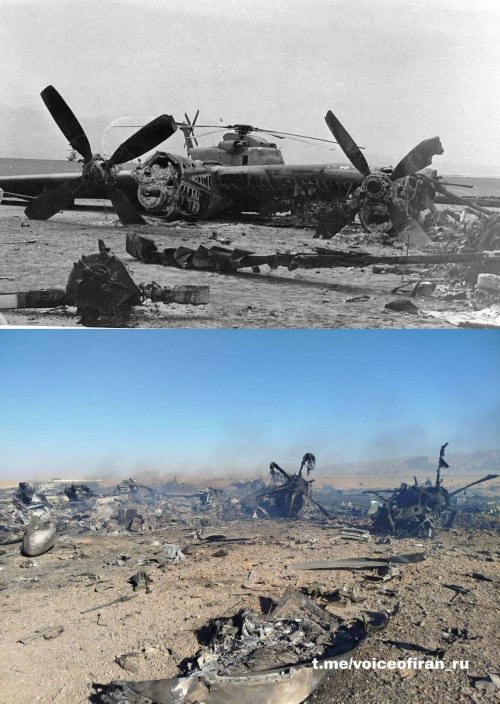
Eagle Claw (the well named US hostage rescue attempt in Iran) again.


Confirmation from the Israeli press.

I am only wondering what were the 3 others C-130 that went there and did not get stuck? Would that one be just a TOW delta, a third party aircraft or something more exotic?
Any major mission like this will have a big armada of contigency aircraft on standby or orbiting to support as needed. I suspect that the C-130's that flew in to extract the crews and passengers of the stuck aircraft were loitering as close as was realistically safe, since it seems their reaction time was relatively fast.
UPDATE: It appears that smaller lighter aircraft were used to extract the crews.
 
Last edited:
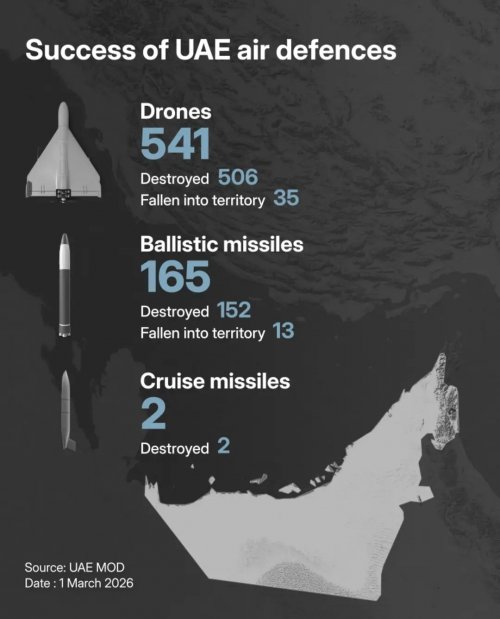
Meanwhile in the UAE:

View: https://x.com/i/status/2041094297655579137


View: https://x.com/i/status/2041096856357183698


View: https://x.com/i/status/2041097587881607434


View: https://x.com/i/status/2041099262168055813


What's truly amusing is that the UAE previously seemed to employ Ukrainian shitposting specialists and claimed similarly laughable interception rates. It seems like they also seek to emulate the catastrophic losses to their energy infrastructure as well. 100% interception rate by targets intercepting incoming missiles head on.
IMG_20260406_225129.jpg
 
How great, the Americans are bringing democracy to the region again!

"running, clean water", ‘transportation", "electricity"? "Education"? C'mon... I bet the average Iranian doesn’t even need those so-called "basic necessities" anyway…
Well, before the Marshall Plan, there was LeMay overhead so...
 
Iran Is Piercing Israel’s Ballistic Missile Defenses With High Altitude Cluster Warhead Releases


Regards,
This has been a highly ineffective strategy. While it does allow Iranian missiles to bypass Israeli defenses, it also significantly reduces the damage potential.

June 2025:
Damage NIS 5.5 billion ($1.75 billion), 53,500 insurance claims, 12 days.

Current war:
Damage NIS 1 billion ($0.32 billion), 26,000 insurance claims, 36 days.

Iran is, on average, generating only ~5% of the daily damage it did last war.
 
This has been a highly ineffective strategy. While it does allow Iranian missiles to bypass Israeli defenses, it also significantly reduces the damage potential.

June 2025:
Damage NIS 5.5 billion ($1.75 billion), 53,500 insurance claims, 12 days.

Current war:
Damage NIS 1 billion ($0.32 billion), 26,000 insurance claims, 36 days.

Iran is, on average, generating only ~5% of the daily damage it did last war.
Probably because they have been focusing a lot more effort on other countries and not just Israel.
 
Damage-wise, how does this compare with the Iran- Iraq war of the cities?

Iraq is, what--a bit of a client state of Iran?
Any Iraqi incursion possible? Potential Janissaries?
 
The B-2 with it's boutique numbers of which like a handful are operational at any given time is not the main US bomber. And even the B-2 is becoming dated, which is why the B-21 is being developed. The B-52 and B-1 are the backbone of US long range aviation and especially the B-52 is becoming geriatric
The B-52s will remain in service until roughly 2060. Maybe longer, if the USAF reduces their yearly flight hours below 350hr/yr.


Why didn't they use MV-22 ?
Carrying capacity. CV-22s (the USAF CSAR bird) only carry 24 dudes and can't carry Little Birds. And CV-22s don't have as much range as C-130s.


According to President Trump (thus take it with a spoon full of salt) 155 aircraft were involved in the alleged rescue operation, including 4 bombers and 64 fighter jets.
Checks with how many aircraft were involved in Op Neptune Spear.
 
The B-52s will remain in service until roughly 2060. Maybe longer, if the USAF reduces their yearly flight hours below 350hr/yr.


Carrying capacity. CV-22s (the USAF CSAR bird) only carry 24 dudes and can't carry Little Birds. And CV-22s don't have as much range as C-130s.
This war is burning a lot of flight hours on a lot of assets...

You don't need Little Birds if you have CV-22s, and they have IFR and the range to reach the pilot. Heck they did the first rescue with HH-60s. So either they don't have any CV-22s in theater, or there was something more to this mission.
 
When will this war end?
President Donald Trump on Monday said he couldn’t know if the war with Iran was ending, or escalating, ahead of his Tuesday 8 p.m. EDT deadline for Iran to reopen the Strait of Hormuz.

“I can’t tell you, I don’t know. I can’t tell you. Depends what they do,” Trump said when asked whether he is winding down the war, as he has previously suggested, or ramping up, referring to his threat to bomb bridges and power plants. “This is a critical period. They have a period of, well, until tomorrow at 8 o’clock.”
 
This footage is not from Israel.
Probably because they have been focusing a lot more effort on other countries and not just Israel.
The Israel effort and GCC effort are separate.
Israel-range weapons are MRBMs, while GCC-range weapons are SRBMs, GLCMs, OWA UAS.
They are not interchangeable and so Iran cannot really focus on one over the other.
 
Trump Floats Seizing Iran Oil as He Weighs Chinese Leverage Play


Always been about the oil, nothing else.

Regards,
China is estimated to import approximately 1.4 million barrels per day (mbd) of Iranian crude, accounting for roughly 12% to 13.4% of China's total seaborne oil imports.


12% to 13.4 of its imports, not much leverage here.

China relies on foreign nations for approximately 70% of its oil.

Iran fulfills approximately under 10% of China's oil needs.
 
How great, the Americans are bringing democracy to the region again!

"running, clean water", ‘transportation", "electricity"? "Education"? C'mon... I bet the average Iranian doesn’t even need those so-called "basic necessities" anyway…
Nobody said anything when Russia did it in the middle of an Eastern European winter, and the difference is Europe will probably send aid for civilians afterwards. Iran has targeted a large perecentage of the world's energy in the Hormuz straight and cluster bombed cities, they have no right to expect anything else.

Always been about the oil, nothing else.

Regards,
If that were the case why didn't Iran just agree to stop enriching Uranium?
 
"We won," Trump insisted during a news conference on Monday afternoon. "They are militarily defeated."
On the other hand:
"We can bomb the hell out of them," he said. "We can knock them for a loop. But to close the Strait, all you need is one terrorist."
And...
"We have an active, willing participant on the other side," he said. "They would like to be able to make a deal. I can't say any more than that."
Bombs start falling again at eight. Maybe. Yet to be decided.
 
Status
Not open for further replies.

Similar threads

Back
Top Bottom