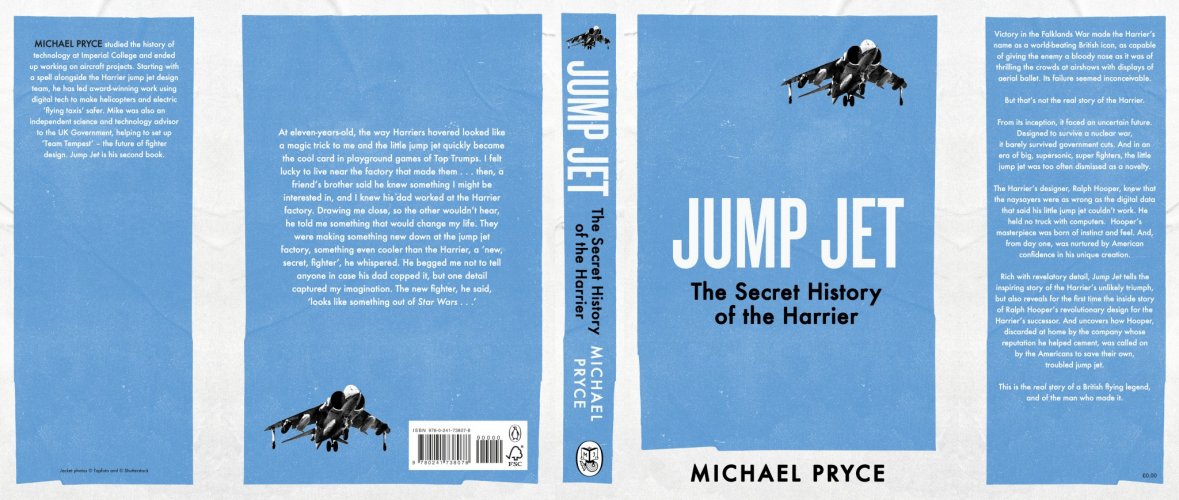
Jump Jet: The Secret History of the Harrier

That's what I had understood from this thread, Mr Pryce: that your forthcoming book is not the color-illustrated on glossy paper, large-trim-size volume that is usual for Secret Projects Forum, but rather a text like (for example) a Max Hastings or Antony Beevor work on military history, with a figures insert. This of course is welcome. I'm looking forward to reading your book when it's published. Not yet mentioned above is what I recall as the worldwide sensation for Harriers and various mini 'Harrier Carrier' designs and planned insta-carrier decked-over container ships immediately after the 1982 Falklands War victory. Even the Soviets got into the craze: as was only revealed years later, in 1983 they trialed VTOL Yak-38s from two modified Ro-Ro ships. I hope the Harriers' Falklands experience and the post-war sensation will be appropriately covered.

May I ask: is Jump Jet your first book?
That's right, the format is very much those popular books.

The opening chapter puts you in the thick of the action in the Falklands. Basically to show 'this is what the Harrier ended up doing'. Then it goes into the history that led to the Harrier and P1154, from the 1940s, contrasting it with the EE Lightning and TSR2, showing how the Harrier was different from the mainstream.

After showing how we got the Harrier, it then shows what we got after it, how it led to the F-35B, as well as contrasting this path with the Eurofighter Typhoon. All these stories are tied together by the people in them and the book tells new things about all these planes.

I don't cover the craze for Harrier carriers but rather look at the plans to develop a naval successor, the P1216, and why that did not work out. Short version - company politics and a belief in design by analysis.

I also wrote this book many years ago, which was much more richly illustrated. https://www.amazon.co.uk/BAe-P-1216-Supersonic-Aircraft-ProjectTech/dp/0956195113
 
That's right, the format is very much those popular books. The opening chapter puts you in the thick of the action in the Falklands. Basically to show 'this is what the Harrier ended up doing'. Then it goes into the history that led to the Harrier and P1154, from the 1940s, contrasting it with the EE Lightning and TSR2, showing how the Harrier was different from the mainstream. After showing how we got the Harrier, it then shows what we got after it, how it led to the F-35B, as well as contrasting this path with the Eurofighter Typhoon. All these stories are tied together by the people in them and the book tells new things about all these planes. I don't cover the craze for Harrier carriers but rather look at the plans to develop a naval successor, the P1216, and why that did not work out. Short version - company politics and a belief in design by analysis...

Mr Pryce, I see now that you had started a thread 'Harrier Carriers' on Secret Projects Forum in 2007. And a thread for what became this forthcoming book in 2012. And perhaps some of the posts in Overscan's 2006-2026 thread 'Advanced Harrier Projects' were helpful to your writing. I look forward to buying a copy of Jump Jet when it's published. Looks like mid-July, for both the USA and UK.
 
Mr Pryce, I see now that you had started a thread 'Harrier Carriers' on Secret Projects Forum in 2007. And a thread for what became this forthcoming book in 2012. And perhaps some of the posts in Overscan's 2006-2026 thread 'Advanced Harrier Projects' were helpful to your writing. I look forward to buying a copy of Jump Jet when it's published. Looks like mid-July, for both the USA and UK.
Yes, I have a long fixation on Harriers.

The new book does not cover advanced Harriers - it does uncover new stories of the P1127/Kestrel and the P.1216, with a focus on the people who designed them. I hope you like it.

I did write this paper on Harrier projects too: https://saemobilus.sae.org/papers/i...v-stol-combat-aircraft-1957-1990-2005-01-3195
 
Yes, I have a long fixation on Harriers.
The new book does not cover advanced Harriers - it does uncover new stories of the P1127/Kestrel and the P.1216, with a focus on the people who designed them. I hope you like it.
I did write this paper on Harrier projects too: https://saemobilus.sae.org/papers/i...v-stol-combat-aircraft-1957-1990-2005-01-3195

Good.

Since (as you said) the subject won't be included in Jump Jet, I refer your worthy 2007-2026 thread 'Harrier Carriers' and pages 182-185 of the book Yakovlev Aircraft Since 1924 by Bill Gunston & Yefim Gordon (Putnam, 1997) to whomsoever might take up the challenge mentioned in post #1122 of the thread 'Some Future Titles of Interest for SPF Members'.
 
Out of curiosity, do you have anything on McDD's proposed AV-8SX demonstrator?
 
Cannot wait to see the Stealth P1216 Mike. Harrier designs cannot get any stranger than that surely. :cool:
 
This utterly wonderful 1970 documentary from the BBC is like a film version of some of my book chapters.

P.1127 and Bill Bedford, TSR2 and computers at Warton with Roly Beamont, and flutter testing. All sounds technical but it's tied together in a story by the people, in this video and in the book.

View: https://youtu.be/sohuixlaowU?si=qeFPVynb_yfy-9Lu
 
Excellent find Mike. These old documentaries are brilliant.
 
Excellent news mike, I cannot wait to see what other goodies are in store for the Website.
 
The Labour government minister that cancelled it called the British aircraft industry "mentally retarded children"!
Funny, after my career in Aerospace, I have that attitude twoard a number of bureaucrats I've dealt with, both in procurement and elsewhere. Without naming the company, a FAA certification team came in and the leader said, "This company has gotten away with murder in the past, they won't this time!" The amusing thing was he used to work for that company and, as preparation for the certification effort, I'd read the reports and damn well knew he was one who had gotten away with said "murder". Then there have been procurement types that faze you, taking an extra month to approve a package and then insisting that you meed the original deadline; we managed it but it was a struggle - I remember getting the drawings released on a Friday afternoon, getting them printed, stuffing the prints into a mailing tube, and hotfooting it across town toe Fed Ex to make sure the site had them by Monday.
 
The British did have unrestricted access to more than a million pages of German data on swept wings, particularly from Messerschmitt but also from Heinkel, Junkers, Arado, Blohm & Voss, Gotha, Lippisch, the Hortens, the DVL, the DFS and the AVA as well as Focke-Wulf. If looking for German influence, the Hunter seems closest to the Messerschmitt P 1110 or the Focke-Wulf Peterle (which wasn't designed by Multhopp). Granted, the Peterle is a turboprop but its wing shape, tailplane position and inlet layout are quite similar.

When I was working on my Mustard book in 2015, BAE Warton - home of Lightning development - definitely still had plenty of German WW2 documents in their archive (especially Junkers, IIRC?). It wasn't really necessary to have Multhopp there in person explaining things and the vast majority of captured German swept wing research didn't come from him.
 
Last edited:
Lightning, sure. Don't really agree on Hunter. The very first version was indeed a German-inspired T Tail tube, but the final design owes almost nothing to the original layout and is in many ways more akin to the Hawker Sea Hawk.
Yes. The development is explained more in the book. Hawker 'de-optimised' his concept to make it practical, which was easier as they only had to make a subsonic version. EE threw intellectual and digital horsepower at it to make his full supersonic concept work.
 
The British did have unrestricted access to more than a million pages of German data on swept wings, particularly from Messerschmitt but also from Heinkel, Junkers, Arado, Blohm & Voss, Gotha, Lippisch, the Hortens, the DVL, the DFS and the AVA as well as Focke-Wulf. If looking for German influence, the Hunter seems closest to the Messerschmitt P 1110 or the Focke-Wulf Peterle (which wasn't designed by Multhopp). Granted, the Peterle is a turboprop but its wing shape, tailplane position and inlet layout are quite similar.

When I was working on my Mustard book in 2015, BAE Warton - home of Lightning development - definitely still had plenty of German WW2 documents in their archive (especially Junkers, IIRC?). It wasn't really necessary to have Multhopp there in person explaining things and the vast majority of captured German swept wing research didn't come from him.
Yes, there was a lot of wider German inspiration at Warton. The book shows a German-inspired canard twin that is like the VSTOL P.103, but from 1955. The designer I focus on, Ivan Yates, was inspired by the Me262 and Horten too. The whole industry was awash with German data. Kingston used it, too, in the Hunter, which did not stem from e.g. the P1040/1052 initially.

Multhopp's civil service file, along with Martin Winter's, shows the role he played in driving British supersonic fighter design. Much like a military Kuchemann or Weber really. Except he caused problems too. He was not allowed near Warton, but the RAE drove EE into making his concept work.
 
Multhopp's civil service file, along with Martin Winter's, shows the role he played in driving British supersonic fighter design. Much like a military Kuchemann or Weber really. Except he caused problems too. He was not allowed near Warton, but the RAE drove EE into making his concept work.

Which concept of Multhopp's? And were Küchemann/Weber really not involved in any military work? Their specialism was jet intakes for military aircraft throughout WW2 - there are a ton of surviving papers by him/them on that topic.

It's incredibly difficult to work out what influence, exactly, any given German engineer or specific piece of wartime research had on postwar developments except in a few cases where their name is literally printed on the project files, as with Amtmann and his work for Convair. The Hortens nearly worked for Westland but had a similar problem to the one you outline for Multhopp.

NB video: there was no 1944 Nazi Emergency Fighter programme. There was a 1-TL-Jäger programme, a 2-TL-Jäger programme and a Grossbomber programme (4 TL). Volksjäger was the closest thing to an emergency programme but Multhopp had no input on that. I've never seen any mention anywhere in any German WW2 documents of 'Das Bocksprung'.

Anyway, so tell us more about the stealth P 1216... stealth shaping, stealth coatings, stealth components or all three??
 
Last edited:
Which concept of Multhopp's?
His transonic research aircraft, derived from the Fw183, as he called it (no credit for Tank!), and fighter derivatives.

And were Küchemann/Weber really not involved in any military work? Their specialism was jet intakes for military aircraft throughout WW2 - there are a ton of surviving papers by him/them on that topic.
They did various things but I think are best known for VC10 wing and Concorde, although Victor and other military types too of course

It's incredibly difficult to work out what influence, exactly, any given German engineer or specific piece of wartime research had on postwar developments except in a few cases where their name is literally printed on the project files, as with Amtmann and his work for Convair. The Hortens nearly worked for Westland but had a similar problem to the one you outline for Multhopp.

Yes. Helpfully, the civil service personnel files make it fairly clear, and just looking at some drawings too. His projects were very distinctive.
NB video: there was no 1944 Nazi Emergency Fighter programme. There was a 1-TL-Jäger programme, a 2-TL-Jäger programme and a Grossbomber programme (4 TL). Volksjäger was the closest thing to an emergency programme but Multhopp had no input on that. I've never seen any mention anywhere in any German WW2 documents of 'Das Bocksprung'.
Yes, I know that from reading your books since the video in 2020. That was my first stab at the subject.

Anyway, so tell us more about the stealth P 1216... stealth shaping, stealth coatings, stealth components or all three??
Spoilers! The book is just off to print and the picture will apparently have a 'spread' so folks can see. It's annotated, with stealth features highlighted.
 
When I researched my book I didn't find the RAE designs of the time very interesting or relevant to OR.329, rather seeming wedded to early jet fighter tube and t tail layouts beyond their best before date.
 
When I researched my book I didn't find the RAE designs of the time very interesting or relevant to OR.329, rather seeming wedded to early jet fighter tube and t tail layouts beyond their best before date.
Yes, the Bristol 188-like layout was the optimum best they thought by 1954ish. They seemed to hop from one flavour of the month to another, although under the Attlee government they did lead the industry - their role was seen as being that, especially by Cripps. Churchill's government seemed to want to restore competition from industry.
 
Lightning, sure. Don't really agree on Hunter. The very first version was indeed a German-inspired T Tail tube, but the final design owes almost nothing to the original layout and is in many ways more akin to the Hawker Sea Hawk.
I think we're more talking about percolation of ideas, influence and some quite specific design approaches/maths.

e.g. Swept wing Vs Straight wing. Deltas? How much sweep? Thick or Thin LEs? Tailplane for pitch control Vs trim?

Some of these influence configuration layout in concept design. But there's also a whole bunch of further work to do the detailed design. And other people have ideas / scepticism / influence as well.
I didn't find the RAE designs of the time very interesting or relevant to OR.329, rather seeming wedded to early jet fighter tube and t tail layouts
The RAE work wasn't really to "design" an aeroplane directly at the end. The concept work they did was for research in order to drive other bits of research e.g. For (sustained) Mach 2 flight then straight wing has lower drag hence lots of research on sharp low swept wing aerodynamics and structures. They were exploring a range of ideas and then providing this basic research to Industry to inform their application into concepts, use of maths/methods etc. It was a fairly academic approach.

The RAE "concepts".also ended up being used in early Operational Research to make decisions and develop requirements e.g. guns Vs missiles for interceptors
 
Multhopp does seem to have been a bit of a one-trick pony. I suppose he did have to defend and support that Huckebein layout for a couple of years against overwhelming company support within Focke-Wulf for the twin-boom Flitzer. Then from Ludwig Mittelhuber's conventional-tail Huckebein rival. Did stacking the engines internally originate with Multhopp? I don't know of any wartime German design where that's a feature.

Regarding 'no credit for Tank!', I mean, Kurt Tank appears to have been a competent company chief executive and he absolutely stood up for his company's products at the highest levels, but by all accounts - including his own - he didn't actually design those products himself. The use of 'Ta' appears to have come from Milch, rather than being something Tank demanded (correct me if I'm provably wrong!). I can imagine him being faintly embarrassed by it.
Multhopp seemed very much 'I am right'. He hated deltas and Lippisch with a passion as he thought work should be mathematically rigorous. He had been Prandtl's star pupil at Gottingen.

So once he had what he saw as the best design he did not seem to want to change his mind. My way or the highway. Tank saw Multhopp as the true strength of Focke-Wulf, at least that is what he told the British (please take him away?), but yes, he seemed to favour the twin boom jet in 1944-45 over Multhopp's.

Again, spoilers re the full story of what passed between them, but nothing indicates Multhopp was anything but difficult, if gifted. Tank's respect can be shown,though, in the early versions of the Pulqui II, e.g. the glider

I do wonder if the name Huckebein, a difficult crow who got killed by his own folly, was given because of the man.

Stacking engines was an RAE thing. They wanted three AJ65s for the full fighter version but the Sapphire came along and saved them from that madness.
 
Which concept of Multhopp's? And were Küchemann/Weber really not involved in any military work? Their specialism was jet intakes for military aircraft throughout WW2 - there are a ton of surviving papers by him/them on that topic.

It's incredibly difficult to work out what influence, exactly, any given German engineer or specific piece of wartime research had on postwar developments except in a few cases where their name is literally printed on the project files, as with Amtmann and his work for Convair. The Hortens nearly worked for Westland but had a similar problem to the one you outline for Multhopp.

NB video: there was no 1944 Nazi Emergency Fighter programme. There was a 1-TL-Jäger programme, a 2-TL-Jäger programme and a Grossbomber programme (4 TL). Volksjäger was the closest thing to an emergency programme but Multhopp had no input on that. I've never seen any mention anywhere in any German WW2 documents of 'Das Bocksprung'.

Anyway, so tell us more about the stealth P 1216... stealth shaping, stealth coatings, stealth components or all three??
Küchemann was certainly asked for advice about the Jaguar's intake configuration for the Adour.
 

Similar threads

Back
Top Bottom