The Concorde inlet system does have an inlet dump door to vent air overboard. It described as a method to keep the inlet stable and functioning with the engine shut down, but it may also have been used during throttle down at the end of the supercruise segment.
According to Ted Talbot, (https://www.amazon.co.uk/Concorde-Designers-Life-Journey-Mach/dp/0752489283) the chap who ran the Concordes air intake development and is named as inventor on the air intake patent ( and who I once had the pleasure of working for) it was mixed compression. Also he tells that in the event of an engine surge, the venting out of the spill door would compensate for the yaw to roll coupling induced by a loss of engine thrust.
 
Last edited:
I'd expect a centerbody plug. Mix the fan and core exhaust together in a chamber with a bunch of sound deadening around the outside, then run it through the plug for supersonic expansion.
The GE Affinity engines was for the Aerion business jet of the late 2010s. It was a medium bypass turbofan with 2 stage fan in front of a CFM56 core. https://en.wikipedia.org/wiki/General_Electric_Affinity The modern 2 stage fan would have capable of a FPR of 3.5 to 4.0, with a supersonic exhaust at full power, which would have been very noisy. They were also aiming for a M1.4 cruise speed which would have avoided the level of inlet heating engines encounter at higher speeds.

Definitely a more traditional path towards supercruise than the Boom engine design

Affinity was expected to provide efficient subsonic cruise before getting over water to supersonic speed. When first revealed, I never expected such a large bypass ratio without augmentation to get supersonic until I saw the mixer and then the mention of a movable nozzle plug. Fun to consider BPR, FPRs, diameters, SFCs, etc to hit certain speed requirements. The F101 core is like the LS1 of engine cores. So many descendants and variations.

What's your opinion on an Affinity-like solution in place of the F101 on the B-1 or even in comparison to the B-1R concept with F119s? An Affinity-like setup would clearly provide more efficient subsonic cruise (at the cost of realistic thrust augmentation), but a static thrust F119 at subsonic cruise is how efficient/inefficient?
 
Last edited:
An afterburning Affinity engine would have been essentially a Super F101. The highest rating for the Affinity is listed at 20K, compared to the F101 at 17.4K non-AB. Basically the same configuration, with a more modern fan with a higher bypass ratio (3 vs 2.2) and the capability of a higher FPR and OPR, plus the latest GE turbine temp capability. Afterburner, if they could make it work with that BPR, would likely be in the 35K range with the similar poor AB SFC of the F101. The higher BPR implies higher airflow, so the inlets would need to enlarged.

The F119 has significantly higher Mil power thrust, so the higher non-AB SFC is offset by not having to be in AB as long. I live approx 15 mile west of Nellis, and the B-1s are still on AB way past our location heading west towards the ranges. And the F119 max AB SFC is significantly better than the F101 AB SFC if max thrust is needed. But SFC would be worse for long cruise mission legs - don’t know which would affect mission range the most.
 
An afterburning Affinity engine would have been essentially a Super F101. The highest rating for the Affinity is listed at 20K, compared to the F101 at 17.4K non-AB. Basically the same configuration, with a more modern fan with a higher bypass ratio (3 vs 2.2) and the capability of a higher FPR and OPR, plus the latest GE turbine temp capability. Afterburner, if they could make it work with that BPR, would likely be in the 35K range with the similar poor AB SFC of the F101. The higher BPR implies higher airflow, so the inlets would need to enlarged.

The F119 has significantly higher Mil power thrust, so the higher non-AB SFC is offset by not having to be in AB as long. I live approx 15 mile west of Nellis, and the B-1s are still on AB way past our location heading west towards the ranges. And the F119 max AB SFC is significantly better than the F101 AB SFC if max thrust is needed. But SFC would be worse for long cruise mission legs - don’t know which would affect mission range the most.
I'd expect the Affinity would be equal-or-better range to F101, while F119 would result in a range reduction.

I don't believe that a "typical" mission for a Bone has a lot of time in AB.
 
At Nelllis, the B-1Bs are at max AB for about 10 minutes from takeoff until they are down range for their mission, probably around at 20-25K altitude. Low level, with 30K thrust with an SFC of 2.5, each engine is burning 75K lbs per hour. 75K x 10/60 minute x 4 engines = 50K lbs of fuel before they get to cruise. With 35K thrust F119s with a SFC of 1.9 (my wild ass guess based on the F100-229) it would only take 40K lbs of fuel, and probably less since it would take less time.

The F119 B-1B would start cruise with 10-15K lbs of fuel extra in the tank. The F101 / F101+ Affinity would make that up in cruise, depending on the length of the cruise portion of the mission.
 
Last edited:
That’s what I’m really trying to deduce: if a non-afterburning Affinity with plug nozzle would potentially deliver supersonic capability to the B-1 or if afterburning is needed to get over the Mach hump (and potentially stay there). Any data out there on actual F101 engine performance over B-1A/B speed range? Things like the intake & pressure recovery play such a big role when you get supersonic.

Also wondering if there is any merit to extracting more of the exhaust energy to run a 3 stage fan to boost bypass pressure, or does that create too much of an imbalance between bypass and exhaust pressures at the mixing stage before the plug nozzle? F119 is a three stage fan, correct?
 
Last edited:
The most thrust the non AB Affinity was credited with was 20K. It might have been enough to maintain the B-1B supersonic (although the inlet design with the F101 limited it to M1.2 with AB, just past the transonic drag rise and before significant ram pressure recovery), but it wouldn’t have been enough thrust for takeoff, with the aircraft needing all of the F101 AB thrust of 30K to get the aircraft off the ground and climbing to its cruise altitude. The Affinity would have needed AB for B-1 use.
 
At Nelllis, the B-1Bs are at max AB for about 10 minutes from takeoff until they are down range for their mission, probably around at 20-25K altitude.
That's quite a bit longer in AB than I expected. I was expecting takeoff roll through first level-out. Maybe 5 minutes.


Low level, with 30K thrust with an SFC of 2.5, each engine is burning 75K lbs per hour. 75K x 10/60 minute x 4 engines = 50K lbs of fuel before they get to cruise. With 35K thrust F119s with a SFC of 1.9 (my wild ass guess based on the F100-229) it would only take 40K lbs of fuel, and probably less since it would take less time.

The F119 B-1B would start cruise with 10-15K lbs of fuel extra in the tank. The F101 / F110+ would make that up in cruise, depending on the length of the cruise portion of the mission.
I admit, I was expecting a multiple-hour cruise section.
 
https://aviationweek.com/aerospace/...upersonic-secures-breakthrough-ai-engine-deal
When I first read this article this morning, it said that the units were rated for full output of 42 megawatts up to ambient temperatures of 110C. Looks like AvWeek edited that to 110F, which seems more appropriate for a stationary ground unit. But it does show that Boom is planning on their engine operating in the elevated inlet temperature environment of M1.8 cruise.
 
From the link above:

The initial Symphony core, now being assembled by Florida Turbine Technologies (FTT), is now due to begin tests at Boom’s site in Watkins, Colorado, before mid-2026. “In parallel, we are building the first twin spool, or really three-spool, if you want to include the free power turbine,” Scholl says.

I fail to understand the logic here. Building an AI data center with an untested/unbuilt/undeveloped power unit is a crazy jump into the unknown for Crusoe, the AI company. I mean, that´s (indeed?) just the kind of bet that would let you spear fish and suck on raw fruits for the rest of your toothless life if anything goes awry. :eek:

Industrial Power turbines are usually built on proven gas turbines with adapted technology to match functionality. They became reliable and hence valuable after years of field testing and a lot specific accessories that come on top of that.

I am simply flabbergasted and now becoming quite concerned with Boom overall ability to reach any of its objectives, that be in aviation or there with this application.

 
Last edited:
I fail to understand the logic here. Building an AI data center with an untested/unbuilt/undeveloped power unit is a crazy jump into the unknown for Crusoe, the AI company.

It's not really Crusoe which is on the line. They've raised $15 billion in debt and equity to build the data centres. If they flop, it's those investors left holding the bag.

And $15 billion is pocket change in the current AI environment.
 
I fail to understand the logic here. Building an AI data center with an untested/unbuilt/undeveloped power unit is a crazy jump into the unknown for Crusoe, the AI company. I mean, that´s (indeed?) just the kind of bet that would let you spear fish and suck on raw fruits for the rest of your toothless life if anything goes awry. :eek:

Industrial Power turbines are usually built on proven gas turbines with adapted technology to match functionality. They became reliable and hence valuable after years of field testing and a lot specific accessories that come on top of that.

I am simply flabbergasted and now becoming quite concerned with Boom overall ability to reach any of its objectives, that be in aviation or there with this application.
It's affordable run time.

You don't need the GT in normal operations of the data center. You can run it, you don't need to. Once you get to "engine can run for 200+ hours" the risks aren't that high.
 
So, Boom plans on the first test run for their first ever turbine in mid-2026 and deliveries to a commercial customer by the end of 2027 (18 months). And first flight on an aircraft a year later.

ROTFLMAO. No, that's not happening.

This feels like a pretty massive grift somewhere (perhaps several somewheres). Boom is taking $300 million from investors to develop a power generation turbine and plan to use that money to also finance the development of their own aircraft engine. And then pay it back out of the $1.25 billion Carusoe are paying for their generators.

And Carusoe is talking about dropping in excess of $42 million per turbine for these, about twice the cost of an LM2500+G5, which is in shouting distance of the same output (38 MW vs 42 for the Boom turbine). Sounds like they are paying well over the market here.
 
Maybe Crusoe was offered a stake in Boom or a contract to provide AI and data services?
 
You don't need the GT in normal operations of the data center. You can run it, you don't need to. Once you get to "engine can run for 200+ hours" the risks aren't that high.
That's not exactly what is happening today due to networks strain and rapid buildup of data centers. Something that will remain the case for long as electrical infrastructure, such as nuclear powerplants, tend to come online at a considerably slower pace.
 
So, Boom plans on the first test run for their first ever turbine in mid-2026 and deliveries to a commercial customer by the end of 2027 (18 months). And first flight on an aircraft a year later.

ROTFLMAO. No, that's not happening.
First delivery of a stationary power turbine, sure.
 
Notice the change in the dialectic emphasizing the long project duration. Not sure what to make of it.

But at least that gives us a good opportunity to view their engine project (notice the thrust reverser, narrow intake with bypass and plug nozzle on this Catia model (import)):

Screenshot 2025-12-10 164947.png
 
Last edited:
Notice the change in the dialectic emphasizing the long project duration. Not sure what to make of it.

But at least that gives us a good opportunity to view their engine project (notice the thrust reverser, narrow intake and plug nozzle on this Catia model):

View attachment 794692
Thanks for that. Variable convergent nozzle with a plug center body matches my engine cycle performance speculation.
 
View: https://www.youtube.com/watch?v=krweC0gvbhM


Superpower is Boom’s 42-megawatt natural gas turbine built to power AI data centers. The same supersonic technology drives both the Superpower turbine and Boom’s Symphony jet engine: an all-new engine core designed for sustained and efficient high power output, even in challenging thermal conditions.

Boom Supersonic raises $300M to build natural gas turbines for Crusoe data centers [Dec 9]

Crusoe will buy 29 of Boom’s 42-megawatt turbines for $1.25 billion to generate 1.21 gigawatts for its data centers. Boom said it will announce more details about a turbine factory next year, with first deliveries occurring in 2027.

[...]

Profits from the sale of Superpower units will go toward funding continued development of the company’s Overture supersonic aircraft, Boom founder and CEO Blake Scholl told TechCrunch.
 
Why Supersonic Jet Engines Will Power AI Data Centers

View: https://www.youtube.com/watch?v=wY9HJQw9Zpc


Dec 28, 2025 #boomsupersonic #ai #aritificialintelligence
AI is turning to supersonic jet engines to power its sprawling data centers. We talked to the company making these engines to learn about the symbiotic relationship between supersonic travel and AI.

0:00 AI’s Power Problem
0:15 Boom’s Supersonic Vision
1:00 When AI Meets Supersonic
1:20 Heat, Water, and Texas
2:04 Superpower vs. Symphony
3:20 The Fossil Fuel Question
4:07 A Bridge to Supersonic Flight
4:26 What Comes Next
4:37 Would You Fly Supersonic?
 
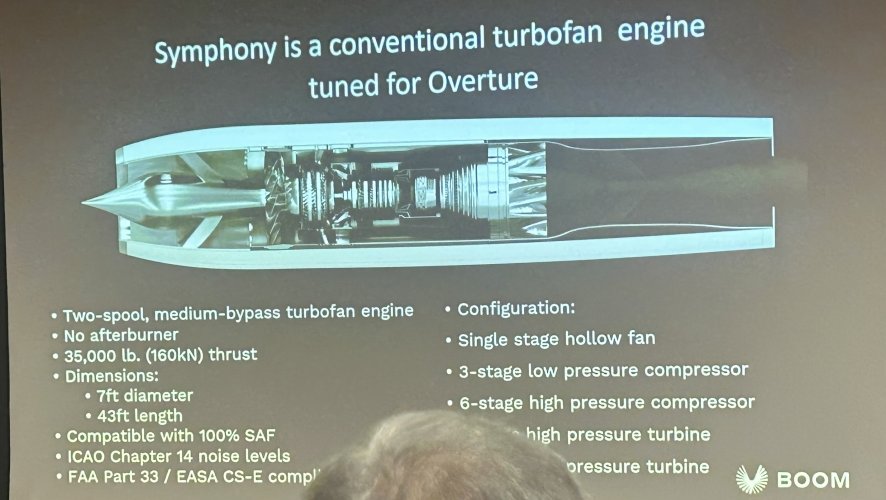
7ft diameter and 43ft long?!? That must be for the entire inlet+engine+exhaust setup, not the engine alone.

The part of the exhaust image that wasn't redacted looks like a fancier version of the JT8D hush kit.
 
What I don't understand is that the differences between a flight worthy supersonic turbine and industrial turbine are a world apart. Not to mention, the industrial turbine is the easy part of the overall generation system. The chances of them having an industrial turbine available by the end of the this year is slim to none. And I would love to know how the industrial turbine development is going to assist in the development of the Boom aircraft engine. Heck, the bearing are even different, and that is just the beginning. It sounds easy to replace bearing types but when the applications are so totally different, it is not easy.

My take on this is that Boom may get the industrial turbine program complete at some point in the future, but the Boom SST will never happen. I would love to see Boom SST successful, but I am afraid it will be relegated to hopeful dreams.
 
And I would love to know how the industrial turbine development is going to assist in the development of the Boom aircraft engine
  • Boom industrial turbine generates PR news stories
  • Venture capitalists see news stories and decide to give money to Boom without doing due diligence
  • Boom spends some of the profit on developing the Boom aircraft engine
  • Repeat
 
What I don't understand is that the differences between a flight worthy supersonic turbine and industrial turbine are a world apart. Not to mention, the industrial turbine is the easy part of the overall generation system. The chances of them having an industrial turbine available by the end of the this year is slim to none. And I would love to know how the industrial turbine development is going to assist in the development of the Boom aircraft engine. Heck, the bearing are even different, and that is just the beginning. It sounds easy to replace bearing types but when the applications are so totally different, it is not easy.

My take on this is that Boom may get the industrial turbine program complete at some point in the future, but the Boom SST will never happen. I would love to see Boom SST successful, but I am afraid it will be relegated to hopeful dreams.
While I have my doubts about the entire Boom / Symphony propulsion project, using the core of the engine (minus the medium bypass fan) is not out of the question as an industrial gas turbine.

While many of the purpose built industrial power plants are built with plain journal bearings with pressurized oil supply delivered by external oil pumps, there have been other aeroderivative industrial engines with standard roller and ball bearings, such as the P&W GG4 (J75 derivative) and the GE LM2500 (CF6 derivative).

The Boom industrial engine capability to provide full power at ambient temperatures up to 110F is reflective of the need for rotor speed and TIT margin to maintain performance under the M1.6 target cruise speed inlet conditions, so it may not be so far beyond belief that the two missions could use a closely related engine design.
 

Similar threads

Back
Top Bottom