We’ve seen the resurgence of gun based SHORAD with 30-40mm guns, do you guys think we’ll see 76mm+ guns return as ground based AA? Primarily thinking as installation defense. Flat bed with the gun? And a tractor trailer magazine?
We’ve seen the resurgence of gun based SHORAD with 30-40mm guns, do you guys think we’ll see 76mm+ guns return as ground based AA? Primarily thinking as installation defense. Flat bed with the gun? And a tractor trailer magazine?
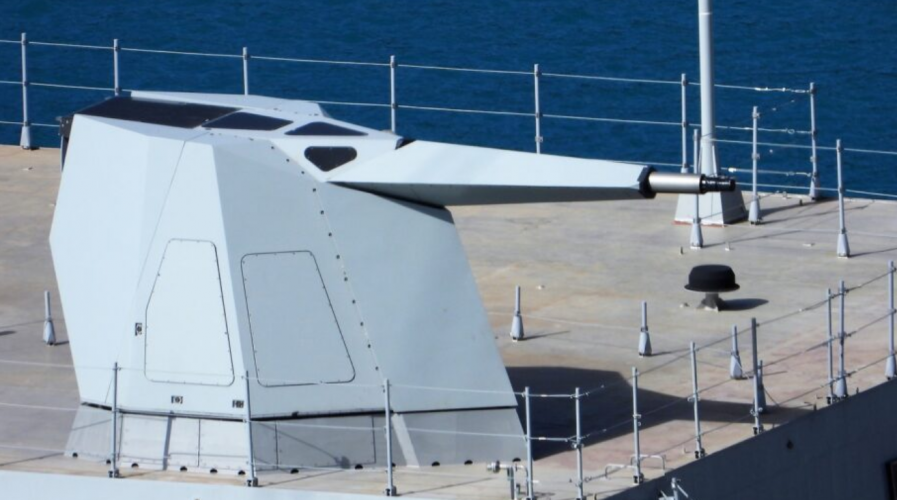
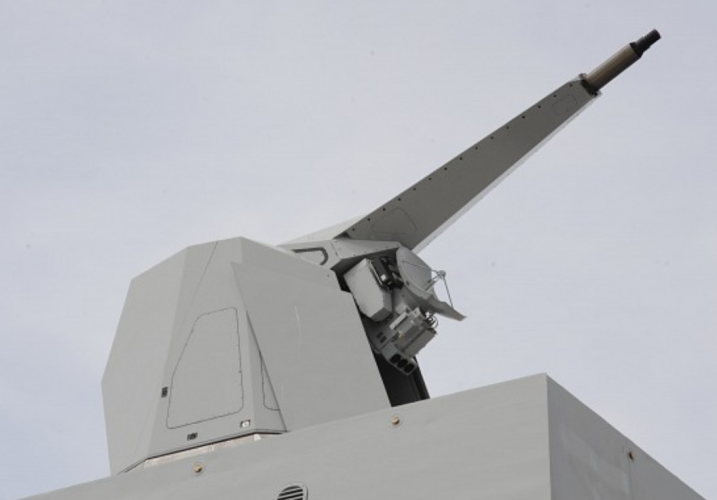
Thing is, a Phalanx CIWS/CRAM is entirely self-contained. But something like an OTO Sovraponte doesn't have the onboard radar system. So you'd need a much bigger setup than a simple 30x173 or Phalanx.
We’ve seen the resurgence of gun based SHORAD with 30-40mm guns, do you guys think we’ll see 76mm+ guns return as ground based AA? Primarily thinking as installation defense. Flat bed with the gun? And a tractor trailer magazine?
I don't think they will. At least not in any serious capacity.
If a 40mm air burst already has more than enough per round lethality to down a drone at reasonable range, then any increase in diameter will cost rate of fire, responsiveness (or cost to enable it), ammo capacity, and utility.
Consider the average cost effective solution. You take a naval gun, do minimal adaptations, put it on a truck. You get a system that's very tall, top heavy, and has to contend with stronger recoil.
Even if these are small costs, these are still costs you wouldn't be paying by just adapting cannons from the land domain like the 30mm, 35mm, 40mm, and 50mm.
I think the 76mm are not for anti-drone but more a SHORAD-like capability.
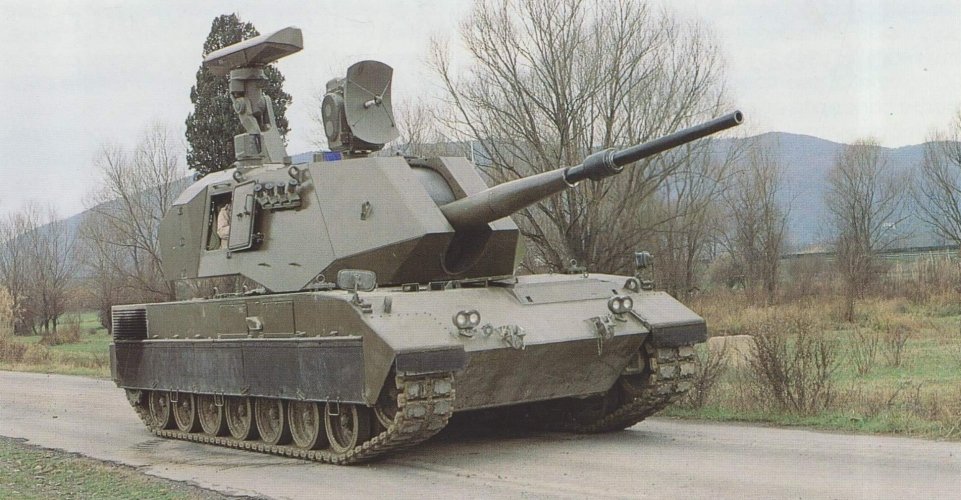
The Italians done that with the 76mm Otomatic back in the days, but that's the time when seems to be the anti-air capability are needles as the air dominance threat was out of question (1990-91 Iraq, 1990's Balkan wars, 2001 Afganistan, 2003 Iraq, etc.).
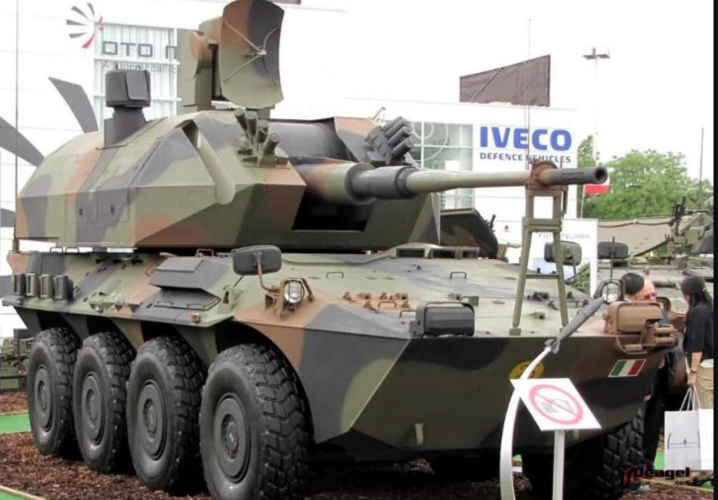
Later on they re-imagined as the 8x8 Centauro based Draco:
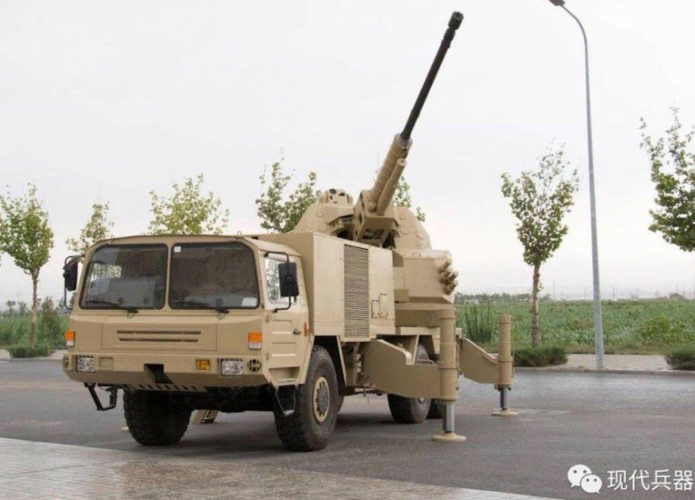
The Chinese of course copied it, but as the Otomatic and the Draco, they never reach the active service status, remains as prototypes or proof-of-concepts.
There is two contenders, the 10x10 chassis based JRGV-1 and the 3x3 truck based SA2:
As for the on-topic question: no, the 76mm SPAAG it's not ideal for C-UAS, at least not against for the cheap quadcopter-types.
For against the cheap cruise missiles ("suicide drones", like the Shaded/Geran types) it's worth noting, as much cheaper per effector cost as the missile based systems. Yet there is still much cheaper cunter-drone-drones effectors in development, while the 30-35-40mm auto cannons with programmable rounds have little less capability with much smaller and somewhat cheaper form.
So the 76mm probably won't get too much love from the military planners in the near future...
(Yes, I'm really like the idea and love the Otomatic / Draco system, as the 76mm Sovraponte turret too...)
Adapting to land use is the problem.
On a ship you have the magazine sitting right under the gun with hundreds or thousands of rounds.
That’s just not feasible with a land based mount. The ready ammo is all that’s available to be shot, limiting engagement times significantly compared to naval mounts, along side much longer reload times.
We’ve seen the resurgence of gun based SHORAD with 30-40mm guns, do you guys think we’ll see 76mm+ guns return as ground based AA? Primarily thinking as installation defense. Flat bed with the gun? And a tractor trailer magazine?
With guided AA rounds the 76mm might be usefaul against fast missiles, and a good way to conserve those AIM120 missiles. Wonder how effective they would be against ballistic missiles, even 20 rounds would be cheaper than a single PAC3.
I don't think they will. At least not in any serious capacity.
If a 40mm air burst already has more than enough per round lethality to down a drone at reasonable range, then any increase in diameter will cost rate of fire, responsiveness (or cost to enable it), ammo capacity, and utility.
Consider the average cost effective solution. You take a naval gun, do minimal adaptations, put it on a truck. You get a system that's very tall, top heavy, and has to contend with stronger recoil.
Even if these are small costs, these are still costs you wouldn't be paying by just adapting cannons from the land domain like the 30mm, 35mm, 40mm, and 50mm.
I mean sure, but a 76mm+ allows for guided rounds. Longer range engagements, while remaining much cheaper than missiles and hire RoF. Im not sure about the cost comparison between a stinger and a guided 5” round.
Technically it's possible to intercept missile like the AS-24 Killjoy or SS-26 Stone with proximity-fused 3" or higher caliber shells but I imagine it would be tricky to do.
With guided AA rounds the 76mm might be usefaul against fast missiles, and a good way to conserve those AIM120 missiles. Wonder how effective they would be against ballistic missiles, even 20 rounds would be cheaper than a single PAC3.
I see it being an option because the sooner you can knock down in bound targets down, the more munitions required to overwhelm defenses.
Start with missiles of various ranges, then 5” then 3”, then finally the smaller guns, and even manned MGs.
I see it being an option because the sooner you can knock down in bound targets down, the more munitions required to overwhelm defenses.
Start with missiles of various ranges, then 5” then 3”, then finally the smaller guns, and even manned MGs.
Aircraft or transonic missiles, sure. Maybe even low supersonic missiles.
You're not effectively engaging a hypersonic or high-supersonic missile with guns unless the guns are more or less on the bullseye. They just have too short a range. AA ceiling of about 10km.
Aircraft or transonic missiles, sure. Maybe even low supersonic missiles.
You're not effectively engaging a hypersonic or high-supersonic missile with guns unless the guns are more or less on the bullseye. They just have too short a range. AA ceiling of about 10km.
Adapting to land use is the problem.
On a ship you have the magazine sitting right under the gun with hundreds or thousands of rounds.
That’s just not feasible with a land based mount. The ready ammo is all that’s available to be shot, limiting engagement times significantly compared to naval mounts, along side much longer reload times.
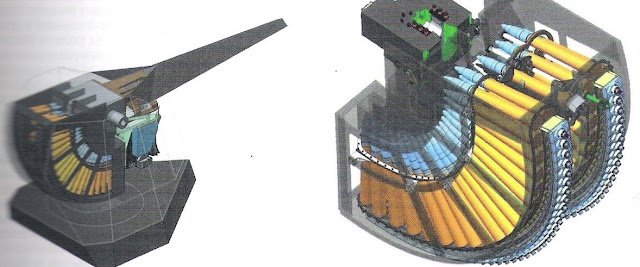
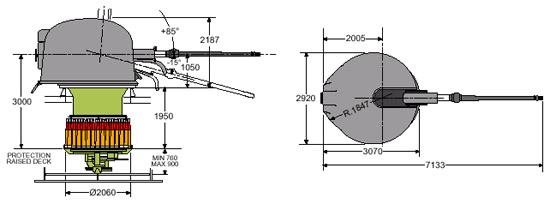
IIRC the Oto-Melara 76mm Sovraponte gun hold 76 pieces of 76.2mm shell inside the tower, there is no deck penetration.
It's can fire the 76mm DART guided ammunition, with range around 6-8 km effective range for a ~5.5 tons complete weight.
If you count two round per target that's 38 target. Much better than any missile-based system with comparable capability...
Iranian Shahed-136 drone appears to destroy US missile defense radar system in Bahrain, according to a social media video US-Israel-Iran war | @geopolitics_prime
IIRC the Oto-Melara 76mm Sovraponte gun hold 76 pieces of 76.2mm shell inside the tower, there is no deck penetration.
It's can fire the 76mm DART guided ammunition, with range around 6-8 km effective range for a ~5.5 tons complete weight.
If you count two round per target that's 38 target. Much better than any missile-based system with comparable capability...
Iranian Shahed-136 drone appears to destroy US missile defense radar system in Bahrain, according to a social media video US-Israel-Iran war | @geopolitics_prime
Adapting to land use is the problem.
On a ship you have the magazine sitting right under the gun with hundreds or thousands of rounds.
That’s just not feasible with a land based mount. The ready ammo is all that’s available to be shot, limiting engagement times significantly compared to naval mounts, along side much longer reload times.
Gun mounts on large warships penetrate several decks down to a deep mag, that has hundreds to around 1000 rounds or so in them. Up until very recently there has always been a team of loaders who feed ammo into a hoist to refill these ready rounds.
Communications in GPS-denied environment? Sounds like not so related things. Did you mean navigation in denied environment?
Some drones in Ukraine-Russia have been spotted with a CRPA - Controlled Reception Pattern Antenna.
If you've ever seen an antenna's reception pattern, you'll know it has areas of narrow and high gain beams, and also areas of high attenuation. The latter are called nulls.
And if you have an array, you can play with the time delays between transmission or reception through these antennas to create and steer beams.
Upon detecting a jam, you digitally steer the beams to center a null on the jam source. And you steer a high gain beam to the satellite (or satellites for GPS).
Another thing if you have no emitters anywhere around - is IMUs. But relative to their capabilities they are expensive so should be coupled with additional things for terminal guidance if it's a long distance flight.
Anti-jam techniques also include DSMAC and target recognition. These do rely on a capability to frequently update terrain data.
In some areas of the world you can triangulate based on known fixed transmitters, like civilian cellular networks. By design, and with a sufficient quality receiver, you should have pings from multiple cell towers.
Some take it a step further and use the cellular network to transmit back data to an operator. But this is suitable for low cost, low quality solutions.
Some American missiles are now fitted with M-Code GPS receivers. M-Code is a new GPS signal that is both encoded differently (so occupies different frequencies on the same band) but also has a narrow beam instead of the typical very wide GPS beams.
Which allows receivers to pick up a stronger GPS signal.
If you can be more specific I can talk about more options perhaps.
The way I formulated the question was wrong. What I meant was communication technologies that enable navigation in GPS-denied environments but are also harder to jam. Thanks for the reply, I had no idea about those conceps. I will take a look.
I think there can be a reason for 76mm AA as a dual purpose capability. If we look at naval designs, large guns are often made AA capable, ranging from the likes 5" all the way to 8", when are generally not the most efficient AA weapon however they tend to have an anti-surface role that is uneconomic/difficult to replace with other weapons, the AA ability is just getting the most value out of the mount.
If we follow the "every tube must be capable of AA against saturation" like what happened in WW2 naval sphere, then pretty much every gun becomes AA, like how AA shells were developed for 18 and 16inch main guns. AA shells out of artillery and tank guns should be made for FCS could be made to work.
If we follow the "every tube must be capable of AA against saturation" like what happened in WW2 naval sphere, then pretty much every gun becomes AA, like how AA shells were developed for 18 and 16inch main guns. AA shells out of artillery and tank guns should be made for FCS could be made to work.
The MPAT rounds already have a timed-detonation function so they can airburst. Adding a proximity fuze would not be difficult, but isn't totally required versus a 200mph target. And crud, they might actually have a prox fuze for anti-helicopter work.
And artillery seems to be getting HVPs.
So I think we're pretty close to "every tube must be AA capable against saturation."
I think there can be a reason for 76mm AA as a dual purpose capability. If we look at naval designs, large guns are often made AA capable, ranging from the likes 5" all the way to 8", when are generally not the most efficient AA weapon however they tend to have an anti-surface role that is uneconomic/difficult to replace with other weapons, the AA ability is just getting the most value out of the mount.
If we follow the "every tube must be capable of AA against saturation" like what happened in WW2 naval sphere, then pretty much every gun becomes AA, like how AA shells were developed for 18 and 16inch main guns. AA shells out of artillery and tank guns should be made for FCS could be made to work.
I was actually about to mention it but then I thought it's too big of a leap and there are 105mm guns and howitzers below that, that could be a better example.
I was actually about to mention it but then I thought it's too big of a leap and there are 105mm guns and howitzers below that, that could be a better example.
I don't think its an either or situation. But if we're talking a system it has to be in the conversation, particularly as most lower calibres will only down a cruise missile like target (which seems to be the direction of travel, lots of OWE and small numbers of more lethal CM's mixed in with ballistics) if its flying directly at it..or flying straight past...within 1-2km.
People always remember the ranks of 40mm Bofors and 20mm Oerlikon from the Pacific films of Kamikaze...but ignore the fact that (becuase of then filming state of the art) that it was the 5 inch guns that were considered the more important layer of defence....
IRAN’S DRONE HUNTERS: A NIGHTMARE FOR U.S. AND ISRAELI UAVs Even under constant U.S. and Israeli airstrikes, Iran still intercepts enemy drones. The reason lies in a set of mobile, radar-silent air defense systems that are far harder to detect and destroy: Missile 358 – a loitering anti-drone...
Iran continues to publish videos of the destruction of Israeli Hermes-900 drones by Type 358 anti-aircraft missiles. The missile uses a solid-fuel booster to reach the required altitude (10 km), and then activates a small jet engine to fly and wait for the target, where a thermal or optical...
Iranian subsonic loitering anti-aircraft missiles Missile 358, equipped with compact turbojet engines, continue to demonstrate effectiveness in countering Israeli Hermes-900 reconnaissance-strike UAVs. A key role is played by the thermal imaging seeker, which is capable of reliably detecting...
In a study published in Ornithology, researchers describe how they used thermal imaging optics, flashlights, and high-speed photography to detect and photograph birds in flight after dark. The technique allowed scientists to identify low-flying species across three fall seasons in Cape May, New Jersey—including thousands that would have gone undetected by other monitoring tools.
This could help spot drones as well...or one hopes:
This site uses cookies to help personalise content, tailor your experience and to keep you logged in if you register.
By continuing to use this site, you are consenting to our use of cookies.