I think in the world of network centric warfare it was assumed that you need to detect and track up to your weapons engagement range.The India/Pakistan exchange is a good exemple I think.Well, I didn’t expect PESA RBE2 to be equal to APG-68v9 either but it was, so probably the issue is that Rafale nose is ways too small for an aircraft of that size and its RCS is not significantly smaller for an aircraft of that size.
Beside, despite being a mechanical array, Mirage radar is not bad either. I mean basic RDY could detect a target with RCS of 5 m2 from 70 nm (129 km) and RDY-2 was supposed to be 15% better than that, in short, it can detect the same target from 148 km.

You are using an out of date browser. It may not display this or other websites correctly.
You should upgrade or use an alternative browser.
You should upgrade or use an alternative browser.
Dassault Rafale --- TECHNICAL News Only !!!!!!!
- Thread starter Triton
- Start date
In short, by the end of 2026, the UAE’s Rafale will be equipped with a radar comparable to the one on the F-16E/F that the UAE has been operating for more than 23 years. And F-16 is not exactly known for having a powerful radar40%, it’s probably possible to calculate because peak power is listed at 9.6kw and we know tr module account from other sources
https://rafalenews.blogspot.com/2011/06/air-and-cosmos-bring-new-insight-on.html?m=1
That extra 10 percent they are talking about would catch it up to apg-80
https://www.key.aero/forum/modern-military-aviation/98455-rafale-news-ix?page=40
Do we ever know the detection range of APG-80?. I vaguely remember its detection or tracking range stated to be 165 km but I don’t know against which target or the source of the numberThat extra 10 percent they are talking about would catch it up to apg-80
It also strange because PESA RBE2 supposed to be capable of detecting a 30 square foot (2.79 m2) target from 75 nm (138.9 km). If AESA RBE2 is 50% better then it can detect the same target from 208.35 km.
But I have the feeling that the number given by dassault a bit overaly optimistic
1- If the number is correct then RBE2 PESA could detect target with RCS of 5 m2 from 160 km. How could that be worst than either RDY-2 or APG-68v9?. RDY-2 top out at 149 km.
2- RBE-2AA supposed to be able to detect target with RCS of 2.79 m2 from 208.35 km, yet UAE demand an additional 10% increase in detection range because they don’t want any regression compared to F-16 block 60??. That mean F-16E/F radar is even better ?
Last edited:

F-2
ACCESS: Top Secret
- Joined
- 22 May 2020
- Messages
- 1,189
- Reaction score
- 2,573
That table is from hereDo we ever know the detection range of APG-80?. I vaguely remember its detection or tracking range stated to be 165 km but I don’t know against which target or the source of the number
It also strange because PESA RBE2 supposed to be capable of detecting a 30 square foot (2.79 m2) target from 75 nm (138.9 km). If AESA RBE2 is 50% better then it can detect the same target from 208.35 km.
1- If the number is correct then RBE2 PESA could detect target with RCS of 5 m2 from 160 km. How could that be worst than either RDY-2 or APG-68v9?
2- RBE-2AA supposed to be able to detect target with RCS of 2.79 m2 from 208.35 km, yet UAE demand an additional 10% increase in detection range because they don’t want any regression compared to F-16 block 60??.
https://www.radartutorial.eu/19.kartei/08.airborne/karte020.en.html
165km is for 5sq meters, idk what the probability is though
I see, so basically 165 km number seem to be just random or guesstimate.That table is from here
https://www.radartutorial.eu/19.kartei/08.airborne/karte020.en.html
165km is for 5sq meters, idk what the probability is though
F-2
ACCESS: Top Secret
- Joined
- 22 May 2020
- Messages
- 1,189
- Reaction score
- 2,573
It’s 65% of the raptors range apparentlyI see, so basically 165 km number seem to be just random or guesstimate.
Attachments
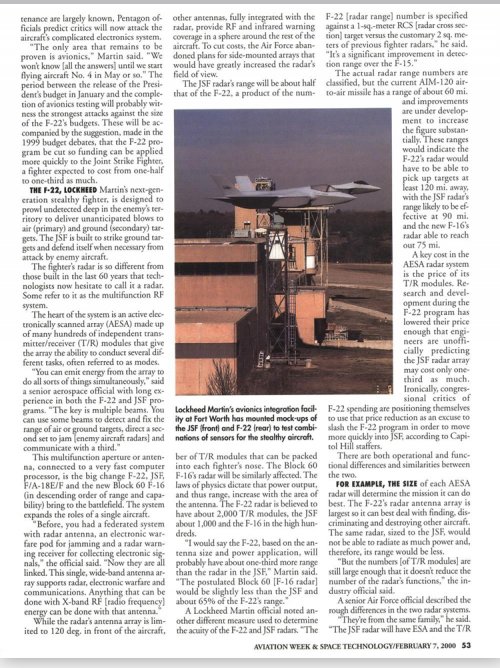
This kinda create more question than it answer.It’s 65% of the raptors range apparently
At the point this article were made, APG-81 were thought to have 1200 T/R modules, so it kinda make sense that it only slightly better than APG-80 with 1000 T/R modules. But now that we know APG-81 has 1676 T/R modules, shouldn’t it be significantly better than APG-80?.
Then according to the article, APG-80 can detect target with RCS of 1 m2 from 120 km. That mean it can detect target with RCS of 2.79 m2 from 153 km. But then that would make it worse than RBE2 AESA. But if APG-80 is worse than RBE2 then why UAE demand an additional 10% increase on RBE2 output so that it can match F-16?
Last edited:
F-2
ACCESS: Top Secret
- Joined
- 22 May 2020
- Messages
- 1,189
- Reaction score
- 2,573
Probably sub-scale test hardwareThis kinda create more question than it answer.
At the point this article were made, APG-81 were thought to have 1200 T/R modules, so it kinda make sense that it only slightly better than APG-80 with 1000 T/R modules. But now that we know APG-81 has 1676 T/R modules, shouldn’t it be significantly better than APG-80?.
Then according to the article, APG-80 can detect target with RCS of 1 m2 from 120 km. That mean it can detect target with RCS of 2.79 m2 from 153 km. But then that would make it worse than RBE2 AESA. But if APG-80 is worse than RBE2 then why UAE demand an additional 10% increase on RBE2 output so that it can match F-16?
https://www.secretprojects.co.uk/threads/dassault-rafale-avionics.942/page-2#post-879810Also, currently, the majority of turkey F-16 are block 30/40/50/52proof ?
Never heard anything about that.
On the contrary the Greek chief of air staff explained some weeks ago that Rafale absolutely don't fear (Trukish) F16 or even EF2000.....
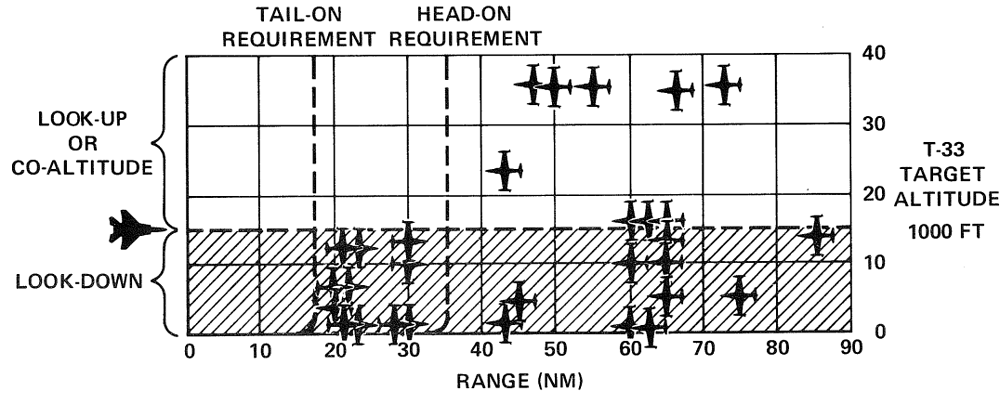
Fighter RCS is lower from front, however, Radar have harder time tracking a retreating target compared to an incomming target. You will often see requirement for head on target is much higher than a tail on targetAre you so noob ?
All fighter RCS is optimised in front sector. Rafale was shooted (if it is the truth... ) by the back because returning to base.
Even the F-35 back is not stealthy.....
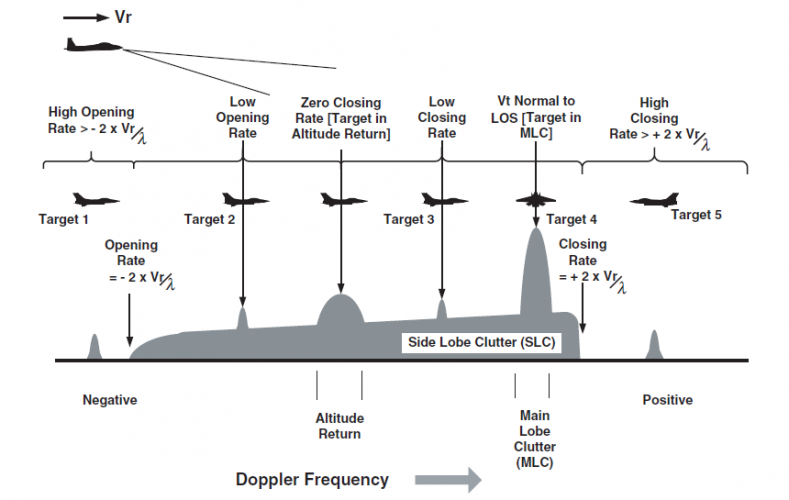
That because it is easier for return of retreating target to blend in with the side lobe clutter of the radar
Yes but that PESA were being compared to APG-68v9 which is a mechanical scanned radar.it's true. But for RBE2 PESA.
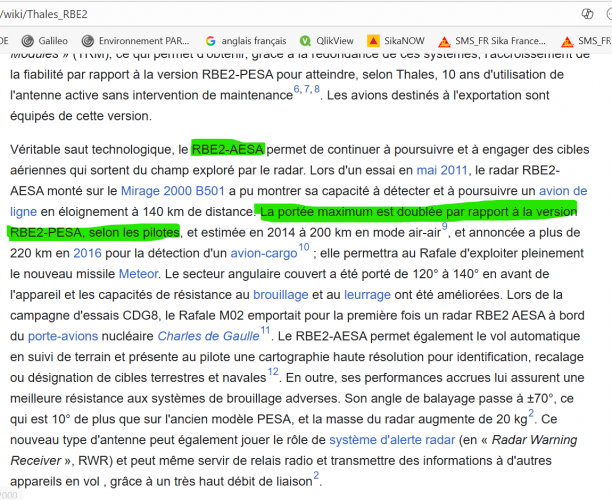
RBE2 AESA, now in service for 13 years is said to have a range doubled.
I have heard that AESA RBE2 have 50% better range than PESA version. I have never heard anywhere that they could double the range, so please provide your source
The point here is that UAE wanted the 10% more range on RBE2 AA because they don’t want it to have shorter detection range compared to APG-80, a radar they have field for more than 20 years.It was at a time (2011) where the sole T/R on the market was US ones (and not so potent. Maybe they decided not to sell their best ones).
UAE at those time needed 10% more range. The sole solution was then to increase the peak power from 9.6 to 13 or 14kw, with some real hurdles to cool this new radar.... Along with this new radar UAE also needed 9T thrust engines. The whole was far too costly : the deal failed.
Please note that the Rafale purchased later by UAE has a legacy AESA radar, and legacies engines.....
When it come to radar range, aperture area arguably have the biggest impact, since T/R count is scale directly with aperture area, more T/R module mean bigger aperture (of course assuming similar operating frequency)what about the quality of T/R ? (there isn't a sole T/R module in the world, even in the sole USA).
what about the signal treatment quality ?

Deltafan
ACCESS: Top Secret
- Joined
- 8 May 2006
- Messages
- 1,784
- Reaction score
- 2,767
-Well, then an article of August 2006 (what is the name of the magazine?) with exercises against Rafale F1 (notably, the planes did not yet have L16 and MICA IR, arrived with the F2 standard). The Rafale F1 was put into service without yet all this equipment to resume as quickly as possible (even if, given the slow development of the Rafale at the time, this "speed" must be put into perspective...) the role of the obsolete Crusaders withdrawn from service.Here:
https://www.secretprojects.co.uk/threads/dassault-rafale-avionics.942/page-2#post-879810And also RBE2 is not even better than RDY-2 in term of detection range
https://breakingdefense.com/2024/06...aded-to-ukraine-heres-how-kyiv-will-use-them/
-Can you show me the passage where the RCS of the Rafale is higher than that of the F-16? I didn't find it...
-But, otherwise, I remind you that the Rafale (in this case the Rafale Marine, exposed to salt) had exterior coating problems at the time, which were only resolved subsequently. And, one of the applications intended to make the Rafale more “discreet” to radars consists of covering them with a coating intended to limit their RCS (I haven't found an article to this effect. It's old. Does anyone in the audience have any? There were photos of the Rafale in question where you could clearly see the state of deterioration of the coating).
-
Well, and ? AFAIK, it was well known at the time and AESA has been delivered as standard on Rafale since 2013... (even the ten initial Rafale Ms, those of the August 2006 article, have since been retrofitted).One of the test pilots was involved in the 1990s development of the Radar à Balayage Electronique 2 plans (RBE2) passive electronic scanning array (PESA) set that was the Dassault Rafale’s original radar. He stated that the RDY was “in several respects superior to even the RBE2 in the air-to-air envelope,” despite being a mechanically-steered array and not fitted with an electronically-scanning antenna. The reason, the pilot said, is the RDY was designed with air-to-air missions in mind, as opposed to the RBE2 which was designed to be multi-role.
-So, F-16s of the Greek air force did exercises with French Rafales, where the French Rafales were so inferior, that, in the end, Greece chose Rafales as the spearhead of its air force to face the Turkish F-16s ?
I think it would be interesting to have the results of Franco-Greek exercises after 2006 (and even another point of view, if possible official and French, on these 2006 exercises...).
Last edited:

BonPlan2
ACCESS: Top Secret
- Joined
- 5 June 2025
- Messages
- 577
- Reaction score
- 737
RBE2 AA was made with US T/R. This radar showed limited improvements against PESA (+25% if I remember well).The point here is that UAE wanted the 10% more range on RBE2 AA because they don’t want it to have shorter detection range compared to APG-80, a radar they have field for more than 20 years.
RBE2 AESA, finally built a couple of years after use europeans T/R, far more efficient.
APG80 delivered in 2003. RBE2 AESA delivered 2013. 10 years and not 20.
Note that RBE2 AESA use all the softwares and data bases of the PESA one (the contrary is false). So became mature very early.
Last edited:

Titus K
ACCESS: Top Secret
- Joined
- 6 September 2025
- Messages
- 818
- Reaction score
- 2,781
Rate 5/month
https://www.figeac-aero.com/sites/default/files/CP_FGA_20260216_SAE M88_EN_vdef.pdf
https://www.figeac-aero.com/sites/default/files/CP_FGA_20260216_SAE M88_EN_vdef.pdf
NEW DEVELOPMENT FOR FIGEAC AÉRO ON THE RAFALE ENGINE
FIGEAC AÉRO (FR0011665280 – FGA:FP), a leading partner for major aerospace manufacturers, announces a new agreement with Safran Aircraft Engines for a component of the M88 engine, further strengthening the Group's strategic exposure to the Rafale military program.
Safran Aircraft Engines has selected FIGEAC AÉRO to develop production capacity for a metal structural part of the M88 engine, which powers the Rafale fighter aircraft produced by Dassault Aviation.
This latest agreement follows on from the recent development regarding the military turbojet engine announced last May 1. In addition to the production being strategically located in France, the agreement once again highlights FIGEAC AÉRO’s expertise in manufacturing highly technical engine parts as well as the dynamic of the Group’s partnership with Safran Aircraft Engines.
FIGEAC AÉRO’s robust manufacturing setup is fully compatible with the strategic importance of this programme and the highly technical nature of the production process. It will utilise capacity not only at its main site in Figeac but also at SN Auvergne Aéronautique.
The first parts are to be delivered in financial year 2026/27. Thanks to its existing production capacity, the Group does not at this stage anticipate any major need for investment.
Thomas Girard, FIGEAC AÉRO’s Deputy Chief Executive Officer, welcomes the news: “We are delighted with the partnership we have developed with Safran Aircraft Engines over many years now, in both commercial and military engines. The M88 and Rafale programmes are strategic in reinforcing Europe’s defense capabilities. FIGEAC AÉRO is proud to be playing an active role by contributing its expertise and production capacity, especially as there are plans to increase the Rafale build rate to 5 units a month, i.e. almost double the current rate.”
This latest development brings FIGEAC AÉRO closer to its annual new business revenue target of €80 million to €100 million by March 2028. Based on the advanced discussions with the Safran group and other major players in the commercial and military aerospace sectors, the Group remains confident that it will meet its targets.
Do you have a source for this?. I think an improvement from 25% to 100% just by changing T/R element from US to France is unlikelyRBE2 AA was made with US T/R. This radar showed limited improvements against PESA (+25% if I remember well).
RBE2 AESA, finally built a couple of years after use europeans T/R, far more efficient.
The rest can be discussed here, so that it not off topic
https://www.secretprojects.co.uk/threads/rafale-vs-f-16.51149/
Last edited:
BonPlan2
ACCESS: Top Secret
- Joined
- 5 June 2025
- Messages
- 577
- Reaction score
- 737
Sorry no source.Do you have a source for this?. I think an improvement from 25% to 100% just by changing T/R element from US to France is unlikely
The rest can be discussed here, so that it not off topic
https://www.secretprojects.co.uk/threads/rafale-vs-f-16.51149/
The RBE2 AA used US T/R, and it was sure that US didn't want to help to create a competitor to a quite new technology, only mastered by USA and Japan at those time.
So we probably received no up to date and high efficiency modules.....
Attachments
You need a software package adapted to the sensibility of the new TRM modules. You can't just take your Coffee grinder CMOS and solder it to manage the spin of your Nuclear reactor´s turbine!*
Regarding your question for the OEM RCS coating, as I have explained here numerous time, and on the condition that this hasn´t changed since the last time I used to check it, it´s a Northrop-Grumman product. The same brand that is used on the SH.
Also note that the early AESA RBE2 were produced so slowly and at such a crazy price that qty wouldn't match any user request. If I do remember correctly, the French Navy had only 6 units, meaning that at any time, only 2 radar were available on their aircraft carrier. That has to be matched with the 50% availability at the time of the Rafale, meaning it was a hard time for their maintainers to match an AESA nose to a mission capable airframe! (and yes, nose swap was the official methodology that came with that early AESA radar order... ).
Hence, don't be surprised by the jump in performance or ill-appropriate it on the back of someone. else.
*Unless you really need that morning expresso shot ->
->
Regarding your question for the OEM RCS coating, as I have explained here numerous time, and on the condition that this hasn´t changed since the last time I used to check it, it´s a Northrop-Grumman product. The same brand that is used on the SH.
Also note that the early AESA RBE2 were produced so slowly and at such a crazy price that qty wouldn't match any user request. If I do remember correctly, the French Navy had only 6 units, meaning that at any time, only 2 radar were available on their aircraft carrier. That has to be matched with the 50% availability at the time of the Rafale, meaning it was a hard time for their maintainers to match an AESA nose to a mission capable airframe! (and yes, nose swap was the official methodology that came with that early AESA radar order... ).
Hence, don't be surprised by the jump in performance or ill-appropriate it on the back of someone. else.
*Unless you really need that morning expresso shot
->
Last edited:
BonPlan2
ACCESS: Top Secret
- Joined
- 5 June 2025
- Messages
- 577
- Reaction score
- 737
I don't know about this 6, but any RBE2 PESA can see its antenna removed and replaced by an AESA one in 2 hours.Also note that the early AESA RBE2 were produced so slowly and at such a crazy price that qty wouldn't match any user request. If I do remember correctly, the French Navy had only 6 units, meaning that at any time, only 2 radar were available on their aircraft carrier. That has to be matched with the 50% availability at the time of the Rafale, meaning it was a hard time for their maintainers to match an AESA nose to a mission capable airframe! (and yes, nose swap was the official methodology that came with that early AESA radar order... ).
So with 6 antennas I don't understand how only 2 can be available at each time.
Some AESA antennas wer also lend from french air force to french navy during the Charles de Gaulle carrier cruise. At least in the early 2010's.
The money got from the sale of some 2nd hand Rafale was used to purchase some more AESA antenna, to replace PESA one in some old Rafale. I don't know how many exactly (I would say 30 to 40...).
@BonPlan2 : some good related link on this forum:
https://www.secretprojects.co.uk/threads/dassault-rafale-technical-news-only.17813/post-573383
https://www.secretprojects.co.uk/threads/dassault-rafale-technical-news-only.17813/post-440445
https://www.secretprojects.co.uk/threads/dassault-rafale-technical-news-only.17813/post-440300
https://www.secretprojects.co.uk/threads/dassault-rafale-technical-news-only.17813/post-440338
Regarding the 6 stated above, it was sometghing like:
- 2 in dev
- 2 in deep maintenance
- 2 available when mission capable
A link or extract should be available in this or the Avionics thread
https://www.secretprojects.co.uk/threads/dassault-rafale-technical-news-only.17813/post-573383
https://www.secretprojects.co.uk/threads/dassault-rafale-technical-news-only.17813/post-440445
https://www.secretprojects.co.uk/threads/dassault-rafale-technical-news-only.17813/post-440300
https://www.secretprojects.co.uk/threads/dassault-rafale-technical-news-only.17813/post-440338
Regarding the 6 stated above, it was sometghing like:
- 2 in dev
- 2 in deep maintenance
- 2 available when mission capable
A link or extract should be available in this or the Avionics thread
So 6 RBE2 AESA with French T/R module?@BonPlan2 : some good related link on this forum:
https://www.secretprojects.co.uk/threads/dassault-rafale-technical-news-only.17813/post-573383
https://www.secretprojects.co.uk/threads/dassault-rafale-technical-news-only.17813/post-440445
Regarding the 6 stated above, it was sometghing like:
- 2 in dev
- 2 in deep maintenance
- 2 available when mission capable
A link or extract should be available in this or the Avionics thread
BonPlan2
ACCESS: Top Secret
- Joined
- 5 June 2025
- Messages
- 577
- Reaction score
- 737
It was the 2014 or 2015 figure, more or less.So 6 RBE2 AESA with French T/R module?
As already said, it takes only 2 hours to replace a PESA eatenna by an AESA or the contrary.
When Charles de Gaulle carrier is on a cruise, french air force lend some antennas to navy, in the past at least.
And since an order for some more AESA antennas, to replace PESA ones on previous Rafale, has been inked.
I dont know the exact number of AESA antennas in the french air + Navy forces, but I think it is +/- 40 now.
Titus K
ACCESS: Top Secret
- Joined
- 6 September 2025
- Messages
- 818
- Reaction score
- 2,781
The official target is 75 AESA radars before 2030.I dont know the exact number of AESA antennas in the french air + Navy forces, but I think it is +/- 40 now.
50% of the fleet was also stated, which is almost the same.
I believe France had ~25 AESA around 2018 when deliveries stopped.
Since 2022, deliveries have resumed (37 aircraft + 3 this year), likely with an AESA radar installed in each aircraft?
Last edited:
BonPlan2
ACCESS: Top Secret
- Joined
- 5 June 2025
- Messages
- 577
- Reaction score
- 737
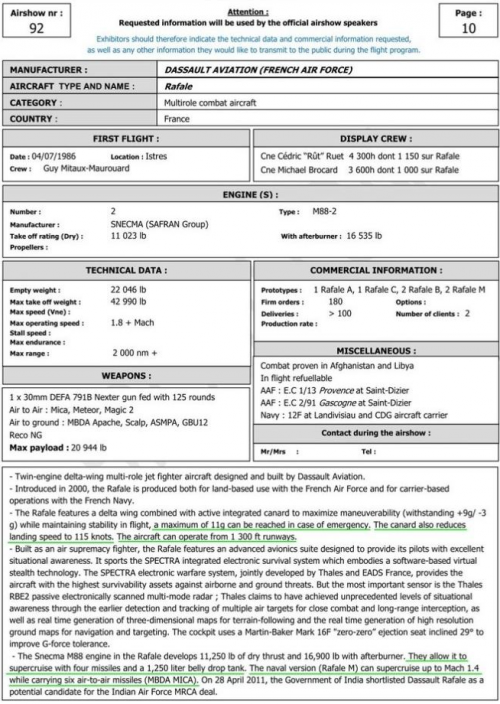
I don't think so.Some media reports in India claim that Rafale can supercruise with some A2A payload at Mach 1.2-1.4 , is that correct ?
It is supercrusing with one external tank and 4 AAM (old news).
Maybe more with T-rex tomorrow.
Attachments
BonPlan2
ACCESS: Top Secret
- Joined
- 5 June 2025
- Messages
- 577
- Reaction score
- 737
since 2013 all are delivered with AESA.Since 2022, deliveries have resumed (37 aircraft + 3 this year), likely with an AESA radar installed in each aircraft?
Dassault website does not say it has Supercruise capability.I don't think so.
It is supercrusing with one external tank and 4 AAM (old news).
Maybe more with T-rex tomorrow.
So likely that sheet data may not correspond to reality. Also no data on SC altitude
BonPlan2
ACCESS: Top Secret
- Joined
- 5 June 2025
- Messages
- 577
- Reaction score
- 737
The document added to my previous answer came from a Dassault official document found in Le bourget show. I think but not sure it was in 2011.Dassault website does not say it has Supercruise capability.
So likely that sheet data may not correspond to reality. Also no data on SC altitude
If I remember well, during the first flight of Rafale C01it reached mach 1.2 (and 4G) without after burner.
CastleBravo
ACCESS: Confidential
- Joined
- 21 January 2026
- Messages
- 197
- Reaction score
- 184
Fighter RCS is lower from front, however, Radar have harder time tracking a retreating target compared to an incomming target. You will often see requirement for head on target is much higher than a tail on target
View attachment 802286
That because it is easier for return of retreating target to blend in with the side lobe clutter of the radar
View attachment 802287
That is true for a radar mounted on the nose of a fighter moving forward at a high rate of speed, but not for an AEW that is beam on towards the target, or possibly even moving away from it. If the PL-15 was shot at track data generated by the KJ-500, then the Rafale should have been easier to track from the rear due to the low frontal RCS.
That said, there is no way any air to air missile fired from such extended range can catch a fighter that is retreating the entire time. If it really was a ~200km shot, the Rafale was almost certainly nose hot at the time of the shot and for most if not all of the missile's flight; whatever Pakistan used to track the Rafale had no problem seeing it from the front.
The document added to my previous answer came from a Dassault official document found in Le bourget show. I think but not sure it was in 2011.
If I remember well, during the first flight of Rafale C01it reached mach 1.2 (and 4G) without after burner.
If it came from Dassault officials then it should be on Dassault website too , why would Dassault ignore such key capability.
AFAIK few 4+ Gen fighter had achieved Supercruise during their test phase Eurofighter , Su-35S but eventually these were not regarded as practical capability with useful payload.
Titus K
ACCESS: Top Secret
- Joined
- 6 September 2025
- Messages
- 818
- Reaction score
- 2,781
They are not selling cars, no one is ordering a Rafale from the Dassault configurator… The website has very limited informationIf it came from Dassault officials then it should be on Dassault website too , why would Dassault ignore such key capability.
https://www.dassault-aviation.com/fr/defense/rafale/caracteristiques-et-performances/
Regarding supercruise (and RCS), since the Rafale is almost always equipped with external fuel tanks, the characteristics of the aircraft in a clean configuration are largely irrelevant imho.
In this video during factory flight testing a Rafale (with 3x 1250 L drop tanks) reaches mach 1.7 burning 300-350kg fuel per minute.
Right before that they are at mach 0.95 … i wonder if that is before activating afterburners ?
At ~6:30
Last edited:
Not correct, Fact is that we don't know what ratio should be considered as a safe guess. French AF and Navy have had dramatically low AESA number. India is also difficult to gauge. The F4 brings standard aesa set but that is murky as well as F4 span across three intermediary standards to reach maturity in par with other advanced aircraft (fusion, datalink, SAR modes, reliability etc...).since 2013 all are delivered with AESA.
Since my post was deleted, what are the updates with India announced intended contract?
Last edited:

Grey Havoc
ACCESS: USAP
- Joined
- 9 October 2009
- Messages
- 24,500
- Reaction score
- 18,175
Grey Havoc
ACCESS: USAP
- Joined
- 9 October 2009
- Messages
- 24,500
- Reaction score
- 18,175
From the comments thread:


BonPlan2
ACCESS: Top Secret
- Joined
- 5 June 2025
- Messages
- 577
- Reaction score
- 737
???That is true for a radar mounted on the nose of a fighter moving forward at a high rate of speed, but not for an AEW that is beam on towards the target, or possibly even moving away from it. If the PL-15 was shot at track data generated by the KJ-500, then the Rafale should have been easier to track from the rear due to the low frontal RCS.
That said, there is no way any air to air missile fired from such extended range can catch a fighter that is retreating the entire time. If it really was a ~200km shot, the Rafale was almost certainly nose hot at the time of the shot and for most if not all of the missile's flight; whatever Pakistan used to track the Rafale had no problem seeing it from the front.
I think this Rafale was returning to base, and the pilot thaught it was out of any enemy missile range (an error of Indian intelligence). So he was flying low speed, without high G, so easy to track and easy to reach even for a missile with low energy.
Rafale easy to track from front ? No évidence. This one may have been targeted once returning to base, or before but "thanks'" to the wings full of ordnances.
BonPlan2
ACCESS: Top Secret
- Joined
- 5 June 2025
- Messages
- 577
- Reaction score
- 737
PESA is no more on production since 2010 or 2011. Even the PESA antenna is no more produced, and replaced in case of serious breakdown by an AESA one (plug and play in 2 hours).Not correct, Fact is that we don't know what ratio should be considered as a safe guess. French AF and Navy have had dramatically low AESA number.
First serially produce AESA was delivered in 2010. The first ones were deeply field tested by CEAM to fine tune it, check there was no recession in the differents modes and elaborate the new instruction manual.
All the 60 "tranche 4" jets are equipped from scratche with this radar, as all the jets delivered in export (I don't know about the 2nd hand ones).

Not news, but don't shoot please...
Just to post this nice pict showing the canards/wing air flow at AOA :

Pict © Dassault - Dassault Aviation - Alex Paringaux
Just to post this nice pict showing the canards/wing air flow at AOA :
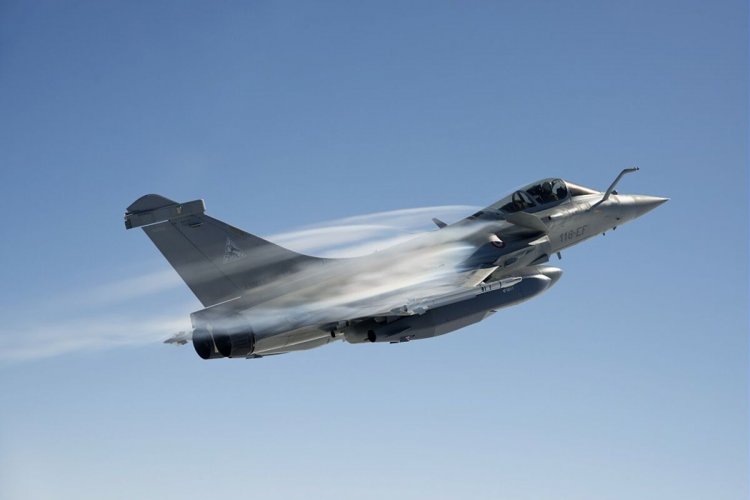
Pict © Dassault - Dassault Aviation - Alex Paringaux
BonPlan2
ACCESS: Top Secret
- Joined
- 5 June 2025
- Messages
- 577
- Reaction score
- 737
probably a air brake posture.Not news, but don't shoot please...
Just to post this nice pict showing the canards/wing air flow at AOA :
View attachment 804288
Pict © Dassault - Dassault Aviation - Alex Paringaux
Scorpion82
ACCESS: Secret
- Joined
- 20 May 2006
- Messages
- 407
- Reaction score
- 873
probably a air brake posture.
Air brake posture? If indeed the "airbrake" is being ment, I would expect the flaperons to be deflected as well.
BonPlan2
ACCESS: Top Secret
- Joined
- 5 June 2025
- Messages
- 577
- Reaction score
- 737
Difficult to see with the air flow.Air brake posture? If indeed the "airbrake" is being ment, I would expect the flaperons to be deflected as well.
Scorpion82
ACCESS: Secret
- Joined
- 20 May 2006
- Messages
- 407
- Reaction score
- 873
Difficult to see with the air flow.
In such a case the vapour should be impacted by the flaperons and not be relatively flush compared to the wings. Nevertheless nice image.
Similar threads
-

-
Dassault VORTEX (Véhicule Orbital Réutilisable de Transport et d'Exploration)
- Started by TomcatViP
- Replies: 53
-
'Neuron 2.0' - New Dassault UCAS launched at Saint-Dizier, 8 October 2024
- Started by Jackonicko
- Replies: 20
-
 NEWS ONLY: France-Germany-Spain Future Combat Air System (FCAS / SCAF / FSAC)
- Started by Deltafan
- Replies: 3K
-