They've already discussed adding the Saudis as buyers. I don't believe the Germans would get more than their names on the order sheet.
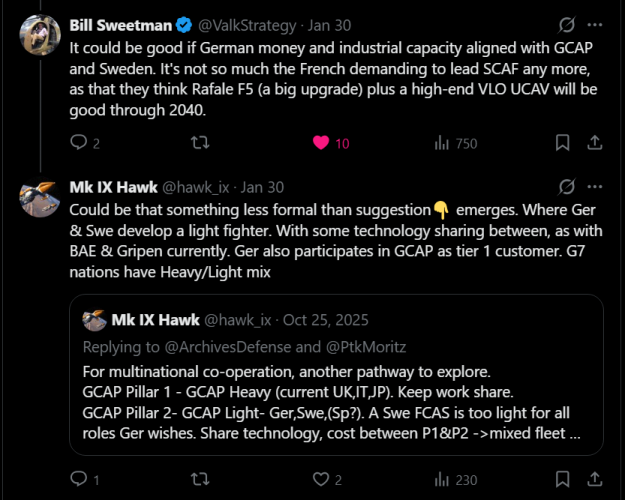
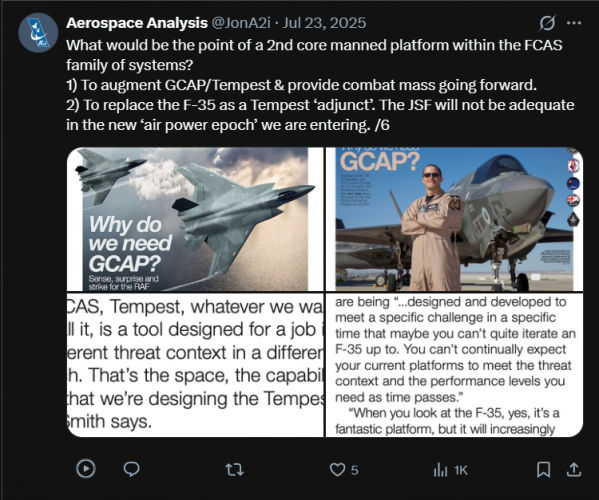
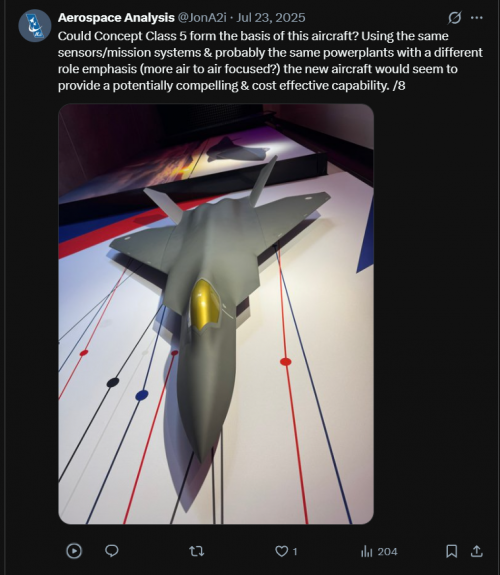
Expanding on the point I made from the X post above & replying to ^ quoted.
Leading to the question of if Germany would develop a light fighter with Sweden, whilst also being a GCAP customer. Not every mission requires the range, payload of GCAP, especially in Europe (& if keeping Swe concept of operations - road based dispersal). However Ger is unlikely to be interested in a fleet which only consists of a light fighter - wanting the GCAP capabilities for deep strike etc. This route would mean Ger has GCAP heavy (le.g. with some industrial work share of production in country) and also the industrial benefits & export opportunities for co-developing GCAP light with Swe.
As far as I’m aware procurement cost and running costs are somewhat correlated to aircraft size/ weight, number of engines etc. Will it be sufficient to acquire GCAP “heavy” and create combat mass with CCAs/ACPs or would a light fighter help to give a high/low mix with a higher number of manned fighters than having only heavy. Or less cost to running the overall fleet, without dropping the number of manned aircraft from current / near future numbers (loosing trained pilots).
Given that Ger & Swe would need to acquire a “6th gen” engine (power, cooling, efficiency etc), and that the European companies that can provide the sensors needed are a short list. Would this lead to a more formal co-operation between Ger, Swe and the GCAP project - i.e. GCAP heavy, GCAP light. Where nations with G7 levels of GDP buy a heavy only or heavy/light mix, with non G7s buying light only.
Or only technology sharing under distinct products (i.e. as Gripen) rather than being in a family of systems with two airframes under the same family.
Having GCAP heavy & light could provide cost burden sharing where -
-Ger buy’s into GCAP main/ heavy project early, with a projected number of airframes and looking to produce components locally (perhaps final assembly plant).
-Ger & Swe collaborate on GCAP light - using as much common sub systems as possible - engine, radar tech, other sensors.
-Given Swe work on partitioned flight control and mission software on the Gripen E, there is already co-operation between BAE and SAAB on some aspects - perhaps software, and certainly hardware integration.
-There could be an avenue of co-production of the software & combat cloud of GCAP/FCAS where Ger & Swe contribute.
-Economies of scale of increased volume of purchases of the sub components that make up GCAP heavy & light.
Later reply to the above X thread:
View: https://x.com/valkstrategy/status/2017602680214954190?s=61
As a side note - on potential for a carrier version.
If a GCAP light developed with Swe, it would require a certain level of STOL, which may put it in a position to be developed for carrier capability either from the outset or a later date. E.g. see proposed Sea Gripen. Would it be possible for a light GCAP to be twin engined, but with a smaller airframe, smaller sensor sizes (reduced cost), and different airframe characteristics than GCAP heavy. This could provide (additional) motivation for UK, Japan & Italy to bring Swe/Germ into the GCAP family, as all three will likely be looking for an F-35B replacement at somepoint.