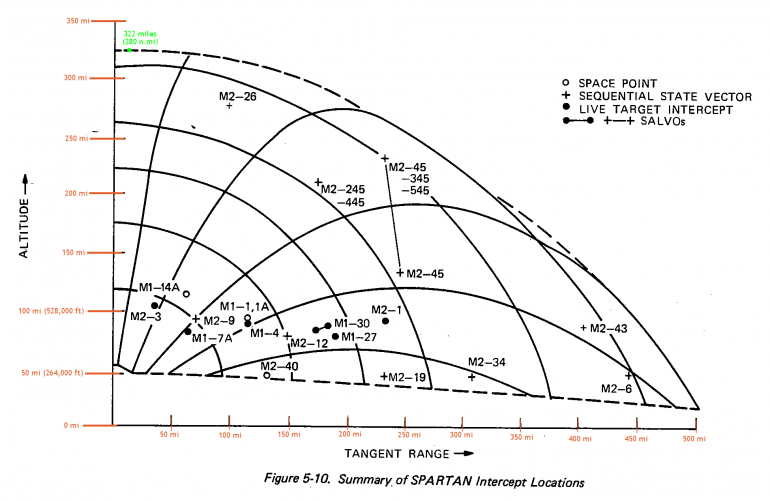
Figured out the Bell Labs SPARTAN Envelope (I think) thanks to this line from:

Draft Memorandum From Secretary of Defense McNamara to President Johnson
Washington, December 22, 1966.
SUBJECT: Production and Deployment of the Nike-X

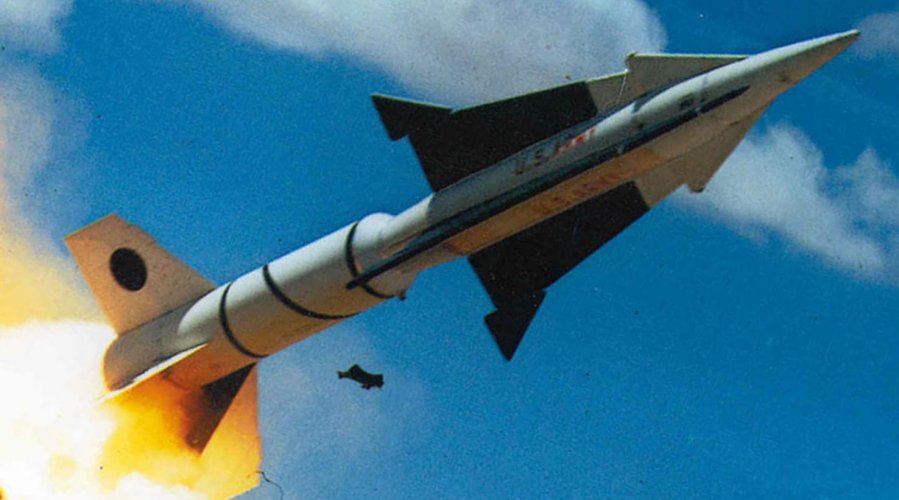
"The extended-range Spartan—a three stage missile with a hot X-ray, [less than 1 line of source text not declassified] capable of intercepting incoming objects at a range of over 400 nautical miles and at altitudes of up to 280 nautical miles. This missile makes use of some of the components of the old Nike-Zeus."
 

Attachments

  • Spartan_Kwaj_Envelope_Corrected.png
    Spartan_Kwaj_Envelope_Corrected.png
    70.5 KB · Views: 176
C.) In doing so, you make ZEUS have potential as a Super Hercules with capabilities against air-breathing targets as well; allowing you to stock one missile at existing NIKE sites to do both missions (SAM/ABM).
Worth remembering here that NIKE 2 - before it became ZEUS - envisaged a system capable of SAM and ABM using a different final stage on the missile.
 
I believe DDR&E was using SPRINT capability against the hardest, worst possible threat -- a incoming MARV with 60G or more maneuver capability -- to define the defended zone of the system for their analyses; counting on the extreme classification of the system to cover their tracks.

I believe I have found the design parameters they were using for the original SPRINT design:

MIRV: A Brief History (COVD-1571) Pages 86-88 and 140

Pg 140

Ref 8
P. Mosher and J. Vullo, Penetration Capability of a Maneuvering Re-Entry Vehicle, Research and Advanced Development Division AVCO Corporation, Wilmington, Massachusetts, Document No. RAD-TM, 62-39, (1962) (Title U, Report SRD).

Ref 9
Preliminary Design Study for Maneuvering Re-Entry Vehicles (Maneuvering Re-Entry Vehicle Project—ARS Program), Research and Advanced Development Division AVCO Corporation, Document No. RAD-TM-62-62, (1962) (Title U, Report SRD).

Pg 86-88

NOTE 12: Excerpt from AVCO reports "Preliminary Design Study for Manuvering Re-Entry Vehicles" and "Penetration Capability of a Maneuvering Re-Entry Vehicle" (References 8 and 9.)

The W/C_D_A of this advanced Minuteman vehicle is 2500 lbs/ft² (12,205 kg/m²), and it has the capability of carrying out a 60 g normal acceleration turn. Although this study utilized the advanced Minuteman, a Titan II re-entry vehicle was designed on the Terminal Guidance Project which has the same W/C_D_A and turn capability. This entire investigation could thus apply to a Titan II vehicle.

The particular group of maneuvers considered are low-altitude maneuvers against a hard-point target. If it is assumed that the re-entry vehicle will have decoy coverage upon re-entry, any maneuver by the re-entry vehicle would immediately reveal its identity relative to the nonmaneuvering decoys. It is thus desirable from an offensive point of view to delay the commencement of a maneuver until the re-entry vehicle is below the survival altitude of the decoys. Further, when considering hard-point targets, the decoys must survive to fairly low altitudes to be effective, since commitment of the interceptor can be delayed until the re-entry vehicle reaches as low as 50,000 feet (15.24 km).
Consequently, the maneuvers considered in this investigation began at 50,000 feet (15.24 km) or below.

The terminal maneuvers start when the re-entry vehicle reaches a descent altitude of 50,000 feet (15.24 km) along a nominal ballistic trajectory. The particular ballistic trajectory selected for the study follows a minimum energy path for a range of 6200 nautical miles (11 470 km). However, the terminal maneuver capability is not a strong function of the ballistic range so the results are generally applicable. Figure 2* shows some of the variations in maneuvers attainable. The extended range or lob maneuver was designed to yield a steep impact angle with a range extension of roughly 100 nautical miles (185 km).

It is possible to get a much larger range extension, if desired, by simply delaying the start of the 60 g pulldown. The range decrease or tuck maneuver yields the greatest range shortening and is probably the most difficult to intercept since the time from the 50,000-foot (15.24 km) altitude to impact is the smallest.

Initially, the study is based on consideration only of variations of the tuck maneuver.

These can be seen in figure 3 which shows 60 g pulldown maneuvers from various altitudes along the ballistic trajectory below an altitude of 50,000 feet (15.24 km). Lateral maneuvers are not considered in this portion of the study.

The dates of the papers cited/copied (1962) fit very well with the SPRINT story, which is roughly:

1959-ish: The USAF begins funding studies on hardened site equipment and vulnerability as an outgrowth of USAF Study Requirement 79813, presumably to protect USAF ICBM sites.

Several studies were conducted for USAF's Rome Air Development Center by a number of aerospace companies including Martin Marietta, United Aircraft, Hughes, Raytheon, General Dynamics and Republic Aviation.

Collectively, these efforts were known as HARK (Hardened Re-Entry Kill) and were completed in 1961.

Shortly after HARK was completed, it was taken away from the USAF on the grounds that terminal BMD was an Army responsibility.

Next year, in 1962; the following study contracts were issued:

Army Ordnance Missile Command (Hardsite) -- Douglas, Martin, North American Aviation (1 OCT 1962)

Advanced Research Projects Agency (Hardpoint) -- Douglas, Hughes, Boeing

A year later in 1963, Martin got the SPRINT contract and Boeing the HIBEX contract.

It's important to remember that a lot of "assumptions" were made from 1959-1962 well ahead of actual testing of radars against actual ICBM re-entry vehicles in actual representative flight paths regarding how decoys would work, and how discriminable they would be IRL.
 
Thanks:), my understanding is that the higher the ballistic coefficient is the accurate the RV is.

This is largely correct, but it partially misses some important caveats.

Broadly speaking, the higher the ballistic coefficient (beta), the lower the amount of drag there is on the RV. As a consequence, as the beta increases, the amount of deceleration due to atmospheric drag decreases, which means that higher beta RV designs will spend less time in the atmosphere, will reach the ground faster, and will have higher velocities when they reach the ground (or the target detonation altitude).

This does not directly translate to improved accuracy. Instead, the improvement comes from how the higher velocity leads to a reduced time of transit through the atmosphere. Thanks to those two factors, the effects of high-altitude winds on accuracy are greatly lessened, as the RV has a much shorter window of exposure to them, and is more resistant to being pushed off course by said winds. While they are still a significant source of error, the amount of error they can introduce is significantly lessened relative to older designs with lower beta RVs.

However beta alone is not the be all and end all of accuracy. Improved RV designs with higher betas are usually co-packaged with other accuracy-improving technology, like improved nose tips, improved fuzes, improved radars, etc.

Nose tips are particularly critical, as it is immensely important that the nose tip can withstand the exceptionally high stress environment of high-speed reentry while wearing down as close to perfectly evenly as possible. This is far from a trivial task, and there are extreme challenges that they must be able to handle. Something as simple as raindrops turn into a lethal threat when you're entering the atmosphere at Mach 25, and while the RV will decelerate significantly, raindrops are still incredibly damaging at lower (typically still double digit) Mach numbers. They will quite literally eat holes into the nosetip as if it had bullets fired at it. The greatest threat is asymmetric ablation, which can send a RV far off course.

Improvements in nose tip design alone can eke out dramatic improvements in accuracy even without changing anything else about the design of the RV.

Similarly, fuze and radar design is an area where there was tons of room for further improvement. Much of the accuracy improvement in higher-beta RVs was actually due to improved fuzes and radars. The Mk21 RV uses radars of a totally different design from the previous Mk12 and Mk12A warheads. The Mk5 RB introduced the radar updated path length (RUPL) fuze, more commonly known as the "super fuze". Both the Mk21 and Mk5 introduced a wide variety of major improvements to the design of their fuzes relative to previous generations of RVs/RBs.

In the end, while it's true that all else being equal a RV with a higher beta will outperform a RV with a lower beta on accuracy due to atmospheric reentry errors, this is not the full picture, and it's rare for all else to be equal.

Even more importantly, you can backport improvements in nose tip and fuze technology to older lower beta RV designs to get dramatic improvements in accuracy without increasing the beta.

Just look at the W76, where:
  • The Mk5's RUPL fuze ("super fuze") has already been backported into the W76-1 via the Mk4A RB in order to provide a substantial accuracy improvement.
  • An improved nose tip design (the Shape Stable Nose Tip (SSNT) that was originally developed for the Mk5) is scheduled to be backported to the W76 RBs in a upcoming mod that will create the Mk4B RB (which is basically just a Mk4A RB that has had its nose tip replaced with the new SSNT). The new nose tip will significantly reduce reentry errors, and should therefore result in another substantial increase in accuracy.
These changes are introducing technology that was originally developed for ultra-high-beta RVs via the ABRES program, which resulted in the ABRV, which in turn was developed into the Mk21 RV (beta = 3000) and Mk5 RB (beta = 2500). And yet now this technology is being backported into the Mk4 RB (beta = 1800).

Sure, the Mk4 will never gain the improved resistance to high altitude winds that the Mk5 and Mk21 have, but it will gain enough improvement in accuracy from backporting the fuze and nose tip designs that the difference in beta won't really matter as much anymore. The introduction of the RUPL alone was enough to give the Mk4 a credible hard target counterforce capability despite its much lower yield. The introduction of the SSNT will only further enhance the lethality of the Mk4.

So yes, higher beta designs do tend to have better accuracy, but it's not just from the higher beta. It's from the whole package. If you threw a Mk4's fuze and nose tip into a Mk5, it'd have pretty atrocious accuracy despite the far higher beta. Heck, the Mk21 lacks a RUPL, so even though it has even higher beta than the Mk5, it's at a disadvantage from a fuzing perspective, and therefore it is significantly less accurate than it could be. The Mk21A mod will integrate a new fuze with RUPL capabilities into the Mk21, which promises to substantially increase the accuracy of Mk21 RVs without any increase in beta.
 
I suppose one way to have a nose-tip that is highly resistant to rain-drop damage and ablate evenly would be for one made out of Tungsten or Tungsten-alloy.
 
What about Osmium (The densest element) with a Tungsten (The element with the highest melting point) jacket?
Not sure it'd help. What we want here is a hard and not-brittle nose cap. We don't really need the extra density.
 
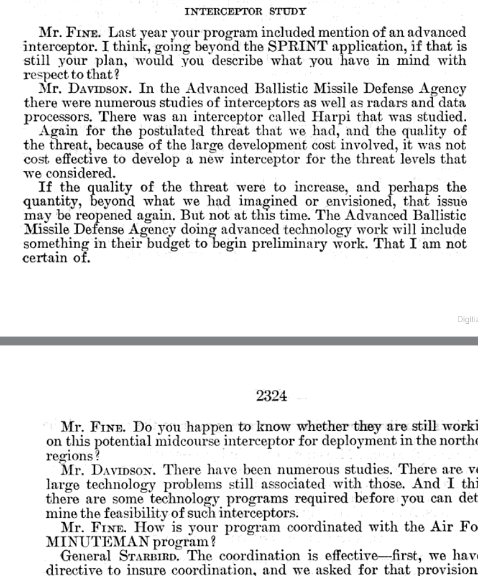
Has anyone ever heard of an interceptor study called Harpi? Based on the discussion in the attached 1971 Senate Committee on Armed Services session it was probably a mid-course concept from 1970. McDonnell Douglas seems to have done the study work - perhaps it was a Spartan derivative?

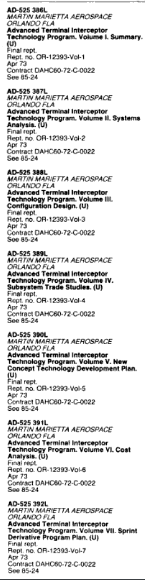
There was a lot of basic study work done 1970-80 that would have fed into various proposals for improved interceptors. Notably the Advanced Terminal Interceptor programme, there are various reports from this effort in DTIC and I would love to see the Martin Marietta Aerospace reports listed in the attached. Apparently the Sperry SLIC-7 laser gyro was one product of this effort. Some really early terminal homing work for the endoatmospheric mission, under the title "endo-homing" and later "Endo-NNK [Non-Nuclear Kill]" was also undertaken. Presumably this would have fed into things like HEDI.
 

Attachments

  • MM Aerospace Advanced Terminal Interceptor Reports.png
    MM Aerospace Advanced Terminal Interceptor Reports.png
    61.3 KB · Views: 28
  • Harpi reference.png
    Harpi reference.png
    168.6 KB · Views: 30
Interesting. Nike II was intended to have interchangeable upper stages depending on whether the target was a ballistic missile or an air vehicle. Zeus A might have some of the same aerodynamic characteristics as the Nike II maneuvering KV even though it was ABM-only. The air breather function was folded into Plato.
 
Last edited:
Figured out the Bell Labs SPARTAN Envelope (I think) thanks to this line from:

Draft Memorandum From Secretary of Defense McNamara to President Johnson
Washington, December 22, 1966.
SUBJECT: Production and Deployment of the Nike-X

"The extended-range Spartan—a three stage missile with a hot X-ray, [less than 1 line of source text not declassified] capable of intercepting incoming objects at a range of over 400 nautical miles and at altitudes of up to 280 nautical miles. This missile makes use of some of the components of the old Nike-Zeus."

US Army Space and Missile Defense Command posted this on Facebook yesterday (28 August 2026):
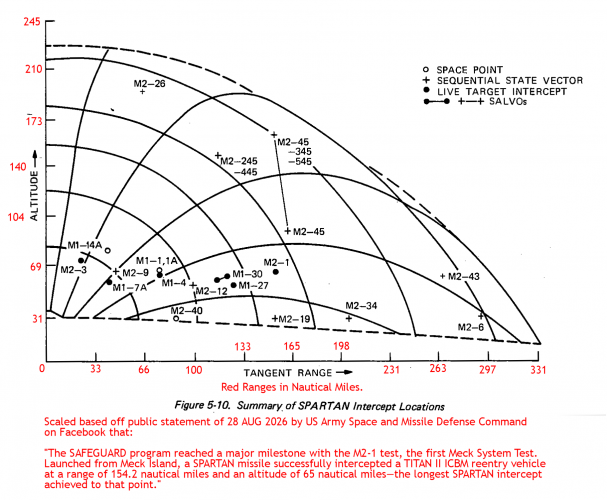
Aug. 27, 1971 – The SAFEGUARD program reached a major milestone with the M2-1 test, the first Meck System Test.
Launched from Meck Island, a SPARTAN missile successfully intercepted a TITAN II ICBM reentry vehicle at a range of 154.2 nautical miles and an altitude of 65 nautical miles—the longest SPARTAN intercept achieved to that point.

The M2-1 test also marked several important firsts for the program, including the first use of an external sensor, Target Track Radar-4, as a Perimeter Acquisition Radar substitute and the first controlled time-of-flight mission with the SPARTAN missile's third stage reoriented prior to intercept. The mission successfully achieved all of its objectives, advancing the development of the Army's ballistic missile defense capabilities.


SAFEGUARD Program Tests:

M1-1/M1-1A: 75.959 n.mi downrange, 65.965 n.mi altitude
M1-14A: 41.206 n.mi downrange, 80.132 n.mi altitude
M1-27: 125.871 n.mi downrange, 55.026 n.mi altitude
M1-30 Salvo #1: 114.806 n.mi downrange, 59.217 n.mi altitude
M1-30 Salvo #2: 121.693 n.mi downrange, 61.669 n.mi altitude
M1-4: 76.218 n.mi downrange, 62.644 n.mi altitude
M1-7A: 42.172 n.mi downrange, 57.09 n.mi altitude
M2-12: 98.493 n.mi downrange, 55.035 n.mi altitude
M2-19: 153.878 n.mi downrange, 31.296 n.mi altitude
M2-245/445: 115.248 n.mi downrange, 148.571 n.mi altitude
M2-26: 64.384 n.mi downrange, 194.656 n.mi altitude
M2-3: 22.856 n.mi downrange, 72.91 n.mi altitude
M2-34: 203.454 n.mi downrange, 30.952 n.mi altitude
M2-40: 87.241 n.mi downrange, 31.296 n.mi altitude
M2-43: 266.55 n.mi downrange, 61.905 n.mi altitude
M2-45 Salvo #1: 153.011 n.mi downrange, 163.244 n.mi altitude
M2-45 Salvo #2: 162.082 n.mi downrange, 94.15 n.mi altitude
M2-6: 292.304 n.mi downrange, 33.016 n.mi altitude
M2-9: 46.678 n.mi downrange, 65 n.mi altitude

Safeguard SPARTAN "certified" performance range seems to be bounded into three possible elliptical envelopes:

Envelope 1
0~ n.mi downrange, 218~ n.mi altitude [top]
111~ n.mi downrange, 190~ n.mi altitude [bottom]

Envelope 2
140~ n.mi downrange, 190~ n.mi altitude [top]
240~ n.mi downrange, 114~ n.mi altitude [bottom]

Envelope 3
240~ n.mi downrange, 114~ n.mi altitude [top]
332~ n.mi downrange, 13.5~ n.mi altitude [bottom]
 

Attachments

  • SPARTAN_Range_Revised.png
    SPARTAN_Range_Revised.png
    332.7 KB · Views: 64
The USN Contract for test targets to be used in the Safeguard System Test Target Program (SSTTP) was N00030-68-C-0303; which leads me to this via google:

https://ntrs.nasa.gov/citations/19720018730

Sphere launcher
The sphere launcher was designed to eject a 200 lb, 15 in. diameter sphere from a space vehicle or missile, at a velocity of 58 ft/sec without imparting excessive lateral loads to the vehicle. This launching is accomplished with the vehicle operating in vacuum conditions and under a 9 g acceleration. Two principal elements are used: a high thrust, short burn time rocket motor and two snubbers for reducing the lateral loads to acceptable limits.

Funding Number(s)
CONTRACT_GRANT: N00030-68-C-0303
 
The Safeguard System Test Target Program (SSTTP) was a lengthy test program that was originally envisoned at system initation in 1970 as:

33 x Minuteman I Launches
7 x Titan II Launches
4 x FOBS launches
6 x Polaris A2 Launches
3 x Polaris A3 Launches

But with the cutback from a larger program to just two Phase I SAFEGUARD sites, and then ultimately just a single SAFEGUARD site, the program was reorganized and ultimately ended up by 1975 as:

26 x Minuteman I Launches
7 x Titan II Launches
4 x Polaris A2 Launches (+1 failure)
1 x Polaris A3 Launches

The targets definitely known to be used during the program were:

Polaris Mk 2 MRV
Titan II Mk 6 RV
SV-1
SV-1D
SV-1S
SV-2B
SV-3
SV-3D
SV-4C

In FY73, the Army wanted to modify 6 x Minuteman, 1 x Titan II, 5 x Mk 11 RVs, and one high beta re-entry vehicle at a cost of $8M for the Safeguard System Test Target Program (SSTTP).

I don't know if this was ever gone through with; especially the "high beta" RV, which would've been analogous to the Mk 12 RV on Minuteman III.

The known list of missions launched in support of SSTTP are listed below; following an explanation of SSTTP mission designations.

=========================

M1-xx [1970-mid 1971] Missions flown with first generation SAFEGUARD software which had been done before the SAFEGUARD deployment decision in March 1969. Supported basic target tracking and target selection via average RCS and geometrical positioning.

SPARTAN/SPRINT Burst Delay Timer - Should the missile be enveloped in nuclear-induced blackout, resulting in a loss of communications with the MSR, the burst delay timer will send a burst command to the warhead at the intercept point.

SPARTAN/SPRINT Minimum Time Guidance Mode

SPARTAN/SPRINT Salvo Launch Mode

=========================

M2-xx: Missions flown with second generation SAFEGUARD software; which went through six major revisions:

=========================

M2 Revision 17 (M2-R17) [Late 1971] -- An essentially complete SPARTAN intercept function containing all major tactical SPARTAN functional capabilities:

SPARTAN Tactical Third Stage Guidance
SPARTAN Tactical Dive Guidance
SPARTAN Intercept Bias
SPARTAN In-Flight Target Redesignation.

As well as external-sensor and sequential-state vector inputs for SPARTAN control/guidance.

Elsewhere, the Tactical Track Filter was added, along with correction for refraction.

=========================

M2 Revision 18 (M2-R18) [Early 1972] — Initial SPRINT intercept, tracking, and target-selection function capabilities:

SPRINT Co-Located Launch Capability
SPRINT Remote Launch Capability
SPRINT Free-Intercept Guidance Mode
SPRINT First Stage Guidance Mode
SPRINT Extended Range Testing

It also included tactical endoatmospheric target selection based on target slowdown characteristics and a RCS signature database.

SPARTAN improvements saw its track rate raised to 20 Hz.

A special search mode (D4) was added for Debris mapping; while the user could set automatic or manual data rates for tactical tracking.

They could now also force T3 tracking mode, while inhibiting T1 tracking mode.

Crossing targets could be tracked; while automatic force coast on slot basis was added.


=========================

M2 Revision 18E (M2-R18E) [Late 1972, early 1973] — Remaining SPRINT tactical functional capability added:

SPRINT Controlled Intercept Guidance Mode
SPRINT Capability Bias
SPRINT Post-Intercept Aero Test Mode
SPRINT Taped-Target Intercept Mode

The user could now set T2 Extended Range Tracking Mode.

=========================

M2 Revision 19 (M2-R19) [Mid 1973] — Expansion of the track functional capability to include:

Tactical Coast, Reacquistion and Handover Capability
Tactical Track Initation Capability
Resolved-target wake track for aspect angles less than 75 degrees.
Variable Gate Tracking

Target selection/discrimination was improved with a dual threshhold endoatmospheric beta filter.

SPARTAN Forced Jet-Head Ignition Capability was added, along with sequential-state vector capability for Salvo launches.

High-fidelity Digital Target Environment Simulation (DTES) was added to allow accurate simulation of heavily waking single and multiple targets.

=========================

M2 Revision 19E (M2-R19E) [Late 1973] — Expansion of the waking-target functional capability to include resolved target wake track for all aspect angles.

Added Chi Square validity tests for target tracking.

Gamma filter added for target selection/discrimination.

=========================

M2 Revision 20 (M2-R20) [end of 1973, early 1974]

Surveillance modifications:

**Tactical detection and acquisition performance in a dense target environment (Tactical TC-3 search).
**Detection Clustering.
**Doppler Mismatch and side lobe rejection filter

Target Track Modifications:

**Unresolved-target wake tracking
**[target] cluster tracking
**track-through-tank breakup of multiple resolved and unresolved targets at all aspect angles.
**Extended Range Search
**Range Resolution Search

=========================

SAFEGUARD missions were not designated in the order that they were flown, but rather in the order that they were created; similar to the early Space Shuttle Program:

STS-51B - April 1985
STS-51C - January 1985

If a mission failed, the designation was repeated with an alphabetical suffix until it succeeded:

M1-7 - First IRBM Intercept attempt. Failed, 15 APR 1971
M1-7A - Second IRBM Intercept attempt. Success, 21 Apr 1971.

BONUS: "The KMR missions, from the SPRINT subsystem point of view, demonstrated the capability to launch and guide the [SPRINT] missile with the MSR and the MSDP to intercept a live or simulated reentry vehicle. Intercepts were accomplished well within required miss distances. In fact, one intercept resulted in physical contact."

===============================
Polaris/IRBM Class Targets:
===============================

SSTTP M1-7 [Polaris A2 w/Mk 1 RV or surrogate] (15 Apr 1971): Launched from EAG-154 OBSERVATION ISLAND. Attempted two face IRBM intercept. Not successful.

SSTTP M1-7A [Polaris A2 w/Mk 1 RV or surrogate] (21 Apr 1971): Launched from EAG-154 OBSERVATION ISLAND. Intercepted by SPARTAN in the first two face IRBM intercept.

SSTTP M1-8 [Polaris A2 w/Mk 1 RV or surrogate] (7 May 1971): Launched from EAG-154 OBSERVATION ISLAND.

SSTTP M2-5 [Polaris A2 w/Mk 1 RV or surrogate] (7 Nov 1971): Launched from EAG-154 OBSERVATION ISLAND.

SSTTP M2-8 [Polaris A2 w/Mk 1 RV or surrogate] (12 Nov 1971): Launched from EAG-154 OBSERVATION ISLAND.

SSTTP M2-3 [Polaris A3 w/Mk 2 MRV Cluster] (8 Dec 1971): Launched from EAG-154 OBSERVATION ISLAND. Intercepted by SPARTAN, following the first in-flight redesignation of target.

===============================
Heavy ICBM Class Targets:
===============================

SSTTP M1-17 [Titan II w/Mk 6 RV] (20 Jun 1971): Radar Target. Was originally scheduled to launch on 26 May 1971; but aborted and recycled to 20 June 1971.

SSTTP M2-1 [Titan II w/Mk 6 RV] (27 Aug 1971): Intercepted by SPARTAN at 154.2 nautical miles and an altitude of 65 nautical miles; and was the first SPARTAN intercept using Tactical Guidance / External Data.

SSTTP M2-10 [Titan II w/Mk 6 RV] (24 May 1972) - Radar Evaluation of Offset Trajectory with Waking target. Possibly intercepted by SPRINT as M2-10R?

SSTTP M2-14 [Titan II w/Mk 6 RV] (11 Oct 1972) - SPRINT Intercept, plus Radar Evaluation of Offset Trajectory with Waking target.

SSTTP M2-27 [Titan II w/Mk 6 RV] (5 Oct 1973) - Radar Evaluation of Fly By Trajectory with Waking target.

SSTTP M2-31 [Titan II w/Mk 6 RV] (1 Mar 1974) - Radar Evaluation of Radial Trajectory with Waking target. Primary objective was to gather data to evaluate response to RV flying through active tank breakup.

SSTTP M2-36 [Titan II w/Mk 6 RV] (20 Jun 1974) - Mission aborted, missile never launched.

===============================
Medium ICBM Class Targets:
===============================

SAC's First Strategic Aerospace Division (1STRAD) turned over LF06 at Vandenberg AFB to SAMSO to support Minuteman launches for SSTTP.

SSTTP-1 (MR CLEAN) [Minuteman 1B] (VAFB LF06) - 23 Sep 1969. FAILURE.

SSTTP-2 (MR CLEAN II) [Minuteman 1B w/Mod Mk 11] (VAFB LF06) - 16 Dec 1969

The above missions were the first flown under the SSTTP program, and used a different sequencing system than the later ones which adopted the Army's methodology.

SSTTP M1-3 [Minuteman IB] (VAFB LF06) (23 Jul 1970)

SSTTP M1-4 [Minuteman IB] (VAFB LF06) (28 Aug 1970) - Intercepted by SPARTAN in first live-target intercept.

SSTTP M1-27 [Minuteman IB] (VAFB LF06) (3 Oct 1970) - Intercepted by SPARTAN.

SSTTP M1-12 [Minuteman IB] (VAFB LF06) (24 Dec 1970) - Intercepted by SPRINT.

SSTTP M1-30 [Minuteman IB] (VAFB LF06) (11 Jan 1971) - Intercepted by SPARTAN in first dual salvo launch.

SSTTP M1-28 [Minuteman IB] (VAFB LF06) (23 Feb 1971) - Radar Target.

SSTTP M1-13 [Minuteman IB] (VAFB LF06) (17 Mar 1971) - Intercepted by SPRINT with a Salvo Launch.

SSTTP M1-14 [Minuteman IB] (VAFB LF06) (27 June 1971) - Radar Target.

SSTTP M2-2 [Minuteman IB] (VAFB LF06) (8 Oct 1971) - Radar Target.

SSTTP M2-7 [Minuteman IB] (VAFB LF06) (16 Mar 1972) - Radar Target. Possibly intercepted as M2-7R by SPRINT?

SSTTP M2-11 [Minuteman IB] (VAFB LF06) (5 May 1972) - Radar Target.

SSTTP M2-15 [Minuteman IB] (VAFB LF06) (15 Jul 1972) - Radar Target.

SSTTP M2-21 [Minuteman IB] (VAFB LF06) (8 Dec 1972) - Intercepted by SPRINT.

SSTTP M2-24 [Minuteman IB] (VAFB LF06) (4 May 1973) - Radar Target.

SSTTP M2-22 [Minuteman IB] (VAFB LF06) (7 June 1973) - Intercepted by SPRINT.

SSTTP M2-18 [Minuteman IB] (VAFB LF06) (21 Jul 1973) - Radar Target.

SSTTP M2-20 [Minuteman IB] (VAFB LF06) (9 Aug 1973) - Radar Target.

SSTTP M2-44 [Minuteman IB] (VAFB LF06) (7 Sep 1973) - Radar Target.

SSTTP M2-38 [Minuteman IB] (VAFB LF06) (3 Nov 1973) - Radar Target. Possibly intercepted by SPRINT as M2-38R?

SSTTP M2-25 [Minuteman IB] (VAFB LF06) (29 Nov 1973) -Intercepted by SPRINT.

SSTTP M2-20A [Minuteman IB] (VAFB LF06) (14 Dec 1973) - Radar Target.

SSTTP M2-28 [Minuteman IB] (VAFB LF06) (23 Jan 1973) - Radar Target.

SSTTP M2-135 [Minuteman IB] (VAFB LF06) (16 Apr 1973) - Radar Target.

SSTTP M2-35 [Minuteman IB] (VAFB LF06) (27 Apr 1974) - Radar Target.

SSTTP M2-146 [Minuteman IB] (VAFB LF06) (18 Jul 1974) - Radar Target.

SSTTP M2-46 [Minuteman IB] (VAFB LF06) (1 Aug 1974) - Radar Target. The last flight in the Safeguard System Test Target Program.

=============
Unknown Targets
=============

M1-99A - SPRINT Intercept. No idea what target was used for this.

It's possible that SAFEGUARD may have used SRBMs to launch the following RVs [SV-1 | SV-1D | SV-1S | SV-2B | SV-3 | SV-3D | SV-4C] over the lifetime of the program as cheap re-entry surrogates to save program funds.

=============
Misc Bonus Stuff
=============

From the Bell ABM Report:

A moderate degradation in kill probability for [SPARTAN] Mission M2-06 resulted from a 2.2-sigma aim-point miss distance. This was the largest miss distance on any mission and was attributed to the combination of a very long coast period after [SPARTAN] third-stage burnout, a large turnaround angle, and a missile-state estimation error. [SPARTAN] Mission M2-06 was a low-altitude, long-range mission — the longest range mission in the test series.

Per our reconstructed graph, M2-6 was about 292 n.mi downrange @ 33 n.mi altitude.

If you look at the SPRINT Chapter of the Bell ABM Report; there's this section:

For example, the extended range [SPRINT] mission provided valuable data to more precisely define drag characteristics for simulation purposes

The entire Meck SAFEGUARD testing setup was also used on targets of opportunity.

TRM-93: Track targets of opportunity, Minuteman IB HK-1 [28 October 1972] and Minuteman IB HK-2 [25 Apr 1973], to obtain data on tank breakup.

TRM-104 and TRM-105: Gather additional data on targets of opportunity involving Mark 11 and Mark 12 reentry vehicles.

 
The Safeguard System Test Target Program (SSTTP) was a lengthy test program that was originally envisoned at system initation in 1970 as:

33 x Minuteman I Launches
7 x Titan II Launches
4 x FOBS launches
6 x Polaris A2 Launches
3 x Polaris A3 Launches

But with the cutback from a larger program to just two Phase I SAFEGUARD sites, and then ultimately just a single SAFEGUARD site, the program was reorganized and ultimately ended up by 1975 as:

26 x Minuteman I Launches
7 x Titan II Launches
4 x Polaris A2 Launches (+1 failure)
1 x Polaris A3 Launches
Very cool find!

Man, that was a really big test program. 53 shots?


The entire Meck SAFEGUARD testing setup was also used on targets of opportunity.

TRM-93: Track targets of opportunity, Minuteman IB HK-1 [28 October 1972] and Minuteman IB HK-2 [25 Apr 1973], to obtain data on tank breakup.

TRM-104 and TRM-105: Gather additional data on targets of opportunity involving Mark 11 and Mark 12 reentry vehicles.
Can't blame them for that. I know I'd do the same even unofficially.
 
168. Minutes of Verification Panel Meeting
Washington, January 25, 1971, 3:40–5:00 p.m.

SUBJECT: Hard-Site Defense and the FY 72 Safeguard Program

PARTICIPANTS

Chairman—Henry A. Kissinger

State
John N. Irwin
Ronald I. Spiers
Raymond Garthoff
Seymour Weiss

Defense
David Packard
Paul Nitze
Gardiner Tucker

CIA
Richard Helms
Bruce C. Clarke

JCS
Adm. Thomas Moorer
Gen. Royal B. Allison

ACDA
Gerard Smith
Philip J. Farley
Spurgeon Keeny

OST
Dr. Edward David
Attorney General John N. Mitchell

OMB
James R. Schlesinger

NSC Staff
Col. Jack Merritt
Helmut Sonnenfeldt
K. Wayne Smith
Jeanne W. Davis

SUMMARY OF DECISIONS

It was agreed:

—to formulate the issues for the President so as to get a decision on what our FY 72 Safeguard Program should be, and its relation to our SALT position;

—to put before him the full range of proposals, including Mr. Smith’s views on the difficulties in changing our SALT position;

—to review our SALT position during the next month.

Dr. Kissinger: I thought we could use this meeting to get from Dave Packard a sense of the meaning of a hard-site defense—what it is and how it differs from the four-site defense plan.

(Mr. Packard briefed from the outline at Tab A. [*] He was interrupted from time to time by the following questions.)

[* – Tab A was not found attached. Another copy of the 28 page outline indicates that Packard’s briefing dealt primarily with two issues: hard-site defense and the FY 72 Safeguard program. (National Archives, Nixon Presidential Materials, NSC Files, NSC Institutional Files (H-Files), Box H–007, Verification Panel Meeting, SALT, 1/25/71)]

Mr. Kissinger: Why is hard-site defense cheaper? Is it because of the radar?

Mr. Packard: It would use smaller radars and local interceptors. The proposed hard-site configuration is spelled out on pages 14 and 15 (of Tab A). [*] Each pattern would include three radars and six interceptor farms with 16 missiles in each farm. This would give you 100 missiles and 21 silos defended. You could have a heavier defense against a higher threat since the modules and the concentration of interceptors in the modules could be built up.

[* – Pages 14 and 15 of Packard’s briefing outline proposed a hard-site defense system that, using modified Sprint interceptors and integrated into the existing Safeguard command and control network, defended 10 to 40 Minuteman silos per radar module deployed.]

Mr. Kissinger: I have heard the argument that the entry price for one MSR is the same as the entry price to saturate the system—that there is no difference between one radar and ten. Would these radars all be netted in the same general area?

Mr. Packard: They would operate autonomously.

Dr. Kissinger: Suppose they should go after Whiteman and all the Sprints were controlled by one MSR. To get one radar they would pay the same entry price as to saturate the system. We don’t solve the problem by putting in 10 radars.

Mr. Packard: But we would increase the number of interceptors and make it more difficult to saturate.

Dr. Kissinger: If I may be the devil’s advocate—if the key element is the number of interceptors, why not increase the number of units in Safeguard?

Mr. Packard: It would be more expensive.

Dr. Kissinger: You can increase the number of interceptors at lower cost?

Mr. Packard: Yes, Also, they could operate to a reasonable degree without MSR. We would have 700 interceptors.

Mr. Kissinger: 700 interceptors to defend 100 Minutemen? In terms of SALT if we want an agreement that would permit hard-site defense, we would have to have a high limit on interceptors.

Mr. Packard: We can’t put a limit on interceptors.

Mr. Nitze: The number of radars and the number of interceptors are both important. We would have to have both.

Mr. Packard: (returning to the briefing outline) On page 16 we indicate what a four-site Safeguard would contribute to hard-site defense. [*]

[* – Page 16 of Packard’s briefing outline listed seven ways in which Safeguard contributed to hard-site defense. ]

Dr. Kissinger: You are proposing a combination of four-site Safeguard and hard-site defense?

Mr. Packard: We’re showing what four-site Safeguard would contribute to hard-site defense.

Dr. Kissinger: If you take away these Safeguard things, you are vulnerable to pin-down, for example?

Mr. Packard: You would be more vulnerable to pin-down. That and the next point on defense-in-depth of Minuteman are the most significant.

Dr. Kissinger: Isn’t pin-down decisive?

Mr. Packard: Pin-down is determined in part by the frequency of the radar and the time involved. You could get some protection against pin-down with a dedicated system without Safeguard.

Dr. Kissinger: But if you can’t, you’ve had it?

Mr. Packard: Some scientists say ‘yes’ and some say ‘no’.

Mr. Nitze: The pin-down risk is largest for SLBM. A four-site system with Spartans gives you some defense of Minuteman against SLBMs.

Dr. Tucker: This is the point of the omni-directional defense. The proposed system for hard-site defense would defend only against the ICBM corridors. The four-site system would be a convenient way to defend against SLBMs from the ocean.

Mr. Packard: To summarize: if the defense of Minuteman is the only problem, in the interest of lower expenditure you could go to a dedicated hard-site defense directly. You remember Panofsky was critical of the Safeguard system for Minuteman and thought there were cheaper ways to do it. I agree with him now. Also, the area defense capability of Safeguard adds to the effectiveness of hard-site defense. The Safeguard program is already underway. Hard-site defense could be added in these terms.

Dr. Kissinger: If the essentials of a hard-site defense are a larger number of radars and interceptors, is it reconcilable with SALT? How would you specify what would be permitted and what prohibited?

Mr. Packard: We have presented two options on page 17 (of Tab A): set a finite time period for negotiation, after which we would begin deployment of hard-site defense, or a symmetrical agreement. Asymmetrical agreements are not attractive. Dr. Kissinger: To us or to them?

Mr. Packard: To them.

Dr. Kissinger: How about an NCA defense for them and a four-site Safeguard for us?

Mr. Packard: It would be better than what we have now.

Dr. Kissinger: It would provide a base.

Mr. Packard: On page 18 (of Tab A) we have indicated that hard-site defense would be allowed only at launch complexes east of the Urals in the USSR and west of the Mississippi and east of the Rockies in the U.S. [*] This would mean roughly equal populations. On page 19 we discuss the effect of Soviet cheating. Even without hard-site defense, if 300 Minutemen survived, without cheating, they could generate 29 percent Soviet fatalities by themselves. [**] With cheating, this drops to 4 percent with 2500 Soviet interceptors and zero with 5000. The situation would be very bad if there were cheating without hard-site defense. If we had hard-site defense and the Soviets cheated, we would still have a reasonably livable situation. The question, of course, is whether the Soviets are more likely to cheat if we have hard-site defense? The program that we are recommending is derived from a combination of Air Force and Army studies. We might modify the details, of course.

[* – Page 18 of Packard’s briefing outline listed “HSD Constraints to Aid in Verification.” ]

[** – A table, entitled “The Retaliatory Capabilities of Minuteman Alone With Soviet Cheating on ABMs,” appears on page 19.]

Dr. Kissinger: What are you recommending?

Mr. Packard: We are recommending that we consider changing our SALT instructions and that we move along with our R&D program for hard-site defense.

Dr. Kissinger: Those are two separate questions. Should we stick with our current proposal for the next year?

Mr. Packard: Next year we should move into advanced R&D for hard-site defense.

Dr. Kissinger: Would you continue construction at all the authorized sites?

Mr. Packard: Our Safeguard alternatives are on page 28 (of Tab A). [*]

[* – Page 28 detailed the three Safeguard alternatives summarized by Packard.]

1) We could slow up the program at the cost of approximately $1 billion per each year’s delay.

2) We could maintain the four sites already approved by Congress which would maintain continuity, keep costs where they are and maintain momentum.

3) We could continue with the four sites plus advanced Washington preparation. We would have to include this in the budget. This has the same features as the four-site program but adds more. It is a logical step toward area defense, and it starts deployment around Washington which agrees with our latest SALT proposal. We think this is the best alternative.

Mr. Schlesinger: There wouldn’t be much saving in FY 72.

Mr. Packard: We estimate about $100 million, which is of course, worth saving. I might say that the estimate of additional cost brought about by delay is a very general estimate.

Mr. Schlesinger: Don’t you have another option: to go ahead with what is in the budget but not tie the construction money to the Warren site. If SALT goes in the direction of NCA, you could then use the money for NCA.

Mr. Packard: If we get agreement on NCA we could transfer some of the work to the NCA configuration if we could get it approved.

Mr. Schlesinger: Or you could go for authorization for a fourth site, that would not necessarily be Warren.

Dr. Kissinger: We have three things to consider:

1) what should our next year’s Safeguard program be?

2) what is a sensible Safeguard program in the absence of a SALT agreement? And

3) what is a sensible Safeguard position to take in SALT?

We don’t have to answer (2) as long as we do not do anything inconsistent with our SALT objectives. We need to get a Presidential decision on the first question and how to relate it to our SALT position. We need to know what we really want in SALT. I know some of you will shudder at any change in our SALT position and we will certainly not undertake it lightly. If a move from our present NCA–ABM position would scuttle the negotiations, the President would obviously weigh it very seriously. But we should have a discussion before March 15 of what we really want from SALT.14 Would the Russians buy a three or four-site system in exchange for NCA? We need to look at the problem. Our immediate problem is how to frame the issues for the President to decide. What we need to put before the President is the immediate issue of the FY 72 Safeguard Program, with enough of SALT to relate the two. (to Gerard Smith) Would you summarize your position, Gerry?

Mr. Smith: I haven’t changed my position after listening to Mr. Packard’s briefing. If I go back to the Soviets with limited radars and interceptors and then we decide on a new system—in General Allison’s words, that dog just won’t hunt. We would be kidding ourselves and the President if we presented this as a thing he would like to go before the world proposing. Some people might argue that we could take the line that the Soviets had accepted NCA but not as part of the package. Therefore, we could feel free to propose X thousands of interceptors which would work to our advantage. This would raise a real question about the President’s seriousness of purpose. Also, we might lose on the Hill on Safeguard. This would give added strength to Safeguard opponents.

Dr. Kissinger: If we adopted a stay-where-we-are on ABMs, this would mean three or four sites as against NCA. Each site would be keyed to the existing system.

Mr. Smith: We could say to the Russians, how about one or two sites. But four sites as against Moscow hasn’t a chance with the Russians or with public opinion.

Mr. Kissinger: You know my hang-up; we are creating a rationale for an area defense, building a three or four-site defense and asking the Russians for an NCA defense. We have no authorization for NCA defense and don’t really know why we want it.

Mr. Packard: The key issue is not hard-site defense. The key is to insure the survival of our land-based missiles. It might be possible by a mobile land system or by controlling or reducing their ability to attack and their accuracy. But we can’t avoid facing the issue of survivability of our land-based forces. We could, of course, move to launch-on-warning, but I wouldn’t recommend it. We could also go to a sea-based system which has some attractions and some advocates.

Dr. Kissinger: (to General Allison) What dog will hunt?

Gen. Allison: The question is whether or not the August 4 proposal in its totality permits the US to do the things necessary to protect the security of the US. I think it does. If this is the case, we should proceed down a path which would not require a change in the August 4 proposal which would further diverge the U.S. and Soviet views. This might be to proceed with an NCA-type structure but slow down the full Safeguard program.

Mr. Kissinger: So you support which position? What does the President ask for next year? Does he ask for authority for a fourth site or for NCA?

Mr. Schlesinger: Authority for a fourth site is in the budget.

Mr. Packard: (referring to page 17 of Tab A) We don’t need to change the present proposal. One of our options is the finite time limit. We could continue R&D in 1972. If we get what we ask for, we would modify the program.

Mr. Smith: You’re talking about four or five years. That’s a lot of money in the bank compared to 12 months. I wouldn’t advertise this time period. I would recommend we go ahead with R&D but not commit ourselves to do something in four or five years.

Mr. Packard: We have to do something.

Mr. Smith: I agree, but we could keep our options open in R&D.

Mr. Kissinger: Gerry Smith wants to limit construction to two sites and continue R&D. Dave Packard wants to continue on four sites and advanced preparation for NCA. (to General Allison) What do you want the President to authorize? What does he decide on the program for next year?

Gen. Allison: I would shave off one site and go toward an NCA, or at least do something to show some interest in the NCA concept. I agree with Mr. Smith; it would be disastrous to SALT to change our proposal.

Mr. Mitchell: Don’t you have the authority for four sites? It’s a question of funding, isn’t it?

Adm. Moorer: There’s also a question as to whether Congress will go along with NCA.

(Mr. Irwin circulated the paper at Tab B)

Mr. Kissinger: (to Mr. Irwin) What is your rationale for this?

Mr. Irwin: We would do what we can under Option E; harden some Minuteman sites; continue construction on two sites; defer construction at Whiteman (approved in FY 71); request no authority for procurement or construction at Warren (site survey authorized in FY 71); carry out R&D for a hard-site defense; and carry out studies for NCA. We shouldn’t commit ourselves to a complete program. We should slow down the construction of Safeguard sites. If we go NCA, we could go ahead with Warren and call off the work on Whiteman. This would keep our options open. I would go along with Gerry (Smith)’s position plus Dave Packard’s point of Washington advanced preparation. I wouldn’t go as far as the whole Defense proposal. My position is similar to General Allison’s.

Mr. Kissinger: (to General Allison) I thought you said four sites plus advanced Washington preparation.

Gen. Allison: Mr. Irwin’s proposal wouldn’t stop the four sites. (to Mr. Irwin) You wouldn’t plan to cancel construction, would you?

Mr. Irwin: Would you continue construction now?

Adm. Moorer: We would ask for authority for Whiteman and no authority for Warren.

Gen. Allison: It would be a difference in pace.

Mr. Helms: Has anyone taken any soundings on the Hill on NCA?

Mr. Packard: No, but I don’t think there’s much interest. There’s more interest in Minuteman survivability. There would be a problem, though, if we back off from what we asked for last year.

Dr. Tucker: But we have authorization for four sites.

Mr. Mitchell: But you only have authorization for a site survey at Warren.

Mr. Smith: We got construction authority for Whiteman last year and would ask for construction authority for Warren this year. I might cite a passage from the conference report on the authorization for the FY 71 appropriation in which Congressman Rivers made it clear that the House conferees considered protection of national command and control essential and that nothing should be done to prohibit programs to ensure the survivability of this vital element. This indicates the House sentiment on NCA.

Mr. Kissinger: This doesn’t explain why we want NCA.

Mr. Smith: Central to any beginning of management of the Chinese threat is a hardened control center. This is central to any control system.

Mr. Kissinger: But last year we were told that Minuteman defense was bearable and area defense was out.

Mr. Smith: I have to have an effective system for bargaining purposes. This would give us ten minutes over Washington to decide.

Mr. Kissinger: Suppose we said both sides could continue building what is already underway. Suppose the Soviets accepted or said they would discuss NCA or a three or four-site system. Which would we accept?

Mr. Smith: I would accept the four sites, but I don’t think this is likely. The potential for expansion would be tremendous—it would be so easy to jump to a broader system.

Mr. Kissinger: Is it easier to jump from a four-site system to area defense or from Moscow to area defense? I thought their system was more expandable.

Mr. Smith: We won’t have a hard-site defense in six years if we started to build it today. I think there might be a possibility of discussing one or two Safeguard sites, but not four sites.

Mr. Nitze: If NCA defense is authorized next year, we would not be spending more than $11 million. If we delay authorization for a year, we would delay a year in starting NCA.

Mr. Kissinger: How can we object to asking for authorization for NCA if we are proposing it to the Russians? How can we convince the Russians we’re serious? If it’s so important, why not ask for it?

Mr. Helms: We should get some feeling for the sentiment on the Hill. Mr. Kissinger: It would be a helluva thing to negotiate for it and then find out we can’t get it. (to Ron Spiers) What do you think?

Mr. Spiers: If we plan to move away from the August 4 proposal, we shouldn’t go beyond the design study for NCA. If we propose to reaffirm the proposal, we could go beyond this stage.

Mr. Garthoff: We would give a signal with a design study and would give a stronger signal if we undertook a site survey.

Mr. Kissinger: It would be even stronger if we go for authorization. I don’t want to be stuck with an agreement and no authority to proceed.

Mr. Packard: If we can’t change the SALT instructions, it is very important that we don’t give on anything.

Mr. Kissinger: How would you change the instructions?

Mr. Packard: I recognize the practical matters of negotiation. Maybe we could put it in better terms. We could say that we are concerned about Minuteman survival. We need assurances on the reduction of their long-range, land-based missiles. If we can’t get a satisfactory reduction, we will have to consider measures of protection, including hard-site defense.

Mr. Mitchell: What would be your Congressional approach?

Mr. Packard: We would tell Congress that we plan to move ahead on the same basis on construction of the four sites, since we have to protect ourselves if we don’t get an agreement. We wouldn’t accelerate the four-site construction, but would go ahead on the same basis and add a requirement for NCA.

Mr. Schlesinger: You ask for the fourth site and, if you get an agreement, put the money into NCA.

Mr. Spiers: Might this stimulate new Congressional interest in an ABM agreement? They might think this is money down the drain.

Mr. Packard: I don’t think so, but I have no specific judgment. Mr. Weiss: If we can get an agreement under Option E, would we be prepared to forego Safeguard? Would we not be concerned about the threat to the survivability of our forces under those circumstances?

Mr. Kissinger: The answer is to change our instructions if the threat to survivability would be so large. Or we might take other measures under the agreement. We have to decide what we want if we can get it. For purposes of the immediate decision, we have to put before the President the range of the proposals that have been made. We must consider a sensible ABM proposal and the question of survivability. During the next month we can take a look at our SALT position. We will draw the President’s attention to Gerry Smith’s views on the difficulties in changing our SALT position. Since it is the survivability of Minuteman that worries us and not the survivability of Washington, why not protect what worries us if it doesn’t add to the dangers. This is our last chance to bring our thinking and our negotiations into line. We won’t change our position lightly, but let’s take a look at it.

Mr. Irwin: If we’re going to change our instructions to something other than Option E this will affect the budget.

Mr. Kissinger: We would have to consider the impact on Congress and the impact on the negotiations. Are the Russians more likely to reach an agreement if they see it would take an agreement to stop our program? Or will they think we are locked into our program and the negotiations are just a cover? Gerry (Smith) thinks the Soviets may think we are just using the negotiations. On the other hand, if they can slow us down by talking about an agreement, might this give them an incentive to talk but not to settle?

Mr. Smith: Even if a four-site system were negotiable, we would need $16 billion.

Dr. Tucker: $8 billion for a four-site system; $16 billion if you include NCA.

Mr. Smith: It still wouldn’t do what needs to be done. The Soviets could do it in. If we start with one site we could get operational experience and still have the potential to expand.

Mr. Mitchell: Isn’t there a time factor? Could we just lay it on the table and say we would be willing to back up? We have an investment but we would be willing to scrap it to get an agreement?

Mr. Smith: That’s our proposal. But we would be negotiating to let the Russians have Moscow and we would have the four sites and would be spending for a hard-site defense.

Mr. Mitchell: That’s time insurance.

Mr. Kissinger: We can defer that decision. But we need a decision this week on: (1) which of the options for next year would be the most consistent with a basis for SALT agreement; (2) if we could, do we want to change our SALT position; (3) if the answer to (2) is yes, would the improvement be great enough to warrant upsetting the structure of the negotiations?

Mr. Packard: We might look further at the mobile option. Gerry (Smith) could accept that change.

Mr. Kissinger: I agree. Let’s make that part of the review
 
The reason DOD/Army was looking into Hard Site Defense (HSD) by 1970 was because of severe budgetary constraints -- the MSR itself cost $170M; which is $1.4B today in 2026.

The original proposals by Bell and others always had more than one MSR per SAFEGUARD/SENTINEL site:

SAFEGUARD System — Basic Deployment — MSR Data Processor Sizing — Case 27950-1600 (U), R. T. Herbst, Bell Laboratories MFF, October 8, 1971. (SECRET)

Provides the basis for the recommendation that the MSR DPS sizing for the basic SAFEGUARD deployment be 10 Processor Units, 12 Program Stores, and 14 Variable Stores, and that the basic deployment, 2 PARS and 4 MSRs, preserve the option to install more than 10 Processors at each MSR site.

This strongly implies that Bell Labs wanted each site to have 2 x MSRs; which wasn't proceeded with due to cost.

It's all but forgotten now, but 1970-1972 was an enormous budget crunch; they were seriously considering cancelling CVAN-70 (CVN-70 CARL VINSON) to save money -- a lot of what Carter took the blame for actually began in this period; as the financial bill for Vietnam came due (like 25B in then year dollars for a single year of Vietnam Ops); and the services all wanted to recapitalize and do their modernization plans that were suffocated by McNamara and Clifford from 1962-1968; on top of replacing Vietnam wear and tear on equipment.

At $1M per emplaced interceptor, you can put 100 x SPRINTs into the field, and have enough left over to buy three HSR radars if you can keep the costs down to 20M or less per radar; and this gets more "Bang for the buck" than adding that second MSR to the SAFEGUARD site.
 
In 2026 i can’t even comprehend a test program like that. Incredible and basically new technology. Oh and they were building hundreds of ICBMs/SLBMs/silos/SSBNs/bombers per year at the same time. Crazy.
 
In 2026 i can’t even comprehend a test program like that. Incredible and basically new technology. Oh and they were building hundreds of ICBMs/SLBMs/silos/SSBNs/bombers per year at the same time. Crazy.
IIRC the military budget was like 10% of GDP.
 
From a 1973 Congressional Hearing:

Let me turn now to the other program, site defense. The currently authorized site defense program is to develop and demonstrate in prototype, state-of-the-art components of a responsively deployable system that could provide an active ballistic missile defense of the Minuteman leg of the Triad. It also provides the base for development of adefense of the national command authorities.

In early 1972, the prime site defense contractor, McDonnell Douglas Astronautics Co., was competitively selected ; and in June 1972 a separate contract was awarded to the developer of the Sprint for Safeguard, Martin- Marietta, to provide a modification, called Sprint II, for site defense use.

During fiscal 1973, the design and development of hardware has proceeded. Most importantly, requirements have been defined. The system specification has been completed and approved, and subsystem specifications are in preparation.

We have looked into this in a preliminary way and think it could be done ; that we could provide an effective system for protecting the National Command Authorities, by modifying the Site Defense system. This would be cheaper and more effective than using a modified Safeguard system.

We would increase the power aperture product of the radar. We would use the same interceptor, Sprint II, in the Washington defense that we would use in the site defense system for Minuteman. The changes would be primarily in the radar and in the data processing software to adapt the system to the defense of the NCA.
 
From SDMC Facebook Page:

The Kwajalein Missile Range conducts test M2-27 with the first launch of a production Sprint interceptor, Oct. 6, 1973. Designed as a nuclear-tipped interceptor, the Sprint was only required to achieve a specific miss-distance to destroy its intended target. M2-27 was particularly successful, as the Sprint actually impacted the target

That's about maybe 7-8 miles downrange.
 
From

Evaluation of fiscal year 1979 arms control impact statements : toward more informed congressional participation in national security policymaking : report / prepared for the Subcommittee on International Security and Scientific Affairs of the Committee on International Relations, U.S. House of Representatives by the Foreign Affairs and National Defense Division, Congressional Research Service, Library of Congress...

The present U.S. effort in the BMD systems technology program has been characterized by DOD officials as a “layered defense” approach in which different types of ballistic missile defense technologies would be progressively integrated into a system for the protection of the silo-based ICBM force.⁶⁶ Like the previous ABM programs, the layered-defense system would be composed of two tiers of interceptors. The “underlay” tier of the system would operate within the atmosphere and would be composed of new radars and sensors, and a more effective Sprint-type interceptor missile. Complementing this layer of terminal defense would be the exoatmospheric “overlay” tier that would utilize new types of sensors and interceptors to attack warheads in mid-course.

According to DOD officials, deployment of a BMD system utilizing these new technologies would currently require 5 to 6 years until the first site would become operational.⁶⁷ This leadtime could be reduced to about 3½ years as certain new technologies, such as sophisticated computer programs, enter the validation phase of development in the next few years.⁶⁸

The baseline terminal defense capability envisioned by the Army would include elements of the earlier Site Defense Program, although many would be substantially reoriented to provide a more effective point defense of hardened silos. “Site defense,” the ICBM defense concept favored by the Army in recent years, envisioned the development of “defense modules” composed of groups of three phased-array radars which would perform the tasks of bulk filtering, tracking, and discriminating enemy warheads.⁶⁹ Each radar would be connected to a battery of improved Sprint interceptors. For comparison, the earlier Safeguard concept allocated only a single MSR radar for the terminal defense of most of a Minuteman wing of 150 to 200 ICBMs, while the current ICBM defense concepts provide numerous defense modules to cover the same area.

The Systems Technology radar would be about one-fifth the size of the MSR radar, and would be cheaper and more resistant to nuclear effects.⁷⁰ It would use less power than the MSR, since it does not need to reach out as far to defend hardened point targets, and could rely more upon atmospheric filtering.⁷¹ The three radars in each defense module would be interconnected so that any one of them could conduct the battle engagement, thereby reducing the system’s susceptibility to blindness from nuclear explosions and its vulnerability to destruction.⁷² Its modular construction on portable platforms or pallets would facilitate rapid deployment.⁷³

This program would also include other improvements. The Sprint II low-altitude interceptor would be more accurate, maneuverable, and hardened against nuclear effects.⁷⁴ Another critical improvement is the data processing software. Accordingly, a site defense system places more demands on data processing than did the Safeguard system.⁷⁵

In order to maintain an adequate ABM capability in the face of the projected increase in the number of Soviet warheads and their penetration capability, the United States is planning to upgrade the baseline site defense system described above. An early improvement will be an advanced digital signal processor that would significantly increase the altitude at which the ABM radar can search through the ICBM clutter to pick out the attacking warheads and improve its discriminating and filtering capability.76

Sources:
⁶⁹ Clarence A. Robinson, Jr., “Prototype Site Defense Construction Set,” Aviation Week & Space Technology, Apr. 29, 1974, pp. 70–76.

⁷³ Aviation Week & Space Technology, Apr. 29, 1974, op. cit.
 

Similar threads

Back
Top Bottom