The Safeguard System Test Target Program (SSTTP) was a lengthy test program that was originally envisoned at system initation in 1970 as:
33 x Minuteman I Launches
7 x Titan II Launches
4 x FOBS launches
6 x Polaris A2 Launches
3 x Polaris A3 Launches
But with the cutback from a larger program to just two Phase I SAFEGUARD sites, and then ultimately just a single SAFEGUARD site, the program was reorganized and ultimately ended up by 1975 as:
26 x Minuteman I Launches
7 x Titan II Launches
4 x Polaris A2 Launches (+1 failure)
1 x Polaris A3 Launches
The targets definitely known to be used during the program were:
Polaris Mk 2 MRV
Titan II Mk 6 RV
SV-1
SV-1D
SV-1S
SV-2B
SV-3
SV-3D
SV-4C
In FY73, the Army wanted to modify 6 x Minuteman, 1 x Titan II, 5 x Mk 11 RVs, and one high beta re-entry vehicle at a cost of $8M for the Safeguard System Test Target Program (SSTTP).
I don't know if this was ever gone through with; especially the "high beta" RV, which would've been analogous to the Mk 12 RV on Minuteman III.
The known list of missions launched in support of SSTTP are listed below; following an explanation of SSTTP mission designations.
=========================
M1-xx [1970-mid 1971] Missions flown with first generation SAFEGUARD software which had been done before the SAFEGUARD deployment decision in March 1969. Supported basic target tracking and target selection via average RCS and geometrical positioning.
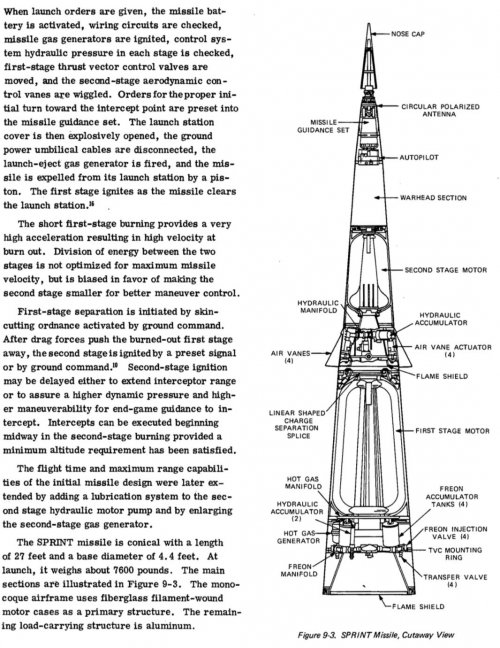
SPARTAN/SPRINT Burst Delay Timer - Should the missile be enveloped in nuclear-induced blackout, resulting in a loss of communications with the MSR, the burst delay timer will send a burst command to the warhead at the intercept point.
SPARTAN/SPRINT Minimum Time Guidance Mode
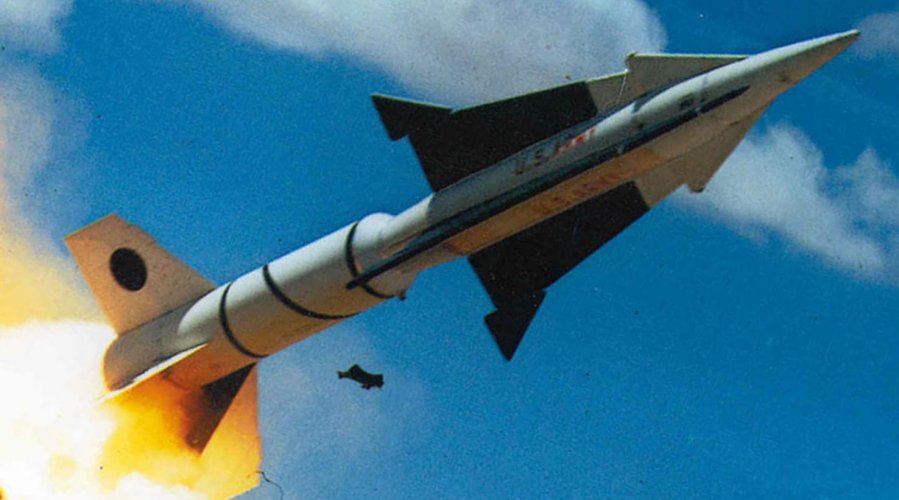
SPARTAN/SPRINT Salvo Launch Mode
=========================
M2-xx: Missions flown with second generation SAFEGUARD software; which went through six major revisions:
=========================
M2 Revision 17 (M2-R17) [Late 1971] -- An essentially complete SPARTAN intercept function containing all major tactical SPARTAN functional capabilities:
SPARTAN Tactical Third Stage Guidance
SPARTAN Tactical Dive Guidance
SPARTAN Intercept Bias
SPARTAN In-Flight Target Redesignation.
As well as external-sensor and sequential-state vector inputs for SPARTAN control/guidance.
Elsewhere, the Tactical Track Filter was added, along with correction for refraction.
=========================
M2 Revision 18 (M2-R18) [Early 1972] — Initial SPRINT intercept, tracking, and target-selection function capabilities:
SPRINT Co-Located Launch Capability
SPRINT Remote Launch Capability
SPRINT Free-Intercept Guidance Mode
SPRINT First Stage Guidance Mode
SPRINT Extended Range Testing
It also included tactical endoatmospheric target selection based on target slowdown characteristics and a RCS signature database.
SPARTAN improvements saw its track rate raised to 20 Hz.
A special search mode (D4) was added for Debris mapping; while the user could set automatic or manual data rates for tactical tracking.
They could now also force T3 tracking mode, while inhibiting T1 tracking mode.
Crossing targets could be tracked; while automatic force coast on slot basis was added.
=========================
M2 Revision 18E (M2-R18E) [Late 1972, early 1973] — Remaining SPRINT tactical functional capability added:
SPRINT Controlled Intercept Guidance Mode
SPRINT Capability Bias
SPRINT Post-Intercept Aero Test Mode
SPRINT Taped-Target Intercept Mode
The user could now set T2 Extended Range Tracking Mode.
=========================
M2 Revision 19 (M2-R19) [Mid 1973] — Expansion of the track functional capability to include:
Tactical Coast, Reacquistion and Handover Capability
Tactical Track Initation Capability
Resolved-target wake track for aspect angles less than 75 degrees.
Variable Gate Tracking
Target selection/discrimination was improved with a dual threshhold endoatmospheric beta filter.
SPARTAN Forced Jet-Head Ignition Capability was added, along with sequential-state vector capability for Salvo launches.
High-fidelity Digital Target Environment Simulation (DTES) was added to allow accurate simulation of heavily waking single and multiple targets.
=========================
M2 Revision 19E (M2-R19E) [Late 1973] — Expansion of the waking-target functional capability to include resolved target wake track for all aspect angles.
Added Chi Square validity tests for target tracking.
Gamma filter added for target selection/discrimination.
=========================
M2 Revision 20 (M2-R20) [end of 1973, early 1974]
Surveillance modifications:
**Tactical detection and acquisition performance in a dense target environment (Tactical TC-3 search).
**Detection Clustering.
**Doppler Mismatch and side lobe rejection filter
Target Track Modifications:
**Unresolved-target wake tracking
**[target] cluster tracking
**track-through-tank breakup of multiple resolved and unresolved targets at all aspect angles.
**Extended Range Search
**Range Resolution Search
=========================
SAFEGUARD missions were not designated in the order that they were flown, but rather in the order that they were created; similar to the early Space Shuttle Program:
STS-51B - April 1985
STS-51C - January 1985
If a mission failed, the designation was repeated with an alphabetical suffix until it succeeded:
M1-7 - First IRBM Intercept attempt. Failed, 15 APR 1971
M1-7A - Second IRBM Intercept attempt. Success, 21 Apr 1971.
BONUS: "The KMR missions, from the SPRINT subsystem point of view, demonstrated the capability to launch and guide the [SPRINT] missile with the MSR and the MSDP to intercept a live or simulated reentry vehicle. Intercepts were accomplished well within required miss distances. In fact, one intercept resulted in physical contact."
===============================
Polaris/IRBM Class Targets:
===============================
SSTTP M1-7 [Polaris A2 w/Mk 1 RV or surrogate] (15 Apr 1971): Launched from EAG-154 OBSERVATION ISLAND. Attempted two face IRBM intercept. Not successful.
SSTTP M1-7A [Polaris A2 w/Mk 1 RV or surrogate] (21 Apr 1971): Launched from EAG-154 OBSERVATION ISLAND. Intercepted by SPARTAN in the first two face IRBM intercept.
SSTTP M1-8 [Polaris A2 w/Mk 1 RV or surrogate] (7 May 1971): Launched from EAG-154 OBSERVATION ISLAND.
SSTTP M2-5 [Polaris A2 w/Mk 1 RV or surrogate] (7 Nov 1971): Launched from EAG-154 OBSERVATION ISLAND.
SSTTP M2-8 [Polaris A2 w/Mk 1 RV or surrogate] (12 Nov 1971): Launched from EAG-154 OBSERVATION ISLAND.
SSTTP M2-3 [Polaris A3 w/Mk 2 MRV Cluster] (8 Dec 1971): Launched from EAG-154 OBSERVATION ISLAND. Intercepted by SPARTAN, following the first in-flight redesignation of target.
===============================
Heavy ICBM Class Targets:
===============================
SSTTP M1-17 [Titan II w/Mk 6 RV] (20 Jun 1971): Radar Target. Was originally scheduled to launch on 26 May 1971; but aborted and recycled to 20 June 1971.
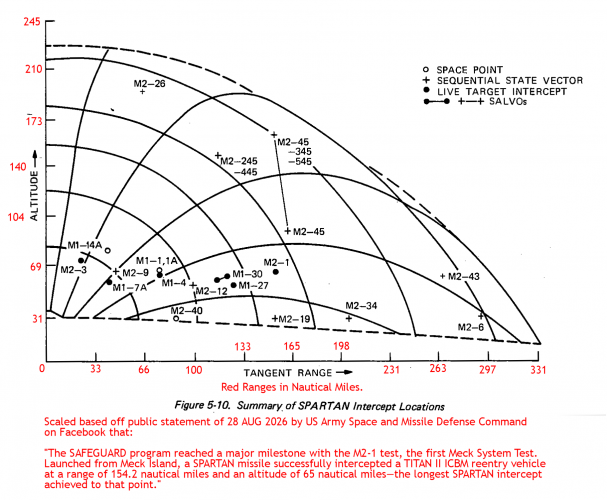
SSTTP M2-1 [Titan II w/Mk 6 RV] (27 Aug 1971): Intercepted by SPARTAN at 154.2 nautical miles and an altitude of 65 nautical miles; and was the first SPARTAN intercept using Tactical Guidance / External Data.
SSTTP M2-10 [Titan II w/Mk 6 RV] (24 May 1972) - Radar Evaluation of Offset Trajectory with Waking target. Possibly intercepted by SPRINT as M2-10R?
SSTTP M2-14 [Titan II w/Mk 6 RV] (11 Oct 1972) - SPRINT Intercept, plus Radar Evaluation of Offset Trajectory with Waking target.
SSTTP M2-27 [Titan II w/Mk 6 RV] (5 Oct 1973) - Radar Evaluation of Fly By Trajectory with Waking target.
SSTTP M2-31 [Titan II w/Mk 6 RV] (1 Mar 1974) - Radar Evaluation of Radial Trajectory with Waking target. Primary objective was to gather data to evaluate response to RV flying through active tank breakup.
SSTTP M2-36 [Titan II w/Mk 6 RV] (20 Jun 1974) - Mission aborted, missile never launched.
===============================
Medium ICBM Class Targets:
===============================
SAC's First Strategic Aerospace Division (1STRAD) turned over LF06 at Vandenberg AFB to SAMSO to support Minuteman launches for SSTTP.
SSTTP-1 (MR CLEAN) [Minuteman 1B] (VAFB LF06) - 23 Sep 1969. FAILURE.
SSTTP-2 (MR CLEAN II) [Minuteman 1B w/Mod Mk 11] (VAFB LF06) - 16 Dec 1969
The above missions were the first flown under the SSTTP program, and used a different sequencing system than the later ones which adopted the Army's methodology.
SSTTP M1-3 [Minuteman IB] (VAFB LF06) (23 Jul 1970)
SSTTP M1-4 [Minuteman IB] (VAFB LF06) (28 Aug 1970) - Intercepted by SPARTAN in first live-target intercept.
SSTTP M1-27 [Minuteman IB] (VAFB LF06) (3 Oct 1970) - Intercepted by SPARTAN.
SSTTP M1-12 [Minuteman IB] (VAFB LF06) (24 Dec 1970) - Intercepted by SPRINT.
SSTTP M1-30 [Minuteman IB] (VAFB LF06) (11 Jan 1971) - Intercepted by SPARTAN in first dual salvo launch.
SSTTP M1-28 [Minuteman IB] (VAFB LF06) (23 Feb 1971) - Radar Target.
SSTTP M1-13 [Minuteman IB] (VAFB LF06) (17 Mar 1971) - Intercepted by SPRINT with a Salvo Launch.
SSTTP M1-14 [Minuteman IB] (VAFB LF06) (27 June 1971) - Radar Target.
SSTTP M2-2 [Minuteman IB] (VAFB LF06) (8 Oct 1971) - Radar Target.
SSTTP M2-7 [Minuteman IB] (VAFB LF06) (16 Mar 1972) - Radar Target. Possibly intercepted as M2-7R by SPRINT?
SSTTP M2-11 [Minuteman IB] (VAFB LF06) (5 May 1972) - Radar Target.
SSTTP M2-15 [Minuteman IB] (VAFB LF06) (15 Jul 1972) - Radar Target.
SSTTP M2-21 [Minuteman IB] (VAFB LF06) (8 Dec 1972) - Intercepted by SPRINT.
SSTTP M2-24 [Minuteman IB] (VAFB LF06) (4 May 1973) - Radar Target.
SSTTP M2-22 [Minuteman IB] (VAFB LF06) (7 June 1973) - Intercepted by SPRINT.
SSTTP M2-18 [Minuteman IB] (VAFB LF06) (21 Jul 1973) - Radar Target.
SSTTP M2-20 [Minuteman IB] (VAFB LF06) (9 Aug 1973) - Radar Target.
SSTTP M2-44 [Minuteman IB] (VAFB LF06) (7 Sep 1973) - Radar Target.
SSTTP M2-38 [Minuteman IB] (VAFB LF06) (3 Nov 1973) - Radar Target. Possibly intercepted by SPRINT as M2-38R?
SSTTP M2-25 [Minuteman IB] (VAFB LF06) (29 Nov 1973) -Intercepted by SPRINT.
SSTTP M2-20A [Minuteman IB] (VAFB LF06) (14 Dec 1973) - Radar Target.
SSTTP M2-28 [Minuteman IB] (VAFB LF06) (23 Jan 1973) - Radar Target.
SSTTP M2-135 [Minuteman IB] (VAFB LF06) (16 Apr 1973) - Radar Target.
SSTTP M2-35 [Minuteman IB] (VAFB LF06) (27 Apr 1974) - Radar Target.
SSTTP M2-146 [Minuteman IB] (VAFB LF06) (18 Jul 1974) - Radar Target.
SSTTP M2-46 [Minuteman IB] (VAFB LF06) (1 Aug 1974) - Radar Target. The last flight in the Safeguard System Test Target Program.
=============
Unknown Targets
=============
M1-99A - SPRINT Intercept. No idea what target was used for this.
It's possible that SAFEGUARD may have used SRBMs to launch the following RVs [SV-1 | SV-1D | SV-1S | SV-2B | SV-3 | SV-3D | SV-4C] over the lifetime of the program as cheap re-entry surrogates to save program funds.
=============
Misc Bonus Stuff
=============
From the Bell ABM Report:
A moderate degradation in kill probability for [SPARTAN] Mission M2-06 resulted from a 2.2-sigma aim-point miss distance. This was the largest miss distance on any mission and was attributed to the combination of a very long coast period after [SPARTAN] third-stage burnout, a large turnaround angle, and a missile-state estimation error. [SPARTAN] Mission M2-06 was a low-altitude, long-range mission — the longest range mission in the test series.
Per our reconstructed graph, M2-6 was about 292 n.mi downrange @ 33 n.mi altitude.
If you look at the SPRINT Chapter of the Bell ABM Report; there's this section:
For example, the extended range [SPRINT] mission provided valuable data to more precisely define drag characteristics for simulation purposes
The entire Meck SAFEGUARD testing setup was also used on targets of opportunity.
TRM-93: Track targets of opportunity, Minuteman IB HK-1 [28 October 1972] and Minuteman IB HK-2 [25 Apr 1973], to obtain data on tank breakup.
TRM-104 and TRM-105: Gather additional data on targets of opportunity involving Mark 11 and Mark 12 reentry vehicles.


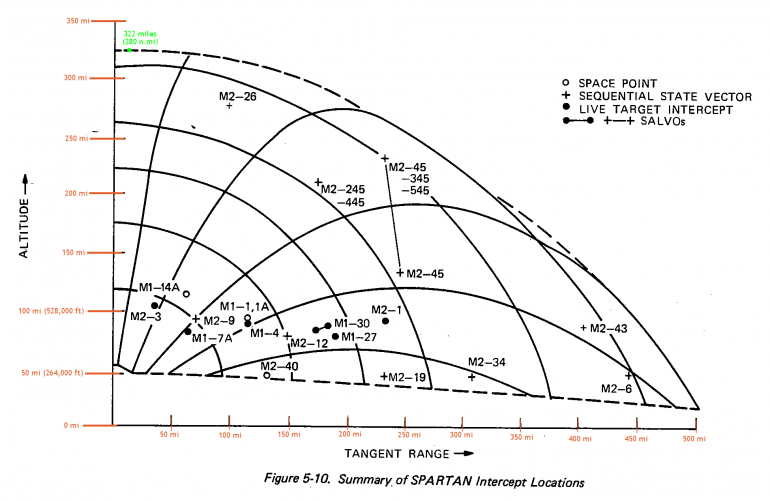
 , my understanding is that the higher the ballistic coefficient is the accurate the RV is.