Why would they take a deal that’s even worse than what was offered for FCAS?

Seems very unlikely that Germany would be satisfied with such a limited role, in particular leaving no R&D opportunity for Airbus DS and Hensoldt, and no workshare for them to supply other GCAP partners and export customers.
Then they can either go back to the French, or go at it alone.

Should have gotten in on the ground floor.
 
Why would they take a deal that’s even worse than what was offered for FCAS?

Seems very unlikely that Germany would be satisfied with such a limited role, in particular leaving no R&D opportunity for Airbus DS and Hensoldt, and no workshare for them to supply other GCAP partners and export customers.
They get the aircraft they actually want (bigger/rangier GCAP) without having to bankroll an FCAS/NGF they don’t want — that’s the trade.

They then get their production lines filled, and they get to fund their own CCAs with Sweden.

Politically, it's a win as they can veto their own stuff from being sold, their unions are happy and airbus is making a top tier CCA and has GCAP work.

As I say, this is better than funding FCAS or their own slightly worse capable FCAS.
 
They get the aircraft they actually want (bigger/rangier GCAP) without having to bankroll an FCAS/NGF they don’t want — that’s the trade.

They then get their production lines filled, and they get to fund their own CCAs with Sweden.

Politically, it's a win as they can veto their own stuff from being sold, their unions are happy and airbus is making a top tier CCA and has GCAP work.

So Airbus DS is shut out of R&D and component production? They just get a final assembly line?
Hensoldt get a few components for the German fighters, but are shut out of the hundreds of partner and export sales?
No work at all for MTU?

That's thousands of job losses, which a CCA won't make up for. I don't see the Bundestag or unions cheering such a raw deal.
 
BAE Systems North America's work and BAE Systems UK involvment in F-35 manufacturing are completely unrelated.
"The British members of the corporate leadership, me included, get to see the financial results; but many areas of technology, product and programme are not visible to us.... The SSA effectively allows us to operate in the US as an American company, providing the highest levels of assurance and integrity in some of the most sensitive fields of national security provision."
You do need to understand which bits of BAE Systems are which when trying to understand how it all ties together, and it's not always obvious. I used to work for a subsidiary of BAE Systems North America, but from the UK. All the FCS work (and HUD, HMD, stick etc) that went into Eurofighter from BAE Systems Rochester (UK), was actually being done by a subsidiary that reported through North America. Meanwhile all the design work that went into F-35 was being done by BAE Systems Warton, not by North America, and reports through the UK side. The bits of North America that don't tell top management back at Farnborough what they're doing are predominantly the EW side and I'd assume also the US cyber side - I think there's also a separate UK cyber side nowadays.
 
Why would they take a deal that’s even worse than what was offered for FCAS?

Seems very unlikely that Germany would be satisfied with such a limited role, in particular leaving no R&D opportunity for Airbus DS and Hensoldt, and no workshare for them to supply other GCAP partners and export customers.
Combined response
So Airbus DS is shut out of R&D and component production? They just get a final assembly line?
Hensoldt get a few components for the German fighters, but are shut out of the hundreds of partner and export sales?
No work at all for MTU?

That's thousands of job losses, which a CCA won't make up for. I don't see the Bundestag or unions cheering such a raw deal.
Then maybe the German government shouldnt have screwed the pooch politically.
 
I mean, GCAP is closer to what Germany needs than SCAF. But good luck getting anything but a place on the order sheet for GCAP.
It really isn't, GCAP is as far removed from the needs of the Luftwaffe as an aircraft could get.

But this doesn't matter, because it's doubtful that a problematic Dassault gets replaced by an even worse BAE. The assumption that this theater is merely meant to get Dassault to budge isn't far fetched. Because from a military and especially industrial POV GCAP is the worst option available, infinitely worse than sticking with Dassault or developing a less ambitious indigenous aircraft. At that point one might as well call up Boeing for an "F-47E". Same industrial outcome but certainly a vastly superior aircraft at least.
 
Considering Italy and the UK have been partnered on GCAP/Tempest since 2019 I'm finding all this sudden noise from the Italians to be a little insincere and suspect. Realistically, they've made it nearly 7 years into this partnership, I doubt there will be any real effort to split it up.

As far as whether F-47 is "vastly superior" to GCAP, we won't have the answers to that for quite some time. Yet I strongly suspect their strengths and weaknesses will just be different shaped spider diagrams. As with almost every other competing aircraft.... But I agree that for Germany if they can make things work with the French then they should. Mainly for the Industrial aspects if nothing else.
 
Considering Italy and the UK have been partnered on GCAP/Tempest since 2019 I'm finding all this sudden noise from the Italians to be a little insincere and suspect. Realistically, they've made it nearly 7 years into this partnership, I doubt there will be any real effort to split it up.

As far as whether F-47 is "vastly superior" to GCAP, we won't have the answers to that for quite some time. Yet I strongly suspect their strengths and weaknesses will just be different shaped spider diagrams. As with almost every other competing aircraft.... But I agree that for Germany if they can make things work with the French then they should. Mainly for the Industrial aspects if nothing else.
The F-47 will not be a "competing aircraft".
It will be an aircraft in a completely different category.
 
Considering Italy and the UK have been partnered on GCAP/Tempest since 2019 I'm finding all this sudden noise from the Italians to be a little insincere and suspect. Realistically, they've made it nearly 7 years into this partnership, I doubt there will be any real effort to split it up.
there is nothing that is suspect, BAE signed the contract, specifically saying they need to provide the data and info that the program itself requires to function properly, Crosetto's comments are just posturing, you could see a lot of it if you looked at the current government, can't you just look at this with a bit of understanding without implying one of the partners is being "insincere and suspect" that is very likely just asking for data necessary to continue this important program, if BAE, Leonardo and Mitsubishi signed the contract, with the necessity of providing the data regardless of opinions they have to follow it, its very interesting how Japan made the same requests as Italy and everyone just focuses at suspecting Italy, the plane will come, Italy increased funding by a lot, BAE has signed a contract they have to follow like the other members already do and let's stop making this continous doubts and this frankly excessive throwing of shade without basis.
 
It really isn't, GCAP is as far removed from the needs of the Luftwaffe as an aircraft could get.
And what makes you think that it is?
But this doesn't matter, because it's doubtful that a problematic Dassault gets replaced by an even worse BAE. The assumption that this theater is merely meant to get Dassault to budge isn't far fetched.
Of course thats the goal but sometimes you gotta switch boats even if the other is worse atleast it isn't sinking.
 
I didn´t know the Luftwaffe operates aircraft-carriers.
The Luftwaffe doesn't, neither does the Marine. Neither do most Rafale operators, or (Super) Hornet operators outside of the USN.

A lighter aircraft, even with carrier capability imbedded into the design (something accounted for by all parties involved), ultimately suites the German needs more than the kind of long range bomb truck GCAP is forming up. The Eurofighter meant to be replaced serve mostly as interceptors and in a secondary role as strike and electronic warfare aircraft. The Tornado, our dedicated tactical bomber/fighter bomber is being replaced by the F-35A. There is no use case for an aircraft like GCAP in the Luftwaffe. Such a decision would be purely political as it would be catastrophic for the industry and the troops would get an aircraft that doesn't fill the role it's intended to fill.

In short, it makes even less sense for Germany than FCAS from an operational POV. It's untenable from an industrial POV. And BAE is just as problematic as Dassault if not more with regards to IP (not even touching on workshares because that's not even on the table). And I'll repeat myself here, if you are already dead set on screwing over the industry and troops, then you might as well go for the best option possible, which would be American.
 
And what makes you think that it is?
See answer above

Of course thats the goal but sometimes you gotta switch boats even if the other is worse atleast it isn't sinking.
Just that the other boat would torpedo your domestic aerospace industry. An indigenous LTS or JSF analog that's able to effectively operate with whatever wingmen and remote carriers Airbus will develop is preferable to GCAP. Because it would see huge participation for the German aerospace industry and would ultimately deliver a system that is "good enough", which is perfectly adequate for Germany in the forseeable future.

The economic side of this ordeal is far more important than any bragging rights about supposed next generation fighter jets (not that GCAP even looks close to one on paper thus far).

[Note to mods, feel free to move this into the "Re-arming Bundeswehr" thread if deemed inappropriate for this thread]
 
there is nothing that is suspect, BAE signed the contract, specifically saying they need to provide the data and info that the program itself requires to function properly, Crosetto's comments are just posturing, you could see a lot of it if you looked at the current government, can't you just look at this with a bit of understanding without implying one of the partners is being "insincere and suspect" that is very likely just asking for data necessary to continue this important program, if BAE, Leonardo and Mitsubishi signed the contract, with the necessity of providing the data regardless of opinions they have to follow it, its very interesting how Japan made the same requests as Italy and everyone just focuses at suspecting Italy, the plane will come, Italy increased funding by a lot, BAE has signed a contract they have to follow like the other members already do and let's stop making this continous doubts and this frankly excessive throwing of shade without basis.
I do tend to agree that is a very fair point of view. If I was BAE right now, I'd be very wary of handing over certain pieces of information to other industrial parties until certain quite critical development agreements and confirmed drop dates and qtys are fixed. Right now there is some indications that UK gov is not politically completely settled on the big shiny aircraft program (don't look at me I'm just telling you how I'm hearing it) especially in light of all the noise about drones. As much as the complementary nature and likely / plausible shortcomings of drones may be clear to some here, the politicians are wrestling with GCAP vs the costs and budget trade offs.

I run a business in the technology/engineering/propulsion space and I think it quite likely that BAE doesn't want to provide all the data until the benefits of the program are much more definite. This may only be a matter of months, not forever.

I am interested (without any disdain) where Emobirb gained such a strong negativity about BAE (and also just a reminder is the argument about GCAP for Germany an issue with the different radius of action goals?) What experience or data does that come from?

If I were involved in the German program/procurement management team I would be feeling very unhappy at the moment. In all negotiations you must have at least one and ideally two strong alternatives (see BATNA). Thinking the French would be a straightforward or compliant partner given the history and intense national politics around Dassault's pride of place in French industry is somewhat to disregard all history. Perhaps if one rolls the clock back the German government felt this would work with the balance of France's central role in Airbus for civil.

Either way (and I apologise for repeating many other contributors here) all the involved governments in Europe and Japan are looking down the barrels of very expensive programs that they can't ideally afford given their economic positions. It is red in tooth and claw, you get what you negotiate but provided previous R&D expenditure is reflected in a deal, Germany has the opportunity to get involved and even to have fair influence on the implementation. There is even the argument given the complexity that the CCAs are by no means the wooden spoon if engineered with conviction. Things can change a lot in 10-15 years.
 
I do tend to agree that is a very fair point of view. If I was BAE right now, I'd be very wary of handing over certain pieces of information to other industrial parties until certain quite critical development agreements and confirmed drop dates and qtys are fixed. Right now there is some indications that UK gov is not politically completely settled on the big shiny aircraft program (don't look at me I'm just telling you how I'm hearing it) especially in light of all the noise about drones. As much as the complementary nature and likely / plausible shortcomings of drones may be clear to some here, the politicians are wrestling with GCAP vs the costs and budget trade offs.

I run a business in the technology/engineering/propulsion space and I think it quite likely that BAE doesn't want to provide all the

See answer above


Just that the other boat would torpedo your domestic aerospace industry. An indigenous LTS or JSF analog that's able to effectively operate with whatever wingmen and remote carriers Airbus will develop is preferable to GCAP. Because it would see huge participation for the German aerospace industry and would ultimately deliver a system that is "good enough", which is perfectly adequate for Germany in the forseeable future.

The economic side of this ordeal is far more important than any bragging rights about supposed next generation fighter jets (not that GCAP even looks close to one on paper thus far).

[Note to mods, feel free to move this into the "Re-arming Bundeswehr" thread if deemed inappropriate for this thread]
I think I understand your argument now. Why does the German Bundeswehr appear to want an aircraft larger than the French preference or do they disagree with your standpoint?
 
Why does the German Bundeswehr appear to want an aircraft larger than the French preference
Some of the German concept studies a few years ago were looking for enough combat radius on internal fuel to be able to fly long CAP missions on NATO’s borders while operating from German bases, crossing all of Poland to reach the Baltics etc. I.e. 1hr CAP @ 550nm.

All that on internal fuel, with no drop tanks or air to air refueling, and a large payload (6 Meteors with no folding fins + 2 IRIS-T). Oh also with the ability to accelerate to Mach 2.0, loiter at 50,000ft, and excellent maneuverability. Basically that means a big airframe, a giant wing, and huge engines.

However what’s not clear is whether these were just thought exercises to see what could work, or hard requirements. Probably a mix of the 2.

Dassault’s philosophy would probably be to aim for a much lighter, less draggy airframe, maybe have it loiter a little lower (45,000ft), fly a little slower (Mach 1.8), and carry fewer Meteors (some missiles could be offloaded to CCAs). And have some of the fuel in CFTs or external tanks. It’s possible that the German side was willing to accept some of these trade offs, but only half heartedly, and would be happier with a larger airframe.

 
Some of the German concept studies a few years ago were looking for enough combat radius on internal fuel to be able to fly long CAP missions on NATO’s borders while operating from German bases, crossing all of Poland to reach the Baltics etc. I.e. 1hr CAP @ 550nm.

All that on internal fuel, with no drop tanks or air to air refueling, and a large payload (6 Meteors with no folding fins + 2 IRIS-T). Oh also with the ability to accelerate to Mach 2.0, loiter at 50,000ft, and excellent maneuverability. Basically that means a big airframe, a giant wing, and huge engines.
Were any design sketches done?
 
Some of the German concept studies a few years ago were looking for enough combat radius on internal fuel to be able to fly long CAP missions on NATO’s borders while operating from German bases, crossing all of Poland to reach the Baltics etc. I.e. 1hr CAP @ 550nm.

All that on internal fuel, with no drop tanks or air to air refueling, and a large payload (6 Meteors with no folding fins + 2 IRIS-T). Oh also with the ability to accelerate to Mach 2.0, loiter at 50,000ft, and excellent maneuverability. Basically that means a big airframe, a giant wing, and huge engines.

However what’s not clear is whether these were just thought exercises to see what could work, or hard requirements. Probably a mix of the 2.

Dassault’s philosophy would probably be to aim for a much lighter, less draggy airframe, maybe have it loiter a little lower (45,000ft), fly a little slower (Mach 1.8), and carry fewer Meteors (some missiles could be offloaded to CCAs). And have some of the fuel in CFTs or external tanks. It’s possible that the German side was willing to accept some of these trade offs, but only half heartedly, and would be happier with a larger airframe.

Those are not requirements for a large airframe. You are describing something right in the ballpark of a Mirage 2000 configured for A2A... (minus no EFT).

Germany and France were looking originally at something more ambitious.
 
Since the parties involved decided to make it a heavy long range "fighter"
Yes, any aircraft where its designers have gone 'we are going to absolutely maximise range and payload of large weapons' is practically speaking a bomber, with the exception that proves the rule being the Tomcat.
 
Those are not requirements for a large airframe. You are describing something right in the ballpark of a Mirage 2000 configured for A2A... (minus no EFT).

Germany and France were looking originally at something more ambitious.

I’d say a requirement for the same excellent dynamic performance as a Eurofighter, with a 20-25% increase in internal fuel fraction, full internal carriage of 8 missiles including 6 large Meteors, and the added penalty of stealth shaping is very very ambitious unless some design trade-offs are accepted.

The German DLR studies pointed to a very large airframe, 19t empty, 100m2 wing area, and 180kN thrust engines.
 
Last edited:
Chipping in on TorpedoJ's point - F-14, Su-27 family and J-20. All long ranged, loiter capable interceptor/fighters.
 
And Mig31.
And F12 before cancellation.
Even the F155 winner.

All big heavy and save the F155 all long ranged aircraft toting substantial missiles.
 
Chipping in on TorpedoJ's point - F-14, Su-27 family and J-20. All long ranged, loiter capable interceptor/fighters.
My own perspective/hope is that Tempest will turn out to be a modern-day Mosquito. Not perhaps the most manoeuvrable fighter when fully loaded, but only because it can be packed with more things that go bang than anything else in its class and fly them further to boot.

I also think that with cheap targets and GBAD proliferating 'magazine depth' will become a real concern for fighters.
 
Among the options for future weapons was a scaled down ASRAAM. Likely aiming for similar performance to the current missile, but exploiting the benefits of smaller electronics needing less power and more energetic fuel and explosives.

Now this carries shades of FLAME in that via datalink the launch aircraft has less to do. But the missile is guided into it's self guiding 'bucket' by the aircrafts onboard sensors.

This kind of thing would greatly enhance something like GCAP in terms of magazine depth and self defence.

Even more extreme was a 1m long guided rocket option.

And a big bore version of ASRAAM. Possibly using a 7" motor.
 
Among the options for future weapons was a scaled down ASRAAM. Likely aiming for similar performance to the current missile, but exploiting the benefits of smaller electronics needing less power and more energetic fuel and explosives.

Now this carries shades of FLAME in that via datalink the launch aircraft has less to do. But the missile is guided into it's self guiding 'bucket' by the aircrafts onboard sensors.

This kind of thing would greatly enhance something like GCAP in terms of magazine depth and self defence.

Even more extreme was a 1m long guided rocket option.

And a big bore version of ASRAAM. Possibly using a 7" motor.
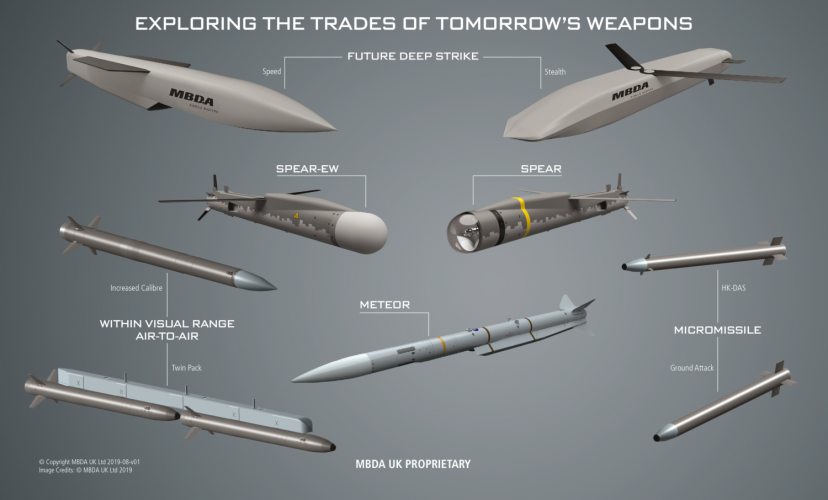
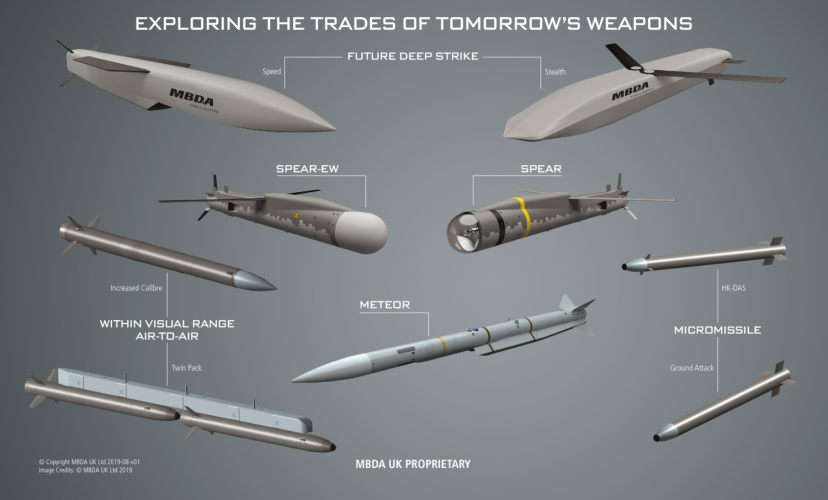
Presumably from
1770492976191.png
The hard kill defensive aid sounds interesting.
 
1770495402797.png
This graphic is probably worth exploring a little more, assuming it still holds as it's quite old.
It looks like the aim with the ASRAAM replacement is to increase the diameter (and therefore acceleration?) but drop the length so that two of them fit nose to tail in the same space as FC/ASW, both variants of which are reportedly 5-5.5m long. That makes a lot of sense for drone blatting, but why not just have separate self defence bays?
The micromissiles are also interesting. When will the aircraft ever be in close enough range to use what looks APKWS sized rockets for ground attack, and how would such a small missile be launched?
 
The micromissiles are also interesting. When will the aircraft ever be in close enough range to use what looks APKWS sized rockets for ground attack, and how would such a small missile be launched?
Self defence? Almost an active defence system like Trophy but for aircraft.
Possibly launched from a pod or even some internal bay with exhaust management?

Pondering the smaller ASRAAM, I would expect more mini-CAMM now, which could have a place as a more direct Rapier/Sea Wolf SAM as well.

Big bore is intriguing. Was this the origin of CAMM-MR?
 
Self defence? Almost an active defence system like Trophy but for aircraft.
Possibly launched from a pod or even some internal bay with exhaust management?

Pondering the smaller ASRAAM, I would expect more mini-CAMM now, which could have a place as a more direct Rapier/Sea Wolf SAM as well.

Big bore is intriguing. Was this the origin of CAMM-MR?
I get the self-defence one (it would be cool, so I'm cool with it- that's the rule of thumb), it's just the ground attack. But storing and launching lots of small missiles would take a lot of space inside the airframe. They could use retractable rocket pods like those 1950s fighters but for self defence it would need really good over-the-shoulder firing which isn't the best way really. How small is it possible to build vectored thrust SRMs?

Mini CAMM would be nice but the radar seeker is AFAIK quite a bit more expensive than the IR one. I've suggested a smaller version for ship self defence as well- if it was rail launch that would be fab for making a UK SeaRam type thing with folding fins for closer packing in the aircraft too.

CAMM was initially designed with a bigger rocket bore than Sidewinder in order to increase range by enough that it could hit the opposing aircraft before they could fire their own missile and so avoid mutual kills which were feared to be inevitable given the performance of seekers at the time. Going for a bigger motor still- CAMM-ER is 7.5"- would improve that but making the missile shorter would increase drag. Nothing to do with CAMM-MR, which is projected to be 100km ground launch and by my estimates is longer and heavier than Meteor.
 
1.ASRAAM is within a millimeter of the earlier SRAAM. There's clearly an evolution there despite the return to aerodynamic controls.
And CAMM is reusing ASRAAM motor, fins, datalink etc...

CAMM-ER is obviously scaling up the motor and lengthening it. Stepping into Sea Sparrow's shoes. Or should we say Aspide's....considering it was funded by Italy.

CAMM-MR, is obviously applying a yet bigger motor, but notably retains the smaller diameter front end.
At one early point some mentioned compatibility with MLRS which implies 227mm.
Though the latest visuals suggests more like 380mm.
Remember no one knew of this until quite recently and it's origin inside MBDA will be an interesting story.

Which motor diameter for large bore ASRAAM is an open question.
Does that step into AIM-260 territory?

2. The concept of Mini-CAMM isn't tied to any seeker. Rather the implementation of CAMM technologies. Which included elements from ASRAAM, so completing the circle.
I would expect multiple options including a last ditch ARM option.
 
View attachment 801322
This graphic is probably worth exploring a little more, assuming it still holds as it's quite old.
It looks like the aim with the ASRAAM replacement is to increase the diameter (and therefore acceleration?) but drop the length so that two of them fit nose to tail in the same space as FC/ASW, both variants of which are reportedly 5-5.5m long. That makes a lot of sense for drone blatting, but why not just have separate self defence bays?
Internal volume makes drag, especially trans-sonic drag. It also makes more stuff to maintain, and another place where your stealth can get screwed up. I've told the story before about how a classmate was an F-117 weapons loader, and how he had to be strapped into the bay with a flashlight and a feeler gauge making sure the doors were closing far enough, while the engines were run up to make vibrations.

But yes, I agree that self defense bays are preferable.


The micromissiles are also interesting.
That HK-DAS seems odd. At least in terms of the shaping.

I'd expect a defensive micromissile to fit into chaff/flare launchers by depth, if not diameter. While I know it's a draggy length/diameter ratio, I'm expecting something broadly comparable to a beer can. (Maybe as large as a 24oz can)


When will the aircraft ever be in close enough range to use what looks APKWS sized rockets for ground attack, and how would such a small missile be launched?
Assuming actual Hydra rocket motors for a moment here, 10km slant range. Which means that at 8km altitude you're talking about 6km flat range to a target at roughly ground level.

And they'd need to be launched out of tubes if they're APKWS.
 
It looks like the aim with the ASRAAM replacement is to increase the diameter (and therefore acceleration?) but drop the length so that two of them fit nose to tail in the same space as FC/ASW, both variants of which are reportedly 5-5.5m long. That makes a lot of sense for drone blatting, but why not just have separate self defence bays?
There's a considerable number of aircraft out there without internal weapons bays that aren't going away. Plus drones that may not have the space for internal bays/large internal bays. That's a considerable market sector you don't want to ignore in future planning.

The micromissiles are also interesting. When will the aircraft ever be in close enough range to use what looks APKWS sized rockets for ground attack, and how would such a small missile be launched?
There's been a considerable expenditure of Hellfire, Brimstone and APKWS over the last couple of decades from both manned aircraft and drones. The future market for air-launched weapons is not solely large, stealthy sixth-gen platforms. And then there's ground-based launchers, of course.
 
Yes, any aircraft where its designers have gone 'we are going to absolutely maximise range and payload of large weapons' is practically speaking a bomber, with the exception that proves the rule being the Tomcat.
That's the key words: large weapons. And since no-one is making big fat AAMs like Phoenix anymore, big fat weapons means ground attack.

Are they actually designing around big fat weapons like 2000lb weapons (or larger?)
 
There's a considerable number of aircraft out there without internal weapons bays that aren't going away. Plus drones that may not have the space for internal bays/large internal bays. That's a considerable market sector you don't want to ignore in future planning.


There's been a considerable expenditure of Hellfire, Brimstone and APKWS over the last couple of decades from both manned aircraft and drones. The future market for air-launched weapons is not solely large, stealthy sixth-gen platforms. And then there's ground-based launchers, of course.
This graphic from MBDA was specifically related to the work MBDA were doing for Tempest, it has no relation to what they think will be a good idea for legacy aircraft. It comes from this press release:
Internal volume makes drag, especially trans-sonic drag. It also makes more stuff to maintain, and another place where your stealth can get screwed up. I've told the story before about how a classmate was an F-117 weapons loader, and how he had to be strapped into the bay with a flashlight and a feeler gauge making sure the doors were closing far enough, while the engines were run up to make vibrations.
But yes, I agree that self defense bays are preferable.

That HK-DAS seems odd. At least in terms of the shaping.

I'd expect a defensive micromissile to fit into chaff/flare launchers by depth, if not diameter. While I know it's a draggy length/diameter ratio, I'm expecting something broadly comparable to a beer can. (Maybe as large as a 24oz can)

Assuming actual Hydra rocket motors for a moment here, 10km slant range. Which means that at 8km altitude you're talking about 6km flat range to a target at roughly ground level.

And they'd need to be launched out of tubes if they're APKWS.
WRT internal volume would having one or two enormous bays wide enough to take 2 Stratus, two Meteor and two twin fat-SRAAMs in parallel be more efficient than having separate self-defence bays for the fat-SRAAMs? That might be what they are going for.

The HK-DAS and micromissile were probably the earliest of early concepts. I could mock the shape up in about 15 minutes on CAD so it's best not to read too much in apart from the concept of use. I'm not expecting actual APKWS motors as they're American, just that that's the sort of size of missile.
Perhaps a rearwards dispenser with a rotating casette, to allow them to fit in a random nook in the fuselage?
 
The main advantages of segregated bays for Short range A2A missile is that you can design those bays for high G forces, leaving all the problems of scaling to an unrelated usage out of the loop. Much simpler. Way safer. More reliable.
 
WRT internal volume would having one or two enormous bays wide enough to take 2 Stratus, two Meteor and two twin fat-SRAAMs in parallel be more efficient than having separate self-defence bays for the fat-SRAAMs? That might be what they are going for.
If you're designing bay space for weapons, I'd be wanting something sized for Meteors as the side bays, even if the current plan is to stick fat-SRAAMs in there.

Note: most of the released concept images for GCAP have a very F-22-like fuselage which means very nice location for AMRAAM/Meteor-sized side bays.

Then you can fuss with how to fit a pair of Stratus missiles and a pair of Meteors across the belly of the beast.


The HK-DAS and micromissile were probably the earliest of early concepts. I could mock the shape up in about 15 minutes on CAD so it's best not to read too much in apart from the concept of use. I'm not expecting actual APKWS motors as they're American, just that that's the sort of size of missile.
Sure.

Thing is, Hydra 70s have the longest range of that size rocket. CRV7s have only about a 4km range!


Perhaps a rearwards dispenser with a rotating casette, to allow them to fit in a random nook in the fuselage?
Maybe? I still have a fascination for the Pye Wacket lenticular missile shape for being able to fly at any relative wind angles.
 

Similar threads

Back
Top Bottom