Su-57 powerplant discussion

In
Some info about Izd 30 from Ye. Marchukov :

''Удельным весом в авиации принято называть отношение массы двигателя к его полной тяге. Для перспективного «Изделия 30» этот показатель составляет менее 0,1, то есть двигатель способен выдавать более чем в 10 раз больше тяги, чем весит сам. Удельной же тягой называется отношение полной тяги к расходу воздуха двигателем.''

''In aviation, specific gravity is the ratio of an engine's mass to its total thrust. For the promising "Product 30," this figure is less than 0.1, meaning the engine is capable of producing more than 10 times its own thrust. Specific thrust, on the other hand, is the ratio of total thrust to the engine's airflow.''

Even Izd 117/AL-41F-1 ( weighs about 1400kg) has t/w ratio more than 10:1, 11:1 exactly. Izd 30 is even lighter I guess with more thrust ,especially in MP mode,also in the AB mode.

''В двигателе второго этапа для Су-57 разработчики применили ряд новых конструкторских подходов и технологий, благодаря чему «Изделие 30» по удельному расходу топлива примерно соответствует двухконтурному двигателю АЛ-31Ф (670 граммов на килограмм-силы в час в крейсерском режиме), однако превосходит его по показателю удельной тяги.''

''In the second stage engine for the Su-57, the developers applied a number of new design approaches and technologies, thanks to which the “Product 30” in terms of specific fuel consumption is approximately equal to the AL-31F bypass engine (670 grams per kilogram-force per hour in cruising mode), but surpasses it in terms of specific thrust.''

"Specific fuel consumption is in opposition to specific thrust. Civilian twin-fan engines achieve the best fuel consumption, but they have the lowest specific thrust due to their high bypass ratio. Conversely, single-fan engines have high specific thrust, but also high fuel consumption.
“Thanks to the use of new designs and technologies in Product 30, the specific fuel consumption remained at the same level, but the specific thrust increased,” Marchukov said.''

If this is correct ,that is great to have the engine with almost the same specific fuel consumption in the cruise mode ( in fact supercruise mode) like old engine AL-31F. For comparison, Su-27 can achieve long term cruising at alt 13 km with speed M 0.85.We have info that Su-57 even with AL-41F-1 has range more than 1500km flying in supersonic mode.

Next citation :

''Двигатель пятого поколения «Изделие 30» будет отличаться от АЛ-41Ф1 повышенной топливной эффективностью и меньшей стоимостью жизненного цикла.

«По сравнению с двигателями четвертого поколения в пятом добавилась возможность крейсерского сверхзвукового движения — для этого двигатель должен обладать изменяемой степенью двухконтурности. Это требование добавило еще один удельный параметр — удельный расход топлива на крейсерском сверхзвуке. Также у двигателя должна быть значительно меньшая заметность в инфракрасном и радиоволновом диапазоне. Это достигается специальной конструкцией сопла и воздухозаборника. Серьезным аспектом нового двигателя является также снижение стоимости жизненного цикла машины — меньше расхода на обслуживание, больше межремонтный ресурс», — рассказал о новых силовых установках Марчуков.''

''The fifth-generation engine, Product 30, will differ from the AL-41F1 in its increased fuel efficiency and lower life cycle costs.
Compared to fourth-generation engines, the fifth-generation added the capability of supersonic cruising—to achieve this, the engine required a variable bypass ratio. This requirement added another specific parameter—specific fuel consumption at supersonic cruising speed.The engine should also have significantly lower infrared and radio frequency signatures. This is achieved through a special nozzle and air intake design.
"Another significant aspect of the new engine is the reduction in lifecycle costs—less maintenance and a longer service life between overhauls," Marchukov said of the new power units.''


''В 2013 году разработчики показали лопатки компрессора высокого давления для двигателя второго этапа, предназначенного к установке на Су-57. Они были изготовлены из алюминида титана — сплава титана и алюминия. В СМИ появлялась информация и о том, что этот же сплав может быть использован для изготовления лопаток турбины низкого давления «Изделия 30». Но позднее все эти работы были приостановлены. По словам Марчукова, алюминид титана не подходит для военного двигателя.''

''In 2013, the developers demonstrated high-pressure compressor blades for the second-stage engine intended for installation on the Su-57. They were made of titanium aluminide—an alloy of titanium and aluminum.
There were also media reports that this same alloy could be used to manufacture blades for the Izdeliye 30 low-pressure turbine. However, all such work was later suspended. According to Marchukov, titanium aluminide is not suitable for military engines.''

''Лопатки из алюминида титана используются в самых последних ступенях турбины низкого давления на гражданских самолетах, где температура газов относительно низка. Это дает значительную экономию по массе, так как в гражданских двигателях турбины многоступенчатые. В военном двигателе температура газов даже перед турбиной низкого давления значительно выше, и алюминид титана в этих условиях просто неприменим», — пояснил генеральный конструктор ОКБ имени А. Люльки.

Интерметаллиды вроде алюминида титана не подходят и для лопаток компрессора. Этот материал хрупок, и любая забоина на лопатке чревата ее разрушением. Да и экономия по весу для компрессора получается незначительной», — добавил Марчуков.''

Titanium aluminide blades are used in the very last stages of low-pressure turbines on commercial aircraft, where gas temperatures are relatively low. This provides significant weight savings, as commercial engines have multi-stage turbines.
"In a military engine, the gas temperature even before the low-pressure turbine is significantly higher, and titanium aluminide is simply not applicable under these conditions," explained the general designer of the A. Lyulka Design Bureau.

"Intermetallic compounds like titanium aluminide are also unsuitable for compressor blades. This material is brittle, and any nicks in the blade can lead to its failure. Furthermore, the weight savings for the compressor are negligible," Marchukov added.


''В целом же разработка «Изделия 30» ведется с применением технологий компьютерного моделирования и симуляций. Благодаря этому полную программу испытаний двигателя планируется завершить с помощью всего десяти опытных образцов.''

''Overall, the development of "Product 30" is being conducted using computer modeling and simulation technologies. As a result, the full engine testing program is planned to be completed using just ten prototypes.''

There was also some info about 6th gen 'three circuit' ( VCE) engine in the well known article from 2019:

https://nplus1.ru/material/2019/03/06/engines

So Izd. 30 is the engine with variable bypass ratio ,question is , what about Izd. 117 ?

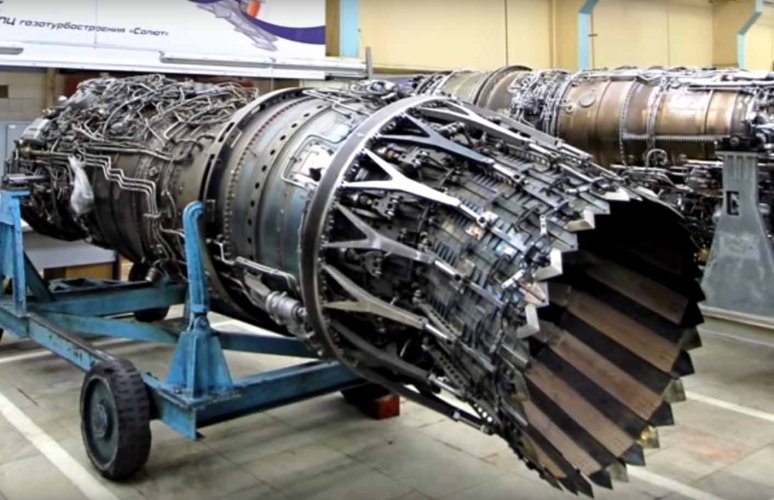
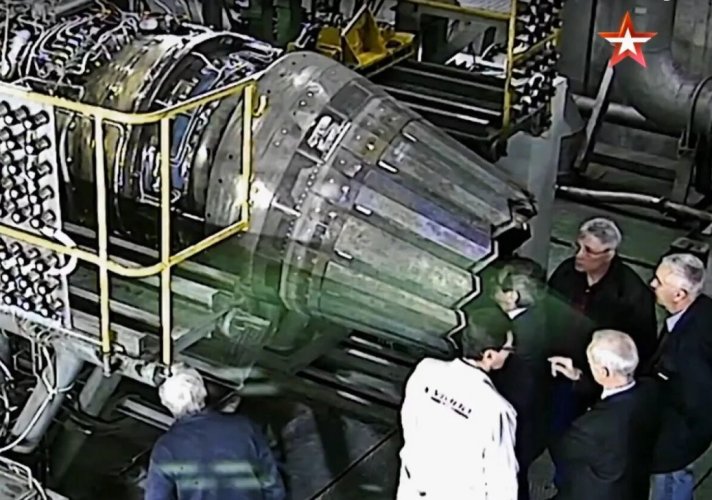
Izdeliye 30 during statis tests .

View attachment 796988
Interesting that Marchukov compares the izd 30 to Al31 when referencing fuel efficiency... does that mean the Al41 is less fuel efficient than Al31? I thought it was the other way round
 
In
Interesting that Marchukov compares the izd 30 to Al31 when referencing fuel efficiency... does that mean the Al41 is less fuel efficient than Al31? I thought it was the other way round
IIRC F119 is less fuel efficient than F110. The lower overall pressure ratio higher EPR tends to lower SFC.

edit: fixed the detail.
 
Last edited:
If this is correct ,that is great to have the engine with almost the same specific fuel consumption in the cruise mode ( in fact supercruise mode) like old engine AL-31F. For comparison, Su-27 can achieve long term cruising at alt 13 km with speed M 0.85.We have info that Su-57 even with AL-41F-1 has range more than 1500km flying in supersonic mode.
This was the specific statement from Marchukov that was discussed here at length, re. variable cycle and performance vs SFC in izd. 30.
But, to be clear, the lowest SFC, in line with that of AL-31F, is obtained not in supersonic flight, but at optimal subsonic cruising speed.

Interesting that Marchukov compares the izd 30 to Al31 when referencing fuel efficiency... does that mean the Al41 is less fuel efficient than Al31? I thought it was the other way round
AL-31F is the SFC design reference for all those new engines, as far as I know. The challenge is not for AL-41F1 to achieve that fuel efficiency, given it is not a low BPR engine, but for izd. 30, since it has an ambitious specific thrust goal (i.e. matching F119)
 
Last edited:
IIRC F119 is less fuel efficient than F110. The lower overall pressure ratio tends to lower SFC.
It is the low bypass / high EPR cycle, not the OPR (which is in the same ballpark) that makes the F119 non-AB SFC worse than the F110.

High specific thrust (I.e. high exhaust velocity) requires high EPR and Nozzle Pressure Ratio, which is worse for propulsive efficiency, but necessary for supercruise performance.

It is difficult to believe the Russian claims that the Project 30 has F119 class specific thrust, world class SFC and supercruise capability, 2x durability, greatly improved LO, and 11:1+ thrust to weight ratio, all in one package. There are trade offs in engine design, and a lot of these performance goals have conflicting design requirements.
 
Last edited:
Interesting that Marchukov compares the izd 30 to Al31 when referencing fuel efficiency... does that mean the Al41 is less fuel efficient than Al31? I thought it was the other way round

This is for the 'S' :

''Двигатель АЛ-41Ф1С по сравнению с АЛ-31Ф обладает бо́льшей на 2000 кгс тягой (14500 кгс против 12500), бо́льшим ресурсом (4000 часов против 1000), сниженным расходом топлива, управляемым вектором тяги.''

''The AL-41F1S engine, compared to the AL-31F, has 2,000 kgf more thrust (14,500 kgf versus 12,500), a longer service life (4,000 hours versus 1,000), reduced fuel consumption, and thrust vector control.''
 
It is difficult to believe the Russian claims that the Project 30 has F119 class specific thrust, world class SFC and supercruise capability, 2x durability, greatly improved LO, and 11:1+ thrust to weight ratio, all in one package. There are trade offs in engine design, and a lot of these performance goals have conflicting design requirements.
Well, to be precise, I never heard Marchukov saying that Izd. 30 would have a TWR of 11:1, he just confirmed that it was higher than 10. But still, we have a publicly marketed Izd. 177 with TWR 10,3:1, 2 tf higher mil thrust than the already advanced AL-41F1, very close to the expected mil thrust of F119, and SFC at optimum cruise regime < 0,67. And this is still below the alleged performance of Izd. 30. So, the question is, what elements could the designers have optimized to reach such values? Based on the apparent incompatibility between SFC and specific thrust claimed, and supported by the rather clear statement in the N+1 interview re. the features of 5th gen engines, I always assumed Izd. 30 would be a VCE, of course without the 3 stream design in study for the upcoming generation, but maybe at the level of Izd. 20. Published diagrams apparently denied that, but your recent comment re. the possibility of making some BPR adjustment simply by opening the exhaust nozzle is very interesting in that regard. Appart from that, I would assume Izd. 30 has a bigger inlet diameter for increased overall thrust and maybe is allowed to run at higher OPR/TIT for even higher specific thrust, since it is intended to be used domestically only, at least for the time being. Other than that, Izd. 177 is already pretty much almost there, and I doubt this engine would be offered publicly without any actual backing.

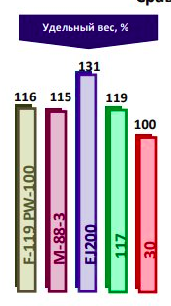
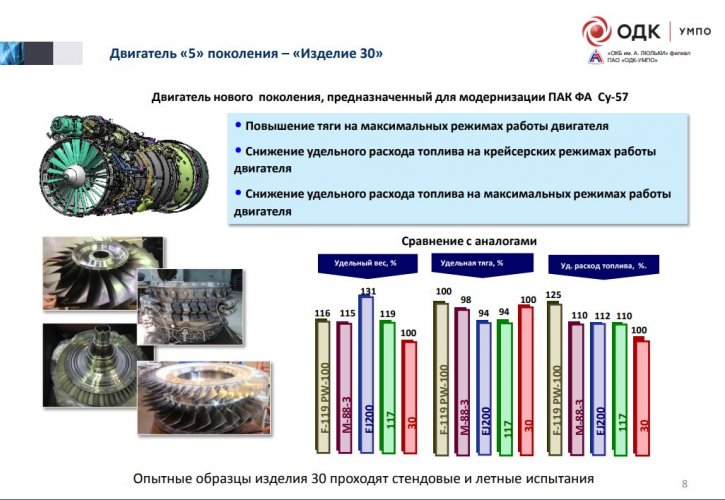
BTW, I just reviewed the UEC slides where some cardinal parameters of the Izd. 30 were compared to the competitors, and based on public data about EJ200, TWR would be 12:1... no idea if that is possible at all, and what the caveats and assumptions are, that need to be taken in consideration.

1767302269952.png
 
Last edited:
@F119Doctor

I have several questions ...

This red line is inlet diameter ,right ?

Su-57 air intake 2 mod1.jpg

If the new 5th gen engines Izd. 177 and Izd. 177S have inlet diameters of 905mm, than they definitely cannot be attached into engine nacelles of the Su-57 and even not into engine nacelles of the Su-35S ? Inlet diameter of the AL-41F-1/S is 932mm and also of the Izd 30/AL-51F ?

Now back to some 'Salyut's modifications' of the famous AL-31F which has inlet diameter of 905mm.

First is AL-31FM1 from 2006 :

''Причем КБ «Салюта» старалось создать новую модификацию, которая нетолько удовлетворила бы китайских заказчиков, но и отвечала бы требованиям российских ВВС к новым двигателямпод наименованием АЛ-31ФМ1 для модернизации парка Су-27. Для этого был разработан модернизированный вариант двигателя с верхним расположением коробки и увеличенной до 13,5 тонны тягой. Прирост тяги, как и на 117-мдвигателе, был обеспечен главным образом за счет увеличения входного отверстия вентилятора: на новом моторе оновыросло до 924 мм с 905 мм у базового АЛ-31Ф.Была разработана новая цифровая система управления мотором сполной ответственностью типа FADEC''

''Moreover, the Salyut Design Bureau tried to create a new modification that would not only satisfy Chinese customers, but would also meet the requirements of the Russian Air Force for new engines, designated AL-31FM1, for the modernization of the Su-27 fleet.
For this purpose, a modernized version of the engine was developed with an overhead gearbox and increased thrust to 13.5 tons. The thrust increase, as with the 117 engine, was achieved primarily by enlarging the fan inlet: on the new engine, it increased to 924 mm from 905 mm on the base AL-31F.A new digital motor control system with full FADEC responsibility was developed.''

Than there was AL-31FM2,also 2006.

''Следующим этапом стало создание двигателя АЛ31ФМ2 с улучшенной геометрией турбины и новым поворотным соплом, разработанным петербургским ОАО «Климов» по технологии КЛИВТ. Испытания завершились 1осенью 2006 года, была достигнута тяга 14,2 тонны.''

''The next stage was the creation of the AL-31FM2 engine with improved turbine geometry and a new rotating nozzle developed by Klimov JSC in St. Petersburg using KLIVT technology. Testing was completed in the fall of 2006, achieving a thrust of 14.2 tons.''

About AL-31FM3-1...

''В 2007 году начались стендовые испытания мотора АЛ31ФМ3-1 с номинальной тягой 14,5 тонны. Для него быласоздана новая камера сгорания по технологии «двойнаястенка», позволяющей поднять температуру газа на 150 градусов. Компрессор низкого давления вместо четырехступенчатого стал трехступенчатым, однако степень повышения давления на нем возросла с 3,6 до 4,2. На лопатках первых ступеней отказались от бандажного кольца, асами лопатки были изготовлены по схеме «с широкой хордой». В мае глава «Салюта» Юрий Елисеев заявил BG, чтоэтот двигатель показал на стенде тягу 15,3 тонны.''


''In 2007, bench testing of the AL31FM3-1 engine, with a nominal thrust of 14.5 tons, began. A new combustion chamber was created for it using double-wall technology, allowing for a 150-degree increase in gas temperature.
The low-pressure compressor, which had been four-stage, was replaced by a three-stage design, but its pressure ratio increased from 3.6 to 4.2. The first-stage blades no longer had a shroud ring, and the rest of the blades were manufactured using a wide-chord design.
In May, Salyut CEO Yuri Eliseev told BG that this engine demonstrated a thrust of 15.3 tons on the test bench.''

...and the AL-31FM3-2

''По словам господина Елисеева, следующая модификация, названная АЛ-31ФМ3-2, будет иметь новый компрессор высокого давления, на котором вместо девяти ступеней, как у АЛ-31Ф, будет шесть. Номинальная тяга этого мотора составит 15 тонн. Он-то и рассматривается на«Салюте» уже как двигатель пятого поколения, которыйпосле доводки может устанавливаться на ПАК ФА.''

''According to Mr. Eliseev, the next modification, called the AL-31FM3-2, will feature a new high-pressure compressor, which will have six stages instead of the nine on the AL-31F. The nominal thrust of this engine will be 15 tons.It is this engine that is being considered at Salyut as a fifth-generation engine, which, after further development, can be installed on the PAK FA.''

We know that Saturn's Izd. 117 / AL-41F-1 was also based on the AL-31F with 80% of the new details and with max static thrust on Full AB mode of 15000kgf.

Компрессор низкого давления для АЛ-31ФМ3​

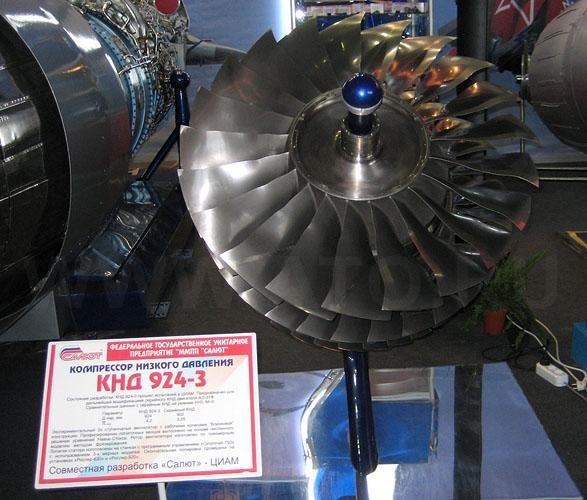
По заверениям представителей ММПП "Салют", новый компрессор низкого давления КНД-924-3 для нового реактивного двигателя АЛ-31ФМ3 также является элементом двигателя пятого поколения.

According to representatives of the MMPP "Salut", the new low-pressure compressor KND-924-3 for the new jet engine AL-31FM3 is also an element of the fifth-generation engine.

7-IMG_2937.jpg

http://www.ato.ru/gallery/images/kompressor-nizkogo-davleniya-dlya-al-31fm3

Interesting citation :

''НПО «Сатурн» крайне ревниво отнеслось к работам«Салюта». Юрий Ласточкин заявил, что вмешательство «Салюта» в АЛ-31 нарушает авторские права разработчика — ОКБ имени Люльки, входящего в НПО «Сатурн» ''

''NPO Saturn was extremely jealous of Salyut's work. Yuri Lastochkin stated that Salyut's interference with the AL-31 violated the copyright of its developer, the Lyulka Design Bureau, which is part of NPO Saturn.''

Source: file:///C:/Users/Windows%207/Downloads/TEMA_27_007.pdf

So with low-pressure compressor which has diameter 924mm they achieved max static thrusts : 13.500kgf, 14.200kgf and 15300kgf.

Now with low-pressure compressors of 177/177S which have diameter 905mm, they achieved 14.500kgf and even 16.000kgf of max static thrust. Same value which have engine 117S and even more than 117 with their 932mm wide LPC. Now, if they achieved such a results especially with Izdeliye 177 ,I am wondering ,what are the real practical results (max static/dynamic thrust values) of the Izdeliye 30.

Data from P .Butowski:

''The architecture is a three-stage fan driven by a single-stage low pressure turbine and five-stage high pressure compressor driven by single-stage high pressure turbine.''


Now some very interesting details about the second stage engine for the T-50/Su-57 :

''Условиями конкурса на разработку двигателя второго этапа для ПАК ФА, по словам Юрия Елисеева, предусматривалось конструирование двух прототипов: "Енисейск-А" - "Сатурну" и "Енисейск-Б" - "Салюту". Первый этап состязания, предполагавший создание отдельных деталей, завершился в ноябре 2008 года; второй, в ходе которого участники должны были представить демонстраторы узлов, финишировал в июне 2009-го. "Что касается "Салюта", - заявил гендиректор этого предприятия, - то имеется заключение комиссии, состоящей из представителей Минобороны, ЦИАМ и ЦНИИ-30 МО, гласящее, что работа выполнена в полном объеме на уровне не ниже мирового, результаты рекомендуются для использования при проектировании двигателя пятого поколения. Что касается "Сатурна", то им, насколько я знаю, второй этап пока не выполнен". К третьему этапу, объявление которого откладывается с третьего квартала прошлого года, в КБ "Салюта" создан аванпроект двигателя пятого поколения, который согласно заключению соответствует техническому заданию.''

''According to Yuri Eliseev, the terms of the competition for the development of the second-stage engine for the PAK FA called for the construction of two prototypes: the Yeniseisk-A for the Saturn and the Yeniseisk-B for the Salyut.The first stage of the competition, which involved the creation of individual parts, concluded in November 2008; the second, in which participants had to present demonstrators of assemblies, concluded in June 2009. As for Salyut," the general director of this enterprise stated, "there is a conclusion from a commission consisting of representatives from the Ministry of Defense, TsIAM, and the Central Research Institute-30 of the Ministry of Defense, stating that the work has been completed in full at a level no lower than world standards, and the results are recommended for use in the design of a fifth-generation engine.
As for Saturn, as far as I know, they haven't completed the second stage yet. For the third stage, the announcement of which has been delayed since the third quarter of last year, the Salyut Design Bureau has created a preliminary design for a fifth-generation engine, which, according to the conclusion, meets the technical specifications.''


Source: http://www.aviaport.ru/news/194329/
 
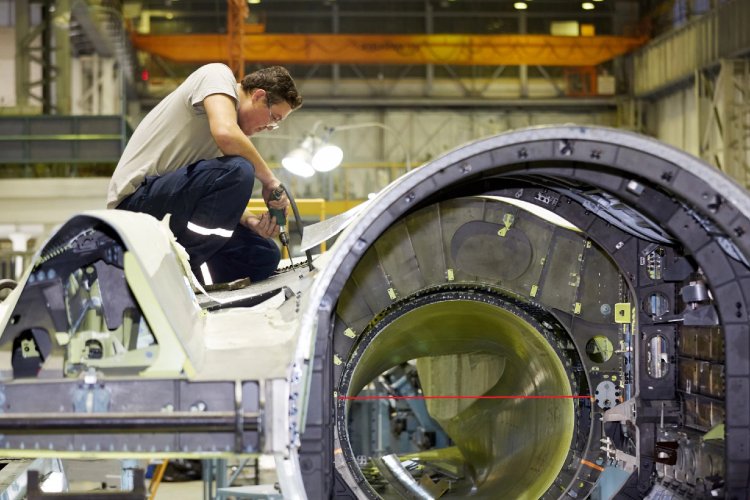
The fan inlet size would be the diameter of the green inlet tube. There is fan structure outside of the flow path, sealing against the black ring outboard of the green tube, and within the fuselage frame you designated with the red arrows.

Although not reflected on the Info Card, I thought the original statements were the Izd 177S used the Izd 30 Fan at 932 mm diameter, and the Izd 177 used a cut down Izd 30 Fan at the 905 mm diameter to match the two different applications. The larger, higher airflow fan on the 177S is reflected in the higher thrust rating.
 
The fan inlet size would be the diameter of the green inlet tube. There is fan structure outside of the flow path, sealing against the black ring outboard of the green tube, and within the fuselage frame you designated with the red arrows.

Although not reflected on the Info Card, I thought the original statements were the Izd 177S used the Izd 30 Fan at 932 mm diameter, and the Izd 177 used a cut down Izd 30 Fan at the 905 mm diameter to match the two different applications. The larger, higher airflow fan on the 177S is reflected in the higher thrust rating.

Thanks, from the previous pdf source:

''Первый этаппредусматривал среди прочего использование двигателя 117С, который являлся модернизацией АЛ-31Ф. При этомдля ПАК ФА первого этапа была снижена максимальная скорость с 2,15 до 2 Махов. На втором этапе предполагалось создать новый двигатель тягой 15–15,5 тонны.В НПО «Сатурн» был предложен проект такого двигателя. По словам первого заместителя гендиректора НПО«Сатурн» по НИОКР и ОКР Виктора Чепкина, этот мотор«должен иметь еще меньший удельный вес — 0,8 или ниже, а его принципиальные отличия от 117-го проекта будутв новом вентиляторе с увеличенным расходом воздуха, новой камере сгорания и цифровой системе управления».Учитывая, что уже 117-й мотор в «Сатурне» отнесли к пятому поколению, новый двигатель стал уже позиционироваться как «поколение 5+». ''

..The first stage included, among other things, the use of the 117S engine, a modernization of the AL-31F. At the same time, the maximum speed of the first-stage PAK FA was reduced from Mach 2.15 to Mach 2. The second stage involved creating a new engine with a thrust of 15–15.5 tons. NPO Saturn proposed a design for such an engine.

According to Viktor Chepkin, First Deputy General Director for R&D at NPO Saturn, this engine “should have an even lower specific gravity—0.8 or lower, and its fundamental differences from Project 117 will be a new fan with increased air flow, a new combustion chamber, and a digital control system.
Considering that the 117th engine in Saturn was already classified as the fifth generation, the new engine began to be positioned as "generation 5+". ..

So they first planned to integrate 117S into the first state T-50 but instead, it was 117 with 15 tons of max static thrust.
 
Marchukov never said that for the Izd 30 but for the Izd 117.
Sorry if you already posted it and I lost track of it, could you link the source please?

Although not reflected on the Info Card, I thought the original statements were the Izd 177S used the Izd 30 Fan at 932 mm diameter, and the Izd 177 used a cut down Izd 30 Fan at the 905 mm diameter to match the two different applications. The larger, higher airflow fan on the 177S is reflected in the higher thrust rating.
The placard states 905 mm for both versions, with 177S having reduced specs vs. 177. 2tf reduction in dry thrust does not reflect the 6% difference in capture area of the compressor, so other internal features need to be playing a role there... unless some idiot screwed it with the published data xD

BTW, 6% compressor area increase of Izd. 30 re. 177 (932 vs 905 mm) would lead, everything else being equal, to 16,97 tf AB and 11,67 tf dry.

According to Viktor Chepkin, First Deputy General Director for R&D at NPO Saturn, this engine “should have an even lower specific gravity—0.8 or lower, and its fundamental differences from Project 117 will be a new fan with increased air flow, a new combustion chamber, and a digital control system.
Wow. That should be TWR of 12,5:1, no less, and , believe it or not, confirms the values in the bars I posted...
 
Sorry if you already posted it and I lost track of it, could you link the source please?

He said that during Samara University's presentation on June 2023.

BTW, 6% compressor area increase of Izd. 30 re. 177 (932 vs 905 mm) would lead, everything else being equal, to 16,97 tf AB and 11,67 tf dry.

It is interesting that they achieved 16000kgf with engine which has 905mm inlet diameter (177) ,so less than 932mm from 117 which can achieve max 15000kgf. It is also interesting that Izd 177 appeared almost ten years after Izd 30 and 117.

More interesting is the story where according to Y. Yeliseyev ,this 'second stage' engine from NPP Salyut was developed and finished earlier than its counterpart from the NPO Saturn.

NPP Salyut second stage engine for the T-50.jpg

NPO Saturn's Izd. 30

NPO Saturn second stage engine for the T-50 called Izdeliye 30.jpg

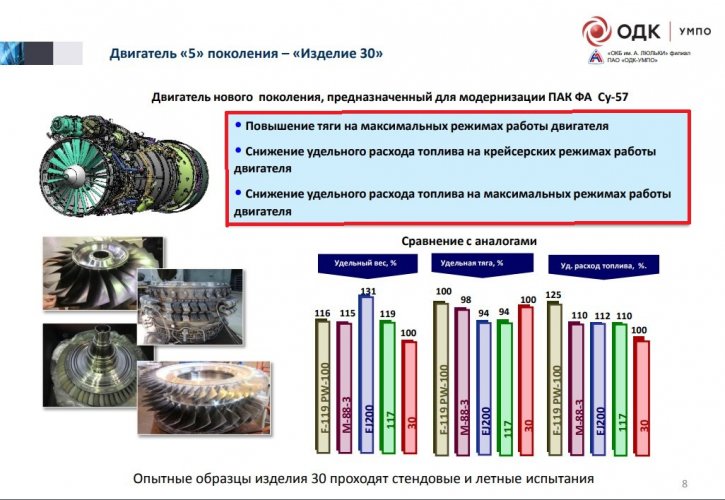
So about Izd 30, we have this,in comp with 117 19% less ,6% more, 10% less.

ODK data about Izdeliye 30.jpeg

then this :

''According to Viktor Chepkin, First Deputy General Director for R&D at NPO Saturn, this engine “should have an even lower specific gravity—0.8 or lower, and its fundamental differences from Project 117 will be a new fan with increased air flow, a new combustion chamber, and a digital control system.''

New fan as the three-stage fan ,new combustion chamber ,I suppose ,he meant on the new main combustion chamber ( not AB combustion chamber, btw, some source mentioned there is no real ,standard AB chamber at all ? ) and which will allow high supersonic long term cruise speed.

Btw,Izd 30 in comparison with Izd. 117 has lighter structural components ,some even made from the composites.
 
Last edited:
There is something to consider about Izd 30 .

''В выпуске программы «Военная приёмка» телеканала «Звезда» в ноябре 2018 года генеральный конструктор-директор ОКБ им. А.М. Люльки Евгений Марчуков рассказал, что «изделие 30» — это поколение 5+, немного опережающее пятое. «Именно этому поколению соответствует двигатель по удельной тяге, удельному расходу и удельному весу», — рассказал Марчуков. Он отметил что по удельной тяге двигатель превосходит все зарубежные аналоги, является совершенно новым изделием и не имеет ничего общего с двигателем истребителя Су-35.''

''In a November 2018 episode of the "Military Acceptance" program on the Zvezda TV channel, Yevgeny Marchukov, General Designer and Director of the A.M. Lyulka Design Bureau, explained that "Product 30" is a 5+ generation, slightly ahead of the 5th.

The engine matches this generation in terms of specific thrust, specific fuel consumption, and specific gravity, Marchukov said. He noted that in terms of specific thrust, the engine surpasses all foreign equivalents, is a completely new product, and has nothing in common with the engine of the Su-35 fighter.''


In fact ,he didn't mention Su-35S at all, Aleksey Yegorov did that . Ye. Marchukov only confirmed what A.Yegorov said ( asked). Aleksey than said that it was new engine specially designed and constructed for the Su-57 only but that was the case with the Izd. 117 also ( as the first stage engine).

https://sdelanounas.ru/blogs/114072/?pid=1085221
A.Yegorov said that it is engine for the Su-57 but he completely forgot to tell that it was second stage engine for the Su-57 as the new one. Thus he compare that engine with the engine of the Su-35S. In fact ,even AL-41F-1 has many differences in comparison with the AL-41F-1S.

Now ,what if Izd 30 has completely new inlet ( new fan with increased air flow) , with the diameter bigger than of Izd. 117 ? To repeat earlier Slyusar's statement,Su-57's with the first stage engines will not receive second stage engines.
 
This is either a translation issue or Russian naming convention. The fan is the low compressor. There is no low compressor between the fan and the high compressor, at least on these engines under discussion.

In the 1-stream turbojet engines we have only LPC, in the 2 or 3 stream turbojet (turbofan) engines we have fans which act as LPC ,right ?

One citation:

''Сердцем авиационного двигателя является компрессор высокого давления.''

''The heart of an aircraft engine is the high-pressure compressor.''
 
Correct - in a 2 stream / 2 shaft forward fan turbofan, the fan is functioning as the LPC for the core flow path. There other configuration, like a low shaft LPC mounted behind the fan (TF30) or a 3 shaft engine with a separate LPC (RB199), but in all cases with a forward fan, the fan is functioning as part of the LPC feeding the HPC.

I will agree with the statement that the HPC is the heart of the engine, both in location and function. Compression efficiency and pressure ratio of the HPC drive many of the other performance characteristics of the full engine.
 
Correct - in a 2 stream / 2 shaft forward fan turbofan, the fan is functioning as the LPC for the core flow path. There other configuration, like a low shaft LPC mounted behind the fan (TF30) or a 3 shaft engine with a separate LPC (RB199), but in all cases with a forward fan, the fan is functioning as part of the LPC feeding the HPC.

I will agree with the statement that the HPC is the heart of the engine, both in location and function. Compression efficiency and pressure ratio of the HPC drive many of the other performance characteristics of the full engine.

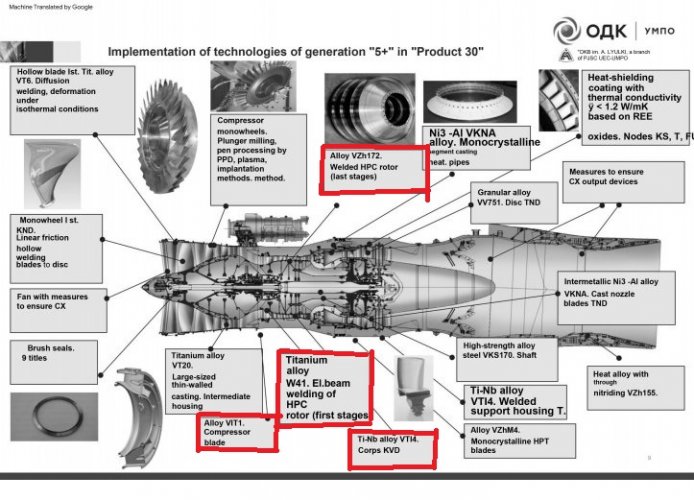
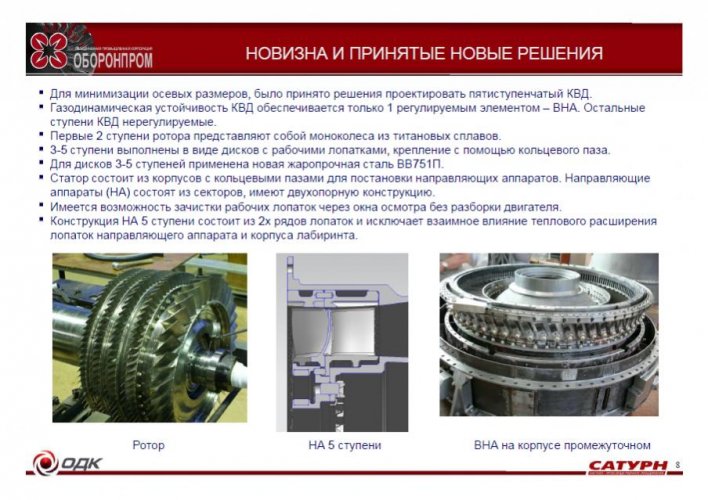
So Izd. 30 has five-stage high pressure compressor. First two stages of the rotor are in fact blisks . Third,fourth and fifth stage are disks with its blades and are made of Ti Alloy VV751P. Here we have some details ,e.g. , compressor blades are made of Titanium-Niobium Alloy VIT1 ,first stage is made of Ti Alloy VT41, Alloy VZh 172ISh is used for the last stage, Titanium-Niobium Alloy VT4 is also used etc...

Izdeliye 30 HPC mod.jpg

Izdeliye 30 HPC parts.jpg

From material that we have from earlier about parts/components of the Izd 30 HPC ,first about the high temp Ti Alloy VT41 with working temp of 600°C

''Сплав ВТ41 в настоящее время является самым жаропрочным титановым конструкционным сплавом, рекомендованным для изготовления рабочих моноколес.''

''VT41 alloy is currently the most heat-resistant titanium structural alloy recommended for the manufacture of working unicycles.''

Pages 10-15 :

https://docs.yandex.ru/docs/view?ur...ные технологии в двигателестроении.pdf&nosw=1
 
Last edited:
We’ve had that Project 30 cross section presented in the forum before. You might be interested in my eyeball analysis, back a few pages:

https://www.secretprojects.co.uk/th...rmance-and-2nd-stage-engine.38521/post-608611

I've read all of that earlier, thanks .

About life cycle of the Izd 30 :

«Его же жизненный путь 30-40-50 лет», - сказал генеральный конструктор - директор ОКБ им. А.Люльки (филиал ОДК-УМПО) Евгений Марчуков в интервью телеканалу Минобороны РФ «Звезда».

https://dfnc.ru/novosti-vpk/novyj-dvigatel-dlya-su-57-prosluzhit-do-50-let-odk/
"Its lifespan is 30-40-50 years," said Yevgeny Marchukov, General Designer and Director of the A. Lyulka Design Bureau (a branch of UEC-UMPO), in an interview with the Russian Ministry of Defense's Zvezda television channel.''

Even 50 years? Can this be achieved and is that possible anyway?
 
This axe has been in my family for 200 years - it’s only had 3 new handles and 2 new heads….

Highly stressed military engines are full of life limited parts. In the USAF, the current standard is that hot section parts need to last one depot inspection interval before replacement, and cold section part have a life limit of 2 intervals with detailed inspection at the first interval. Some parts can have their lives extended with detailed inspection - if it’s not cracked now, it can go another interval. There are certain parts that don’t have published life limits, but they still get inspected for cracks or wear. You may have to jack up the data plate and replace every part on the engine to make 50 years..
 
Even 50 years? Can this be achieved and is that possible anyway?
He refers to the life of the platform, including further evolution, like AL-31F > AL-41F1, for instance.
Now ,what if Izd 30 has completely new inlet ( new fan with increased air flow) , with the diameter bigger than of Izd. 117 ? To repeat earlier Slyusar's statement,Su-57's with the first stage engines will not receive second stage engines.
Increased airflow does not necessarily mean a bigger fan
He said that during Samara University's presentation on June 2023.
Ok thanks
It is interesting that they achieved 16000kgf with engine which has 905mm inlet diameter (177) ,so less than 932mm from 117 which can achieve max 15000kgf. It is also interesting that Izd 177 appeared almost ten years after Izd 30 and 117.
117 is the result of applying some 5th gen technologies to a 4th gen engine. The leap achieved with 177 is way beyond what I was expecting, I must say. BTW, 117 and Izd. 30 do not have the same age, at all. One is the first stage engine, the other is the second one, which is not yet operational.
More interesting is the story where according to Y. Yeliseyev ,this 'second stage' engine from NPP Salyut was developed and finished earlier than its counterpart from the NPO Saturn.
IMHO this is just Salyut trying to get some attention. Why would Russia favor Lyulka if Salyut had a better / more mature engine?

Regardless, I still find it very interesting to analyze the published specs from Izd. 177, as a first glimpse into the performance of the technology behind Izd. 30. For instance, the ratio AB/dry thrust is only 1,45:1 (vs 1,61:1 on 177S), in line with lower BPR engines like F119, which is what one would expect from a design intended for high supersonic flight speed on mil settings, and my guess is that Izd. 30 should follow along those lines, too.
 
Am I parsing this correctly? 1 fan stage and 2 LP compressor stages (grouped together as the "3 fan stages"), 5 HP compressor stages, 1 HP turbine, 1 LP turbine?
 
117 is the result of applying some 5th gen technologies to a 4th gen engine. The leap achieved with 177 is way beyond what I was expecting, I must say.

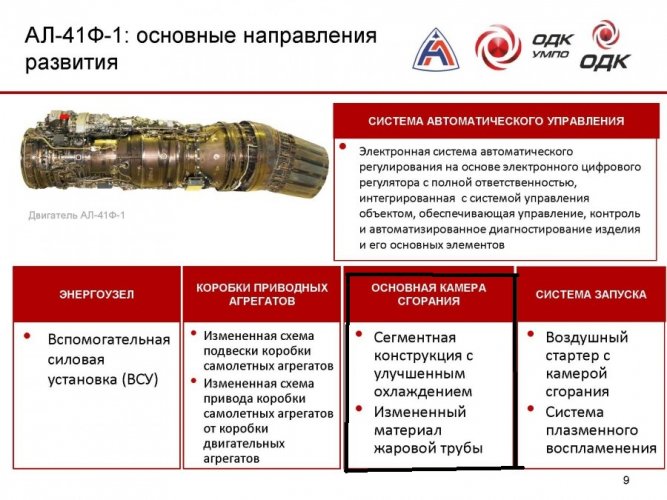
Yes, 80% new details in comparison with the old AL-31F. Main combustion chamber was one of the subject of development.

AL-41F-1 main chamber mod.jpg

сегментная конструкция с улучшенным охлаждением , or segmented design with improved cooling
измененный материал жаровой трубы or modified flame tube material
It seems that they focused on the main combustion chamber with the goal to increase thrust on the MP mode ?
One detail more :
In this pdf we have some details about 6-stage HPC, is it maybe from the Izd 117 ?
Pages 15 ,16,17,18,19,20 and 21

Source: https://docs.yandex.ru/docs/view?ur...ные технологии в двигателестроении.pdf&nosw=1

Regardless, I still find it very interesting to analyze the published specs from Izd. 177, as a first glimpse into the performance of the technology behind Izd. 30. For instance, the ratio AB/dry thrust is only 1,45:1 (vs 1,61:1 on 177S), in line with lower BPR engines like F119, which is what one would expect from a design intended for high supersonic flight speed on mil settings, and my guess is that Izd. 30 should follow along those lines, too.

What V. Maslov said during 2016 ,in the time when static test of the Izd 30 started :

"«Изделие 30» значительно превзойдёт двигатель первого этапа «по топливной эффективности и удельной тяге, а по конструктивно-технологическому исполнению и уровню достигаемых параметров будет полностью соответствовать мировому уровню двигателя пятого поколения»" © гендиректор ОДК Владислав Маслов.

По своим характеристикам «изделие 30» будет превосходить установленный сейчас на Т-50 двигатель «изделие 117» (АЛ-41Ф1) на 15-20%. Характеристики силовой установки повышены за счет резкого улучшения параметров рабочего цикла, КПД агрегатов, новых конструкционных материалов, значительно уменьшен удельный расход топлива (не только на крейсерском режиме, но и в режиме форсажа) и др."

"Product 30" will significantly surpass the first-stage engine in terms of fuel efficiency and specific thrust, and in terms of design and technological implementation and the level of achieved parameters, it will fully correspond to the world level of the fifth-generation engine" © UEC CEO Vladislav Maslov.
In terms of its characteristics, the "Product 30" engine will be 15-20% superior to the "Product 117" (AL-41F1) engine currently installed on the T-50.
The power plant's performance has been improved by dramatically improving the operating cycle parameters, unit efficiency, new construction materials, significantly reducing specific fuel consumption (not only in cruising mode, but also in afterburner mode), etc.''

It will be great if it is 15%-20% better than Izd. 117.

Now back to one article from 2021 in the relation with reducing specific fuel consumption in the AB mode. This detail was mentioned earlier but let us repeat :

''Владимир Попов заявил, что российские конструкторы значительно изменили термодинамический процесс, который применяется на предыдущих поколениях реактивных двигателей. Это связано с особой ионизацией воздушного потока, воздушно-топливной смесью. В традиционной камере сгорания располагается форсажная камера. В «Изделии 30» форсажной камеры как таковой не будет. Вместо неё появилась кольцевая система, которая будет создавать сгорание топлива без его дополнительной подачи по насосным системам, что будет экономичнее. КПД от сгорания топлива планируется увеличить в 1,2—1,5 раза», — рассказал эксперт.
Также, как отметил Попов, в двигателе второго этапа предусмотрен комплекс новой топливной автоматики, который будет регулировать режим полёта за счёт тяги. По его оценке, на бесфорсажном режиме тяга «Изделия 30» будет в 1,5 раза больше, чем у сегодняшних двигателей.''

https://russian.rt.com/russia/article/926444-su-57-dvigatel-izdelie-30
''Vladimir Popov stated that Russian designers have significantly modified the thermodynamic process used in previous generations of jet engines. This is due to the special ionization of the air flow and the air-fuel mixture. A traditional combustion chamber houses an afterburner.
"Product 30" will not feature an afterburner as such. Instead, it will feature a ring system that will create fuel combustion without additional pumping, which will be more efficient. Fuel combustion efficiency is planned to be increased by 1.2-1.5 times," the expert explained.
Popov also noted that the second-stage engine incorporates a new fuel automation system that will regulate flight mode using thrust. He estimates that, without afterburners, the thrust of the "Product 30" will be 1.5 times greater than that of current engines.''

Hm, what kind of ''ring system'' ?

'F119Doctor' gave some comments and details earlier about this if I remember well ( on the main Su-57 thread) .

P.S. There is no photo/video yet where we can see what is really inside ,what can be seen through the nozzle.
 
Am I parsing this correctly? 1 fan stage and 2 LP compressor stages (grouped together as the "3 fan stages"), 5 HP compressor stages, 1 HP turbine, 1 LP turbine?
No - it is a conventional 3 stage Fan, with the exit flow split into bypass down the fan ducts to the AB, and into core flow into the 5 stg HPC.
 
''Vladimir Popov stated that Russian designers have significantly modified the thermodynamic process used in previous generations of jet engines. This is due to the special ionization of the air flow and the air-fuel mixture. A traditional combustion chamber houses an afterburner.
"Product 30" will not feature an afterburner as such. Instead, it will feature a ring system that will create fuel combustion without additional pumping, which will be more efficient. Fuel combustion efficiency is planned to be increased by 1.2-1.5 times," the expert explained.
Popov also noted that the second-stage engine incorporates a new fuel automation system that will regulate flight mode using thrust. He estimates that, without afterburners, the thrust of the "Product 30" will be 1.5 times greater than that of current engines.''
This claim appears to be fantasy. Unless they have managed to create a Rotating Detonation combustion process to increase the combustion pressure in the AB, there no 20-50% increase in efficiency to be had in the AB, plasma or not. The heating value of jet fuel is a fixed value and you can’t get beyond 100% combustion efficiency. You might be able to get from 96% to 98%, for example, but you can’t get above 100%.

In some other discussions, it appeared that the “plasma” was referring to AB ignition. Instead of using a hot streak ignition, where a separate injector shoots a squirt of fuel into the main combustor, resulting in a streak of flame passing thru the turbine and torching off the AB flame, an electric plasma arc is used to ignite the AB. P&W has been using electric “plasma” ignition since the TF30-P-100 engine on the F-111F.
 
Vladimir Popov is Joe-Schmoe in aircraft engines that don't understant what he's talking about. As most of Squirrel 'sources'
 
This claim appears to be fantasy. Unless they have managed to create a Rotating Detonation combustion process to increase the combustion pressure in the AB, there no 20-50% increase in efficiency to be had in the AB, plasma or not. The heating value of jet fuel is a fixed value and you can’t get beyond 100% combustion efficiency. You might be able to get from 96% to 98%, for example, but you can’t get above 100%.

In some other discussions, it appeared that the “plasma” was referring to AB ignition. Instead of using a hot streak ignition, where a separate injector shoots a squirt of fuel into the main combustor, resulting in a streak of flame passing thru the turbine and torching off the AB flame, an electric plasma arc is used to ignite the AB. P&W has been using electric “plasma” ignition since the TF30-P-100 engine on the F-111F.

Thanks,indeed it is weird ,strange to say there is no real,standard AB chamber at all but some sort of rings because AB chamber also has those rings, right ?

About that rotating detonation we have some details :

''Перспективы применения спиновой детонации в конструкции ФК''

''Prospects for the application of spin detonation in the design of the FK''

Page 39 : https://www.secretprojects.co.uk/th...and-2nd-stage-engine.38521/page-7#post-603593

Some details about 'detonating engine' etc ,we have here :

https://www.secretprojects.co.uk/th...and-2nd-stage-engine.38521/page-8#post-608775

What about adaptive AB chamber with its rings?


Adaptive AB chamber.jpg
 
Vladimir Popov is Joe-Schmoe in aircraft engines that don't understant what he's talking about. As most of Squirrel 'sources'

Yes aha and Vladimir Popov is '' генерал-майор, заслуженный военный летчик, кандидат технических наук, доцент.''
 
yes, typical invited expert of all trades with self-written glamorous bio
 
Last edited:
Thanks,indeed it is weird ,strange to say there is no real,standard AB chamber at all but some sort of rings because AB chamber also has those rings, right ?

About that rotating detonation we have some details :

''Перспективы применения спиновой детонации в конструкции ФК''

''Prospects for the application of spin detonation in the design of the FK''

Page 39 : https://www.secretprojects.co.uk/th...and-2nd-stage-engine.38521/page-7#post-603593

Some details about 'detonating engine' etc ,we have here :

https://www.secretprojects.co.uk/th...and-2nd-stage-engine.38521/page-8#post-608775

What about adaptive AB chamber with its rings?


View attachment 797361
Unfortunately, I can’t read Russian on the slide, so I don’t know exactly the point they are discussing.

But I do see a 1/4 section burner rig with radial flame holders, which appears relatively consistent with the image in the upper left. GE used stand alone radial flame holders in the F110 engine, while P&W uses radial flame holders on the F119 and F135 integrated with the turning vanes of their multi-function turbine exhaust case.

The 1/4 section burner rig would not be able to be used to demonstrate rotating detonation, since detonation waves have to travel around the combustion chamber.

P&W had a design for a “swirl augmentor” for the F100 around 1980. While it was promising in rig tests, the advantages were not realized in full engine tests and the configuration was never adopted. While I don’t know everything they thought it would provide, it was not a detonation combustion scheme.
 
yes, typical invited expert of all trades with self-written glamorous bio

I don't think that he invented all this. All in all ,this is not topic about him ...

https://vrzk.ru/vopros/vladimir-popov-general-major-aviaczii-biografiya/

Unfortunately, I can’t read Russian on the slide, so I don’t know exactly the point they are discussing.

But I do see a 1/4 section burner rig with radial flame holders, which appears relatively consistent with the image in the upper left. GE used stand alone radial flame holders in the F110 engine, while P&W uses radial flame holders on the F119 and F135 integrated with the turning vanes of their multi-function turbine exhaust case.

The 1/4 section burner rig would not be able to be used to demonstrate rotating detonation, since detonation waves have to travel around the combustion chamber.

P&W had a design for a “swirl augmentor” for the F100 around 1980. While it was promising in rig tests, the advantages were not realized in full engine tests and the configuration was never adopted. While I don’t know everything they thought it would provide, it was not a detonation combustion scheme.

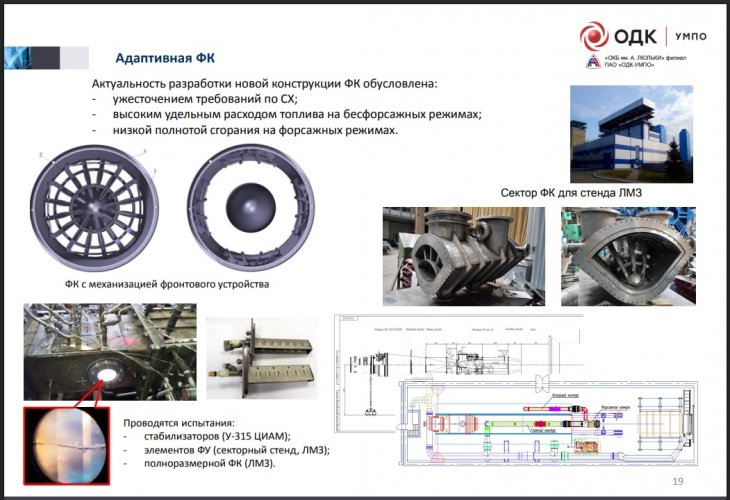
OK ,I will translate you some details about so called 'adaptive AB chamber'.

Adaptive AB chamber

The relevance of developing a new design of the adaptive AB chamber is due to:

-tightening of requirements for specific characteristics

-high specific fuel consumption in non-afterburning modes

-low combustion efficiency in afterburner modes
 
СХ are not 'specific characteristics'
 
@F119Doctor

This is also interesting about Izd. 30 ( from the material which author is Ye.Marchukov)

Izdeliye 30 fuel cons  mod.jpg

Translated details from the red rectangular:

-increased thrust on the Mil Power working engine mode

-reduction of specific fuel consumption on the cruising mode of the engine

-reduction of specific fuel consumption on the MP mode of the engine

It seems that Izd. 30 can provide cruising not only in MP mode ( regime Maximal) but e.g. on the Min AB mode like engines of MiG-25/-31 ?
 
Adaptive AB chamber

The relevance of developing a new design of the adaptive AB chamber is due to:

-tightening of requirements for specific characteristics

-high specific fuel consumption in non-afterburning modes

-low combustion efficiency in afterburner modes
Most afterburners have some pressure loss due to flow blockage from the spray ring and flame holders. Perhaps they are turning the flame holders to reduce blockage during non-AB operation, then turning them across the flow during AB.

Cruising in minimum AB can be normal
operation at mid supersonic speeds. Per the JB Brown talk, the F-22 cruises at M2 using approximately 1/3 AB power. The SR-71 could cruise at M3.2 at minimum AB if the ambient temperature was well below standard for 80K altitude.
 
Cruising in minimum AB can be normal
operation at mid supersonic speeds. Per the JB Brown talk, the F-22 cruises at M2 using approximately 1/3 AB power. The SR-71 could cruise at M3.2 at minimum AB if the ambient temperature was well below standard for 80K altitude.

Just as MiG-25/-31 can cruise with 2.35 Mach on the Min AB mode,yes.

When we mentioned that AL-41F-1/Izd. 117 is 150 lighter than AL-31F/Izd. 99 ,there is one detail ( one of maybe many details) , I think in relation with that .

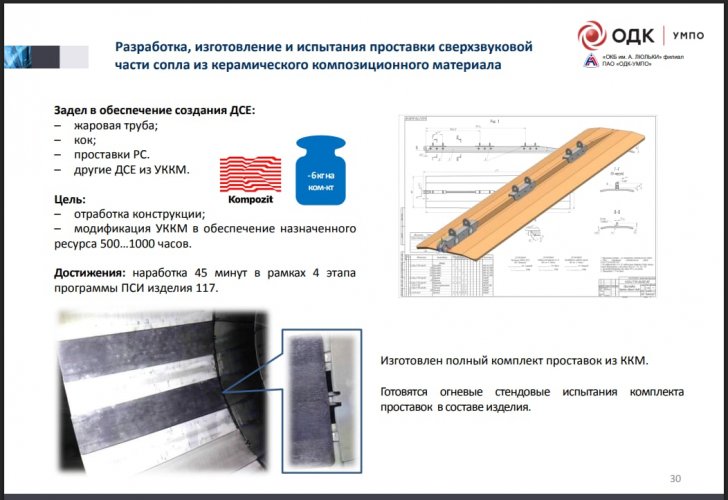
Nozzle petals are made from ceramic composite material.It also seems that 'modified flame tube material' is in fact this ceramic composite material.

''Development, manufacture, and testing of a supersonic nozzle spacer made from a ceramic composite material.''

Izdeliye  177 nozzle.jpg
 

Similar threads

Back
Top Bottom