

PleaseSaveUsDonald
ACCESS: Restricted
- Joined
- 7 September 2025
- Messages
- 7
- Reaction score
- 8
This is a discussion on the general future of passive stealth, but I will use the Strait of Taiwan and a possible near term conflict between the US and PRC to concretize it.
The main idea here is; With the emergence of multiple new multi-domain IUSS sensor networks, that not only have the old passive acoustic and towed arrays, but also active sensors in the form of UUVs, satellites, USVs and UAVs - will passive stealth be enough in the future, for offensive missions? Say you were a submarine, how would you get close enough to the an enemy coast to launch any sort of attack on a port or in land target?
In the context of Taiwan, China's public IUSS goes under two different name, with the Transparent Ocean strategy being the overall encompassing system or pattern that is employed in various locations near the Chinese coast like the Taiwan Strait or the South China Sea.
 It is quite a formidable system, but by no means the only one; The UK, Australia, South Korea and lately the US (through a revamp) are building similar systems. The big difference is, however, that the Chinese system has been in development since approx. 2014 and it seems to be hooked up to a "Deep Blue Brain" which is a Peta-FLOP scale AI cluster somewhere deep in China, that suppossedly can do real-time simulations. To drive home the awe of this; It would essentially allow you to turn any set of sensor readings into a vision of the future, by simulating all possible scenarios that might have caused that specific reading and picking the most probable. Of course, no such system is ever going to be perfect,
I know that detection and identification are two different tasks; And this is exactly what will lay the foundation - according to me and Bryan Clark's belief - for future warfare. If you take inspiration from Ukraine's air war or the US-Navy's distributed maritime operation concept, it seems like the future of warfare will not rely on "stealth" in the traditional sense of the word, but rather noise or overwhelming your adversary with decisions, forcing them to either waste expensive fires, allow you to finish your operation or maybe just buy you enough time to finish your offensive operation.
For submarine forces specifically, it means that, apart from traditional passive stealth, they must invest in active stealth in the form of decoys, UUVs to finish last mile operations and EW.
I am eager to hear your thoughts on this. What - if any - major doctrinal changes do you believe these new technologies will usher forth? Do you believe that relying purely/primarily passive stealth (at least in littoral combat) is over? Please back up your points.
The main idea here is; With the emergence of multiple new multi-domain IUSS sensor networks, that not only have the old passive acoustic and towed arrays, but also active sensors in the form of UUVs, satellites, USVs and UAVs - will passive stealth be enough in the future, for offensive missions? Say you were a submarine, how would you get close enough to the an enemy coast to launch any sort of attack on a port or in land target?
In the context of Taiwan, China's public IUSS goes under two different name, with the Transparent Ocean strategy being the overall encompassing system or pattern that is employed in various locations near the Chinese coast like the Taiwan Strait or the South China Sea.
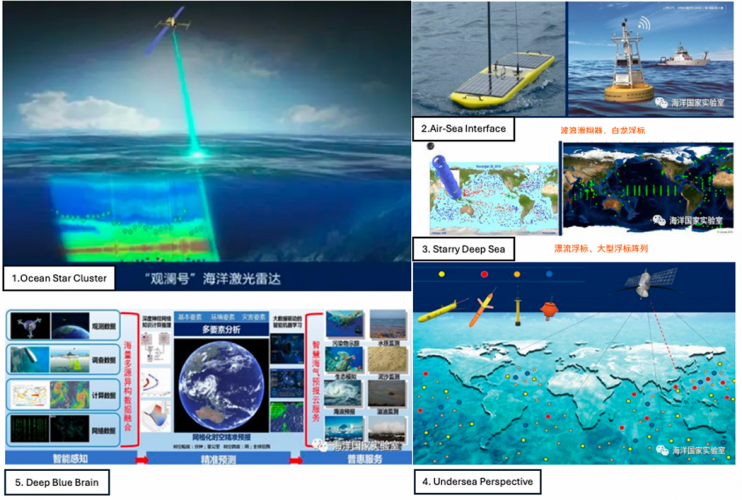 It is quite a formidable system, but by no means the only one; The UK, Australia, South Korea and lately the US (through a revamp) are building similar systems. The big difference is, however, that the Chinese system has been in development since approx. 2014 and it seems to be hooked up to a "Deep Blue Brain" which is a Peta-FLOP scale AI cluster somewhere deep in China, that suppossedly can do real-time simulations. To drive home the awe of this; It would essentially allow you to turn any set of sensor readings into a vision of the future, by simulating all possible scenarios that might have caused that specific reading and picking the most probable. Of course, no such system is ever going to be perfect,
 I know that detection and identification are two different tasks; And this is exactly what will lay the foundation - according to me and Bryan Clark's belief - for future warfare. If you take inspiration from Ukraine's air war or the US-Navy's distributed maritime operation concept, it seems like the future of warfare will not rely on "stealth" in the traditional sense of the word, but rather noise or overwhelming your adversary with decisions, forcing them to either waste expensive fires, allow you to finish your operation or maybe just buy you enough time to finish your offensive operation.
For submarine forces specifically, it means that, apart from traditional passive stealth, they must invest in active stealth in the form of decoys, UUVs to finish last mile operations and EW.
I am eager to hear your thoughts on this. What - if any - major doctrinal changes do you believe these new technologies will usher forth? Do you believe that relying purely/primarily passive stealth (at least in littoral combat) is over? Please back up your points.


