
The Secret Horsepower Race by Calum Douglas (and piston engine discussion)

It's not really offtopic as the topic title nowadays is:
The Secret Horsepower Race by Calum Douglas (and piston engine discussion)

Note that I was referring to the DB engine which, due to its variable speed drive, should also below FTH benefit from ram pressure.

Apparently you are now referring to Hooker's booklet on the Merlin XX engine, which does not have a variable speed drive and therefore does not benefit from ram pressure below FTH. In any case there are many inaccuracies in that booklet. Going into those here would be offtopic.
 
Hi Dagger,

Apparently you are now referring to Hooker's booklet on the Merlin XX engine

The exact title of the book is given in the article I linked. It is not a book on the Merlin XX, test data of which it uses for validation, but discusses the physics of supercharged piston engines in detail.

Regards,

Henning (HoHun)
 
It's not really offtopic as the topic title nowadays is:
The Secret Horsepower Race by Calum Douglas (and piston engine discussion)

Note that I was referring to the DB engine which, due to its variable speed drive, should also below FTH benefit from ram pressure.

Apparently you are now referring to Hooker's booklet on the Merlin XX engine, which does not have a variable speed drive and therefore does not benefit from ram pressure below FTH. In any case there are many inaccuracies in that booklet. Going into those here would be offtopic.
If piston engine discussion is now on-topic for this thread, then the issues with that booklet would be on topic, IMO.
 
Sure, but the point was: running on C3 instead of B4 does not by itself increase BHP if the manifold pressure (boost) remains controlled at the same setting.
C3 merely allows the pilot to operate at a higher boost, which would then result in increased BHP.
Fair point.
 
The exact title of the book is given in the article I linked. It is not a book on the Merlin XX, test data of which it uses for validation, but discusses the physics of supercharged piston engines in detail.
I have that booklet, so I know that it is basically about the Merlin XX, and that it is rather sloppy with respect to physics and thermodynamics. Suitable for qualitative but not for quantitative analysis.

If piston engine discussion is now on-topic for this thread, then the issues with that booklet would be on topic, IMO.
I do not intend to post a review of that booklet here as that would only result in unpleasant discussions with Hooker fanboys as I have already noticed on another forum.


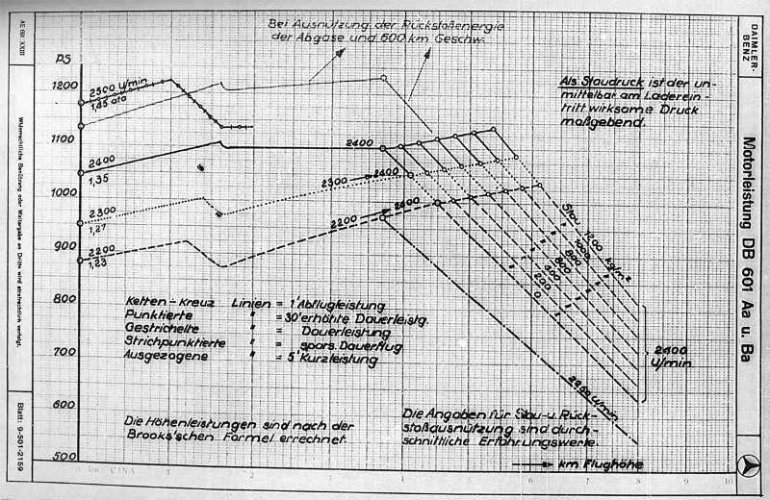
I just noticed that I have a DB 601 graph in my files (don't know where I found it) that looks very similar to the sloppy graph that I criticised earlier, but it is not quite the same as it has more text and does not have the (in my opinion wrong) lines for different ram pressures below FTH. It does indicate the ram pressure values up to 1200 kg/m2, see attachment:
 

Attachments

  • Motorleistung  DB601Aa und Ba.jpg
    Motorleistung DB601Aa und Ba.jpg
    90.9 KB · Views: 18
Hi Dagger,

I do not intend to post a review of that booklet here as that would only result in unpleasant discussions with Hooker fanboys as I have already noticed on another forum.

I wouldn't mind some discussion of said booklet, in its own thread, and don't strictly count myself as a Hooker fanboy, so as far as I am concerned, fire away.

I just noticed that I have a DB 601 graph in my files (don't know where I found it) that looks very similar to the sloppy graph that I criticised earlier

It's worth noting that the German "nach der Brookschen Formel errechnet" probably refers to the same Ait Ministry-approved formula Hooker et al. criticize in the preface of their booklet, so it might not represent the state of the art even back then.

Regards,

Henning (HoHun)
 
Hi Dagger,


Oh, I'm sorry - I wasn't aware of that. Well worth joining though, it's a very similar forum to this one, albeit with a more general focus on aviation.


If you really want the full story, Hooker explains it in the booklet discussed here:

I'll leave it at that as it's sort of offtopic here.

Regards,

Henning (HoHun)

As Dagger and I pointed out, it makes a big difference if you have a variable drive for the compressor or use a throttle. In the Paper of Hooker is no reference to a variable supercharger drive system.
 
Hi Nicknick,

As Dagger and I pointed out, it makes a big difference if you have a variable drive for the compressor or use a throttle. In the Paper of Hooker is no reference to a variable supercharger drive system.

Well, I was commenting on the general statement in your recent post only:


Where's the original discussion then so I can read up on the full context?

Regards,

Henning (HoHun)
 
Hi Dagger,

That depends on whether you are looking at a Merlin (or Allison V-1701) that maintains boost pressure up to FTH by adjusting a throttle valve , or whether you are looking at a DB engine that has a variable speed drive for the supercharger.

Ah, I begin to see where you're coming from. However, aren't you implying that the variable speed drive is controlled to deliver more or less exactly the desired manifold pressure below full throttle height?

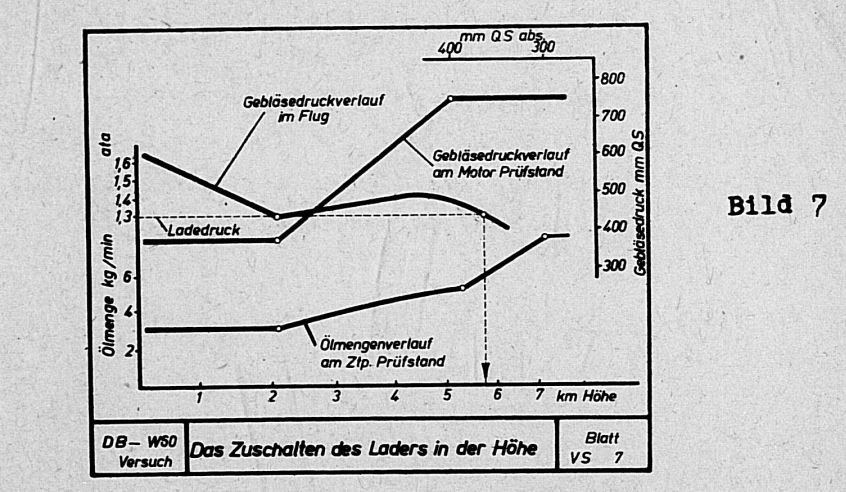
In practice, the Foettinger coupling didn't have the speed ratio range to do that, with the supercharger, in most of the regime, providing excess pressure similar to fixed-speed superchargers and thus having to be throttled, too. This is illustrated in this diagram, with "Gebläsedruck" ('blower pressure') being the pressure downstread of the supercharger, and "Ladedruck" ('charge pressure') the manifold pressure:


Regards,

Henning (HoHun)
 
Hi HoHun,

I should have formulated my remark more general: an engine with a full range variable speed drive will benefit from ram pressure below FTH, but an engine with fixed speed drive and a throttle valve will not benefit below FTH.

I am not familiar with the details of the DB variable speed drive. I have never felt the need to dive into that as I did not realise that it had such poor performance.
If I understand that graph correctly then only at 2.25 km altitude the blower pressure equals the desired manifold pressure of 1.3 ata, however below, as well as above that altitude up to FTH, throttling is required. That seems weird to me.
 
Hi HoHun,

I should have formulated my remark more general: an engine with a full range variable speed drive will benefit from ram pressure below FTH, but an engine with fixed speed drive and a throttle valve will not benefit below FTH.

I am not familiar with the details of the DB variable speed drive. I have never felt the need to dive into that as I did not realise that it had such poor performance.
If I understand that graph correctly then only at 2.25 km altitude the blower pressure equals the desired manifold pressure of 1.3 ata, however below, as well as above that altitude up to FTH, throttling is required. That seems weird to me.
In the DB 605A, below 2100 m the supercharger boost is limited by an aneroid controlled throttle. The hydraulic drive generates heat due to slipping and I recall (from the manual) that half of the oil pumped to the drive is for cooling only. From 2100 m to 5700 m (FTH at Notleistung) the slippage is gradually reduced to a minimum. Hence the 2 peaks in the power curve.
 
Still, its better to have the heat in the oil than in the charge air, especially when not using a charge air cooler

To me it is quite suprizing, that the DB 605 was controlled by throtteling and not by the variable drive. Might have been a quick fix, for not heaving enough oil cooling capacity or troubles with the Kommandogeraet.

There have been later MB engines with Foettinger Wandler/torque converters which can be much more efficient.
 
... From 2100 m to 5700 m (FTH at Notleistung) the slippage is gradually reduced to a minimum. Hence the 2 peaks in the power curve.
Sure, slippage is gradually reduced so as to increase pressure ratio by increasing the impeller speed, but that does not explain why at for example 4 km the Gebläsedruck (supercharger pressure) is 1.41 ata instead of the required 1.3 ata. That means that at 4 km the impeller speed is 5 % higher than required to deliver 1.3 ata.
At 3 km the Gebläsedruck is 1.37 i/o 1.3 ata, which means that the impeller speed is 4 % higher than required.

Up to 2.2 km the impeller runs at 75 % of its maximum speed. That sounds like a miserable turndown ratio to me.
From 2.2 to 5.3 km the impeller speed should gradually increase to 100 % (by reducing slippage) to maintain 1.3 ata.
However as is visible in the graph the speed increases too rapidly for some unclear reason, resulting in overpressure that needs to be throttled away.

It seems that the control system that is to maintain the manifold pressure at 1.3 ata is not optimal.
 
Last edited:
Hi Dagger,

However as is visible in the graph the speed increases too rapidly for some unclear reason, resulting in overpressure that needs to be throttled away.

It seems that the control system that is to maintain the manifold pressure at 1.3 ata is not optimal.

My impression is that the simple Foettinger clutch was too limited in its capabilities to replace the traditional boost regulation through throttling. One aspect of this is that its efficiency goes down as the speed ratio between driving and driven shaft goes up, leading to an increase in rejected heat, which as Niknik pointed out wasn't a trivial amount. For the potential gain in the practical operation range, I think your analysis is accurate, but I suspect that it wasn't just a case of the control law being too simple, but that to make it a robust system that would neither under- nor overshoot the target pressure, you'd have to use more sensors than just the barometric sensor it historically had, and some kind of mechanical computer as well.

Since the system as is was pretty light and compact, while also being a pretty good step up from the fixed-ratio supercharger two-speed gearbox, I presume the engine manufacturers at the time just accepted the imperfect control. One has to keep in mind that the pace of development prior to WW2 and especially in the war years was very rapid, and there probably would have been a tendency to prefer low-handing fruit. (I suspect the Foettinger clutch also eliminated the need for a torsion-dampening element in the supercharger drive, helping to offset its additional weight.)

The variable speed supercharger drive in late WW2 was also used on the V-1710 I believe, and also - maybe post-war, I don't know the exact time line - on the R-2800 of the F8F-2 as well as on the R-4360 of the F2G "Super Corsair", and I'd be curious now how the drive was controlled on these engines.

For the F8F-2, there's a set of engine curves around, and they definitely have some interesting undulations in the graphs that I think must be artifacts of the engine control system, which I believe the F8F-2 had (though maybe not initially from the factory, from all I know).

Regards,

Henning (HoHun)
 
For any type of clutch, the efficiency is the ratio of speed out/speed in. Fortunately, in a super charger drive shaft, the efficiency is at the maximum when most power and torque is needed and at the minimum when also the required power is at the minimum.

However, I still believe it has never been the intention to reley mainly on throtteling with this drive shaft. My guess, it was a quick fix for an overheating oil/cooling cirquit and might have worked differently in later or even earlier versions of this engine.
 
My impression is that the simple Foettinger clutch was too limited in its capabilities to replace the traditional boost regulation through throttling. One aspect of this is that its efficiency goes down as the speed ratio between driving and driven shaft goes up, leading to an increase in rejected heat, which as Niknik pointed out wasn't a trivial amount. For the potential gain in the practical operation range, I think your analysis is accurate, but I suspect that it wasn't just a case of the control law being too simple, but that to make it a robust system that would neither under- nor overshoot the target pressure, you'd have to use more sensors than just the barometric sensor it historically had, and some kind of mechanical computer as well.
Crud, if the supercharger is really putting out too much boost, just install a blow-off valve.
 
Crud, if the supercharger is really putting out too much boost, just install a blow-off valve.
This is the worst option with the highest power consumption. I make a list for all options which have been used during WW2

1: variable drive with a Foettinger torque converter

2: variable drive with a Foettinger clutch

3: fixed drive with throttle before the charger

Usefull addition to 2-3: variable intake swirl ''Dralldrossel''

With a Pop off valve, you will allways compress the max. amount of air with the maximum compression ratio resulting in maximum power consumption an charge air cooling requirement
 
One aspect of this is that its efficiency goes down as the speed ratio between driving and driven shaft goes up, leading to an increase in rejected heat, which as Niknik pointed out wasn't a trivial amount.
I understand the cooling problem that Pasoleati and NickNick mentioned, so apparently the fluid drive cannot be operated below say 75 % speed, resulting in overboost up to 2.2 km that has to be throttled away, but that does not explain why between 2.2 and 5.3 km there is again overboost while there is none at 2.2 km.

The supercharger pressure ratio at 3 and 4 km is about 5 % and 8 % too high meaning that the impeller speed could have been about 4 % and 5 % lower as that would still have given a speed well above the minimum required 75% speed.
Hence my impression that the manifold pressure control system is not optimal.

Note also that the graph that you linked to is for the DB 605. One would think that by the time the DB 605 went into operation they would have improved the control above 2.2 km, but apparently not.
 
Last edited:
We know, that German engine development during WW2 wasn't allways straight forward, threre have been lot of bombardments, material shortages, cooling proplems and a lot of varients by using up whatever parts were available. Just because of one chart, I wouldn t conclude that this pressure regulation characteristic was intended that way and used on all DB 605. The German developres shurly had something different in mind, but had to react to things like insufficient cooling capacity, wrong type of Kommandogeraet, not enough testing etc..
 
In the mean time I went through some books I have and, to my surprise, Michael Baumgartl in his Bf 109 book page 388-389 actually mentions the problem with too high supercharger pressure at 3 to 4 km altitude:

"Probleme gab es auch mit dem Gebläsedruckverlauf beim DB 605. Offenbar war der Gebläsedruckanstieg nach Zuschaltung in etwa 2 km Höhe viel zu stark, was in Höhen von 3 bis 4 km zu einem unnötigen Leistungsverlust führte."

"Auch die E'Stelle Rechlin hatte auf dem Höhenprüfstand festgestellt, dass die Leistung des DB 605 zwischen 2 und 5 km trotz der hydraulischen Kupplung einen ähnlichen Verlauf nimmt wie ein Motor mit einem Lader mit mechanischem Schaltgetriebe."
 
With a Pop off valve, you will allways compress the max. amount of air with the maximum compression ratio resulting in maximum power consumption an charge air cooling requirement
Yes, and it is also greatly simpler than trying to control the pressures some other way.
 
Yes, and it is also greatly simpler than trying to control the pressures some other way.
It's not as simple as it looks.
A centrifugal supercharger has (like any other centrifugal compressor) a performance curve: the pressure ratio it delivers depends on the flowrate through it. That performance curve droops with increased flowrate, so to reduce the operating discharge pressure would require a considerable increase in operating air flowrate (with the excess air leaving through the blowoff) and consequently a considerable increase in supercharger power consumption at the expense of engine BHP delivered to the propeller.
 
It's not as simple as it looks.
A centrifugal supercharger has (like any other centrifugal compressor) a performance curve: the pressure ratio it delivers depends on the flowrate through it. That performance curve droops with increased flowrate, so to reduce the operating discharge pressure would require a considerable increase in operating air flowrate (with the excess air leaving through the blowoff) and consequently a considerable increase in supercharger power consumption at the expense of engine BHP delivered to the propeller.
Yes, that has penalties. Significant penalties that way.

But in terms of developing a kommandogerat to control the supercharger as well it's a lot simpler.

What works better, an option that works RIGHT NOW or an option that will come in 2 years?
 
As said, there were other alternatives and please note, a pop off valve is the worst solution in terms of efficiency.

So we know that the Germans were aware of the unefficient boost regulation and Im shure the problem was solved in short time. The negative G problem of the Spitfire was first solved by a famous quick fix before a better solution could be worked out and this here was very likly a similar story of a quick fix. We might never find out the background but we should not take it for granted that this is typical for all DB 605.

There has also been an American report about a faulty Kommandogeraet in a captured FW 190.
 
Hi Nicknick,

So we know that the Germans were aware of the unefficient boost regulation and Im shure the problem was solved in short time.

This Finnish test might be interesting:


I am not entirely sure what the optimally-controlled supercharger's speed curve would look like, but the real speed curve (note the indicated data points of individual measurements, which align very well with the smoothed curve) sags a bit below the geometrical straight connection. That's probably what one would ecpect from a loss of power to excessive supercharging, as indicated in the early test posted above.

Still, that's much less of a power loss than from a fixed-ratio two-spped drive, so I am not sure how much fixing was actually needed. It might be a case of "good enough is the enemy of better".

Regards,

Henning (HoHun)
 
I understand the cooling problem that Pasoleati and NickNick mentioned, so apparently the fluid drive cannot be operated below say 75 % speed, resulting in overboost up to 2.2 km that has to be throttled away, but that does not explain why between 2.2 and 5.3 km there is again overboost while there is none at 2.2 km.

The supercharger pressure ratio at 3 and 4 km is about 5 % and 8 % too high meaning that the impeller speed could have been about 4 % and 5 % lower as that would still have given a speed well above the minimum required 75% speed.
Hence my impression that the manifold pressure control system is not optimal.

Note also that the graph that you linked to is for the DB 605. One would think that by the time the DB 605 went into operation they would have improved the control above 2.2 km, but apparently not.
Maybe I don't understand well your doubt :), but from 2,1 km on the 2nd pump (Zuteilpumpe) starts to increase oil quantity in the coupling, so supercharger rpm and so the pressure increases. In theory, the excess pressure shouldn't be as pronounced, see this graph from BA R3/3827 (downloadable from Invenio):
geblaeseverlauf.JPG
The manifold pressure control system is really done by the Ladedruckregler (or Ladredruckwähler in DB 605D) + Leistungsklappe, not the supercharger variable speed mechanism.

Hi Nicknick,


This Finnish test might be interesting:


I am not entirely sure what the optimally-controlled supercharger's speed curve would look like, but the real speed curve (note the indicated data points of individual measurements, which align very well with the smoothed curve) sags a bit below the geometrical straight connection. That's probably what one would ecpect from a loss of power to excessive supercharging, as indicated in the early test posted above.

Still, that's much less of a power loss than from a fixed-ratio two-spped drive, so I am not sure how much fixing was actually needed. It might be a case of "good enough is the enemy of better".

Regards,

Henning (HoHun)
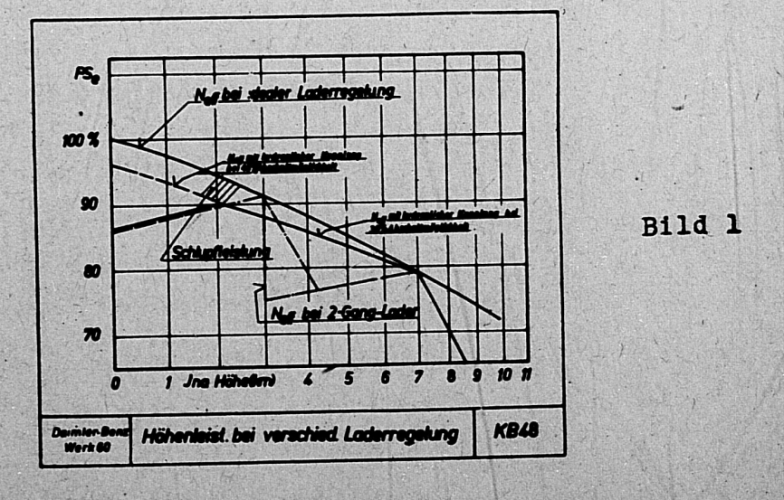
From the same source, the theoretical shapes of power curve with different supercharger configurations:
1766435794770.png
 
This sentence is cotradicting somewhat to that what you wrote before:

"The manifold pressure control system is really done by the Ladedruckregler (or Ladredruckwähler in DB 605D) + Leistungsklappe, not the supercharger variable speed mechanism."

My idea is, that the Ladedruckregler determins the oil supply to the hydraulic coupling and regulates the charge air pressure this way (in an ideal world).

Note, I mentioned cooling problems as one possible explanaition, but, as said, it might have been something else. I'm sure the initial development target was a "technically" ideal pressure regulation by the clutch, not the throttle.
 
Hi Nicknick,

The Ladedruckregler "just" control a throttle valve so that the Gebläsedruck doesn't exceed 1,30 ata (or 1,42 ata if the power level is in this position) below VDH. The more advanced Ladedruckwähler can control any excess pressure based on the pre-adjusted rpm/ata combinations below VDH. With both systems, if you want to fly with a reduced power setting (like Reiseleistung, for example) above VDH, you'll need to move the power lever to Kampfleistung and control the engine rpm by hand , otherwise you'll have restricted airflow into the manifold (Reglerklappe fully opened and Leistungsklappe partially closed).

The oil supply in the coupling is controlled by the quantity provided by the two pumps, which depends on engine rpm (one let it in at a fixed rate, and the other at variable rate based on outside pressure).
 
My ìdea is, that this throttle is not acting on the air stream but controling the flow of the oil.
 
Why not? Every partislly closed valve acts as a throttle. In German it would be totally normal "einen Ölvolumenstrom durch eine Drossel zu regulieren""
 
there is also another explaination, it could be, that the compressor was surging in one area and this was prevented by throtteling the intake side. even in this case, I eould regard it as a quick fix, since a better adapted compressor design would have been technically a better option. Of course, it was war and introducing a new design would have interrupted the production process, so they used an intake throttle instead.
 
Significant deviations in expected operation of the compressor occur with any problem with the oil system, at the time this happened a lot with sludging blocking the oil exit holes from the variable speed couplng, as the coupling`s very high speed acts as a perfect centrifuge which collects crud at its periphery, which is where the oil exits. This can mean the percentage oil filling is not as expected or commanded.

The regulation systems outside of the compressor speed are only really intended for minor corrections, and so you can get quite major deviations from the expected altitude power surve in the "slip" region of the coupling.

So in this way, deviations in the oil behaviour can change the boost operation.
 
It could shurly happen, but I doubt that an "official" German power curve measurement was done with blocked oil holes.
 
P&W also implemented fluid coupling variable speed control of the their 2 stage superchargers on later versions of the R2800, such as the -32W on the F4U-5. Do we know if they used that for boost control, or were they still throttling the flow at the injection carburetor as the primary boost control below critical altitude?
 
Whenever a fluid coupling was used, it was shurly intended as major device for boost regulation
 
P&W also implemented fluid coupling variable speed control of the their 2 stage superchargers on later versions of the R2800, such as the -32W on the F4U-5. Do we know if they used that for boost control, or were they still throttling the flow at the injection carburetor as the primary boost control below critical altitude?
Perhaps nitpicking, but the R2800 is a small engine by Rotec of c. 100 hp.
 
P&W also implemented fluid coupling variable speed control of the their 2 stage superchargers on later versions of the R2800, such as the -32W on the F4U-5. Do we know if they used that for boost control, or were they still throttling the flow at the injection carburetor as the primary boost control below critical altitude?
What I understand from Graham White's book on the R-2800 the -32W has two stages of supercharging in series:
an auxiliary stage (consisting of two impellers in parallel) and a main stage.

The auxiliary stage uses a hydraulic drive system with three settings: neutral, low blower, or high blower.
Two couplings are used: one for low blower and one for high blower.
The main stage always rotates at a fixed ratio.
Between both stages are the intercoolers and the up-draft carburettor.

An automatic engine control unit performs the function of an automatic boost control by operating and correlating the carburettor throttle with the supercharger drive coupling selector valve.
Constant manifold pressure is maintained by regulating the carburettor throttle in conjunction with the supercharger impeller speed.
 
What I understand from Graham White's book on the R-2800 the -32W has two stages of supercharging in series:
an auxiliary stage (consisting of two impellers in parallel) and a main stage.

The auxiliary stage uses a hydraulic drive system with three settings: neutral, low blower, or high blower.
Two couplings are used: one for low blower and one for high blower.
The main stage always rotates at a fixed ratio.
Between both stages are the intercoolers and the up-draft carburettor.

An automatic engine control unit performs the function of an automatic boost control by operating and correlating the carburettor throttle with the supercharger drive coupling selector valve.
Constant manifold pressure is maintained by regulating the carburettor throttle in conjunction with the supercharger impeller speed.
You made me dig out my copy of Graham White’s excellent book “R-2800 Pratt & Whitney’s Dependable Masterpiece”. Your description of the -32W two stage supercharger is correct, however on the -18W (F4U-4) and -32W (F4U-7) the auxiliary stage was controlled with hydraulic couplings, with one each for the Low Blower and one for the High Blower speed. There is a good description of the mechanics of the systems on pages 185 - 193. Re-reading, it appears the hydraulic couplings were used for engaging and disengaging the Low and High settings instead of clutches, and and not variable speed.

However, the -30W used on the F8F-2 did use a variable speed single stage supercharger with an automatic engine control unit with automatic boost control correlating the carburetor throttle with the supercharger drive coupling selector valve (page 204). The supercharger drive ratio varied from 7.29:1 to 10.55:1 (page 521, Fig 9.139). What I don’t know is whether the throttle remains full open once you reach critical altitude for the lowest drive ratio up thru the highest ratio.
 
Back
Top Bottom