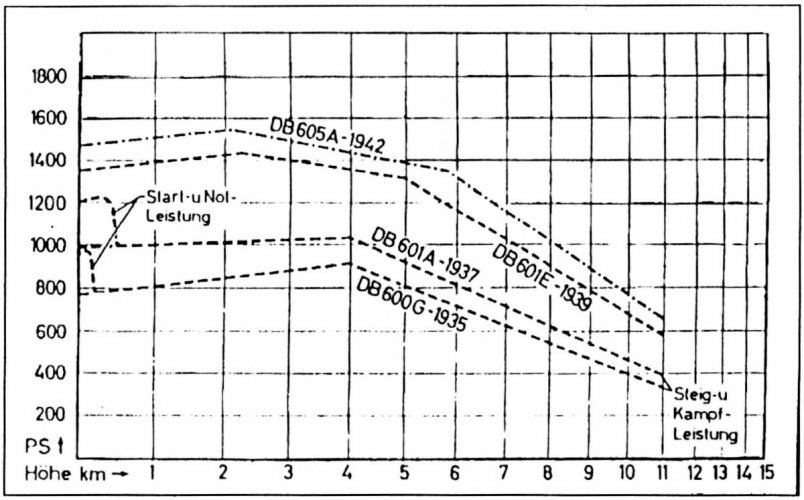
The Secret Horsepower Race by Calum Douglas (and piston engine discussion)

Hi Pasoleati,


So you have evidence of one incident and agree that it would be ridiculous to draw any conclusion from single incidents.

As stuff you claim something about usually turn out not to support what you say as soon as I can see it for myself, I'll just wait until there's more I can see for myself.

Regards,

Henning (HoHun)
No, I don't agree. Plus let me ask you again: Would a unit commander request that the training programme be shortened to 4.5 hours and 13 landings specifically to save engines without substantial evidence that the failures are caused by the training use?

Finnish National Archives are open to foreigners as well. You are free to gather all the evidence you want. Go ahead.

Meanwhile, some pertinent info. During the year 1943, when 48 G-2s in total (18 of which were replacements for losses arrived, the best engine achieved 86 hours before overhaul. No fewer than 10 engines failed. 16 engines had to be changed. 5 engines had bearing failures which were reclamated and 5 replacements were received. Disastrous performance! For comparison, the Twin Wasp engine of the Myrsky prototype ran over 230 hours before being removed for overhaul. And this at a time when DB engines received "factory tech support" while tech support for the Twin Wasp had ceased years, before.

What is more, regarding 1944, some statistics were compiled including "engine incidents "per flying hour, that is the number of aborted flights due to engine malfunction. The 109 (super-DB!) achieved 181 hours/engine incident. The Buffalo achieved 2100 hours/incident, the Curtiss Hawk did 666 hours/incident and even the crappy Morane 206 hours/incident. The relatively rare Merlin III achieved over 1000 hours/incident (during the service use in whole). The Jumo 211 achieved around 150 hours while the Bramo (Dornier Do 17) over 500 hours.

So of the 4 main fighters in 1944, the worst by far had that masterpiece DB. Again, manufacturer's tech support had ceased for all other 3 years, ago while DB had it most of the year. In fact, even the Klimov VK-105 was found to more reliable than the wonder DB; instead of blowing up, it wore loose over hours and lost some power.
 
Hi Pasoleati,

Finnish National Archives are open to foreigners as well. You are free to gather all the evidence you want. Go ahead.

You want to prove a point, so the burden of proof is entirely yours.

I'll not be responding to the rest of your post because it's a classical diversion (sleight of hand #29 in Schopenhauer's "Eristic Dialectic") to distract from the fact that you can't defend the point you originally made.

Regards,

Henning (HoHun)
 
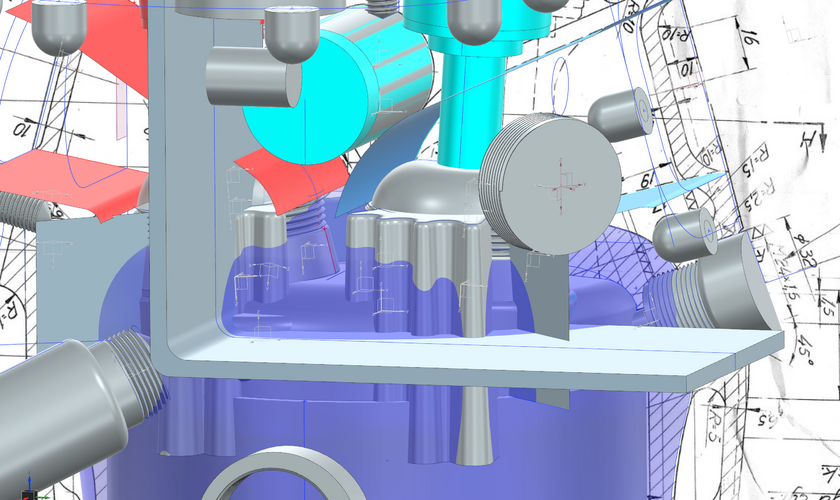
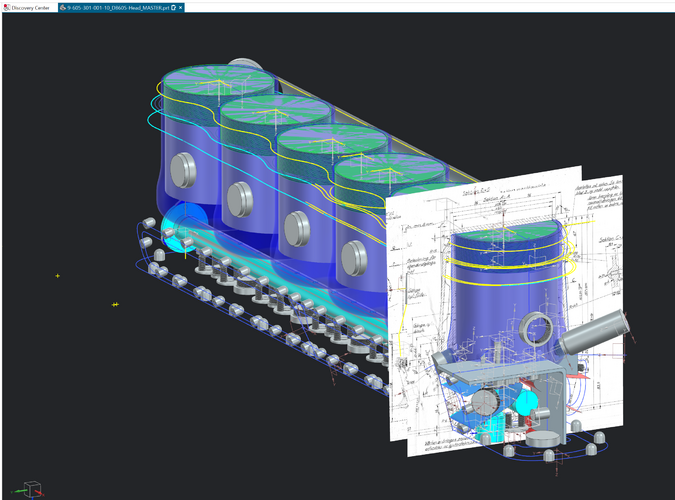
Reproducing can be more work than a new design. No CAD system can create filets as reliable as the thumb of a mold maker... Are you sure, that the original castings are exactly as designed in the drawings? It wasn't so uncommon in older engine design, that there are some discrapancies.

Are you doning it just for fun, or for a reproduction?

I have the great pleassure, to design a new aero engine...
 
Reproducing can be more work than a new design. No CAD system can create filets as reliable as the thumb of a mold maker... Are you sure, that the original castings are exactly as designed in the drawings? It wasn't so uncommon in older engine design, that there are some discrapancies.

Are you doning it just for fun, or for a reproduction?

I have the great pleassure, to design a new aero engine...
This is just for "fun" at the moment, although it will be a pretty much flightworthy geometry afterwards, if it then did have to go and get made, you would get an original head CAT scanned and do a CAD overlay to check if any ad-hoc mods were made. It should be pretty good however as the drawings are not what we`d call "machining drawings" these days, they dimension very large areas of the casting too, and the pattern makers would have almost certainly carved the patterns using this as the basis. So probably the CAT scan would just confirm/provide a few slightly ambigous dimensions on the drawing, rather than provide any huge changes.
 
I see it in the drawing, they didn't make seperate drawings/designs for mashining and casting those days. Quite a difference to modern 3d designs, here the mold maker really had to interpret a lot. From what I heard (old autmotive world) the design of complex parts was often done with many iterations between the mold makers and the design department.

I hope we get to see a presentation of the final design!
 
I see it in the drawing, they didn't make seperate drawings/designs for mashining and casting those days. Quite a difference to modern 3d designs, here the mold maker really had to interpret a lot. From what I heard (old autmotive world) the design of complex parts was often done with many iterations between the mold makers and the design department.

I hope we get to see a presentation of the final design!
It takes a LONG time to make in 3D from the drawings.

Even the details take ages, most of the threads are all some "extra special fine pitch" etc so I`ve had to draw most of them from scratch.
 
You could have choosen the easier way by starting with the scan, but so it is surly more fun and you make as intended without the disturbance of worn out molds warping etc..

I once redesigned a Diesel cylinder head out of quite tricky scanned data. It was done by another company which scanned the complete (section) of the head, than they cut it into three peaces and arranged the peaces in the exact position like they have been before the cutting. As a result, you get an almost complete inside geometry of the head (exept the slits from cutting). It was relativly cheap compared to x-ray and very precise. I did not a one by one copy, but used the (redesigned) port geometry and quite similar water cores, but with a different spacing and slightly different bolt positions. Even the valve seat geometry could be redesigned out of the scan data.

For obvious reasons, you wouldn't cut an old DB-605 head into peaces...
 
You could have choosen the easier way by starting with the scan, but so it is surly more fun and you make as intended without the disturbance of worn out molds warping etc..

I once redesigned a Diesel cylinder head out of quite tricky scanned data. It was done by another company which scanned the complete (section) of the head, than they cut it into three peaces and arranged the peaces in the exact position like they have been before the cutting. As a result, you get an almost complete inside geometry of the head (exept the slits from cutting). It was relativly cheap compared to x-ray and very precise. I did not a one by one copy, but used the (redesigned) port geometry and quite similar water cores, but with a different spacing and slightly different bolt positions. Even the valve seat geometry could be redesigned out of the scan data.

For obvious reasons, you wouldn't cut an old DB-605 head into peaces...
Might be possible to cut up one from a non-airworthy piece, especially if it's got non-repairable cracks or whatever, so that you could make new cores for castings.
 
Might be possible to cut up one from a non-airworthy piece, especially if it's got non-repairable cracks or whatever, so that you could make new cores for castings.
Its better to CAT scan a new one, with non-ferrous parts, the CAT scan can actually give you discrete 3D zones of the core and metal volumes. It costs a lot, but if you cant afford a CAT scan you DEFINETLY cant afford to make a DB605...:) or indeed any flightworthy WW2 V12.
 
My interview with A. A. Griffith`s son, pioneer of the axial jet, now live on YouTube, where we discuss the "Whittle Debacle" and many other things about his fathers work.
I mean, centrifugal compressors were pretty well understood from the supercharger and then turbocharger development, and appealed to the "you get more compression per stage" mentality (edit) because they make about 7:1. As opposed to only getting 1.2-1.5:1 compression per axial stage back then. Today, they're up to something like 2.2:1 per axial stage! (edit) Which means 3 axial stages can get you 10.65:1 compression.
 
Last edited:
Turbochargers development was just in the beginning, despite having been used in experimental aircrafts long before.


The Swiss (especially Mr. Büchi) has also contributet quite a lot to axial turbine development (e.g. the first gas turbine locomotive Am 4/6 1101) and I would have like to know, how much know how from there was used in the German and British jet propulsion development.
 
Its better to CAT scan a new one, with non-ferrous parts, the CAT scan can actually give you discrete 3D zones of the core and metal volumes. It costs a lot, but if you cant afford a CAT scan you DEFINETLY cant afford to make a DB605...:) or indeed any flightworthy WW2 V12.
I can imagine it now...

Hospital radiologist: "You want me to scan WHAT???" :D
 
Well, I asked an ex-girlfriend who was a doctor in a clinic if I could have a scan of a cylinderhead and her reaction wasn't very positive either...
 
Thank you for the feedback.
It is very unfortunate that the 'contamination' by indium story is not backed up by an exact and known source in the book.
I recently found an email contact for Graham White, and received this response from him regarding the German indium “contamination” conclusion regarding the US lead / silver plain bearings.

“Thank you for your enquiry about R-2800 bearings. I wrote the 2800 book over 30 years ago so therefore I have lost a lot of the information used to write it. I would assume that the lead/indium statement came from a P&W SMR (Short Memorandum Report) obtained from the P&W archives located in E. Hartford. However, I doubt if the archives even exist today. There is also the possibility that the information was obtained from NARA (National Archives and Records Administration) located in College Park, Maryland.

I apologize for not being able to answer your query more specifically.

Best regards, Graham.”

Unfortunately, even the author no longer has the source reference to that statement.
 
I just wanted to reach out and say congratulations, @Calum Douglas, on your incredible book! I honestly haven't been excited to read anything since grade school, but your work completely changed that. I enjoyed every single page, from front to back. Since your book was so phenomenal, I'd love to know: what books do you recommend I read next?
 
Last edited:
I'd love to know: what books do you recommend I read next?
Calum probably waits until you indicate what exactly you are interested in, and what not.
In the mean time I would suggest you consider this book by Ralph Pegram (forum member Schneiderman). Could be considered as a prequel to Calum's book:

1762347995766.jpeg

Another book that might be of interest to you could be "The Power to Fly, The Development of the Piston Engine in Aviation" by L. J. K. Setright, however it will be very difficult to find a second hand copy of this sold out book for a fair price:

1762348385221.jpeg

Calum published, together with Dan Sharp (forum member newsdeskdan) a book on the Me 309.
Moreover Dan published many books and bookazines, using primary sources (archives), on WW2 aircraft such as Me 262, Me 328, He 162 and many more.

Calum regularly posts messages on twitter (x.com) that may be of interest to you, for example yesterday on German avgas:
View: https://x.com/CalumDouglas1/status/1985494860401406085

You can also find interesting info on his website https://www.calum-douglas.com/ and on his linkedin page and youtube page.

He sometimes mentions a book that he liked, for example:
View: https://x.com/CalumDouglas1/status/1788273831771062302

Note that this is about jet engines, not piston engines.
 
Calum probably waits until you indicate what exactly you are interested in, and what not.
In the mean time I would suggest you consider this book by Ralph Pegram (forum member Schneiderman). Could be considered as a prequel to Calum's book:

View attachment 790545

Another book that might be of interest to you could be "The Power to Fly, The Development of the Piston Engine in Aviation" by L. J. K. Setright, however it will be very difficult to find a second hand copy of this sold out book for a fair price:

View attachment 790546

Calum published, together with Dan Sharp (forum member newsdeskdan) a book on the Me 309.
Moreover Dan published many books and bookazines, using primary sources (archives), on WW2 aircraft such as Me 262, Me 328, He 162 and many more.

Calum regularly posts messages on twitter (x.com) that may be of interest to you, for example yesterday on German avgas:
View: https://x.com/CalumDouglas1/status/1985494860401406085

You can also find interesting info on his website https://www.calum-douglas.com/ and on his linkedin page and youtube page.

He sometimes mentions a book that he liked, for example:
View: https://x.com/CalumDouglas1/status/1788273831771062302

Note that this is about jet engines, not piston engines.
Thank you!
 
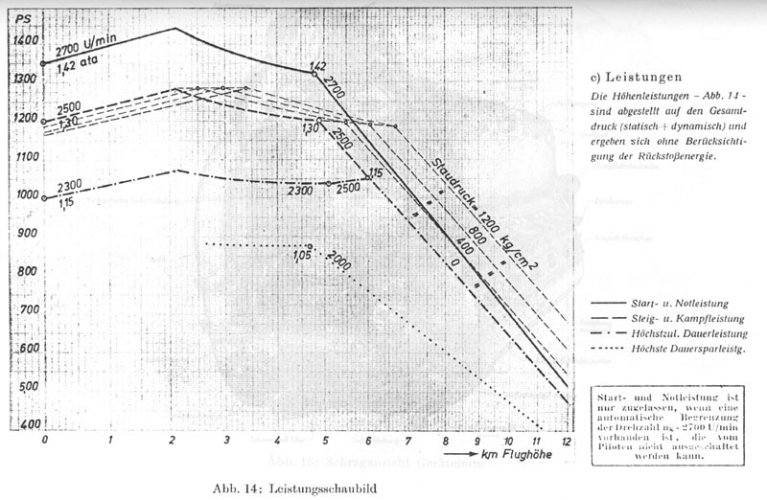
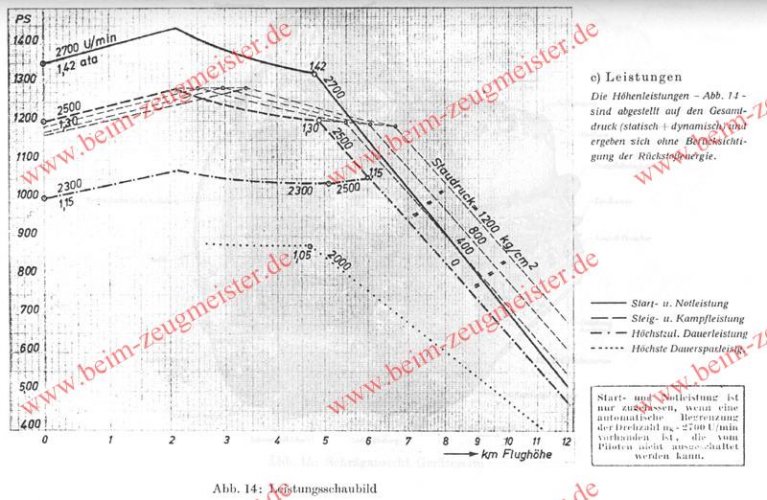
These are the right power curves for the 601 with C2 fuel, correct?
DB601En_tehokäyrät_LW_A0001_B019.jpg
Have you ever come across documents concerning hydrogen peroxide injection into piston engines?
 
Yes, but its my understanding that ~1400PS was only achieved with C2 fuel. The switch to C3 led to a dropping of power.

EDIT: there is also this graph from an unknown source
db 601 engines.jpg
 
Last edited:
Hi Sienar,

Yes, but its my understanding that ~1400PS was only achieved with C2 fuel. The switch to C3 led to a dropping of power.

Wasn't the DB 601E normally run on B4? The "conventional" values for 2700 rpm/1.42 ata are 1350 PS at sea level, 1320 PS at 4.8 km. In between these two altitudes, it would obviously have a somewhat higher power, exceeding 1400 PS at just above 2 km.

Regards,

Henning (HoHun)
 
These are the right power curves for the 601 with C2 fuel, correct?
View attachment 794791
Have you ever come across documents concerning hydrogen peroxide injection into piston engines?
Independently from the fuel question, this chart is intresting because it shows directly the influence of the Staudruck (dynamic intake pressure). I remember that "we" (don't remember who) had a discussion about this in which one person claimed it wouldn't have any significant influence on sea level or any other altitude before the max. charge pressure can no longer be supplied by the charging system. This clearly prooves it was wrong.
 
Independently from the fuel question, this chart is intresting because it shows directly the influence of the Staudruck (dynamic intake pressure). I remember that "we" (don't remember who) had a discussion about this in which one person claimed it wouldn't have any significant influence on sea level or any other altitude before the max. charge pressure can no longer be supplied by the charging system. This clearly prooves it was wrong.
You absolutely can get significant ram pressure.

I remember one of the motorcycle magazines rigged up a manometer in the nose of one of the first sportbikes to have a ram air inlet, and at 60mph they had +1"Hg pressure.
 
Shure, but the point was, does ram air make a difference in max power at altitudes before the compressor runs out of steam.
 
A question connected to fuels: Will there really be a significant difference if you run an engine on say, B4 or C3 as long as you don't get knocking? For example, say I fill up a Bf 109 E-4 which usually runs on B4, with C3, I thought you would not see that much difference?

For sure, AFAIK the fuel constituents (aromatics etc) in say C2 and C3 fuel are different (which was why DB 601 N's run on C3 got into trouble with diluted oil), but I would have assumed that the actual power output as long as you have decent fuel is more proportional to the boost pressure and as long as your engine is not knocking, souping up with higher octane fuel will not give you much of a benefit?
 
My guess is, the German expierienced a contemporay phaenomenon called ''low speed pre ignition''. The synthetic fuels had high oktan numbers but reacted with the rubber of the self sealing fuel tanks or engine oil. Something similar was (and to a lower degree propably still is) happening with modern DI engines. Here, the fuel hits the cylinder wall and mixes with the oil in the ringland. This mixture produces dangerous compinents which can cause a very advanced pre ignition leadung to super.knock phaenomenons which can kill engines with a single event. The reason is fully understood since about 10 years, it was kind of bad luck running into this problem.
 
That thing you mention about some types of fuels reacting with seals leading to unintended results rings a bell, and IIRC then the Germans did run into those kinds of problems. But what I was most curious about was that there was a question connected to a power altitude chart above and if it was with C2 fuel, and my belief so far has been that the power was more or less fixed by the rpms and boost pressure for a particular engine, not if it was run on B4 or C3 (provided if was cleared to run on B4 at that that boost pressure of course). But for sure, a different fuel in the fuel system rather than that it was designed for, and that reacts chemically with things in it, producing new unintended compounds could of course lead to "interesting" results no doubt. ;)
 
Running on C3 instead of B4 allows running at a higher boost pressure and consequently deliver more BHP.
The chemical composition difference of C3 versus B4 will have very little effect on delivered BHP.
All this is provided the C3 does not damage engine parts.

Shure, but the point was, does ram air make a difference in max power at altitudes before the compressor runs out of steam.
That depends on whether you are looking at a Merlin (or Allison V-1701) that maintains boost pressure up to FTH by adjusting a throttle valve , or whether you are looking at a DB engine that has a variable speed drive for the supercharger.

A Merlin below FTH does not benefit from ram pressure as that would only result in less opening of the throttle valve (so as not to exceed set boost pressure) without saving supercharger power. Ram pressure will increase the FTH (compared to no ram) and the BHP above FTH.

A DB with a variable speed drive will benefit from ram pressure at all altitudes. Below FTH it saves some supercharger power and thus increases BHP. Like with the Merlin, ram pressure will increase the FTH (compared to no ram) and the BHP above FTH.


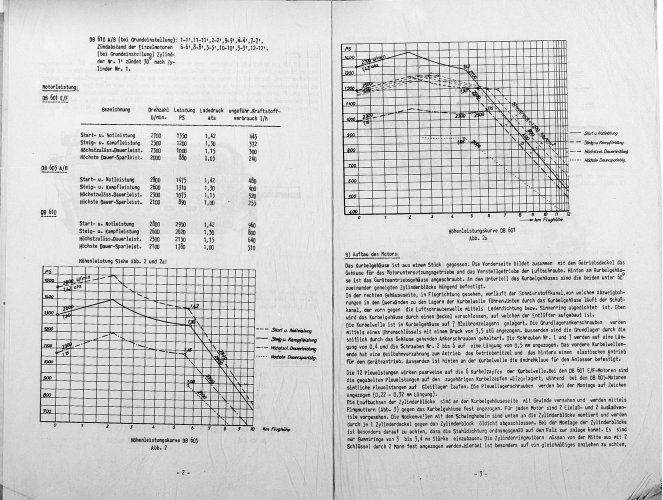
In addition to the graphs posted by Sienar and Hohun I attach similar with some text.
I don't remember where I ever found those:
 

Attachments

  • DB 605 & DB 601 curves.jpg
    DB 605 & DB 601 curves.jpg
    823.7 KB · Views: 22
Hi Nicknick,

Shure, but the point was, does ram air make a difference in max power at altitudes before the compressor runs out of steam.

Here's a post by Peter Achs quoting a booklet on WW2-era BMW methods of establishing engine power curves for ram effect:


While they don't explain the physics, the power reduction below full throttle height incurred by ram effect follows naturally by applying their suggested graphical extrapolation from the newly calculated rammed full-throttle-height power data points.

Regards,

Henning (HoHun)
 
A question connected to fuels: Will there really be a significant difference if you run an engine on say, B4 or C3 as long as you don't get knocking? For example, say I fill up a Bf 109 E-4 which usually runs on B4, with C3, I thought you would not see that much difference?
If the boost remains the same, the power will remain the same.
 
If the boost remains the same, the power will remain the same.

No, you need to take the charge air temperature and the compressor power consumption into account. This is different for every engine configuration.

Below the critical altitude, every engine should be able to reach the full boost pressure, but as we see in the curves, the power output varies.

When a throttle is used to keep the boost pressure constant, the pressure ratio in the charging system and the power consumption remains constant independently from ram air or not, as long as no switching into the next stage/drive gear is necessary. However, ram air enables to stay longer in the lower stage/gear, and in the altitude difference (with/without ram air) between switching to the next gear/stage, the engine will benefit from ram air.

When a variable drive ratio is used, the ram air lowers the amount of energy consumed by the charging system, since a variable pressure ratio is produced by the compressor. This will increase the engine output power. Since ram air is more efficient (the power adsorbed by the drag is not regarded), the charge air temperature will also be lower, since more of the compression is done with an very High isentropic efficiency. The German engines usually had no charge air cooler, so that they will benefit more from ram air, than the Allied engines which mostly had charge air coolers.
 
Last edited:
Hi Nicknick,


Here's a post by Peter Achs quoting a booklet on WW2-era BMW methods of establishing engine power curves for ram effect:


While they don't explain the physics, the power reduction below full throttle height incurred by ram effect follows naturally by applying their suggested graphical extrapolation from the newly calculated rammed full-throttle-height power data points.

Regards,

Henning (HoHun)
Note that the images in that link are only accessible for members of that forum.

As they "don't explain the physics" I tend to distrust their estimated "power reduction below full throttle height incurred by ram effect follows naturally by applying their suggested graphical extrapolation from the newly calculated rammed full-throttle-height power data points". What does that hocus pocus even mean?

The effect of ram pressure on BHP can easily be calculated for a DB or BMW or Merlin engine by using simple physics. No "graphical extrapolation" required. Any author that comes up with claims that are not supported by physics should be mistrusted, no matter how many fancy titles that person has.

The suggestion that below FTH ram pressure reduces BHP of a DB601 engine, like in the graphs that were posted above, seems very suspect, as physics would predict the opposite.
Note also that the indicated values of "Staudruck" (ram pressure) up to 1200 kg/cm2 are ABSURD.
The manifold pressure is only 1.42 kg/cm2 (= 1.42 ata). In reality the Staudruck will be less than 0.1 kg/cm2.
Maybe the person who made that graph meant 1200 kg/m2 = 0.12 kg/cm2 but even that would likely not be reached.

As long as you don't get detonation.
Sure, but the point was: running on C3 instead of B4 does not by itself increase BHP if the manifold pressure (boost) remains controlled at the same setting.
C3 merely allows the pilot to operate at a higher boost, which would then result in increased BHP.
 
It is in line with what I wrote
Exactly these words I've had in mind (my underscore):

Sure, but the point was: running on C3 instead of B4 does not by itself increase BHP if the manifold pressure (boost) remains controlled at the same setting.

This is my last comment on that topic.
 
Hi Dagger,

Note that the images in that link are only accessible for members of that forum.

Oh, I'm sorry - I wasn't aware of that. Well worth joining though, it's a very similar forum to this one, albeit with a more general focus on aviation.

The suggestion that below FTH ram pressure reduces BHP of a DB601 engine, like in the graphs that were posted above, seems very suspect, as physics would predict the opposite.

If you really want the full story, Hooker explains it in the booklet discussed here:

I'll leave it at that as it's sort of offtopic here.

Regards,

Henning (HoHun)
 
Back
Top Bottom