That would be a smart move I would think kqcke for you, having partner nations along similar lines like how the F-35 is organised in Tier systems.
 
I presume Germany will be offered CCA and cloud for UK/ITALY, for that it will be a few billions in and 150 GCAPs bought.
 
Can anyone figure out what the First Sea Lord is talking about here:

"We will get a demonstrator for our fast jet fighter capability off the carrier next year, because it’s a key component of Atlantic Strike, we’re working closely with the Air Force to make sure that we can develop together, transform together."

https://www.royalnavy.mod.uk/news/2025/december/08/20251208-1sl-sea-power-conference-speech
But for 'off the carrier' I'd assume he meant the Flying Combat Air Demonstrator, and the 'demonstrator' rules out F-35B.
 
Can anyone figure out what the First Sea Lord is talking about here:

"We will get a demonstrator for our fast jet fighter capability off the carrier next year, because it’s a key component of Atlantic Strike, we’re working closely with the Air Force to make sure that we can develop together, transform together."

https://www.royalnavy.mod.uk/news/2025/december/08/20251208-1sl-sea-power-conference-speech
But for 'off the carrier' I'd assume he meant the Flying Combat Air Demonstrator, and the 'demonstrator' rules out F-35B.
I presume it is either some demonstrator under the ACP program like a mosquito successor, or it is the gambit 5.
 
I presume it is either some demonstrator under the ACP program like a mosquito successor, or it is the gambit 5.
It looks like it likely is an unmanned demonstrator, but AIUI, Gambit 5 is planned to be fitted for Air to Air, while Atlantic Strike is specifically a strike capability, so an unmodified Gambit 5 seems unlikely to match, especially if the RN are using the Vixen requirement for 2x 500Kg 'payloads'. OTOH wasn't the BAE Systems ACP due to fly next year?

https://www.navylookout.com/general...ucav-concept-for-qec-class-aircraft-carriers/
"1SL confirmed that a demonstrator for uncrewed fast-jet operations from the carrier will fly next year, and says the RN and RAF are genuinely in lock-step developing their approach together."

https://www.navylookout.com/first-sea-lord-issues-blunt-warning-we-need-to-be-ready-to-fight/
 
Do we know what will happen to the japanese F-15? I mean we know atleast are going to the JSI standard but i doubt all will be upgraded so it seems logical that GCAP would fill that role.

Edith: i looked at the MoD graphic and it seems that i completly forgot that most Go into the F-35. Tho there graphic for 2022 still leaves a 33 fighter gap.
The plan is to convert 100 of the 200 aircraft to JSI.
However, there have been delays in JSI development in the US, and the conversion may not be completed until 2035.
Furthermore, the cost of the new F-15EX is roughly the same as the cost of converting to JSI, making the cost too high.
There is a possibility that some orders may be cancel.
 
The plan is to convert 100 of the 200 aircraft to JSI.
However, there have been delays in JSI development in the US, and the conversion may not be completed until 2035.
Furthermore, the cost of the new F-15EX is roughly the same as the cost of converting to JSI, making the cost too high.
There is a possibility that some orders may be cancel.
If the cost of converting to JSI really is the same as buying a whole brand new EX, I cannot see the JSI project completing. I just see Japan buying new EXs, whether produced in the US or in Japan.
 
If the cost of converting to JSI really is the same as buying a whole brand new EX, I cannot see the JSI project completing. I just see Japan buying new EXs, whether produced in the US or in Japan.

Japan has never really evaluated the cost of indigenous projects against the market. The F-2, for example, cost between $98 and $122 million apiece depending on how you look at expenditure. They could have had three F-16s or an F-22 for that price.

Given tensions in the region and local industry work security I reckon JSI will have to proceed.
 
Flight Global reported back in July that the number of F-15Js slated for upgrade has been cut to 54. Unfortunately, this figure has kept shrinking over time: the original plan called for 98, then it dropped to 68, and now it stands at only 54. It seems that just two (?) JASDF squadrons will operate the F-15JSI. :confused:
Tokyo to reduce number of F-15Js to be upgraded

By Greg Waldron |15 July 2025

Japan remains committed to an ambitious upgrade programme for its Boeing F-15J fighters but has reduced the number of aircraft involved.

In its 2025 Defense of Japan white paper, the Japan Ministry of Defense (JMOD) states that 54 examples will be upgraded. Previously, Japanese officials had suggested the upgrade would affect approximately 70 aircraft.
https://www.flightglobal.com/fixed-...umber-of-f-15js-to-be-upgraded/163789.article
 
Flight Global reported back in July that the number of F-15Js slated for upgrade has been cut to 54. Unfortunately, this figure has kept shrinking over time: the original plan called for 98, then it dropped to 68, and now it stands at only 54. It seems that just two (?) JASDF squadrons will operate the F-15JSI. :confused:

https://www.flightglobal.com/fixed-...umber-of-f-15js-to-be-upgraded/163789.article
Then whats the plan for the rest of the fleet/ fighters? Staying with the old standard or?
 
That is what I would like to know kqcke for you. Whether Japan is going to follow the Wests example and reduce the number of fighters in their fleet or start to design a new fighter or another thing would be is to buy more GCAP/Tempest's or to replace the F-15Js which are getting rather old.
 
It looks like it likely is an unmanned demonstrator, but AIUI, Gambit 5 is planned to be fitted for Air to Air, while Atlantic Strike is specifically a strike capability, so an unmodified Gambit 5 seems unlikely to match, especially if the RN are using the Vixen requirement for 2x 500Kg 'payloads'. OTOH wasn't the BAE Systems ACP due to fly next year?

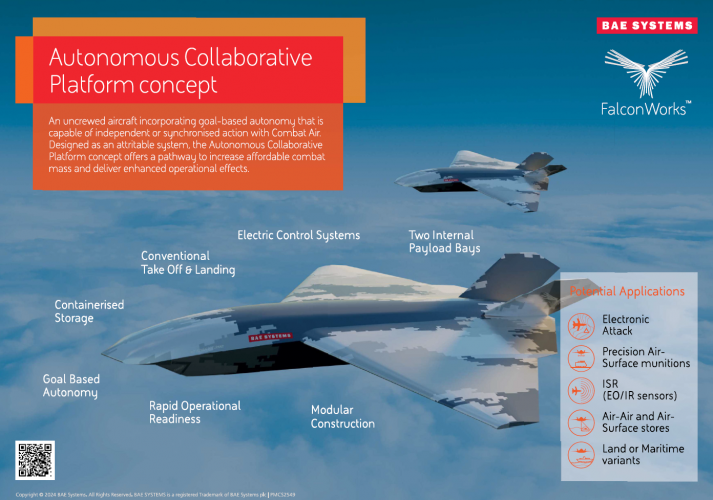
Yes the BAE Class 2 ACP was reported to be aiming for first flights approx. early 2026. "Land or maritime variants" (see image attached).

Flight Global article - February 2024
https://www.flightglobal.com/defenc...ator-will-fly-within-two-years/156791.article
"BAE Systems has revealed the design of an autonomous collaborative platform (ACP) demonstrator which it aims to fly within the next two years."

“We have a programme laid out until it gets to first flight within two years. To take the programme much further, we are going to need a partner to help us develop the programme, and develop it in the right direction.

“We are actively looking for industrial partners to be able to come on board, so that we can produce the very best product in the best timescale.”

Also to note from Sept this year:

https://www.baesystems.com/en-uk/insight/crewed-and-uncrewed-synthetic-demonstration
"BAE Systems and QinetiQ have successfully completed synthetic trials to show how uncrewed aircraft can operate alongside existing crewed aircraft like Typhoon to provide a more cost-effective and flexible concentration of combat air power. "

"The trials will inform other programmes, including the design and development of Tier 2 Autonomous Collaborative Platforms (ACPs) and wider multi-sector interoperability. "

 

Attachments

  • Class 2 ACP.png
    Class 2 ACP.png
    800.1 KB · Views: 202
Last edited:
What do they mean by Electric Control system? Is that active flow with electro-forcing or, oddly*, simply FBW? Notice that there is no ailerons/Elevons to be seen here (but a V-tail).

*There is obviously no human to pull a stick linked by cables to the governs...
 
Last edited:
Electro-mechanical rather than electro-hydraulic or electro-pneumatic actuators for control surfaces. Electro-mechanical are used a lot in small drones and in some aircraft functions which don't require a lot of force like secondary surfaces but they haven't generally been used for primary control surfaces due to strength and reliability concerns. I think one of the first large drones to use them for primary control surfaces is the Ghost Bat which uses actuators manufactured by Saab.
 
Electro-mechanical rather than electro-hydraulic or electro-pneumatic actuators for control surfaces. Electro-mechanical are used a lot in small drones and in some aircraft functions which don't require a lot of force like secondary surfaces but they haven't generally been used for primary control surfaces due to strength and reliability concerns. I think one of the first large drones to use them for primary control surfaces is the Ghost Bat which uses actuators manufactured by Saab.
You can cheat the work a little. Put the EM actuators onto a nice servo tab that pulls the control surface in the desired direction.
 
F-2: $100m
F-16: $60m
Your own aerospace industry: Priceless
The initial estimate for the F-2 did not include the cost of avionics development. Initially, joint development began with the promise that the United States would provide avionics. However, the U.S. Congress reneged on its promise and did not provide avionics to Japan.
As a result, Japan had to develop its own avionics from scratch.
Because this cost is included, I think the price, although high, is reasonable.
 
The initial estimate for the F-2 did not include the cost of avionics development. Initially, joint development began with the promise that the United States would provide avionics. However, the U.S. Congress reneged on its promise and did not provide avionics to Japan.
As a result, Japan had to develop its own avionics from scratch.
Because this cost is included, I think the price, although high, is reasonable.

They also ended up with an AESA radar years ahead of everyone else.
 
FS-X RAND Study

About time to re-reccomend this RAND study into the F-2 programme. Japan wanted to indigenously develop a new fighter jet for their Industry. They achieved this by completely redesigning the F-16 to address their needs, lowering technical risk compared to indigenous, and maintaining political relationships with USA. It might have cost more than buying F-16s off the shelf, but that was never the objective.
 
Yes the BAE Class 2 ACP was reported to be aiming for first flights approx. early 2026. "Land or maritime variants" (see image attached).

Flight Global article - February 2024
https://www.flightglobal.com/defenc...ator-will-fly-within-two-years/156791.article
"BAE Systems has revealed the design of an autonomous collaborative platform (ACP) demonstrator which it aims to fly within the next two years."

“We have a programme laid out until it gets to first flight within two years. To take the programme much further, we are going to need a partner to help us develop the programme, and develop it in the right direction.

“We are actively looking for industrial partners to be able to come on board, so that we can produce the very best product in the best timescale.”

Also to note from Sept this year:

https://www.baesystems.com/en-uk/insight/crewed-and-uncrewed-synthetic-demonstration
"BAE Systems and QinetiQ have successfully completed synthetic trials to show how uncrewed aircraft can operate alongside existing crewed aircraft like Typhoon to provide a more cost-effective and flexible concentration of combat air power. "

"The trials will inform other programmes, including the design and development of Tier 2 Autonomous Collaborative Platforms (ACPs) and wider multi-sector interoperability. "
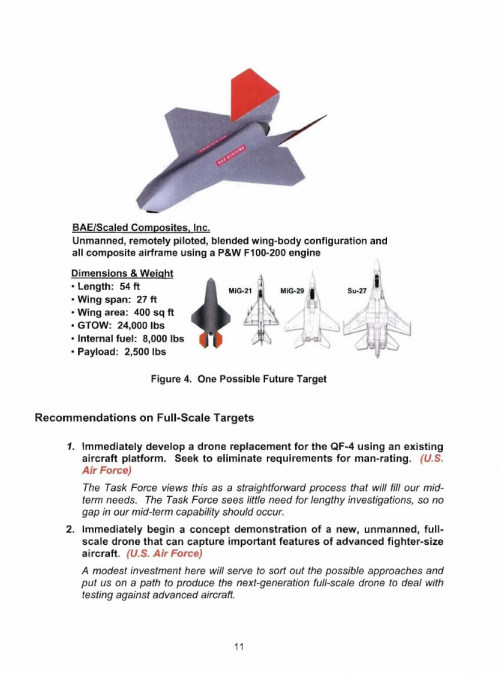
Looks similar to when we did Fighter Size Target (predecessor to 5GAT) back in 2005) at BAE-Mojave with Scaled. We (BAE) had Scaled design the airframe for us and BAE, we did all the systems/subsystems work. The front of this aircraft concept looks very similar our BAE FST. Our FST looked like a single engine F-23 (diamond wing and v-tails).
 
Looks similar to when we did Fighter Size Target (predecessor to 5GAT) back in 2005) at BAE-Mojave with Scaled. We (BAE) had Scaled design the airframe for us and BAE, we did all the systems/subsystems work. The front of this aircraft concept looks very similar our BAE FST. Our FST looked like a single engine F-23 (diamond wing and v-tails).

It does look to be from that design lineage. Interesting to hear about the work share split on the airframe & systems/subsystems.

It will be interested to see where it sits cost wise. Are they aiming for cost similar to General Atomics YFQ-42A, or something between YFQ-42A and the LM Vectis. The diamond wing providing more fuel fraction than I'd expect YFQ-42A or the Ghostbat to have.

Image attached from doc: https://apps.dtic.mil/sti/citations/ADA441466
 

Attachments

  • BAE, Scaled Composites.png
    BAE, Scaled Composites.png
    336.1 KB · Views: 127
It does look to be from that design lineage. Interesting to hear about the work share split on the airframe & systems/subsystems.

It will be interested to see where it sits cost wise. Are they aiming for cost similar to General Atomics YFQ-42A, or something between YFQ-42A and the LM Vectis. The diamond wing providing more fuel fraction than I'd expect YFQ-42A or the Ghostbat to have.

Image attached from doc: https://apps.dtic.mil/sti/citations/ADA441466
would love to see some more info on that, the question is how are they going to make it carrier capable without arrestor gear.
 
It does look to be from that design lineage. Interesting to hear about the work share split on the airframe & systems/subsystems.

It will be interested to see where it sits cost wise. Are they aiming for cost similar to General Atomics YFQ-42A, or something between YFQ-42A and the LM Vectis. The diamond wing providing more fuel fraction than I'd expect YFQ-42A or the Ghostbat to have.

Image attached from doc: https://apps.dtic.mil/sti/citations/ADA441466
Notice that the Scaled design ended up like the F-23 but 5GAT (which I also worked on) looked more like the F-22 due the former Lockheed Skunk Works gray-beards which were great guys to work with. Since I had worked for Northrop and on YF-23, I was referred to as the other guy who worked for Brand X, all in fun though.
 
would love to see some more info on that, the question is how are they going to make it carrier capable without arrestor gear.
A good question, the Project Vanquish brief is for non-arrested landing. Though the BAE class 2 is listed with maritime variant's we don't know if it's expected to land with or without arresters.

https://www.find-tender.service.gov.uk/Notice/062294-2025"It should be able to launch and recover to QEC without Catapults or Arrested Recovery Systems and with a credible payload and endurance. There must be an exploitation pathway to the delivery of a wide range of maritime mission sets in support of UK Carrier Strike in due course (ISR/Strike/Air-Air Refuelling), to compliment F35B LIGHTNING, as part of QEC and its Carrier Air Wing. "

It maybe that limiting landing to non-arrested is not worth the technical trade off... But if they're planning flight trails next year + Vanquish brief you'd assume they'd already decided on the approach for the planned jet. We'll find out at some point.

Something being able to provide a meaningful amount of Air-Air refueling (+ other mission set requirements listed), and land without arresters ... will be interested to see what they come up with.
 
A good question, the Project Vanquish brief is for non-arrested landing. Though the BAE class 2 is listed with maritime variant's we don't know if it's expected to land with or without arresters.

https://www.find-tender.service.gov.uk/Notice/062294-2025"It should be able to launch and recover to QEC without Catapults or Arrested Recovery Systems and with a credible payload and endurance. There must be an exploitation pathway to the delivery of a wide range of maritime mission sets in support of UK Carrier Strike in due course (ISR/Strike/Air-Air Refuelling), to compliment F35B LIGHTNING, as part of QEC and its Carrier Air Wing. "

It maybe that limiting landing to non-arrested is not worth the technical trade off... But if they're planning flight trails next year + Vanquish brief you'd assume they'd already decided on the approach for the planned jet. We'll find out at some point.

Something being able to provide a meaningful amount of Air-Air refueling (+ other mission set requirements listed), and land without arresters ... will be interested to see what they come up with.
It’s going to be very interesting to see, I’ve heard the technique could involve some active flow controls
 
Why not? UAS face a new paradigm in term of landing mass, available lift, structural design, power ratio and safety requirements like impact load etc... They might not need arrested landings depending of their design mission. Some might do as well with overbuilt brakes, landing parachute, landing barrier, lowered design life criteria etc...
 
The physics of lowering stall speed to a reasonable number are not easy... let's say the requirement is Vs=80kts, with a Vpa of 95kts (1.2 Vs), this would give you a deck speed of ~75kts (assuming ~20kts wind over deck).

Now determine braking from 75kts to 0 in ~180m (available deck length is ~210m, less safety margin), that's ~0.42g deceleration. Factor in braking effectiveness on a wet deck, additional safety margins etc.

Doable? At a stall speed of 80 knots, probably. But every knot of speed increase above that will make it harder and harder.
 
You are applying airplane physics and landing geometry to a crewless vehicle with no durability requirements. My post was all about having better imagination ;)
 
That would be my expectation as to what they're going to do. Also, it means that the stores separation tests can be run concurrently once there are at least 3 airframes available.
In theory yes but in practice no. Even for a flight test campaign with multiple flight test vehicles each vehicle is configured for different types of test. The primary difference is instrumentation. The first flying article would be aerodynamics and flight air-data systems verification instruments, things like pitot tubes, control surface encoders so you know what real deflections are, torque and strain gauges to check control surface loads (a lot of stuff). With all the instrumentation devoted to aero and air data systems, you’d run out of telemetry channels to do anything else. This is repeated for different disciplines, one might be instrumented for aero-loads, or for flutter testing, engine integration test, spin test. This is why you need at least half a dozen prototype aircraft before you build your first production aircraft.

Meaning that vehicle wouldn’t be equipped with things like cameras and photogrammetry instruments that you really want for store separation testing. Conversion is both expensive and undesirable because you want to keep instrumented aircraft the way they are so if somewhere down the line you have to troubleshoot an aerodynamics problem, you’d have the exact same equipment and calibration. The last thing you want to do is to pull your instrumentation and out it in again because even if it’s the same equipment, nothing is every installed exactly the same again and is a nightmare to recalibrate everything so that if you re-fly the same operating conditions you get the same readings in your instrumentation.

Store sep analysis isn’t simply tossing your store and gives a thumbs up that it doesn’t come back. When you actually get to a point where you are doing a separation test, you would have done months if not years of separation simulations and predictions. The whole point of a separation test is to collect data on the trajectory, body rates and angle of the store from a key drop; compare the test data to your predictions to verify your models are correct. This is how you can clear a whole separation envelope with a handful of test drops.

If you use an aircraft that is not equipped with instrumentation to collect the separation data, then all you’ve prove is that it works only for that one point and that’s be one extremely expensive data point.

So no, even if you have a squadron of 3 test aircraft for your flight test campaign, you are not going to do 3 separate store sep test campaigns concurrently because these aircraft are instrumented to do different things.
 
So no, even if you have a squadron of 3 test aircraft for your flight test campaign, you are not going to do 3 separate store sep test campaigns concurrently because these aircraft are instrumented to do different things.
I mean that each country would have their own set of flight-test aircraft. UK has one set up for stores separation, Italy has one, Japan has one.
 

Similar threads

Back
Top Bottom