- Joined
- 11 February 2007
- Messages
- 4,134
- Reaction score
- 8,878
Nightmarish timing, right as they're lifting off.Best series of photos I've seen of the engine separation. As in AA191, the engine pivoted up and forward, then went over the wing.

Nightmarish timing, right as they're lifting off.Best series of photos I've seen of the engine separation. As in AA191, the engine pivoted up and forward, then went over the wing.

Nightmarish timing, right as they're lifting off.
There have been a few other cases of incipient failures not detected before catastrophe. Most famously the Impossible Landing in Sioux City.So the lug fatigue failed at just under 23,000 cycles and it wasn't due to be inspected until nearly 30,000 cycles?
There have been a few other cases of incipient failures not detected before catastrophe. Most famously the Impossible Landing in Sioux City.

Nightmarish timing, right as they're lifting off.
Not enough data points for any real conclusions---but it seems like the same nacelle position each time. Why might that be? Just bad luck?
Would top mount nacelle positions be less dangerous, if more noisy?
Elsewhere on the site, there was some talk about converting tri-jets to twin-jets. Might that be an opportunity to look at the wings?
There are design differences between the two, more than just the winglets.The the remaining DC-10 fleet (I refuse to call them "MD-11"s) need that anyway at this point.
If the choice is bad or worse, I'll take bad. And pretty much anything is better than barely in the air and barely past Vr.Is there any such thing as a good time for the engine to fall off?

Maybe, but it also seems like failure wasn't going to happen unless it happened then and there. AA191's engine also came off right at rotation, though in that case the fatal damage was the engine damaging the wing rather than taking out Engine 2.If the number one engine had torn off, say, 30 seconds later when the MD-11 a few hundred in height about travelling ~300knots (I suppose the flaps and landing gear would be up) could the flight-crew have had time to keep control of their aircraft and be able to circle around for an emergency landing?
There are already planes back in the air. The AD "check for cracks" boiled down to "overtorque the bolt and replace it if it breaks"Which is why the blanket grounding. The rear pylon mount is a single point of failure for the whole MD-11, DC-10 type, a single point of failure which is most likely to give way *on rotation* as it did with the UPS flight.
10 Tankers operate 4 DC-10s as air tankers as well, so this incident has impacts on global forest fire fighting capability as well.
The DC-10/MD-11 was already on the verge of retirement before the crash. UPS planned to withdraw them in a couple of years, and their 27 are half the MD-11s flying, Fedex has almost as many, 25, and had planned to withdrawn them in 2028, but then decided the market justified running them on until 2032. That business case isn't going to work with any significant maintenance/repair outlay.Elsewhere on the site, there was some talk about converting tri-jets to twin-jets. Might that be an opportunity to look at the wings?
As I said, if you can overtorque the mounting bolt and it breaks, you replace it.The DC-10/MD-11 was already on the verge of retirement before the crash. UPS planned to withdraw them in a couple of years, and their 27 are half the MD-11s flying, Fedex has almost as many, 25, and had planned to withdrawn them in 2028, but then decided the market justified running them on until 2032. That business case isn't going to work with any significant maintenance/repair outlay.
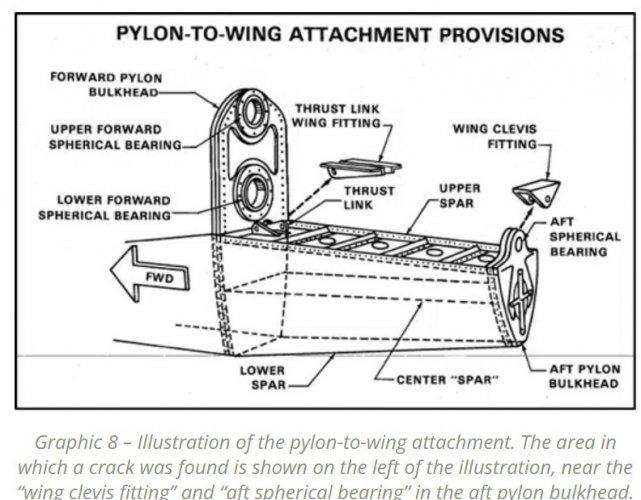
What goes through that ring? A bolt. A very big bolt, since it has to hold takeoff thrust.How does it work? It is a closed 360 degree ring structure without any bolt holding it together.
Well I can't open the pics in the moment, but I don't believe, the axial forces of the bolt will act on the aluminium lugs. There must have been a sleeve inside or a step in the bolt on the nut side which does this job, otherwise there would have been a way to high bending force from the side of the lugs. This would be a catastrophic design which wouldn't have lasted for a single take off. Keep in mind, that the spherical bearing needs to be moving around freely, otherwise it wouldn't have been spherical.What goes through that ring? A bolt. A very big bolt, since it has to hold takeoff thrust.
Once the engine mounting bolts failed, they allowed the spherical bearing to come apart due to differential loadings on it.
How would these bolts compare to those used to attach an ET to an orbiter? They only need to work once. When I see failures like this, it does make me wince a a bit about some RLV designs, though in-line designs spread out loads.
What about additional composites? If a nacelle bolt snaps, fibers keep it hanging on by a thread such that it just drags and doesn’t flip out and impale something.
Better for parts to fail in a preferable manner if they fail at all.
Oh, they go together that way. Too used to 727s which had the engine cradle bolted to the airframe and 4 bolts holding the engine to the cradle, sorry.Well I can't open the pics in the moment, but I don't believe, the axial forces of the bolt will act on the aluminium lugs. There must have been a sleeve inside or a step in the bolt on the nut side which does this job, otherwise there would have been a way to high bending force from the side of the lugs. This would be a catastrophic design which wouldn't have lasted for a single take off. Keep in mind, that the spherical bearing needs to be moving around freely, otherwise it wouldn't have been spherical.
Edit, here we can see the arrangement. The axial forces (thrust) )were not transmitted by this structure and the bolt/spherical bearing surly had some axial play to compensate heat expansion.
The bolts that held the ET to the orbiter were explosive.How would these bolts compare to those used to attach an ET to an orbiter? They only need to work once. When I see failures like this, it does make me wince a a bit about some RLV designs, though in-line designs spread out loads.
You're supposed to be able to disassemble the pylon from the wing. IIRC there's some inspections that the pylons are in the way of doing.What about additional composites? If a nacelle bolt snaps, fibers keep it hanging on by a thread such that it just drags and doesn’t flip out and impale something.
This is the preferable manner for those parts to fail.Better for parts to fail in a preferable manner if they fail at all.
Oh, they go together that way. Too used to 727s which had the engine cradle bolted to the airframe and 4 bolts holding the engine to the cradle, sorry.
Alright, the thrust link does carry some of the thrust loads. Other thrust loads are carried the length of the bolts in those spherical joints, trying to either rip the heads off the bolts or the nuts off depending on how the instructions tell you to put those bolts in.
But again, the fix in the AD was to overtorque the bolts, and replace all those bolts that broke. I suspect that was thought to be limited enough now to allow some Boeing machine shops to spin up a fresh batch of those bolts to replace all bolts currently in service later on. If there even is a "later" for the MD11s.
“During the past two weeks, WGA has been in constant communication with Boeing, who originally anticipated that by Nov. 14 they would have an approved noninvasive inspection protocol to return the aircraft to service. Because of this, we were hopeful that the MD-11 grounding would be short-lived. However, Boeing has now advised that more and highly invasive inspections, as well as repairs and parts replacements, would be required, resulting in an extended grounding of the MD-11 fleet for an undeterminable period of time,”


IIRC the race is heated up and the bearing is cooled in liquid nitrogen to assemble them.If the bearing race would have been a single part, there would have been no way to get the inner spherical ball joint into the outer race. Those bearings are usually made with a split outer bearing race which sits in an housing which hold everything together. Some important information is missing here, were those two halves welded together after installing the inner sphere?