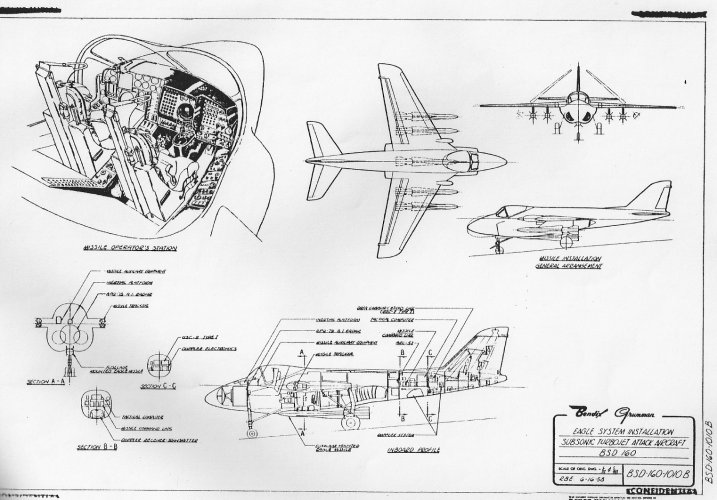
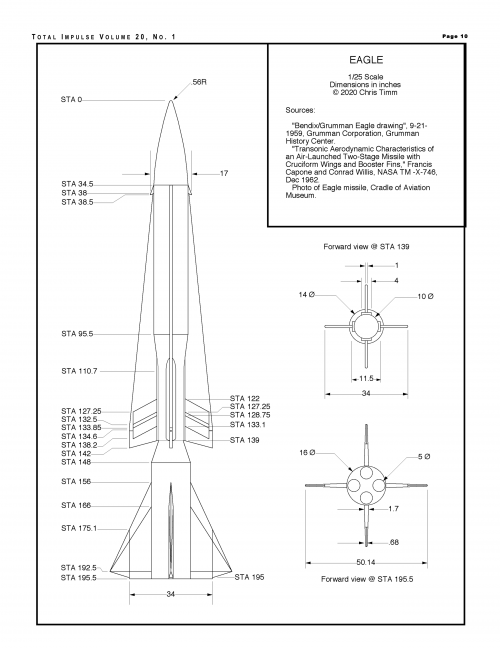
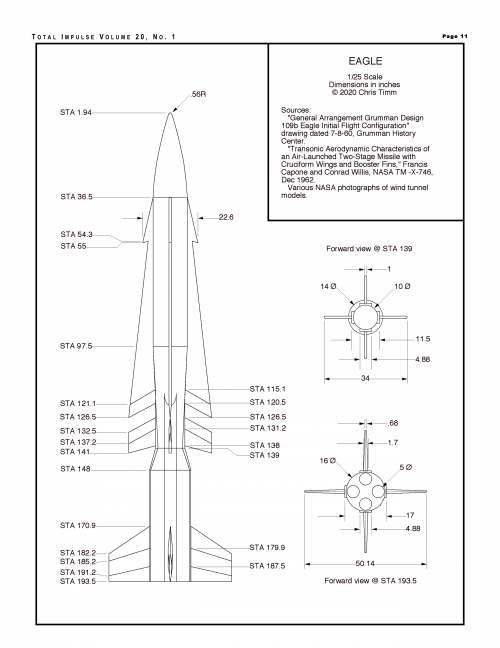
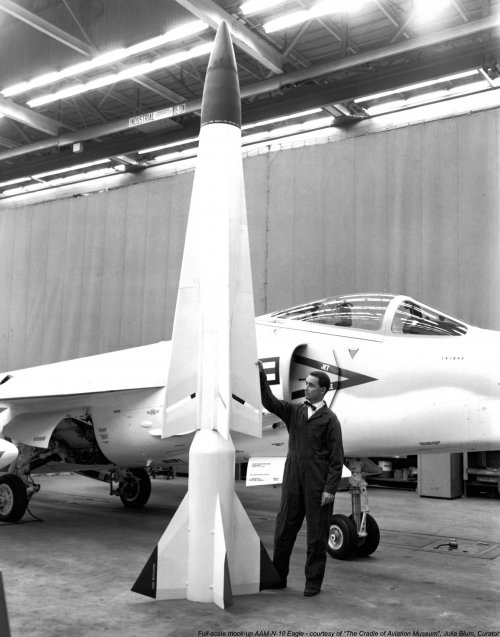
The Bendix-Grumman XAAM-N-10 Eagle was a proposed two-stage solid fuel air-to-air missile designed to provide long range fleet defense. It was to have been paired with the Douglas F6D Missileer which would engage Soviet bombers 100nm miles or more from the fleet. The booster diameter was
16” and length was 4’ 6.5”. The sustainer was 14” in diameter and 11’ 7” long for a total missile length of 16’ 1.5”. Each stage had four cruciform fins with a sustainer fin span of 34” and booster fin span of 50”. The booster’s fin tips were also retractable for wing clearance. Eagle would carry a 110-pound conventional or W42 nuclear warhead with an overall expected weight of 1,284 pounds. It was estimated to be effective against targets from sea-
level to 100k feet and speeds up to Mach 4 and a range of 60nm to 100nm.
Towards the end of World War II, the US Navy developed radar pickets as a means for early detection of enemy air craft so they could be engaged well before they reached the capitol ships. It consisted of a ring of radar equipped destroyers, aircraft, submarines, and land stations that provided an early warning network which dramatically increased fleet defense by vectoring Combat Air Patrols (CAP) towards incoming threat aircraft away from the fleet core.
In the post war years technology was advancing faster than the Navy could adapt defensive measures. The radar picket of WW II had difficulty in detecting and directing interceptors due to the increasing speed of attacking aircraft which was demonstrated again and again through fleet exercises. Events were occurring too quickly for Alert 5* and CAP to react before inbounds became a threat. Large numbers of incoming bogies, combined with decoys, saturated Combat Information Centers (CIC) complicating defense measures even further. Too many simulated attack groups were reaching the carrier fleet core undetected and unmolested.
*Alert 5 is an aircraft crewed on the catapult and capable of launching in less than 5 minutes
As fleet exercises continued through the 1950’s defense countermeasure success remained dismal. Too many bogies were not detected at all. Of those detected, a good percentage had no CAP assets within engagement parameters, or a breakdown of data transfer resulted in missed opportunities. When correctly vectored, the CAP still had to visually acquire the bandits for any chance at a successful engagement. Again, too much ordnance was making it all the way to the carriers and it became apparent that detection and engagement had to be moved outward.
The use of shore-based airborne early warning (AEW) aircraft showed promise, but range was a limitation and left large gaps in coverage. Another issue contributing to adequate defense was patrol aircraft endurance. At the time, the F2H Banshee possessed the longest mission duration (legs) for fleet defense and that was only 1.5 hours, less if it had to patrol at lower, less fuel-efficient altitudes. The emergence of Soviet air-to-surface anti-ship missile
developments made a bad situation exponentially worse. Initial carrier based AEW aircraft extended detection range, but failed to address another gap, detecting low fliers. Search radars at the time were susceptible to radar ground clutter which effectively masked low flying intruders. The flat sea and rain showers exasperated the problem. Exercises continued and despite process improvements, the results failed to improve detection and engagement to an acceptable level. The fleet defense deficits increased the importance of surface-to-air missile development as the Navy realized how important the last line of defense was becoming. Missilery was also a fledgling technology in the 1950’s with growth pains of its own.
Attempts to improve fleet defense were not restricted to process and training. The Navy utilized many internal and external “think tanks” to investigate current technological advances and threats as well as revolutions just over the horizon. Internally, the Navy’s Bureau of Aeronautics’ (BuAer) 1945, Aviation Design Research (ADR) study, held the genesis of Missileer-Eagle as it first mentioned the concept of a low speed attack aircraft that would loiter for several hours at 100-300nm from the fleet core. Over in Navy’s Bureau of Ordnance (BuOrd) the next steps in anti-aircraft-missile technology were develoed in the late 1950’s which lead to the XSAM-N-8 Typhon, also known as Super Talos. Typhon, the precursor to Aegis and Standard Missile, was slated to replace the SAM-N-6 Talos and would possess a 200nm range.
The Bell Labs Naval Interception Program Study from 1953-55, recommended interceptors use pulse-doppler radars to combat the ground clutter interference in detecting and tracking low altitude targets. Pulse-doppler does this by measuring a target’s speed through a high radar pulse repetition rate (PRT). This study resulted in the Navy issuing a contract to Westinghouse in 1957 for the APQ-81 radar. This study also mentioned the potential advantages of a long-range subsonic aircraft armed with longrange missiles.
The 1957 Navy Fighter Study Concept study by Cornell Aeronautical Laboratory benefited from data generated by multiple fleet exercises and evaluations by the Navy’s Operational Evaluation Group (OEG). By this time the apparent threat was Soviet bombers using anti-ship missiles and megaton nuclear
warheads. Several conclusions were obvious. Fleets could no longer contain multiple aircraft carriers where a megaton nuke would potentially wipe out all of them. Also, the response time and distance from the fleet to intercept an incoming attack meant that the CAP had to be stationed much further away, an assessment that was continuously recognized through the many fleet exercises.
These studies concluded that incoming soviet bombers would need to be eliminated 100nm from the fleet to ensure they didn’t reach their missile launch envelope. Once a group of bombers launched multiple missiles and decoys the ability to destroy the attack became untenable. The Cornell studies compared su personic interceptors armed with improved AIM-7 Sparrow III missiles vs other platforms including the sub-sonic, long range missile equipped fighter from the ADR study. The sub-sonic design performed 2 to 4 times better than the other proposals throughout the simulations. Further Cornell studies refined the tactics and technology the Navy needed for fleet defense moving into the next decade. This included the ability of airborne missile platforms that
[could track and engage multiple bogies at once reducing the support needed by command and control assets. These, as well as follow-up studies resulted in the Navy settling on the requirement for a sub-sonic fighter capable of carrying six long-range missiles as well as the Westinghouse APQ-81 radar with a 60” dish. The missile contract was awarded first and won by the team of Bendix/Grumman for their XAAM-N-10 Eagle in 1958. The complete fire-control system including the Westinghouse APQ-81 radar, Litton tactical computer, and Bendix-Grumman Eagle missile. This integrated weapons system introduced technology advances never seen in an interceptor. The Missileer aircraft would be capable of receiving target information from AEW
aircraft and other Missileers via data link and integrate it with data from its onboard APQ-81 radar. It could also home on jamming if it was unable to “burn through” enemy electronic countermeasures (ECM).
Bendix Aviation Corporation, located in Ann Arbor, MI bordering the University of Michigan’s Engineering campus, wasthe prime contractor responsible for systems management. Grum an Aircraft Engineering Corporation, located in Bethpage, NY on Long Island was the principle sub-contractor responsible for airframe, propulsion, as well as launching and support equipment. Other subcontractors include Sanders Associates (guidance),Litton Industries (tactical computer), and Westinghouse Corporation, Air Arm Division (air intercept radar).
To maximize range the Eagle missile would be launched in a loft trajectory. The solid rocket booster would accelerate the missile almost vertically to mach 3.5. After booster burnout themissile would coast up to an altitude of 100k-feet where the long-burn sustainer solid rocket motor would ignite. The sustainer would accelerate the Eagle to mach 4.5 providing enough energy to intercept maneuvering targets out to 60nm. Mid-course guidance was provided by the launching aircraft via radio link and the Eagle would take over terminal guidance with its onboard radar based on the DPN-53 set from the CIM-10 Bomarc surface-to-air missile. The Eagle could also be launched in a direct trajectory for shorter range threats. The Eagle’s range was potentially 100nm in a home on jam situation.
The aircraft design competition was announced in late 1959 for an aircraft capable of carrying the Bendix-Grumman fire-control system, Westinghouse APQ-81 radar, and six Eagle missiles. The competition was won by Douglas with its F6D Missileer submission. It vaguely resembled the F3D Skyknight, but only in appearance. In addition to the APQ-81 radar and its 60” dish, it would be powered by two Pratt & Whitney TF-30 non-afterburning turbofan engines. Turbofans were new at the time and much more fuel efficient than turbojet engines. The Missileer would carry the six Eagle missiles, three under each wing, to a patrol area 150nm miles from the fleet core and loiter on station for up to six hours.
The APQ-81 was a multi-mode radar and theheart of Missileer-Eagle. Through digital computer control it could switch from track-while-scan (TWS)
mode where the fire-control system could track up to 16 individual bombers out to 80nm, to illumination mode which provided mid-course guidance to outbound Eagle missiles. The APQ-81 could resolve target velocity and range by varying the PRT through computer control.
The F6D Missileer was not without weaknesses. Because the Missileer would not be able to defend itself from close-quarter Soviet interceptors, it would
need to be paired with the McDonnell F4H Phantom II air superiority fighter for protection. It would be especially vulnerable after all Eagle missiles were expended. Also, the concept of a sub-sonic attack type aircraft as a standoff missile platform was atypical to the faster, self-protective nature of fighter interceptors at the time and was met with skepticism and pushback from some NAVAIR circles.
The Navy hoped to deploy the Missileer-Eagle and Typhon as a complete anti-air warfare system; however, each program would be extremely expensive and purely defensive. Rather than sign the Missileer contract in late 1960, President Eisenhower’s Secretary of Defense, Thomas Gates Jr, left it to John
McNamara, incoming President Kennedy’s Secretary to decide. It did not take McNamara long to cancel the F6D Missileer in favor of the upcoming USN/USAF joint service TFX program, which was strongly disliked by the Navy. The Eagle development remained active for a short time longer, but without Missileer, there was no active aircraft capable of carrying it, effectively sealing its fate. Typhon was also cancelled in 1963 due to costs and technology shortcomings of the time.
Many of the Soviet strengths and tactics assumptions in the 1950’s would not be realized until the 1970’s. By that point the F-14 Tomcat and AIM-54 missile were assuming the role of fleet defender that was originally slated for Missileer-Eagle. Had the Missileer-Eagle program entered production in the mid-1960’s it would have been nearly worthless in the Vietnam conflict. The restrictive rules of engagement (ROE) denied the US Navy and Air Force any beyond visual range (BVR) engagements due to the required visual identification of enemy aircraft.
Even though few components of the Missileer-Eagle were used in future programs, most notably the TF-30 turbofans (F-111 and F-14 Tomcat), other program developments such as the use of multi-mode doppler radar, TWS, datalink integration between fleet assets, and more, found their way into the Tomcat and Phoenix.
References:
- Ciminera, Michael V., The Aircraft Designers: A Grumman Historical Perspective, American Institute of Aeronautics & Astronautics, Reston, (2013), p211
- Friedman, Norman, Fighters Over the Fleet: Naval Air Defence from Biplanes to the Cold War, Naval Institute Press Annapolis, MD (2016) p312-315, 333-336
- Gunston, Bill, The Illustrated Encyclopedia of the World’s Rockets and Missiles, Crown Publishers New York, NY (1979) p223
- Butler, Tony, American Secret Projects: Fighters and Interceptors 1945-1978, Ian Allen Publishing, Shepperton, UK, (2007), pg 130-133
- Newlon, Clark, missiles and rockets: Magazine of World Astronautics, American Aviation Publications, Washington, DC, Volume 5 Number 18, (May 4, 1959)
- Department of Defense Appropriations for 1960: Part 1, U.S. Government Printing Office, (Dec 31, 1959), Page 741
- NASA Langley Research Center, 16-foot Transonic Tunnel photos
- Secret Projects forum, www.secretprojects.uk.co.uk