Developments and News in clean energy: Wind, solar and batteries grow despite economic challenges

Hydrogen production out of ammonia is completely uneccessary, exapt you need hydrogen as chemical element and not as energy
But the advantage to anhydrous ammonia is that it is already in mass production as a commercial fertilizer. Ammonia is also a stable liquid and portable. It is a big enough molecule that tanks to hold it are easily had. Overall, it is really no more or less hazardous than gasoline only in different ways. Since it's made primarily from natural gas, you have an industry that can supply the raw material converting a 'fossil fuel' into a clean burning one. With nuclear, the energy to do this is affordable.
 
If you are using wind for base load you are doing it wrong, if your wind power requires significant backups, you are doing it wrong, if you are using coal as a backup/top up, you are doing it wrong. The only fossil fuel plants being built/used should be natural gas, which works great to balance out the grid.
Natural gas should be used primarily for peaking plants that run intermittently while base load is nuclear.
 
Home solar is, in the grand scheme of things, a complete waste of time and money. The installs only pay out with heavy government subsidies. Nobody would install or pay for one without those. The amount of energy produced is so miniscule as to be irrelevant.

Let's say, when a home solar array is up and running, it returns 2 kw to the grid (I'm being generous) for a few hours. To get 1 megawatt, you need 500 homes. But that output is variable continuously to an extent as each home grid experiences clouds, shade from trees, poor positioning of the panels, etc. Thus, the supply to the grid is unstable making it hard to keep loading overall constant. More home solar, more instability.

Then there's the payout for that electricity to homeowners. This too is problematic. It involves more accounting and paperwork. If the scheme pays the homeowner above wholesale rate the utility is losing money buying expensive, unreliable, power from those homeowners.

It all becomes one expensive mess.
Those of us who have solar panels might well disagree. We also have batteries attached. Generally we can be totally self sufficient on our system. We also sell power back to the grid but that is a minor part of it. We did this for a combination of the economic value (and it has worked out nicely for us) plus the self-sufficiency aspect (important if you live in an area where you can get cut off both physically and from the grid multiple times a year) as well as for the environmental benefits.

We did not have these subsidised by the Govt though on that point, I would still argue that it is hypocritical to make a deal of it given the massive subsidies 'traditional' utilities have had over the decades.

As for utilities losing money, it has been shown already that utilities actually win by supporting solar since it can be done incrementally and thus saves them the cost of massive investments in 'traditional' (fossil fuels or nuclear) power plants.
 
I wonder what became of Bill Maher's problems with PG&E

That could go either way. PG&E is just another corporation--and all that comes with that. It wouldn't surprise me if Bill was correct.
Was he telling the truth or no?


A team of researchers, led by Feng Jiao, the Lauren and Lee Fixel Distinguished Professor in the McKelvey School of Engineering at Washington University in St. Louis, has found that inexpensive and robust materials, porous separators called diaphragms, can be viable alternatives to these membranes in the carbon monoxide conversion process.

After testing various diaphragms, they found that some of them performed as well or better than polymer-based commercial membranes in various operating conditions.

Their findings were published Sept. 26, in Nature Communications. Wanyu Deng, a postdoctoral researcher, and Siyang Xing, a doctoral student, are the first authors on the paper.
 
Last edited:
Those of us who have solar panels might well disagree. We also have batteries attached. Generally we can be totally self sufficient on our system. We also sell power back to the grid but that is a minor part of it. We did this for a combination of the economic value (and it has worked out nicely for us) plus the self-sufficiency aspect (important if you live in an area where you can get cut off both physically and from the grid multiple times a year) as well as for the environmental benefits.

Good for you!
We did not have these subsidised by the Govt though on that point, I would still argue that it is hypocritical to make a deal of it given the massive subsidies 'traditional' utilities have had over the decades.

The typical install for a home solar array (with batteries) right now runs about $60,000 to $80,000 where I live. You can DIY it, or if you know a "Guy" get it for about half that. The subsidies amount to about a third of the total price. Without them, you would be in the hole financially.
As for utilities losing money, it has been shown already that utilities actually win by supporting solar since it can be done incrementally and thus saves them the cost of massive investments in 'traditional' (fossil fuels or nuclear) power plants.
Name a major utility or nation that has heavily invested in solar (in particular, but wind too) that hasn't seen customer costs go anywhere from double to triple what they were before. Solar is an economic loser.

For example, California has some of the highest kwh prices in the US continuous 48 with it being about $ .26 right now. That's about double what most other consumers pay. One issue California has is that their heavy investment in wind and solar often produces too much power for load conditions, so they are forced to dump this on Arizona, Nevada, and Utah. In order to do that, they PAY those states to take the electricity to offset their idling conventional plants. So, those states get cheaper electricity courtesy of California subsidizing the cost to avoid disaster on their own grid.

Germany has the same problem. Their neighbors have largely disconnected from the German grid because they don't want the Germans dumping their excess power on them. Batteries are no solution because of the cost.
 
But the advantage to anhydrous ammonia is that it is already in mass production as a commercial fertilizer. Ammonia is also a stable liquid and portable. It is a big enough molecule that tanks to hold it are easily had. Overall, it is really no more or less hazardous than gasoline only in different ways. Since it's made primarily from natural gas, you have an industry that can supply the raw material converting a 'fossil fuel' into a clean burning one. With nuclear, the energy to do this is affordable.
I was not denieyng the advantages of ammonia, but the conversion back to hydrogen
 
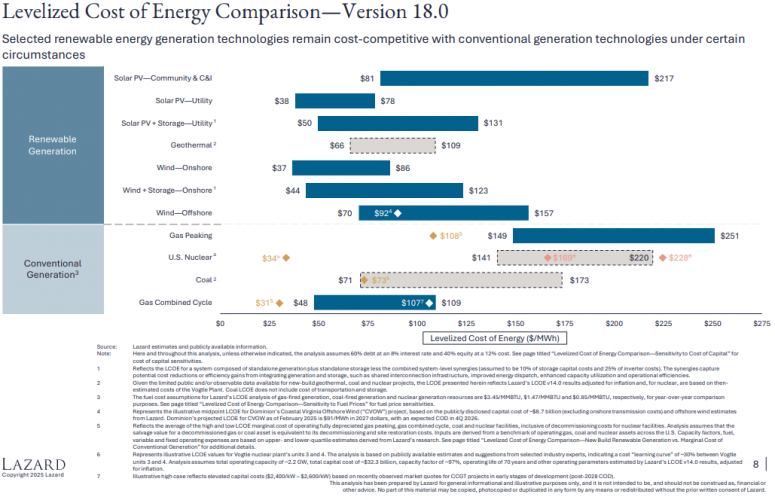
WRT renewable energy costs:
2880px-20201019_Levelized_Cost_of_Energy_%28LCOE%2C_Lazard%29_-_renewable_energy.svg.png

Sources:

And as for the cost of solar panels:

w=2160


Source:


The bottom line here is that the cost of electricity generated from sources such as solar is getting cheaper and the costs of the things such as solar panels used to generate it are also getting cheaper. One of the other advantages often missed is that things such as this can be incrementally grown unlike traditional fossil fuelled or nuclear solutions.
 
WRT renewable energy costs:
2880px-20201019_Levelized_Cost_of_Energy_%28LCOE%2C_Lazard%29_-_renewable_energy.svg.png

Sources:

And as for the cost of solar panels:

w=2160


Source:


The bottom line here is that the cost of electricity generated from sources such as solar is getting cheaper and the costs of the things such as solar panels used to generate it are also getting cheaper. One of the other advantages often missed is that things such as this can be incrementally grown unlike traditional fossil fuelled or nuclear solutions.
What these miss, and I keep coming back to it, is that solar is an intermittent source. You need electricity that is stable and available 24/7.

The typical solar plant has a capacity factor...


...in the range of 25% usually. This means it doesn't make electricity about 75% of the time.

Why is this important? Because you need electricity 24/7. Therefore, the key metric is the kilowatt-day. That is producing 1 kw for one day / 24 hours straight.

Using that 25% capacity factor (and I've pointed this out already), you need 5 or 6 kw of installed solar panels and about 18 hours of installed 1 kw of battery capacity (or other storage system) to get a kilowatt-day out of a solar array. All of a sudden, the levelized cost of solar becomes unaffordable when you try to use it for base loading.

That is, to match 1 kw-day of installed gas, coal, or nuclear, you need 5 or 6 kw of solar panels. So, if we take the top graph, the cost to install one kw-day of solar for the panels alone rises to around $0.30. That alone becomes insanely expensive compared to conventional generation systems.

Now, toss in 18-ish hours of battery at, let's low ball that at $225 a kwh, or about $4000-- or about $0.50 for the levelized cost--on top of the $0.30 for those panels. Now you're at $0.80 per kwh for solar where it can reliably produce 1 kilowatt-day of power.

THIS is why solar is unaffordable! It is horribly unreliable and to make it reliable you need a massive system of extra capacity and batteries that conventional, reliable, sources of generation do not need. Every place on the planet that has invested heavily in solar has found their grid become unstable, and the price of electricity per kwh double to triple. A grotesquely expensive "smart grid" that works marginally, as Germany has found out, doesn't fix the problem either. It just raises the cost of electricity higher.

The solution, if you want to reduce CO2 is nuclear backed up by natural gas. You also ditch EV's in favor of using either hydrogen or anhydrous ammonia as your portable fuel for vehicles manufactured from natural gas using cheap nuclear electricity.

 
My favourite general purpose quote by now -
"Reality is frequently inaccurate" - Douglas Adams.
 
Note, Germany and Danmark are the strongest users of wind and solar power and have the highest electricity prices in Europe. France and Hungary with their high percentqge of nuclear power offer much cheaper electricity. Slovakia has also a high percentage of nuclear power but suffers from Austria and Germany buying their electricity at a very high price, same is true for Norway.


Countries like Germany with a high degree of wind and solar power are in fact using their neighbours as battery. This concept is not sustainable
 
New technologies for solar

Other finds


A critique

Nuclear

Issues
https://phys.org/news/2025-11-plastics-industry-shifted-responsibility-recycling.html (it's a deadbeat who tosses crap)

A new source of bio-power?

This is one for Ripley

Fix the grid
 
Last edited:
Good for you!


The typical install for a home solar array (with batteries) right now runs about $60,000 to $80,000 where I live. You can DIY it, or if you know a "Guy" get it for about half that. The subsidies amount to about a third of the total price. Without them, you would be in the hole financially.

Name a major utility or nation that has heavily invested in solar (in particular, but wind too) that hasn't seen customer costs go anywhere from double to triple what they were before. Solar is an economic loser.

For example, California has some of the highest kwh prices in the US continuous 48 with it being about $ .26 right now. That's about double what most other consumers pay. One issue California has is that their heavy investment in wind and solar often produces too much power for load conditions, so they are forced to dump this on Arizona, Nevada, and Utah. In order to do that, they PAY those states to take the electricity to offset their idling conventional plants. So, those states get cheaper electricity courtesy of California subsidizing the cost to avoid disaster on their own grid.

Germany has the same problem. Their neighbors have largely disconnected from the German grid because they don't want the Germans dumping their excess power on them. Batteries are no solution because of the cost.
Where do you live!? I did my Masters in Solar Energy, and you could install a DIY residential solar system in Arizona for $10k, a commercial installation was around 20k, thats without subsidies.

I now live in California and my electric bill last month was about $100...

Did you just complain about having too much power!?

And speaking of subsides, you do know that non-renewable energy is heavily subsidized? In fact the US just got rid of all renewable subsidies and increased carbon subsidies.
 
Where do you live!? I did my Masters in Solar Energy, and you could install a DIY residential solar system in Arizona for $10k, a commercial installation was around 20k, thats without subsidies.

I now live in California and my electric bill last month was about $100...

Did you just complain about having too much power!?

And speaking of subsides, you do know that non-renewable energy is heavily subsidized? In fact the US just got rid of all renewable subsidies and increased carbon subsidies.
Not today you can't. The panels run--for decent quality ones about $500 to $900 a shot not including the mounting equipment. Copper wire is outrageous in cost atm. The inverter, a new service panel (if needed), and the metering and associated conduit will run you $2500 easily. Having somebody like me (I charge way less than some commercial company would) install it is in the neighborhood of $20,000 and it'll take you 6 to 9 months to get it installed if you live in the APS utility service area (that's due to APS).

I know that sounds insane, but that's the reality of it.

And no, non-renewable energy is not heavily subsidized. That's a canard that the environmental front uses to try and make solar and wind look better.
 
Thats due to a combination of tariffs and anti-solar actions from APS. In California, solar is running around $2.4 a W, which is approximately $12,000 for a 5kW system.

What would you call this, if not subsidies?
 
Thats due to a combination of tariffs and anti-solar actions from APS. In California, solar is running around $2.4 a W, which is approximately $12,000 for a 5kW system.

What would you call this, if not subsidies?
No, it is due to APS. For example, I had to do a service panel upgrade for someone earlier this year. They had been quoted $8000 by several electric companies. I quoted $4000 and said it was likely to be a lot less.

The permit took me longer to drive downtown to Phoenix city hall to get than the actual process. I got all the materials in an afternoon. Then I called APS to come disconnect the existing panel. I had done stuff with SRP (the other utility in the area), and gotten permits from a number of cities in the metro area. APS floored me with what I was told.

They said before they could disconnect me I had to give them:

Photos of the existing panel and surrounding building.
A load calculation for the residence and new panel.
A circuit breaker layout for the new panel.
List which panel I would be installing, and it had to be on their approved list of panels.

Once I did that, they assigned me a job / project number.

I was then told that the earliest date they could come and disconnect the service was 90 days from their approval of the job. I asked for the service to be re-hooked up three days later. They said I should call when I was ready for that.

Their contractor came on the appointed day, and I watched in horror as the three stooges they sent disconnected the service fully expecting one of them to electrocute himself. Not really my problem though. Finished I called, gave them the final inspection number and within an hour the same three bozos showed up and hooked things back up. My final cost to the customer was $2750.
 
Last edited:
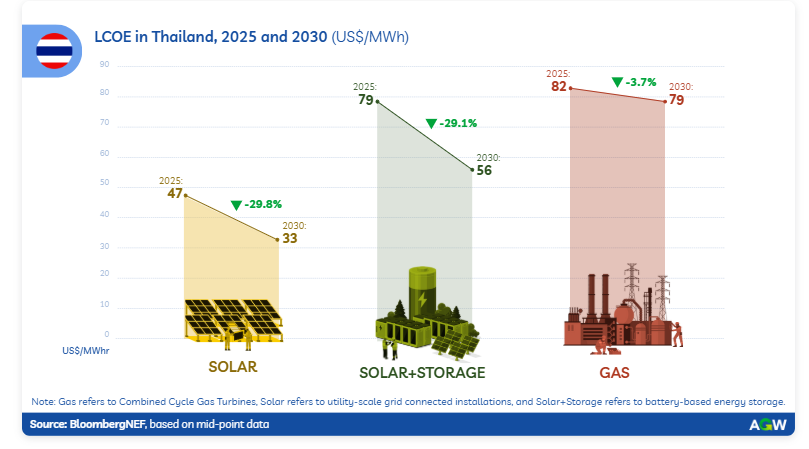
Solar is fairly low cost, and getting competitive even with batteries.
This is interestingly, especially true in poorer nations, where diesel for backup generators or pumps is priced quite high, to the extent that a solar panel setup should be able to make money back within six months.

Chinese supply chains may suffer a ten percent price increase due to removal of VAT rebates for green exports and remaining indirect subsidies.
1762314189971.png

1762313526032.png
 
I believe, flywheel energy storage is in most cases a better alternative to store solar power. Long time energy storage will always remain to expensive for batteries and short time storage (from mid day to evening) can be provided by flywheels. In this application, Flywheels are much cheaper and have almost unlimited life (with magnetic bearings).

For a national grid which should provide reliably electricity all around the year, the cost can look very different, than the cost for solar energy and battery storage only until the next day...
 
Last edited:
I believe, flywheel energy storage is in most cases a better alternative to store solar power. Long time energy storage will always remain to expensive for batteries and short time storage (from mid day to evening) can be provided by flywheels. In this application, Flywheels are much cheaper and have almost unlimited life (with magnetic bearings).

For a national grid which should provide reliably electricity all around the year, the cost can look very different, than the cost for solar energy and battery storage only until the next day...
Tried and failed economically even with huge government subsidies.

 
Well, not so good, but it's still alive somehow, I hope they (or others) will make it.
 
Well, not so good, but it's still alive somehow, I hope they (or others) will make it.
I remember watching a video on this company making flywheels, more than the one I've linked, and all I could think is how expensive all that precision machining is and the sheer cost of the mass of materials that goes into one has got to be uncompetitive.

 
I remember watching a video on this company making flywheels, more than the one I've linked, and all I could think is how expensive all that precision machining is and the sheer cost of the mass of materials that goes into one has got to be uncompetitive.

There is more than one company working on these approach, I saw one (not shure which company) which used ordinary steel flywheels and bearings, nothing very fancy. Energy losses were something like 5 % per hour or so
 
Well, not so good, but it's still alive somehow, I hope they (or others) will make it.
It is good to have a mix---you don't want one consortium to have the kind of power over us as in the past. The best thing the Green movement did was advance technology---of more importance to me at least than fighting AGW.

The existing idea is that the climate is "supposed" to be what it was in the pre-industrial era...when famines were common, deserts perhaps close to maximum extent, and the Thames freezing over. There is no giant thermostat nailed to the sky after all. Having 100 parts per million of CO2 would scare me more than 450.

The Dust Bowl wasn't quite a century ago, and trying to grow both fuel AND food could be horrific. Poor Borlaug meant well--but his water and nitrogen intensive methods were meant as a stopgap only. When folks try to clean the air--it backfires:

It is all very sad. I suppose there is a set amount of evil...like Jello. Push it back in one direction--it just comes right back at you through gaps between fingers.

Right now, the chief problem is poverty

This, however, surprised me:

They somehow managed to combine plexiglass and styrofoam. As the former 'evaporated,' what was left behind was a material full of tiny gaps smaller than a virus, that weighed less than a gram but had a surface area of a full sized tennis court.
 
Last edited:
There is more than one company working on these approach, I saw one (not shure which company) which used ordinary steel flywheels and bearings, nothing very fancy. Energy losses were something like 5 % per hour or so
Machining a steel flywheel that weighs say a ton or more to precision levels to let it spin up to the kind of rpm's necessary is a very expensive proposition. Just getting the castings is a trick in itself. Few companies do that sort of thing anymore and it is costly.
 
Wouldn't it be maraging steel, and thus run right into ITAR scrutiny? Not to mention good maraging steel smells more expensive.

I wonder if a thermal sand battery would be better? I'd imagine they would have very large volume requirements though.
 
Wouldn't it be maraging steel, and thus run right into ITAR scrutiny? Not to mention good maraging steel smells more expensive.

I wonder if a thermal sand battery would be better? I'd imagine they would have very large volume requirements though.

Only the high end maraging steels are into ITAR scrutiny, but I'm sure, maragin steels would be way too expensive anyway. Keep in mind, this is for stationary use, there is no need for an excellent energy to weight ratio. Forged 42CroMo4 will will do the job, and if it's 50 % heavier than maraging steel, so what?

I would propose a semi magnetic bearing, a simple magnet to iron support which carries the weight of the flywheel in combination with ceramic ball bearings which provide exact guiding of the flywheel. The sealing of the drive shaft between the flywheel in a vaccuum and the lubricated bearings should be done with a ferromagnetic sealing, to minimize friction and wear to an absolute minimum.

Machining a round flywheel isn't complicate at all, there are thousands of mashining companies which have lathes much larger than that what would be required. See e.g. how gigantic flanges for components of the chemical industry are machined.
 
Last edited:
Great news!

Solar stability---
a novel coating to the interface between the surface of the perovskite and the top contact layer. This has even boosted efficiency to almost 27%, which represents the state-of-the-art.

After 1,200 hours of continuous operation under standard illumination, no decrease in efficiency was observed. The study involved research teams from China, Italy, Switzerland and Germany and has been published in Nature Photonics.

"We used a fluorinated compound that can slide between the perovskite and the buckyball (C60) contact layer, forming an almost compact monomolecular film," explains Abate. These Teflon-like molecular layer chemically isolate the perovskite layer from the contact layer, resulting in fewer defects and losses. Additionally, the intermediate layer increases the structural stability of both adjacent layers, particularly the C60 layer, making it more uniform and compact.

"It's actually like the Teflon effect," says Abate. "The intermediate layer forms a chemical barrier that prevents defects while still allowing the electric contact."


Now don't be scared by "Teflon"
Scientists from Newcastle University and the University of Birmingham have developed a clean and energy-efficient way to recycle Teflon (PTFE), a material best known for its use in non-stick coatings and other applications that demand high chemical and thermal stability.

In-fighting
 
Last edited:
Great news!

Solar stability---
a novel coating to the interface between the surface of the perovskite and the top contact layer. This has even boosted efficiency to almost 27%, which represents the state-of-the-art.

After 1,200 hours of continuous operation under standard illumination, no decrease in efficiency was observed. The study involved research teams from China, Italy, Switzerland and Germany and has been published in Nature Photonics.

"We used a fluorinated compound that can slide between the perovskite and the buckyball (C60) contact layer, forming an almost compact monomolecular film," explains Abate. These Teflon-like molecular layer chemically isolate the perovskite layer from the contact layer, resulting in fewer defects and losses. Additionally, the intermediate layer increases the structural stability of both adjacent layers, particularly the C60 layer, making it more uniform and compact.

"It's actually like the Teflon effect," says Abate. "The intermediate layer forms a chemical barrier that prevents defects while still allowing the electric contact."


Now don't be scared by "Teflon"
Scientists from Newcastle University and the University of Birmingham have developed a clean and energy-efficient way to recycle Teflon (PTFE), a material best known for its use in non-stick coatings and other applications that demand high chemical and thermal stability.
Lot of farm land in Getmany is spoiled by Teflon and other longlifed haloginized plastics from windfarms. So how do we collect that Teflon for efficient recycling???

There is an official warning to not eat the livers of wild pics anymore because of high contamination.
 
There have been lots of reports on how to break down PFAS over the past year or so…hopefully they will be implemented soon. Every so often, I will see old articles and finds refloated/reposted, admittedly.

Today--
Researchers at Clarkson University have discovered a new way to destroy "forever chemicals," known as PFAS, using only stainless steel ball milling equipment. The method does not need added chemicals, heat, or solvents.

News

Wind problems
 
Last edited:
There have been lots of reports on how to break down PFAS over the past year or so…hopefully they will be implemented soon. Every so often, I will see old articles and finds refloated/reposted, admittedly.

The problem is not how to break in down once you have it in a canister, but how to get it out of the environent. Harversting livers of wild boars is not a good large scale solution...
 
There have been lots of reports on how to break down PFAS over the past year or so…hopefully they will be implemented soon. Every so often, I will see old articles and finds refloated/reposted, admittedly.
Wind farms 'spray' micro-plastics down wind of their location almost continuously in operation. The fiberglass turbine blades are scrubbed by dust in the air and even just the wind giving off small amounts of plastics as a result. You aren't getting that out of the soil and such it is deposited on. It's too fine and the area is simply too large to deal with that issue.
 
I had no idea.

Embarrassing if true:

Other Green tech

Jet fuel advance?
 
Last edited:
Last edited:

Similar threads

Back
Top Bottom