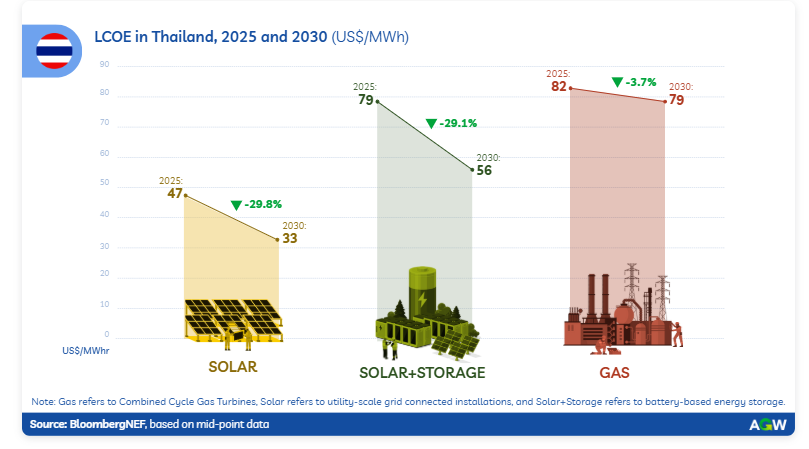
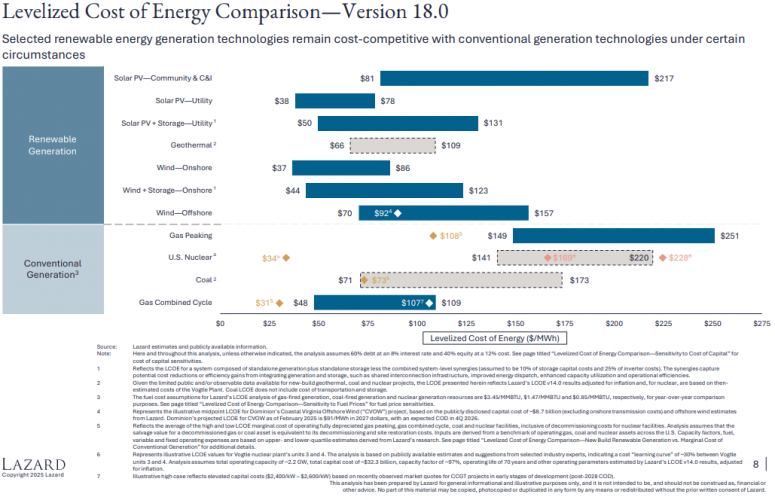
WRT renewable energy costs:
Sources:
https://www.popsci.com/story/environment/cheap-renewable-energy-vs-fossil-fuels/https://www.lazard.com/media/xemfey0k/lazards-lcoeplus-june-2024-_vf.pdf
And as for the cost of solar panels:
Source:
https://www.irena.org/Publications/2024/Sep/Renewable-Power-Generation-Costs-in-2023
The bottom line here is that the cost of electricity generated from sources such as solar is getting cheaper and the costs of the things such as solar panels used to generate it are also getting cheaper. One of the other advantages often missed is that things such as this can be incrementally grown unlike traditional fossil fuelled or nuclear solutions.
What these miss, and I keep coming back to it, is that solar is an
intermittent source. You need electricity that is stable and available 24/7.
The typical solar plant has a capacity factor...
https://visualizingenergy.org/what-are-capacity-factors-and-why-are-they-important/
...in the range of 25% usually. This means it doesn't make electricity about 75% of the time.
Why is this important? Because you need electricity 24/7. Therefore, the key metric is the
kilowatt-day. That is producing 1 kw for one day / 24 hours straight.
Using that 25% capacity factor (and I've pointed this out already), you need 5 or 6 kw of installed solar panels and about 18 hours of installed 1 kw of battery capacity (or other storage system) to get a kilowatt-day out of a solar array. All of a sudden, the
levelized cost of solar becomes unaffordable when you try to use it for base loading.
That is, to match 1 kw-day of installed gas, coal, or nuclear, you need 5 or 6 kw of solar panels. So, if we take the top graph, the cost to install one kw-day of solar for the panels alone rises to around $0.30. That alone becomes insanely expensive compared to conventional generation systems.
Now, toss in 18-ish hours of battery at, let's low ball that at $225 a kwh, or about $4000-- or about $0.50 for the levelized cost--on top of the $0.30 for those panels. Now you're at $0.80 per kwh for solar where it can reliably produce 1 kilowatt-day of power.
THIS is why solar is unaffordable! It is horribly unreliable and to make it reliable you need a massive system of extra capacity and batteries that conventional, reliable, sources of generation do not need. Every place on the planet that has invested heavily in solar has found their grid become unstable, and the price of electricity per kwh double to triple. A grotesquely expensive "smart grid" that works marginally, as Germany has found out, doesn't fix the problem either. It just raises the cost of electricity higher.
The solution, if you want to reduce CO2 is nuclear backed up by natural gas. You also ditch EV's in favor of using either hydrogen or anhydrous ammonia as your portable fuel for vehicles manufactured from natural gas using cheap nuclear electricity.