Space shuttle turbofans for ferry flight

Temporary still has drawbacks. Structural scarring for attach points. Fuel tank location and installation, fuel lines, control and monitoring wire harnesses, etc. All increase mass and complexity.
Shure, but the fuel tank as bubble could be easily loaded in the freight space and the jets might be fixed on the landing gear. the L/D ratio would still be terrible, but with a cover on the rear (as used for transports anyway) it would have been duable. There wouldn't have been much additional weight and complexity left after removing the stuff.

I really think, the testing and certification stuff would have been the biggest hurdle and the main reason why it was never done.

One more note @publiusr : Stuff like new materials which have just beeing created are more than a decate away from any real world application and 99% of them will remain a curiosity. No real life engineer will solve a problem by using an effect or material which has just been discovered. Get used to TRG levels. There is a hughe difference between experimental research and industrial applications. Its not, that the engineers missed something and are needing your help...
 
Last edited:
Shure, but the fuel tank as bubble could be easily loaded in the freight space and the jets might be fixed on the landing gear. the L/D ratio would still be terrible, but with a cover on the rear (as used for transports anyway) it would have been duable.
putting nasty hydrocarbons in the payload bay is a big drawback.
Putting jets on the landing gear doesn't make sense, extending the gear increases drag greatly
 
I know tech advances take time--that is one reason a more conservative orbiter without SSME could better accept jets, or at least hard points (scars I think Byeman called them--like L1011 has for Pegasus.)

That's light years simpler than trying to get an SSTO to work.

Old and new technologies might be useful. Old transmissions had elaborate fluid channels. A.I. might be trained on them and design fluidic memories for orbital assets now resilient to solar-flares. There is now a chip that uses sound. Yes these technologies are a ways out. This goes to show how something seemingly unrelated--like sliding shower fixtures for Hubble--can make all the difference.

There is no reason to fear hydrocarbons in space. Coking worries didn't stop Elon from making Merlin reusable. Sintin was going to be used on orbit.

Might a space plane that uses all hypergolics also use them for jets? There may be coatings now to allow a return of old concepts put to bed due to lack of good materials at the time.

With SSME's under the External tank like Energiya/SLS, you could have different types of orbiters. One, crew only with a metal heat-shield, could have good thrust to weight ration without a huge payload bay---another orbiter unmanned--perhaps a lifting body.

By getting rid of the SSMEs, the orbiter can be more aerodynamic. Let an empty Energiya core block come back SpaceX style--I want astronauts to have a real plane--with real options...options they don't have with Starship.
 
Last edited:
Bubble tanks have been used on all kinds of airplanes, I don't see any major issue with that. The hypothetical "Jetpack" would have included a fairing for the landing gear to reduce the drag.

Somewhere I have in mind, that every ferry flight costed millions of Dollars, that's why the Nasa really tried to avoid them. If the Space Suttle would have been the promised low cost solution (as today the Falcon rockets) a more efficient way for bringing back a large number of Shuttles would have become neccessary. As we all know, this didn't happen and so the transport cost/time wasn't a high priority.
 
Last edited:
Temporary still has drawbacks. Structural scarring for attach points. Fuel tank location and installation, fuel lines, control and monitoring wire harnesses, etc. All increase mass and complexity.

Also the Shuttle as it came to be can't open their doors without a big holder system that would support them in gravity. Underslung means some way to attach that compromises the heat shield so it wasn't possible really.

Randy
 
Shure, but the fuel tank as bubble could be easily loaded in the freight space and the jets might be fixed on the landing gear. the L/D ratio would still be terrible, but with a cover on the rear (as used for transports anyway) it would have been duable. There wouldn't have been much additional weight and complexity left after removing the stuff.

I really think, the testing and certification stuff would have been the biggest hurdle and the main reason why it was never done.


Not very much room under the Shuttle to put engines and more to the point it would need more than just a couple engines to even get airborne. (IIRC it was up to 6 already before the design was finalized) A "simpler" idea would be a jet powered sled but even then you'd need to add wings to the sled to get the whole thing into the air and you already have aircraft that can carry an empty orbiter so why not use them?

Randy
 
There is no reason to fear hydrocarbons in space. Coking worries didn't stop Elon from making Merlin reusable. Sintin was going to be used on orbit.

Eh "coking" isn't the problem as you can use RP-1 in a jet engine, (and in fact there are even more kerosene types that could be used with no coking issues) the problem is that the jet, unless specially designed and built, could not survive a trip into space. Jets have a lot of fluids that need to be kept within certain tolerances to be useful any length of time so the jets would have essentially needed around the same "life support" systems as humans to have them function on return to Earth.
And on top of that the suggestion is to then 'deploy' them once you are slow enough which is a whole different set of machinery and fluid feeds that now need to be designed in. All for engines you don't really need in the first place.

There have been a LOT of studies and work done on air-breathing launch assist systems, most of which pretty much "square-the-circle" by going with integrated designs where each 'stage' works at its best range and in most cases the actual subsonic portions end up having to be 'sealed' away from the conditions that the other engines (and vehicle) generate in their portion of flight.

Hence why Skylon used essentially air-breathing rockets and no actual "jet" engines.

Randy
 
Also the Shuttle as it came to be can't open their doors without a big holder system that would support them in gravity. Underslung means some way to attach that compromises the heat shield so it wasn't possible really.

Randy
As said, I proposed fixing them to the landing gear, so no new hardpoints and no impact on the heatshield. I'm thinking about one engine left and right on every wheel plus a fairing around the wheel/struts. the jets might have even been attached to the unprung mass with some flexibility in the mounting structure.

Note, fuel bubbles are very flexibel when empty, it could have been rolled and beeing draged into the freight compartment through the doors and galleys without opening the main hatches. I've seen how such bladders were pushed through small openings in the tamks of historic race cars (as a modern safety device).
 
Last edited:
As said, I proposed fixing them to the landing gear, so no new hardpoints and no impact on the heatshield. I'm thinking about one engine left and right on every wheel plus a fairing around the wheel/struts. the jets might have even been attached to the unprung mass with some flexibility in the mounting structure.

Again, no. Too much drag with landing gear deployed.
Note, fuel bubbles are very flexibel when empty, it could have been rolled and beeing draged into the freight compartment through the doors and galleys without opening the main hatches. I've seen how such bladders were pushed through small openings in the tamks of historic race cars (as a modern safety device).
No, bladders are not feasible, the shuttle does not have a cargo deck/floor. Everything is attached to the sides.
 
I know tech advances take time--that is one reason a more conservative orbiter without SSME could better accept jets, or at least hard points (scars I think Byeman called them--like L1011 has for Pegasus.)
Wrong. And orbiter without SSMEs is not "more conservative". Again, there is no difference other than mass. An orbiter with SSMEs is the same as an SSME-less orbiter but with 2iKLB of return payload,
There is nothing structurally that allows an SSME-less orbiter to accept engines better than an orbiter with SSMEs
There is no reason to fear hydrocarbons in space. Coking worries didn't stop Elon from making Merlin reusable. Sintin was going to be used on orbit.
Wong again. Most spacecraft don't like hydrocarbons. Especially in shared spaces. Long term on-orbit use of hydrocarbons is different than for launch. Don't care what the Russians were going to do. Their practices are not share by the rest of the world.
Might a space plane that uses all hypergolics also use them for jets? There may be coatings now to allow a return of old concepts put to bed due to lack of good materials at the time.
NO
There may be coatings now to allow a return of old concepts put to bed due to lack of good materials at the time.
wrong. you keep pulling on this thread. There is nothing out there like that
 
Dedicated aerospace professionals may be far to busy to read things in other fields...perhaps they come here on occasion for a break...then see something in a link that might spark a solution to a problem they are otherwise too close to.

Velcro might have harmed topology. Some dumb kid having trouble with shoestring knots might inspire a much smarter person whose brain has turned to mud.

I can't prove this, but it may be that there are solutions to problems vexing professionals who can't see them for working too hard.

"The Bar" has no direct impact on aerospace--but it might.
They aren't going to find them on forums like these.
You are correct that "The Bar" or any forum doesn't have impact on the industry.
But it is good place for suggestions* vs messing up good threads.

* especially ones that are spitballing and don't have "some *BASIC* comparative/quantitative mass/performance/LCC... estimates"
 
Again, no. Too much drag with landing gear deployed.

No, bladders are not feasible, the shuttle does not have a cargo deck/floor. Everything is attached to the sides.
We can go on forever....

Put six contemporary P&W TF30 (two on every strut of the landing gear) on it and is will fly. These six jets could lift about 40 t vertically in the air (without after burner). The Shuttle + fuel + jetpack might en up with estimated 100 t take off weight, so that 200 KN thrust would be the theoretical minimum to keep it in the air with a glide ratio of 1:5. The after burner might even be used for take off, providing almost twice the thrust. The Shuttle could still fly with half of the jets. These jets have a diameter of only 1.25 m, so there was enough height under the wing for them.

Many missions of the shuttle were done with research equipment which returned to earth, so the Shuttle could carry heavy loads an even do landings with them. Of course, on our (utopical) ''low cost shuttle flight scenario'' most flights would have been commercial and the Shuttle would have been empty after landing.

Fixing the weight of the freight only on the side walls is clearly illogical and was surly not done, I guess you came to this conclusion, because it was also strapped to the side walls to stop it from moving around. Of course, fuel bubbles could also hang on the side walls....
 
Put six contemporary P&W TF30 (two on every strut of the landing gear) on it and is will fly.
No, it won't.
a. again, it is too draggy to work with the gear deployed
b. It makes the gear too heavy
c. there is no place for it on the front gear
The Shuttle + fuel + jetpack might en up with estimated 100 t take off weight,
The shuttle weighs 125 t
Many missions of the shuttle were done with research equipment which returned to earth, so the Shuttle could carry heavy loads an even do landings with them. Of course, on our (utopical) ''low cost shuttle flight scenario'' most flights would have been commercial and the Shuttle would have been empty after landing..
Not true, it always had something in it, even for commercial missions.
Fixing the weight of the freight only on the side walls is clearly illogical and was surly not done, I guess you came to this conclusion, because it was also strapped to the side walls to stop it from moving around.
How is it "illogical"? What "conclusion"? Did you work shuttle payload integration? Have you been in the shuttle payload bay? Did you worked 30 shuttle missions? Were you assigned to the Air Force shuttle program office?
Of course, fuel bubbles could also hang on the side walls....
Wrong, they are not designed to be suspended.
I will end this conversation, because you are lacking some basic knowledge on the space shuttle.
 
I'm thinking that at this point on the calendar it is pretty safe to say the Space Transportation System, STS, shuttles had enough potential failure points of catastrophic nature as they were, they did not need the additional quantity of them that fitting turbojet engines would introduce.
 
To 1:
Discussion is senseless, but anyway:
-define to draggy, as long as the jets have a safety margin above 2 in holding this thing in the air (without afterburner), I think it's fine
-Gear to heavy for what?
-the diameter is only 1.25 m, so there is surly enough space

To 2:
Nope, the empty weight is just about 75 tons

To 3:
Nope, if their was a satelite at take off, it wasn't there in the return flight. Space-X is also not recovering any satelites from space in their regular commercial application.

To4: Hard to believe, that everything has to hang on the walls, but even if so, let the fuel bubbles hang on the walls, so what?

P.S. Are you really trying to tell me, that you worked on 30 shuttle missions and have been assigned to the Air Force shuttle program office, without knowing the empty weight of the Shuttle???
 
To 1:
Discussion is senseless, but anyway:
-define to draggy, as long as the jets have a safety margin above 2 in holding this thing in the air (without afterburner), I think it's fine
-Gear to heavy for what?
-the diameter is only 1.25 m, so there is surly enough space

To 2:
Nope, the empty weight is just about 75 tons

To 3:
Nope, if their was a satelite at take off, it wasn't there in the return flight. Space-X is also not recovering any satelites from space in their regular commercial application.

To4: Hard to believe, that everything has to hang on the walls, but even if so, let the fuel bubbles hang on the walls, so what?

P.S. Are you really trying to tell me, that you worked on 30 shuttle missions and have been assigned to the Air Force shuttle program office, without knowing the empty weight of the Shuttle???
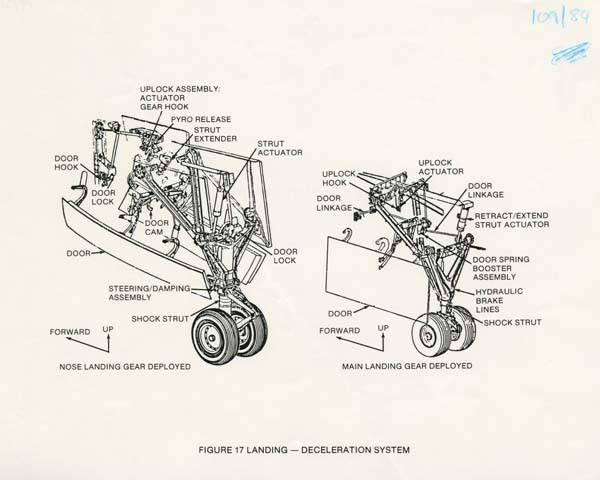
1. The gear would have be much heavier to handle the thrust loads and the landing loads of the engines. The vehicle could barely fly with the gear retracted and now it would have to fly with it extended and at faster speeds than at landing. There is little room around the nose gear of an orbiter.

2. no. The orbiter is not ferried at its dry mass. It is ferried closer to the launch mass. The orbiter mass for the last 10 ferry flights averaged 218klb with the highest being 227klb. Ferry weight was near the landing weight and there were landing in the low 230's. But also, an orbiter has to be capable of being ferried with full payload complement for abort situations, and that would be above 250klb.

3. Nope, with most deployable payloads, there was support equipment that remained in the payload payload bay.

4. No, it isn't hard to believe. Here is a thread on it for your education.
https://www.secretprojects.co.uk/th...-shuttle-payload-attachment.49588/post-833661
And again, fuel bladders are not designed to be hung. It would require rigid tanks to be installed using a spanning structure.

5. I didn't use wikipedia for my answers, just my memory and documentation I have.
 
Last edited:
Given the final-Shuttle's "glide" ratio, I'm not sure 4x F100/F401s would have been enough.

5 minutes from landing, the Shuttle is still at 120,000ft. Rocks are more aerodynamic!

The Shuttle Training Aircraft has to drop the gear, go to beyond full flaps, and engage the thrust reversers in flight in order to have a bizjet fall out of the sky as fast as the Shuttle does.
 
OK, one more final round...

1: thrust and breaking (as well as the touch down impact) doesn't appear at the same time and even if so, they work into opposed direction. Breaking and touch down forces are surly much higher than the thrust forces, so the max. load on the landing gear will not alter significantly.

2 & 3: I wasn't talking about the usual real world Shuttle operation, but about the fictional''what if the Shuttle would have made commercial space flights really cheap'' situation. So no complex research missions, just releasing a satellite and fly back to earth. I know unfortunately, that didn't happen and it never will, but that was one promise of this concept. In these kind of missions, the shuttle would be (almost) empty for landing. This scenario is also necessary to assume a world with many Space Shuttles flying around and a significant number of them have to be transported back to their starting ground.

4. the fuel bladder could be hung in a kind of hammock.

BTW. thanks for the interesting information about the Shuttle!
 
Last edited:
1: thrust and breaking (as well as the touch down impact) doesn't appear at the same time and even if so, they work into opposed direction. Breaking and touch down forces are surly much higher than the thrust forces, so the max. load on the landing gear will not alter significantly.

2 & 3: I wasn't talking about the usual real world Shuttle operation, but about the fictional''what if the Shuttle would have made commercial space flights really cheap'' situation. So no complex research missions, just releasing a satellite and fly back to earth. I know unfortunately, that didn't happen and it never will, but that was one promise of this concept. In these kind of missions, the shuttle would be (almost) empty for landing. This scenario is also necessary to assume a world with many Space Shuttles flying around and a significant number of them have to be transported back to their starting ground.

4. the fuel bladder could be hung in a kind of hammock.
1. That is an unqualified statement. It lacks basis in engineering. Because thrust loads and drag are in the opposite direction and thrust is in the direction of retraction, the gear is not designed to take such loads.
The landing gear would require major modifications to accommodate engines.

2. Wrong. The "real world" shuttle did do commercial spaceflights during the first 25 missions. And in the thread I linked shows the hardware needed to support commercial payloads in the shuttle would have to return after the satellite was released. They would not be "almost" empty.
3. In your scenario, there is no reason for "many" shuttles to be "flying around" and need to fly back to the launch site. At the end of the shuttle program, there was very few landings that were not at the launch site. And.... it would be quicker and cheaper (this is the commercial scenario) to use the 747 vs installing jets engines and opening the payload bay to install fuel tanks at a landing site.
4. why bother with a bladder then and just use a fuel tank on a frame which was the original design.
 
Last edited:
1. That is an unqualified statement. It lacks basis in engineering. Because thrust loads and drag are in the opposite direction and thrust is in the direction of retraction, the gear is not designed to take such loads.
The landing gear would require major modifications to accommodate engines.

2. Wrong. The "real world" shuttle did do commercial spaceflights during the first 25 missions. And in the thread I linked shows the hardware needed to support commercial payloads in the shuttle would have to return after the satellite was released. They would not be "almost" empty.
3. In your scenario, there is no reason for "many" shuttles to be "flying around" and need to fly back to the launch site. At the end of the shuttle program, there was very few landings that were not at the launch site. And.... it would be quicker and cheaper (this is the commercial scenario) to use the 747 vs installing jets engines and opening the payload bay to install fuel tanks at a landing site.
4. why bother with a bladder then and just use a fuel tank on a frame which was the original design.

Landing Geas are designed to be locked in position when extended. The thrust force would not have worked against the hydraulic. Its on you to show, why the gear could not have withstand the thrust. They need to be designed in a way, that they survive hard landings and significant side loades too.

Rockets release theire cargo without complicate and heavy tools which need to be brought back to earth. If it is the standart on any rocket, it would have worked for the Shuttels too.

Solid fuel tanks would have required at least a crane and, as you said, special tools to open the hatches. This cold have been avoided by the usebof a bladder.

With frequent starts, I mean about as many as Space X is planing to do in ten years..
 
Landing Geas are designed to be locked in position when extended. The thrust force would not have worked against the hydraulic. Its on you to show, why the gear could not have withstand the thrust. They need to be designed in a way, that they survive hard landings and significant side loades too.

Rockets release theire cargo without complicate and heavy tools which need to be brought back to earth. If it is the standart on any rocket, it would have worked for the Shuttels too.

Solid fuel tanks would have required at least a crane and, as you said, special tools to open the hatches. This cold have been avoided by the usebof a bladder.

With frequent starts, I mean about as many as Space X is planing to do in ten years..
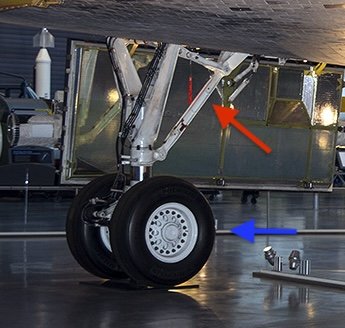
1. again, unqualified statement. keeping gear down and locked is nowhere near braking loads and not in the same direction. Certain parts are only designed to loads in tension or compression and both both. The landing gear would be doubled in size and mass to hold jet engines. See shuttle landing gear photo. the strut (red arrow)n in the photo can only take tension from braking loads (blue arrow direction) and not compression.

2. wrong. they are not the same. the payload bay sidewall attachments drive different load paths and designs. And the actual hardware from those designs in that thread I made to try to educate you.
3. no, your idea does not negate the need for opening the doors or a crane. Installing the bladders and the frame to support them would require it. As you see in the other thread, there is no place to stand in the payload bay. Platforms have to be installed.

4. The 747 is even more cheaper than the jet engines at higher flight rates. the shuttle would be flying with unnecessary mass to accommodate jets engine3 for all those flights.


Just face it, your concept would not work on the shuttle.
 

Attachments

  • gear.jpg
    gear.jpg
    56.3 KB · Views: 21
Last edited:
The breaking loads are.much higher than the thrust loads. Same is true for the vertical loads and side loads. With a 1.5 g Landing with side wind, the rubber tires will in the worst case apply about the same load (1.5 tiimes the gravity force) sideways and upwards at yhe same time (with the mostvof it by only one side). Of course, this could be avoided in almost any case, but surly not in the design and certification. Landing gears are not flimsey and the thrust force is just a fraction of the max load.

In a non gravity situation, no high forces for releasing the freight are required.

Put some planks on.the floor temporarily....
 
1. The breaking loads are.much higher than the thrust loads. Same is true for the vertical loads and side loads. With a 1.5 g Landing with side wind, the rubber tires will in the worst case apply about the same load (1.5 tiimes the gravity force) sideways and upwards at yhe same time (with the mostvof it by only one side). Of course, this could be avoided in almost any case, but surly not in the design and certification. Landing gears are not flimsey and the thrust force is just a fraction of the max load.

2. In a non gravity situation, no high forces for releasing the freight are required.

3. Put some planks on.the floor temporarily....
1. meaningless , a redesign is still required and the gear will be much heavier. there is no way around it. Thinking otherwise is delusional.

2. Doesn't matter, the attach hardware is to support the satellites. Are you saying that commercial satellite manufacturers didn't what they were doing?
3. Still need payload bay doors opened and crane to install them. Shuttle was not designed to bring large amounts of hardware in the payload bay, which whether you like it or not IS required.

This is not a matter of a difference of opinions. I am not stating an opinion, but only facts. Your opinions are based on an incomplete knowledge of the space shuttle system and operations. For example, not knowing that the shuttle flew over 25 commerical Satellites.
 
Last edited:
Put six contemporary P&W TF30 (two on every strut of the landing gear) on it and is will fly. These six jets could lift about 40 t vertically in the air (without after burner). The Shuttle + fuel + jetpack might en up with estimated 100 t take off weight, so that 200 KN thrust would be the theoretical minimum to keep it in the air with a glide ratio of 1:5. The after burner might even be used for take off, providing almost twice the thrust. The Shuttle could still fly with half of the jets. These jets have a diameter of only 1.25 m, so there was enough height under the wing for them.

I get what you are trying to say but the simple fact is that to do any of this it is no longer the "Orbiter" we knew and is therefore something greatly different.
1758773340325.png

Look at the clearances and try to fit two (2) jet engines on each gear set. Now have kerosene feed lines draped over the side of the OPEN payload doors to feed them all on an airframe that is so draggy that the estimated distance it can go (which they calculated with far less 'draggy' options) is only a couple of hundred miles before it has to land again to refuel.

Probably the worst issue is the engines are pretty much guaranteed to FOD out quite often which means an emergency landing at best and an LOV at worst with and engine turbine coming apart during take off (or landing) that throws parts into the wheel assembly, the landing gear bay, and into the TPS tiles like shrapnel.

2 & 3: I wasn't talking about the usual real world Shuttle operation, but about the fictional''what if the Shuttle would have made commercial space flights really cheap'' situation. So no complex research missions, just releasing a satellite and fly back to earth. I know unfortunately, that didn't happen and it never will, but that was one promise of this concept. In these kind of missions, the shuttle would be (almost) empty for landing. This scenario is also necessary to assume a world with many Space Shuttles flying around and a significant number of them have to be transported back to their starting ground.

So we're not talking about "our" Shuttle Orbiter then anyway. So there are likely different compromises and different design decisions which lead to a different Shuttle all together.

Randy
 
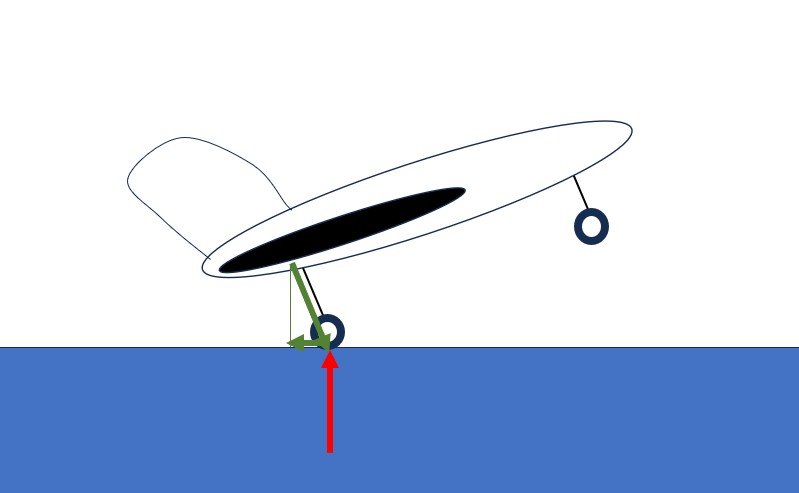
The landing gear of the Space Shuttle needed to withstand much higher forward directed forces by landings than by the proposed jetpack. If we assume a 20 deg angle at touch down, about one third (sin 30 deg) of the touch down force will be directed into the forward direction. With a landing weight of 100 t and a 1.5 g landing, the rear wheels will have to cope about 750 KN each. In forward direction this will be around 250 KN on each side, this is exeeding the max. thrust of even two P&W TF30 with afterburner (2x 93 kN).

The max load on the landing gear will not change significantly in any direction by using them as support for the jets.

The Space shuttle had a unique capability in bringing a crew and heavy equipment together into space, great for research and military applications, but not needed for commercial use. Don’t get me wrong, I was once a kid with a model Space Shuttle and even watched the Columbia in Cologne and I really loved it, but 25 commercial missions with three Shuttles are not so impressive. I was expecting much more back than…
 

Attachments

  • Landing_shuttle.jpg
    Landing_shuttle.jpg
    23.4 KB · Views: 16
The landing gear of the Space Shuttle needed to withstand much higher forward directed forces by landings than by the proposed jetpack. If we assume a 20 deg angle at touch down, about one third (sin 30 deg) of the touch down force will be directed into the forward direction. With a landing weight of 100 t and a 1.5 g landing, the rear wheels will have to cope about 750 KN each. In forward direction this will be around 250 KN on each side, this is exeeding the max. thrust of even two P&W TF30 with afterburner (2x 93 kN).

The max load on the landing gear will not change significantly in any direction by using them as support for the jets.…
This is so wrong. It is a fact that just adding attach points to the gear strtucture to just support the gear mass, not to mention loads and thrust is going to drive major changes. The attach points are going to induce loads and in directions not part of the original design and have be accounted for.

Also, the gear has to account for landing loads and thrust for a go around.

To ignore this is just hand waving.

The Space shuttle had a unique capability in bringing a crew and heavy equipment together into space, great for research and military applications, but not needed for commercial use. Don’t get me wrong, I was once a kid with a model Space Shuttle and even watched the Columbia in Cologne and I really loved it, but 25 commercial missions with three Shuttles are not so impressive. I was expecting much more back than……
And by what measure? You had no basis to expect more. You were a kid and wouldn't know any better.
The shuttle flew more times and more mass from April 1981 to January 1986 than Falcon 9 did from June 2010 to May 2016.
No other vehicle flew more earlier
 
I didnt ignore the loads for a go around an compared the forwards load during landing with the max load of two jets with afterburner. No matter what the gear looks like, it has to be able to withstand this forward directed load.

The Shuttle enabled things like the ISS and many research missions, including the German D1 mission, but 25 commercial flights are not a mayor break through. The press at the time (at least in Germany) wrote about scenarios were space flights would become a daily routine...
 
The Shuttle enabled things like the ISS and many research missions, including the German D1 mission, but 25 commercial flights are not a mayor break through. The press at the time (at least in Germany) wrote about scenarios were space flights would become a daily routine...
A. The Shuttle was never going to be daily. A single orbiter was to fly every two weeks (but that was far from reality)
B. It was a major breakthrough at the time. You can't judge it with today's standards
c. The dream was dashed with the Challenger accident.
 
Last edited:
View attachment 786076

Look at the clearances and try to fit two (2) jet engines on each gear set.
The closest thing to that was Spacejet:
https://up-ship.com/blog/?p=6010
So we're not talking about "our" Shuttle Orbiter then anyway. So there are likely different compromises and different design decisions which lead to a different Shuttle all together.

True. Without SSMEs, you can put the OMS where the SSMEs used to be, and put some jets where the OMS pods were. Just move everything down one, and leave the landing gear unencumbered..

The un-manned core block can be reused Starship style (perhaps--if scaled up enough)--but the astronauts have a bit more of a real airplane. Maybe one orbiter could be crew only with no huge cargo bay? That might be quite agile.
 
The un-manned core block can be reused Starship style (perhaps--if scaled up enough)--but the astronauts have a bit more of a real airplane
not needed if there is a Starship

Maybe one orbiter could be crew only with no huge cargo bay? That might be quite agile.
Not on a Starship and might as well as to upgrade an X-37 or Dreamchaser.
 
I don't judge the space Shuttle with the standard of today, but with all the prediction which were being made back than! Honestly, I don't know which information came direct from the NASA and which might have been pure speculation of the media, but generally, the euphoria was very high and space trips were superposed to become much much cheaper and much more frequent than with conventional rocket technology.

When this didn't materialize, the whole idea of reusablility became out of fashion, a major mistake as it was relativly recently proved by Space-X.

BTW, I would choose the axles (slightly elongated outwards) as major attach points (plus a support lever to keep the angular position) . As said, when the jets are fixed on the unsprung mass, the support structure of the jets should have some flexibility to protect the jets. Thy might be fixed with a kind of two parallel leave spring which allows some up and down motion but keeps the in constant orientation.
 
Last edited:
?

The Space Shuttle (as produced) did not "glide like a rock". That's an insult to rocks, they're more aerodynamic than the Shuttle!

5 minutes from landing, the Shuttle was still above 100,000ft. The Shuttle Training Aircraft had to lower the landing gear and flaps, over-extend the flaps in fact, and then deploy the thrust reversers at altitude. That was the only way you could get a normal airplane to fall out of the sky like the Shuttle did.

How on earth did they think that the Shuttle would fly anywhere under jet power?!?
 
?
The Space Shuttle (as produced) did not "glide like a rock". That's an insult to rocks, they're more aerodynamic than the Shuttle!
5 minutes from landing, the Shuttle was still above 100,000ft. The Shuttle Training Aircraft had to lower the landing gear and flaps, over-extend the flaps in fact, and then deploy the thrust reversers at altitude. That was the only way you could get a normal airplane to fall out of the sky like the Shuttle did. How on earth did they think that the Shuttle would fly anywhere under jet power?!?

As mentioned above, a turbofan-engined testbed based on the Soviet Buran, which (not coincidentally) had very similar dimensions, planform, lift-to-drag ratio, and weight to the US Space Shuttle orbiter, took off from runways in the 1980s and by all accounts maneuvered adequately. As it turned out, the Shuttle orbiters' glide landings worked well, night or day, during their 30-year service despite the steep glideslope, and did not contribute to the two fatal losses (which were takeoff-related). But many believe, I think correctly, that because physics dictates that a final decision to land at Kennedy Space Center had to be made an hour before touchdown, after which the unpowered orbiter was committed, it was only a matter of time before the notoriously changeable central Florida clime would pop up a thunderstorm over the Shuttle Landing Facility runway near the end of a mission and cause a crash.

Air-breathing engines would give a future spaceplane the ability to divert like an airliner, or at least go around, allowing more options than a glider. The spaceplane would then need to be able to retract its landing gear, not possible on the Space Shuttle orbiters. The greater safety of being able to divert in an emergency is more important than being able to accomplish ferry flights.
 
?

The Space Shuttle (as produced) did not "glide like a rock". That's an insult to rocks, they're more aerodynamic than the Shuttle!

5 minutes from landing, the Shuttle was still above 100,000ft. The Shuttle Training Aircraft had to lower the landing gear and flaps, over-extend the flaps in fact, and then deploy the thrust reversers at altitude. That was the only way you could get a normal airplane to fall out of the sky like the Shuttle did.

How on earth did they think that the Shuttle would fly anywhere under jet power?!?
the Shuttle was at 95kft and Mach 3.5 at 7:15 minutes before landing. And 75kft and Mach 2.0 at 5:24 minutes
 
Air-breathing engines would give a future spaceplane the ability to divert like an airliner, or at least go around, allowing more options than a glider. The spaceplane would then need to be able to retract its landing gear, not possible on the Space Shuttle orbiters. The greater safety of being able to divert in an emergency is more important than being able to accomplish ferry flights.
Nope, it never will make sense. See X-37, Dream Chaser. It really doesn't increase safety. And regardless of jet engines, the entry is still going to take the vehicle to the planned landing site area since the engines wouldn't operate until below 60kft which is less than 5 minute before landing.
As mentioned above, a turbofan-engined testbed based on the Soviet Buran, which (not coincidentally) had very similar dimensions, planform, lift-to-drag ratio, and weight to the US Space Shuttle orbiter, took off from runways in the 1980s and by all accounts maneuvered adequately.
Not relevant. the engines were not in a protective enclosure and there was not payload onboard
 
Nope, it never will make sense. See X-37, Dream Chaser. It really doesn't increase safety. And regardless of jet engines, the entry is still going to take the vehicle to the planned landing site area since the engines wouldn't operate until below 60kft which is less than 5 minute before landing.
And IIRC most planes cannot start the engines in flight at above 30,000ft.
 
Back
Top Bottom