
archipeppe
ACCESS: Top Secret
- Joined
- 18 October 2007
- Messages
- 2,564
- Reaction score
- 3,915
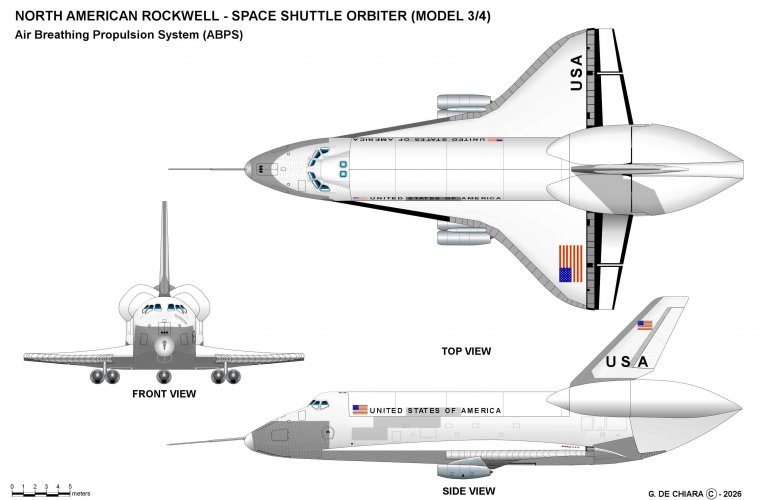
Here it is an updated (and also upgraded) version of my original ABPS artwork.


So that eliminates airfield diversion, since the vehicle is already on the HAC at 5 minutes.And IIRC most planes cannot start the engines in flight at above 30,000ft.

Nope, it never will make sense. See X-37, Dream Chaser. It really doesn't increase safety. And regardless of jet engines, the entry is still going to take the vehicle to the planned landing site area since the engines wouldn't operate until below 60kft which is less than 5 minute before landing.
So that eliminates airfield diversion, since the vehicle is already on the HAC at 5 minutes. As for go around, if the vehicle makes it to the HAC, it doesn't need to worry about being short of energy. What do you thing the weight of engines, structure, wiring, controls, fuel, etc would do to the size, utility and operation of Dream Chaser or X-37? The chances of building another shuttle size orbiter are slim to nil.
Here it is an updated (and also upgraded) version of my original ABPS artwork.
YJ-93 turbojets already had to operate at high-altitudes and higher temperatures...twice the thrust as J-57. Even if jets are not strictly needed if coming back to an airstrip near the launch site---the point is that you don't have to.Excellent artwork of a prospective jet-powered Shuttle orbiter; thank you Archipeppe. Those look like turbojets (J57s?) rather than high-bypass turbofans.
We will see what the future brings.
Because you're only going to be able to start whatever jet engines you have below 30,000ft. Which means ~20 miles or less from the landing strip.I'm not following you, Byeman—unpowered spaceplanes necessarily have to glide to touchdown, and spaceplanes with air-breathing engines necessarily have to glide to touchdown?
According to Dennis R. Jenkins's magisterial reference, the average for the Shuttle flight campaign was for the orbiter to pass 49,000 feet and Mach 1 approximately 30 miles out from the intended runway (Space Shuttle 4th Ed Vol III p13). Any pilot seeing black thunderclouds gather ahead with little warning (as is common in central Florida) will want options if at all possible. That the unpowered Shuttle orbiter with no options (except a chancy bailout from STS-26 onward) glided to landings with surprisingly ease is a historical fact. But again, many believe that rolling the dice would inevitably have resulted in bad news someday.
Today we can and should do better than the Space Shuttle's 1970s design and tech. Byeman's prophecy that diversion will forever be impractical for a spaceplane is unconvincing.
And IIRC most planes cannot start the engines in flight at above 30,000ft.
Because you're only going to be able to start whatever jet engines you have below 30,000ft. Which means ~20 miles or less from the landing strip.
YJ-93 turbojets already had to operate at high-altitudes and higher temperatures...twice the thrust as J-57. Even if jets are not strictly needed if coming back to an airstrip near the launch site---the point is that you don't have to...
Agreed, the YJ93 turbojet worked well at over Mach 3 in the two XB-70s sixty years ago (and was adequate for subsonic ferry flights). Supersonic operating speeds would allow powered flight for a reentering spaceplane farther from the runway. The technology was there in the 1970s (but perhaps not the budget).
There's a significant difference between "low enough to restart an already-spinning engine" and "low enough to windmill-start a stalled engine from 0 rpm"In the late 1950s, 49,000 feet was about the altitude that a U-2 would descend to for J57 restart after a flameout at its 70,000+ operating altitude. NASA's two early-model B-52s (eight J57s) could maintain level flight at over 50,000 feet. So designing appropriate flyback engines for the Space Shuttle orbiter in the 1970s that would start at 49,000 when it became subsonic was hardly an impossibility. Even more capable flyback/ferry engines could be designed today. And in another twenty years, who knows what will be doable?
It was't 30 miles "out", it was 30 miles from landing. The orbiter would be entering the heading alignment circle/cone (HAC) to turn to the runway (the 30 miles includes flying around the HAC). It has already been committed to the intended runway when it enters the HAC.According to Dennis R. Jenkins's magisterial reference, the average for the Shuttle flight campaign was for the orbiter to pass 49,000 feet and Mach 1 approximately 30 miles out from the intended runway (Space Shuttle 4th Ed Vol III p13). Any pilot seeing black thunderclouds gather ahead with little warning (as is common in central Florida) will want options if at all possible. That the unpowered Shuttle orbiter with no options (except a chancy bailout from STS-26 onward) glided to landings with surprisingly ease is a historical fact. But again, many believe that rolling the dice would inevitably have resulted in bad news someday.
No, not with chemically powered jet engines. Too much mass for no real benefit.Today we can and should do better than the Space Shuttle's 1970s design and tech. Byeman's prophecy that diversion will forever be impractical for a spaceplane is unconvincing.
With what fuel? Going to carry all that fuel up and back down?Instead of underwing pods, perhaps engines could be atop the wing root. If nothing else, simple *ramjets* could ignite on orbital return, so perhaps you could re-enter over water, and fly a Buran like orbiter to a wider range of airfields... meaning you may not have to re-enter over populated areas deadstick.
It wasn't the fiscal budget, it was the mass budget. J57 engines weighed 5,000lb. 5 were planned for self ferry. That is 25,000lb, almost 1/2 the payload capacity of the shuttle and that doesn't include mounting structure, fuel, tanks, wiring and controls.Agreed, the YJ93 turbojet worked well at over Mach 3 in the two XB-70s sixty years ago (and was adequate for subsonic ferry flights). Supersonic operating speeds would allow powered flight for a reentering spaceplane farther from the runway. The technology was there in the 1970s (but perhaps not the budget).
That's why the concept works better with no SSME's in the boat-tail. Ramjets would weigh less of course...perhaps helping to warm up small turbojets next door. Not having three heavy RS-25s helps.Two YJ93s (or similar) are going to weigh about 5 tons for the engines alone, add in another 5 tons of fuel and you get enough gas to run them for about 20 minutes (rough calc).
No, it doesn't work at all. Cost matters now. There is no business case that supports such a vehicle. There is no reason to have a large orbiter type vehicle that isn't part of the launch vehicle. It is just a very expensive crewed reusable payload fairing both in development and operations.That's why the concept works better with no SSME's in the boat-tail. Ramjets would weigh less of course...perhaps helping to warm up small turbojets next door. Not having three heavy RS-25s helps.
There is no such thing.Design a good non-glider orbiter that can function as a true airplane,
It was't 30 miles "out", it was 30 miles from landing. The orbiter would be entering the heading alignment circle/cone (HAC) to turn to the runway (the 30 miles includes flying around the HAC)...
It has already been committed to the intended runway when it enters the HAC...
When you are at the landing site and want to watch a shuttle landing, you don't look to the horizon to find the orbit, you look straight up...
I used actual Shuttle documentation for my reference.Byeman, I spoke with Mr Jenkins, and he confirms that when he wrote in his book
Diversion to Orlando, Jacksonville, West Palm, etc could happen after OMS burnThe Shuttle orbiter was already committed to the intended runway after it was halfway through its OMS rocket burn on the other side of the planet. Risky.
No hyperbole. I was at the SLF for 20 or so landings, Edwards for a few and at KSC or surrounding area for another 30 or so. On a few of them, especially those with a HAC of greater than 180 degrees, we could see yaw RCS firings (smoke puffs) and many we saw it before it entered the HACYou indulge in hyperbole (it wasn't a Stuka), but yes, my line of sight to a Shuttle orbiter closer than thirty miles away at circa 49,000 ft altitude would indeed be well above my horizon. A notably steep glidepath, as Scott Kenny reminded us.
Byeman, I spoke with Mr Jenkins, and he confirms that when he wrote in his book that the reentering Space Shuttle orbiter went subsonic "about 30 miles from the runway", this is a measure of the actual traverse of the vehicle as it turned and banked around the heading alignment cone. Not a measure of a straight line between the spot where the orbiter went subsonic and the runway threshold, as I had mistakenly thought. Such a straight line would necessarily be considerably less than 30 miles. You were right.
Never. The nozzles were sized for vacuum, they would collapse. Plus the T/W was less than 0.05.I'd like to ask... was there any kind of contingency plan to fire the OMS pods during a landing, in case the Shuttle fell a little short of the runway ? (provided of course the pods had some propellant left)
wasn't the OMS translate burn 1m/s? A couple of bumps would likely be just enough to get to the runway threshold.Never. The nozzles were sized for vacuum, they would collapse. Plus the T/W was less than 0.05.
Not with a T/W of .05, it would take too long.wasn't the OMS translate burn 1m/s? A couple of bumps would likely be just enough to get to the runway threshold.
Even the big OMS rockets? the ones used for the deorbit burn?Not with a T/W of .05, it would take too long.
They aren't big. T/W of >0.05. 12klb thrust vs 250klb massEven the big OMS rockets? the ones used for the deorbit burn?
Two YJ93s (or similar) are going to weigh about 5 tons for the engines alone, add in another 5 tons of fuel and you get enough gas to run them for about 20 minutes (rough calc). Add in whatever doohickey you're using to deploy them into the airstream after the hypersonic portion of reentry, structural reinforcements, other additional systems, etc. and you'd be lucky if they Shuttle has enough payload left to deploy a sputnik into orbit.
It wasn't the fiscal budget, it was the mass budget. J57 engines weighed 5,000lb. 5 were planned for self ferry. That is 25,000lb, almost 1/2 the payload capacity of the shuttle and that doesn't include mounting structure, fuel, tanks, wiring and controls.
He worked on the shuttle program. So he knows a bit about it.
Blackstar, your message is unclear, but if "he" refers to Byeman instead of Space Shuttle program veteran Dennis R. Jenkins, then this is welcome news. Such experienced authorities keep our technical discussions here on Secret Projects Forum honest.
I'd like to ask... was there any kind of contingency plan to fire the OMS pods during a landing, in case the Shuttle fell a little short of the runway ? (provided of course the pods had some propellant left)
Never. The nozzles were sized for vacuum, they would collapse. Plus the T/W was less than 0.05.
wasn't the OMS translate burn 1m/s? A couple of bumps would likely be just enough to get to the runway threshold.
It isn’t as if that couldn’t be beefed up.. OK-92 style. That used kerosene, which lends itself to, say, ramjet use.
Not with a T/W of .05, it would take too long.
Even the big OMS rockets? the ones used for the deorbit burn?
They aren't big. T/W of >0.05. 12klb thrust vs 250klb mass
Getting that and most of the eggshell tankage outside of the airframe makes for an aircraft less of a beached whale.

Bricks are more aerodynamic than the Space Shuttle.Beached whale? More like a brick with wings and a tail-fin.
wrong. Use of the OMS has multiple issue:In principle, the Orbital Maneuvering System's two rocket motors could have been beefed up during the 1970s design process to any arbitrary size, to provide rocket-powered landings for the orbiter rather than the glide landings actually chosen. Yet this seems inelegant. For a future spaceplane, just like was decided for the Saunders-Roe SR.53 rocket fighter (and planned SR.177), a modest air-breathing jet engine added to the vehicle would be better than rocket power or unpowered glide for bringing her safely home (at flight idle), and (at full thrust) go-around or diversion when necessary. Then the OMS can be efficiently sized for space use only, as it was in Space Shuttle.
Meaningless points. Hypergols availability is not an issue. Using GOX is not an advantage,I think it is good to have margin...we know X-37 can remain in orbit a long time with hypergolics...but kerosene is more plentiful on the ground, and oxygen allows life support.
Wrong. What is the point of a large orbiter with no main engines? The object is to reduce costs. It does the opposite by increasing costs by turning the orbiter into just an expensive payload fairing and throwing away the engines. There are bettter ways to design for payload fairing reuse.Not having a tail full of dead-mass SSMEs really opens things up. Getting that and most of the eggshell tankage outside of the airframe makes for an aircraft less of a beached whale.
Which was another wrong path.Imagine if the orbiter ate its External Tank
That was the Rockwell X-33 path.
that's the problem. A crew compartment is not needed. This is a launch vehicle.By keeping the rocketry part needed to achieve orbit outside the airframe--you don't have to fly just one kind of orbiter. One might be less or a brick, with a more streamlined crew compartment.
You almost had it right and then get it completely wrong in the last sentence.There is a wonderful quote on page 94 of Jenkins' book called LOCKHEED SECRET PROJECTS--INSIDE THE SKUNK WORKS, a quote about how the VentureStar design morphed from internal payload bays to a hump, and finally the payload:
"had been moved completely out of the vehicle and into a piggyback container. This may not be detrimental since it would allow the vehicle to carry payloads of almost any given size and shape, at least within some aerodynamic and thermal considerations."
--thus my advocacy of parallel staging and piggyback payload mount of the modular Buran approach.
The point is to make space launch cheaper and not just fly a space planes.As for the unmanned rocket core once shed...have that come back like Starship...use it as a wet workshop...expend it.. whatever. At least it's parasite mass doesn't interfere with the flight dynamics of the space-plane.
Separation of function allow both--Falcon and X-37 were both flown back... separately.The point is to make space launch cheaper and not just fly a space plane.


