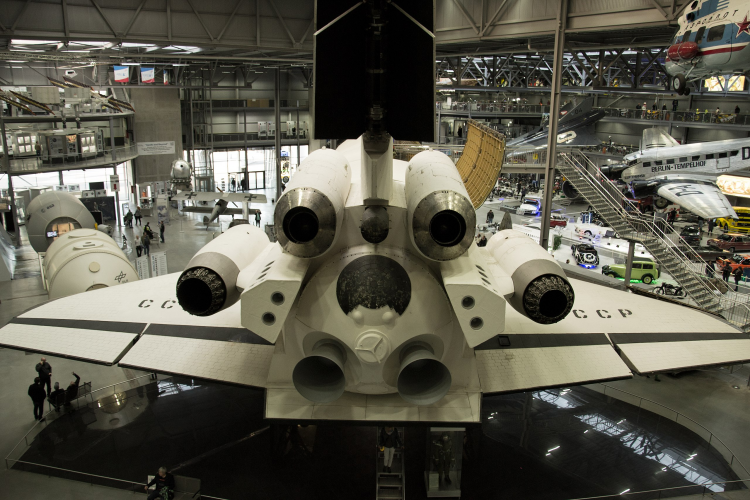
Space shuttle turbofans for ferry flight

Archibald

ACCESS: USAP
Senior Member
Joined
6 June 2006
Messages
14,974
Reaction score
21,293
Today the space shuttle use a modified 747-200 for its ferry flight (between Edwards AFB and Cap canaveral).
But this was decided only in 1974. Before that, and according to a serious website http://www.capcomespace.net/dossiers/espace_US/shuttle/index.htm
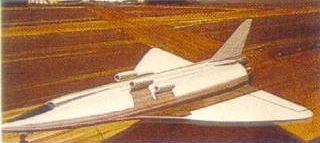
(in french) in 1972-73 the shuttle was to have
- five TF-33 P7 (1972)
or
- four F-401 (1973)
for its ferry flights! There was a fuel tanks in the cargo bay. Of course, these equipments were deleted for spaceflight, to save 10 tons or something like that.
Anybody have drawings of this equipments?
 
This configuration applied only to an intermediate version of the Shuttle design, between the original concept with straight wings and tail surfaces and the final version with an ogee wing, that had a pure delta wing. For modelling purposes, you could figure that the four engines were spaced out from the fuselage, as a percentage of semi-span, the same as the engines on the B-58, though not protruding forward of the wing as on the B-58. I mainly remember this because my alma mater had the nearest large low-speed wind tunnel to NASA-Houston and we did a lot of testing during the Shuttle's evolution; I can remember the model of this configuration, complete with similated exhaust flows.
 
Merci... I red that range was something like 700km.
I'm asking about handling of such a plane...speed of an airliner,ok but peculiar aerodynamics (very different from a fighter or a bomber).
Maybe not much lift from the wings, but four F-401 seems powerfull enough to fly this brick.
 
Could be interesting to fit the four turbofans to the 1.72 scale Shuttle (revell)
 
I know that. It was the equivalent of the enterprise Ie it never went to space.
Any news of this peculiar article? I mean, in 2000 it was showed in australia, after a bankrupcy it was shiped to the EAU, then the sinsheim museum tried to buy it...
 
Oh, and a bit of humor about that wind tunnel model. The four locations were stations 1-4, running from left to right, and each was humorously labelled with a "fuel" (remember, this was done while the "honorable" Sen. Proxmire was riding high); the labels from left to right were: "JP-4", "80/87", "Coal Oil", & "Wisconsin Milk".
 
According to Didier Capdevilla "capcom espace" (excellent) website Shuttle ferry turbojets were first 5*TF-30 then 4*F-100 before being deleted in the mid-70's.
Could have helped Moonraker hijackers (much better than firing SSME without having External Tank, stupid!)
 
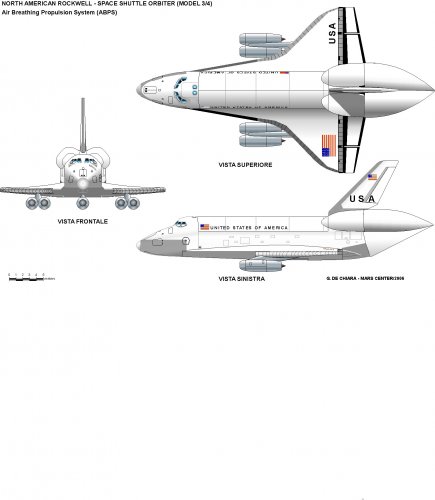
Based upon the description given by the excellent Jenkins' book, that's my personal interpretation of the 5 engined air-breathing Shuttle.
 

Attachments

  • OV-00 Model 3-4.jpg
    OV-00 Model 3-4.jpg
    223.1 KB · Views: 665
The position of the jet engines makes them extremely vulnerable. If to place them somewhere, than the best position is to move them aft above the wing.
 
Matej said:
The position of the jet engines makes them extremely vulnerable. If to place them somewhere, than the best position is to move them aft above the wing.

I suppose that's the main reason which forced the Russians to place the engines in the aft-end of the fusalage in the Buran Analog (or "Aero-Buran").
 
Based upon the description given by the excellent Jenkins' book, that's my personal interpretation of the 5 engined air-breathing Shuttle

i've seen a drawing of the shuttle orbiter with the jet engines mounted underneath, i'm sure it's in one of the Jenkins' Shuttle books, maybe the first one, the one in the 'aerofax datagraph' series.

cheers,
Robin.
 
Matej said:
The position of the jet engines makes them extremely vulnerable. If to place them somewhere, than the best position is to move them aft above the wing.

Considering well-known problems with the Shuttle tiles / heatshield the 747 ferry is probably a better solution
IMHO jet blast and take off run would have spread havoc on Shuttle underside, which is already costly to maintain... and vulnerable!

Archipeppe I like very much the 3-views you post - particularly the shuttle-II
 
Archibald said:
Archipeppe I like very much the 3-views you post - particularly the shuttle-II

I'm really glad that you appreciated my drawings, thanks Archibald.
 
Hi,


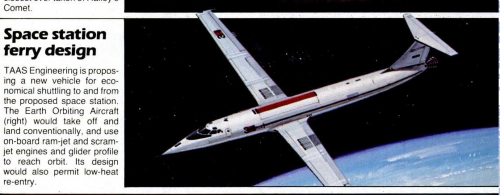
the TAAS Engineering created a ferry aircraft for space station,used ram-jet and scram-jet
to reach orbit.


http://books.google.com.eg/books?id=HuMDAAAAMBAJ&printsec=frontcover&dq=popular+mechanics+1986&hl=en&sa=X&ei=6GwAVLWWEKmu0QW02YGQCw&ved=0CCsQ6AEwBDgK#v=onepage&q=popular%20mechanics%201986&f=true
 

Attachments

  • TAAS.png
    TAAS.png
    546.3 KB · Views: 441
Scott Manley has uploaded a video about how the Space Shuttle lost its' jet-engines:


The space shuttle as we know it was not the Space Shuttle NASA originally envisaged, and in the original concepts the orbiter would carry turbojets to help it land, and give it the option of performing a go around if there was a problem. The engines would also give the orbiter the ability to ferry itself from its landing site to its launch site, reducing logistical complexity.​
But between budget challenges and a better understanding of the engineering the shuttle lost many of its ambitious features and found its true nature as the worlds most extreme glider.​
Credit where credit is due: This was inspired by a post on the somethingawful forums.
 
During phase A & B the Orbiter design got Jet engine build in airframe.
This would give crew better chance to land and transfer from landing site to Launch site (or production side)
later as Orbiter design got smaller with external tanks
They proposed engine modules in Cargo bay to fly Orbiter
obviously the issue with cargo bay doors, drop that plan
finally drop the Jet engines to reduce weight and pilots had focus to get Orbiter on ground on first approach...
 
Scott threw a little shade at the concept-but with no SSME's it gets easier to have them. The orbiter could be a tad lighter, especially if titanium.

Just train the pilots to approach as if they had no engines--just keeping them in the back pocket. Remember, the OK-92 concept could even take off on its own with its abort solid---usable with or without Energia.

Has Moonraker's opening sequence used an OK-92 atop the 747 ferry---it would have been more plausible.

The old 747 ferry is best for long distances--but not being a pure glider is nice.

Having added jets to me exemplifies the KISS method--in that you aren't trying to build a scramjet airbreather.
A simpler orbiter with J-79swould have been just another jet plane.
 
Scott also pointed out due to the bad aerodynamics having engines to "transfer" the Shuttle anywhere wasn't going to work because it had an incredibly horrible range with jet engines mounted.

Randy
 
Scott threw a little shade at the concept-but with no SSME's it gets easier to have them.
Not true. It isn't easy no matter what the weight.

Just train the pilots to approach as if they had no engines--just keeping them in the back pocket.
Wrong. It was more than that. The flight design and planning had had to assume no engines. And hence, the engines become a disadvantage and

The old 747 ferry is best for long distances--but not being a pure glider is nice.
Not true. The only thing worse on a spacecraft than wings is a jet engine.

Having added jets to me exemplifies the KISS method--in that you aren't trying to build a scramjet airbreather.
A simpler orbiter with J-79swould have been just another jet plane.
That doesn't make sense
A. It is the opposite of the KISS. It makes the vehicle more complex
B. Scamjets are for ascent only. Don't know of any vehicle using them for descent.

A simpler orbiter with J-79swould have been just another jet plane.
It wouldn't be simpler. And it would be the worse of either world, a poor jet plane and a bad spacecraft

134 Shuttle missions, x number of llifting body flights and Y number of capsule returns have demonstrated precision of entry control and landing. Airliners go arounds are not for hardware failures or bad approaches but for traffic or bad weather, some things returning spacecraft don't have to deal with. Jet engines won't ever be needed for returning spacecraft.

The shuttle's circular approach was to reserve energy in case of a shortfall. The orbiter could go straight instead. This is the go around replacement.
 
Why jet engines on a spacecraft are bad:
a. Dead mass for ascent. Makes vehicle dry mass and drag higher.
b. Increases complexity greatly
c. Dirty. Hydrocarbon cloud around the spacecraft
d. Special lubricants required for jet engines due to exposure to vacuum
e. uses vehicle volume
 
It might have been an option, to fix the jets temporarily on the landing gear. A landing gear is required anyway and would have been a suitable attachment point for carrying the high loads. Of course, this solution would have been very aerodynamically inefficient, but for ferry flights this is surly not a very important point. It is more critical, to provide enough trust to make it airborne.

The ''jetpack'' might have also contained a aerodynamic fairing for the landing gear to make it less draggy.
 
Last edited:
Scott threw a little shade at the concept-but with no SSME's it gets easier to have them. The orbiter could be a tad lighter, especially if titanium.

Just train the pilots to approach as if they had no engines--just keeping them in the back pocket. Remember, the OK-92 concept could even take off on its own with its abort solid---usable with or without Energia.

Has Moonraker's opening sequence used an OK-92 atop the 747 ferry---it would have been more plausible.

The old 747 ferry is best for long distances--but not being a pure glider is nice.

Having added jets to me exemplifies the KISS method--in that you aren't trying to build a scramjet airbreather.
A simpler orbiter with J-79swould have been just another jet plane.
It would be *REALLY* great if you could provide some *BASIC* comparative/quantitative mass/performance/LCC (heck, you can even skip environmental impact assessments!) estimates for your ideas, rather than just some dreamy arguments built entirely out of Handwavium...
 
Last edited:
It would be *REALLY* great if you could provide some *BASIC* comparative/quantitative mass/performance/LCC (heck, you can even skip environmental impact assessments!) estimates for your ideas, rather than just some dreamy arguments built entirely out of Handwavium...
That's fair enough...an engineless orbiter (that would be a better candidate for jet pods) can be found here:
https://aiaa.org/wp-content/uploads/2024/12/shuttlevariationsfinalaiaa.pdf
An engineless orbiter developed from a “challenge” by an individual at NASA/MSFC regarding the ability of the orbiter to evolve into an unpowered vehicle, something like the Russian Buran. This worked out very nicely, as seen in Fig. 21, by adding a payload bay segment at the aft end of the bay (as noted above for the stretched orbiter) and moving as much equipment into a new faired aft body as possible to compensate for the removal of the engines and thrust structure. The subsonic L/D increased to an estimated 6.02 as a result.

I am thinking that jets with kerosene (burning nitric acid oxidizer in a vacuum) would also compensate for no SSMEs, though one could still lengthen a (new build) Shuttle-2.

At any rate the drawing at the nearby thread shows that folks were looking at alternative configurations:
https://www.secretprojects.co.uk/attachments/shuttle-1972-png.784961/OK-92 wouldn't have been so crowded as that concept. No handwavium. I don't think the folks who at least looked at that concept were "low quality." The individuals who worked on that likely as accomplished as Byeman. So it wasn't just me being dreamy. That's the SSTO guys.

Nick said See this thread:
https://www.secretprojects.co.uk/threads/augmented-cooling-radiators.38612/post-551787
none of his several postings here were related to coolers in any way...

Having lots of liquid channels (nano-pipes for circuits at least?) helps with cooling.
Here too
https://arc.aiaa.org/doi/10.2514/3.8626
 
Last edited:
That's fair enough...an engineless orbiter (that would be a better candidate for jet pods) can be found here:
https://aiaa.org/wp-content/uploads/2024/12/shuttlevariationsfinalaiaa.pdf
An engineless orbiter developed from a “challenge” by an individual at NASA/MSFC regarding the ability of the orbiter to evolve into an unpowered vehicle, something like the Russian Buran. This worked out very nicely, as seen in Fig. 21, by adding a payload bay segment at the aft end of the bay (as noted above for the stretched orbiter) and moving as much equipment into a new faired aft body as possible to compensate for the removal of the engines and thrust structure. The subsonic L/D increased to an estimated 6.02 as a result.
An increased L/D in itself does not make a case for the use of jet engines. It just means a shallower trajectory.
I am thinking that jets with kerosene (burning nitric acid oxidizer in a vacuum) would also compensate for no SSMEs, though one could still lengthen a (new build) Shuttle-2.
Huh? nitric acid oxidizer doesn't make a jet engine work in a vacuum. A jet engine relies on nitrogen in the air used as a working fluid to provide thrust. Plus you are adding more complexity and mass. This is where "some *BASIC* comparative/quantitative mass/performance/LCC... estimates" would go. Not throwing more crap on the wall to see if it sticks.

At any rate the drawing at the nearby thread shows that folks were looking at alternative configurations:
https://www.secretprojects.co.uk/attachments/shuttle-1972-png.784961/
Not an alternative configuration, but a discarded configuration that had many systems that were found to be unworkable or unnecessary such as ET deorbit motor, Escape motors, ABPS, etc

OK-92 wouldn't have been so crowded as that concept. No handwavium.
That statement is exactly what "handwavium" is. Just because a statement about a subject matter is true, doesn't mean it translates to supporting a completely separate subject.

OK-92 not having main engines mounted on it (i.e. "less crowded"*) has nothing to do with whether jet engines are necessary/feasible for a returning winged spacecraft. The shuttle orbiter can be thought of as not having main engines mounted on it for return but just returning with additional payload mass equivalent to the main engines (21klb or so).

* And another thing don't use roundabout phrases to describe what you actual mean. Most people don't get your inferences because they don't share your experiences.
 
Huh? nitric acid oxidizer doesn't make a jet engine work in a vacuum.
I didn't say it did. Use nitric acid and kerosene together on orbit in place of hypergolic OMS engines
After re-entry, open up jet intakes and just use kerosene by itself.
 
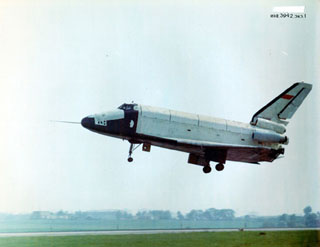
While the Americans never got to a jet-engine Space shuttle, the Soviets (kind of) did. The Soviets had their own Space Shuttle known as the Buran, which in 1989 flew for the first and last time. Like the Shuttle, the Buran was designed to glide to its runway following reentry, which called for atmospheric aerodynamic tests of the vehicle. The Americans did this by using the Shuttle Carrier to bring the Shuttle to altitude, and then release it to glide independently. The Soviets however chose to build a separate aircraft known as the OK-GLI (acronym for "Orbital Ship For Horizontal Flight Tests) that was essentially the Buran with jet engines. It flew 25 times between 1984 and 1988, after which it was shipped to Australia, the Middle East, and finally to Germany for museum exhibition.
1758315869115.png
1758315779089.png
 
I didn't say it did. Use nitric acid and kerosene together on orbit in place of hypergolic OMS engines
After re-entry, open up jet intakes and just use kerosene by itself.
So how does "I am thinking that jets with kerosene (burning nitric acid oxidizer in a vacuum)" refer to OMS?

Again, you assume everyone thinks like you.
 
We need to differentiate between temporary attached jet engines for ferry flights and permanent jet engines. With payload beeing allways just a fraction of the take off mass, it surly hurts to add anyting on a spacecraft which adds a lot of mass and no performance increase.

For the ferry flight, attaching jets might have been feasable, but this solution would have required a lot of development cost. The Shuttle would have become a regular aircraft as well as a spacecraft with all the hurdles for testing and certification.


@publiusr : where do you see the relation to any aircraft cooler or cooler in general? Just throwing 3d printing and nano in the room to open another topic is not the way to go
Nick said See this thread:
https://www.secretprojects.co.uk/threads/augmented-cooling-radiators.38612/post-551787
none of his several postings here were related to coolers in any way...

Having lots of liquid channels (nano-pipes for circuits at least?) helps with cooling.
Here too
https://arc.aiaa.org/doi/10.2514/3.8626
 
I always turn things over. Skylon's SABRE needs really fine channels--might that be useful in other ways? Perhaps channels of different diameters can help cool engine and structure both.

It is always good to look for anything that might come out of left field. Now, Energia's RD-0120 had channel wall. Simple turbojets are more well known than other airbreathing systems--but perhaps what started as one technology might be more useful in another.

Dedicated aerospace professionals may be far to busy to read things in other fields...perhaps they come here on occasion for a break...then see something in a link that might spark a solution to a problem they are otherwise too close to.

Velcro might have harmed topology. Some dumb kid having trouble with shoestring knots might inspire a much smarter person whose brain has turned to mud.

I can't prove this, but it may be that there are solutions to problems vexing professionals who can't see them for working too hard.

"The Bar" has no direct impact on aerospace--but it might.
 
I always turn things over. Skylon's SABRE needs really fine channels--might that be useful in other ways? Perhaps channels of different diameters can help cool engine and structure both.

It is always good to look for anything that might come out of left field. Now, Energia's RD-0120 had channel wall. Simple turbojets are more well known than other airbreathing systems--but perhaps what started as one technology might be more useful in another.

Dedicated aerospace professionals may be far to busy to read things in other fields...perhaps they come here on occasion for a break...then see something in a link that might spark a solution to a problem they are otherwise too close to.

Velcro might have harmed topology. Some dumb kid having trouble with shoestring knots might inspire a much smarter person whose brain has turned to mud.

I can't prove this, but it may be that there are solutions to problems vexing professionals who can't see them for working too hard.

"The Bar" has no direct impact on aerospace--but it might.
You just mentioned cooling channels (small diameter channels dont work for low pressure coolers btw) and jumped directly into another topic. There was no attempt to connect these channels with the coolers and how they might be used. You are just producing a lot of entropy this way. Talking about everything but the topic doesn't help here or in real life.
 
I always turn things over. Skylon's SABRE needs really fine channels--might that be useful in other ways? Perhaps channels of different diameters can help cool engine and structure both.

It is always good to look for anything that might come out of left field. Now, Energia's RD-0120 had channel wall. Simple turbojets are more well known than other airbreathing systems--but perhaps what started as one technology might be more useful in another.

Dedicated aerospace professionals may be far to busy to read things in other fields...perhaps they come here on occasion for a break...then see something in a link that might spark a solution to a problem they are otherwise too close to.

Velcro might have harmed topology. Some dumb kid having trouble with shoestring knots might inspire a much smarter person whose brain has turned to mud.

I can't prove this, but it may be that there are solutions to problems vexing professionals who can't see them for working too hard.

"The Bar" has no direct impact on aerospace--but it might.
You do you, bro...
 
We need to differentiate between temporary attached jet engines for ferry flights and permanent jet engines. With payload beeing allways just a fraction of the take off mass, it surly hurts to add anyting on a spacecraft which adds a lot of mass and no performance increase.

For the ferry flight, attaching jets might have been feasable, but this solution would have required a lot of development cost. The Shuttle would have become a regular aircraft as well as a spacecraft with all the hurdles for testing and certification.
Temporary still has drawbacks. Structural scarring for attach points. Fuel tank location and installation, fuel lines, control and monitoring wire harnesses, etc. All increase mass and complexity.
 
Back
Top Bottom