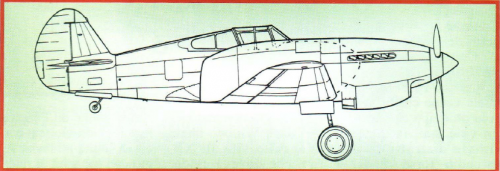
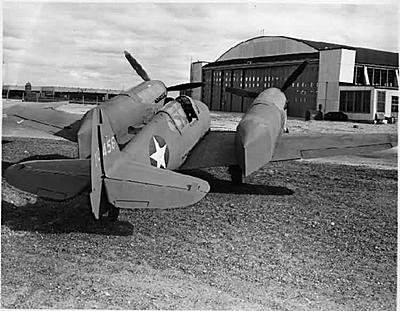
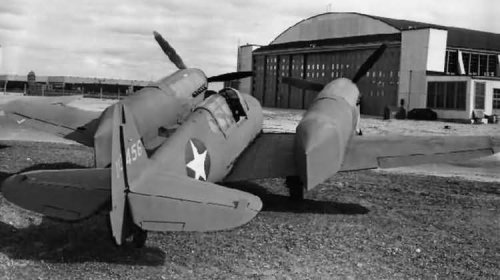
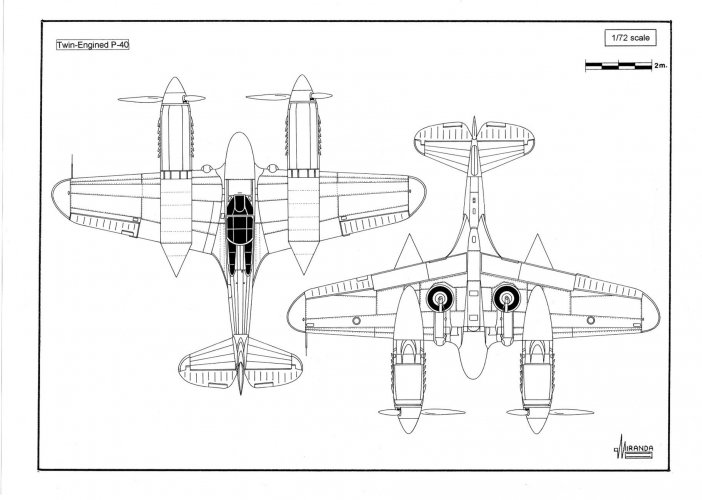
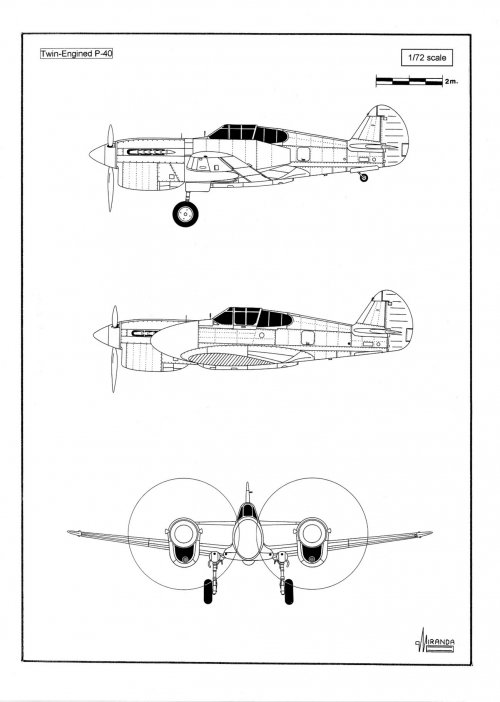
One of the more extreme P-40 modifications proposed was a twin-engine version.
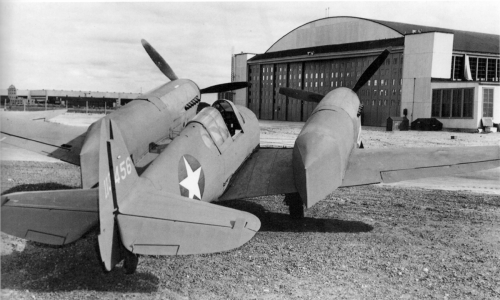
In 1976 Ernest R. McDowell published a picture of the mock up in the Squadron Signal monograph ‘Curtiss P-40 in action’.
The aircraft was the ex-P-40 C s/n 41-13456 extensively modified with the installation of a P-40 D canopy and two wing mounted Packard/
Merlin V-1650-1 engines coming from two P-40 F airplanes.
The serial number fate is listed as ‘
condemned Feb. 27, 1943’ on Joe Baugher site of U.S. aircrafts.
In 1979 the picture was credited to National Air and Space Museum (NASM) by Peter M. Bowers in the Putnam book ‘
Curtiss Aircraft 1907-1947’.
The picture was republished by the same author in ‘Airpower’ May 1983 and in 2007 by Francis H. Dean in the Schiffer book ‘
Curtiss Fighter Aircraft 1917-194’.
In an article published in
'American Aviation Historical Society Journal', spring 2017, Dan Hagedorn revealed that the picture had been taken in the South-West quadrant of the Buffalo Municipal Airport N.Y. which just happened to be the location of the Curtiss-Wright manufacturing facilities.
Between July 2006 and May 2015 the picture was analyzed by the experts of the forum
https://www.secretprojects.co.uk/threads/twin-engine-curtiss-p-40.509/ with the result of several interesting theories and the publication of the same picture with different contrast level that might show some more details, including a
shark mouth paint in the starboard engine nacelle.
The 68th F.S., 347 F.G. fighting in Guadalcanal between January and June 1943 was the only P-40F unit using
shark mouth paint. These aircraft belonged to the P-40 F-15-CU series (c/n 41-19733 to 41-19932).
Possibly the starboard
Merlin of the mockup was a surplus engine from one of the damaged aircraft on Guadalcanal and could not reach Buffalo before June 1943.
Grumman Aircraft Engineering Corporation proposed the concept of a lightweight twin-engine point-defence interceptor, with outstanding climb rate, in 1938 the firm won two development contracts with the U.S. Navy and the USAAC.
The naval prototype, named XF5F-1
Skyrocket, was flown on 1 April 1940 powered by two 1,200 hp Wright R-1820 radial engines.
In 1941 flight tests were conducted against eight types of Allied fighters. Hawker
Hurricane Mk. IIB, Supermarine
Spitfire Mk.VC, Bell P-39 D, Bell XFL-1, Curtiss P-40 D, Grumman F4F, Brewster F2A and Vought XF4U.
These trials revealed the superiority of the
Skyrocket in top speed (383 mph) and climb rate (4,000 ft/minute).
The Army prototype, designated XP-50, first flew on 18 February 1941 powered by two 1,200 hp Wright R-1820-67/69 turbo-supercharged engines.
With 423 mph top speed and 4,575 ft/minute the P-50 was superior even the
Skyrocket in the point-defence role, but the U.S. navy pressed Grumman into the mass production of
Wildcats,
Hellcats and
Avengers, the aircraft types most urgently needed in the Pacific Front.
On May 14,1941, the turbo-supercharger failure resulted in the destruction of the XP-50 and the project was cancelled.
Theoretically, one P-40 powered by two
Merlin engines could exceed 400 mph top speed, 3,450 ft/minute climb rate and over 10,500 lbs gross weight.
In June 1943 the USAAF cancelled the Lockheed XP-49 high-altitude fighter, with 3,300 ft/minute climb rate, in favour of the P-38 J. But the
Lightning was a heavy fighter with 2,857 ft/minute climb rate, inferior to those of the Hawker
Hurricane Mk. IIB.
After the cancellation of the Curtiss XP-62A on September 21,1943, and the Curtiss XF14C-2 in December, the United States lacked any type of point-defence interceptor.
In these circumstances the non-flyable mock up could have been used to demonstrate that that a twin-engine P-40 could be built with parts coming from the production line, to circumvent the cancellation of the project in favour of the P-40 K, M and N series.
The mock up could be an experiment for evaluating the twin-engine configuration as part of the XP-50 competition.
In the opinion of the experts the construction of a hypothetic flyable prototype would have required the following modifications: installation of an strengthened landing gear, reinforcement of the wing structure, design of a new streamlined nacelles in order to reduce the turbulence over the tail surfaces, increasing the fuselage length and the tailfin area to compensate the large side area of the nacelles, a significant amount of ballast added in the tail in order to preserve the centre of gravity location.
The poor lateral visibility was acceptable in a point-defence interceptor.
The mock up could be just another attempt of Curtiss to save the basic P-40 design, improving performance with increased power and cancelled because the unavailability of
Merlin engines.
Or it was a hoax created for unknown reasons?