Sure if you want to defeat TBM's like the ALHTK concept proposed. A long range engagement weapon in the ERINT or PAC-3 form factor would need to go through considerable re-design to a point where it would basically be a completely new weapon designed around the existing PAC-3 rocket motor perhaps. They can probably leverage internal components from the JATM and MSE programs though.
Sure if you want to defeat TBM's like the ALHTK concept proposed. A long range engagement weapon in the ERINT or PAC-3 form factor would need to go through considerable re-design to a point where it would basically be a completely new weapon designed around the existing PAC-3 rocket motor perhaps. They can probably leverage internal components from the JATM and MSE programs though.
With that speed and range requirements for a LREW its going to have to loft quite a bit more than where PAC-3 is optimized to perform so probably some other differences in design as well. But overall, I really like the 10" diameter 15 ft. long form factor.
With that speed and range requirements for a LREW its going to have to loft quite a bit more than where PAC-3 is optimized to perform so probably some other differences in design as well. But overall, I really like the 10" diameter 15 ft. long form factor.
In my deep dive i did find some info on JATM... but only things that could be reasonably inferred already, or is already known (JATM JPO is at Eglin, JATM TPO is at China Lake, it's an ACAT ID program, in DT, OT, and LF, etc.), but something scored me a phone call from DISA J6 C4E yesterday morning that I wasn't a big fan of, so it might be time for me to lay off the hunt for AIM-174 and AIM-260 info
There is a lot on the system in public without the need to go to the DOD to ask for information. Every time I spend some time digging into it, I end up finding something new (to me) on the program.
With that speed and range requirements for a LREW its going to have to loft quite a bit more than where PAC-3 is optimized to perform so probably some other differences in design as well. But overall, I really like the 10" diameter 15 ft. long form factor.
As capable as the AIM-120 is it is well past time that something new was developed to replace it and the USAF/USN shouldn't restrict themselves by insisting that it fits into the AIM-120's "Footprint" (12ft long by 7" in diameter).
Except that the F-22 would not be able to carry those. Or F-35, though I think the F-35 has longer bays and MIGHT be able to carry those.
And until the F-22 is retired, it's still the premier fighter on earth.
F-15s would not be able to carry that missile on the Sparrow dents on the inlets, it'd have to carry a missile that big on the CFTs. But IIRC all Eagles fly with CFTs these days, so not a big deal.
Super Bugs don't have a dent on the inlet, IIRC, but have a small pylon so they're fine.
Length-wise, that might be a challenge. A 14ft length missile (168") would be more viable, though I suspect that the USN weapons bays will be long enough for that weapon as-is, since they'd have been sized for SM-6.
Though, modern technology would allow for a smaller seeker section to help keep the rocket motor length.
Making its premiere in the Air Force’s unclassified budget this year is the AIM-260 JATM, built by Lockheed Martin, which is expected to vastly increase the range at which Air Force and Navy fighters can engage enemy aircraft. The Air Force is asking $376.9 million for 112 missiles, all from reconciliation, but revealed that it bought 104 missiles in fiscal 2024 and 40 in 2025, for $373.5 million and $165.6 million, respectively. Roughly speaking, that puts the cost of the latest missiles cost at about $3.36 million each, down from $4.14 million in ‘24, not including long-lead spending. The Navy is also requesting $301 million for JATM procurement.
Development of the missile is still far from over, though, with the Air Force asking for $425.1 million for JATM research, development, test and evaluation, while the Navy is asking $222.8 million for JATM RDT&E; a combined $647.9 million investment.
Good news for the AIM-260 finally getting budget clearance for 112 missiles, though I suspect that the final number getting built will be much higher than that. Remember that the AIM-120 has been built for over 30 years now so the same thing could eventually happen to the AIM-260.
Worth noting that some if not most significant number of flight test missiles would have been part of the RDT&E funding. For example all ARRW, HACM etc test missiles were funded via their RDTE efforts..Initial B-21s were funding via RDTE budget etc.
This is just the procurement funding side of the house for the program for just one year with references to procurement budget quantities for the last two. All of those test flights referenced in the USAF's FSAT utilization data probably entailed fligh test JATMs straight from the RDTE budgets.
It depends, but the context you ask here is for an all up qual on something brand new like the -260 is years and tens of millions on the low end. Captive carry does two things, software integration and P&FQ which includes flutter.
I ran the WCMD program in the 419th for the BUFF after it got its new OAS and it was less than 10 flights, schedule 6 months (12 with all the planning and paperwork), budget ~$5M, most of which is paying for analyst headcount, although the bombs were $1M. All the aero work was done in the original integration, so we were software only. Final flight was the drop, show end to end function. All three bombs failed to function and exploded on impact with the ground. Only time I thought a fist fight would break out in debrief in my entire flying career. Turns out, Hot Mike, our resident grey beard Test Director repeatedly told the SPO to put a TIC on the bombs for telemetry, they were too cheap and didn't want to spend the $20K. All the analysts missed the HOF being passed as 0 in all ten flights. Had to rewrite the software and drop another $1M in bombs six months later.
Now the launches/drops start with safe separation which on A/C like F-15, Raptor and Fat Amy that eject the missile begin with pit drops. After that best cruise, then you work your way out to the more challenging flight conditions. These will be with mass simulators. This takes far fewer drops these days as Seek Eagle's modeling and simulation is way better and the Design of Experiments approach is used. In parallel with the safe separation, the end-to-end function of weapon can be done for the cleared parts of the envelope. Rail launches off of F-15 and F-16 similar, but no ground tests and initial safe separation test are also with missiles without warheads and expensive avionics. In parallel, once the flight envelope is cleared end to end tests, both DT and OT.
I also ran the MALD program for the BUFF and it was a much longer program with I want to say 20ish flights. It was also the first time a MALD was dropped at Edwards since the F-16 chase killed the pilot and photog. I conducted the first safe separation mission. Every O-6 grilled me before they would sign the test cards. There was a lot of brass in the control room viewing room. We did several more of those. I was on the final safe separation flight where we dropped the MALD at M 0.92 and 390 kt, which is pretty cool since the TO limit is M 0.88. We had an F-16 chase, set up 2,000 ft above the expected altitude at M 0.92, then we walked the altitude down until the Viper saw 390 KCAS. The chase that day was Animal (Dan Javorsek), first time I'd run into him since Purdue, he was flying support sorties with the 445th while he waited to attend TPS. Flew one captive carry mission to a classified location, we were told follow the F-16 and turn off all of your OAS and DAS... Final mission was the all up shot at Eglin. We took off the minute the Edwards runway opened at exactly 0600, it was weird sitting 5 minutes on a black runway, hear the open the radio call, see the lights turn on and immediately depart. It was an 11-hour flight with a 30 minute AR. Read the entire book, The 11 days of Christmas, which is about the B-52's in Linebacker II.
Weapons integration programs are always the best programs for existing airframes. Since the -260 will be on multiple airframes they have to do all that stuff multiple times, and it won't be cheap. Thanks @Scott Kenny for asking the old guy to reminisce.
Worth noting that some if not most significant number of flight test missiles would have been part of the RDT&E funding. For example all ARRW, HACM etc test missiles were funded via their RDTE efforts..Initial B-21s were funding via RDTE budget etc.
This is just the procurement funding side of the house for the program for just one year with references to procurement budget quantities for the last two. All of those test flights referenced in the USAF's FSAT utilization data probably entailed fligh test JATMs straight from the RDTE budgets.
It depends, but the context you ask here is for an all up qual on something brand new like the -260 is years and tens of millions on the low end. Captive carry does two things, software integration and P&FQ which includes flutter.
I ran the WCMD program in the 419th for the BUFF after it got its new OAS and it was less than 10 flights, schedule 6 months (12 with all the planning and paperwork), budget ~$5M, most of which is paying for analyst headcount, although the bombs were $1M. All the aero work was done in the original integration, so we were software only. Final flight was the drop, show end to end function. All three bombs failed to function and exploded on impact with the ground. Only time I thought a fist fight would break out in debrief in my entire flying career. Turns out, Hot Mike, our resident grey beard Test Director repeatedly told the SPO to put a TIC on the bombs for telemetry, they were too cheap and didn't want to spend the $20K. All the analysts missed the HOF being passed as 0 in all ten flights. Had to rewrite the software and drop another $1M in bombs six months later.
Now the launches/drops start with safe separation which on A/C like F-15, Raptor and Fat Amy that eject the missile begin with pit drops. After that best cruise, then you work your way out to the more challenging flight conditions. These will be with mass simulators. This takes far fewer drops these days as Seek Eagle's modeling and simulation is way better and the Design of Experiments approach is used. In parallel with the safe separation, the end-to-end function of weapon can be done for the cleared parts of the envelope. Rail launches off of F-15 and F-16 similar, but no ground tests and initial safe separation test are also with missiles without warheads and expensive avionics. In parallel, once the flight envelope is cleared end to end tests, both DT and OT.
I also ran the MALD program for the BUFF and it was a much longer program with I want to say 20ish flights. It was also the first time a MALD was dropped at Edwards since the F-16 chase killed the pilot and photog. I conducted the first safe separation mission. Every O-6 grilled me before they would sign the test cards. There was a lot of brass in the control room viewing room. We did several more of those. I was on the final safe separation flight where we dropped the MALD at M 0.92 and 390 kt, which is pretty cool since the TO limit is M 0.88. We had an F-16 chase, set up 2,000 ft above the expected altitude at M 0.92, then we walked the altitude down until the Viper saw 390 KCAS. The chase that day was Animal (Dan Javorsek), first time I'd run into him since Purdue, he was flying support sorties with the 445th while he waited to attend TPS. Flew one captive carry mission to a classified location, we were told follow the F-16 and turn off all of your OAS and DAS... Final mission was the all up shot at Eglin. We took off the minute the Edwards runway opened at exactly 0600, it was weird sitting 5 minutes on a black runway, hear the open the radio call, see the lights turn on and immediately depart. It was an 11-hour flight with a 30 minute AR. Read the entire book, The 11 days of Christmas, which is about the B-52's in Linebacker II.
Weapons integration programs are always the best programs for existing airframes. Since the -260 will be on multiple airframes they have to do all that stuff multiple times, and it won't be cheap. Thanks @Scott Kenny for asking the old guy to reminisce.
Best way to get the real "likely scope of job" is to ask the old timers.
Oh, right. Is there a difference in number of flights usually necessary between "carriage in weapons bay" and "external carriage" clearance?
Development of the missile is still far from over, though, with the Air Force asking for $425.1 million for JATM research, development, test and evaluation, while the Navy is asking $222.8 million for JATM RDT&E; a combined $647.9 million investment.
The amount of money they're throwing around sounds like operational clearance kinds of work to me. I'm sure it's been worked up for probably F-15 already (maybe F-22, unlikely to be both).
The Navy has 2.5 airframes to clear JATMs on: Super Bugs, F-35Cs, and the half goes to F-35Bs for the Corps. I'm guessing that the underside airflow is similar enough to allow for one set of clearance flights to cover both -Cs and -Bs. If the -Bs are going to get JATMs soon, that is. So probably just Super Bugs and Charlies right now, and Charlies arguably need both internal and external carriage clearance.
On the other hand, USAF needs to clear JATMs on F-22s, the various Eagles (assuming that they're close enough that you only need one set of flight tests for C/Ds, Es, and EXs), F-16s, and F-35As (just like the Charlies, both internal and external). And, if there's any funding left for a Dale Brown Special, B-21s, just to surprise some people. Remember, either Eagle or Raptor should already be cleared.
I'm assuming that F-35s would be cleared to carry JATMs both internally and externally, just so that the option exists for a "delete your air force" loadout. It's a rather unlikely option to be used, IMO, since the Sidekick racks give you 6x internally. But the mental image of an F-35 with ~14x BVRAAMs and a pair of Sidewinders makes me giggle. IMO it'd be the USN that would push for that most of all.
And this does kinda line up, USAF spending roughly 2x what USN is, when USAF has ~2x the airframes to clear for the missile.
F-22 is a key platform for the USAF JATM capability. It would be extremely odd if they integrated it on the F-15 ahead of the F-22A. For the Navy, this would be SH making F-22 and SH as the first to get it. Unless there's evidence about JATM/F-15 integration jumping ahead for some reason or the Navy pursuing integration on the smaller F-35C ahead of the much larger F-18 fleet, F-22+SH >> F-15+F-35 would be a logical way to go about releasing this capability into service.
From the budget request and subsequent reporting, we can establish that JATM has two funded production lots with the third included as part of the FY26 budget request. We know that its RDT&E strategy is actually not too dissimilar to how the AF or Navy have handled previous generations of Air-to-Air weapons (product improvement - SIP etc). For actual platform integration details, one would also have to sift through those individual platforms and their budget docs to see where they are investing in but I believe that aspect of JATM integration may be excluded from the budget docs.
F-22 is a key platform for the USAF JATM capability. It would be extremely odd if they integrated it on the F-15 ahead of the F-22A. For the Navy, this would be SH making F-22 and SH as the first to get it. Unless there's evidence about JATM/F-15 integration jumping ahead for some reason or the Navy pursuing integration on the smaller F-35C ahead of the much larger F-18 fleet, F-22+SH >> F-15+F-35 would be a logical way to go about releasing this capability into service.
I agree, but remember that the initial development of [ example ] the GBU-57 MOP was done from the B-52 and not the B-2. Despite the B-2 being the only aircraft to carry it operationally.
I assumed that the initial development and launches would have been from an F-15, just because it'd be hanging out in the breeze and easy to do the work. Not to mention far more F-15s available for use than F-22s.
From the budget request and subsequent reporting, we can establish that JATM has two funded production lots with the third included as part of the FY26 budget request. We know that its RDT&E strategy is actually not too dissimilar to how the AF or Navy have handled previous generations of Air-to-Air weapons (product improvement - SIP etc). For actual platform integration details, one would also have to sift through those individual platforms and their budget docs to see where they are investing in but I believe that aspect of JATM integration may be excluded from the budget docs.
Valid point, IIRC one Sparrow model's development was paid for out of the F-111 budget line item because that model Sparrow was specifically for the F-111D.
Valid point, IIRC one Sparrow model's development was paid for out of the F-111 budget line item because that model Sparrow was specifically for the F-111D.
I assumed that the initial development and launches would have been from an F-15, just because it'd be hanging out in the breeze and easy to do the work. Not to mention far more F-15s available for use than F-22s.
Quite possibly. Then again it could have also been F-16 or even F-22. The distinction I am interested in is what is the threshold air force platform for the services to field the weapon (test shots etc aside). I don't have reasons to believe that this isn't the F-22A for AF and F/A-18 E/F for the Navy.
Quite possibly. Then again it could have also been F-16 or even F-22. The distinction I am interested in is what is the threshold air force platform for the services to field the weapon (test shots etc aside). I don't have reasons to believe that this isn't the F-22A for AF and F/A-18 E/F for the Navy.
Agreed that JATM is definitely supposed to be the "killer app" for the F-22.
But I'm actually torn for the Navy. On the one hand, the Navy has far more Super Hornets in service. On the other hand, Charlies with Sidekicks means just as many JATMs as a Raptor, and a Stealthy fighter with long range AAMs is a terrifying thing.
Faster F-35C integration does not automatically increase F-35C inventory or carrier activations. F/A-18E/F is deployed in very large numbers and is the overwhelming majority of fighters out at sea at any given moment. In fact 90+% for the carrier fast jet capability most likely. We also know that the Navy has been testing JATM and F-18E/F from Facebook posts I stumbled upon a few months ago that were then subsequently deleted by the Navy after bloggers wrote about them. There is really no basis to even formulate a WAG that F-35 A or C is being given a priority. Or F-15 / F-16 for that matter but hopefully those follow through keeping pace with production increase for the weapon over subsequent order lots.
I agree, but remember that the initial development of [ example ] the GBU-57 MOP was done from the B-52 and not the B-2. Despite the B-2 being the only aircraft to carry it operationally.
I assumed that the initial development and launches would have been from an F-15, just because it'd be hanging out in the breeze and easy to do the work. Not to mention far more F-15s available for use than F-22s.
Plenty of Raptors at the 411th full of orange wires and boxes to do all of that test and integration work. There's even a det of OT guys there to do all that congressionally mandated stuff.
Defense Updates has a new video about the AIM-260A:
A clear picture is now emerging regarding the progress of AIM-260A Joint Advanced Tactical Missiles, or JATM.For the first time publicly, the U.S. Navy and U.S. Air Force are requesting nearly $670.5 million in their latest annual budget to procure the missile for operational deployment. Specifically, the Navy is requesting $301.858 million for JATM procurement, while the Air Force is seeking $368.593 million. In addition, the services are jointly seeking approximately $687 million to continue the development of JATM. This is a significant development as adversaries bring longer-range missiles to combat.
@Scott Kenny sorry I missed this question on my first pass. Like all good aviation questions, the answer is usually it depends. Is it a weapon that only goes out of the bay? Is it a weapon that only goes from an external store? Does it go from both? How many bays are on the aircraft and how much does the aero differ between them? These questions answer themselves.
The stuff that makes it really fun is how is the weapon going to be released from the aircraft? Bombers are pretty easy since straight and level is the norm. Although, some got to do the fun loft profiles with early nukes. Anybody game for an Immelmann in a B-47 with a 10 Klb bomb (yes, that was one the "family features" one year at SETP)?
Really to get this back on topic, A2A missiles by nature need more because the launch platform will fire them from way more conditions than most A2G. The real decision point is if the AF/Navy decide to external carry on their LO platforms, yes then more, no then less. Vipers only rail launch, less. Bugs and Eagles eject and launch so more.
This is the stuff that made this type of work really fun. It's looks easy on the surface, but the dependencies make it really complex, and yeah, you get paid to blow stuff up.
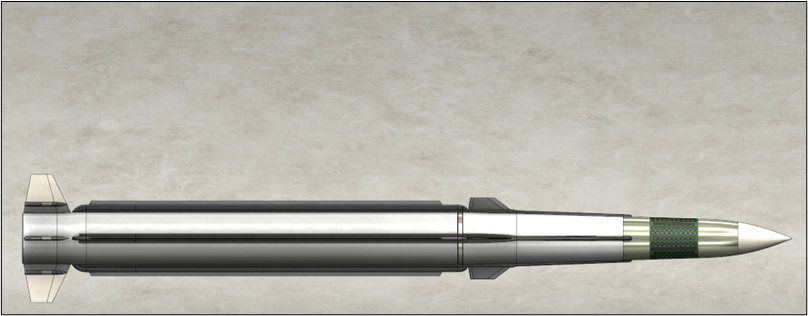
Here are all my predictions and educated guesses on the aim260. I believe the US wants a do it all missile that can engage anything and will eventually take over across the board with little to no downsides besides cost. it will even take over for smaller missiles like aim9X with a dual mode seeker but not anytime soon since current stealth bays for the 9x wouldn't be able to hold the 260 there.
1st the image originally shown by Shusui is in fact a accurate copy of the aim260.
2nd the US is prioritizing TTK (time to kill) and NEZ (no escape zone) rather than true maximum range.
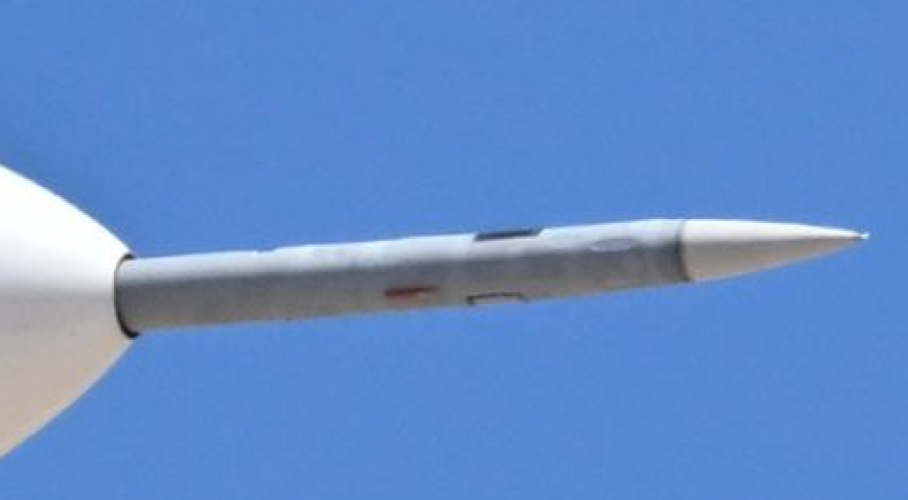
3rd the hexagon shapes on the side of the missile may not be for the payload instead they are used for HOB targeting. Suspecting the missile is in fact hit to kill if it misses the side arrays will re acquire the target and will use any remaining energy it has to try and achieve a kill. another potential benefit is better ECCM (electronic counter counter measures) plus total chaff rejection. I say this because now with a side looking radar it can see the target aircraft from a different angle that is not a notch and pull the missile in for a kill. And if its not hit to kill than they can also certainly be used for a fuse detonation. You can imagine this works similarly to the MICA missile but has much greater long range. And they may be part of my next talking point
4th the US wants this missile to preform exceptionally well at close ranges maybe not quite aim9X level but certainly greater than the AMRAAM(advanced medium range air to air missile). we can infer this as the US does see itself getting into dogfights WVR(within visual range) due to more and more advancing stealth adversaries which can see each other at ever closing distances. I remember seeing somewhere on this forum that it has a 270 degree arch for targeting and i believe it gets its arch from the hexagon arrays on the side, unknown if this is part of a new multimode seeker or just radar but my guess would be radar meaning the US is looking forward for this missile to see its target no matter the aspect or where the missile or target is at.
5th the aim260 will be at least 50% greater in terms of range to that of the aim120D. This is due to much more fuel, battery life, lower drag. Some key things to notice as a bit of evidence- first no forward wings, less surface area for air to hit means less drag. Second no visible DL (datalink) antenna protruding from the body further reducing surface area. We can also see the radome is shaped further back to reduce drag as well. Bands on the missile tell us that it has much more fuel, we can also say this is a fact due to it not having a forward control section which notoriously ate up space in the AMRAAM. We know we can see a exponential increase in battery life due to that one LRAAT (long range air to air technology) document. If we get a much more modern fuel that has a greater energy density we can see a even greater range increase across all missiles which may have been the hint to the aim120E.
6th the engine is a reduced smoke solid fuel rocket motor that has 2 major pulses for long range engagements, it will also be throttleable. Sorta in a boost sustainer config but is more like that found in a PL15 with a boost, coast ,boost terminal attack.
7th it shares identical dimensions with the aim120. Maybe a slightly wider diameter but that would mean the fins would also be shrunk too to fit inside stealth bays. It would also share these dimensions to use the same rail launcher as the AMRAAM.
(edit) 8th certainly a AESA radar with a LPIR (low probability of intercept radar) technology. Which would hopefully delay a RWR detection range or not appear at all.
conclusion you are not winning against this missile unless you can outrun it by going cold and never coming back. Expensive yes but for something that may have a almost guaranteed PK (probability of kill) its will worth it especially when it comes to taking out fighters 100x the cost. i had some other ideas but had ultimately forgotten them and i may update later if i remember.
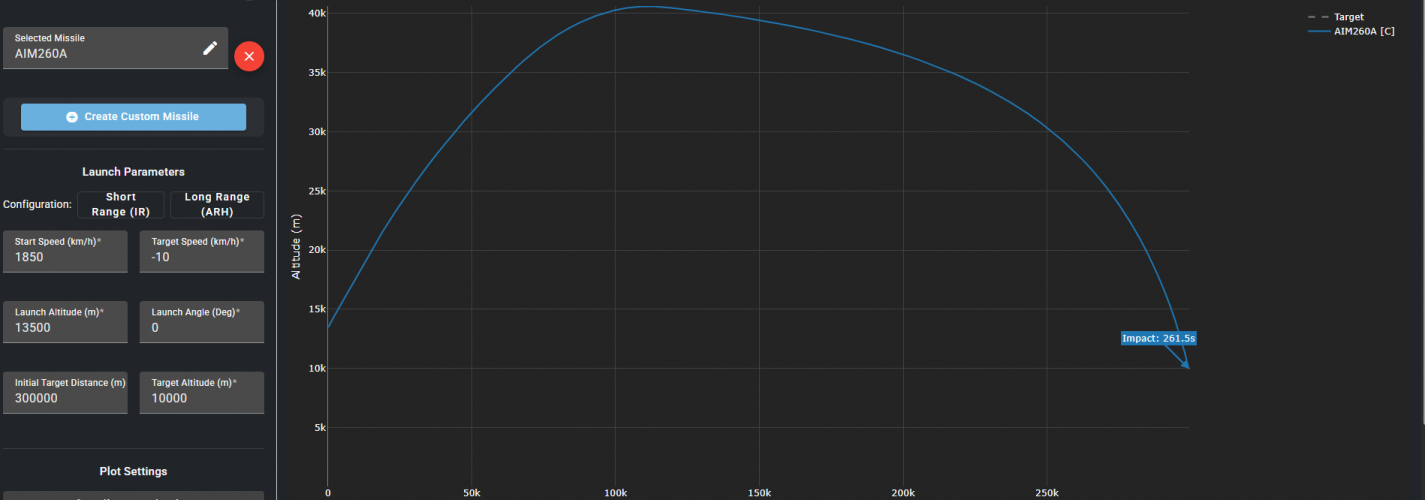
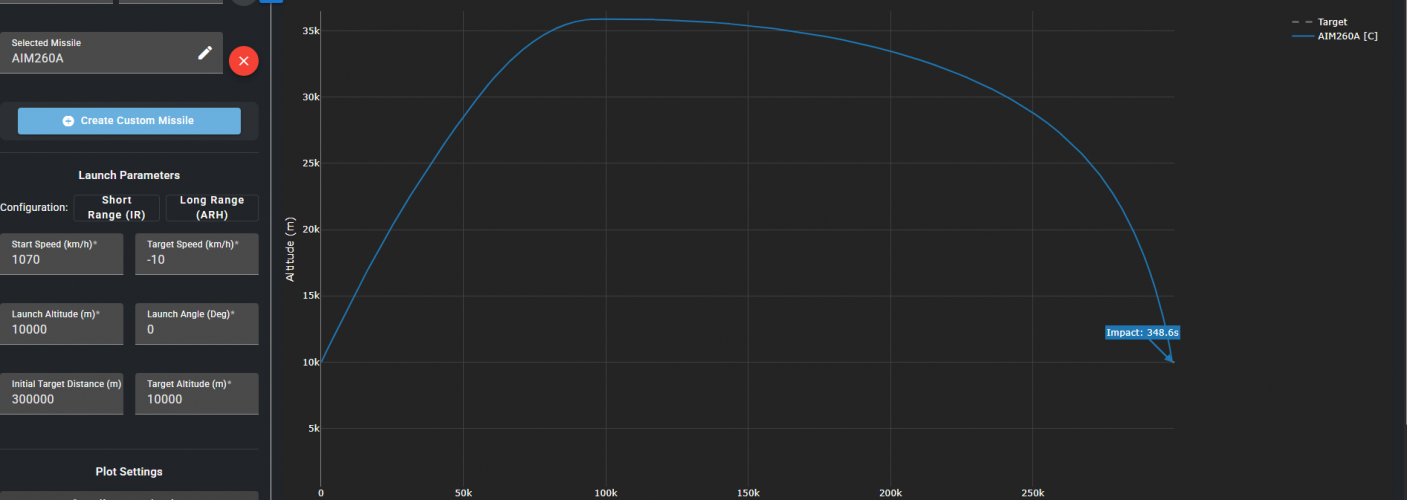
Here are 2 simulations I did for the AIM-260 one is a F/A18 scenario and the other is a F22 scenario. Some disclaimers, the sim doesn't take into account any IOG(inertial ordinance guidance) losses. It doesn't take into account any changes in weather or temperature; so it simulates in the most optimal conditions. You'll notice the target speed is -10kmh it cant be set to 0 and the "-" indicates a target moving towards you. also the altitude of the missile may be a bit unrealistic but it still gives a good idea of how it will preform. <-- to note from my research the AIM-54 would go well above 100,000FT in altitude and id imagine with modern tech the AIM-260 would the also do such as thing. Something else that couldn't be modeled is the boost, coast, boost terminal attack but again this gives us a decent idea of the performance of the missile.
About the missile
-16772N(newtons) of thrust and burns for 11.7seconds. I got this from the roughly 7.75 seconds of burn time currently in the AIM-120C-5 with a fuel mass of 51.1xxx kg. The 11.7 seconds assumes 80KG worth of fuel. Thrust is based on the current AIM-120C-5/later motor and propellent<-- to note due to advancements in motor and fuel tech these can be improved. -12'(3.66M) long, 7''(1778mm) in diameter. Weighs 357LBS(162kg) -lower drag compared to the AIM120C by 20% -50G of max pull though that doesn't really matter for this simulation. -after burn out the missile weighs 80KG -loft angle of 45 degrees
About the simulation
-The target is flying in a straight line non maneuvering -First photo should be a F22 scenario at mach 1.8 and 45,000FT -Second photo should be the F/A18 scenario at high subsonic and 30,000FT -target is at 10,000M or 30,000FT altitude and 300KM away or 180MI -In the F/A18 example top speed of the AIM-260 was mach 6.25 with a impact speed of mach 2.16 <-- To note this would assume a constant thrust for the entire 11.7 seconds, this likely wouldn't happen in real life unless there is a target sub 40 miles -the simulation does take into account altitude and speed drag
Any suggestions, questions and thoughts are as always welcome.
Looks about right and is similar to what I've. The simulation doesn't seem to model coasting with pull-up phases to increase range.
Unless it would only do for longer target ranges like 400 km...
Looks about right and is similar to what I've. The simulation doesn't seem to model coasting with pull-up phases to increase range.
Unless it would only do for longer target ranges like 400 km...
Its a bit more optimized for time to kill, so i have it going down to pick up speed sorta simulating the boost, coast, boost terminal attack. im sure the actual aim260 would keep its altitude until its ready for terminal attack
Its a bit more optimized for time to kill, so i have it going down to pick up speed sorta simulating the boost, coast, boost terminal attack. im sure the actual aim260 would keep its altitude until its ready for terminal attack
- w clever engineering can’t you “have your cake and eat it too” wrt to rapid time to kill & expanded NEZ AND long-range, especially if launched from decent altitude?
- courld smart fuzing coupled with advanced end-game seeking and target recognition confer a secondary air-to-surface, anti-AD role?
Crazy?
Edit: one more thing, not sure this is hit to kill. I think it can tailor a blast pattern that maximizes the impact of a smaller warhead with LE elements. Multimode, CM resistant terminal seeking that incorporates target image analysis and missile & target energy state to design a tailored blast that maximizes the missiles vector. Or something like that.
This site uses cookies to help personalise content, tailor your experience and to keep you logged in if you register.
By continuing to use this site, you are consenting to our use of cookies.