A modern frigate?

The Constellations are not that expensive… basically a $600M hull with $300M of weapons & sensors. You could cut those of course, but that’s what brings all the capability (AEGIS, EASR, MK-41, CEC, COMINT, SQQ-89, SEWIP, NIXIE etc…).

LCS is a $450M hull with only $50M of weapons and sensors. It has no wartime utility without adding $$$ for modules and proper sensors and weapons, which it doesn’t have the SWaP-C margins to carry or the endurance to bring to the combat zone.

Notice that the difference in hull cost itself is only $150M. There are ways to build a cheaper general purpose frigate of course, but there’s going to be a capability trade-off and it will be hard to save more than $100-200M per hull while maintaining full spectrum AAW, ASW, ASuW, and EW capability… you’ll definitely lose AEGIS and some AAW capability along the way for example.

To save more than that (say if you want something for 1/2 or 1/3 the cost of an FFG-62), capability and hull-size would need to be drastically cut… see my ocean-going corvette proposal.

They’re $1.2b your numbers are falling $300m short
 
budget for building ships is probably an even bigger hurtle than the industrial capacity.

If congress won’t approve the funds to build these high end ships it doesn’t matter what our industrial base looks like.
If congress approves funding then ships get built, just slowly.

I’m all for getting smaller yards geared up and producing corvette-esque ships.
I think those will end up being XLUSVs rather than a baby Connie.


When a real naval conflict comes for us I think we’ll be happy we have LCSes, and after the conflict I think we’ll want to build more of them, and maybe even upgrade to MMSCs
That I doubt, their combining gears have been an issue since day 1. Maybe more LCS2s, the big helo deck is well liked.


They’re $1.2b your numbers are falling $300m short
$300m of weapons.
 
I think those will end up being XLUSVs rather than a baby Connie.


That I doubt, their combining gears have been an issue since day 1. Maybe more LCS2s, the big helo deck is well liked.


$300m of weapons.
No the freedom’s combining gears weren’t an issue from day one. The first 2 had 0 combining gear issues. I believe it was someone in congress that demanded the freedoms utilize a different cheaper combining gear in order to penny pinch.

Cost of missiles and gun ammunition isn’t part of the cost to build a ship.
Building them is 1.2b
 
They’re $1.2b your numbers are falling $300m short
That's just for the first couple ships in the class. Which are always more expensive as the kinks of building them are worked out. The costs are expected to drop below 1 billion after the first few hulls
 
They’re $1.2b your numbers are falling $300m short
I’m quoting official SCN budget materials so have 100% confidence in my numbers.
https://www.secnav.navy.mil/fmc/fmb/Documents/24pres/SCN_Book.pdf
It’s always a good idea to read the detail rather than take media reported numbers at face value… for example in this case the $1.2B quoted in news reports includes one-time costs for the 1st of class and the land-based engineering facility as well as PMO costs. There’s also some equipment inflation in the latest FY24 budget which I’m ignoring as this impacts all ships classes and should be stripped out when comparing to prior LCS or DDG costs on a constant dollar basis.

The actual follow-on ships themselves cost $900M.
 
I’m quoting official SCN budget materials so have 100% confidence in my numbers.
https://www.secnav.navy.mil/fmc/fmb/Documents/24pres/SCN_Book.pdf
It’s always a good idea to read the detail rather than take media reported numbers at face value… for example in this case the $1.2B quoted in news reports includes one-time costs for the 1st of class and the land-based engineering facility as well as PMO costs. There’s also some equipment inflation in the latest FY24 budget which I’m ignoring as this impacts all ships classes and should be stripped out when comparing to prior LCS or DDG costs on a constant dollar basis.

The actual follow-on ships themselves cost $900M.
I will never understand why onetime costs for a class get charged to the lead ship...
 
I suspect the real reason is to hide, shall we say, incentives? One time, tax free and nice if you can get it too.
 
Not sure how much this will cost, but this is the sort of frigate I think the USN needs.

https://www.navalnews.com/naval-news/2023/07/new-details-on-taiwans-new-light-frigate/
Except the main justification that Taiwan is using for building two separate versions, is not having to integrate the ASW and AAW warfare systems into one functional combat control system. The US has already done that. They have literally no reason to build dedicated ships for a single mission
 
Not sure how much this will cost, but this is the sort of frigate I think the USN needs.

https://www.navalnews.com/naval-news/2023/07/new-details-on-taiwans-new-light-frigate/
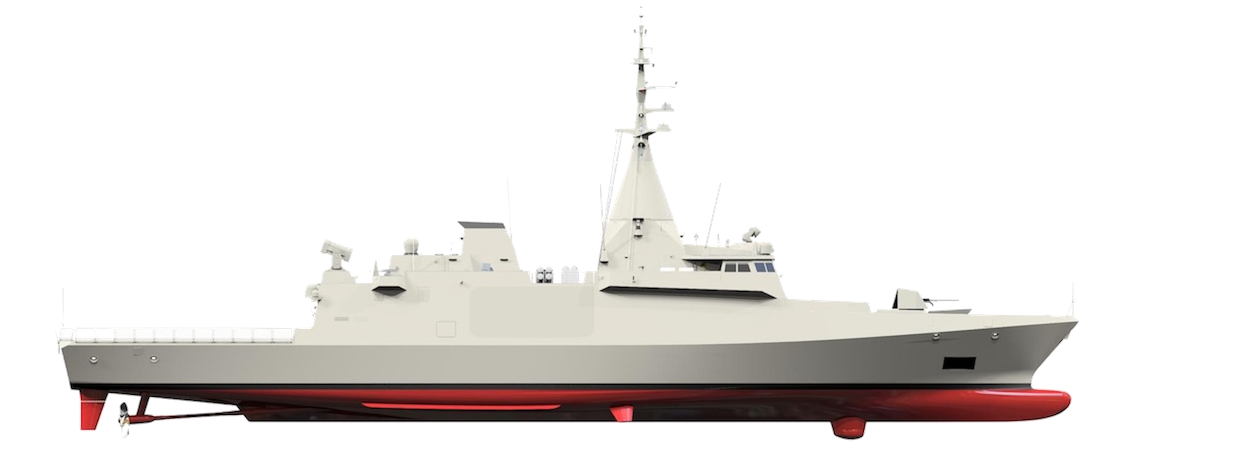
Nothing new here that hasn’t already been done by others. E.g. Gowind class corvette / light frigate.

Gowind-2500.jpg
 
Not sure how much this will cost, but this is the sort of frigate I think the USN needs.

https://www.navalnews.com/naval-news/2023/07/new-details-on-taiwans-new-light-frigate/
A 3000ton ASW-only craft?

Too small. Even the FFG-7 class was noted for limited endurance, which means a larger ship for more fuel, food stores, and crew habitability space.

Plus, any convoy escort these days needs to be able to provide at least minimal area defenses, and the Tuo Chiang class only has 16x ESSM equivalents and no SM-2s.
 
Gowind does it rather better. Of course given the situation Taiwan is in, I'd suggest they build minelayers and SSKs, light frigates are too limited in capability to be viable, and Taiwan can't really afford anything better. Should probably just use SSKs and minelayers, with the hope that the latter can do their job in the last days of peacetime before the balloon goes up.
 
A 3000ton ASW-only craft?

Too small. Even the FFG-7 class was noted for limited endurance, which means a larger ship for more fuel, food stores, and crew habitability space.

Plus, any convoy escort these days needs to be able to provide at least minimal area defenses, and the Tuo Chiang class only has 16x ESSM equivalents and no SM-2s.
Size says very little about range or endurance.
Heritage class cutter is 3700 tons and has a range of 10k nmi and endurance of 60 days

That’s double the range of a burke
 
Size says very little about range or endurance.
Heritage class cutter is 3700 tons and has a range of 10k nmi and endurance of 60 days

That’s double the range of a burke
Double the range of a Burke at a lower cruising speed, so the gap is closer than you seem to think.

Also, the Heritages are devoting a lot more space to fuel bunkerage than the Taiwanese frigate - that's obvious just comparing their weapons and sensor loads - and 700 tons heavier to boot, so I don't know why you're making this comparison in the first place.
 
Double the range of a Burke at a lower cruising speed, so the gap is closer than you seem to think.

Also, the Heritages are devoting a lot more space to fuel bunkerage than the Taiwanese frigate - that's obvious just comparing their weapons and sensor loads - and 700 tons heavier to boot, so I don't know why you're making this comparison in the first place.
Just pointing out an FFG at this size can have good range. Maybe not 10k nmi, but 4-5k nmi seems completely reasonable, plenty of range.

Scott said these frigates were too small to have a range that would be useful for the US. I was simply pointing out the size isn’t really that relevant to range.
 
Last edited:
Just pointing out an FFG at this size can have good range. Maybe not 10k nmi, but 4-5k nmi seems completely reasonable, plenty of range.
For sure. Even the 2,000 ton Sigma 9813 corvettes advertise ~4,000nm range @ 18 knots with 260m3 of fuel (~11% of displacement which is not unreasonable).

That would translate to 5,000nm+ at 15 knots and 6,000nm+ at 12 knots.
 
Coming back to the debate about long ranged light frigates, tailored in particular to the Indopac theater, and whether this is smart / affordable / feasible…

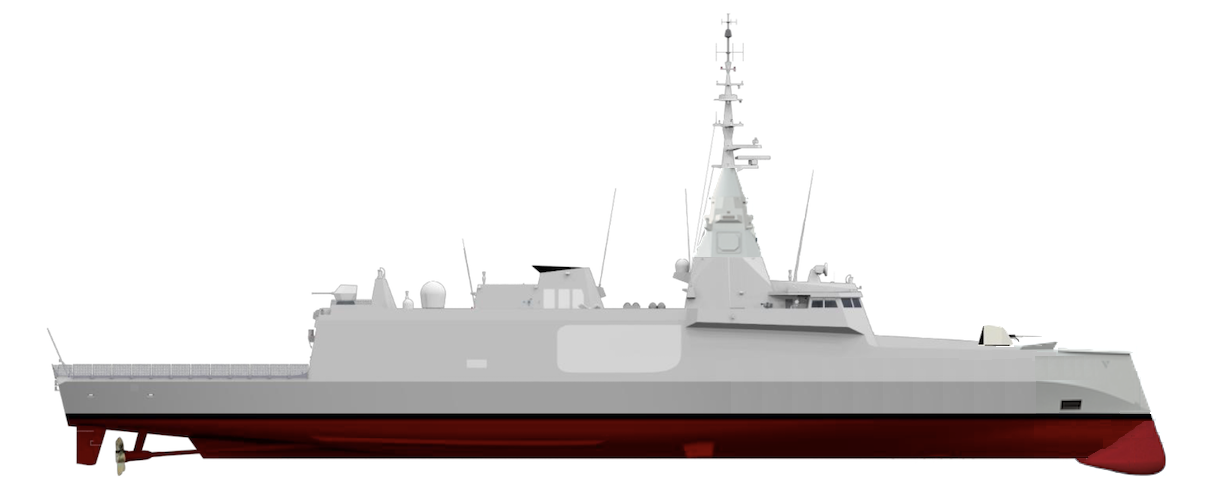
Here is a hypothetical Gowind patrol frigate (~3,100 tons) to replace the French Floreal class based overseas. There are rumors that the French Navy is looking at the Gowind 3100 platform for this role, rather than the clean sheet European Patrol Corvette. The idea is to leverage an existing design to reduce acquisition costs, with sufficient built-in ASW and AAW capability. Will be interesting to see what comes out of this… especially as this entails taking an existing short legged light combattant and turning it into an oceanic escort.

The main design change would be to simplify the propulsion to allow for more fuel bunkerage, at the cost of slightly reduced speed (24-25 knots). I’ve also hypothesized the addition of a few modern touches such as flat panel radar and a reverse angle bow… there would also likely be modular bays for a few 20ft containers or other payloads in the stern and amidships.

Gowind-3100-10px-1m-mod.png


Compare to the Gowind 2500 corvette baseline:
Gowind-2500-10px-1m.png


Some back of the envelope math indicates that good range could be achieved with modern fuel efficient diesels and ~330 tons of onboard fuel (11% of displacement). Range would be roughly 7,500 nm @ 15kts or 9,500 nm @ 12kts, with a 20% reserve. The tradeoff would be lower top speed, likely ~24 knots sustained assuming a CODAD plant with 4x small medium speed diesels (eg. ABC 16V DZC, 4x 3.75MW, total 14MW) and ~25 knots sprint at full power.

(Note: The same design exercise could be done with the Meko A100, Sigma 10514, FCX 30, Daegu class or other off-the-shelf light frigates… I chose the Gowind since this is an actual program of record and more likely to become real)
 
Last edited:
OK, several reverse bow designs about, simple question, why?
 

Attachments

  • memoire_42.pdf
    2.1 MB · Views: 32
Not really a frigate except in terms of displacement…

No, it is not a frigate. It is a Coast Guard Cutter designed for long, slow speed patrol and good sea keeping. Law enforcement.

The Coast Guard could really use some new ships though so it is good there is some movement on this.
 
No, it is not a frigate. It is a Coast Guard Cutter designed for long, slow speed patrol and good sea keeping. Law enforcement.

The Coast Guard could really use some new ships though so it is good there is some movement on this.
Yes and as such kinda off topic in a thread about modern frigates.
 
Coming back to the debate about long ranged light frigates, tailored in particular to the Indopac theater, and whether this is smart / affordable / feasible…

Here is a hypothetical Gowind patrol frigate (~3,100 tons) to replace the French Floreal class based overseas. There are rumors that the French Navy is looking at the Gowind 3100 platform for this role, rather than the clean sheet European Patrol Corvette. The idea is to leverage an existing design to reduce acquisition costs, with sufficient built-in ASW and AAW capability. Will be interesting to see what comes out of this… especially as this entails taking an existing short legged light combattant and turning it into an oceanic escort.

Gowind-3100-10px-1m-mod.png

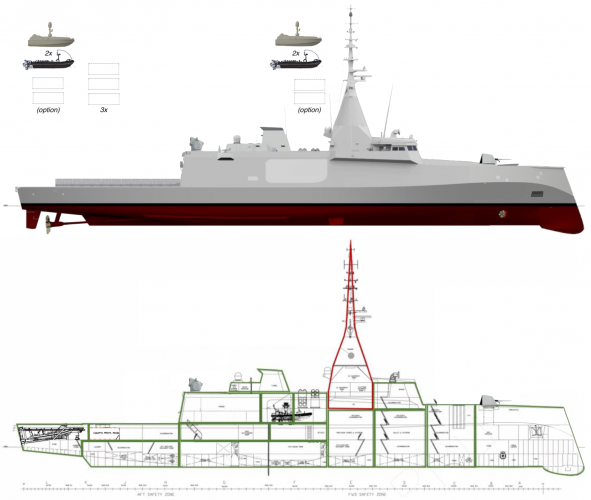
Coming back to the long range patrol frigate for the Pacific that the French need to replace their Floreal class... here's my updated take with an internal view to illustrate the design details. 3 main changes to the Gowind design:
  • Increased modularity with several options for RHIBs, USVs or containers in the stern bay, under the flight deck, and midships
  • Improved seakeeping with higher foredeck and 3m longer bow to reduce bow wetness
  • Improved close-in defense with MPLS modular launcher for laser-guided rockets, Mistral point-defense SAMs, ATGMs and decoys
Total length 114m and displacement ~3,300 tonnes.

Escort missions include local AAW with Aster 15/CAMM/Mica VL and optional ASW with Captas 2 towed sonar and tube launched torpedoes. Long range fuel tank allows for ~7,500-8,500nm @15kts or 10,000nm+ @12kts. 16-20MW CODAD plant (4 diesels) or CODLAD (2 diesels + 2 e-motors) for 25+ knots.

Gowind 3000 mod CH 15px=1m v5.png
 
I like the general layout. One modification I would suggest is to explore the modern equivalent of an all forward design to minimize the need for armor in one citadel-tower. Get the bridge higher off the water. Put the radar-communication mast over the bridge structure.so it has a higher LOS. This would perhaps give enough structural height to add a modest number of full Mark 41 tubes. Shorter Mark 41 tubes could be placed further back.

The nose might best be an axe bow to simplify installation of a ramming bow. The rear half of the citadel to the stern of the ship would be more of a knee board shape, to skim over water at sprint speed. The perimeter from the forward bow to sides of the stern on the ship would generally be like a vikingship (tumberhome), Where the ship widens past the width of the citadel perhaps an ogee leading edge extension to encourage water to go below the hull so about two thirds of the boat rides on a pressure wave.

The above deck structure behind the citadel would be concealed behind sloped walls that integrate with the tumblehome shaped perimeter wherever possible. Solar panels across much of thr sloped walls to augment power supply. The hangar would be on the back end of this space. In between there should be enough cargo space that is wide enough and tall enough for housing several full ship containers wide and at least stacked two high. Being able to swap whole cargo containers both speeds up and simplifies general resupply.

I love the idea of the boat ramp at the stern. It would be nice for frigates to directly support docking with medium craft used by special forces that may be 25-30 meters long. If these craft could nose into the stern they could unload out of the weather. RHIBs could still drive up into slings mounted on davits that pivot out of the way inside the well space.

I also would like to see electronic sensors, including a vision-based system akin the EOTS on an F-35, all around the ship to give the CIC maximum situational awareness. Good 2D and 3D radars. Redundant systems. Diesel motors that are adequate to hit at least a cruise at 16-18 knots while powering most everything on the ship. Turbine power bolstered by modest battery storage for beyond that. Solar power to both reduce fuel burn and provide emergency power for engineering to use in an emergency.

The idea of a traditional frigate is presence and just enough firepower for quick diplomacy. It doesn't need to be a mini destroyer or cruiser. It doesn't have to operate as an island.
 
Certainly a fixed staring eye EO/IR sensor suite where the images be stitched together in real time supplements directional EO/IR systems.
Modern software can track via video. And inspection via traditional optics boosts recognition and assessment.

Modern low cost, low power AESA sets good enough for 30km or more now exist. Very capable against drones, but high speed threats need greater range/power/cost systems.

Diesels don't limit a ships speed, so much as hull design. Though obviously power density matters when volume is precious.
 
A 3000ton ASW-only craft?

Too small. Even the FFG-7 class was noted for limited endurance, which means a larger ship for more fuel, food stores, and crew habitability space.

Plus, any convoy escort these days needs to be able to provide at least minimal area defenses, and the Tuo Chiang class only has 16x ESSM equivalents and no SM-2s.

I'm not sure on the fixation some people have on a small ship either....they seem to forget the adage...Steel is Cheap and Air is Free...

The USN is going to find out the hard way if its not careful that adding in capability as the ship is in service costs a hell of a lot more in the long term in a small vessel than a larger one...and there isn't a huge difference in initial cost...
 
I'm not sure on the fixation some people have on a small ship either....they seem to forget the adage...Steel is Cheap and Air is Free...

Yet the adage is certainly wrong given what we know about shipbuilding prices from recent competitions. And the success of smaller corvette/light frigate designs like the Sigmas, Gowind, FCX30 etc implies that Damen, Naval Group, Fincantieri etc, all understand that costs go up with tonnage. As do their clients.

To give just one example, in the 2022 Greek competition Babcock’s Arrowhead 140 was priced at €600M per hull vs €350-400M for the Sigma 10514, Gowind 2500, and FCX30. All with similar combat systems, weapons fits, propulsion etc… that’s a 50%+ cost difference for a 6,000t hull vs ~2,800-3,000t hull.

Likewise in the same year Naval Group quoted the Greeks €360M for a Gowind 2500 vs €650M for an FDI. Same yard, with the only difference being radar (Seafire 4 panel AESA vs NS110 rotating AESA), sonar (Captas 4 vs Captas 2 VDS), and VLS launcher (16x Mica vs 16x Aster). Even assuming the most generous case that those systems might have added €100M to the FDI’s cost, the result would still be a ~50% cost difference for a 4,500t hull vs ~2,800t hull (€550 vs €360M).
 
Last edited:
The rest of the comms/sensor packages is quite different between the FDI/Gowind. The FDI has much more comms, EO equipment, something more than self defense VLS, CIWS, 1/3 more range, better aviation facilities, and more endurance. Do you have sources on what was on all of them?

I am extremely skeptical that, they didn't fit anything extra or make future provisions for on a hull 2x as big as the others.
 
Steel is cheap... compared to the electronics and equipment that goes into the ship. But bigger ships mean more of everything. More piping, more electronics, more equipment, more men, bigger engines, more fuel....
 
Steel is cheap... compared to the electronics and equipment that goes into the ship. But bigger ships mean more of everything. More piping, more electronics, more equipment, more men, bigger engines, more fuel....
Exactly.
 
The overall cost of the Gowind 2500 corvette program for Egypt with MBDA missiles (VL-MICA, Exocet MM40 Block 3c) and premium torpedoes is between 1.5 and 1.7 billion euros. Once these super corvettes are outfitted they are not cheap. But $2 billion dollar will be about the outfitted cost of the Legend class FF(X) with far less AAW capability.
 
Yet the adage is certainly wrong
Not automatically. The problem is the Navy (and Congress) seeing a bigger ship with space and buoyancy reserved for future growth and thinking to themselves, "absolutely fucking not!" And then proceeding to cram as much into said space as possible.
 
The overall cost of the Gowind 2500 corvette program for Egypt with MBDA missiles (VL-MICA, Exocet MM40 Block 3c) and premium torpedoes is between 1.5 and 1.7 billion euros. Once these super corvettes are outfitted they are not cheap. But $2 billion dollar will be about the outfitted cost of the Legend class FF(X) with far less AAW capability.
That was for 4 frigates! Plus a transfer of technology package which adds to the overall cost. Total cost was ~400M per Gowind for Egypt, similar to the Greek cost I mentioned.
 

Similar threads

Back
Top Bottom