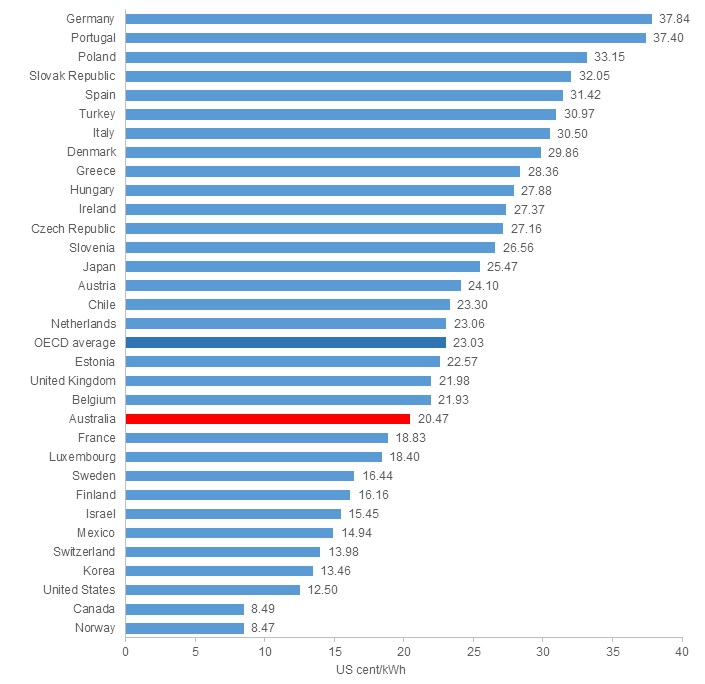
You are assuming that any price increases are due to the renewables. That sounds like a case of correlation does not imply causation. One would need to dig more into the fact before making such assertions.
They generally are. Operating costs skyrocket with solar and wind. One of the biggest reasons is you have to idle conventional generation plants while using solar and wind, then bring these on-line when solar and wind shutdown. Battery storage is insanely too expensive--even at $50 a kwh compared to the current cost of about $225 a kwh they're unaffordable--to make a workable alternative.
So, you have to have natural gas, coal, oil, nuclear, something for base loading and for operation when your solar and wind aren't generating. With solar, this means often having a natural gas plant hot and idling to take the load when solar isn't generating. It takes time to bring such a plant on-line or take it off-line.
In all reality you end up duplicating your generation facilities rather than building an efficient and cost effective system. Then there's the attempt at a "smart" grid. Germany is still floundering with that and their cost is approaching a trillion USD. Germany's neighbors have largely disconnected from the German grid due to Germany dumping electricity when their solar and wind systems over produce. California pays--PAYS--Arizona and Nevada to take their excess solar and wind generation when that occurs. That cost is passed onto Calforina's consumers. Arizona and Nevada are being compensated to idle conventional generation plants and have the cost of that covered.
Then there's the cost of brown and blackouts caused by unstable solar and wind sources. Toss in that solar and wind require more transmission lines because they are often placed in remote locations and you have a recipe for insanely expensive electricity.
Look at it this way:
To get a kilowatt-day (kwd, 24 hours of 1 kilowatt of power) using solar you need an installed capacity of about 5 kwh in solar panels and 3 kwh in batteries. This is rough. I base that on a capacity factor of .25 which is pretty typical for large commercial solar arrays. What you are doing is producing 1 kwh of power and storing another 3 kwh of power. But because the panels aren't all that efficient much of the time, or completely no generating, you need 5 kwh to get 1 kwh steadily for an entire day. You might even need more batteries if you have issues with clouds and weather.
With a natural gas generation plant you need 1 kwh of installed capacity to get 1 kwd of power. Even with the cost of fuel included, it's cheaper to run this plant than build and run the above solar plant. The extra installed capacity and batteries absolutely destroy the solar plant's cost efficiency.