
- Joined
- 21 January 2015
- Messages
- 14,339
- Reaction score
- 22,733
Scott Manley - We just discovered the fastest interstellar comet - 150,000 Miles Per Hour:
View: https://youtu.be/8HeTCmtNJSU?si=WoJrBCHJlnaYnGl3



150K miles/sec would bei about 80% speed of light, which is obviously absurd.It is amazing that the comet has a speed of 150,000 miles per second (after watching the Scott Manley YouTube video)

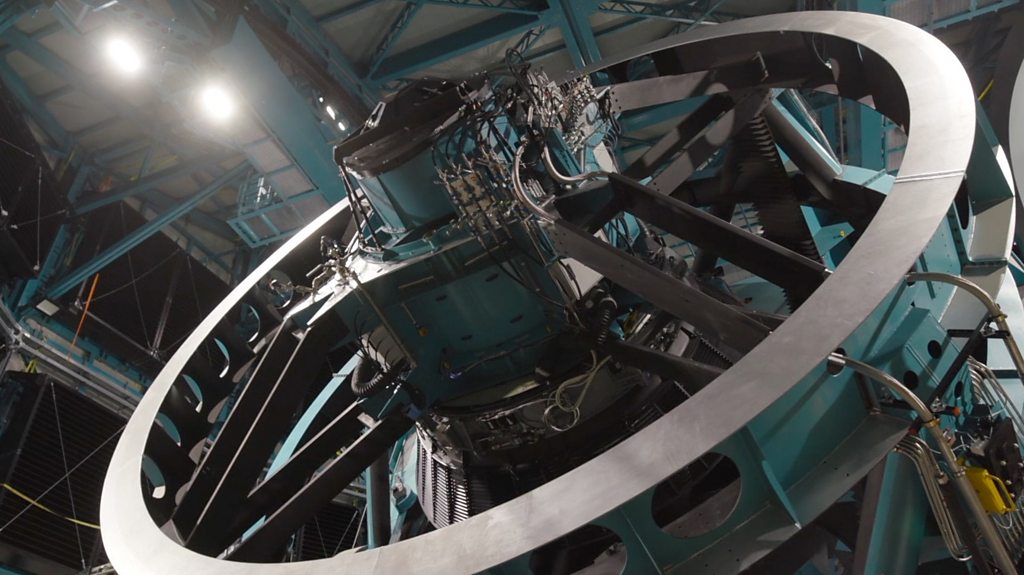
The observatory that can reveal deepest secrets of space
Tech Now is given rare access to the world's most advanced telescope with the largest digital camera ever built.www.bbc.com
I asked Google Gemini if any probes were near our latest Interstellar Visitor.That was what I was meaning Andreas Parsch, thanks for the correction.
Hello and welcome! My name is Anton and in this video, we will talk about another planet that shouldn't be possible
Links:
https://www.nature.com/articles/s4155...https://www.youtube.com/redirect?ev...com/articles/s41550-025-02552-4&v=aFHCPimcsoQ
https://arxiv.org/abs/2305.19357
https://www.youtube.com/watch?v=XnEeHKWCijE
• What If Jupiter Didn't Exist? Why Do Other... https://www.youtube.com/watch?v=XnEeHKWCijE
Other videos:
Black holes aren't just cosmic monsters, they might be home. A discovery from the James Webb Space Telescope has scientists questioning everything we know about space, time, and the very fabric of our universe. Watch now to find out more!
It would take SLS Block 2 to get to Oumuamua with an NTR and NEP both perhaps. Interstellar Probe was slated for SLS.Currently I highly doubt that NASA, ESA, JAXA or any other space-agency have space-probes with the required delta-V to intercept this interstellar object, Scott Manley's video goes into detail about the required delta-V needed and hence the size of the LV needed (It would be huge).
.
Why is Mars barren and uninhabitable, while life has always thrived here on our relatively similar planet Earth?
A discovery made by a NASA rover has offered a clue for this mystery, new research said Wednesday, suggesting that while rivers once sporadically flowed on Mars, it was doomed to mostly be a desert planet.
Lead study author Edwin Kite, a planetary scientist at the University of Chicago and a member of the Curiosity team, told AFP it appeared there were "blips of habitability in some times and places" on Mars.
But these "oases" were the exception rather than the rule.
However Mars has a "feeble" rate of volcanic outgassing compared to Earth, Kite said. This throws off the balance, leaving Mars much colder and less hospitable.
According to the modelling research, the brief periods of liquid water on Mars were followed by 100 million years of barren desert – a long time for anything to survive.
It is still possible that there are pockets of liquid water deep underground on Mars we have not yet found, Kite said.

 www.sciencealert.com

 www.nature.com
 arxiv.org
arxiv.org
arxiv.org
arxiv.org
arxiv.org
arxiv.org
arxiv.org
Astronomers using the European Space Agency’s Cheops mission mission have caught an exoplanet that seems to be triggering flares of radiation from the star it orbits. These tremendous explosions are blasting away the planet’s wispy atmosphere, causing it to shrink every year.
This is the first-ever evidence for a ‘planet with a death wish’. Though it was theorised to be possible since the nineties, the flares seen in this research are around 100 times more energetic than expected.
 www.nature.com
Jul 7, 2025
Finding signs of life on planets outside our solar system will require a more powerful space telescope than any ever built. NASA’s Habitable Worlds Observatory will draw on technologies proven by the agency’s Hubble, Webb and upcoming Roman Space Telescopes to peer into the cosmos and find the unique signatures of planets that can support life as well as possibly life itself.
Actor John Rhys-Davies narrates this short video about the mission and its objectives.
Related paper:
Close-in planet induces flares on its host star - Nature
Planet-induced flares on HIP 67522, a 17 million-year-old G dwarf star with two known close-in planets, were detected.
A new interstellar object has been discovered racing through the Solar System at record speed. Now named Comet 3I/ATLAS, this icy traveler is only the third interstellar object ever discovered. And just days after its detection, it has already become a global astronomical sensation. This new interstellar comet could solve the mysteries left behind by its two predecessors, Oumuamua and comet Borisov.
REFERENCES:
Comet 3I/ATLAS (NASA Science) – https://sou42.co/4kq9b9lhttps://www.youtube.com/redirect?ev...hpVQ&q=https://sou42.co/4kq9b9l&v=KYnZk-rdxXA
New Interstellar Object Stuns Scientists as It Zooms through Solar System (Scientific American) – https://sou42.co/45XJjy0
On July 5, between 9:00 and 9:15 UTC, something appears to have hit Saturn. If verified, it will be the first ever to be caught on camera.

 www.iflscience.com
Hello and welcome! My name is Anton and in this video, we will talk about supernovae and extinction events
Links:
https://arxiv.org/pdf/2503.08286
https://www.youtube.com/redirect?ev...ttps://arxiv.org/pdf/2503.08286&v=DhPmxM0tQxo
Other videos:
https://www.youtube.com/watch?v=2PYG_upOxUc
#supernova #extinction #earthhttps://www.youtube.com/hashtag/earth
0:00 Near Earth Supernovae
1:20 Handful of candidates and most famous supernovae
2:10 What happens if there is a nearby supernova
2:55 Historical records
4:30 Recent study and examination of potential chances
5:50 Overall results and likelihood of extinction
6:40 What about other effects?
8:40 More evidence
9:50 Problems and solutions
"A potential solution to this inconsistency is that our galaxy is close to the centre of a large, local void," Dr Indranil Banik, from the University of Portsmouth, said in a statement sent to IFLScience.
"It would cause matter to be pulled by gravity towards the higher density exterior of the void, leading to the void becoming emptier with time. As the void is emptying out, the velocity of objects away from us would be larger than if the void were not there. This, therefore, gives the appearance of a faster local expansion rate."
In the research presented today at the National Astronomy Meeting in Durham, UK, Dr Banik showed that there are observations that are consistent with the idea of such a deep void; namely, the number of galaxies around us and the peculiar Baryonic Acoustic Oscillation, the “sound” of the Big Bang.
The team is planning to independently verify these observations using alternative methods, such as galaxies that stopped forming stars. These can be used as a stopwatch for the expansion of the universe. If these too suggest that a void scenario is possible, it would be a very interesting finding.
 www.iflscience.com

 www.iflscience.com
I’ve deleted the post. Nor is it recent you tube apparently has been doing it for well over a year. It’s hard to get around as it defaults to that when using the share in the apps.

Deleted my post likewise. I only ever copy the url when sharing yt links. I think some 3rd party yt apps let you copy clean links on phones as well.I’ve deleted the post. Nor is it recent you tube apparently has been doing it for well over a year. It’s hard to get around as it defaults to that when using the share in the apps.
For some reason if you delete the si code part it breaks the link on some forums?Deleted my post likewise. I only ever copy the url when sharing yt links. I think some 3rd party yt apps let you copy clean links on phones as well.
That's f҉ ing horrifying.For some reason if you delete the si code part it breaks the link on some forums?
Shining Science @ShiningScience
7 lip
The beautiful planet Saturn taken by the James Webb Space Telescope!
I’ve deleted the post. Nor is it recent you tube apparently has been doing it for well over a year. It’s hard to get around as it defaults to that when using the share in the apps.
Deleted my post likewise. I only ever copy the url when sharing yt links. I think some 3rd party yt apps let you copy clean links on phones as well.
For some reason if you delete the si code part it breaks the link on some forums?

Ultrasound triggers nuclear decay anomaly hinting at flexible space-time
by Erica Marchand
Paris, France (SPX) Jul 08, 2025
A pair of Italian physicists has observed unexpected changes in radioactive decay triggered by ultrasonic waves-findings that could reshape current views on the rigidity of space-time. In experiments using cobalt-57, brief ultrasound pulses appeared to disrupt standard decay behavior, offering rare experimental support for the Deformed Space-Time (DST) theory.
Led by Stefano Bellucci of INFN-Frascati and Fabio Cardone of ISMN-CNR, the study revealed that even nanosecond-long bursts of ultrasound at 2.25 MHz can cause measurable alterations in nuclear behavior. The key signal came from the 14.4 keV emission of iron-57, where the decay curve showed clear deviations from standard expectations.
"These changes occur after less than one percent of a single ultrasound wave cycle," said Bellucci. "It suggests that under certain conditions, space-time itself becomes distorted in ways that allow new nuclear processes to unfold."
The DST theory holds that at specific energy thresholds, space-time can deviate from its normal geometry, allowing alternative nuclear interactions to emerge. One explanation proposed by the researchers is that ultrasonic stress generates microscopic cavities-called Ridolfi cavities-which serve as miniature nuclear reactors. Within these, cobalt-57 atoms may undergo transformations bypassing classical radioactive decay channels.
Unlike traditional decay governed by the weak nuclear force, these alternative processes could involve the strong nuclear interaction-normally off-limits in such low-energy conditions. This two-channel decay model offers a fresh lens for reexamining long-held assumptions in nuclear physics.
The researchers also point to similarities with earlier DST experiments involving thorium-228 and nickel-63, where similar ultrasonic effects drastically lowered radioactivity. In the cobalt-57 study, long-lasting metric changes and unusual field couplings were recorded-features the team links to the "Mignani mimicry" phenomenon predicted by DST.
"This challenges the idea that decay rates are untouchable constants," said Cardone. "If external fields can deform space-time, it reshapes how we think about nuclear stability and even causality."
The researchers are now designing experiments to determine whether ultrasound speeds up natural decay or causes a fundamentally different type of nuclear transformation. One proposed test involves real-time radiation monitoring during sonication. According to Bellucci, "If more radiation appears, we're seeing accelerated decay. If not, we're witnessing something entirely new."
This work could impact not only nuclear physics but also cosmology and field theory-areas where space-time, matter, and energy may interact in far more dynamic ways than previously thought.
It seems likely that this will be her last video for a little while as at towards the end she reveals she’s just been diagnosed with early stage breast cancer.


 • What If Jupiter Didn't Exist? Why Do Other...