
- Joined
- 3 June 2011
- Messages
- 20,895
- Reaction score
- 19,083
How do we know that?The operational orientation of this aircraft is different from any previous aircraft,

How do we know that?The operational orientation of this aircraft is different from any previous aircraft,
You'd be pretty much redesigning the whole plane for that. 50% larger engines need 50% larger inlets.That top inlet looks off kinda sugests its a a protype till more powerfull engines apear and it goes to being a twin engine design. Given how fast Chinese are evolving their designs i would not be surprised if a twin engine is not already under construction.
With novel aerodynamic configurations , flight hours on such a plane are what they need for refinment of final designs ,.

The operational orientation of this aircraft is different from any previous aircraft, and it may not be appropriate to make a similar comparison with the SU34.

I would expect J-36 to be near 60t instead, as a tender from CAC for a tow vehicle capable of atleast 60t was found.You'd be pretty much redesigning the whole plane for that. 50% larger engines need 50% larger inlets.
No, I really think the J-36 is a 3-engined ~50ton aircraft.
I'm aware that the projected role is vastly different, or at least as far as we know so far. I was just curious as a second HUD occurred somewhat redundant to me?
Although with regards to HUDs, it could probably be a feature only on the prototypes. Perhaps serial aircraft ditch them for solutions directly integrated into the advanced helmet. Either way, it's a very exciting turn of events to see such a photo so soon after it's initial spotting.
To channel my inner zoomer, 'China is cooking'.

Based on what?I'm aware that the projected role is vastly different,
Based on what?
So basically NGAD?Based on what PLA watchers from mainland China have said, some (with good track records) referring to people that work at CAC.
This thread should delve into it more towards the start, alternatively the SinoDefenceForum definitely has it in the dedicated J-36 thread.
It was thus established rather early on that despite some premature claims by western commentators, that this aircraft supposedly isn't a strike fighter or fighter bomber like a Su-34 or F-111, but through and through meant to dominate air combat at long ranges. That's basically the summary of the current consensus as far as I am aware. Blitzo, Deino or Siegecrossbow may be able to expand on it further, given their expertise in the realm of PLA watching.

More or less, some refer to it jokingly as CHAD because of this, J-XD/J-50 having the humorous nickname of Shengad.So basically NGAD?

What are the chances that this aircraft(J-36, IMO J-XDS seems too small to pack such a system) will/is equipped with MSDMs like shown in the patent as some credible leaker has been touting, it could potentially act as an APS against missiles and even aircrafts if they somehow got close enough. US has been working on a similar system, although it seems to use a different launch method ie. being carried in a rocket pod instead of being on an internal VLS. Missiles themselves is quite small, estimated to be under 1m in length and lacks a warhead thus relies on direct impact to intercept missiles.
View attachment 772998
This is the Lockheed concept:View attachment 772999
Only 78cm long and 41mm in diameter if PLAAF has a similar missile I think it could be possible to pack a few of these into the fusolage.
It looks delightfully futuristic, although would it realistically need two HUDs? Does the Su-34 have two HUDs? The F-111? (Ka-52?)
Given that one person is the pilot and the other a weapons operator, wouldn't it only be necessary for one of them?
So basically NGAD?
As I've said before - if it has sensors, supercruise, and can sustain supersonic turns (i.e. a high supersonic lift-to-drag ratio at low AoA, combined with a high thrust to weight ratio at 2/3rds fuel)... then it has potential to excel in BVR.
Amusingly though, these frontal shots make me think 'bomber'... thus are my actual biases. I suspect that the big deciding factor may be the amount of structural weight spent on structural strength (that said, after burning off half its fuel, and with a relatively low aspect integrated airframe design - getting sufficient structural strength to pull seven gees might not be that hard).
..with a heavier focus on extremely long ranged engagements using oversized weapons, yes. For those that were picturing NGAD as a >100,000 F-111 sized ultra long ranged interceptor (myself included), this is kinda what was imagined. F-47 instead seems more of a long ranged air superiority machine that likely has a relatively light f-22 level internal payload which achieves long range with a better fuel fraction and three stream engines. So it looks like the two countries went in very different directions with their long ranged air dominance designs.
I wouldn't say that, given SAC has the J-XDS which is also large but not quite as uber-sized as J-36, and by all accounts the PLA are pursuing both J-36 and J-XDS.
I am sure many of us are eager to see the size of F-47 when it emerged; I for one would not be too surprised if it is about the Flanker-esque size of J-XDS.
? Oh? Holy crap!I would expect J-36 to be near 60t instead, as a tender from CAC for a tow vehicle capable of atleast 60t was found.
Combined response:So basically NGAD?
It is almost exactly what I had been picturing for NGAD, minus the 3 engines. I was picturing NGAD running on a pair of 35-45klb engines...with a heavier focus on extremely long ranged engagements using oversized weapons, yes. For those that were picturing NGAD as a >100,000 F-111 sized ultra long ranged interceptor (myself included), this is kinda what was imagined.
I also suspect that the J-36 has very big bays, which can carry large missiles and bombs. Possibly a rotary rack inside.F-47 instead seems more of a long ranged air superiority machine that likely has a relatively light f-22 level internal payload which achieves long range with a better fuel fraction and three stream engines. So it looks like the two countries went in very different directions with their long ranged air dominance designs.
Translation, please?
It's about a development of a towing vehicle for aircraft - whose weight should not exceed 60tTranslation, please?
Thank you!It's about a development of a towing vehicle for aircraft - whose weight should not exceed 60t
Thank you!
So that gives us a viable upper bound for the J-36's weight. ~132klbs. That's honestly significantly heavier than I expected, I was expecting around 90klbs at 50% fuel, because that would give you a combat TWR of 1.
Let's round down a little, to 130klbs, and then halve that to get an estimated Empty Weight of 65klbs. Guesstimate 10klbs of weapons internal and that gives us 55klbs of fuel.
*blink*
Huh. That does math out to about 103klbs at 50% fuel, and if the engines can do 34klbs thrust (not unreasonable for F110-equivalents) that would give a combat TWR of 1. Why was my brain not grokking that?
====================
Does anyone know how heavy the Chinese VLRAAMs (PL-17?) are? They're not SM6 weight, right? I'm guessing they're more likely Phoenix weight, ~1000lbs?
I also suspect that the J-36 has very big bays, which can carry large missiles and bombs. Possibly a rotary rack inside.
While the F-47 has more or less F-22 sized bays (nothing bigger than a 1000lb bomb) with much better fuel fraction and more efficient engines to get the range.***
So the J-36 is likely to be more capable of a striker than the F-47 would be, more in line with the FAXX or possibly better.
I was referring specifically to J-36. It is possible both get adopted, but I always thought the J-XDS with the dual nose gear was intended for PLAN.

No, no, no, that place is a bit vague, in fact, the indicator is not less than 60tIt's about a development of a towing vehicle for aircraft - whose weight should not exceed 60t
For reference, the MTOW of the Su-34 and F-111 is about 45t
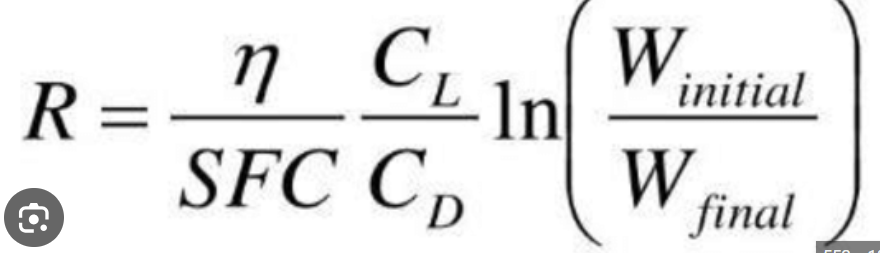
I did some very rough calculations using the Breguet Range Equation:Thank you!
So that gives us a viable upper bound for the J-36's weight. ~132klbs. That's honestly significantly heavier than I expected, I was expecting around 90klbs at 50% fuel, because that would give you a combat TWR of 1.
Let's round down a little, to 130klbs, and then halve that to get an estimated Empty Weight of 65klbs. Guesstimate 10klbs of weapons internal and that gives us 55klbs of fuel.
*blink*
Huh. That does math out to about 103klbs at 50% fuel, and if the engines can do 34klbs thrust (not unreasonable for F110-equivalents) that would give a combat TWR of 1. Why was my brain not grokking that?
====================
Does anyone know how heavy the Chinese VLRAAMs (PL-17?) are? They're not SM6 weight, right? I'm guessing they're more likely Phoenix weight, ~1000lbs?
Frack!No, no, no, that place is a bit vague, in fact, the indicator is not less than 60t
AIM-174 is ~1980lbs, so 4x PL-17 is likely 8000lbs.PL-17 is about 12 inches wide and 20 feet long, so a little thinner and much longer than AIM-174. IMO, probably very similar in weight, north of 1500 lbs. Add in 4-6 PL-15, which are conservatively rated at 400 lbs (inch wider and foot longer than AIM-120) so I think ~10,000 lbs / 5t internal payload is very close.
Sure, but I'm still thinking that ~12-15klbs might be the more accurate guesstimate for the J-36s' AAM payload weight.Actually, all the hints point that the medium range BVR will be the PL-16, which is said to be comparable to AIM-260. So probably the immediate future AAMs are PL-16 and PL-17 (or more likely an improved hypothetical PL-17B variant, afterall PL-17 is something like a decade old by now, same as PL-15 btw).
There's solid source for PL-15(E)'s weightFrack!
Doesn't really change the analysis, but does suggest that the J-36 may be even heavier.
AIM-174 is ~1980lbs, so 4x PL-17 is likely 8000lbs.
Sparrows are also an inch wider than AIM-120 and are 500lbs, so I'd guess PL-15s are more like 500-600lbs than 400. That's another ~3000.
So I may have underestimated the AAM weapons weight for the J-36.
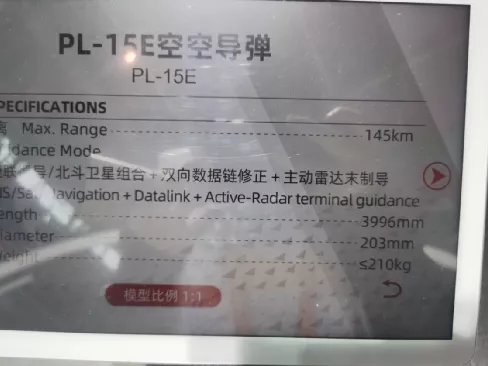
Huh. Okay, I'll withdraw the 600lb guesstimate. but 450-500lbs is still valid for PL-15-no-suffix.There's solid source for PL-15(E)'s weight
View attachment 773154
PL-15E is of the same dimension as the normal PL-15 but has less range either due to different propellent used or lack of a dual pulse motor like on the actual PL-15, some even thinks it's actually just a software change, so the missile uses a less optimal trajectory. But point is I think the actual mass of the PL-15 should be close to the PL-15.
I was guesstimating off iron bombs for max weight, not missiles. Or other weapons that fit into the bays, like JASSM-sized cruise missiles.As for strike I think J-36 would be at best capable of 2 YJ-21 type air launched BMs which weigh 2000kg or 4400lbs each for the H-6 variant, but I think whatever J-36 would be using probably weigh a bit less and be a bit smaller since they could be launched at supersonic speed, of course also add in 4 PL-15/16 in the side bays. That's ~11k lbs for a long-range strike loadout.
Nice, thanks for supporting and confirming my guestimate.J-20 has a combat radius of around 1100nm, so the rough calculations say J-36 would have a combat radius of around 1400nm and this is with old WS-10C. Realistically with intended VCEs, all the aerodynamic trickery and massive use of composites and 3D printed aerostructure I think J-36 could have a combat radius above 2000nm.
IMO, the VCE that is intended to be used by J-36/J-XDS wouldn't have too much of a thrust improvement over WS-15 but would massively focus on cooling capacity/power generation and fuel efficiency. So I think it's pretty reasonable to assume that the new engine would be in the 18tf class(Especially when WS-15 is already in the 160kN-170kN class), accounting in thrust loss from intakes and nozzles etc, this would give J-36 around a TWR of ~1.1 at combat weight. Coupled with very low wing loading(~180kg/m^2 at combat load which is comparable to WW2 era turnfighters ie. Bf-109G's wingloading is 196kg/m^2) should in theory give J-36 a very good sustained turn rate and energy retention although it might be somewhat lacking in instantaneous turn rate and high AoA capabilities.
Or, it could carry as many as 16x 2000lb weapons if the bay is large enough (~1.5m wide by ~7.9m long). 32klbs of weapons is very probably NOT going to allow for full fuel at takeoff.
I agree with the post, but there are at least some indications that F-47 is noticeably lighter/smaller than Shenyang aircraft.- PLAAF: J-36 and J-XDS --> thus the PLAAF and USAF would not have gone very different directions for their long ranged air dominance designs (if F-47 is something J-XDS sized), but rather that the PLAAF have an additional category of long ranged air dominance design (the uber heavy J-36) on top of the regular heavy J-XDS/F-47 category.
I agree with the post, but there are at least some indications that F-47 is noticeably lighter/smaller than Shenyang aircraft.
I also have personal, thinly substantiated (for now) suspicions that both Chinese aircraft are on a slower end, with much stricter focus on IR stealth (and detection).
F-47, on the other hand, seems likely to be extremely fast (mach 1.5-2) in combat, potentially even in transit.
I.e. both class and view on future of air superiority mission is different even between more comparable Boeing and SAC aircraft.
-A lot of attention to IR masking, well over 5th gen average, despite having it harder(no stabilizers to work with). IR signature just doesn't work together with supersonic flight. Maybe sound as well, btw.That said, if it is a question of speed, I don't think there's anything about either the CAC or SAC aircraft that makes a mach 1.5-2 speed particularly out of reason, whether it is supercruise or AB.
Yes, supercruise is a tactical option it's not meant to be use just because you want to go around fast.But my current inner understanding is they're normally transsonic/low supercruisers(perhaps up to 1.5 for normal operating envelope, with mean speeds below m=1)), and their high wing sweep is less about speed, more about desired signature reduction.
Then, their power is mostly to help them get out of predicaments (bvr maneuvers, disengaging, slower pursuits), onboard energy/cooling, as well as to ensure fighter class take off and landing performance.
Higher speeds, not so much. They're undesirable, as those are aircraft that really don't want to be found or seen; blinking is not enough. Especially J-36, which is range-bound to keeping very low profile.


