Astronomy and Planetary Science Thread

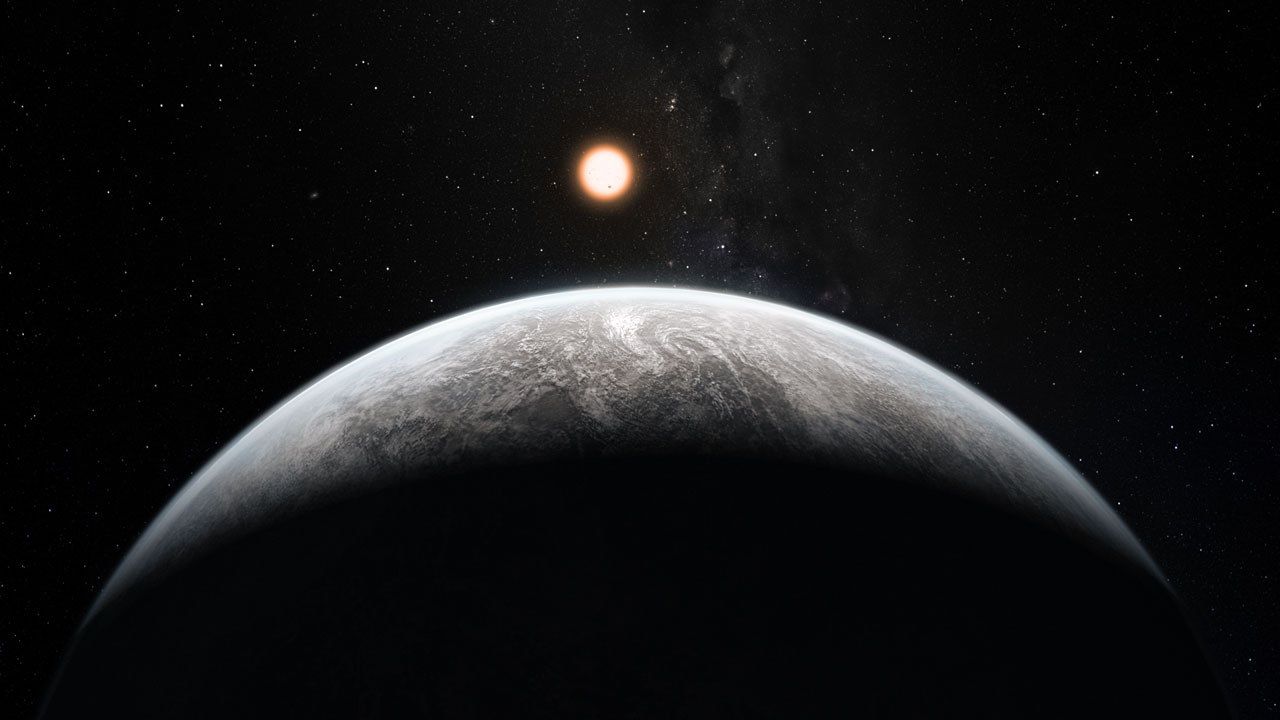
Discovery of giant planet orbiting tiny star challenges theories on planet formation
The best my feeble brain can come up with would be a near collision of a couple of two-to-3+ body systems.

They do a Do-Si-Do, swap partners--and the result is a Mutt-and-Jeff situation that couldn't form organically from any one star system.
 
The best my feeble brain can come up with would be a near collision of a couple of two-to-3+ body systems.

They do a Do-Si-Do, swap partners--and the result is a Mutt-and-Jeff situation that couldn't form organically from any one star system.
My first thought was are there any other planets in the system, or did this planet use up all available material.
 
Discovery of giant planet orbiting tiny star challenges theories on planet formation
AFP story on the discovery:
1749122714913.png
ORIGINAL CAPTION:
An artist's illustration of an exoplanet and its star (HO)
HO/ESO/AFP
 
UH astronomers discover the biggest explosion since the Big Bang

A team at the University of Hawaiʻi’s Institute for Astronomy (IfA) has uncovered a dazzling new kind of cosmic explosion, more energetic than anything seen before. The team named these rare events “extreme nuclear transients” (ENTs), which occur when massive stars—at least three times the mass of our Sun—are shredded by supermassive black holes. The team’s findings were recently published in Science Advances.


One of the ENTs studied in this work, named Gaia18cdj, released 25 times more energy than the most powerful supernova on record. In just one year, it radiated energy equal to the lifetime output of 100 Suns. Most supernovae, in comparison, produce only one Sun’s lifetime output over a similar timescale.


Related paper:

 
AFP story on the discovery:
View attachment 772436
ORIGINAL CAPTION:
An artist's illustration of an exoplanet and its star (HO)
HO/ESO/AFP

Given that this gas-giant has a mass about half that of Saturn that puts its' mass at 47-48 Earth-masses.
 
The best my feeble brain can come up with would be a near collision of a couple of two-to-3+ body systems.

They do a Do-Si-Do, swap partners--and the result is a Mutt-and-Jeff situation that couldn't form organically from any one star system.
Hi
 

Attachments

  • fantasia3.jpg
    fantasia3.jpg
    214.8 KB · Views: 5
A hidden 'super-Earth' exoplanet is dipping in and out of its habitable zone

A huge "super-Earth" with an extreme climate that results in it being habitable for only part of its orbit has been discovered orbiting a star 2,472 light years away. And the most remarkable thing is, it was discovered without even being directly detected.


Meanwhile, the planet's orbit is unusual to say the least. It is highly elliptical, with an eccentricity of 0.44. For comparison, Earth's orbit has an eccentricity of 0.0167 and is therefore close to circular; at the other extreme, an orbital eccentricity of 1 would be parabolic. Kepler-7825c's orbit is oval-shaped, meaning that at some points in its orbit it is much closer to its star than at other times. While overall Kepler-725c receives 1.4 times as much heat from its star as Earth does from the sun, this is just the average over the course of its orbit, and at times it is receiving less.

 
Ground-based telescopes have a trick up their sleeve to deal with atmospheric turbulence: lasers. By creating artificial stars in the sky and monitoring how blurred they are we can obtain very sharp images of the cosmos. Together with our industrial partners we are now testing next-generation lasers for both our Very Large Telescope (VLT) and our Extremely Large Telescope (ELT).

View: https://youtu.be/P3f_67I_ISM?si=q6D-pUH_2SRPrURM
 
Strange lasers in the sky captured by aurora and sky cams in the UK caused by a train

View: https://www.youtube.com/watch?v=a9DMw4crEYE


Jun 6, 2025
The culprit for the strange blue light show is a specialized train that records track condition information using lasers at speeds of up to 125 mph. It is officially known as the New Measurement Train (NMT)

Captured on two nights - May 1 and May 29, 2025 from Oxfordshire, UK on an auroracam and all sky camera.
 
The dreary diesels were scandalized seeing a Big Boy Steam locomotive come home from a rave at 2 AM after having stolen the light show and glitter.
 
The Science Channel has uploaded a video concerning some of NASA famous interplanetary space-probes:


Explore the Voyager, Cassini, and Juno missions' spacecraft, and learn how they helped NASA scientists make incredible discoveries in our solar system.
About Space's Deepest Secrets
A few generations ago, traveling to the Moon was hard to imagine, and going beyond the Moon was a pipe dream. Today there is a new breed of explorer, tasked with going deep into space to unlock and reveal first-ever views of alien worlds and cosmic bodies far beyond anyone's imagination. These men and women have pushed their ingenuity and curiosity beyond the limits to uncover some of the most-groundbreaking findings in the history of space exploration.
 
It would be strange living on that new Super Earth NMaude that is for sure that is if life can survive it's crazy orbit going into and out of the habital zone of it's star.
There's a novel by Hal Clement called Cycle of Fire, which is about a planet orbiting a double star which has such extreme variations that complex lifeforms adapted to the heat cannot survive the cold and vice versa. The evolutionary solution was for two separate alternating ecosystems, with the hot and cold systems each dying out as the planet became uninhabitable to them but leaving seeds/eggs/whatever (been a while since I read it) to last until better conditions returned.
 
JWST confirms the coldest exoplanet found so far, from Anton Petrov:


Hello and welcome! My name is Anton and in this video, we will talk about the coldest planet ever found
Links:
https://arxiv.org/abs/2504.16982
https://www.youtube.com/redirect?ev...ttps://arxiv.org/abs/2504.16982&v=gdKPcGmLqjI
Other videos: • White Dwarfs Form Exceptional Habitable Co...
https://www.youtube.com/watch?v=b81AlweGxP8&pp=0gcJCR0AztywvtLA
• White Dwarf With a Planet in The Habitable...

• Habitable Zone Planet That Formed Inside A...
https://www.youtube.com/watch?v=zLiReB7FZ8U&pp=0gcJCR0AztywvtLA
#exoplanet #jwst #whitedwarf

0:00 Planetary nebulae and white dwarfs
1:20 New study explores a bizarre planet around a white dwarf
2:00 How we usually search for planets
4:00 Why it's hard to find certain types of planets and why white dwarfs are perfect for this
5:55 What was just found - new discovery and why it matters
10:00 Summaries and what's next?
 
So do I NMaude, but there are those that say that it is only a matter of time before Alpha Orionis goes supernova because we are just waiting on the light cone of the supernova to catch up with Earth. So it could be the next night or even next year when it finally goes.
 
Dr. Becky put out a video a couple of days ago about why we need to return samples from Mars to Earth for analysis:


Is there life on Mars? It’s a BIG question that David Bowie has been asking for a long time! So the majority of missions and rovers that get sent to Mars have a focus on figuring out if life currently exists on Mars, or more likely (we think), whether life once existed on Mars in the past but no longer. From the rovers of the past like Opportunity, to the rovers of the future like the Rosalind Franklin rover (ESA’s ExoMars mission), and to Perseverance and Curiosity rovers currently operating on Mars. The Perserverance rover is collecting rock samples and leaving them on the surface for a future Mars mission to collect and return to Earth. But why? Why do we need to return samples to Earth to test for this when the rovers are essentially scientific lab instruments on wheels? Well a few years ago this paper by Azua-Bustos and collaborators was published who used the techniques available to current and planned Mars rovers to test whether they could find signs of life in a sample of rock from Earth in the Atacama desert. And spoiler alert: they couldn’t...​
00:00 Introduction
03:00 Why was the Atacama Desert chosen for the experiment?
05:15 What kind of tests were done?
08:40 What can Mars rover instruments detect in the Atacama Desert?
14:11 Bloopers
 
May be paywalled. Sometimes you can get past it by clicking reload and then stop before it completely loads, but you have to be quick.


The idea of a dark star was first floated in 2007 by Katherine Freese at the University of Texas at Austin and her colleagues. They suggested that vast clouds of hydrogen and helium in the early universe could have mixed with a self-annihilating form of dark matter to form massive, stable stars. Without dark matter, such large clouds of gas would collapse to form a black hole, but the energy from the self-annihilating dark matter can prevent this, allowing the gas to heat up and form a star-like object, even though the nuclear fusion that takes place in most ordinary stars is absent.

Now, Freese and her colleagues say that new spectroscopic observations of these early galaxies from JWST lines up well with theoretical predictions for how dark stars should look, as well as identifying another two dark star candidates.


Anyway, the preprint:


Dark Stars, i.e. early stars composed almost entirely of hydrogen and helium but powered by Dark Matter, could form in zero metallicity clouds located close to the center of high redshift Dark Matter halos. In 2023 three of us identified (in a PNAS work) the first three photometric Dark Star candidates: JADES-GS-z11-0, JADES-GS-z12-0, and JADES-GS-z13-0. We report here our results of a followup analysis based on available NIRSpec JWST data. We find that JADES-GS-z11-0 and JADES-GS-z-13-0 are spectroscopically consistent with a Dark Star interpretation. Moreover, we find two additional spectroscopic Dark Star candidates: JADES-GS-z14-0 and JADES-GS-z-14-1, with the former being the most distant luminous object ever observed. We furthermore identify a feature in its spectrum indicative of the smoking gun signature of Dark Stars: the He IIλ1640 absorption line. In view ALMA's recent identification of a probable OIII nebular emission line in the spectrum of JADES-GS-z14-0, the simple interpretation of this object as an isolated Dark Star is unlikely. If both spectral features survive follow-up observations it would imply a Dark Star embedded in a metal rich environment, requiring theoretical refinements of the formation of evolution of Dark Stars, which in previous studies were assumed to form in isolation, without any companions.
 
Coming June 23, 2025: First Look at the cosmos with NSF–DOE Vera C. Rubin Observatory

Get ready to join us virtually around the world on June 23, 2025 at 11:00 a.m. US EDT as we unveil the first spectacular images from NSF–DOE Vera C. Rubin Observatory! This First Look event will be live streamed via Youtube in English and in Spanish — links will be made available here and via social media. Join us to celebrate the start of a new era in astronomy and astrophysics with the world's newest and most powerful survey telescope.

Over the next ten years, Rubin Observatory will create the ultimate movie of the night sky using the largest camera ever built — repeatedly scanning the sky to create an ultra-wide, ultra-high-definition time-lapse record of our Universe.

 
Some unexpected findings in regards to the predicted Andromeda/Milky Way galaxies collision, from Anton Petrov:


0:00 Milky Way and Andromeda galaxy collision
1:30 How this was initially proposed
3:50 First signs it could be wrong
4:18 New study and new calculations
6:10 Results and what this means
8:30 Conclusions
9:00 Andromeda mystery
 
I have read articles and papers online about the Milky Way/Andromeda collision and from what I have read is that the two galaxies will just have a glancing blow the first time round then come back in a few billion years time for the final collision. And also the stars in the Milky Way will not collide with the stars in the Andromeda galaxy instead they will get flung out of both galaxies as they get closer with the gravitational pull of both galaxies.
 
Everything winds up being in a giant elliptical...with other galaxies over the light horizon--looking like how folks first thought of the Milky Way...then called an island universe with sci-fi calling Star systems "galaxies."
 
looking like how folks first thought of the Milky Way...then called an island universe with sci-fi calling Star systems "galaxies."

The Andromeda galaxy was originally referred to as the Andromeda nebula IIRC, as for the merger of that galaxy and our galaxy I think it will happen but the merger will be far, FAR away in the future.
 
Last edited:
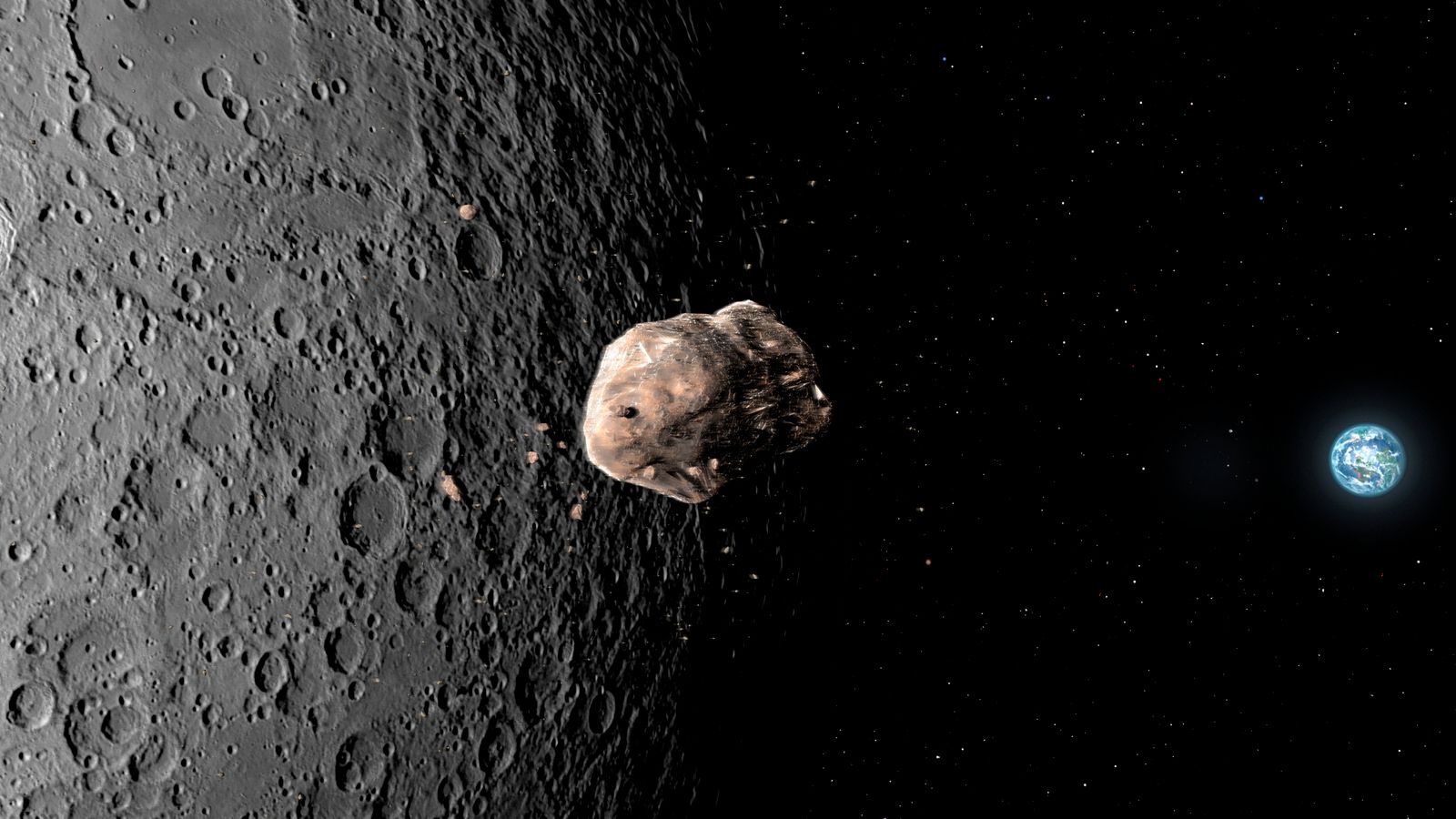
NASA raises the odds that an asteroid could hit the moon in 2032

Although now too distant to observe from Earth, the asteroid briefly came into view in May for the James Webb Space Telescope (JWST). Using data from the telescope's Near-Infrared Camera, a team led by Andy Rivkin of the Johns Hopkins Applied Physics Laboratory refined predictions of where 2024 YR4 will be on Dec. 22, 2032 by nearly 20%. That revised trajectory nudged the odds of a lunar impact from 3.8% to 4.3%, according to a NASA update.

"As data comes in, it is normal for the impact probability to evolve," the statement read. Even if a collision occurs, "it would not alter the moon's orbit."

 
NASA raises the odds that an asteroid could hit the moon in 2032


How can they say that an impact will not change the orbit of the moon without knowing where it will impact? An frontal impact is not the same as a rear one that affects the orbital velocity in opposite ways. There is also the danger of fragments detached during the collision, they can be quite large and fall into New York. Like in the movies. And the danger of orbital deviation if the asteroid passes too close to the moon, the next time it approaches the earth its trajectory will have changed, I think that effect is called "keyhole".
 
Monster black hole M87 is spinning at 80% of the cosmic speed limit — and pulling in matter even faster

The results are pretty mind-blowing. This black hole, which weighs in at 6.5 billion times the mass of our Sun, is spinning at roughly 80% of the theoretical maximum speed possible in the universe. To put that in perspective, the inner edge of its accretion disk is whipping around at about 14% the speed of light - that's around 42 million meters per second.

The team figured this out by studying the "bright spot" in the original black hole images. That asymmetric glow isn't just there for show - it's caused by something called relativistic Doppler beaming. The material on one side of the disk is moving toward us so fast that it appears much brighter than the material moving away from us. By measuring this brightness difference, the scientists could calculate the rotation speed.

 
I wonder what would happen to that blackhole if it did exceed its' cosmic speed limit?
 
Stunning Direct Images of Alien Worlds Are Detailed Enough to Reveal Clouds

New images from the JWST are about as close as we've ever come to seeing the sky of an alien world outside the Solar System.

Direct images of a gas giant exoplanet orbiting a star called YSES-1 have revealed clouds of fine sand drifting high up in its atmosphere. What's more, similar observations of a neighboring world suggest it is surrounded by a large, swirling disk rich with olivine, a mineral that can form the gemstone peridot here on Earth.


Related paper:

 
Scientists stunned to see humpback whales trying to send messages to humans

A new study by the scientists from SETI and the University of California, published in Marine Mammal Science, has addressed both these aspects of whale behaviour and documented humpbacks producing large bubble rings during friendly encounters with humans that seem to be an attempt at sending messages.


“Humpback whales live in complex societies, are acoustically diverse, use bubble tools and assist other species being harassed by predators,” says co-lead author Dr Fred Sharpe. “Now, akin to a candidate signal, we show they are blowing bubble rings in our direction in an apparent attempt to playfully interact, observe our response, and/or engage in some form of communication.”


The study analysed 12 bubble ring-production episodes involving 39 rings made by 11 individual whales. “We’ve now located a dozen whales from populations around the world, the majority of which have voluntarily approached boats and swimmers blowing bubble rings during these episodes of curious behaviour,” said co-lead author Jodi Frediani, a marine wildlife photographer.

 
Solar Orbiter gets world-first views of the Sun’s South Pole:

What if we could look at the Sun from a whole new angle, one we've never seen before?

From Earth, we always look towards the Sun's equator. This year, the ESA-led Solar Orbiter mission broke free of this ‘standard’ viewpoint by tilting its orbit to 17° – out of the ecliptic plane where the planets and all other Sun-watching spacecraft reside. Now for the first time ever, we can clearly see the Sun’s unexplored poles.

Using different instruments, Solar Orbiter can see what happens throughout the Sun's outer layers. The material in these layers never stays still, being pushed outward and (usually) falling back to the Sun.

Interestingly, it saw that the Sun's magnetic field has its north and south all tangled up, with patches of both magnetic polarities present right up to the Sun's south pole. This only happens once every 11 years, at the point in the solar cycle when the Sun's magnetic field flips.

Solar Orbiter will keep a close eye on the Sun – including its poles – for the years to come. Its unique viewing angle will change our understanding of the Sun’s magnetic field, the solar cycle and the workings of space weather.

View: https://youtu.be/ujmIY9p0pxQ?si=gnFryig6W8P58Dzv
 
How can radio astronomers successfully identify extraterrestrial radio signals while discerning them from Earth-based radio signals? This is what a recent study published in The Astronomical Journal hopes to address as a team of researchers investigated how machine learning could be used to search for extraterrestrial technosignatures while simultaneously identifying radio contamination from human radio signals. This study has the potential to help radio astronomers develop more efficient methods in searching for and identifying radio signals from extraterrestrial civilizations.
 

This is where having a permanent base on the Moon's far side would be helpful for radio-astronomy as the Moon's bulk would block radio "Noise" from the Earth.
 
Astronomers may've just figured out why some stars get so massive, from Anton Petrov:


Similar threads

Back
Top Bottom