aonestudio
I really should change my personal text
- Joined
- 11 March 2018
- Messages
- 3,377
- Reaction score
- 9,218


How many were they getting again?? I reckon they will primarily act as "airborne ads", i.e. shoot down cruise missiles and whatnot. They do not pose a credible threat against modernized Flankers(Su-30/34/35S).

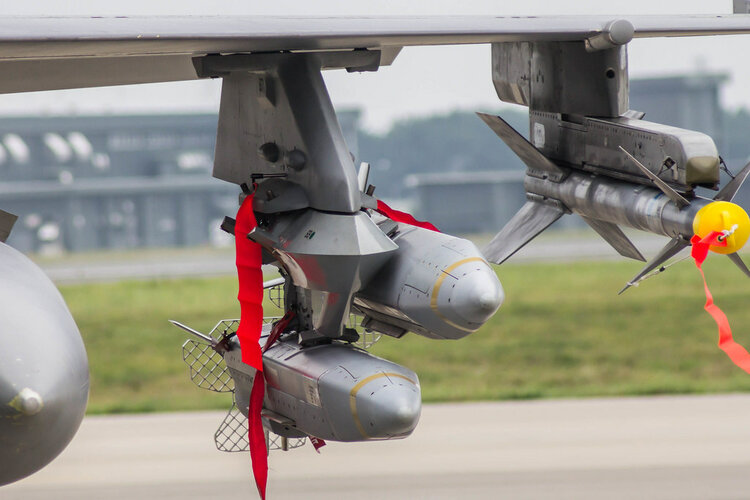
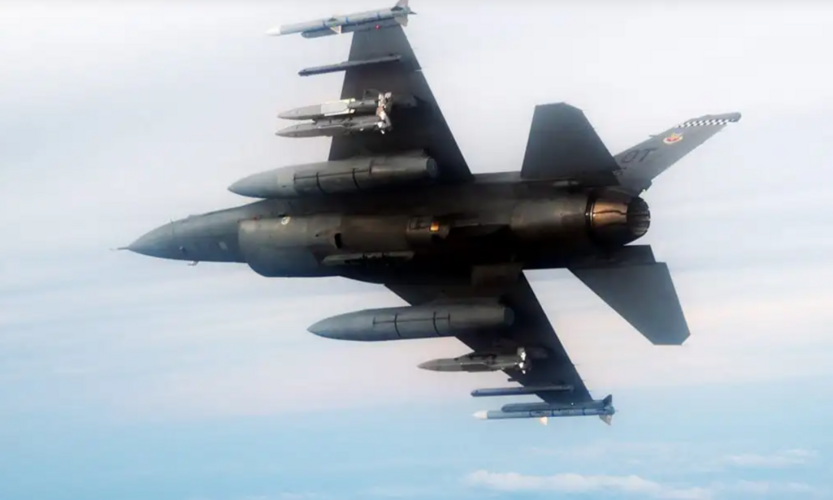
The ex-Dutch F-16s can carry AMRAAM, IRIS-T, AIM-9X. LANTIRN, TFR, ECM-pods, Litening, FLIR. AN/APG-66v2 radar. They should be quite a handful to take on. The ex-Danish F-16s can at least handle AMRAAM and AIM-9X - https://www.secretprojects.co.uk/th...-21-growler-tabm-sam.2985/page-10#post-635818They do not pose a credible threat against modernized Flankers(Su-30/34/35S).
They do not pose a credible threat against modernized Flankers(Su-30/34/35S).
How many were they getting again??

Yes, but will AIM-9Xs be delivered to Ukraine ?Ah, no, I'd say they do definitely pose a credible threat and as Arjen has pointed out they can carry a wide range external stores including the AIM-9X and the latest AMRAAMs.
Are they expected to get into dogfights with the Russians? Here are the facts:Ah, no, I'd say they do definitely pose a credible threat and as Arjen has pointed out they can carry a wide range external stores including the AIM-9X and the latest AMRAAMs also from what I understand the Russian pilots training is bit inadequate so I think the Russian airforce will be in for a nasty surprise.


1) The Russians can pose a credible threat to even tactical fighters from a 150 miles away.
2) They have superior situational awareness, they can see you further away than you can see them
3) They possess larger numbers and they also have superior firepower
4) Their aircraft have superior kinematics, meaning the missiles they launch have a better probability of hit, thus increasing their NEZ.
5) They can more easily replace their losses while you can't.
Western support for Ukraine is dwindling and that's a fact.
6) Superior enemy firepower means that you have to commit more resources to protect the ones you already have.
The ex-Dutch F-16s can carry AMRAAM, IRIS-T, AIM-9X. LANTIRN, TFR, ECM-pods, Litening, FLIR. AN/APG-66v2 radar. They should be quite a handful to take on. The ex-Danish F-16s can at least handle AMRAAM and AIM-9X - https://www.secretprojects.co.uk/th...-21-growler-tabm-sam.2985/page-10#post-635818

And another yesterday.Do they? Russia has only a handful of operational Beriev A-50 AEWACS aircraft with one being shutdown last month.
All of that is true but F-16 can carry MALD decoys (which is practically a cruise missile that can augmented its RCS to look like any particular fighter, from F-5 to B-52, some version carry jammer and 2 way datalink). Each F-16 can carry 4-8 MALD decoys depend on whether you want to carry fuel tank or not. These decoys can fly for 920 km at Mach 0.8.Are they expected to get into dogfights with the Russians? Here are the facts:
1) The Russians can pose a credible threat to even tactical fighters from a 150 miles away.
2) They have superior situational awareness, they can see you further away than you can see them
3) They possess larger numbers and they also have superior firepower
4) Their aircraft have superior kinematics, meaning the missiles they launch have a better probability of hit, thus increasing their NEZ.
5) They can more easily replace their losses while you can't. Western support for Ukraine is dwindling and that's a fact.
6) Superior enemy firepower means that you have to commit more resources to protect the ones you already have. Essentially this means that you have to shoot down enemy missiles one way or the other even if you need to engage aircraft also.
Excuse for my forthrightness, but this is nonsense.Russia can no longer purchase these devices and cannot design or manufacture its own. Russia never developed a viable semiconductor industry and cannot do so now.
At this point, new-build Russian aircraft are probably consuming the last stocks of mported microdevices--hence the small numbers of new aircraft completed and the delays in fielding replacement types like the Su-57. When devices fail in serving aircraft, replacements are unlikely to be available. If the affected aircraft remain flyable at all, they will lose much or all of their ability to process targeting data.
Note also Russia's heavy use of older/obsolete missiles and iron bombs. The more advanced weapons are likely be in short supply and hard to replace, particularly if aircraft have priority for the limited remaining stocks of Western microdevices.
Given the above, I suspect that F-16s and AIM-120s will be more than enough to drive Russian aircraft out of Ukrainian airspace.
Block 70 is a single seat "F-16V".
Block 72 is a two seat "F-16V".
No, and you're just overly complicating things. The reason F-16 block 70/72 standard aircraft are still C/D is because the upgrade program itself was designed in such way that it fits existing F-16 C/D aircraft around the world, often using pre-existing avionics from CCIP standard aircrafts. E/F are structurally very different, especially the nose section.OK, that does better fit the existing naming conventions.
That article also refers to the aircraft as an "F-16D Block 70, a new-build equivalent to the upgraded F-16V", whereas what I had been seeing labeled all block 70/72s as F-16Vs.
As the Block 60s for UAE had been designated F-16E/F, it did not seem correct for the Block 70s to revert to the earlier type designation... especially with other Block 70s carrying the -V designation, but apparently they did.
What I saw (https://www.f-16.net/f-16-news-article5089.html) said
which contradicts your reference.
So does anyone have something official from LM, the US government, or the Bahrain government (not the media) as to how these are designated?
The V designation is indeed a LM marketing thing as you've mentioned, but it has also been used in official documents, eg: DSCA notifications. It's the matter of convenience. Also, different AF designate their aircraft differently, eg: upgraded ROKAF KF-16s are designated KF-16U, not V"F-16V" seems to be a Lockheed Martin thing, for example this article from 2016: Meet the F-16V: The Most Technologically Advanced 4th Generation Fighter in the World
If we look at Bahrain, for example, in 2017 we see that they are obtaining the F-16V via FMS: Bahrain to buy 19 new F-16Vs and upgrade 20 current Block 40s
FMS aircraft are usually assigned a US military serial number. These aircraft for Bahrain were assigned FY18 serial numbers as follows:
(from Joe Baugher's serial number lists)
I'm not sure where to look up serial numbers otherwise, but if that is accurate, then the official US military designation is still F-16C and F-16D for these aircraft.

Actually while the software on the block 70 is almost certainly better I think the Block 60 radar has much greater range because it’s liquid cooled vs air cooled. It also has that monster engine and if I remember right a custom EW system and flight control.^ From what I understand, the E/F (Block 60) also require approval from the UAE to be sold to other places and maybe additional costs as well?
The first flight of the Block 60 was also over 20 years ago (time flies, felt like yesterday).
I am wondering how much the block 70/72 improves over them, if at all, at least in terms of avionics.
The reason F-16 block 70/72 standard aircraft are still C/D is because the upgrade program itself was designed in such way that it fits existing F-16 C/D aircraft around the world, often using pre-existing avionics from CCIP standard aircrafts. E/F are structurally very different, especially the nose section.
eg: upgraded ROKAF KF-16s are designated KF-16U, not V
As I understand the UAE didn’t pay for the development so much as the intergration of a lot of those systems. They recently offered the F110-GE-132 to India about a year or two ago.I thought the UAE gets royalties on sales on the Block 60 but they have to approve sales as well? Seems a shame because it does have some nice features on it. Does it apply to specific components like the F110-GE-132 engine?
It seems odd to me that none of the customers for the current crop of improved F-15s and F-16s are getting them with either the F110-GE-132 or the F100-PW-232.

The K is for Block 52s produced under license by Samsung, hence KF-16. This is to differentiate against the Block 32 F-16s procured earlier in Peace Bridge I.The K prefix shouldn't be used as it falsely implies that those F-16s have been modified into aerial-tankers.
The K is for Block 52s produced under license by Samsung, hence KF-16. This is to differentiate against the Block 32 F-16s procured earlier in Peace Bridge I.
That would have probably made more sense. It's what was done for the Japanese F-15J which was built under license by Mitsubishi.Well then call it the F-16K.
KF-16 is its official designation in Korean service. Turns out if you cut a check for a couple hundred million dollars nobody stops you calling your jet what you want.Well then call it the F-16K.
So many changes have occurred that they should be referred to as the G/H (Since E/F is already taken) not C/D.

The K prefix shouldn't be used as it falsely implies that those F-16s have been modified into aerial-tankers.
When block 1/5/10/15/20 are all "same" A/B and 25/30 32/40 42/50 52 are C/D, there is zero reason to call 70 72 with a new designation, especially due to reasons I've mentioned.So many changes have occurred that they should be referred to as the G/H (Since E/F is already taken) not C/D.
The K prefix shouldn't be used as it falsely implies that those F-16s have been modified into aerial-tankers.
That ain't what you decide but ROKAF.Well then call it the F-16K.
There are examples like CF-188 so I don't really see a problem here.That would have probably made more sense. It's what was done for the Japanese F-15J which was built under license by Mitsubishi.
That's indeed correct iirc, although I also cannot remember the exact source nor could specifically confirm it was the A/B version. AFAIK there were also proposals for a license produced and "japonized" C/D in the later years also called the F-16J.infuriatingly I can’t find any evidence it was the logical F-16J at any point, though that was seemingly used for an early F-16A proposal.
Speaking of which, there was also a model named block 61 that UAE considered in early 2010s as a follow-up order, a designation that is also not in-line with past conventions (the #0/#2 convention and renaming the suffix for major upgrade for pre-existinf blocks), just like "U". Though "U" makes tone of sense otherwise.The delta wing F-16 proposed to the UAE was sometimes called F-16U.
I think, key word think, the block 61 would have had some of the improvements of the block 70 back fitted onto the 60. Not sure if it will ever happen.That's indeed correct iirc, although I also cannot remember the exact source nor could specifically confirm it was the A/B version. AFAIK there were also proposals for a license produced and "japonized" C/D in the later years also called the F-16J.
Speaking of which, there was also a model named block 61 that UAE considered in early 2010s as a follow-up order, a designation that is also not in-line with past conventions (the #0/#2 convention and renaming the suffix for major upgrade for pre-existinf blocks), just like "U". Though "U" makes tone of sense otherwise.
The delta wing F-16 proposed to the UAE was sometimes called F-16U.
Sort of the fusalage was the same but the planform was different, didn’t bleed as much, better rcs characteristics. The role was the similar to the XLWas that to have been basically a production version of the F-16XL?
Had the UAE offered enough money to get this built would the changes necessary to the production line have meant an end of production of "standard" F-16 variants?
Yes, time-wise, that makes sense. Iirc the Taiwanese upgraxe programme, which became block 70/72 standard later, also started in the early 2010s, before the block 61 proposal. I could definitely see newer mission computers like MMC 7000A or B (AH is too new) being fitted for block 61, as well as the new IFF.I think, key word think, the block 61 would have had some of the improvements of the block 70 back fitted onto the 60. Not sure if it will ever happen.
. I could definitely see newer mission computers like MMC 7000A
U.S. Air Force Test Pilot School and the X-62 VISTA Team score a major win. Here is the story of this unique and futuristic airplane.
I've read on this forum that Have Glass is up to 12mm thick...
Some prediction i made on potential of RCS reduction from Have Glass. The big issue was no real description of the material used. Except that (but vague) It's a magnetic absorber and 0.3mm thick. In my estimate, the material covers almost whole surface of the F-16's and the inlet lip. The substitute material is Barium Hexaferrite which also a magnetic absorber.
View attachment 718546
There are 2 modeled cases (armed and unarmed) Along with 3 conditions, untreated, treated but with old radome, treated and with new bandpass radome.
View attachment 718547
The result can be seen above. the treatment along with bandpass radome allow the lowest RCS reduction to be attained, however addition of external weapons kinda diluted the "stealth" advantage of the airframe. This might work against older fighter types like Su-27SK's or MiG-29 Izd 9.13 with old N001 and N019 also to some extent More modern MiG-29SMT with N010 ZhukM/ME. It will however struggle against more modern types with much more powerful radar.
K for Korea. Same as K1 tanks, KF21 fighter, etc.The K prefix shouldn't be used as it falsely implies that those F-16s have been modified into aerial-tankers.
K for Korea. Same as K1 tanks, KF21 fighter, etc.


