P-51 Mustang & F-82 Twin Mustang Proposals and Variants

I'm not really able to travel, certainly that far. And I do already have books with the photos I've described (and may be buying more in the next month or two). And I do believe that Air Corps Aviation is trying to digitize various P-51 and P-82 documents that were saved from NAA's old Columbus factory before Rockwell would try and get rid of them.

But the photos being digital and on my laptop is a bit of a matter of convenience, since I don't really right now have a good place to read them right now.
 
My understanding is that the weight difference between the Merlin and Griffon is such that it would be more involved than a straight swap. A lot of rebalancing of the airframe would be required to make the aircraft fit for combat.

Note the larger airframe of the later Spitfire marks.

Would have been a monster though.
I understand that a Mustang with a full fuselage tank was a bit of a handful to fly, the CG was a bit too far aft (relaxed stability). Empty the fuselage tank first and the CG gets forward where it should be.

Weight difference between a Merlin 61 and Griffon 65 is 340lbs. Since the Griffon needs a bigger tail like the F82 anyways, I suspect that the stretch needed there would address most of the changes necessary.

========

Had an airshow Sunday, got to listen to a Merlin fly around with an F35. Gotta love the Mustang whistle caused by the gun ports.
 
Does anyone have any information on a possible P-51E Mustang?

I just ran across a reference to it in FLYING Magazine; September 1945; with the terse text:


"Between the D and the H, the E died on the design boards..."
The P-51D (NA-106) and P-51E (NA-107) began life in Jan 1943 as the six gun/Birdcage canopy P-51B/C modification. Original planning projected NA-106 for Inglewood/NA-107 at Dallas. NAA negotiated the MCR for the six gun wing just before MCR 258 for the Cockpit Enclosure, Sliding was executed.

The production breaks for NA-106/107 are well documented in the Preliminary Design General Assembly 106-900002 P-51D Major Assembly Breakdown. Between Jan 1 and March 15, when 9000002 was released, the actutal work on both canopy and new wing design had started and all production drawings were completed by mid-July, 1943. P51B-1-NA 43-12102 was delivered to the xperimental department for the cockpit mod. Two spare P-51B-1 fuselages were pulled to perform the exact cockpit mods as P-51D and P-51D-1. The wings were installed in the Experimental Department. P-51D-1 remained to begin installation of 55 gal fuse tank.

In September AAF decreed 'only 85 gal tanks will be accepted post Jan 1" and the P-51D and D-1 were assigned the first two numbers of the planned production break, namely 42-106539/540 but the project of planned B-1 fuselage basis for production was killed, NA-107 was killed, All funding and pooled parts were folded from NA-106 into P-51D-5 NA-109 and P-51B-10 NA-104; NA -107 funding was moved into NA-103 and NA-111.

In October a Change E.O. was approved to move the wing back 4" to accomodate the aft cg issues introduced by NA-106 85 gal requirement as well as 2x50 cal/600 round increase to aft cg issue - but by that time flight tests as Eglin stated that while deliterious at full combat weight, the P-51 was flyable until fuel reduced to 60 gal - and NAA/AAF agred to proceed 'as is',

The continuation of P-51B-5 moved to P-51B-10 and the P-51B-10 production skipped 42-106539/540 to 42-106541.

Summary - didn't die on the design boards. Somebody woke up and remembered that while NA-102 and 103 were the same airframe, NA and NT clearly differentiated between Inglewood and Dallas, so why not P-51D-5-NA and P-51D-5-NT?

The modified P-51B-1-NA and P-51D-NA were flight tested by AAF and Chilton in November/December 1943, but P-51D-1-NT was not delivered until December 31, 1943 and Chilton never flew it (at least not recorded in his logbook).

Take what you want and leave the rest.

Bill Marshall

 
Both of these videos are showing (for me at least) as disabled by the video owner.

A few Youtube links lately have either come up like this or are blocked (at least in the UK). Folks should really be aware of this problem - no point posting videos if nobody can see them....
 
Both of these videos are showing (for me at least) as disabled by the video owner.

A few Youtube links lately have either come up like this or are blocked (at least in the UK). Folks should really be aware of this problem - no point posting videos if nobody can see them....
Have been seeing similar issues with tweeter links being deader then some of the projects listed on this site.

Tweeter or X or what ever its called today, is far too unstable to rely on just the links for information posted
 
I understand that a Mustang with a full fuselage tank was a bit of a handful to fly, the CG was a bit too far aft (relaxed stability). Empty the fuselage tank first and the CG gets forward where it should be.

Weight difference between a Merlin 61 and Griffon 65 is 340lbs. Since the Griffon needs a bigger tail like the F82 anyways, I suspect that the stretch needed there would address most of the changes necessary.

========

Had an airshow Sunday, got to listen to a Merlin fly around with an F35. Gotta love the Mustang whistle caused by the gun ports.
It was a handful with respect to combat manuevers with full 85 gal fuselage tank. The resultant CG was a couple of inches aft of the designated static aft cg point. Very light conrol forces in turn, with tendency to reverse control of elevator and spin out. Bob weights were retrofitted to alleviate (but not eliminate) the very sensitve pitch condition.

The flight testing of the three P-51B-1s at Eglin Field recommended burning down to 45gal (IIRC) before being in safe cg limit for combat manuevering.

SOP in ETO was to a.) load 65 gal, or b.) burn 20+ gal during climb to cruise altitude. There were exceptions depending on the projected mission profile. A very long range mission to say, Posnan or Stettin, with 75gal tanks dictated 20+ gal burned and be aware that the projected 20min Combat Rating fuel consumption margin was no longer a safe consideration for fuel reserve to return home.

Anecotally, my father who led the 355th FG escort for FRANTIC VII maintained full tank untll near Berlin, when the Bomber Task Force leader radio'ed that he was 10 min early to R/V and the group switched to fuse tank and spun up to Military Power to forge an intercept point NNW of Warsaw. The 355th had a fight with JG 51 shortly thereafter. He didn't land with the 355th at Piryatin but flew on to Poltava for a briefing for the next leg to Foggia. He told me that he 'couldn't have had more than 5-10gal remaining when he landed. His longest mission at 7:30 or &7:50 hrs
 
Last edited:
It was a handful with respect to combat manuevers with full 85 gal fuselage tank. The resultant CG was a couple of inches aft of the designated static aft cg point. Very light conrol forces in turn, with tendency to reverse control of elevator and spin out. Bob weights were retrofitted to alleviate (but not eliminate) the very sensitve pitch condition.

The flight testing of the three P-51B-1s at Eglin Field recommended burning down to 45gal (IIRC) before being in safe cg limit for combat manuevering.

SOP in ETO was to a.) load 65 gal, or b.) burn 20+ gal during climb to cruise altitude. There were exceptions depending on the projected mission profile. A very long range mission to say, Posnan or Stettin, with 75gal tanks dictated 20+ gal burned and be aware that the projected 20min Combat Rating fuel consumption margin was no longer a safe consideration for fuel reserve to return home.

Anecotally, my father who led the 355th FG escort for FRANTIC VII maintained full tank untll near Berlin, when the Bomber Task Force leader radio'ed that he was 10 min early to R/V and the group switched to fuse tank and spun up to Military Power to forge an intercept point NNW of Warsaw. The 355th had a fight with JG 51 shortly thereafter. He didn't land with the 355th at Piryatin but flew on to Poltava for a briefing for the next leg to Foggia. He told me that he 'couldn't have had more than 5-10gal remaining when he landed. His longest mission at 7:30 or &7:50 hrs
Always good to hear from the people who used the tools!

If your Dad's still with us, have a drink with him for me, please.
 
I'm sure we all (or most of us) know of the variant that had the 8 .50 MGs in it, but I did read both on Wikipedia and Twin Mustang: The North American F-82 At War that there were other projects being looked at for the gun pod, including a 40mm cannon. Is there any truth to this?

And also on ww2aircraft, I did learn some of the possible differences between the NA-117 (preproduction P-51H design) and the NA-126 (production P-51H). This is from forum correspondence between me and drgondog there, and research is still ongoing for the successor to the P-51B book.

But if you want to imagine was a production NA-117 would look like, imagine a P-51H with the same length as a P-51D or XP-51F/G, with the wing the same place as on the XP-51F/G instead of being moved about 6 inches back as on the actual P-51H.
 
Last edited:
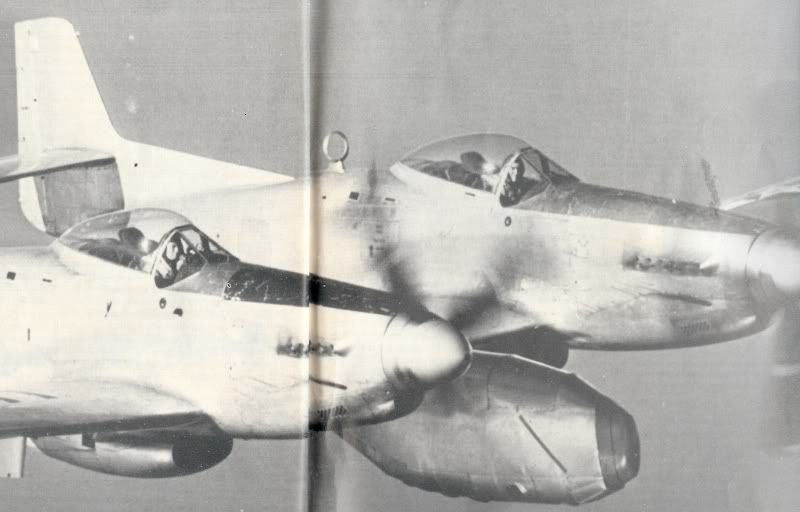
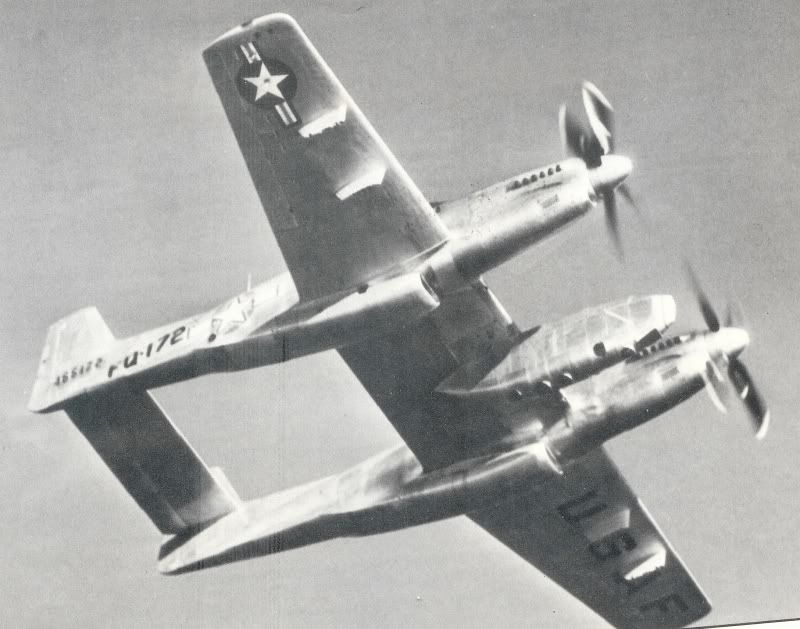
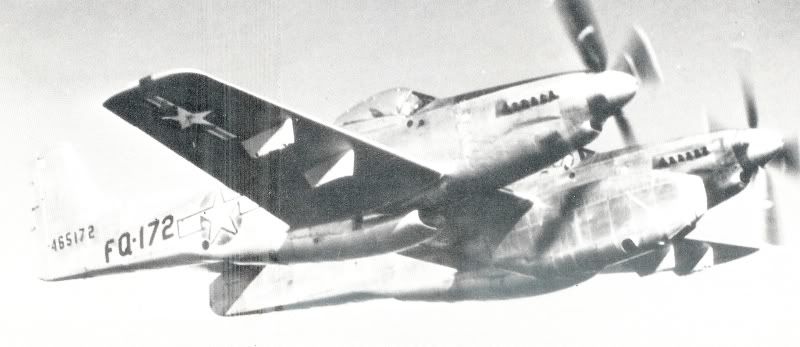
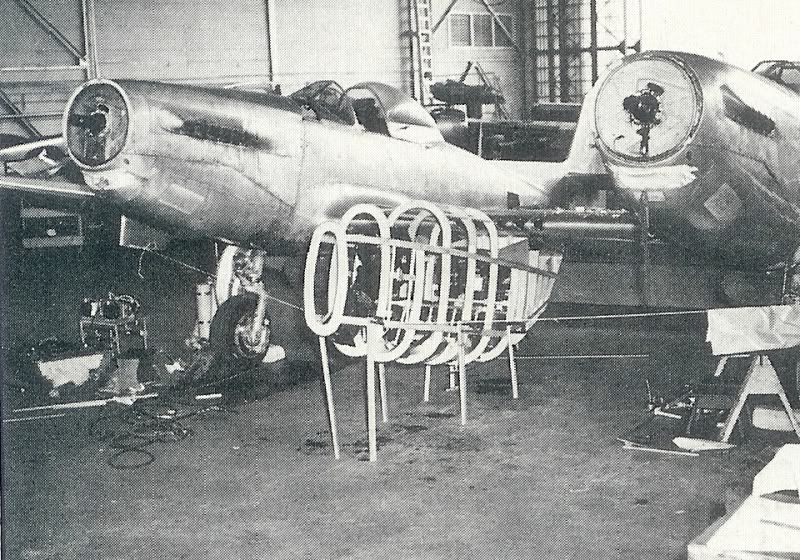
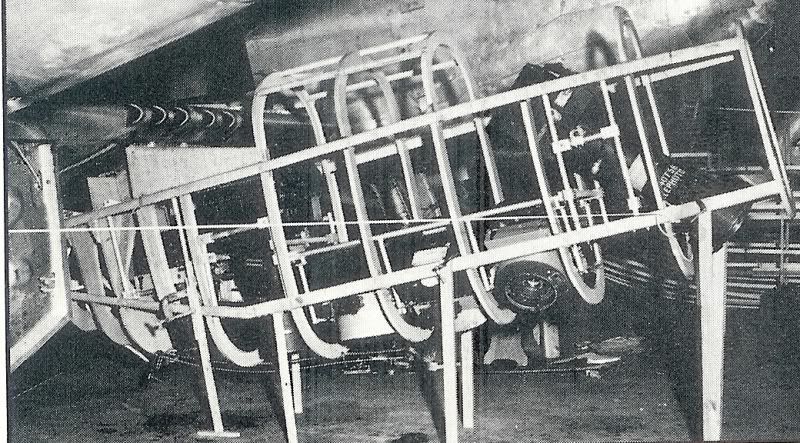
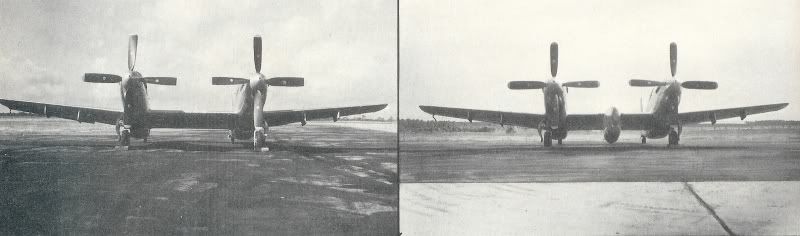
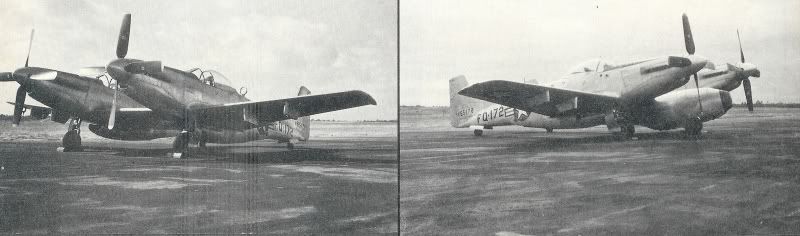
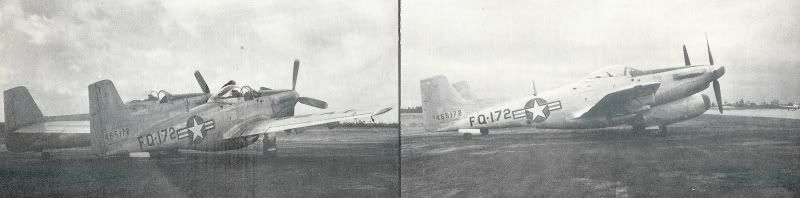
Any info or such on the "RF-82" that had a camera pod? San Diego Air and Space Museum has HQ photos of it (they have low res versions of them on their Flickr page, you can buy the HQ versions in print or digital form). I asked about it at WW2Aircraft.com, and got some info, but aside from that and the photos, not much else. Or anything additional on the P-82C/D (P-82Bs used as R&D aircraft for F-82 night/AW fighters)?
I thought this had been previously posted:

a single F-82B was converted into a photo-recon RF-82B in the late '40s:

In flight trials:
scan0007-1.jpg

scan0013.jpg

scan0014.jpg


Pod in construction:
scan0008.jpg

scan0009.jpg


With an without pics:
scan0010.jpg

scan0011.jpg

scan0012.jpg
 
Nice pics, thanks.

Several preliminary pursuit designs were studied under USAAF project MX-176. Among them was a little-known proposal that Hughes Aircraft should build a P-51 look-alike from duramold, and fit it with an Allison V-1710 engine. Apparently, P-51 design data was sent from North American to Hughes, but it is unknown how much work was actually done. Does anyone know more about this project?
 
Nice pics, thanks.

Several preliminary pursuit designs were studied under USAAF project MX-176. Among them was a little-known proposal that Hughes Aircraft should build a P-51 look-alike from duramold, and fit it with an Allison V-1710 engine. Apparently, P-51 design data was sent from North American to Hughes, but it is unknown how much work was actually done. Does anyone know more about this project?

Actually Hughes company designed a two single engined fighter projects,the
first was a single seat aircraft of 1937,developed from H-1 racer,and I think it
was called D-1,the second was a lightweight fighter in class of Bell XP-77,1941
up to 1942,surley called D-4.
 
Last edited:
Actually Hughes company designed a two single engines fighter projects,the
first was a single seat aircraft of 1937,developed from H-1 racer,and I think it
was called D-1,the second was a lightweight fighter in class of Bell XP-77,1941
up to 1942,surley called D-4.
Yep, but that's not what I'm talking about here.
 
For those of you who have drgondog's and Lowell Ford's book on the P-51B Mustang (covered NAA's origins, and development of the Allison and Merlin Mustangs prior to the Normandy Landings), there are photos of 20mm and 37mm cannon armed mock ups for the P-51 and A-36. The 37mm and 20mm were ground strafing weapons for the A-36 and 20mm were for air to air for the P-51. Four of each guns were intended to be carried (though the A-36 could have 2 20mm and 2 37mm as well).

Also, there was the never built paper project known as the "Packard Pursuit", which was a precursor to the P-51B and D Mustangs. For 1942, it looked like some serious stuff based on the illustrations, and pointed the direction that the Merlin Mustangs would go.
 
Another good excuse to buy that book is not only does it tell the first half of the Mustang story in detail (part 2 is being worked on), but there's also illustrations that also include design studies also for Rolls Royce Griffon and Allison V-1710-45 variants. Problem was that the Griffon was too larger overall and the two-stage Allison was too long to fit without major redesign. And they had to cope with that a fair bit with the two stage Merlin (even if the tooling from the firewall on back was used to make the pre-lightweight Merlin Mustangs). P-51Bs and Ds had to carry about 60 lbs of ballast on account of the four bladed prop messing with trim and CG.
 
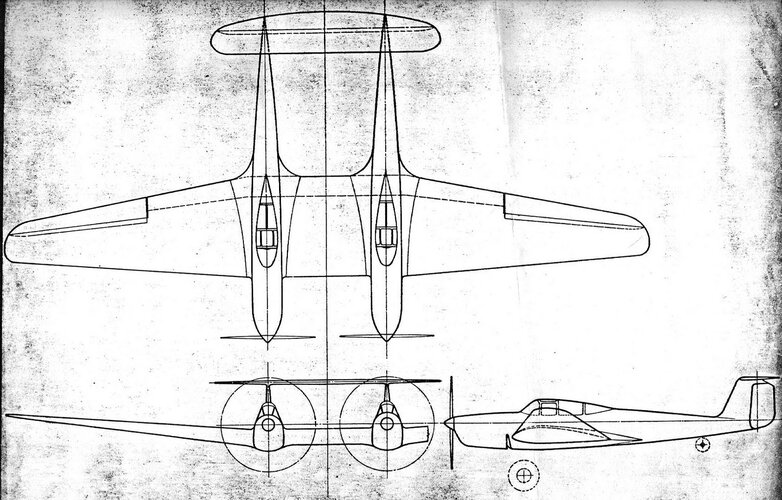
"Lowell Ford, the plans wizard from California, sent us the attached original drawings done by Edgar Schmued, the head designer at North American who designed the P-51 and the XP-82.

Back in 1941, he came up with the concept of a twin-fuselaged Mustang and when the president of NAA saw these drawings on his table, he said in no uncertain terms, " his job was to design on the P-51 and get rid of those drawings." Edgar put them in his top left drawer of his desk and, three years later, when Gen. Hap Arnold, the head of the USAAF, came to NAA inquiring about building a two-fuselaged, multi-engine fighter that could fly with the B-29s’ high-cruise speed, he pulled the drawings out, showed them to Gen. Arnold and was told to build two prototypes ASAP. And, the rest is history."
schmeud early twin fuselage.jpg

 
"Lowell Ford, the plans wizard from California, sent us the attached original drawings done by Edgar Schmued, the head designer at North American who designed the P-51 and the XP-82.

Back in 1941, he came up with the concept of a twin-fuselaged Mustang and when the president of NAA saw these drawings on his table, he said in no uncertain terms, " his job was to design on the P-51 and get rid of those drawings." Edgar put them in his top left drawer of his desk and, three years later, when Gen. Hap Arnold, the head of the USAAF, came to NAA inquiring about building a two-fuselaged, multi-engine fighter that could fly with the B-29s’ high-cruise speed, he pulled the drawings out, showed them to Gen. Arnold and was told to build two prototypes ASAP. And, the rest is history."
View attachment 726313

These were probably circa 1939 with distinct similarity to P-500 w/Ranger engines. I'll ask Lowell about this.
 
I talked to Lowell and sent him a screen shot.. he's scratching is head trying to remember the time period but agrees it looks like a P-500 derivative.
Picked up your P-51B book and read it all the way thru on my family vacation last week. Kudos to both of you on a most excellent book! I really appreciate the way you tied the timelines together for the Mustang, Lightning and Thunderbolt along with the Bf109 and Fw190. Don't recall reading that anywhere else, at least in that detail, and it really helped me understand when and how we finally got proper escort coverage deep into Germany.

Elsewhere in this thread, it is implied there will be a Volume II. If so, what will you cover - D and H development?

Thanks again, great book!! Mark
 
Last edited:
Picked up your P-51B book and read it all the way thru on my family vacation last week. Kudos to both of you on a most excellent book! I really appreciate the way you tied the timelines together for the Mustang, Lightning and Thunderbolt and the 109 and Fw190. Don't recall reading that anywhere else, at least in that detail. and it really helped me understand when and how we finally got proper escort coverage deep into Germany.

Elsewhere in this thread, it is implied there will be a Volume II. If so, what will you cover - D and H development?

Thanks again, great book!! Mark
Thank you Mark. I'm deep into Lightweight Mustangs, but extensive coverage on the parallel development of the D, and ultimately why neither F or G went into production, leading to the H.
 
Both of these videos are showing (for me at least) as disabled by the video owner.

A few Youtube links lately have either come up like this or are blocked (at least in the UK). Folks should really be aware of this problem - no point posting videos if nobody can see them....
Read that block note again. You can watch the video just fine, you just have to go directly to YT to watch it so the video owner gets the ad revenue.


For those of you who have drgondog's and Lowell Ford's book on the P-51B Mustang (covered NAA's origins, and development of the Allison and Merlin Mustangs prior to the Normandy Landings), there are photos of 20mm and 37mm cannon armed mock ups for the P-51 and A-36. The 37mm and 20mm were ground strafing weapons for the A-36 and 20mm were for air to air for the P-51. Four of each guns were intended to be carried (though the A-36 could have 2 20mm and 2 37mm as well).
Quad 37mm guns for ground attack would be wicked! Are they in the wings, or is it specified?

I don't think that the mixed load would be good, the two cannons have very different trajectories. (See also the complaints about the P39's gun mix.) It'd also make a scary interceptor fit in the Merlin Mustangs. Maybe drop to only 2x 37mm in the wings of one of the lightweight versions?

And now I have a desire to write up a what-if with A-36 Apaches in North Africa strafing tank formations with quad 37mm guns... When Stukas or Hurricanes only had 2 guns. Need to read Rudel's memoir first, though.
 
Nice pics, thanks.

Several preliminary pursuit designs were studied under USAAF project MX-176. Among them was a little-known proposal that Hughes Aircraft should build a P-51 look-alike from duramold, and fit it with an Allison V-1710 engine. Apparently, P-51 design data was sent from North American to Hughes, but it is unknown how much work was actually done. Does anyone know more about this project?
I was just about to ask this question. I'm currently reading U.S. Experimental & Prototype Aircraft Projects: Fighters, 1939-1945 by Bill Norton. I just finished the section on Hughes projects and I was also wondering about MX-176 myself. Fortunately your old post saves me from starting a whole thread!
 
I was just about to ask this question. I'm currently reading U.S. Experimental & Prototype Aircraft Projects: Fighters, 1939-1945 by Bill Norton. I just finished the section on Hughes projects and I was also wondering about MX-176 myself. Fortunately your old post saves me from starting a whole thread!
Talking about Duramold, here's a video on the process in detail

 
From Mustange, the Story of P-51 Fighter
 

Attachments

  • 20.png
    20.png
    1 MB · Views: 67
That's an A-36 Apache (the Allison engine P-51) used for ground support.
The image was a P-51-NA prior to conversion for Recon.

The A-36 Apache myth was spawned probably by Squadron/Signal. The A-36 Mustang was the NAA designation, along with all other future P-51 variants and formalized with USAAF Public Relations Office after 13 July 942 following a letter from Kindelberger..

The NAA Proposal for Low Altitude Pursuit, before A-36 Mustang Dive Bomber contained various armament proposals including 2 and 4 gun 20mm as well as a variety of 37mm/20mm and mixed 50 cal/20mm bateries.

The only Mustang delivered with 20mm was the NA-91 Mustang IA/P-51-NA.

Various 20mm installations were proposed, including NA--110/P-51D-5 for Australian license, NA-117 P-51H before the fuselage tank requirement was imposed to attain minimum range. The XP-51F/G/J and NA-117 H were ultimately not purchased because AAF needed long rang escort much more than Super Spitfire interceptors. In all examples the British and Australians preferred 20mm battery but the AAF Production Division at Wright Field rejected all recommendations.

O'Leary has image of Hispano installation in the NA-117 P-51H mockup, but the NA-126 P-51H was never proposed with anything other than 50 caliber M2's
 
I want to use and give appropriate credit for this image in my new Lightweight Mustang book. It was sent long ago by a friend who named NARA as the source.

Can anyone confirm the source of this drawing?

Regards,

Bill Marshall


View attachment 781282
I believe it was first published here:

603.jpg
 
If you or someone else has a copy of that issue, it may well be written in the article who did it. I will try to see if I still have a copy here.
 
@drgondog Bill - Correction: The image in question was first published in Air Enthusiast magazine, Issue n°101, September/October 2002 as part of an article Unknown North Americans by Jared Zichek. Jared also did the drawing. Perhaps you and @jzichek can communicate directly via PM.
 
Last edited:
@drgondog Bill - Correction: The image in question was first published in Air Enthusiast magazine, Issue n°101, September/October 2002 as part of an article Unknown North Americans by Jared Zichek. Jared also did the drawing. Perhaps you and @jzichek can communicate directly via PM.
I PM'd Jared a couple of days ago with no response so far. Is anyone in direct contact with him that could reach out on my behalf?
 
What was the reason for the improvement of range from P-51 to P-82?
Has anyone info on the fuel capacity?

I guess
- less drag because one wing tip and two stabiliser tips less per Merlin (less tip vortices)
- three less machineguns per Merlin (weight saving)
- saving some weight on the main undercarriage (though I guess the remaining legs and tires had to be strengthened and thus became heavier)
- possibly a big fuel tank in the inner wing
- only one radio needed at two Merlins
 
Last edited:
What was the reason for the improvement of range from P-51 to P-82?
Has anyone info on the fuel capacity?

I guess
- less drag because one wing tip and two stabiliser tips less per Merlin (less tip vortices)
- three less machineguns per Merlin (weight saving)
- saving some weight on the main undercarriage (though I guess the remaining legs and tires had to be strengthened and thus became heavier)
- possibly a big fuel tank in the inner wing
- only one radio needed at two Merlins
One helluva lot of fuel combined with relatively low drag - very low for twin engine.

IIRC 600 gal internal fuel. 400 w/heavy external stores load (2x1000 pound bombs plus six HVAR plus 2x110gal tanks)

I think Betty Jo had max of 600gal internal 2x 165 plus 2x300 gal external for the NY to Hawaii flight.
 
I talked to Lowell and sent him a screen shot.. he's scratching is head trying to remember the time period but agrees it looks like a P-500 derivative.
Warbirds International April 2013 says the following;
As far back as the mid-1930s, Edgar Schmeud, NAA's chief design engineer, had made pencil sketches of a twin-engine fighter and put them away in his top desk drawer. At the time, he was attempting to create a series of low-cost aircraft that could be a trainer, fighter, and twin-fuselage fighter. Schmeud and one of his designer buddies were hoping to create a new company to build these machines but the time was not right. Dutch Kindelberger, President of NAA, had chastised Edgar for the time spent on an unauthorized design project and told him if he was working on other projects then he would have to sever his NAA employment, so Schmued had taken the drawings home.
And from Lowell Ford; http://bald-eagles.org/from-the-archives/xp-82.html
It was late in 1939, NAA was a beehive of activity as events in Europe began to overheat. As James H. Kindelberger walked past Chief Designer Edgar Shmued’s drafting table he noticed a design he had not been aware of or authorized. It was a low wing twin fuselage airplane designed around two Ranger air cooled engines. Kindelberger approached Schmued regarding the design and strongly suggested that unless he wanted to seek new employment, he should remove the twin fuselage design from his board and stick with approved projects at hand.

Ed followed the advice of his boss and took the drawing home with him where he allotted time to improve the design as best he could. The demands of the wartime effort weighed heavily on any spare time to be devoted to his pet twin fuselage project. It seemed that the design would never find an opening for use in aviation history.
 
Back
Top Bottom