D

Deleted member 29851

Guest
Navweaps (which I’m sure we’re all familiar with) lists something called the Mk-47 torpedo. It says the program was terminated in favor the Mk 48, so it probably ended sometime around the Mk 48 began development (1970). Furthermore, my 14th Edition of Ships and Aircraft of the US Fleet (1986) lists something called the “Anti-Surface Warfare a Torpedo beint developed as a cheap way of killing surface vessels. Does anyone know anything about these torpedoes?
 

Attachments

  • BDBCCF7C-3610-41F5-BD7D-76A4BF11C581.jpeg
    BDBCCF7C-3610-41F5-BD7D-76A4BF11C581.jpeg
    151.4 KB · Views: 176
  • image.jpg
    image.jpg
    1.9 MB · Views: 187
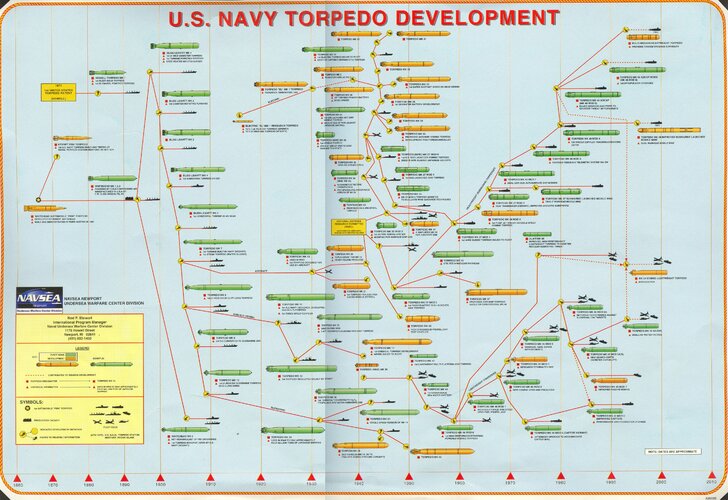
ustorpdev.jpg

There's this chart from Navweaps which suggests it's a Mk 45 development.

Norman Friedman's British Submarines of the Cold War Era mentions British attempts to join an American program for an anti-ship torpedo. I'll dig it out later and write up any details.

A Brief History of US Navy Torpedo Development doesn't mention anything more than what you have already posted here.
 
Found the relevant sections of Friedman.

The US Navy began a programme called SLAST (Submarine-Launched Anti-Ship Torpedo) or EX-13 which was to replace the cancelled Mk 47 (EX-12). In 1963 the Royal Navy sought to participate in the development of this torpedo, and in 1965, offered to design the pump-jet for the new weapon.

Initially the US decided to go with an approach offered by the Bureau of Naval Weapons, using EX-10 (Mk 48) technology, with the weapon being expected to enter service in 1970 if production began before the end of Operational Evaluation.

It was expected that torpedo would have a range of 15,000 yards at 45 knots, travelling at a depth of 50ft to reduce the wake, with provision for a 60 knot burst. Terminal homing would be passive, and the warhead would be 500lbs of PBX. The British observed that this was just EX-12 (Mk 47) with a pump-jet propulsor. The US issued a Advanced Development Objective in March 1965, but refused to describe it as an urgent program. In 1966 funding to EX-13 was cut, and the program was refocused on general torpedo development, with the program eventually being cancelled in April 1967.

 
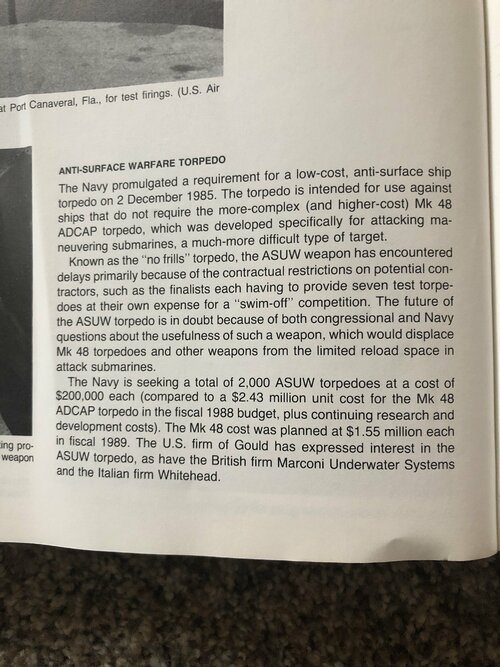
I recently bought a copy of Combat Fleets of the World, but the 1988-1989 edition. Found a brief tidbit on the late-80s "Anti-Surface Warfare Torpedo". The following attachment is the relevant section. Based on what it says, the thing seems like a piece of junk. The old Mark 8 WW1-era torpedo had a longer range. Glad we continued buying Mk 48s instead. Also, am I correct to interpret that 34 torpedoes were authorized but none were produced?

https://cdn.discordapp.com/attachments/925185127217266719/967183984012451870/IMG_4176.jpg
Also, this has been floating around on a Discord I'm in. It interests me greatly.

https://cdn.discordapp.com/attachments/925185127217266719/966811463798886530/unknown.png
Does anyone know anything else about it? I asked a friend, who asked his friend, and he said it was canceled pretty quickly, which makes sense with the 1989 Revolutions.
 
I recently bought a copy of Combat Fleets of the World, but the 1988-1989 edition. Found a brief tidbit on the late-80s "Anti-Surface Warfare Torpedo". The following attachment is the relevant section. Based on what it says, the thing seems like a piece of junk. The old Mark 8 WW1-era torpedo had a longer range. Glad we continued buying Mk 48s instead. Also, am I correct to interpret that 34 torpedoes were authorized but none were produced?

https://cdn.discordapp.com/attachments/925185127217266719/967183984012451870/IMG_4176.jpg
Also, this has been floating around on a Discord I'm in. It interests me greatly.

https://cdn.discordapp.com/attachments/925185127217266719/966811463798886530/unknown.png
Does anyone know anything else about it? I asked a friend, who asked his friend, and he said it was canceled pretty quickly, which makes sense with the 1989 Revolutions.

Surface Torpedo came and went very quickly. I think it may have been related to some other efforts to increase the magazine depth of the LA class -- judging from the proposed weapons (Mk 37 without the wire spool, a shortened Tigerfish, and the Italian A184) the unspoken goal may have been to stow two weapons in place of one Mk 48 and its associated wire spool. Gould also proposed a half-length Mk 48 around the same time, speaking to the same problem.
 
No reverse depth charges for subs to use against ships above either?
 
Last edited:

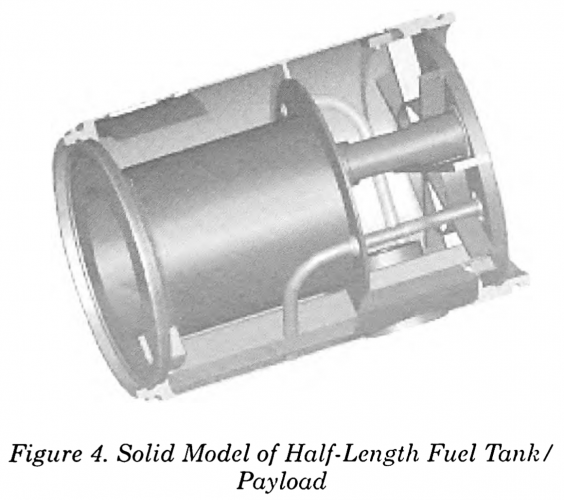
The September 1998 Naval Undersea Warfare Center Division Newport Technical Digest has some information on the shortened Mk 48 Multi-Mission Heavyweight Torpedo, including mention of integrating a Mk 46 warhead and 250lb fuel capacity into a single section 30.5 inches long.

Screenshot_20251109-224102.png
 

Attachments

  • Naval Undersea Warfare Center Division Newport Technical Digest September 1998.pdf
    15.4 MB · Views: 22
View attachment 667052

There's this chart from Navweaps which suggests it's a Mk 45 development.

Norman Friedman's British Submarines of the Cold War Era mentions British attempts to join an American program for an anti-ship torpedo. I'll dig it out later and write up any details.

A Brief History of US Navy Torpedo Development doesn't mention anything more than what you have already posted here.
Mk45? The nuclear torp?

I mean, it was electrically powered. But it was unguided, so they'd need some flavor of seeker developed. More technically, it was externally guided and controlled via wire.


Found the relevant sections of Friedman.

The US Navy began a programme called SLAST (Submarine-Launched Anti-Ship Torpedo) or EX-13 which was to replace the cancelled Mk 47 (EX-12). In 1963 the Royal Navy sought to participate in the development of this torpedo, and in 1965, offered to design the pump-jet for the new weapon.

Initially the US decided to go with an approach offered by the Bureau of Naval Weapons, using EX-10 (Mk 48) technology, with the weapon being expected to enter service in 1970 if production began before the end of Operational Evaluation.

It was expected that torpedo would have a range of 15,000 yards at 45 knots, travelling at a depth of 50ft to reduce the wake, with provision for a 60 knot burst. Terminal homing would be passive, and the warhead would be 500lbs of PBX. The British observed that this was just EX-12 (Mk 47) with a pump-jet propulsor. The US issued a Advanced Development Objective in March 1965, but refused to describe it as an urgent program. In 1966 funding to EX-13 was cut, and the program was refocused on general torpedo development, with the program eventually being cancelled in April 1967.
Is that with the Mk48 engine?

The Mk45 could do 40 knots on electrical power.


Surface Torpedo came and went very quickly. I think it may have been related to some other efforts to increase the magazine depth of the LA class -- judging from the proposed weapons (Mk 37 without the wire spool, a shortened Tigerfish, and the Italian A184) the unspoken goal may have been to stow two weapons in place of one Mk 48 and its associated wire spool. Gould also proposed a half-length Mk 48 around the same time, speaking to the same problem.
That's still a really good idea.


The September 1998 Naval Undersea Warfare Center Division Newport Technical Digest has some information on the shortened Mk 48 Multi-Mission Heavyweight Torpedo, including mention of integrating a Mk 46 warhead and 250lb fuel capacity into a single section 30.5 inches long.

View attachment 790971
That doesn't make sense, a Mk46 only has a 100lb charge of boom. You want about twice that much to crack a ship's keel.

Navy Women Can [Fornicate] Anything (mnemonic for the parts of a Mk48):
Nose - holds the seeker and guidance computer​
Warhead - self explanatory​
Center body - I think the engine is here.​
Fuel tank - also self explanatory​
Afterbody - tapering section down to the propulsor​
So, in the Mk48 parts bin version, it just has the Nose, this new Warhead/Fuel Tank, Centerbody, and Afterbody?
 
That doesn't make sense, a Mk46 only has a 100lb charge of boom. You want about twice that much to crack a ship's keel.

Given the date (late 1990s), I expect it intended more for killing diesel-electric submarines in the littorals, whilst also increasing magazine depth.
 
Given the date (late 1990s), I expect it intended more for killing diesel-electric submarines in the littorals, whilst also increasing magazine depth.
I would think that the cost and practical advantages of using common parts and maintenance procedures outweighed any advantages of a bespoke and optimized design. Moreover, I suspect that the primary threats to a very large submarines operating in littoral waters in support of a special forces mission are small surface patrol boats. The Russians operate dedicated anti-diver boats in all/most/some of their naval ports, which serves only as a generic example of the type of threat a rogue state might pose to a special forces operation.

Even if it’s expensive in terms of the Mk48 parts, a Mk46 “business end” might prove entirely adequate for the threats envisioned. It also would raise less of an alarm if a patrol boat was sunken at a harbor mouth by a small underwater “pop.” Moreover, the safety of proven components and systems would be a greater selling point than an optimized and cheaper battery powered solution that might cause a fire in a torpedo room.
 
Oddly enough, it’s the fourth warship lost to a submarine torpedo since WWII, if you count the INS Kukri in 1971, ARA General Belgrano in 1982 and ROKS Cheonan in 2010. It looks like a video from an optronic mast but considering modern optics and digital cropping, the distance might be a lot farther away than any previously published periscope photo. You can see the glowing white thermal signature of the internal exhaust trunks where the hull broke in two, apparently right in the middle of the diesel room.
 
I'm surprised the Mk-48 didn't go for a midships kill breaking the frigate in half.
 
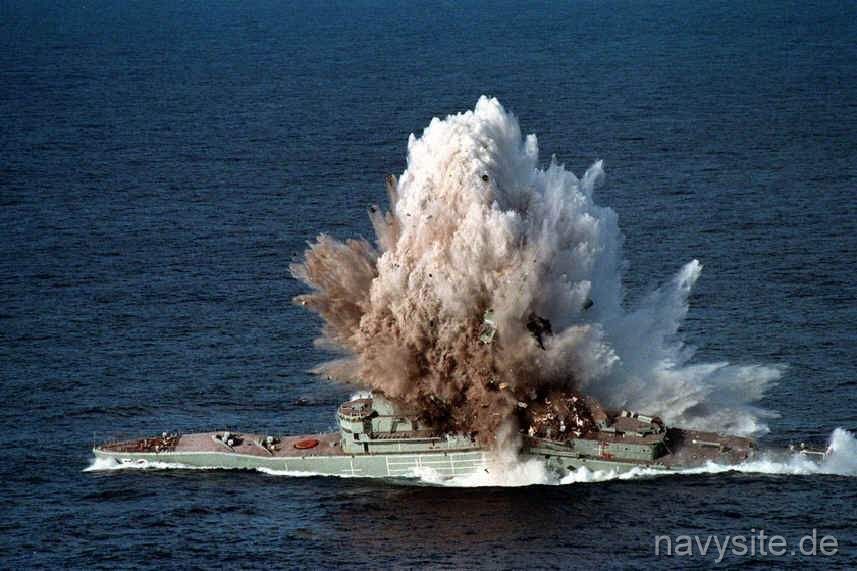
It probably looked something like this:

mk48ex3.jpg


but it seems to have gotten hit in the stern. I'd say that was a major pain in the ass... :D
 
That was the traditional submariner "death from below (and behind)", vulgarly known as "surprise butts*x"


I would think that the cost and practical advantages of using common parts and maintenance procedures outweighed any advantages of a bespoke and optimized design. Moreover, I suspect that the primary threats to a very large submarines operating in littoral waters in support of a special forces mission are small surface patrol boats. The Russians operate dedicated anti-diver boats in all/most/some of their naval ports, which serves only as a generic example of the type of threat a rogue state might pose to a special forces operation.

Even if it’s expensive in terms of the Mk48 parts, a Mk46 “business end” might prove entirely adequate for the threats envisioned. It also would raise less of an alarm if a patrol boat was sunken at a harbor mouth by a small underwater “pop.” Moreover, the safety of proven components and systems would be a greater selling point than an optimized and cheaper battery powered solution that might cause a fire in a torpedo room.
Honestly, that is the exact situation that IDAS was developed for. And you get at least 4 of the those per torpedo stow, maybe 8 since the IDAS missile is only 2.8m long while a Mk48 ADCAP is 5.8m long. Downside is that IDAS breaches the surface, so it's painfully obvious that a submarine is at work and now attempting to run away.
 
Looking at the video, I'd wager most of the bodies they found at sea were the guys who were on the helicopter deck when the ship was hit. Looks like they were yeeted at least twenty to thirty meters into the air before coming down again.
Survivors were probably the guys in the forward superstructure, and everyone else missing went down with her.

Helluva blast.
 
Looks like they were yeeted at least twenty to thirty meters into the air before coming down again

Judging by the periscope footage the aft 100ft of the stern was shattered by the explosion with the rear most 50ft blasted right up into the air by about 50ft, so anybody on deck an inside those stern compartments would've been killed instantly by the concussion and/or direct blast effects.

Survivors were probably the guys in the forward superstructure

That's what I'm thinking too.

everyone else missing went down with her

Very likely, I have no doubt that the engineering crew present in the engine-room and decks directly above that compartment would've also been killed instantly by the blast.
 
Last edited:

Similar threads

Back
Top Bottom