
You are using an out of date browser. It may not display this or other websites correctly.
You should upgrade or use an alternative browser.
You should upgrade or use an alternative browser.
80's British air-launched missile projects?
- Thread starter Supertom
- Start date


red admiral
ACCESS: Top Secret
- Joined
- 16 September 2006
- Messages
- 2,199
- Reaction score
- 3,472
There were a couple of variants of Sea Eagle and the ALARM and SRARM anti-radiation missiles.

- Joined
- 2 January 2006
- Messages
- 670
- Reaction score
- 362
From the Skomer site of Chris Gibson
TASM Tactical Air-to-Surface Missile. To SR (A) 1244. WE.177 replacement. Cancelled 1993. R = 373miles
Documentation shows that previous interest in the US SRAM, ALCM projects together with French ASMP. Seen something about an Anglo/French project to do an Extended range ASMP under the guise of TASM.
Note that the Stormshadow program stipulated a none Nuclear warhead in line with the withdrawal of all tactical nuclear weapons.
G
TASM Tactical Air-to-Surface Missile. To SR (A) 1244. WE.177 replacement. Cancelled 1993. R = 373miles
Documentation shows that previous interest in the US SRAM, ALCM projects together with French ASMP. Seen something about an Anglo/French project to do an Extended range ASMP under the guise of TASM.
Note that the Stormshadow program stipulated a none Nuclear warhead in line with the withdrawal of all tactical nuclear weapons.
G

Grey Havoc
ACCESS: USAP
- Joined
- 9 October 2009
- Messages
- 24,500
- Reaction score
- 18,175
Skyflash, "Taildog" through SRAAM which eventually led to ASRAAM.
Some background on Taildog/SRAAM, though incomplete:
https://en.wikipedia.org/wiki/SRAAM
Grey Havoc
ACCESS: USAP
- Joined
- 9 October 2009
- Messages
- 24,500
- Reaction score
- 18,175
A bit of background on TASM:
https://www.forecastinternational.com/archive/disp_old_pdf.cfm?ARC_ID=1103
https://www.forecastinternational.com/archive/disp_old_pdf.cfm?ARC_ID=1103
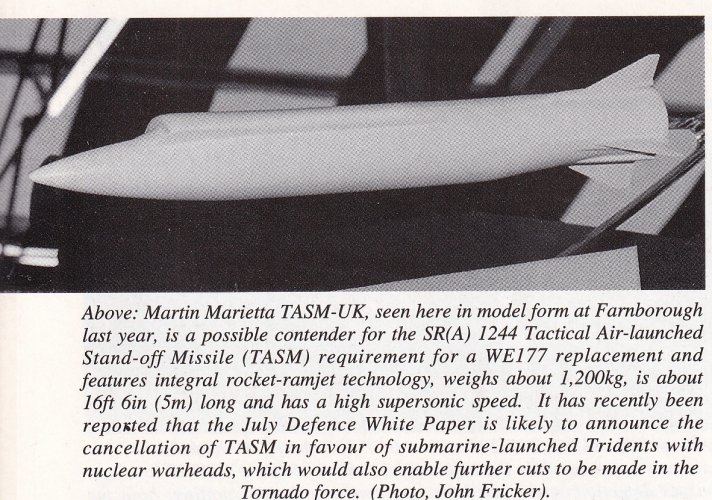
TASM/US. Britain was evaluating a Martin Marietta system under a Memorandum of Understanding (MoU) signed in December 1989. Martin Marietta, which was teamed with British Aerospace/Hunting Engineering, was expected to offer a nuclear missile using integral rocket ramjet technology developed under its AQM-127 Supersonic Low Altitude Target (SLAT) and Advanced Strategic Air-Launched Missile (ASALM) programs. The ASALM effort was a US Air Force program aimed at providing an extremely long-range air-to-air missile for strategic aircraft (such as the B-1). The AQM-127A SLAT was a supersonic target drone being developed for the US Navy's low-altitude anti-ship missile simulator need. However, both these efforts were canceled prior to the start of production. Martin Marietta would have supplied parts to British Aerospace for final assembly and guidance system integration, with Hunting Engineering supplying nuclear warhead interface and perhaps contin-uing as part of the weapon integration team.
TASM/France. A cooperative ASLP program had also been under discussion between France and the United Kingdom for almost four years. The new system would have a range of between 800 kilometers and 1,000 kilometers, as compared to the 150 kilometers of the in-service ASMP. For additional information please see the separate ASMP/ASLP report.
Last edited:
Grey Havoc
ACCESS: USAP
- Joined
- 9 October 2009
- Messages
- 24,500
- Reaction score
- 18,175
I should have mentioned the fact that Boeing also tried for the requirement with the AGM-131B SRAM-T (Tactical) missile, but that more or less fell by the wayside when Bush senior foolishly cancelled the overall SRAM II program in 1991.

- Joined
- 1 April 2006
- Messages
- 12,285
- Reaction score
- 15,112
from Air International May'93
New Weapons Sought
The widely-discussed question of a 270nm (500km) range TASM (tactical air-launched stand-off missile) successor to the WEI 77 free falling nuclear weapon for the Tornado's continuing sub-strategic roles remains to be resolved at ministerial level. However, Archie Hamilton, the Minister of State for the Armed Forces, has indicated that WEI 77 is likely to remain in the RAF inventory until at least "well into the first decade of the next century". Even so, work is already reported to have started on the required nuclear warhead at the Atomic Weapons Establishment at Aldermaston under the MoD's SR(A) 1244 requirement for a WE177 successor and several potential stand-off delivery systems are being evaluated. These are thought to include the Aerospatiale ASLP, Boeing Aerospace SRAM-T (although its SRAM-2 predecessor has been cancelled), and Martin Marietta TASM-UK with an integral rocket/ramjet, in conjunction with BAe Defence and Hunting Engineering. The T ASM requirement is now being reviewed by the government, but an early decision seems unlikely. So far as non-nuclear air-launched weapons are concerned, the need to avoid overflying heavily-defended targets for their delivery, demonstrated by RAF Tornado and other Allied aircraft losses during the Gulf War, has given additional impetus to the SR(A) 1236 requirement, otherwise known as CASOM (Conventionally Armed Stand-Off Missile) programme. Evaluations are being made of some 14 jet-powered stand-off precision attack weapons able to deliver a 2,000lb (910kg) unitary warhead, about.half originating in the US, including the General Dynamics Tomahawk/Airhawk; a Lockheed tri-service AGM-137 derivative; Loral Vought's ALCAM based on the 73nm (135km) range ATACMS; McDonnell Douglas upgraded AGM-84E; the Rockwell Extended-Range AGM-130E with a Williams P8300 turbofan; and proposals from Brunswick Defense (ITALD) and Texas Instruments (JSOW). Other possible CASOM contenders include Rafael's 54nm (100km) range AGM-142 Have Nap or Popeye; a joint DASA/Hunting/Bofors KEPD250 submission based on the MBB DWS39 glide-dispenser but with a turbofan engine, an improved navigation and tracking system, and a penetrative warhead; a version of the Aerospatiale ASMP, known as ASMP C, with a HE instead of a nuclear warhead, and a 160nm (300km) range; and a projected development of the BAeD Sea Eagle, known as Golden Eagle, with a new kinetic-energy penetrator or tandem-charge warhead, and a range of more than 54nm (100km). The future of other BAe private venture stand-off weapon projects with possible CASOM applications, notably REVISE and MANTIS, now appears doubtful. After finalisation of a cardinal-points specification, the MoD is expected to invite CASOM requests for proposals later this year. There is still strong RAF interest in implementation of the long- · standing SR(A) 1238 requirement for new anti-armour munitions to replace the Hunting BL 755 cluster-bomb system, although the emphasis has shifted since the Gulf War towards greater stand-off and all-altitude capability. Prior to the suspension of the SR(A) 1238 programme through Treasury restrictions in 1990, work had been started by Hunting on the SWAARM (Smart Weapon AntiArmour) glide-bomb dispenser system for 16 sub-munitions with millimetre wave (MMW)/infra-red seeker heads, and by Marconi Defence Systems on Brimstone, a MMW development of the Rockwell AGM-114 Hellfire. With the revival of MoD interest in SR(A) 1238 since the Gulf War, Hunting is proposing an upgraded SW AARM 2 based on MBB's stub-winged Dispenser Weapon System being developed for the SAAB JAS 39 Gripen, carrying 16 Alliant Techsystems parachute-retarded SADARM sub-munitions, employing MMW/IR terminal guidance. As a second string to its SR(A) 1238 bow, Hunting has also joined with Thorn EMI Electronics for their SWATHE smart weapon anti-armour proposal, which combines the BL755 dispenser with four MLRS Phase 3-derived MMW-guided sub-munitions. GEC Marconi Dynamics is still offering the 5.4nm (10km) range Brimstone for the same requirement, for which BAe has discussed with Hercules in the US an MMW-seeker variant of the AGM-65 Maverick, although Hughes reportedly has its own plans for a similar submission. Alenia's Skyshark and Textron's Sensor-Fused Weapon dispenser systems are other possible contenders. Some of these weapons are also being offered for the Army Air Corps' Air Staff Target 428 attack helicopter requirement, for which invitations to tender were recently issued by the MoD for response by November. Other conventional RAF weapons for w_hich requirements are outstanding are SR(A) 1242 and 1243 for laser-guided and autonomous guided bombs for all-altitude delivery. While the Gulf conflict dramatically demonstrated the greatly enhanced accuracy, and therefore cost-effectiveness, of laser-guided bombs, it also showed the desirability of having heavier ordnance available than the RAF's standard 1,000lb (454kg) free fall Mk 13/18 HE weapon for hardened targets. Possible contenders include the Elbit Opher, GEC Marconi Al Hakim, MATRA Arcole, and Texas Instruments Paveway III. BAe Dynamics could possibly revive its 1980s Bushcat studies for laser-guidance and perhaps rocket-booster kits for standard RAF ordnance, although these would now need to be expanded from their original focus on low-level release.
Attachments
Last edited:
- Joined
- 15 July 2007
- Messages
- 5,740
- Reaction score
- 6,324
Interesting....Even so, work is already reported to have started on the required nuclear warhead at the Atomic Weapons Establishment at Aldermaston under the MoD's SR(A) 1244 requirement for a WE177 successor

- Joined
- 16 April 2008
- Messages
- 10,603
- Reaction score
- 18,181
There was Active Skyflash.
Not a cruise missile, which is what the OP asked about.
- Joined
- 5 May 2007
- Messages
- 2,019
- Reaction score
- 4,281
That was TD.127, which was to have been a UK physics package but incorporating some subsystems and electronics from the US W91.Interesting....
Production was projected to take place from 1998 to 2001 after three proof tests (March 1995, September 1996 and September 1997).
It wouldn't fit in the ASLP, and the ASALM-derived Lockheed/Hunting TIRRM would be a UK-only (read: cost and risk) project. So when SRAM-T for the USAF died, it was largely a dead project walking.
Similar threads
-
 British A/S Torpedo-Carrying Missiles
- Started by Hood
- Replies: 0
-
 Kramer X-4 Air-To-Air Missile
- Started by red admiral
- Replies: 160
-
Active Skyflash/Rb 71A/Rb 91, Rb 73 drawings?
- Started by Rdn4
- Replies: 11
-

-
Request for info on Soviet 'M-61 supersonic cruise missile' please??
- Started by Pioneer
- Replies: 2