I'd advise ignoring the title, that's only referring to the very last paragraph, the rest of this has some interesting thoughts on the Su-57's export potential - OTOH it is from RAND, so certain biases can be assumed.
RAND biased!?! Surely you jest Sir! Why they are the most circumspect of experts. Just ask the USAF Inc.
 
The question from Rand is actually quite legit, and it would be fair to say that 5.5G is a more accurate classification of the plane. When the "first iteration" NGAD (i.e. F-22 refreshment) comes online we can talk further about the topic
 
5.5?!!
But is it at least Stealth?
No (most airframe don't have coating)
Sorry I forgot "stealth" is not a technical parameter based on some analog RCS magnitude given in dBsm for a given frequency, polarization and aspect, but a BOOLEAN buzzword as in TRUE (anything US MIC produces) and FALSE (anything that Russia clumsily attempts). I think we saw already in the dedicated thread the depth of the Western claims in this regard, and I also think it is better not go further down that path here.

BTW, some key features of NGAD to be considered: speed, payload, range. Now think about the caveats that apply to the "European version" of it, and let me know if considering those two aspects together does not ring a bell for you.
 
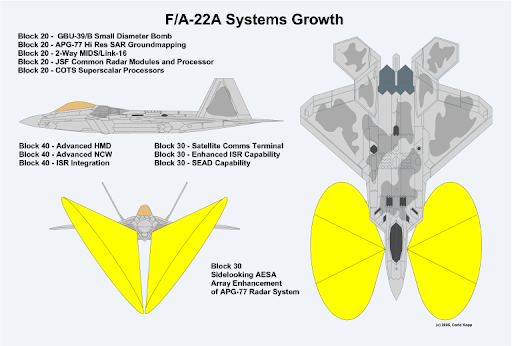
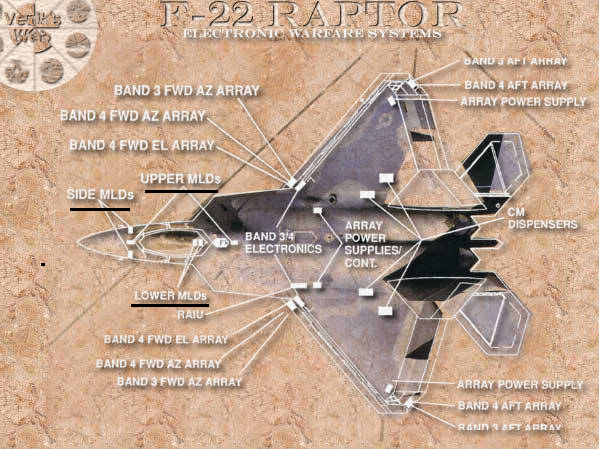
F-22 have only single radar array in X-band, while T-50 have five to eight radar arrays in both X-band and L-band. F-22 have no dedicated active ECM suite and relies only on main radar array for very limited ECM, while T-50 have dedicated ECM suite which utilizes both radar arrays and its own arrays, plus full coverage by DIRCM system. F-22 relies solely on main radar for search and track and have no passive SaT capability, while T-50 have dedicated IRST station plus wide array of IR and UV sensors for 360 degree passive coverage for search and track. F-22 is limited in both AA and AG work, being unable to carry LRAAMs and most of guided air to ground ordnance, which limits its usage as multirole. T-50 has both wider array of AA options, including LRAAMs, and wider array of AG options, including ARMs, CMs and AShMs.

Based on all that, glorified Me states that T-50 is six gen when compared to widely accepted fifth gen of F-22.
 
F-22 have no dedicated active ECM suite and relies only on main radar array for very limited ECM, while T-50 have dedicated ECM suite which utilizes both radar arrays and its own arrays, plus full coverage by DIRCM system. F-22 relies solely on main radar for search and track and have no passive SaT capability, while T-50 have dedicated IRST station plus wide array of IR and UV sensors for 360 degree passive coverage for search and track. F-22 is limited in both AA and AG work, being unable to carry LRAAMs and most of guided air to ground ordnance, which limits its usage as multirole. T-50 has both wider array of AA options, including LRAAMs, and wider array of AG options, including ARMs, CMs and AShMs.
Sorry I meant it as a joke from the directed negativity of what gen aircraft it is by comparing their aircrafts to the U.S. to calm them down. Might as well throw a comparison in from what the Su-57 has with the F-22.

1626674793499.png
1626674875901.png
I have heard that for MAWS the F-22 is both infrared and UV. And KRET and RTI stated 10-15 years or 5-10 years somewhere in their articles(don't want to relook depressing information) cant remember which of the 2 have said which, announced they are behind in MMIC technology so I will say 10 years behind in AESA radar technology. Meaning if the F-22 received that 4th gen radar in 2007 the Su-57 if still using MMICs, has better upgraded their radars somewhere in 2017 or afterwards. 2009 is quite old for their existing radars hence I am assuming project megapolis by new avionics they mean new radars for 2022-2024.

The F-22 could have been further upgraded to be like the Su-57 but the F-35 came later or as other users before suggested to me more expensive to implement. If the U.S. did go with the F-22 upgrade plan they might have maybe called it a 5.5 gen. The only thing I don't like is how this aircraft was treated during hurricane season in Florida, they have to respect beauty and dedication more.

I didn't mention the IRST because some say addition to RCS and the others give a minimal RCS exception for a further view. Example: F-22 with IRST is .0005 one without it is .0001 but the IRST capability makes one F-22 see the other F-22 better before that F-22 can spot that one with radar, etc, etc.
 
Last edited:
F-22 have only single radar array in X-band, while T-50 have five to eight radar arrays in both X-band and L-band. F-22 have no dedicated active ECM suite and relies only on main radar array for very limited ECM, while T-50 have dedicated ECM suite which utilizes both radar arrays and its own arrays, plus full coverage by DIRCM system. F-22 relies solely on main radar for search and track and have no passive SaT capability, while T-50 have dedicated IRST station plus wide array of IR and UV sensors for 360 degree passive coverage for search and track. F-22 is limited in both AA and AG work, being unable to carry LRAAMs and most of guided air to ground ordnance, which limits its usage as multirole. T-50 has both wider array of AA options, including LRAAMs, and wider array of AG options, including ARMs, CMs and AShMs.

Based on all that, glorified Me states that T-50 is six gen when compared to widely accepted fifth gen of F-22.
Plus even more problematic issues like fixed intakes, small bays, small fuel fraction, no advanced lift augmentation devices, huge fixed tails and thirsty heavy engines. Compared to PAK-FA's stealthy fully adjustable intakes, huge oversizing of airflow, likely 2 stream VCE izd. 30 with 18 t thrust, TWR 13, highest specific thrust, big fuel tanks and huge deep weapon bays, supermaneuverability, all moving keels, LEVCONS... 5.5G is a modest assessment.
 
F-22 have only single radar array in X-band, while T-50 have five to eight radar arrays in both X-band and L-band. F-22 have no dedicated active ECM suite and relies only on main radar array for very limited ECM, while T-50 have dedicated ECM suite which utilizes both radar arrays and its own arrays, plus full coverage by DIRCM system. F-22 relies solely on main radar for search and track and have no passive SaT capability, while T-50 have dedicated IRST station plus wide array of IR and UV sensors for 360 degree passive coverage for search and track. F-22 is limited in both AA and AG work, being unable to carry LRAAMs and most of guided air to ground ordnance, which limits its usage as multirole. T-50 has both wider array of AA options, including LRAAMs, and wider array of AG options, including ARMs, CMs and AShMs.

Based on all that, glorified Me states that T-50 is six gen when compared to widely accepted fifth gen of F-22.
Plus even more problematic issues like fixed intakes, small bays, small fuel fraction, no advanced lift augmentation devices, huge fixed tails and thirsty heavy engines. Compared to PAK-FA's stealthy fully adjustable intakes, huge oversizing of airflow, likely 2 stream VCE izd. 30 with 18 t thrust, TWR 13, highest specific thrust, big fuel tanks and huge deep weapon bays, supermaneuverability, all moving keels, LEVCONS... 5.5G is a modest assessment.

If you're going down this path, then the significant issue is not aerodynamics, engines or systems, but systems integration to give full sensor fusion. We know the F-35's sensor fusion supposedly blows pilots away, we've seen very little on where Su-57 stands in comparison.
 
F-22 have only single radar array in X-band, while T-50 have five to eight radar arrays in both X-band and L-band. F-22 have no dedicated active ECM suite and relies only on main radar array for very limited ECM, while T-50 have dedicated ECM suite which utilizes both radar arrays and its own arrays, plus full coverage by DIRCM system. F-22 relies solely on main radar for search and track and have no passive SaT capability, while T-50 have dedicated IRST station plus wide array of IR and UV sensors for 360 degree passive coverage for search and track. F-22 is limited in both AA and AG work, being unable to carry LRAAMs and most of guided air to ground ordnance, which limits its usage as multirole. T-50 has both wider array of AA options, including LRAAMs, and wider array of AG options, including ARMs, CMs and AShMs.

Based on all that, glorified Me states that T-50 is six gen when compared to widely accepted fifth gen of F-22.
Plus even more problematic issues like fixed intakes, small bays, small fuel fraction, no advanced lift augmentation devices, huge fixed tails and thirsty heavy engines. Compared to PAK-FA's stealthy fully adjustable intakes, huge oversizing of airflow, likely 2 stream VCE izd. 30 with 18 t thrust, TWR 13, highest specific thrust, big fuel tanks and huge deep weapon bays, supermaneuverability, all moving keels, LEVCONS... 5.5G is a modest assessment.

If you're going down this path, then the significant issue is not aerodynamics, engines or systems, but systems integration to give full sensor fusion. We know the F-35's sensor fusion supposedly blows pilots away, we've seen very little on where Su-57 stands in comparison.
All i know is that F-35 pilots from Norwegian Airforce say the wonder Helmet fits better for powerpoint representations..
 
F-22 have only single radar array in X-band, while T-50 have five to eight radar arrays in both X-band and L-band. F-22 have no dedicated active ECM suite and relies only on main radar array for very limited ECM, while T-50 have dedicated ECM suite which utilizes both radar arrays and its own arrays, plus full coverage by DIRCM system. F-22 relies solely on main radar for search and track and have no passive SaT capability, while T-50 have dedicated IRST station plus wide array of IR and UV sensors for 360 degree passive coverage for search and track. F-22 is limited in both AA and AG work, being unable to carry LRAAMs and most of guided air to ground ordnance, which limits its usage as multirole. T-50 has both wider array of AA options, including LRAAMs, and wider array of AG options, including ARMs, CMs and AShMs.

Based on all that, glorified Me states that T-50 is six gen when compared to widely accepted fifth gen of F-22.
Plus even more problematic issues like fixed intakes, small bays, small fuel fraction, no advanced lift augmentation devices, huge fixed tails and thirsty heavy engines. Compared to PAK-FA's stealthy fully adjustable intakes, huge oversizing of airflow, likely 2 stream VCE izd. 30 with 18 t thrust, TWR 13, highest specific thrust, big fuel tanks and huge deep weapon bays, supermaneuverability, all moving keels, LEVCONS... 5.5G is a modest assessment.

If you're going down this path, then the significant issue is not aerodynamics, engines or systems, but systems integration to give full sensor fusion. We know the F-35's sensor fusion supposedly blows pilots away, we've seen very little on where Su-57 stands in comparison.
All i know is that F-35 pilots from Norwegian Airforce say the wonder Helmet fits better for powerpoint representations..
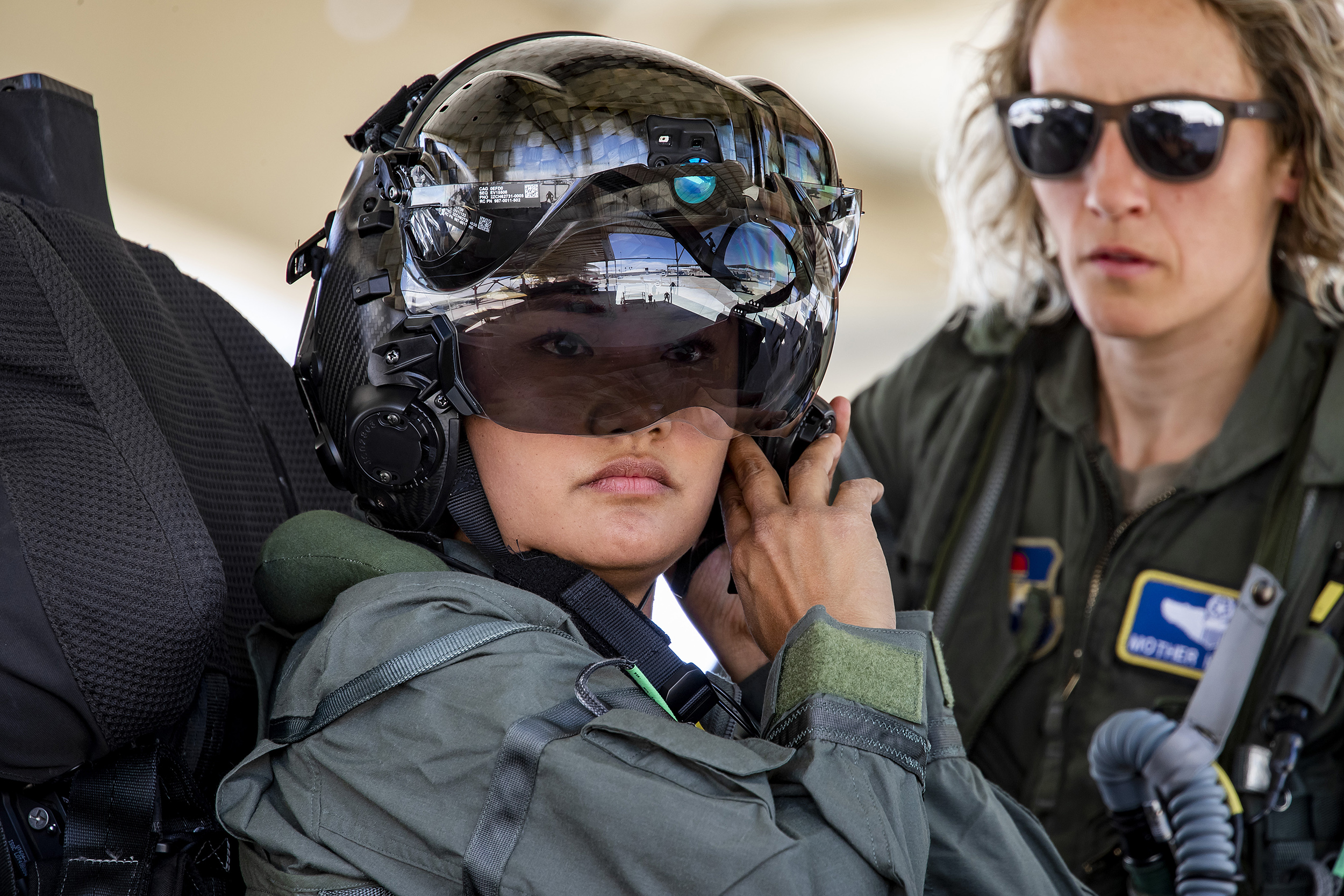
I don't know for you, but to me PowerPoint just became terrific:
B33I9067.JPG
 
If you're going down this path, then the significant issue is not aerodynamics, engines or systems, but systems integration to give full sensor fusion. We know the F-35's sensor fusion supposedly blows pilots away, we've seen very little on where Su-57 stands in comparison.
You can stuff an old airframe with new avionics and upgrade that part (this is routine around mid-life of any platform), but you cannot avoid its fundamental kinematic and physical limitations that way. That is why this fake dichotomy between SA and kinematics is nothing but brainless sales chatter, having SA does not impede you having a good airframe, too, and you can bet your last cent your enemies will do exactly that. The fact that F-22 does not receive a thorough mid-life avionics upgrade as any other fighter before should make you wary that everything is ok with it, airframe wise. Of course the F-22 has significant limitations, and that is the reason why NGAD goes the path it does and that we hear about flying prototypes already. I am not even making things up, this is your own USAF leadership saying so. Airframe wise, the F-22 is surpassed in every aspect by the Su-57. But US side prefers to focus on stealth, which is not possible to assess seriously from the outside unless in very obvious cases, in which PAK-FA does not belong.

I don't know for you, but to me PowerPoint just became terrific:
That looks sci-fi gear, I am sure they price it accordingly? xD

haavarla said:
A decent Cobra at 04:40
Decent? That was 160 deg at least ;)
 
Last edited:
Communication and navigation systems for the Su-57 fighter will be presented at MAKS-2021

Also, visitors to the air show will be able to get acquainted with the S-108 communication and data exchange complex from the Su-35 multipurpose super-maneuverable fighter, with an on-board communication complex based on integrated modular avionics technology

MOSCOW, July 19. / TASS /. The Ruselectronics holding of the Rostec state corporation will show at the MAKS-2021 airshow communication, navigation and identification systems for the Russian fifth-generation fighter Su-57. This was reported to journalists in the press service of Ruselectronics.

In particular, NPP Polet (part of Ruselectronics) will demonstrate at MAKS-2021 the S-111 communications system from the Su-57 fifth-generation multipurpose fighter. "The equipment provides telephone radio communication and aircraft data exchange with other aircraft for various purposes, as well as with ground, air and surface control points. The equipment uses the latest high-speed information transfer technology and uses advanced network solutions," the holding said.

In addition, the newest development of NPP "Polet" will be presented - the unified system of communication, data exchange, navigation and identification (OSNOD). "Currently, the OSNOD system terminals are installed on the Su-57, Su-30SM aircraft, the modernized Su-27, Su-34, Su-35S and on the export version of the Su-35, on the Il-76 of various modifications, the Il-112V, and also on modernized long-range aircraft - Tu-95, Tu-160. In addition, ground control points and communication centers are equipped with the OSNOD system, "Ruselectronics said.

Also, visitors to the air show will be able to familiarize themselves with the S-108 communication and data exchange complex from the Su-35 multipurpose super-maneuverable fighter. The complex provides noise-immune closed data and voice information exchange over the air-to-air and air-to-ground lines.

In addition, an onboard communications complex based on integrated modular avionics technology will be demonstrated. Due to the open architecture, modular construction principle and the use of standardized data exchange protocols, the functionality of the complex can be supplemented and modernized without significant costs. In addition, the equipment can be installed on a variety of media.

https://tass.ru/armiya-i-opk/11935661
 
Wanted to know more their latest communication equipment like the OSNOD which was talked about before but not in too much details on how it was better improved in data exchange.
 
If you're going down this path, then the significant issue is not aerodynamics, engines or systems, but systems integration to give full sensor fusion. We know the F-35's sensor fusion supposedly blows pilots away, we've seen very little on where Su-57 stands in comparison.
You can stuff an old airframe with new avionics and upgrade that part (this is routine around mid-life of any platform), but you cannot avoid its fundamental kinematic and physical limitations that way. That is why this fake dichotomy between SA and kinematics is nothing but brainless sales chatter,

If your victory is dependent on your airframe kinematics, you're doing it wrong, because that implies you're seeking out a "fair fight", when that's precisely the thing you should be avoiding. If you aren't cheating you aren't trying hard enough. And sensor fusion is a major step towards getting the information necessary to do that, and to get inside your opponents OODA loop. Hell, Ogarkov's Military Technological Revolution is a Russian idea, not an American one, though the US grabbed it with both hands as the Revolution in Military Affairs.

(The idea of stuffing an old airframe full of new avionics isn't as simple as you seem to think. And that's for any old airframe, a stealth airframe makes it massively more difficult).

F-22 does not receive a thorough mid-life avionics upgrade as any other fighter before should make you wary that everything is ok with it, airframe wise.

It's pretty clear from the avionics perspective that F-22's avionics architecture is problematical and the issue isn't the airframe (other than their only being 200 of them) but that F-22 doesn't datalink into networked warfare particularly well.

this is your own USAF leadership saying so.

My USAF leadership? I think you're mistaking me for American.
 
F-22 have only single radar array in X-band, while T-50 have five to eight radar arrays in both X-band and L-band. F-22 have no dedicated active ECM suite and relies only on main radar array for very limited ECM, while T-50 have dedicated ECM suite which utilizes both radar arrays and its own arrays, plus full coverage by DIRCM system. F-22 relies solely on main radar for search and track and have no passive SaT capability, while T-50 have dedicated IRST station plus wide array of IR and UV sensors for 360 degree passive coverage for search and track. F-22 is limited in both AA and AG work, being unable to carry LRAAMs and most of guided air to ground ordnance, which limits its usage as multirole. T-50 has both wider array of AA options, including LRAAMs, and wider array of AG options, including ARMs, CMs and AShMs.

Based on all that, glorified Me states that T-50 is six gen when compared to widely accepted fifth gen of F-22.
Plus even more problematic issues like fixed intakes, small bays, small fuel fraction, no advanced lift augmentation devices, huge fixed tails and thirsty heavy engines. Compared to PAK-FA's stealthy fully adjustable intakes, huge oversizing of airflow, likely 2 stream VCE izd. 30 with 18 t thrust, TWR 13, highest specific thrust, big fuel tanks and huge deep weapon bays, supermaneuverability, all moving keels, LEVCONS... 5.5G is a modest assessment.

LOL
 
Well its that time of every 2nd year, in which some people goes all out :mad:o_O:p
Some love it, some outright hate it.

Sinse Russia now is a red country in the Covid Pandemic map, it must affect the Air salon pretty badly.
Cudos for them trying to put on a good show!
 
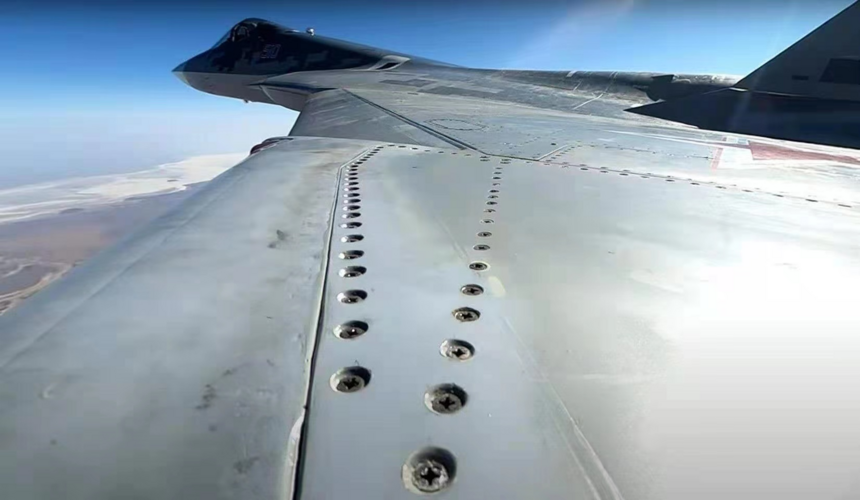
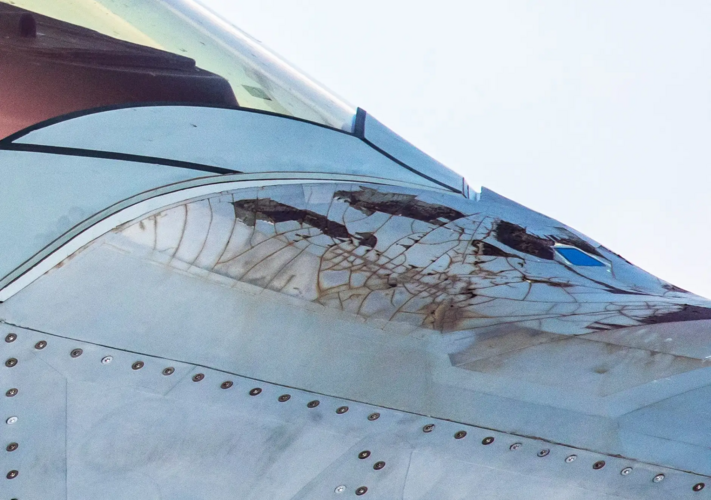
The F-22 has some nice rivets exposed with cracked RAM.
Thing is that there is no point to bother about the rivets, skin quality and RAM on both: be it an F-22 of USAF demo-team(which is depicted on that photo) or T-50 flight prototype #510.

BTW, not so long time ago someone already posted here the difference in skin and coating between the #510 prototype and #01 production airframe.
 
This thread's content seems more appropriate for https://www.russiadefence.net/ than Secret Projects
The F-22 has some nice rivets exposed with cracked RAM.

View attachment 661025
I guess they have alot in common thanks for pointing that out. In case you get lost again. https://www.secretprojects.co.uk/th...l-stealth-discussion.36240/page-3#post-431289
Unfortunately that's what happens when a plane has been operational for over a decade and a half.
 
The F-22 has some nice rivets exposed with cracked RAM.
Thing is that there is no point to bother about the rivets, skin quality and RAM on both: be it an F-22 of USAF demo-team(which is depicted on that photo) or T-50 flight prototype #510.

BTW, not so long time ago someone already posted here the difference in skin and coating between the #510 prototype and #01 production airframe.
Exactly. Eighter people have very short memory, or they never actually read the stuff being posted here, only interesting in running a sh!tshow..

Anyway, the show must go on.
Do you think they get to sign more orders on Su-34 or Su-35S?
 
The F-22 has some nice rivets exposed with cracked RAM.
Thing is that there is no point to bother about the rivets, skin quality and RAM on both: be it an F-22 of USAF demo-team(which is depicted on that photo) or T-50 flight prototype #510.

BTW, not so long time ago someone already posted here the difference in skin and coating between the #510 prototype and #01 production airframe.
Exactly. Eighter people have very short memory, or they never actually read the stuff being posted here, only interesting in running a sh!tshow..

Anyway, the show must go on.
Do you think they get to sign more orders on Su-34 or Su-35S?
Su-34M must happen soon. Su-35 might be in not great numbers to not excessively occupy KNAAZ workforce, but we'll see.
 
Do you think they get to sign more orders on Su-34 or Su-35S?
Su-34M - highly probably...albeit i'm not a fan of it.
Su-35S - not sure we need it. Would be better to fully focus KnAAZ on Su-57 production increase.
 
The premise of arguing that the Su-57 is a half generation over the F-22 assumes many of the Su-57’s attributes from the “Megalopolis” upgrade program, which hasn’t even finished development
Everything mentioned by me is present on current production model.
No source has ever stated that the izdeliye 30 engine is variable cycle.
It kinda known it isn't. Some people just refuse to settle with this.
 
Except for stealth, which is a core requirement of being defined as a 5th gen fighter.
The mods here were smart enough to create a children's corner to discuss that kind of topic at the Su-57 stealth thread. You find all relevant opinions and data (or rather "data") there. No need to spoil this thread too, please.
If your victory is dependent on your airframe kinematics, you're doing it wrong, because that implies you're seeking out a "fair fight", when that's precisely the thing you should be avoiding. If you aren't cheating you aren't trying hard enough. And sensor fusion is a major step towards getting the information necessary to do that, and to get inside your opponents OODA loop. Hell, Ogarkov's Military Technological Revolution is a Russian idea, not an American one, though the US grabbed it with both hands as the Revolution in Military Affairs.

(The idea of stuffing an old airframe full of new avionics isn't as simple as you seem to think. And that's for any old airframe, a stealth airframe makes it massively more difficult).
When someone speaks about kinematics and good old physics, the Western reaction is to assume that means they are disregarding SA somehow. Since this is not what I have said, you may want to reconsider your reasoning.
 
Except for stealth, which is a core requirement of being defined as a 5th gen fighter.
The mods here were smart enough to create a children's corner to discuss that kind of topic at the Su-57 stealth thread. You find all relevant opinions and data (or rather "data") there. No need to spoil this thread too, please.
If your victory is dependent on your airframe kinematics, you're doing it wrong, because that implies you're seeking out a "fair fight", when that's precisely the thing you should be avoiding. If you aren't cheating you aren't trying hard enough. And sensor fusion is a major step towards getting the information necessary to do that, and to get inside your opponents OODA loop. Hell, Ogarkov's Military Technological Revolution is a Russian idea, not an American one, though the US grabbed it with both hands as the Revolution in Military Affairs.

(The idea of stuffing an old airframe full of new avionics isn't as simple as you seem to think. And that's for any old airframe, a stealth airframe makes it massively more difficult).
When someone speaks about kinematics and good old physics, the Western reaction is to assume that means they are disregarding SA somehow. Since this is not what I have said, you may want to reconsider your reasoning.

What if I'm looking for the new physical principles, since that what it seems like you're evaluating aircrafts based on.
 
In spite of the limitations of the F-22, I’m rather amused by those touting the superiority of the Su-57 as 5.5 generation or even better. The premise of arguing that the Su-57 is a half generation over the F-22 assumes many of the Su-57’s attributes from the “Megalopolis” upgrade program, which hasn’t even finished development. The izdeliye 30 engines being an example. Some of the claims put forth are also purely speculative. No source has ever stated that the izdeliye 30 engine is variable cycle. The airframe design of the Su-57 represent a different set of requirements, with range and payload being higher priority compared to the F-22.

Some of the points listed also seem like advertising talking points. Fixed inlet? “Advanced lift augmentation devices?” So what? I frankly don’t even see a tangible benefit of the former; the latter is pretty marginal.

In any case, the debate over a comprehensive MLU of the F-22 within USAF stems more from economy of scale rather than the physical limitation of the airframe itself. Perhaps the F-22’s airframe doesn’t have the potential to reach what USAF is looking for in the NGAD, but it’s quite presumptuous to somehow equate this as an example of the Su-57’s superiority; whose to say the Su-57 can meet NGAD requirements any better?

Before simply handwaving away the differences in stealth between the two aircraft, industry sources that I’ve spoken with have alluded to the Su-57’s LO design lacking features for the S-band, in contrast to the F-22. Certainly this would be a limitation for maritime strike.
That was a good post at least

I think the reasoning is pretty straightforward. The airframe of the Su-57 is intrinsically superior in range, payload, propulsion and has more resources for maneouverability. The engine part of it was what depends on Megapolis, but by now, 10 years on after the development of izd. 30 started and roughly one year away from state tests beginning, we know enough and the risk is low enough to start talking with some basis about it. The values I am giving are founded in statements by the designer, not in internet sources. I am the first sceptic, but after many instances of the same data I consider them solid enough not to be lightly dismissed.

Is izd. 30 a VCE? I said likely, because of a series of reasons. If you have a better explanation of how a fixed BPR engine can have at the same time higher specific thrust than F119 and the fuel consumption of the AL-31F, I am all ears, really. In the end, what is more difficult, to develop a VCE, or to create a fixed bypass engine with equivalent performance? BTW, the core of izd. 30 is currently being used for the development of the three stream engine that they consider 6G (izd. 30 is considered 5.5G by the manufacturer)

You don't see a tangible advantage of variable intakes at high speeds, or do you think such speeds are not relevant? Why does NGAD need speed among its main features, then? What is to be expected from a second stage Su-57, with higher specific thrust engines and 30% bigger intakes than F-22, in regards of supercruising? As to the payload and range features. F-22 is considered outdated and lacking on them, but Su-57, which has them plus quite superior propulsive arguments, is (widely, maybe not by you) considered 4.5G. That is BS of the highest order.

Do you think a lift augmentation feature like the LEVCONS is of no use, does it not help trimming the plane in supersonic and keeping the airflow attached at high AoA? This, as almost anything in the Su-57, was designed to match or surpass the F-22, designing to be worse from the beginning and coming late is simply a non workable strategy.

The issue with what is X gen is that US makes the claim, makes the narrative and declares who is entitled to carry the title. If you want that privilege to remain unchallenged granting those attributes at will is ok, but if the same features in NGAD define 6G but in Su-57 just 4.5, then I call it self serving and logically weak.

As to the S band features on the Su-57, it may be the case. I think this is a quite difficult topic on many regards and we addressed it in a specific thread for a good reason. I can say though, that modern lower band radars are declared to see US VLO without any problem. So they are also not stealth either, it seems.

trose213 said:
What if I'm looking for the new physical principles, since that what it seems like you're evaluating aircrafts based on.
I have no idea what you are referring to

 
Last edited:
izd. 30 a VCE? I said likely, because of a series of reasons. If you have a better explanation of how a fixed BPR engine can have at the same time higher specific thrust than F119 and the fuel consumption of the AL-31F, I am all ears, really. In the end, what is more difficult, to develop a VCE, or to create a fixed bypass engine with equivalent performance? BTW, the core of izd. 30 is

currently being used for the development of the three stream engine that they consider 6G (izd. 30 is considered 5.5G by the manufacturer)
I think you can increase performance by increasing diameter of Fan and Compressor stages.
 
Again, we’re still talking about the planned Su-57M with proposed capabilities rather than what the current production Su-57 as ordered by the VKS is capable of.

Is izd. 30 a VCE? I said likely, because of a series of reasons. If you have a better explanation of how a fixed BPR engine can have at the same time higher specific thrust than F119 and the fuel consumption of the AL-31F, I am all ears, really. In the end, what is more difficult, to develop a VCE, or to create a fixed bypass engine with equivalent performance? BTW, the core of izd. 30 is currently being used for the development of the three stream engine that they consider 6G (izd. 30 is considered 5.5G by the manufacturer)
That variable bypass offers superior performance on paper is not being debated. I am questioning the assertion that the izdeliye 30 will be variable cycle; I haven’t seen this to be the case, and statements claiming this were usually made by journalists rather than from officials themselves.

You don't see a tangible advantage of variable intakes at high speeds, or do you think such speeds are not relevant? Why does NGAD need speed among its main features, then? What is to be expected from a second stage Su-57, with higher specific thrust engines and 30% bigger intakes than F-22, in regards of supercruising? As to the payload and range features. F-22 is considered outdated and lacking on them, but Su-57, which has them plus quite superior propulsive arguments, is (widely, maybe not by you) considered 4.5G. That is BS of the highest order.
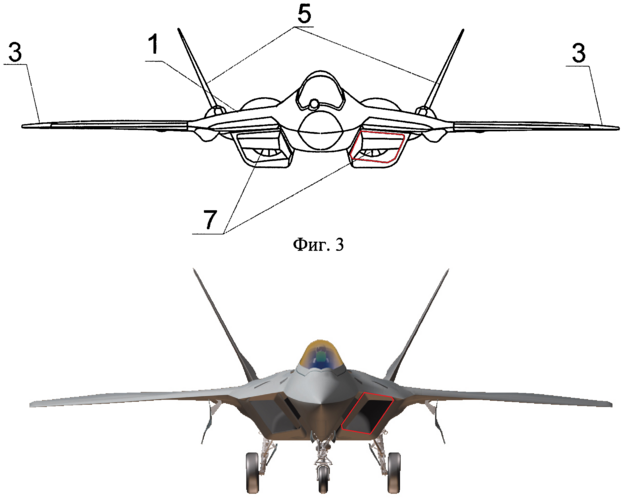
I don’t see much benefit in the Su-57’s operating envelope. The airframe is designed with a maximum speed of about Mach 2, and like the F-22, mainly due to materials rather than drag limitations. A variable inlet’s benefit in this regime is marginal.

30% bigger capture area? Source? In any case, large capture area tends to have little to do with supercruise performance and pertains more to low speed engine performance in order to ensure adequate airflow; large capture area can lead to increased spillage drag, since an engine “consumes” as much air as it needs; this can be mitigated to some extent by the variable ramps.

EDIT: Don't know what you're measuring, but from official views, it's more like around 5% difference, not worth noting considering all the functions that the inlet provides and that the flow field is not necessarily captured by the frontal area. This argument of "oversized" inlets also ignores that the F-15's inlet capture area is smaller than the Su-27's, despite the F-15 using the higher mass flow F110-GE-129 in the EX.

Do you think a lift augmentation feature like the LEVCONS is of no use, does it not help trimming the plane in supersonic and keeping the airflow attached at high AoA? This, as almost anything in the Su-57, was designed to match or surpass the F-22, designing to be worse from the beginning and coming late is simply a non workable strategy.
The Su-57 is meant to meet the Russian Air Force’s requirements; I doubt Sukhoi or the Russian Air Force is looking to overmatch the F-22 stat for stat. Requirements are rarely defined in such a narrow manner, not to mention economic and political factors.
 

Attachments

  • t-50 frontal.png
    t-50 frontal.png
    246.7 KB · Views: 60
Last edited:

Similar threads

Back
Top Bottom