Grey Havoc
ACCESS: USAP
- Joined
- 9 October 2009
- Messages
- 24,500
- Reaction score
- 18,175

Finally build something NATO instead of continuing to talk about requirements in non-binding agreements. Human evolution itself could benefit from the global competition...jeepers

Until the electroids decide that the exceedingly slow carbon based infestation no longer need be tolerated, there will be an undercurrent of necessity for human judgement.Will we go back to UCAR ?

Maritime and land variants should use a common airframe and have a footprint no larger than the NH Industries NH90 or Leonardo Helicopters AW101, including a folding tail and main rotors.

I want to see how they tackle folding the wings and props on a Racer-like configuration!
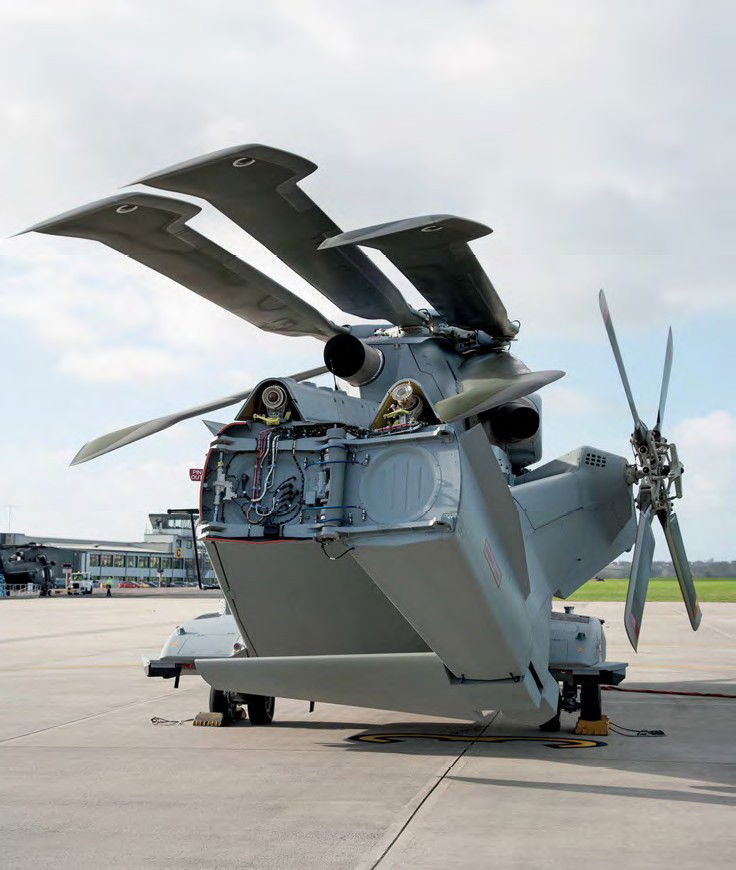


That certainly seems like the most reasonable way to handle things, and I'm sure a CH-53K passes more shaft power through the quick disconnect than what this will require, so it's not outside of the state of the art...I want to see how they tackle folding the wings and props on a Racer-like configuration!
Most likely the same way a tail rotor is folded... ie. via a pair of load bearing hinges with a shaft connector.
There are a couple of papers on the Racer wing structure that show how the wing attaches to the fuselage also via a pair of hinges and a shaft connector... so folding potential may exist.
https://nottingham-repository.worktribe.com/OutputFile/2333212
https://www.dglr.de/publikationen/2020/490227.pdf
The way I see this, you’re eliminating one tail rotor and replacing it with 2 side rotors... net gain of only one rotor. Same with any folding mechanism.Nonetheless, it can't be light, it will come out of payload or range.


I like the first one ability to be optionally manned.Found the NGRC requirements document here:
https://assets.verticalmag.com/wp-content/uploads/2021/05/NGRC_Industry_Day_additional-info.pdf
Required attributes
- Ability to act as an optionally unmanned/remotely piloted vehicle
- Modular Open Systems Approach (MOSA) inclusive of the digital backbone and AI AIDED multi‐sensor fusion, allowing cost effective and simple integration of upgrades and spiral development (including nationally sensitive/proprietary equipment).
- Manoeuvrability & Agility: Level 1 (the pilot is able to achieve all missions including Deck landings, Low Level (NOE) NVD, Formation, within safety and performance standards).
- Availability of >75% on operational/forward fleet for an enduring period (i.e. at least 3 of 4 routinely available every day). A technical-logistic support system based on in-flight data exchange between aircraft and ship or ground station.
- Internal cabin dimensions of at least 2m x 1.6m x 5m facilitating transport of 12- 16 troops in Combat Equipment Marching Order (CEMO) (160kg) or being usable for installation of mission equipment such as ASW
- Affordability: Fly-away cost of no greater than €35M and cost per flight hour optimally €5,000 but no greater than €10,000 (based on 2021 values).
- Load Lifting capacity of >4,000kg (Combined external and internal) and at least 2,500kg of internal cabin payload with Max Fuel/ 80% Max Fuel.
- Range: Must have an unrefuelled range > 900nm (1650km).
- ROA > 400nm with 30 minute loiter time.
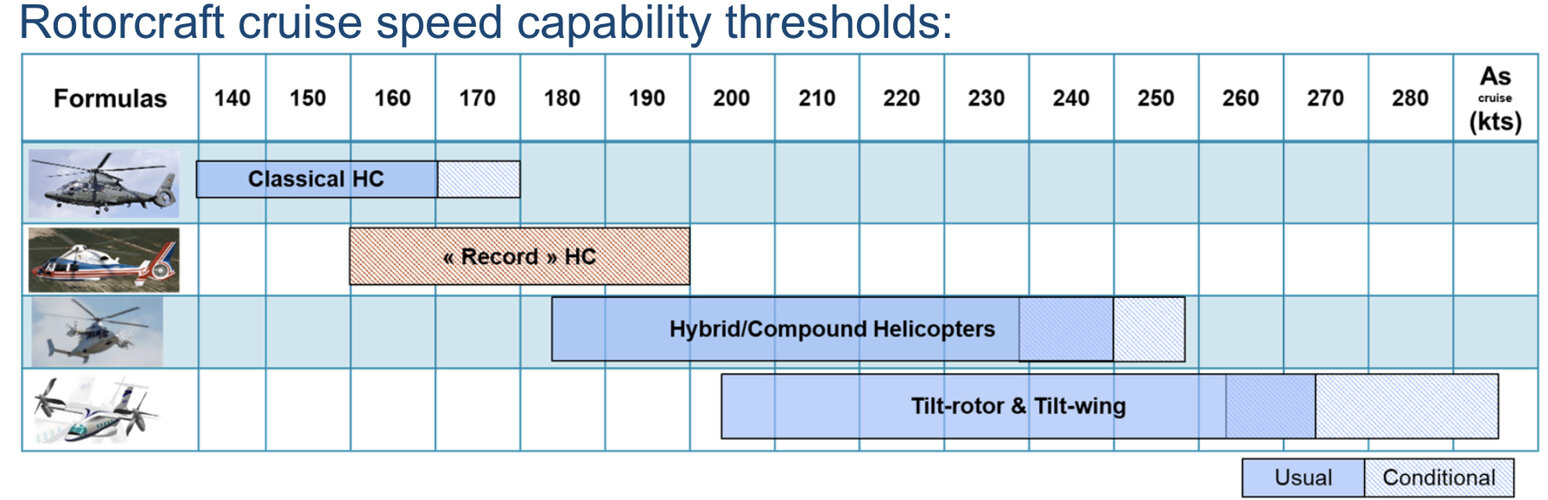
- Cruise airspeed in mission configuration: optimally 220 Kts or more but not less than 180 Kts.
- Ability for rapid reconfiguration of aircraft in accordance with operator’s individual requirements (Special ops, ASuW/ ASW / EW, SAR, PR, MEDEVAC, other).
- Endurance: >5 hrs with crew and payload of >1,000 Kgs. (Target 8 hours endurance with range tanks).
- Maximum mission take-off gross target weight (MAUM) of 10,000 kg - 17,000 kg
- Able to be deployed for medium-long periods (6-9 months) and fully operate from Frigate (FF)/Destroyer (DD) class of vessel, i.e. not larger than the footprint or dimension of either NH-90 (NFH), or AW-101, including the optional capability of folding main rotor/tail to be moved onto ship's elevator/hangar for maritime operations.
- Common airframe to land/air and maritime variants (fully “wet-assembled”), which has to address all land/air and maritime requirements. In case they cannot be addressed, development of separate land/air and maritime variants should be considered.
Desired attributes
- Performance: HOGE 4000ft @(ISA+25° Celsius (95 °F) at MAUM.
- Multiplex fly by light/fly by wire
- Responsiveness: 2 min automated rapid start, full systems at 8 min.
- Mission Equipment incl. Rescue Hoist, cargo sling, Fast Rope, LTES, RTES, FMV Downlink capability, deck lock, surface radar, early warning radar, sonar, tactical data link, deck lock, ballistic protections, Electro-Optical sensor
- Novel/Hybrid Powerplant (3000 SHP+)
- Advanced Teaming of organic and 3rd party assets (included Teaming & Interoperability with unmanned vehicle (MUMT):
capability to manage swarm drone;
capability to launch small (mini-micro) drone (expendable and attritable);
capability to recover small (mini-micro) drone (recoverable)- Air Transportable in a single A400M (or C-17) without the disassembly of major systems.
- Air to Air refuelling capability (as a receiver and optionally a donor)
- Capable of full range of scalable, lethal, and non-lethal effects, including the available hard points and mountings such that msn equipment, ALE, launch tubes/rails and ISTAR hardware can be physically integrated
- Armaments. Improved Crew Served Weapons. Options for rockets, missiles, Air Launched Effects (ALE), and Tactical Off Board Sensors (TOBS).
May not be your point, but an electric tail rotor(s) system. I know it has flown once. Not sure of it status, but Bell engineers seem excited they are on the right path.@coanda Electric motors aren’t ready for primetime… too heavy. Let’s see someone design a working electric tail rotor first, then we can discuss other applications requiring a lot more power.
I must have missed them. Name an in-production aircraft (fixed or rotary wing), or at the very least a commercially viable prototype, with an electric system producing several hundred KW for several hours, and delivering a significant % of the aircraft’s power requirements (say >20%).I disagree. Plenty of electric propulsive systems out there now.@coanda Electric motors aren’t ready for primetime… too heavy. Let’s see someone design a working electric tail rotor first, then we can discuss other applications requiring a lot more power.
A generator driven electric motor is quite capable of doing the job of the shaft driven props.
Testing...
That's where public subsidies should help. Those are there to bear the economical risks and prove (or not) emerging technologies.
https://www.flightglobal.com/helico...tos-next-generation-rotorcraft/148718.article
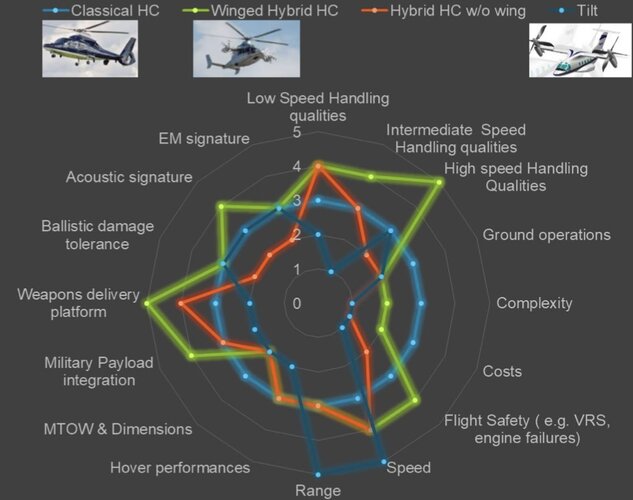
Preliminary design attributes released in 2021 called for a helicopter whose cruise speed should “optimally” be 220kt (407km/h) or more, but no lower than 180kt. Radius of action was pegged at 400nm (740km), maximum range 900nm, and MTOW at between 10-17t.
But Mathieu Louvot, executive vice-president, head of programmes at Airbus Helicopters, says that if operators want to achieve all those performance targets then “physics” will inevitably lead to an aircraft at the upper end of the weight range.
“This leads to 16-17t [MTOW] platforms in order to carry the same type of payloads that the helicopters carry today,” he told journalists at the manufacturer’s headquarters on 18 May. Louvot argues that “much bigger machines” than those they are replacing will be required, leading to “a lot of consequences” on cost, logistics, the footprint of the helicopter, and the level of noise generated.
He estimates it will cost 25-30% more to carry the same payload over a given distance if high-speed is required. Cost concerns could then lead to other attributes being sacrificed in the quest for affordability.
“So it is not obvious that speed is the most important thing and that everything should be sacrificed to it,” says Louvot.
Source? I haven’t seen any public info on the V-280’s weights, except for a single old (2016) article that mentioned a 38,000lb rolling take off. Since then the engines have been uprated and are now the same as the V-22’s which is not a good sign (Defiant-X has seen weight growth too from the 32,000lb demonstrator).The V-280 is half the the empty weight, has 80% the MTOW