BMW Flugelrad III: Opinion on Aeronautics

ArmchairSamurai

ACCESS: Confidential
Joined
1 July 2019
Messages
198
Reaction score
295
Hello all.

After a while of perusing posts on the site, I decided to make my first post. Hopefully, this is the appropriate place to do so.

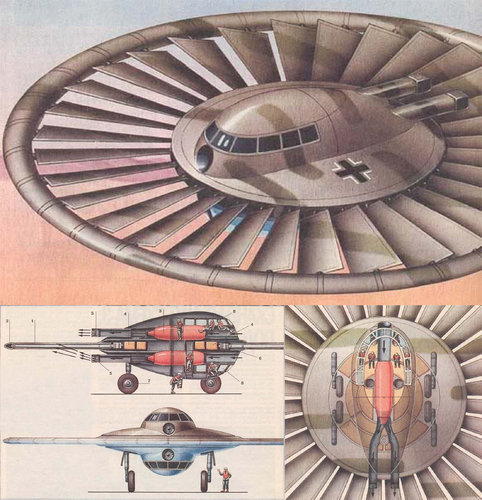
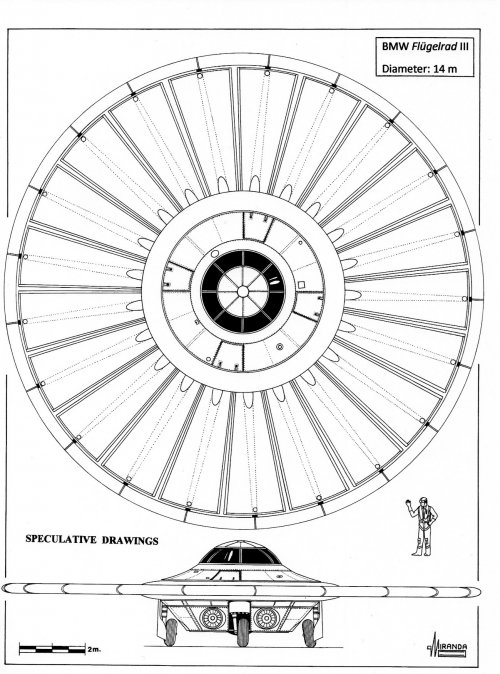
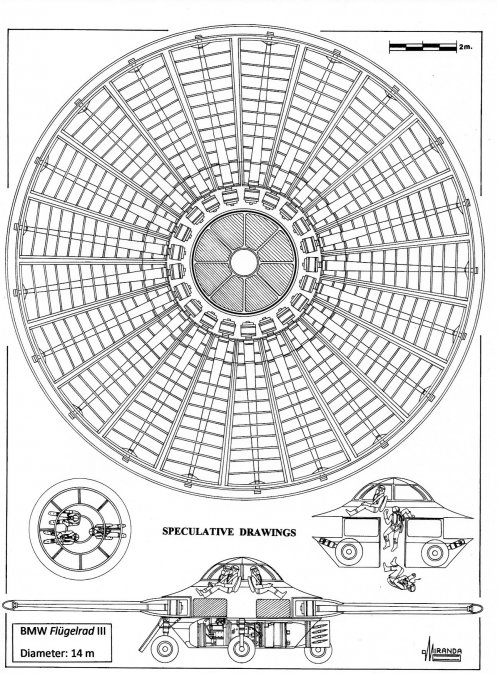
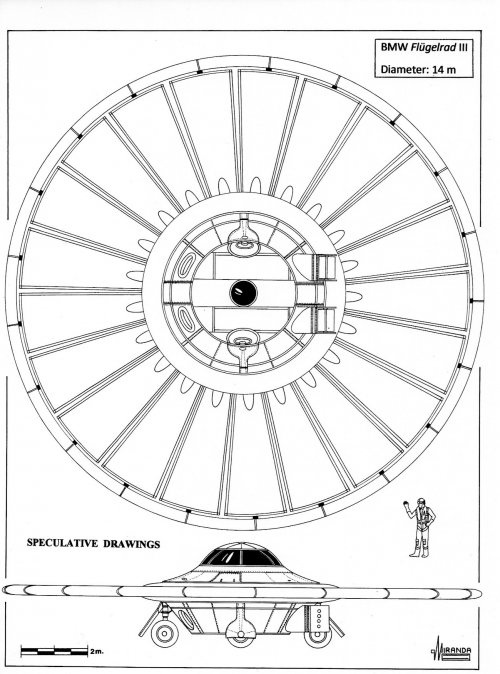
This is more or less, an opinion piece. I figure all of you are already aware the BMW Flugelrad is completely fake (until proven otherwise) yet I am still fascinated by the design. The third variant is what I consider to be most intriguing of all. That being said, do any of you think it is actually capable of flight (why or why not)? I am still learning the principles of flight in regards to aeronautical engineering and thought this would be a fun topic to discuss.


BMW Flugelrad III.jpg
 
Ech, I mean...maybe? The more I look at it the less likely it seems to be able to get off the ground, the sidewalls aren't enough to be a ducted fan and it's got no side skirts. And wait, am I looking at this right, where the propeller-fan-thing is apparently powered by pointing a jet exhaust at it? Because if yes I don't even know where to begin on how the absurdity of that.

Absolute best case, it might get a foot or two off the ground and wobble until it crashes like the Avrocar.
 
Oops. I forgot to include this little snippet I found on the "aircraft". I translated it from a German website, so the English may not make sense.

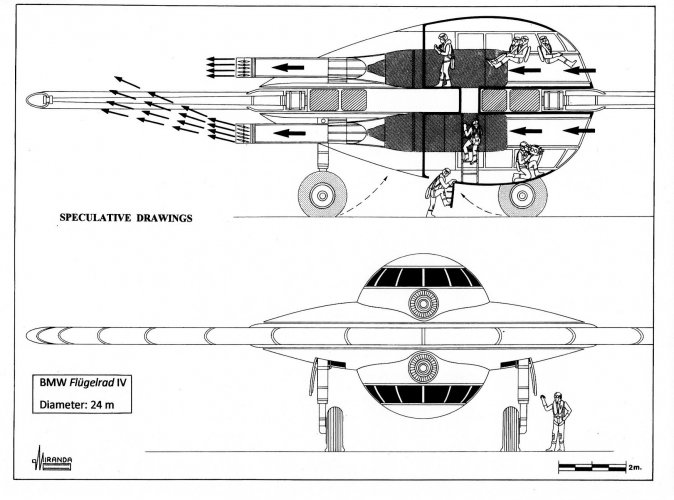
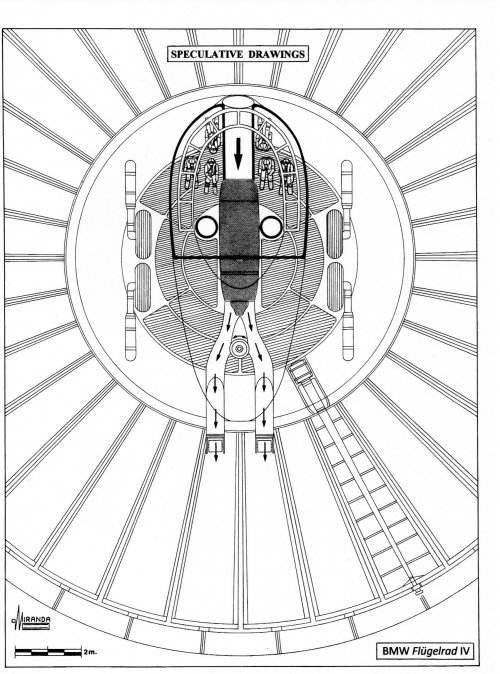
"The BMW v.III was ultimately to become the standard version with a diameter of 24 meters. Two jet engines of the second generation, He S0 11 or BMW 018 with an output of 1300 and 3400 kg respectively, were planned as propulsion. The engines were arranged one above the other and separated by the rotor. The thrust nozzles were divided into two nozzles each, which were equipped with valves and thus allowed every flight maneuver.
- To climb, the power of the lower engine was increased and the thrusters of the upper engine were directed upwards.
- To descend, the power of the upper engine was increased and the thrust nozzle of the lower engine was directed downwards.
- For a left turn the left thrusters had to be closed.
- For a right turn the two right thrusters.
- For a left turn when rolling on the floor, the upper left thrust nozzle was directed upwards and the lower right nozzle downwards.
- For a right turn the same controls only had to be carried out in opposite directions.
- To start, the rotor was accelerated and the two lower thrust nozzles were directed upwards. During level flight, the rotor blades were brought into a zero degree position and acted like a conventional wing."
 
Last edited:
German Flying Saucers Bibliography

- ‘Die Realität der Flugscheiben’ by Andreas Epp, Michaels Vertrieb editor, 2002.

- ‘Flugscheiben-Realität oder Mythos: Gespräche mit dem Flugscheiben-Erfinder’, by Andreas Epp, Michaels Vertrieb editor, 2005.

- ‘Die deutschen Waffen und Geheimwaffen des 2. Weltkrieges und ihre Weiterentwicklung’ by Rudolf Lusar, J. F. Lehmann; Edition: 4., stark überarb. u. erw. Aufl. (1962).

- Epp, Joseph Andreas, ‘U.S. Army Intelligence, Record Group 319, Box 186, File Number GE013347’. The National Archives at College Park, College Park, Maryland. - http://www.archives.gov/iwg/declassified-records/rg-319-army-staff/personal-name-files-new.html

- ‘Evaluation Reports (ER), Final Reports (FR) und Overall Reports der British Intelligence Subcommittee, Reports der Combined Intelligence Objectives Subcommittee (C.I.O.S.) und Field Intelligence Agency (F.I.A.T.)’.

- ‘Hitler’s Flying Saucers: A guide to German Flying Discs of the Second World War’ by Henry Stevens, Adventure Unlimited, 2013.

- ‘Flying Saucer Technology’ by Bill Rose, Midland, 2011.

- ‘Secret Projects- Flying Saucer Aircraft’, by Bill Rose & Tony Buttler, Midland, 2006.

- ‘Jet Planes of the Third Reich-The Secret projects-Volume One’, by Manfred Griehl, Monogram, 1998.

- ‘Secret Weapons of the Third Reich’ by Leslie E. Simon, WE, INC., Publishers, 1971.

- ‘Messerschmitt Me 328 Bordjäger’, by Paul Malmassari, Wingmasters Nº 2.

- ‘Der Fliegende Bierdeckel’, by Arthur Sack, Die Deutsche Sportflieger, November 1939.

- ‘Der Kreisflüger AS6 V1’, by Hans Justus Meier, Luftfahrt International 4/79.

- ‘Aktennotizen und Niederschriftender der ATG-Maschinenbau GmbH.’, Leipzig, von 4.2, 3.2, 17.4 und 18.5, 1944.

- ‘Veröffentlichungen zuden Modellen von Arthur Sack’, Der Flieger 11-12/1940.

- ‘Hochwertige Motorflugmodelle’, Der Deutsche Sportflieger, 9/1940.

- ‘Das Buch der Deutschen Luftfahrttechnik’, Bidteil, Mainz, 1970.

- Der Flieger 4/1944.

- Air International, March 1979.

- ‘Neue formen des Starrflügel-Flugzeuges’, by W. Zuerl, Der Flieger 1/1944.

- ‘Dreikomponentenmessungen an einem Kreisflügel mi zwei klappen’, by E. Hildenbrand, Aerodynamische Versuchsanstalt Göttingen, Beritche Nr.40/14/40 vom 3.8.1940 und 41/14/5 vom 21.2.1941.

- ‘Deutsche Kreisflügelflugzeuge’, Flugzeug Profile Nr.23.

- ‘Fliegender Bierdeckel’, by Volker Koos, Flug Revue 3/1994.

- ‘Kreisflügler Arthur Sack AS6’, by Volker Koos, Flug Revue 11/1998.

- ‘Saucers, Swastikas and Psyops’, by Joseph T. Farrell, Adventures Unlimited, 2011.

- France Soir, June 27, 1952.

- ‘Erste Flugscheibe flog 1945 in Prag enthullt speers beauftragter’, by Georg Klein, Welt am Sonntag, April 25, 1953.

- ‘German Discs: UFO in the Third Reich’, Los Angeles Mirror, 24 March, 1950.

- Dortmund Newspaper, Westphalian Overview, 9 July 1947.

- ‘Deutsche Flugkreisel, Gab’s die?’ Luftfahrt International May/June 1975.

- ‘Projekt Flugkreisel’, by Rudolph Schriever, Bremerhavener Zeit entstanden.

- ‘Untertassen-Flieger Combination’, Der Spiegel, 30 March, 1950.

- ‘Flugkreisel Irdisch’, Helm & Welt Nr.14, 2 April, 1950.

- ‘Fliegende Untertassen’, Die 7 Tage Nr.26, June 1952.

- ‘Fliegende Untertasse’, Farb Illustrierte Nr.18, September 1952.

- ‘Fliegende Untertasse in Deutschland erfunden’, Deutsche Illustrierte, S.1350/51.

- ‘Secret Wings of WWII: Nazi Technology and the Allied Arms Race’, by Lance Cole, Pen & Sword Aviation, 2015.

- ‘Das gab’s die fliegende untertasse der deutschen Luftwaffe’, ZB Illustrierte für menschen in atomzeitalter Nr.25, December 1953.

- ‘Wunderwaffen 1945’, Bild am Sonntag, 17 February, 1957.

- ‘Die UFOs, eine deutsche Erfindung’, Das neue Zeitalter Nr.41, October 1957.

- ‘Deutsche Kreisflügelflugzeuge’, by Hans Justus Meier, Flugzeug 2/89.

- ‘Deutsche Geheimwaffen und Wunderwaffen des II. Weltkrieges’, by Christof Friedrich, Samisdat Publishers, Canada.

- ‘Aeronautical Research in Germany: From Lilienthal until Today’, by Ernst Heinrich Hirschel, Springer 2012.

- Henry Coanda Propelling Device Patents 2,157,281/2,131,472/2,108,653 (10 January 1936).

- ‘Applications of the Coanda Effect’, by Imants Reba, Scientific American, June 1966.

- ‘The Coanda Effect’, by R.S. Sproule and S.T. Robinson. CIOS Reports. File Nº IX (1), 1944.

- ‘The Vanishing Paperclips’ by Hans H. Amtmann, Monogram, 1988.

- ‘Ich flog als erster eine untertasse’, Kristall Nr.2, 1956.

- ‘Intercept but don’t shoot’, by Renato Vesco, Adventures Unlimited Press, 1994.

- ‘Interceptarlos sin disparar’, by Renato Vesco, Ediciones 29, 1968.

- ‘Intercept UFO’, by Renato Vesco, Pinnacle Books, 1976.

- ‘Man-Made UFOS 1944-1994’, by Renato Vesco & David Hatcher, Adventures Unlimited Press, 1994.

- ‘German Secret Weapons of World War 2’, by Rudolph Lusar, (Review by Reuters in the Washington Post, 18 February, 1957.

- ‘German Secret Weapons of World War 2’, by Rudolph Lusar, Neville Spearman, 1959.

- ‘Die Deutschen Waffen und Geheimwaffen des 2. Weltkrieges und ihre Weiterentwicklung’, by Rudolph Lusar, J.F. Lehmans Verlag, 1962.

- ‘Fliegende Untertassen, eine Deutsche Erfingdung’, by Rudolph Lusar, Das Neue Zeitalter Nr.9, 1958.

-NASM microfilms R 2750 F 268 and R 3216 F 75.

- ‘Messerschmitt Me 328 Bordjäger’, Wingmasters Nº2.

-‘Flugscheiben über Peenemunde?’ by Leonhard Eckardt & Heiner Gehring, AMUN-Verlag, 2001.

- ‘Die deutschen Flugscheiben-Konstrukteure, by Andreas Epp, Sternentorverlag, DVD, May 1999.

- ‘Die Realität der Flugscheiben’, by Andreas Epp, Michaels Verlag, January 2002.

- ‘Geheimprojekte der Luftwaffe-Band III’, by Dieter Herwig & Heinz Rode, Motorbuch Verlag Stuttgart 2002.

- ‘Die Luftwaffe Projekte der Deutschen Luftrüstung -Band 1‘, by Ingolf Meyer, Kissing 2004.

- ‘German Explosive Ordnance TM9-1985-2’, Departments of the Army and the Air Force, March 1953.

- ‘Aircraft Vibration and Flutter Research in Germany’, US Naval Technical Mission in Europe. BIOS Miscelaneous Report 61. 1945.

- ‘Die Deutsche Luftrüstung 1933-1945 -Band 1 to 4’, by Heinz J. Nowarra, Bernard & Graefe Verlag 1993.

- ‘German Jet Genesis ‘, by David Masters, Jane´s 1982.

- ‘Jet Planes of the Third Reich, the Secret projects Volume One’, by Manfred Griehl, Monogram Aviation Publications 1998.

- ‘Jet Planes of the Third Reich, the Secret projects Volume Two’, by Manfred Griehl, Monogram Aviation Publications 2004.

- ‘German Jet Engine and Gas Turbine Development 1930-1945’, by Antony L.Kay, Airlife 2002.

- ‘Paper Planes of the Third Reich’, Toros Publications 1988.

- ‘German Aircraft New and Projected Type, A.I.2(G) Report Nº 2383’ by H.F. King, January 1946.

- ‘Dragonfly, The Luftwaffe Experimental Triebflügeljäger project’, by David Myhra, Schiffer 2003.

- ‘Secret Messerschmitt Projects by Willy Radinger & Walter Schick’, Schiffer 1996.

- Luftfhart International Nº 9, 10 and 17.

- ‘Flugzeugfahrwerke ‘, by Günter Sengfelder, Motorbuch Verlag Stuttgart 1979.

- ‘Die Deutschen Raketenflugzeuge 1935-1945’, by Joachim Dressel & Manfred Griehl, Motorbuch Verlag Stuttgart 1989.

- Die Deutsche Illustrierte, 1953.

- Welt am Sonntag, 26 April, 1953.

- Flieger Welt Deutscher Aero-Digest, Heft 1/1951.

-Flugzeug 1/2000.

-Flugzeug 2/94.

-Avionrevue 6/1982.

- ‘German Helicopters’ by Heinz J. Nowarra, Schiffer, 1980.

- ‘Helicopters of the Third Reich’, by Steve Coates, Classics Publications Nº 10, 2003.

- ‘Rotorcraft of the Third Reich’ by Ryszard Witkowski, MMP Books, 2007.

- ‘Doblhoff WNF 342’, by Paul Lambermont, Le fanatique de l’Aviation Nº 120.

- ‘Corona and Induced Current Effects’, Tri-Valley Project PEA, SFO/992220016/November 1999.

- ‘The Coanda Story’, by Martin Caidin, Flying Magazine, May 1956.

- ‘Romanian Inventions And Priorities In Aviation’, by Constantin C. Gheorghiu, Ed., Albatros, 1979.

- ‘The hunt for zero point’, by Nick Cook, Century, 2001.

- ‘Le dossier des soucoupes volantes’ by Jacques Lob, Dargaud Ed, 1972.

- ‘Gas Turbine Development-BMW, Junkers, Daimler Benz’, by P.Lloyd, CIOS Report. File Nº XXIV (6). C. 1945.

- ‘Gas Turbine Development by BMW’, by P.R. Price. CIOS Report. File Nº XXIV (30). C. 1945.

- ‘German Submarine Rotary Wing Kite’, by B. Kelley and H.J. Mulvey. CIOS Report. File Nº XXVIII (21). C. 1945.

- ‘Ceskoslovenska Letadla 1918-1945’, by Václav Nemecek, Nase Vojsko Praha, 1983.

- ‘Les étranges creations d’Otto Kauba’, by Otakar Saffek, le Fanatique de l’Aviation Nº 272.

- ‘Skoda-Kauba Flugzeugbau’, by Walter Schroeder, Öfh nachrichten, Sonderheft Nr.23, 1998.

- ‘German Gas Turbine Development During the Period 1939-1945’, by J.W. Adderley, British Intelligence Objectives Sub-Committee Report Nº. 12, 1949.

- ‘Centrifugal Compressors’, by L.J. Cheshire, George Newnes Ltd, 1955.

- http://www.aerospaceweb.org/question/helicopters/q0141.shtml

- https://en.wikipedia.org/wiki/Hiller_YH-32_Hornet

- https://www.quora.com/Could-a-helicopter-utilize-a-jet-engine

-https://www.saturdaynightuforia.com/html/articles/articlehtml/taleofthenazisaucer.html

-http://www.ufor.asn.au/wp-content/uploads/2016/04/Real-Flying-Saucers.pdf

...so what do we make out of that?
 
German Flying Saucers Bibliography

- ‘Die Realität der Flugscheiben’ by Andreas Epp, Michaels Vertrieb editor, 2002.

- ‘Flugscheiben-Realität oder Mythos: Gespräche mit dem Flugscheiben-Erfinder’, by Andreas Epp, Michaels Vertrieb editor, 2005.

- ‘Die deutschen Waffen und Geheimwaffen des 2. Weltkrieges und ihre Weiterentwicklung’ by Rudolf Lusar, J. F. Lehmann; Edition: 4., stark überarb. u. erw. Aufl. (1962).

- Epp, Joseph Andreas, ‘U.S. Army Intelligence, Record Group 319, Box 186, File Number GE013347’. The National Archives at College Park, College Park, Maryland. - http://www.archives.gov/iwg/declassified-records/rg-319-army-staff/personal-name-files-new.html

- ‘Evaluation Reports (ER), Final Reports (FR) und Overall Reports der British Intelligence Subcommittee, Reports der Combined Intelligence Objectives Subcommittee (C.I.O.S.) und Field Intelligence Agency (F.I.A.T.)’.

- ‘Hitler’s Flying Saucers: A guide to German Flying Discs of the Second World War’ by Henry Stevens, Adventure Unlimited, 2013.

- ‘Flying Saucer Technology’ by Bill Rose, Midland, 2011.

- ‘Secret Projects- Flying Saucer Aircraft’, by Bill Rose & Tony Buttler, Midland, 2006.

- ‘Jet Planes of the Third Reich-The Secret projects-Volume One’, by Manfred Griehl, Monogram, 1998.

- ‘Secret Weapons of the Third Reich’ by Leslie E. Simon, WE, INC., Publishers, 1971.

- ‘Messerschmitt Me 328 Bordjäger’, by Paul Malmassari, Wingmasters Nº 2.

- ‘Der Fliegende Bierdeckel’, by Arthur Sack, Die Deutsche Sportflieger, November 1939.

- ‘Der Kreisflüger AS6 V1’, by Hans Justus Meier, Luftfahrt International 4/79.

- ‘Aktennotizen und Niederschriftender der ATG-Maschinenbau GmbH.’, Leipzig, von 4.2, 3.2, 17.4 und 18.5, 1944.

- ‘Veröffentlichungen zuden Modellen von Arthur Sack’, Der Flieger 11-12/1940.

- ‘Hochwertige Motorflugmodelle’, Der Deutsche Sportflieger, 9/1940.

- ‘Das Buch der Deutschen Luftfahrttechnik’, Bidteil, Mainz, 1970.

- Der Flieger 4/1944.

- Air International, March 1979.

- ‘Neue formen des Starrflügel-Flugzeuges’, by W. Zuerl, Der Flieger 1/1944.

- ‘Dreikomponentenmessungen an einem Kreisflügel mi zwei klappen’, by E. Hildenbrand, Aerodynamische Versuchsanstalt Göttingen, Beritche Nr.40/14/40 vom 3.8.1940 und 41/14/5 vom 21.2.1941.

- ‘Deutsche Kreisflügelflugzeuge’, Flugzeug Profile Nr.23.

- ‘Fliegender Bierdeckel’, by Volker Koos, Flug Revue 3/1994.

- ‘Kreisflügler Arthur Sack AS6’, by Volker Koos, Flug Revue 11/1998.

- ‘Saucers, Swastikas and Psyops’, by Joseph T. Farrell, Adventures Unlimited, 2011.

- France Soir, June 27, 1952.

- ‘Erste Flugscheibe flog 1945 in Prag enthullt speers beauftragter’, by Georg Klein, Welt am Sonntag, April 25, 1953.

- ‘German Discs: UFO in the Third Reich’, Los Angeles Mirror, 24 March, 1950.

- Dortmund Newspaper, Westphalian Overview, 9 July 1947.

- ‘Deutsche Flugkreisel, Gab’s die?’ Luftfahrt International May/June 1975.

- ‘Projekt Flugkreisel’, by Rudolph Schriever, Bremerhavener Zeit entstanden.

- ‘Untertassen-Flieger Combination’, Der Spiegel, 30 March, 1950.

- ‘Flugkreisel Irdisch’, Helm & Welt Nr.14, 2 April, 1950.

- ‘Fliegende Untertassen’, Die 7 Tage Nr.26, June 1952.

- ‘Fliegende Untertasse’, Farb Illustrierte Nr.18, September 1952.

- ‘Fliegende Untertasse in Deutschland erfunden’, Deutsche Illustrierte, S.1350/51.

- ‘Secret Wings of WWII: Nazi Technology and the Allied Arms Race’, by Lance Cole, Pen & Sword Aviation, 2015.

- ‘Das gab’s die fliegende untertasse der deutschen Luftwaffe’, ZB Illustrierte für menschen in atomzeitalter Nr.25, December 1953.

- ‘Wunderwaffen 1945’, Bild am Sonntag, 17 February, 1957.

- ‘Die UFOs, eine deutsche Erfindung’, Das neue Zeitalter Nr.41, October 1957.

- ‘Deutsche Kreisflügelflugzeuge’, by Hans Justus Meier, Flugzeug 2/89.

- ‘Deutsche Geheimwaffen und Wunderwaffen des II. Weltkrieges’, by Christof Friedrich, Samisdat Publishers, Canada.

- ‘Aeronautical Research in Germany: From Lilienthal until Today’, by Ernst Heinrich Hirschel, Springer 2012.

- Henry Coanda Propelling Device Patents 2,157,281/2,131,472/2,108,653 (10 January 1936).

- ‘Applications of the Coanda Effect’, by Imants Reba, Scientific American, June 1966.

- ‘The Coanda Effect’, by R.S. Sproule and S.T. Robinson. CIOS Reports. File Nº IX (1), 1944.

- ‘The Vanishing Paperclips’ by Hans H. Amtmann, Monogram, 1988.

- ‘Ich flog als erster eine untertasse’, Kristall Nr.2, 1956.

- ‘Intercept but don’t shoot’, by Renato Vesco, Adventures Unlimited Press, 1994.

- ‘Interceptarlos sin disparar’, by Renato Vesco, Ediciones 29, 1968.

- ‘Intercept UFO’, by Renato Vesco, Pinnacle Books, 1976.

- ‘Man-Made UFOS 1944-1994’, by Renato Vesco & David Hatcher, Adventures Unlimited Press, 1994.

- ‘German Secret Weapons of World War 2’, by Rudolph Lusar, (Review by Reuters in the Washington Post, 18 February, 1957.

- ‘German Secret Weapons of World War 2’, by Rudolph Lusar, Neville Spearman, 1959.

- ‘Die Deutschen Waffen und Geheimwaffen des 2. Weltkrieges und ihre Weiterentwicklung’, by Rudolph Lusar, J.F. Lehmans Verlag, 1962.

- ‘Fliegende Untertassen, eine Deutsche Erfingdung’, by Rudolph Lusar, Das Neue Zeitalter Nr.9, 1958.

-NASM microfilms R 2750 F 268 and R 3216 F 75.

- ‘Messerschmitt Me 328 Bordjäger’, Wingmasters Nº2.

-‘Flugscheiben über Peenemunde?’ by Leonhard Eckardt & Heiner Gehring, AMUN-Verlag, 2001.

- ‘Die deutschen Flugscheiben-Konstrukteure, by Andreas Epp, Sternentorverlag, DVD, May 1999.

- ‘Die Realität der Flugscheiben’, by Andreas Epp, Michaels Verlag, January 2002.

- ‘Geheimprojekte der Luftwaffe-Band III’, by Dieter Herwig & Heinz Rode, Motorbuch Verlag Stuttgart 2002.

- ‘Die Luftwaffe Projekte der Deutschen Luftrüstung -Band 1‘, by Ingolf Meyer, Kissing 2004.

- ‘German Explosive Ordnance TM9-1985-2’, Departments of the Army and the Air Force, March 1953.

- ‘Aircraft Vibration and Flutter Research in Germany’, US Naval Technical Mission in Europe. BIOS Miscelaneous Report 61. 1945.

- ‘Die Deutsche Luftrüstung 1933-1945 -Band 1 to 4’, by Heinz J. Nowarra, Bernard & Graefe Verlag 1993.

- ‘German Jet Genesis ‘, by David Masters, Jane´s 1982.

- ‘Jet Planes of the Third Reich, the Secret projects Volume One’, by Manfred Griehl, Monogram Aviation Publications 1998.

- ‘Jet Planes of the Third Reich, the Secret projects Volume Two’, by Manfred Griehl, Monogram Aviation Publications 2004.

- ‘German Jet Engine and Gas Turbine Development 1930-1945’, by Antony L.Kay, Airlife 2002.

- ‘Paper Planes of the Third Reich’, Toros Publications 1988.

- ‘German Aircraft New and Projected Type, A.I.2(G) Report Nº 2383’ by H.F. King, January 1946.

- ‘Dragonfly, The Luftwaffe Experimental Triebflügeljäger project’, by David Myhra, Schiffer 2003.

- ‘Secret Messerschmitt Projects by Willy Radinger & Walter Schick’, Schiffer 1996.

- Luftfhart International Nº 9, 10 and 17.

- ‘Flugzeugfahrwerke ‘, by Günter Sengfelder, Motorbuch Verlag Stuttgart 1979.

- ‘Die Deutschen Raketenflugzeuge 1935-1945’, by Joachim Dressel & Manfred Griehl, Motorbuch Verlag Stuttgart 1989.

- Die Deutsche Illustrierte, 1953.

- Welt am Sonntag, 26 April, 1953.

- Flieger Welt Deutscher Aero-Digest, Heft 1/1951.

-Flugzeug 1/2000.

-Flugzeug 2/94.

-Avionrevue 6/1982.

- ‘German Helicopters’ by Heinz J. Nowarra, Schiffer, 1980.

- ‘Helicopters of the Third Reich’, by Steve Coates, Classics Publications Nº 10, 2003.

- ‘Rotorcraft of the Third Reich’ by Ryszard Witkowski, MMP Books, 2007.

- ‘Doblhoff WNF 342’, by Paul Lambermont, Le fanatique de l’Aviation Nº 120.

- ‘Corona and Induced Current Effects’, Tri-Valley Project PEA, SFO/992220016/November 1999.

- ‘The Coanda Story’, by Martin Caidin, Flying Magazine, May 1956.

- ‘Romanian Inventions And Priorities In Aviation’, by Constantin C. Gheorghiu, Ed., Albatros, 1979.

- ‘The hunt for zero point’, by Nick Cook, Century, 2001.

- ‘Le dossier des soucoupes volantes’ by Jacques Lob, Dargaud Ed, 1972.

- ‘Gas Turbine Development-BMW, Junkers, Daimler Benz’, by P.Lloyd, CIOS Report. File Nº XXIV (6). C. 1945.

- ‘Gas Turbine Development by BMW’, by P.R. Price. CIOS Report. File Nº XXIV (30). C. 1945.

- ‘German Submarine Rotary Wing Kite’, by B. Kelley and H.J. Mulvey. CIOS Report. File Nº XXVIII (21). C. 1945.

- ‘Ceskoslovenska Letadla 1918-1945’, by Václav Nemecek, Nase Vojsko Praha, 1983.

- ‘Les étranges creations d’Otto Kauba’, by Otakar Saffek, le Fanatique de l’Aviation Nº 272.

- ‘Skoda-Kauba Flugzeugbau’, by Walter Schroeder, Öfh nachrichten, Sonderheft Nr.23, 1998.

- ‘German Gas Turbine Development During the Period 1939-1945’, by J.W. Adderley, British Intelligence Objectives Sub-Committee Report Nº. 12, 1949.

- ‘Centrifugal Compressors’, by L.J. Cheshire, George Newnes Ltd, 1955.

- http://www.aerospaceweb.org/question/helicopters/q0141.shtml

- https://en.wikipedia.org/wiki/Hiller_YH-32_Hornet

- https://www.quora.com/Could-a-helicopter-utilize-a-jet-engine

-https://www.saturdaynightuforia.com/html/articles/articlehtml/taleofthenazisaucer.html

-http://www.ufor.asn.au/wp-content/uploads/2016/04/Real-Flying-Saucers.pdf

...so what do we make out of that?

I figure Justo Miranda is trying to prove something along the lines of "there is more to this than you think". I did say in my original post "fake (until proven otherwise)" and this is his attempt at setting the record straight, by the mere suggestion of a deeper mystery. That is my interpretation of course, not sure if Justo is actually saying just that. I have gone through an picked a few files and searched them. The intel reports are real. I have since added them to my own archive. Whether or not the other "sources" are relevant is up for debate.
 
There is no need for debate. This subject has enough relevant documentation. The only thing missing is a willingness to investigate. The desired, and heavily marketed, position is that there was nothing to this concept. I thank Justo Miranda for providing document references that I did not have. That said, any reasonable researcher
should know that there are a significant number of documents that are still classified. The other problem is knowing who was collecting the relevant information so that any queries to archives will have enough information to identify what were called 'unconventional aircraft.' Without the right terms or identifiers and researchers are likely to receive a message like: "We have found no records that are responsive to your request." Among those other organizations are:

Office of Naval Intelligence, who handled the transport of advanced German aircraft.
Counter-Intelligence Corps, who worked with the British T-Force. A published document reveals that one CIC unit was given the task of locating information and interviewing anyone in Germany who may have known about these unconventional aircraft in the immediate post-War period.
Supreme Headquarters Allied Expeditionary Forces or SHAEF records. Some Top Secret documents have been published and SHAEF took a special interest in all advanced German weapons and aircraft.
Technical Industrial Intelligence Committee.
 
There is no need for debate. This subject has enough relevant documentation. The only thing missing is a willingness to investigate. The desired, and heavily marketed, position is that there was nothing to this concept. I thank Justo Miranda for providing document references that I did not have. That said, any reasonable researcher
should know that there are a significant number of documents that are still classified. The other problem is knowing who was collecting the relevant information so that any queries to archives will have enough information to identify what were called 'unconventional aircraft.' Without the right terms or identifiers and researchers are likely to receive a message like: "We have found no records that are responsive to your request." Among those other organizations are:

Office of Naval Intelligence, who handled the transport of advanced German aircraft.
Counter-Intelligence Corps, who worked with the British T-Force. A published document reveals that one CIC unit was given the task of locating information and interviewing anyone in Germany who may have known about these unconventional aircraft in the immediate post-War period.
Supreme Headquarters Allied Expeditionary Forces or SHAEF records. Some Top Secret documents have been published and SHAEF took a special interest in all advanced German weapons and aircraft.
Technical Industrial Intelligence Committee.

Very true. Off-topic, but I still have that problem with reports on German cipher machines. The Schlüssel-Fernschreibmaschine SFM T-43 is the crown jewel of my research, and yet, it evades my grasp because it's buried so deep I cannot find it. The same applies to so much more that we are not even aware of.
 
I do not know what you know so you may already have this information about the Siemens T-43.

https://www.cryptomuseum.com/crypto/siemens/t43/index.htm

That is appreciated my friend, but I have already cataloged that. I really want the debriefs and any good photographs, which I have for all machines except the SFM T-43. The following linked document claims that a handful of said machines exist in the States, which is a plus, yet I do not how FOIA's work, nor do I know where to send it, or if it is available, so I am at an impasse. Apologies for getting the thread off-topic. :p

http://www.intelligenia.org/downloads/SFMT43neu.PDF
 
From what I gather it's essentially a jet powered autogryo. The jet exhaust was used to spin up the disk (the edge was weighted to help retain spin once the exhaust flow was cut) for a 'hop' take-off but the disk was unpowered in flight and had a positive angel of attack even during 'level' flight. I don't see it actually working as well as it may have been thought at the time. Quite obviously the materials issues with the jet-deflectors was going to be a major problem as well as the automation that would be needed to keep the thrust(s) stable in all axis while airborne.

Randy
 
Pierre TIAN replies>
Yes, the Flugelrad moved< I mean it heft at 4 5 m high made some cumbersome hops in a some clumsy right line at Munchen Prien in 1945, not far from August Sack AS4 Argus inverted V8 propelled lenticular wing, that suffered same fate> they crashed lamentably after some hops in the grass.
As AS4 was a little bird with full thrust but few lift surface, BMW Fluggelrad that worked with an upstair downstair doubleflow fitted BMW 008, to prove the feasability of that sort autogyr fantasy.
BMW director Dr Schaaf was so deeply concerned to promote his future double flow 018 and hence turboprop counterproppelled 028, that he sketched the P I P II PIII planes that never went at real blueprints level
Still after WWII Hermann Oestrich German French team moved at Rickenbach, east of Lindau, am Bodensee, to build the ATAR 101 from the 018 blueprints
for the later propulsion of Ouragan, Mystere,Mirage and Rafale, more and more powerfull versions
 
I wouldnt scrap out too soon autors of Spanish and especially Latin Americam origins. In the oleole manners, they often rely on secure sources, we don t necessarily dispose, here in Europe, and Justo Miranda was quite well informed on Blohm and Voss projects, Daimler Benz, and others. Remember that many nazis flew in Soth America after WWII. Their sons and grandsons, often lead the internatioinal historians on some usefull hints, even if this his mostly end-of -the war daydreams. History is such a gigantic jigsaw...

Pierre Tian
 
I wouldnt scrap out too soon autors of Spanish and especially Latin Americam origins.
I'm sorry, but Justo made probably the worst thing as far as the German flying discs legend is concerned, publishing his deliberately fake book about German flying saucers, full of precise scale plans and historical data, without a word of warning, these are just his fantasies. And so he legitimized this whole fairy tale, convincing many aviation enthusiasts and modellers, it were historical facts - particularly that scale models based on his plans were marketed soon. :mad:
 
Sad that prior to Justo Miranda there was other published material about German flying discs, such as Waffen und Geheimwaffen by Rudolf Lusar. Or recent books like Secret Projects: Flying Saucer Aircraft by Bill Rose and Tony Buttler, or Requiem for a Giant by Palmiro Campagna. Air Technical Intelligence at Wright Field wrote to the commander of the USAAF that it was possible to build an aircraft approximating the shape of the flying disc based on present US knowledge. That was in 1947 and that present US knowledge included interrogation reports.
 
Last edited by a moderator:
O boy, Lusar et consortes...
You know, there's a three volume book by a Polish author, Bartosz Rdułtowski - "Ostatni sekret Wunderwaffe" (The last secret of the Wunderwaffe), over 700 pages of text. He investigates the myth of the German flying saucers just from the 1940s, tracing all published information, article by article, book by book - who wrote what first, who copied from him, who added what, who suddenly made a mistake or alteration repeated after him by subsequent authors, what are the proofs supporting each story - and so on. The conclusion is very simple - the truth of the Wunderwaffe is really disappointing.
 
Dear members,

I think you’ll better try to stop going further with personal and offensive comments in your posts.

Thanks
 
Pierre TIAN replies>
Yes, the Flugelrad moved< I mean it heft at 4 5 m high made some cumbersome hops in a some clumsy right line at Munchen Prien in 1945, not far from August Sack AS4 Argus inverted V8 propelled lenticular wing, that suffered same fate> they crashed lamentably after some hops in the grass.
As AS4 was a little bird with full thrust but few lift surface, BMW Fluggelrad that worked with an upstair downstair doubleflow fitted BMW 008, to prove the feasability of that sort autogyr fantasy.
BMW director Dr Schaaf was so deeply concerned to promote his future double flow 018 and hence turboprop counterproppelled 028, that he sketched the P I P II PIII planes that never went at real blueprints level
Still after WWII Hermann Oestrich German French team moved at Rickenbach, east of Lindau, am Bodensee, to build the ATAR 101 from the 018 blueprints
for the later propulsion of Ouragan, Mystere,Mirage and Rafale, more and more powerfull versions
Mmh... sorry, from Atar 101 to ATAR 09 yes, you can trace origin to Oestrich and Atelier technique aéronautique de Rickenbach (ATAR), with ATAR 09K50 been very last of a long evolution. But the M88 powering Rafale has nothing to do with ATAR apart from being a mil jet engine and being made by the same manufacturer. Same with the M53 powering M2000 and 4000, no connection with ATAR.
 
I wouldnt scrap out too soon autors of Spanish and especially Latin Americam origins.
I'm sorry, but Justo made probably the worst thing as far as the German flying discs legend is concerned, publishing his deliberately fake book about German flying saucers, full of precise scale plans and historical data, without a word of warning, these are just his fantasies. And so he legitimized this whole fairy tale, convincing many aviation enthusiasts and modellers, it were historical facts - particularly that scale models based on his plans were marketed soon. :mad:
OK, you are right on that point: you have to be very carefull about literatures on behalf Projecys, being germans, japanese, american, etc.
What I do, it s crossing the sources. Sure that force you to dive in a lot of different autors and different languages. So , be ready for Turkish,Russian, Czech, Polish... That s why some well-known German historian did me advice to write in English, what I did cum the version in french, because it had to be sold in Northern France
The Rolf Lussar example was the first fantasy in the fifties, when the 10 years ban was over. It was explainable by the 1955 German context. Lussar was a plain Luftwaffe ground officer that found the Der Spiegel - way to make some money telling tales. Leslie Simon "German WWII research" book, was there to sort the right from the wrong
But yet in the seventies, the After the Battle british review, did mix the fw 1000X1000X1000 project with existing late german realisations. William Green book 2 Warplanes of the IIId Reich, was some times on the verge of fiction, when Henschel dive-bomber later was revealed like an artist view, showing the real craft not even fitted with its BMW 008.
Can we speak about fantasy , when David Myhra pictures show mock-ups of FW 229 or Oberammergau "Attrappen" of some Messerschmitt 3th generation fighters ? Is a windtunnel Junkers EF128 or EF 132 still of fantasy domain or the first step towrds reality? Many of these projects were to be shown to the Allies, as mock-up or blueprints. People like Richard Vogt, Waldemar Voigt, Hans Mülthopp, ... did asset their post WWII career like that. In the ruins of Messerschmitt Augburg factories, engineers and designers were still designing dressed in heavy winter coats, waitinf for the GIs and Allied officers to show their fifthy years advance ( dixit the British invasion forces)
 
Hi all, a quick question regarding Justo's Flügelrad III colour art in the first post - what (Russian?) publication has this been scanned from? It's shared in various places online, without accreditation, and I've always wondered..thanks
 
Hi all, a quick question regarding Justo's Flügelrad III colour art in the first post - what (Russian?) publication has this been scanned from? It's shared in various places online, without accreditation, and I've always wondered..thanks

Техника молодёжи 2000-12​

 
Pierre TIAN replies>
Yes, the Flugelrad moved< I mean it heft at 4 5 m high made some cumbersome hops in a some clumsy right line at Munchen Prien in 1945, not far from August Sack AS4 Argus inverted V8 propelled lenticular wing, that suffered same fate> they crashed lamentably after some hops in the grass.
As AS4 was a little bird with full thrust but few lift surface, BMW Fluggelrad that worked with an upstair downstair doubleflow fitted BMW 008, to prove the feasability of that sort autogyr fantasy.
BMW director Dr Schaaf was so deeply concerned to promote his future double flow 018 and hence turboprop counterproppelled 028, that he sketched the P I P II PIII planes that never went at real blueprints level
Still after WWII Hermann Oestrich German French team moved at Rickenbach, east of Lindau, am Bodensee, to build the ATAR 101 from the 018 blueprints
for the later propulsion of Ouragan, Mystere,Mirage and Rafale, more and more powerfull versions
Mmh... sorry, from Atar 101 to ATAR 09 yes, you can trace origin to Oestrich and Atelier technique aéronautique de Rickenbach (ATAR), with ATAR 09K50 been very last of a long evolution. But the M88 powering Rafale has nothing to do with ATAR apart from being a mil jet engine and being made by the same manufacturer. Same with the M53 powering M2000 and 4000, no connection with ATAR.
But the M88 powering Rafale has nothing to do with ATAR apart from being a mil jet engine and being made by the same manufacturer.
isn't it a bit too much of hair splitting..... so SNECMA built M53 without looking back to ATAR engines and all the experience ( and fame) gained with it.. Pierre didn't say that ATAR built M53 rather it was built on the science and experience of ATAR.....
 
Last edited:
How do flying saucers generate lift?

I can understanding the basic concept of how the BMW Flugelrad (first post on this thread) generates lift ... by extrapolating what I learned while wrenching on Sikorsky S-61 Sea King helicopters.
I can also vaguely understand the complex internal ducting in the Avrocar, but the rest of the smooth-skinned flying saucers leave me baffled???????????
Do they depend upon straight jet lift?
Do they try to entrain boundary layer flow across the top skin?
Do they depend upon magic that is beyond the comprehension of a mere wrench-bender?????
 
Last edited:

Air Intelligence Digest

February 1956 Volume 9 Number 2

Published by the Directorate of Intelligence UNITED STATES AIR FORCE

SECRET

TECHNICAL BRIEFS

VTOL AIRCRAFT. Here are two views of René Couzinet’s original design of a circular planform, vertical take-off-and-landing aircraft. It is claimed that his improved version has undergone preliminary wind tunnel tests. [CONFIDENTIAL]​

Couzinet has improved his flying saucer

René Couzinet of France reportedly has improved his original design of a circular planform, vertical take-off-and-landing aircraft. The reported specifications for the improved version are:

Span: 44.6 feet
Lifting surface area: 645.6 square feet
Six Lycoming engines (180 hp each): 1,080 hp
One turbojet (Marcel Dassault Viper): 1,639 pounds thrust
Empty weight: 9,900 pounds
Useful load: 19,800 pounds
Total weight: 27,700 pounds

According to the report, the modified version incorporates a principle of operation similar to that used in Couzinet’s original proposal, that is, two contra-rotating discs superimposed to annul gyroscopic effect. The discs are supported by a fixed central section in which the cockpit, the engines, and landing gear are located. There are now 50 adjustable vanes around the periphery of each disc instead of the 48 in the earlier proposal.

It is claimed that this improved version has already undergone preliminary wind tunnel tests, and is expected to be flown in April. [CONFIDENTIAL] End
 
A little curiosity

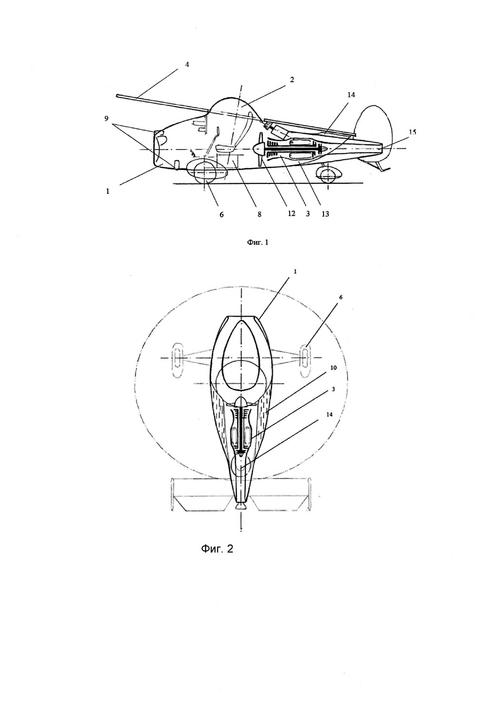
2020) RU2728950 - Автожир авиалесоохраны / Author: Кириллов Сергей Владимирович

https://yandex.ru/patents/doc/RU2728950C1_20200803
Author refers to: autogyro Kamov A-7-3 (Камов А-7-3) and BMW Flügelrad 1 V.1 (Флюгегельрад-1 V1) from Техника молодёжи 2000-12.

Espacenet has bigger pictures, but Yandex has text


http://zhurnalko.net/=nauka-i-tehnika/tehnika-molodezhi/2000-12--num33
Arthur Sack AS6
BMW Flügelrad from 1 to 3
Andreas Epp Omega Diskus
Henri Coanda "Disc"

Mr. J.Miranda also is mentioned in Техника молодёжи.

http://ioh.pl/artykuly/pokaz/niemieckie-latajce-talerze--niebezpieczny-mit,1092/
Article: Niemieckie latające talerze - niebezpieczny mit
Author: Bartosz Rdułtowski

The article was originally published in magazine "Inne Oblicza Historii Numer 02/2005 Grudzień-Styczeń" pages 52-58. He had pay attention on the book "Syndrom V-7" B. Rdułtowski, Wydawnictwo Technol, Kraków 2003

He searches and researches the oldest mentions in newspapers and archives and proves it this myth is only a lie.


BMW Flügelrad series is of course false. This nothing other than development of old fake Flugkreisel, Rudolfs Schriever.
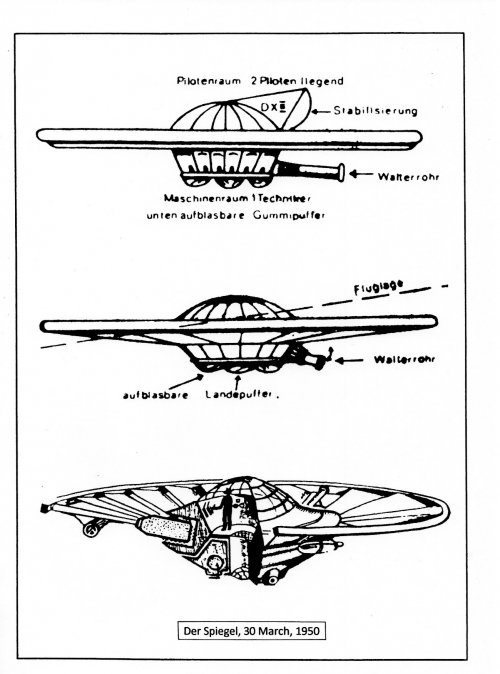
In the oldest drawings, there is no BMW name and it doesn't even have wheels (Landepuffer, aufblasbare gummipuffer).

Even despite the passage of years, none modeler he didn't making a working RC model, of such vehicle. That too about proves something.
 

Attachments

  • 2020) RU2728950 (1 of 3.png
    2020) RU2728950 (1 of 3.png
    364.2 KB · Views: 122
Last edited:
Hello all.

After a while of perusing posts on the site, I decided to make my first post. Hopefully, this is the appropriate place to do so.

This is more or less, an opinion piece. I figure all of you are already aware the BMW Flugelrad is completely fake (until proven otherwise) yet I am still fascinated by the design. The third variant is what I consider to be most intriguing of all. That being said, do any of you think it is actually capable of flight (why or why not)? I am still learning the principles of flight in regards to aeronautical engineering and thought this would be a fun topic to discuss.


View attachment 641195
Hello all.

After a while of perusing posts on the site, I decided to make my first post. Hopefully, this is the appropriate place to do so.

This is more or less, an opinion piece. I figure all of you are already aware the BMW Flugelrad is completely fake (until proven otherwise) yet I am still fascinated by the design. The third variant is what I consider to be most intriguing of all. That being said, do any of you think it is actually capable of flight (why or why not)? I am still learning the principles of flight in regards to aeronautical engineering and thought this would be a fun topic to discuss.


View attachment 641195
Apparently there’s more information about it here’s the link screen shot copy past to your browser https://www.nevingtonwarmuseum.com/bmw-flugelrad-iii.html
 
The Flugelrads are mentioned in Justo Miranda's "German Concept Aircraft Volume Four: CIRCULAR WINGS 1941 - 1945". They are described as real (unbuilt) projects, and there is even a mention of scale models being constructed.

Is this book and author reputable; and how true is this information?
 
Hello all.

After a while of perusing posts on the site, I decided to make my first post. Hopefully, this is the appropriate place to do so.

This is more or less, an opinion piece. I figure all of you are already aware the BMW Flugelrad is completely fake (until proven otherwise) yet I am still fascinated by the design. The third variant is what I consider to be most intriguing of all. That being said, do any of you think it is actually capable of flight (why or why not)? I am still learning the principles of flight in regards to aeronautical engineering and thought this would be a fun topic to discuss.


View attachment 641195
There once were witness about test of Miethe-Belluzo model in Prague March 1945[ at the same time when Ho299 tested V2-V3]
It was really but destroyed to prevent capturing by Red Army ( Ho299V3 captured by US troopers intacted); realistic of Miethe-Belluzo model, obscured Vrill - Haunebu series; simply, why started new Miethe-Belluzo if Haunebu series working well? Antarctic operation Paperclip encounter Haunebu - looks like saucers but these saucers weren't made by Germany engineering
 
The Flugelrads are mentioned in Justo Miranda's "German Concept Aircraft Volume Four: CIRCULAR WINGS 1941 - 1945". They are described as real (unbuilt) projects, and there is even a mention of scale models being constructed.

Is this book and author reputable; and how true is this information?
“There are more things in Heaven and Earth, Horatio, than are dreamt of in your philosophy.”

Act 1 Scene of Shakespeare´s play Hamlet


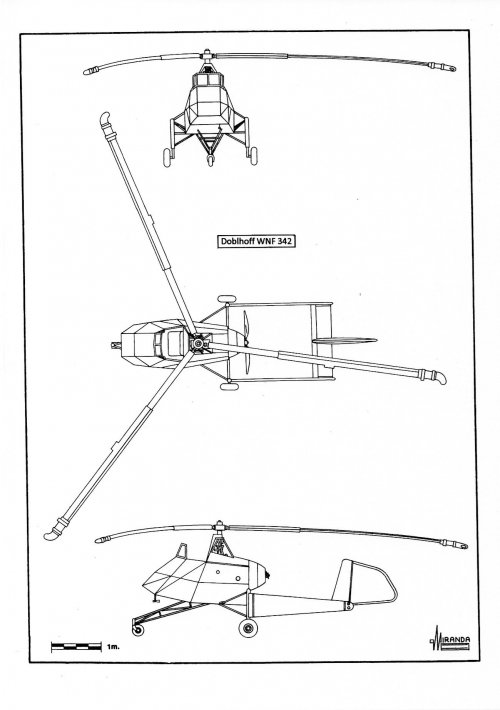
In 1942 the Austrian engineer Friedrich von Dobhloff, of Wiener Neustädter Flugzeugwerke, started the development of the jet-propelled gyrocopter WNF 342 with two-bladed tip-driven rotor. The propulsion elements were two combustion chambers made of a chromium-nickel-steel alloy, where they burned B4 fuel mixed with compressed-air at 2,000º C, at a stoichiometric fuel/air ratio of 1:20.

For horizontal flight propulsion, the WNF 342 used a conventional piston engine that also powered an Argus As 411 supercharger, sending 0.7 kg of compressed air to the combustion chambers every second.

Vertical control was achieved by varying the rotor speed, but the system had problems of ground-resonance vibration caused by the rotor blades.

During the flight tests carried out in 1943, it was found that the compressed-air system limited the thrust and by early 1945 it was decided to replace the combustion chambers with rotor mounted ramjets.

After being examined by engineers of General Electric Corp. in September 1946, the basic design of the WNF 342 was used in several models of North American gyrocopters during the 1950s.

The new propulsion system exhibited powerful lifting capacity. In 1953 the Bensen Midget could lift four times its weight and the Hughes XH-17 flew with a gross weight of 23 tons.

This quality would have been particularly useful for the air defense of the Reich during the last year of war in Europe.

A lonely fighter attacking a 'box' got in the gunsight of as many as 40 Browning M2 heavy machine guns. German fighters Messerschmitt Bf 109 E-3 and Bf 110 C were equipped with 20-mm MG FF cannons from May 1940, but this weapon also proved insufficient against Viermots (American heavy bombers).

The Jagdwaffe tried many different Pulkzerstörer (formation destroyer) tactics to break the ‘boxes’ without having to get too close.

The four-engine enemy bombers were attacked from a range of 1,800 m by Me 410 A-2/U4 heavy fighters, fitted with Rheinmetall-Borsig BK.5 cannons of 50-mm that capable of dismantling a B-17 with a single hit. But they were so heavy that prevented the Me 410 could escape the Mustangs escort.

The Viermots were attacked from 1,300 m with W.Gr.21 rockets of 210-mm, launched from specially modified aircraft Bf 110 G-2/R3, Fw 190 A-7/R6 and Bf 109 G-6/R2. However, this type of spin-stabilised rocket was very inaccurate, and after the attack, the launcher plane could not release the launch tubes on flight, which considerably diminished its speed.

From a range of 900 meters, some Ju 88 P-2 and Bf 110 G-2/R1 heavy fighters fired their Rheinmetall-Borsig 'Flak 38' of 37-mm, an anti-tank canon with a low rate of fire that was too heavy to be installed on a light fighter and which use in air-to-air mode was a failure.

In the summer of 1943, the Luftwaffe tested various air-to-air bombing techniques in the summer of 1943, using fighters Bf 109 G-4 that flew at 1,000 m over the stream bombers, throwing AB 50 containers, each one loaded with 34 standard infantry fragmentation grenades.

The Fw 190 A-4/U3 fighters of the I./JG1 launched SC 250 bombs and AB 500 containers, loaded with 370 kg of HE and provided with time and proximity fuses, over the 'boxes' without achieving success.

American bombers flew together in self-defensive formations running the risk that one of the bombers would destroy all the planes in the 'box', which happened rarely when the bomb bay was hit by one of the millions of shells fired by the Flak. The Germans called this situation Pulkzerstörer but lacked a weapon strong enough to achieve this effect regularly.

None of the 22,000 anti-aircraft cannons used by the Flakartillerie could launch the 2,000 kg of high explosive needed for the destruction of a 'box'. The 88-mm Flak 41 fired shells of only 9.4 kg, the Flak 39 of 105 mm 15.1 kg and the Flak 40 of 128 mm 26 kg, out of which only 10 per cent were HE.

The warhead of a Wasserfall ground-to-air missile weighed 235 kg only and that of an Enzian weighed 300 kg.

The lethal radius of 200-300 kg H.E. is only likely to be in the order of 30-40 meters.

But the destruction capacity at flight altitude of Allied bombers is lower than that of an SC 250 bomb exploding on the ground, due to the lower density of the air.

At 6,000 meters altitude ambient air pressure in 0.6 kg/q. m. It would expect a standoff range of 100 to 150 meters against airplanes to be sufficient to induce severe structural damage.

The explosive increase needed to cause this damage at 30,000 ft should be approximately 10 per cent with respect to sea level and 70 per cent more at an altitude of 55,000 ft.

At the end of 1944, the suicide bombers Focke-Wulf Ta 154 A-0/U2, Gotha P.55 and Messerschmitt Me 328 S.O. were designed. They could carry out Pulkzerstörer missions loaded with 2,000 kg of H.E. Amatol. But their construction was dismissed because they were slow machines that would not have survived the Allied escort fighters.

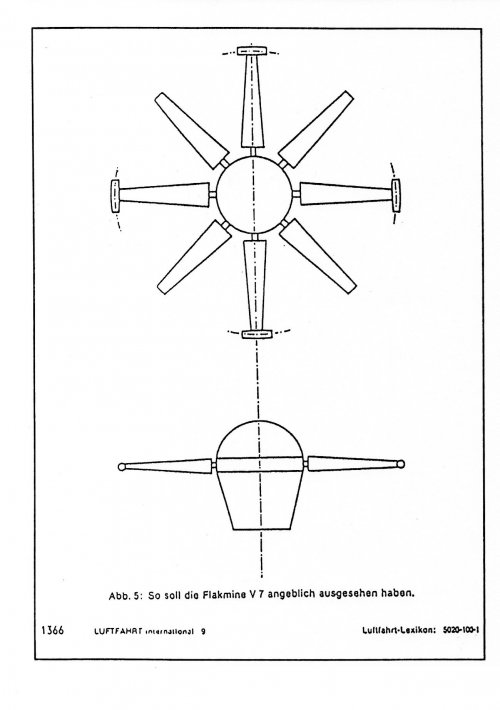
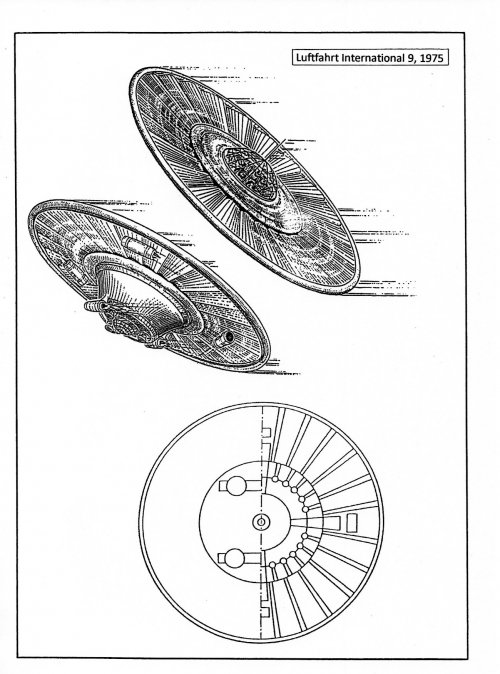
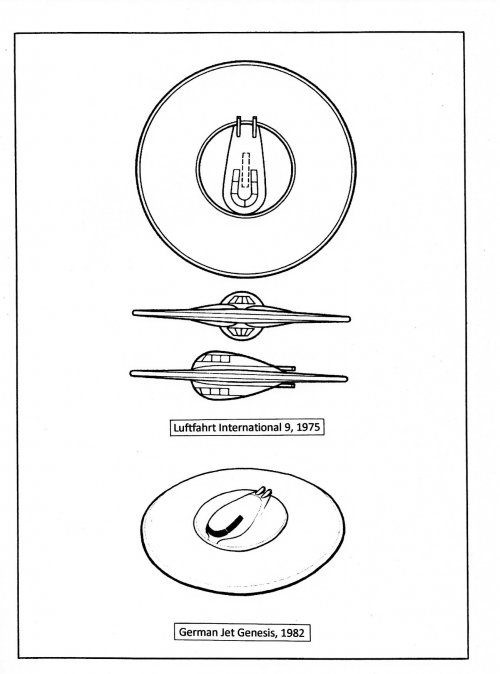
-In the May/April 1975 issue, the German magazine Luftfahrt International published the drawing of an unknown gyrocopter, named Flakmine V7, with a circular body and an eight-blade rotor propelled by four ramjets, which looked like a machine designed to lift-off a great charge of explosives.

The movement of the ramjets and the high temperature of the exhaust gases in this type of gyrocopters used to ionize the air causing corona discharges and induced current effects. This evanescent field electromagnetic phenomenon, called Feuerball Effekt by the Germans, could affect the operation of electronic equipment.

It is possible that this propulsion system would have inspired Focke-Wulf designers during the planning of their senkrechtstarter jagdflugzeug (VTOL) project. In the summer of 1944, Dipl.-Ing. Flugbaumeister Heinz von Halem and designer Ludwig Mittelhüber designed a gyrocopter with a two-bladed rotor spinning freely that were propelled by tip-ramjets, a system called the Triebflügel (thrust-wing).


Some peculiar incidents reported by British airmen seem to confirm the existence of these weapons.

The nickname Catherine Wheel appeared in a Flak Liaison Report at the end of July 1943.

Some spin-like projectiles were observed, flying at heights varying between 2,500 and 6,000 meters with an incredibly high rate of climb, throwing off colored incandescent cascades of about 200 meters of diameter.

No aircraft were damaged, so the Allied intelligence services concluded that it was another variant in the enemy’s program of deterrent pyrotechnics. (Consolidated FLO Report Nº.169, July 24-26, 1943, AFHRA).

The bursting effect reported suggested a structural failure due to centrifugal force rather than the explosion of a warhead.

Perhaps these devices were experimental prototypes tested in combat conditions, one of them was observed disintegrating while being followed by several searchlights.

During a mission over Hamburg on the night of 27/28 July 1943, a Halifax Mk. II heavy bomber of No. 77 Sqn (KN) flew through the Catherine Wheel burst of a spin-like rocket projectile. (AIR 27/656/33, Record events, Nº 77 Sqn, July 1943. TNA).

On August 10, 1943, another Halifax of No. 77 Sqn reported a burning object with cascading multi-colored burst falling slowly over Mannheim. (AIR 27/656/35, Record events, Nº 77 Sqn, August 1943. TNA).

Rocket bursting with cascade effect at 25,000 ft. over Kiel. (Data of Unusual Objects & Missiles encountered on Missions, 1943. AFHRA).

These weapons were also described as Phoo Bombs in the document Nº 519.635, 1945 “An Evaluation of German Capabilities in 1945” (Office of the Director of Intelligence. United States Strategic Air Forces in Europe Headquarters).
 

Attachments

  • Picture1.jpg
    Picture1.jpg
    229.8 KB · Views: 42
  • Picture2.jpg
    Picture2.jpg
    203.7 KB · Views: 34
  • Picture3.jpg
    Picture3.jpg
    25.7 KB · Views: 40
In April 1941 Andreas Epp, an Unterofficier of the KG 26 Bomber Group based at Norway-Stavanger, built one flying disc model with 60 cm of diameter. Thanks to the help of the Luftwaffe Director-General of Equipment Ernst Udet, Epp was able to give the model and their construction plans to the RLM.

In 1946, Epp constructed the Helioplane, another airworthy model with coaxial rotor, and in 1954 he designed an aerodyne that used six ducted fans for lift and two turbojets for propulsion. In March of 1955 he designed the Delta aircraft project for Warnow Werft-Warnemünde in East Germany.

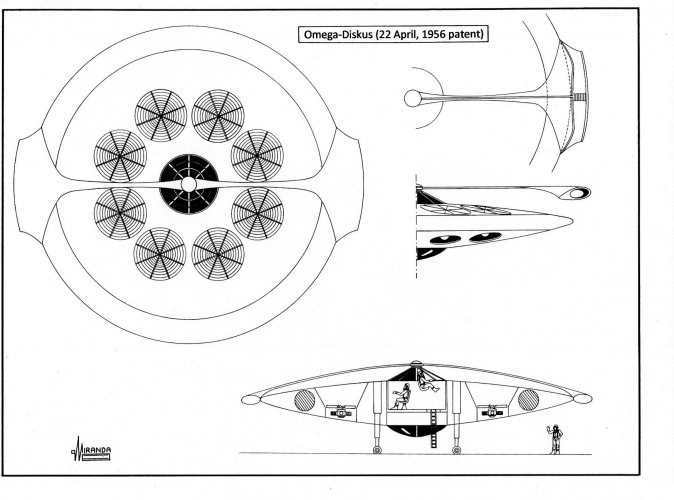
On April 22, 1956 he patented the Flugscheibe Omega-Diskus gyrocopter and in 1958 he built a 1/10 scale model with 190 cm of diameter.

The main rotor of Omega-Diskus was designed to rotate freely and no torque was transmitted to the airframe. The rotation was started by means of two small bipropellant rockets (Aniass-Raketen) Walter 109-509 B-0 with 350 kp thrust each. Once rotational speed was sufficient, the two huge Pabst ramjets were started, and lift-off was achieved. The eight auxiliary engines could be throttled changing the plane of the main rotor in the desired direction.

The project was offered to the USAAF but nothing more is known.

Omega-Diskus technical data

Rotor diameter: 22 m (72 ft.), disc diameter: 19 m (62 ft), cockpit diameter: 4 m (13 ft), ducted fans conical diameter. 3 to 1.8 m (9.8 to 5.9 ft), height: 6 m (19.7 ft), estimated weight: 28,000 kg (62,000 lb.), estimated ceiling: 12,000 m (39,360 ft), crew: 10, engines: two Pabst ramjets with 2,500 kp thrust and eight 80 hp Argus As 8A radial engines driving four bladed propellers.
 

Attachments

  • Picture2.jpg
    Picture2.jpg
    271.1 KB · Views: 42
Triebflügel (The dark side)

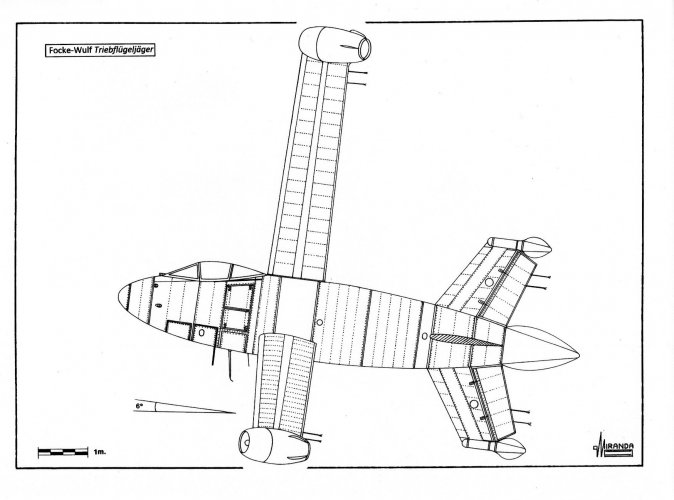
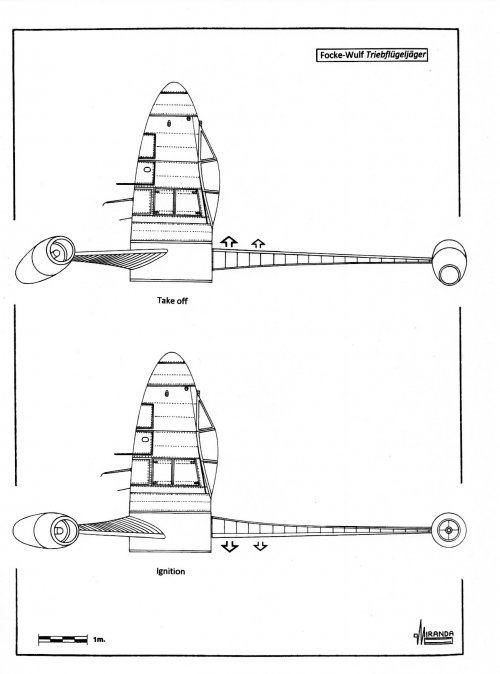
On ground, the aircraft was kept upright over four tailfins and the rotor was rotated in neutral pitch by means of a small ground engine, until the wingtips reached the necessary speed for the ignition of the ramjets. For the lift-off, the pilot varied the incidence angle of the blades in 3 degrees.

It was expected that after the lift-off the blades rotated 87 degrees, acting as untappered wings with conventional airfoil. Also, it was considered to use small turbojets, but the idea was dismissed because the acceleration of Coriolis negatively affected its operation. On the contrary, the ramjet, with no moving parts, compresses the air and adds fuel by means of its movement through the air, without being affected by the changes in the angular velocity.

On ground, the narrow landing gear track and rotor above the center of gravity affected the stability, the use of a pair of blades rotor produced ground resonance effect and the fuselage could only contain enough fuel for a few minutes of flight.

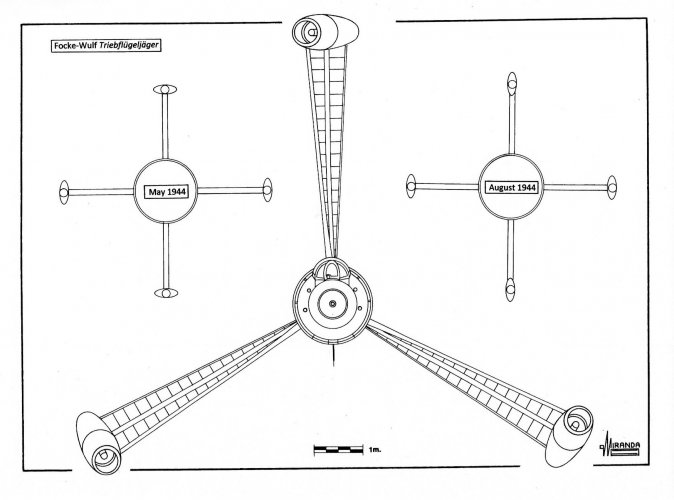
In August 1944, the original design was modified by increasing the diameter of the fuselage and the capacity of the fuel tanks and by using a new three-bladed rotor. The project was renamed Triebflügeljäger.

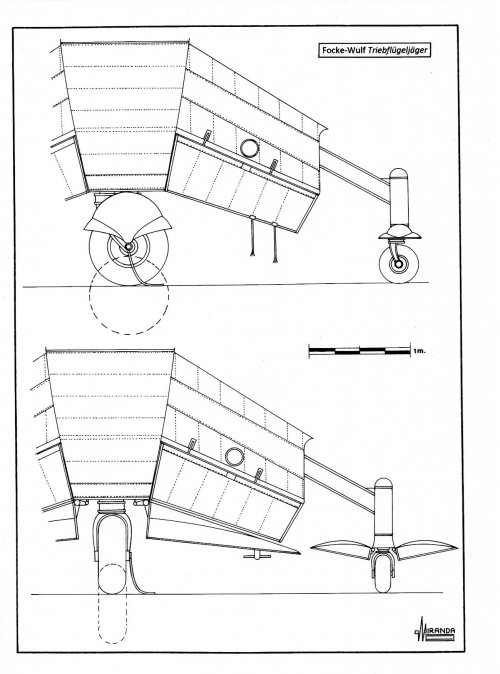
Its considerable weight gain was offset by redesigning the landing gear, adding a central wheel with a powerful shock absorber. The outer wheels were installed at the end of the extensible supports that improving stability during landing.

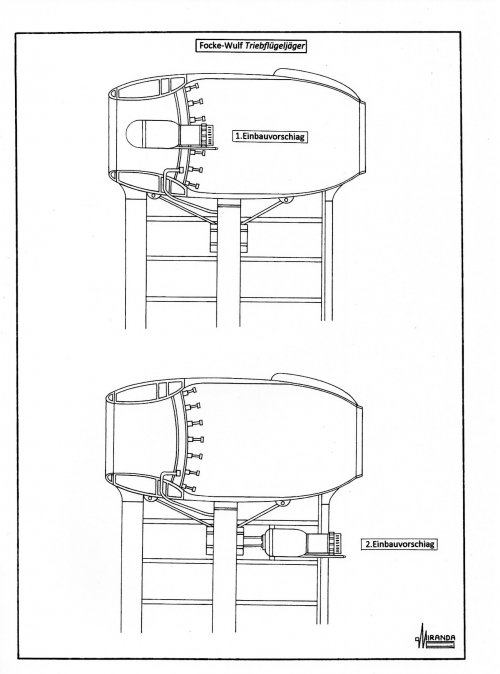
Hans Multhopp joined the design team and with his usual disdain for the safety of the pilots, proposed to install the rotor behind the cockpit, at a 37 per cent fuselage length. The mechanical device that actuated the rotary collar was replaced by three Aniass-Raketen (Walter 109-509 B-0 bi-propellants rockets) of 350-kp thrust each, installed in the air-intake of each ramjet in 1. Einbauvorschiag configuration.

When the correct rotation speed of 220 rpm was reached, the ramjet would start, and the rockets were shut down. The blades were designed with variable incidence so that they continued to generate lift during horizontal flight even with 90 degrees pitch at the root.

In September, some safety mechanisms were added. In case of emergency the blades could be disengaged by explosive bolts before the pilot operated the ejection seat. The ramjets were very vulnerable to the defensive fire of the Allied bombers and a single impact of 12.7 mm could alter the aerodynamic properties of the outer coating creating flameout and destructive vibrations in the rotor.

It was estimated that the rockets would ensure emergency power, but the drag generated by the ramjets would prevent safe landings by autorotation with unacceptably high sink rate. The solution consisted in using explosive devices to detach the ramjets, changing the Aniass-Raketen location to the trailing edge of the blades, inboard the ramjet, in 2. Einbauvorschiag configuration.

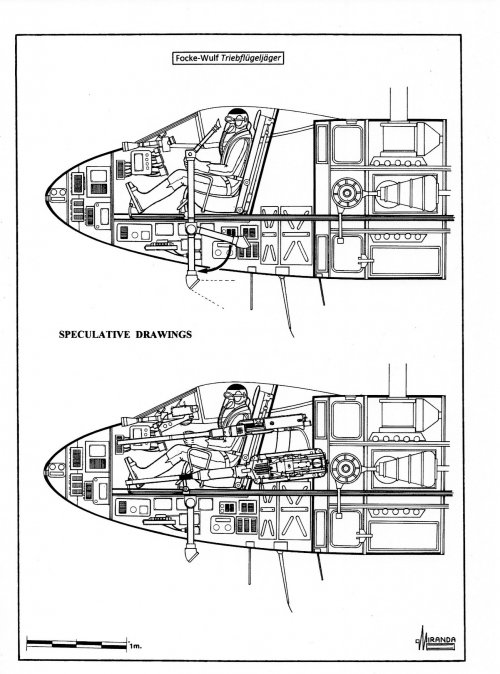
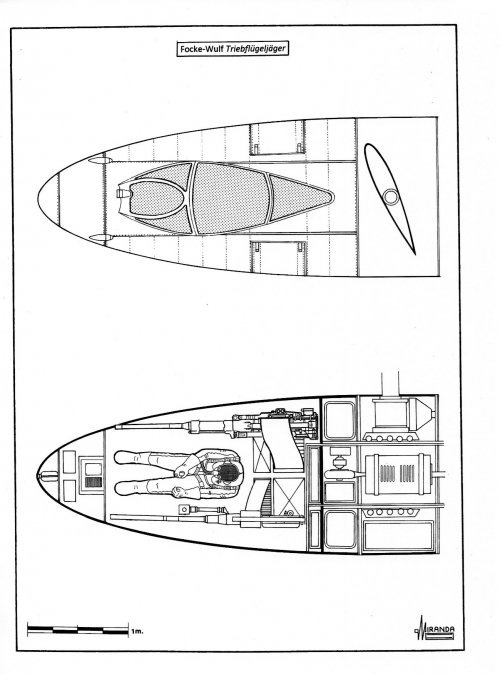
The forward section of the fuselage, 320 cm length, would be made of light alloy and would house the pressurized cockpit, with ejector seat, EZ 42 gyroscopic gunsight and ZFR 4a telescopic gunsight. The electronic equipment was housed under the cockpit floor: FuG 24 SE, FuG 25a, FuG 101a, FuG 120K, FuG 125a, Patin PKS and RF2C rear-periscope.

The armament (angled down 6 degrees) was to both sides of the cockpit and consisted of two Mauser MG 151/20 cannons with 250 rounds per gun, and two Rheinmetall-Borsig MK 103/30 cannons with 100 rounds per gun. The ammunition tanks were located behind the cockpit. The protection for the pilot consisted of a 15-mm thick armored nosecone, containing one MG BSK 16-gun camera, one 50 mm thick armored glass windshield and two 12 mm steel plates behind the back and head.

The rotary collar, made of steel, would have had a 160 cm of diameter and 82 cm of length. It housed the rotor roller-bearings, the hydraulic actuators of the collective pitch system, the electric generator, the fuel and propellants pumps, one rocket-propellant tank with 380 liters of T-Stoff, another with 70 liters of C-Stoff and the evaporation plant.

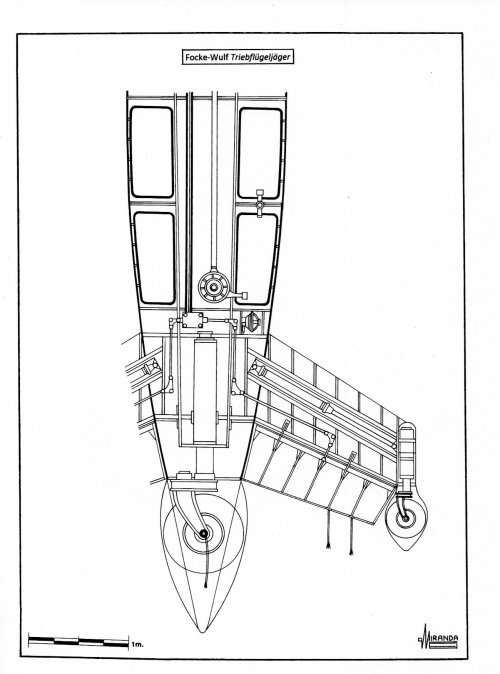
The rear fuselage section with 533 cm length, would have been made of steel and light alloy and housed two tanks with 1,800 and 1,400 liters of ramjet-fuel, the central steel tube, the main wheel shock-absorber and some electronic equipment.

The cruciform tailfins, with 32 degrees sweepback angle and four rudders, housed the hydraulic retraction systems of the auxiliary wheels with 5.4 m (extended) track. The landing gear had a central wheel of 780 x 260 mm, one main shock-absorber with 50 cm play and four auxiliary wheels of 300 x 150 mm. All wheels were steerable, with swivel mounts to facilitate ground towing. They were enclosed by streamlined tulip-shaped pods during flight. In flight configuration, the aircraft overall length was of 9.35 m.

The rotor blades, with 436 cm long and 114 cm chord, would be constructed entirely in steel with a Skoda tubular main spar, containing the rocket propellant ducts, ramjet propellant and electric wiring for the explosive bolts located at both ends of each blade. Those mounted in the root were used to detach the rotor and those installed in the tips served to detach the ramjets in auto-rotation emergency landing.

The rotor had a maximum diameter of 11.76 m and a disc surface of 108.56 sq. m. It was designed to rotate freely, and no torque was transmitted to the fuselage. In level flight, the pitch at the root varied automatically to maintain a constant rotation speed of 120 r.pm. During lift-off and landing the (subsonic) rotation speed would be 220 rpm.

The Triebflügeljäger used three Pabst ramjets, 70 cm in diameter and 140 cm long, entirely built of steel. Each had 35 injectors and a thrust of 840 kp, with operating speed between 300 kph and 0.9 Mach and 18,000 m estimated ceiling. The specific fuel consumption rate varied with the speed of rotation and the type of fuel used. With hydrogen, it was 1.47 at 0.8 Mach and 900 degrees C, with crude oil (superheated and vaporized to achieve rapid mixing with the incoming air) was increased by about 3 per cent.

Ramjets would run on any combustible medium which could be vaporized, passing through the heat exchanger designed by Otto Pabst. It consisted of a tiny ramjet that worked with petrol 133/5000, consuming only a 2 per cent of that of the main engine, and could process substances that were as little volatile as lignite tar and pitch oil. The high fuel consumption, compared to piston or turbojets engines, was caused by the subsonic speed at the rotor tips.

The low compression ratio of the air intakes generated inefficient combustion, high noise, poor range, high night-time visibility Feuerball Effekt, corona discharges and induced current effects.

The circular movement of the ramjet left a low-pressure zone behind. To prevent the formation of vortex and destructive vibrations on the external face of the nozzle, an aerodynamic fence of 56 cm length was installed.

The three rockets could be run for 200 seconds using a mixture of T-Stoff (highly concentrated solution of hydrogen peroxide) and C-Stoff (57 per cent methyl alcohol, 30 per cent hydrazine hydrate and 13 per cent watery solution of potassium cuprocyanide).

T-Stoff and C-Stoff were unstable and dangerous hypergolic substances which reacted explosively on contact, so an ignition device was not necessary.

During the ignition of the rockets, the rotor blades had neutral pitch and their roots and 30 degrees negative pitch at the tips. The generated negative lift avoided a premature take-off before all the ramjets operated at full power. When the rotor reached the 220 rpm the pilot disconnected the electric-driven pumps from the rockets and gradually increased the collective pitch angle to perform the take-off.

The transition to forward flight was made at 300 m altitude and 120 rpm, increasing the rotor pitch up to 90 degrees at the roots and 120 degrees at the tips. The higher thrust-lift ratio was obtained by flying with the tail depressed 6 degrees, so the armament and gunsight were also installed with 6 degrees down with respect to the longitudinal fuselage axis.

With a range of only 500 km, the Triebflügeljäger was considered a point defense interceptor that would only start the flight when detecting a bomber stream near its base.

Once the service ceiling had been reached, it should be directed towards the target following the instructions of the Reichsjägerwelle communications network via the FuG 120k device. The MK 103/30 heavy cannons were powerful enough to destroy a four-engine bomber with only five hits of 30x184B Minengeschoss ammunition and could be fired from a safe distance of 1,500 m, using the ZFR 4a telescopic gunsight. The MG 151/20 rapid-fire cannons and the Adler gyroscopic gunsight were more useful in dogfight against the escort fighters.

An experienced pilot could perform some conventional fighter maneuvers with the Triebflügeljäger. Using the collective pitch he could stop its advance by easily changing direction and even flying backwards, and he could also avoid combat because of its superior rate of climb. Hovering under the bomber stream could shoot the belly of the planes from a safe distance, out of the range of their ventral turrets.

Guided by the FuG 125a radio-beacon receiver, the pilot could return to his base that might be a section of autobahn surrounded by forests and signaled with ground radar-reflectors as a reference for the FuG 101a radio-altimeter.

The small diameter of the auxiliary wheels suggests that the gyrocopter would be towed from the landing site to the maintenance area, through a network of tarmac path. There the ground crews would attach stairs to both sides of the fuselage to replenish oxygen, ammunition, fuel pumps, B4 petrol from the evaporation plant, heavy kerosene from ramjets and rocket propellants. Afterwards, the fighter would be towed to one of the take-off sites covered by nets stretched between the trees.

Data on the semi-automatic landing procedure planned for the Triebflügeljäger have not been kept. It might be expected that it could have used part of the blind bomb and level bomb electronic equipment developed for the Arado Ar 234 and adopted by the firm Focke-Wulf for its project 1000 x 1000 x 1000 bomber.

After making the transition to the vertical flight on the landing area, the pilot would connect the three-axis Patin PKS autopilot and the Lofte tachometric bomb-sight rear periscope. Both devices acted together driving the airplane according to the pilot movements over the bombsight.

The rate of descent to 120 rpm would be regulated by varying the rotor pitch until reaching the landing point predicted by the computer. To get a view of the ground from the cockpit, it would have been necessary to modify the RF2C rear-periscope by installing the PV1B sighting head at the end of a retractable tube that would be long enough to save the visual obstacle of the rotating collar.

The FuG 101a radio-altimeter, designed for horizontal flight, used two inverted 'T' dipoles that normally were installed under the wings of the big airplanes, but the Triebflügeljäger would require that they be installed in the tailfins for its use during vertical landing.

The indications of the FuG 101a were only reliable for altitudes above 200 m due to the phenomenon of interference between the transmitter dipole 'S' and the receiver 'E', suggesting that the final descent step would be carried out manually by the pilot following indications from the ground crews. The conclusion is that the Triebflügeljäger had to operate in well-provided bases of fuel, towing vehicles, reflectors, communications equipment, and ground crews.

This dependence made it less effective than the VTOL rocket fighter Bachem Natter, which only needed a truck, six men and a launching ramp hidden among the trees.

Triebflügeljäger technical data

Estimated maximum speed of 1,000 kph at sea level, 900 kph at 7,000 m, 840 kph at 11,000 m. Initial climb rate: 125 m/sec. Service ceiling: 14,000 m. Empty weight: 2,800 kg. Maximum lift-off weight: 5,175 kg. Range: 500 km at 675 kph and 14,000 m. Endurance of 42 minutes at sea level.
 

Attachments

  • Picture3.jpg
    Picture3.jpg
    180.3 KB · Views: 35
  • Picture4.jpg
    Picture4.jpg
    212.9 KB · Views: 34
  • Picture5.jpg
    Picture5.jpg
    219 KB · Views: 35
  • Picture6.jpg
    Picture6.jpg
    212.4 KB · Views: 32
  • Picture7.jpg
    Picture7.jpg
    191.4 KB · Views: 27
  • Picture8.jpg
    Picture8.jpg
    439.7 KB · Views: 27
  • Picture9.jpg
    Picture9.jpg
    324.7 KB · Views: 30
  • Picture10.jpg
    Picture10.jpg
    292.3 KB · Views: 27
  • Picture11.jpg
    Picture11.jpg
    294.1 KB · Views: 26
  • Picture12.jpg
    Picture12.jpg
    238.1 KB · Views: 36
Flügelrad (The dark side)

In December 1934, the RLM (LC II) development group decided to support the research of new types of rotary wing aircrafts. In January 1935 Anton Flettner received a development contract for the experimental gyroplane Fl 184. In February, the RLM started negotiations for the license manufacture of the C-30 autogyro by Focke-Wulf Flugzeugbau AG. Additionally, the Luftwaffe Technical Office (TAL) commissioned Proffesor Heinrich Focke to develop the Fw 186, a new type of gyroplane with jump-start capability.

Early autogyros required about 50 feet of runway to take off, but the Fw 186 was designed as vertical take-off aircraft, using the tail plane to deflect the slipstream from the propeller up into rotor. The deflected wind would cause the rotor to spin up before the aircraft began moving. When the rotor reached 1,700 rpm the pilot changed the angle of the blades, by means of the collective pitch control, and the huge momentum gained by the rotor allowed to make the jump start. For cruising flight, the speed of rotation will be turned to 500 rpm with the drag and thrust forces in balance.

In helicopters, a complicated gear system connects the rotor to the engine, which in turn is firmly attached to the airframe that tends to rotate in the opposite direction of the rotor. To compensate for the torque effect, it is necessary to use an auxiliary tail propeller or a dual rotor system that rotate in opposite directions. The torque-compensation equipment accounts for 20 per cent of the weight of the helicopter and requires frequent maintenance. The rotor of a gyrocopter rotates freely, generating lift when moving forward thanks to an aerodynamic phenomenon called autorotation, like the one used in the nautical parachuting. This design avoids the need for a tail rotor.

Since the rotor is unpowered, the gyroplane needs a separate source for propulsion like propellers or jet engines. The machine does have to be moving forward some to maintain autorotation, but because the huge increase in drag generated by the rotor, the gyroplanes are not as suitable for high-speed flights as the airplanes. Additionally, the gyroplanes are incapable of the hovering and vertical landing that helicopters perform. After the experience gained with the Fw 186 and the Fl 184, the RLM had concluded that the inadequacies of gyroplanes could only eliminated by a real helicopter.

In 1937 was flown the Focke-Wulf Fw 61, the first serviceable helicopter in the world. In 1938 the helicopter Flettner Fl 185 V1, based in the Fl 184 airframe, was flight tested.

On May 8, 1945 Germany surrendered to the Allied troops and, in the chaos of the collapsing Third Reich, a number of American intelligence teams collected documents and interrogated German, Austrian and French scientific experts. Under the codenames Alsos, Overcast and Paperclip, 492 German specialists in science and technology were deported to the United States and large numbers of extremely valuable German documents were shipped to the Air Document Research Center at Wright Field.

The Americans were particularly interested in atomic research, supersonic wind tunnels, aerodynamic research, rockets, and turbojets engines. Many German engineers and scientists not indispensable were left behind, trying to survive in the hard postwar conditions.

When the American press started publishing flying saucers reports in June 1947, some experts that took part in the development of German circular wings acquired some popularity after being interviewed by European magazines. One of them was Dipl. Ing. Rudolf Schriever from the Heinkel-Marienehe design team.

In 1940 he had been interested in the improvement of gyroplanes with some advanced ideas about vertical take-off and landing (VTOL) concept. In the spring of 1941, Professor Ernst Heinkel encouraged him to construct a proof-of-concept scale model powered by a compact two-stroke engine.

In June 1942, a 1/10 scale fully functional prototype, with gyroplane configuration, was flight tested. The conventional rotor was changed by one rotary fan with 60 cm of diameter named Flügelrad (Wingwheel). The external ring was expected to increase the structural stiffness and the rotor momentum during the vertical take-off, avoiding the vibrations and drag of a conventional rotor.

On February 7, 1942, Minister of Armaments Fritz Todt died in a plane crash just hours after informing Hitler that the war could not be won by conventional means. Since then, the production of armament was divided into two branches: The Organization Todt, headed by Albert Speer and the SS Special Projects Office, under the leadership of Dr. Ing. Hans Kammler.

Speer made a god work rationalizing the production of conventional weapons, but very few of the 39,807 aircraft manufactured in 1944 had the opportunity to fight, grounded for lack of fuel.

Following the RAF bombing raid on the rocket research center at Peenemünde, in the night of August 17/18, 1943, Hitler ordered to Hans Kammler to excavate underground sites to produce secret weapons.

By the last moths of the war the SS Organization eventually succeeded in establishing its own industrial empire, with 143 underground factories and 600 facilities in caves and mines across Germany, France, Italy, Hungary, Poland, and Czechoslovakia.

The SS Special Projects Office was a Pandora box of advanced weaponry that controlled the production of V-1 and V-2 missiles in the Nordhausen Mittelwerke complex, the Natter VTOL rocket fighter production at Bachem-Werke-Waldsee and DFS Ainring-Salzburg, the Heinkel Wespe VTOL ducted fan fighter development in Wiener Neustädter Flugzeugwerke-Vienna, the SK P14 ramjet-driven interceptor development at Skoda-Kauba Flugzeugbau-Prague and the Rammer fighter and Flugschnittel flakmine development at Zeppelin Werke-Schwarzwald.

The most valuable projects were transferred to the East of the Reich, out of reach of the Allied bombers based in the British Islands, but in March 1944 the B-17 and B-24 American bombers could already reach Prague with P-51 Mustangs escort.

By mid-1944, even the deepest underground German sites could be destroyed by the new anti-bunker heavy bombs developed by the British scientist Barnes Wallis. In the night of 8/9 June the RAF Bomber Command made its first attack with 12,000 pounder Tallboy bombs and on March 13, 1945 with the 22,000 pounder Grand Slam bombs.

The construction of the Flügelrad prototype (one car-towed unpowered rotor kite to prove the concept) was to be undertaken early 1943 at Heinkel-Marienehe and flight tested during the summer.

Early 1944 the project had evolved towards the jet propulsion, but the whole production of Jumo 004 turbojets had been reserved for the Messerschmitt Me 262 jet fighter and the Arado Ar 234 jet bomber, and the production of the HeS 011 turbojet (still in development) had already been assigned to the future Jägernottprogramm air-superiority fighter Focke-Wulf Ta 183.

There was just one option, the BMW 003 turbojet that have had development problems when converted to diesel in 1943.

By August 1944 it was finally ready for mass production, under the SS control, in underground dispersed sites of SS-Kraftfahrttechnischen Versuchsanstalt-Oranienburg, Eisenach, Zühlsdorf, Nordhausen, Wittringen and Stassfurt.

In the spring of 1944, the Flügelrad Projekt was transferred to Skoda Werke, a giant industrial complex in the Czech towns of Brno and Pilsen, with the administrative center in Prague.

In February 1942, under auspices of Hermann Göring, the Skoda-Kauba Flugzeugbau research center was founded with the objective to design a pilot-less flying bomb. Under the leadership of Dipl. Ing. Otto Kauba, the Skoda-Kauba Flugzeugbau Entwicklung secret design team was formed at Prague-Cakowitz, with prototype workmanship facilities at Avia-Cakowitz and Avia-Klecany Werke.

When the flying bomb project was dropped in June 1942 in favor of the Fieseler Fi.103 (V-1) cruise missile, the design team focused in experimenting with unusual configuration airframes.

The SK V2 prototype, with rear swept wings, was flight tested in June 1943 at Prague-Ruzyn airfield, the SK SL-6 was a ‘bat-wing’ flying mock-up of the radical Blohm und Voss P.208.02 jet fighter project, the SK V7 was a canard swept wing aerodynamic research prototype, the SK V12 was a light plane project with forward swept wings and the SK P.14 an interceptor project powered by one Flugtechnische Fertigungsgemeinschaft Prag (FGP) ramjet engine.

Early 1943 the Kauba team obtained its first practical result with the unusual Banweise wing construction system, of the SK V4 prototype, using a conical steel single spar, made at Podbrezova Werke. So successful were flying trials with the V4 that the RLM awarded a contract for 1,000 units of the SK 257 trainer.

By 1944 the Skoda-Kauba workforce consisted of 120 technical personnel headed by the engineers Eduard Lehmayer, Kurt Haas, and Frantisek Kadlec, three workshops, one aerodynamic test site and flying test facilities at the VZLU-Prague.

End of 1944 Kauba had obtained contract for the transformation of the Fw 190 D and the Fw Ta 152 fighters with new laminar profile wings.

In 1945 the Banweise system was the best option for the construction of the Flügelrad rotor, but the destruction of all documents and project drawings by the SS Special Evacuation Kommando in April 30 of that year, made impossible the confirmation of the hypothesis.

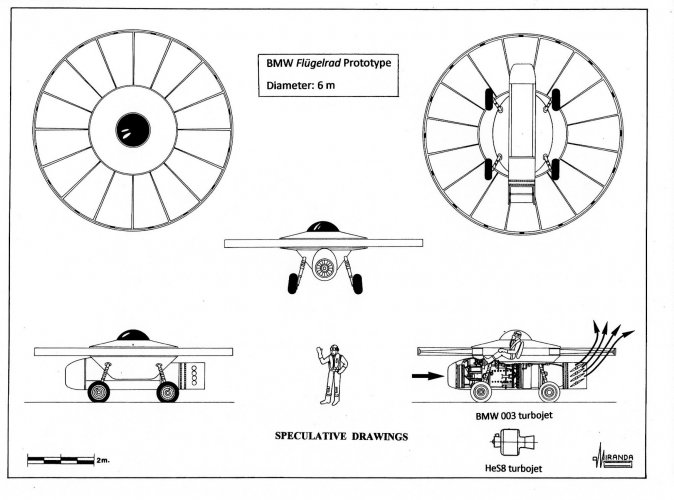
In my opinion, a prototype with 6 m of diameter could have been built in the Avia-Cakowitz workshop during the autumn of 1944, performing a few taxiing trials across the Prague-Gbely airfield in February 1945 and was destroyed by the SS on May 6 to 9.

Although several sources indicate that the prototype was powered by one BMW 003 turbojet, it is unlikely that the builder would use such a valuable engine during the first trials.

In my opinion, the initial power plant could have been a small Heinkel HeS 8 turbojet with 700 kp static thrust. The HeS 8 production was abandoned by the spring of 1943 following the cancellation of the Heinkel He 280 jet fighter, but thirty prototypes were available.

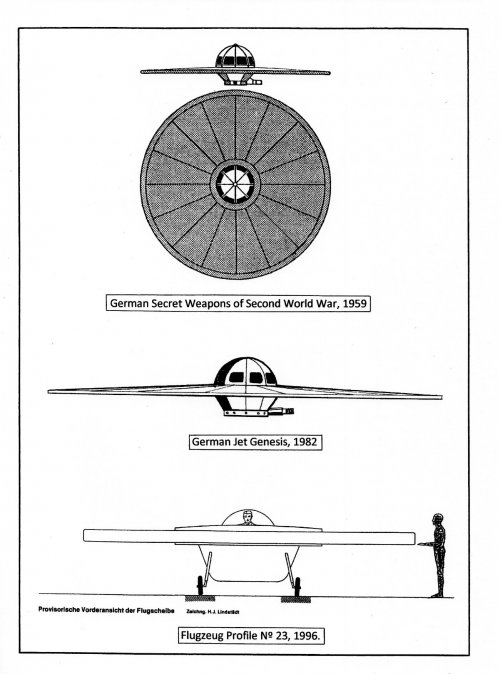
The Flügelrad was a jet-powered gyroplane with the rotor blades mounted so close to each other that they formed a disc. The operation principle was the deflection of turbojet exhaust gases upwards to start the rotor spin, after achieving 1,800 rpm the exhaust was redirected backwards, the blades pitch was changed from -3 to +3 degrees and the machine jumped upwards. When reaching cruising height, the blades were positioned in negative pitch and the gyroplane flew like a kite, with a small angle of attack.

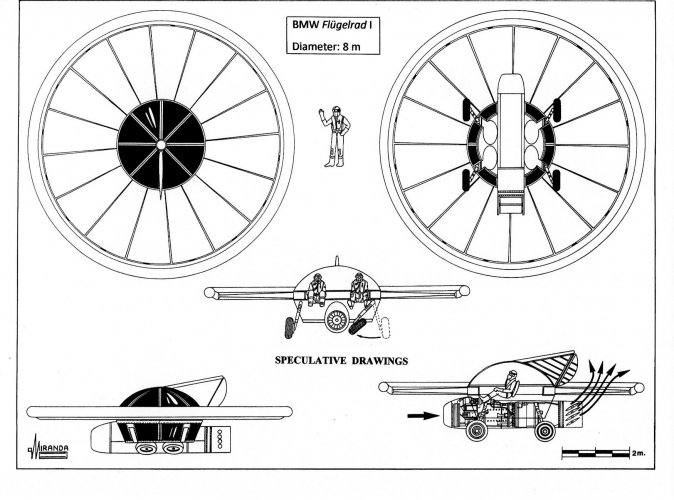
Flight tests carried out at Marienehe had shown that flight control was impossible by redirecting the engine exhaust and it was considered the construction of a second gyroplane with 8 m diameter (Flügelrad I) fitted with a conventional tailfin and rudder assembly. But the wind tunnel tests performed with a scale model revealed that, at high angles of attack, the turbulent boundary airflow rendered the control surface useless.

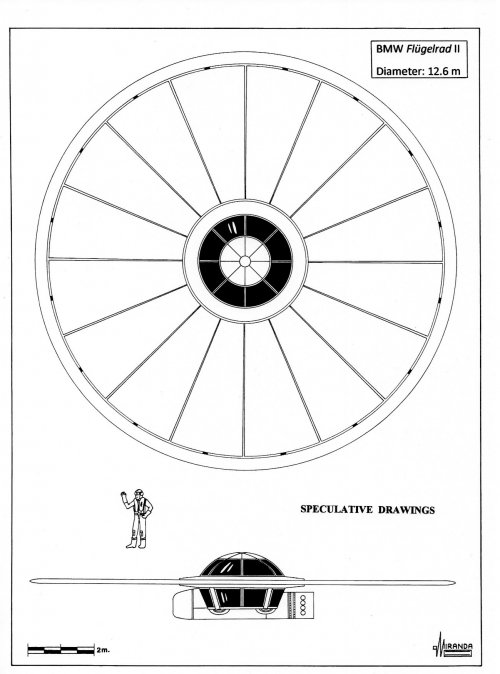
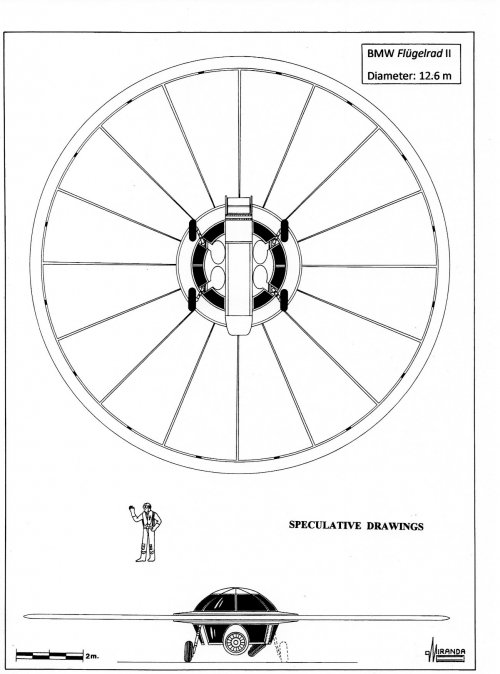
Same thing happened with the projected Flügelrad II with which it was attempted to solve the problem by extending the rotor diameter to 12.6 m. For the future production version Flügelrad III it was decided to use two turbojets and a rotor of 14 m of diameter and 21 blades, to prevent ground resonance phenomena.

Theoretically, the pilot of the Flügelrad III could obtain yaw control by varying the power of one of the turbojets, pitch control by redirecting upwards or downwards simultaneously the exhaust flow of both engines and roll control by alternating the flow upwards and downwards. The flow was directed by means of the new NOTAR thrust system, and the exhaust automatic control for continuous variable operation patented by Heinrich Focke in June 1944 under the title: Hubshrauber mit Einrichtung zum Ausgleich des Rückdrehmomentes.

By 1940 BMW started the design of the turbojet model 018, a 116 per cent scaled-up version of the BMW 003 with 450 per cent increased power. The new engine was too big and heavy to be installed in a fighter and was therefore intended to see operational service through the jet bomber force planned for 1947.

In the summer of 1944 BMW designed the advanced jet bomber Strahlbomber II powered by four BMW 018 turbojets. When all bomber projects were cancelled by the RLM early 1945 the use of two 018 was considered to propel the Flügelrad IV, with 24 m of diameter. These engines were located one above the other separated by the rotor plate. The nozzles were diverted in two Strahlrohr pipes fitted with Focke jet shutters made of Sicromal 10 heat-resistant steel.

Official development of the BMW 018 was stopped in late 1944 but BMW managed to build a prototype in Oberwiesenfeld. The tests were to be done at Dresden and Oberhausen, but the engine was destroyed at Stassfurt in 1945 to avoid its capture.

In 1995, after the publication of my book Die Geheimen Wunderwaffen des III Reiches, Herr Manfred Franzke, editor of Flugzeug Publikations GmbH, asked me to perform a design analysis of the Flügelrad concept based on the drawings published between 1950 and 1982 in Der Spiegel, German Secret Weapons of the Second World War, Luftfhart International and German Jet Genesis. I sent him twelve pages of speculative drawings showing the Flügelrad principle of operation in August 1996. My work was published in Flugzeug Profile Nº 23 under the title Deutsche Kreisflügelflugzeuge, together with an article by Hans Justus Meier and a sketch by H.J. Lindstädt, without any indication that warned the reader of its speculative nature.

Bibliography


Die Realität der Flugscheiben’ by Andreas Epp, Michaels Vertrieb editor, 2002.

Flugscheiben-Realität oder Mythos: Gespräche mit dem Flugscheiben-Erfinder’, by Andreas Epp, Michaels Vertrieb editor, 2005.

Die deutschen Waffen und Geheimwaffen des 2. Weltkrieges und ihre Weiterentwicklung’ by Rudolf Lusar, J. F. Lehmann; Edition: 4., stark überarb. u. erw. Aufl. (1962).

Epp, Joseph Andreas, ‘U.S. Army Intelligence, Record Group 319, Box 186, File Number GE013347’. The National Archives at College Park, College Park, Maryland. - http://www.archives.gov/iwg/declassified-records/rg-319-army-staff/personal-name-files-new.html

‘Evaluation Reports (ER), Final Reports (FR) und Overall Reports der British Intelligence Subcommittee, Reports der Combined Intelligence Objectives Subcommittee (C.I.O.S.) und Field Intelligence Agency (F.I.A.T.)’.

‘Hitler’s Flying Saucers: A guide to German Flying Discs of the Second World War’ by Henry Stevens, Adventure Unlimited, 2013.

‘Flying Saucer Technology’ by Bill Rose, Midland, 2011.

‘Secret Projects- Flying Saucer Aircraft’, by Bill Rose & Tony Buttler, Midland, 2006.

‘Jet Planes of the Third Reich -The Secret projects -Volume One’, by Manfred Griehl, Monogram, 1998.

‘Secret Weapons of the Third Reich’ by Leslie E. Simon, WE, INC., Publishers, 1971.

‘Messerschmitt Me 328 Bordjäger’, by Paul Malmassari, Wingmasters Nº 2.

Der Fliegende Bierdeckel’, by Arthur Sack, Die Deutsche Sportflieger, November 1939.

Der Kreisflüger AS6 V1’, by Hans Justus Meier, Luftfahrt International 4/79.

Aktennotizen und Niederschriftender der ATG-Maschinenbau GmbH.’, Leipzig, von 4.2, 3.2, 17.4 und 18.5, 1944.

Veröffentlichungen zuden Modellen von Arthur Sack’, Der Flieger 11-12/1940.

Hochwertige Motorflugmodelle’, Der Deutsche Sportflieger, 9/1940.

Das Buch der Deutschen Luftfahrttechnik’, Bidteil, Mainz, 1970.

Der Flieger 4/1944.

Air International, March 1979.

Neue formen des Starrflügel-Flugzeuges’, by W. Zuerl, Der Flieger 1/1944.

Dreikomponentenmessungen an einem Kreisflügel mi zwei klappen’, by E. Hildenbrand, Aerodynamische Versuchsanstalt Göttingen, Beritche Nr.40/14/40 vom 3.8.1940 und 41/14/5 vom 21.2.1941.

Deutsche Kreisflügelflugzeuge’, Flugzeug Profile Nr.23.

Fliegender Bierdeckel’, by Volker Koos, Flug Revue 3/1994.

Kreisflügler Arthur Sack AS6’, by Volker Koos, Flug Revue 11/1998.

‘Saucers, Swastikas and Psyops’, by Joseph T. Farrell, Adventures Unlimited, 2011.

France Soir, June 27, 1952.

Erste Flugscheibe flog 1945 in Prag enthullt speers beauftragter’, by Georg Klein, Welt am Sonntag, April 25, 1953.

‘German Discs: UFO in the Third Reich’, Los Angeles Mirror, 24 March 1950.

Dortmund Newspaper, Westphalian Overview, 9 July 1947.

Deutsche Flugkreisel, Gab’s die?’ Luftfahrt International May/June 1975.

Projekt Flugkreisel’, by Rudolph Schriever, Bremerhavener Zeit entstanden.

Untertassen-Flieger Combination’, Der Spiegel, 30 March 1950.

Flugkreisel Irdisch’, Helm & Welt Nr.14, 2 April 1950.

Fliegende Untertassen’, Die 7 Tage Nr.26, June 1952.

Fliegende Untertasse’, Farb Illustrierte Nr.18, September 1952.

Fliegende Untertasse in Deutschland erfunden’, Deutsche Illustrierte, S.1350/51.

‘Secret Wings of WWII: Nazi Technology and the Allied Arms Race’, by Lance Cole, Pen & Sword Aviation, 2015.

Das gab’s die fliegende untertasse der deutschen Luftwaffe’, ZB Illustrierte für menschen in atomzeitalter Nr.25, December 1953.

Wunderwaffen 1945’, Bild am Sonntag, 17 February 1957.

Die UFOs, eine deutsche Erfindung’, Das neue Zeitalter Nr.41, October 1957.

Deutsche Kreisflügelflugzeuge’, by Hans Justus Meier, Flugzeug 2/89.

Deutsche Geheimwaffen und Wunderwaffen des II. Weltkrieges’, by Christof Friedrich, Samisdat Publishers, Canada.

‘Aeronautical Research in Germany: From Lilienthal until Today’, by Ernst Heinrich Hirschel, Springer 2012.

Henry Coanda Propelling Device Patents 2,157,281/2,131,472/2,108,653 (10 January 1936).

‘Applications of the Coanda Effect’, by Imants Reba, Scientific American, June 1966.

‘The Coanda Effect’, by R.S. Sproule and S.T. Robinson. CIOS Reports. File Nº IX (1), 1944.

‘The Vanishing Paperclips’ by Hans H. Amtmann, Monogram, 1988.

Ich flog als erster eine untertasse’, Kristall Nr.2, 1956.

‘Intercept but don’t shoot’, by Renato Vesco, Adventures Unlimited Press, 1994.

‘Interceptarlos sin disparar’, by Renato Vesco, Ediciones 29, 1968.

‘Intercept UFO’, by Renato Vesco, Pinnacle Books, 1976.

‘Man-Made UFOS 1944-1994’, by Renato Vesco & David Hatcher, Adventures Unlimited Press, 1994.

‘German Secret Weapons of World War 2’, by Rudolph Lusar, (Review by Reuters in the Washington Post, 18 February 1957.

‘German Secret Weapons of World War 2’, by Rudolph Lusar, Neville Spearman, 1959.

Die Deutschen Waffen und Geheimwaffen des 2. Weltkrieges und ihre Weiterentwicklung’, by Rudolph Lusar, J.F. Lehmans Verlag, 1962.

Fliegende Untertassen, eine Deutsche Erfingdung’, by Rudolph Lusar, Das Neue Zeitalter Nr.9, 1958.

NASM microfilms R 2750 F 268 and R 3216 F 75.

‘Messerschmitt Me 328 Bordjäger’, Wingmasters Nº2.

Flugscheiben über Peenemunde?’ by Leonhard Eckardt & Heiner Gehring, AMUN-Verlag, 2001.

Die deutschen Flugscheiben-Konstrukteure, by Andreas Epp, Sternentorverlag, DVD, May 1999.

Die Realität der Flugscheiben’, by Andreas Epp, Michaels Verlag, January 2002.

Geheimprojekte der Luftwaffe-Band III’, by Dieter Herwig & Heinz Rode, Motorbuch Verlag Stuttgart 2002.

Die Luftwaffe Projekte der Deutschen Luftrüstung -Band 1‘, by Ingolf Meyer, Kissing 2004.

‘German Explosive Ordnance TM9-1985-2’, Departments of the Army and the Air Force, March 1953.

‘Aircraft Vibration and Flutter Research in Germany’, US Naval Technical Mission in Europe. BIOS Miscelaneous Report 61. 1945.

Die Deutsche Luftrüstung 1933-1945 -Band 1 to 4’, by Heinz J. Nowarra, Bernard & Graefe Verlag 1993.

‘German Jet Genesis ‘, by David Masters, Jane´s 1982.

‘Jet Planes of the Third Reich, the Secret projects Volume One’, by Manfred Griehl, Monogram Aviation Publications 1998.

‘Jet Planes of the Third Reich, the Secret projects Volume Two’, by Manfred Griehl, Monogram Aviation Publications 2004.

‘German Jet Engine and Gas Turbine Development 1930-1945’, by Antony L. Kay, Airlife 2002.

‘Paper Planes of the Third Reich’, Toros Publications 1988.

‘German Aircraft New and Projected Type, A.I.2 (G) Report Nº 2383’ by H.F. King, January 1946.

‘Dragonfly, The Luftwaffe Experimental Triebflügeljäger project’, by David Myhra, Schiffer 2003.

‘Luftwaffe Secret Jets of the Third Reich, by Dan Sharp’, Mortons Media Group Ltd. 2015.

‘Secret Messerschmitt Projects by Willy Radinger & Walter Schick’, Schiffer 1996.

Luftfhart International Nº 9, 10 and 17.

Flugzeugfahrwerke ‘, by Günter Sengfelder, Motorbuch Verlag Stuttgart 1979.

Die Deutschen Raketenflugzeuge 1935-1945’, by Joachim Dressel & Manfred Griehl, Motorbuch Verlag Stuttgart 1989.

Die Deutsche Illustrierte, 1953.

Welt am Sonntag, 26 April 1953.

Flieger Welt Deutscher Aero-Digest, Heft 1/1951.

Flugzeug 1/2000.

Flugzeug 2/94.

‘German Helicopters’ by Heinz J. Nowarra, Schiffer, 1980.

‘Helicopters of the Third Reich’, by Steve Coates, Classics Publications Nº 10, 2003.

‘Rotorcraft of the Third Reich’ by Ryszard Witkowski, MMP Books, 2007.

‘Doblhoff WNF 342’, by Paul Lambermont, Le Fanatique de l’Aviation Nº 120.

‘Corona and Induced Current Effects’, Tri-Valley Project PEA, SFO/992220016/November 1999.

‘The Coanda Story’, by Martin Caidin, Flying Magazine, May 1956.

‘Romanian Inventions and Priorities in Aviation’, by Constantin C. Gheorghiu, Ed., Albatros, 1979.

‘The hunt for zero point’, by Nick Cook, Century, 2001.

Le dossier des soucoupes volantes’ by Jacques Lob, Dargaud Ed, 1972.

‘Gas Turbine Development-BMW, Junkers, Daimler Benz’, by P. Lloyd, CIOS Report. File Nº XXIV (6). C. 1945.

‘Gas Turbine Development by BMW’, by P.R. Price. CIOS Report. File Nº XXIV (30). C. 1945.

‘German Submarine Rotary Wing Kite’, by B. Kelley and H.J. Mulvey. CIOS Report. File Nº XXVIII (21). C. 1945.

‘Ceskoslovenska Letadla 1918-1945’, by Václav Nemecek, Nase Vojsko Praha, 1983.

Les étranges creations d’Otto Kauba’, by Otakar Saffek, le Fanatique de l’Aviation Nº 272.

Skoda-Kauba Flugzeugbau’, by Walter Schroeder, Öfh nachrichten, Sonderheft Nr.23, 1998.

‘German Gas Turbine Development During the Period 1939-1945’, by J.W. Adderley, British Intelligence Objectives Sub-Committee Report Nº. 12, 1949.

‘Centrifugal Compressors’, by L.J. Cheshire, George Newnes Ltd, 1955.

http://www.aerospaceweb.org/question/helicopters/q0141.shtml

https://en.wikipedia.org/wiki/Hiller_YH-32_Hornet

https://www.quora.com/Could-a-helicopter-utilize-a-jet-engine

 

Attachments

  • Picture13.jpg
    Picture13.jpg
    344.3 KB · Views: 37
  • Picture14.jpg
    Picture14.jpg
    330.3 KB · Views: 38
  • Picture15.jpg
    Picture15.jpg
    447.1 KB · Views: 42
  • Picture16.jpg
    Picture16.jpg
    208.1 KB · Views: 43
  • Picture17.jpg
    Picture17.jpg
    246.4 KB · Views: 39
  • Picture18.jpg
    Picture18.jpg
    324.9 KB · Views: 38
  • Picture19.jpg
    Picture19.jpg
    268.2 KB · Views: 34
  • Picture20.jpg
    Picture20.jpg
    271.7 KB · Views: 40
  • Picture21.jpg
    Picture21.jpg
    508.2 KB · Views: 35
  • Picture22.jpg
    Picture22.jpg
    807.4 KB · Views: 35
Last edited:

Similar threads

Back
Top Bottom