Flügelrad (The dark side)
In December 1934, the RLM (LC II) development group decided to support the research of new types of rotary wing aircrafts. In January 1935 Anton Flettner received a development contract for the experimental gyroplane Fl 184. In February, the RLM started negotiations for the license manufacture of the C-30 autogyro by Focke-Wulf Flugzeugbau AG. Additionally, the Luftwaffe Technical Office (TAL) commissioned Proffesor Heinrich Focke to develop the Fw 186, a new type of gyroplane with jump-start capability.
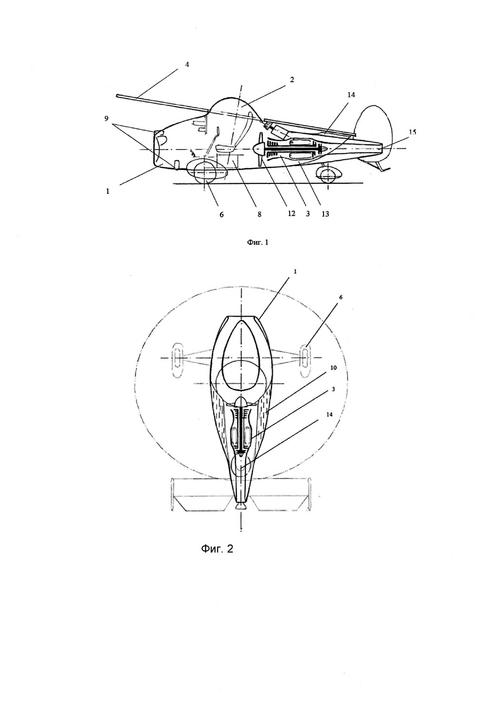
Early autogyros required about 50 feet of runway to take off, but the Fw 186 was designed as vertical take-off aircraft, using the tail plane to deflect the slipstream from the propeller up into rotor. The deflected wind would cause the rotor to spin up before the aircraft began moving. When the rotor reached 1,700 rpm the pilot changed the angle of the blades, by means of the collective pitch control, and the huge momentum gained by the rotor allowed to make the jump start. For cruising flight, the speed of rotation will be turned to 500 rpm with the drag and thrust forces in balance.
In helicopters, a complicated gear system connects the rotor to the engine, which in turn is firmly attached to the airframe that tends to rotate in the opposite direction of the rotor. To compensate for the torque effect, it is necessary to use an auxiliary tail propeller or a dual rotor system that rotate in opposite directions. The torque-compensation equipment accounts for 20 per cent of the weight of the helicopter and requires frequent maintenance. The rotor of a gyrocopter rotates freely, generating lift when moving forward thanks to an aerodynamic phenomenon called autorotation, like the one used in the nautical parachuting. This design avoids the need for a tail rotor.
Since the rotor is unpowered, the gyroplane needs a separate source for propulsion like propellers or jet engines. The machine does have to be moving forward some to maintain autorotation, but because the huge increase in drag generated by the rotor, the gyroplanes are not as suitable for high-speed flights as the airplanes. Additionally, the gyroplanes are incapable of the hovering and vertical landing that helicopters perform. After the experience gained with the Fw 186 and the Fl 184, the RLM had concluded that the inadequacies of gyroplanes could only eliminated by a real helicopter.
In 1937 was flown the Focke-Wulf Fw 61, the first serviceable helicopter in the world. In 1938 the helicopter Flettner Fl 185 V1, based in the Fl 184 airframe, was flight tested.
On May 8, 1945 Germany surrendered to the Allied troops and, in the chaos of the collapsing Third Reich, a number of American intelligence teams collected documents and interrogated German, Austrian and French scientific experts. Under the codenames
Alsos, Overcast and
Paperclip, 492 German specialists in science and technology were deported to the United States and large numbers of extremely valuable German documents were shipped to the Air Document Research Center at Wright Field.
The Americans were particularly interested in atomic research, supersonic wind tunnels, aerodynamic research, rockets, and turbojets engines. Many German engineers and scientists not indispensable were left behind, trying to survive in the hard postwar conditions.
When the American press started publishing
flying saucers reports in June 1947, some experts that took part in the development of German circular wings acquired some popularity after being interviewed by European magazines. One of them was Dipl. Ing. Rudolf Schriever from the
Heinkel-Marienehe design team.
In 1940 he had been interested in the improvement of gyroplanes with some advanced ideas about vertical take-off and landing (VTOL) concept. In the spring of 1941, Professor Ernst Heinkel encouraged him to construct a proof-of-concept scale model powered by a compact two-stroke engine.
In June 1942, a 1/10 scale fully functional prototype, with gyroplane configuration, was flight tested. The conventional rotor was changed by one rotary fan with 60 cm of diameter named
Flügelrad (Wingwheel). The external ring was expected to increase the structural stiffness and the rotor momentum during the vertical take-off, avoiding the vibrations and drag of a conventional rotor.
On February 7, 1942, Minister of Armaments Fritz Todt died in a plane crash just hours after informing Hitler that the war could not be won by conventional means. Since then, the production of armament was divided into two branches: The
Organization Todt, headed by Albert Speer and the
SS Special Projects Office, under the leadership of Dr. Ing. Hans Kammler.
Speer made a god work rationalizing the production of conventional weapons, but very few of the 39,807 aircraft manufactured in 1944 had the opportunity to fight, grounded for lack of fuel.
Following the RAF bombing raid on the rocket research center at Peenemünde, in the night of August 17/18, 1943, Hitler ordered to Hans Kammler to excavate underground sites to produce secret weapons.
By the last moths of the war the SS Organization eventually succeeded in establishing its own industrial empire, with 143 underground factories and 600 facilities in caves and mines across Germany, France, Italy, Hungary, Poland, and Czechoslovakia.
The
SS Special Projects Office was a Pandora box of advanced weaponry that controlled the production of V-1 and V-2 missiles in the
Nordhausen Mittelwerke complex, the
Natter VTOL rocket fighter production at Bachem-Werke-Waldsee and DFS Ainring-Salzburg, the Heinkel
Wespe VTOL ducted fan fighter development in
Wiener Neustädter Flugzeugwerke-Vienna, the SK P14 ramjet-driven interceptor development at Skoda-Kauba Flugzeugbau-Prague and the
Rammer fighter and
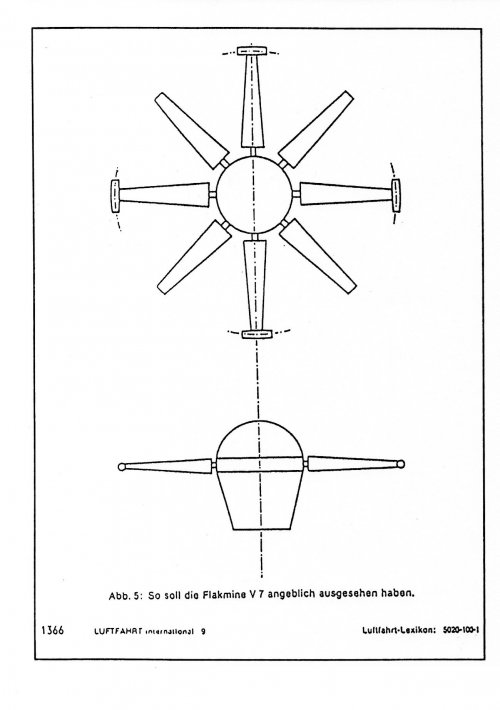
Flugschnittel flakmine development at Zeppelin Werke-Schwarzwald.
The most valuable projects were transferred to the East of the Reich, out of reach of the Allied bombers based in the British Islands, but in March 1944 the B-17 and B-24 American bombers could already reach Prague with P-51
Mustangs escort.
By mid-1944, even the deepest underground German sites could be destroyed by the new anti-bunker heavy bombs developed by the British scientist Barnes Wallis. In the night of 8/9 June the RAF Bomber Command made its first attack with 12,000 pounder
Tallboy bombs and on March 13, 1945 with the 22,000 pounder
Grand Slam bombs.
The construction of the
Flügelrad prototype (one car-towed unpowered rotor kite to prove the concept) was to be undertaken early 1943 at Heinkel-Marienehe and flight tested during the summer.
Early 1944 the project had evolved towards the jet propulsion, but the whole production of Jumo 004 turbojets had been reserved for the Messerschmitt Me 262 jet fighter and the Arado Ar 234 jet bomber, and the production of the HeS 011 turbojet (still in development) had already been assigned to the future
Jägernottprogramm air-superiority fighter Focke-Wulf Ta 183.
There was just one option, the BMW 003 turbojet that have had development problems when converted to diesel in 1943.
By August 1944 it was finally ready for mass production, under the SS control, in underground dispersed sites of
SS-Kraftfahrttechnischen Versuchsanstalt-Oranienburg, Eisenach, Zühlsdorf, Nordhausen, Wittringen and Stassfurt.
In the spring of 1944, the
Flügelrad Projekt was transferred to Skoda Werke, a giant industrial complex in the Czech towns of Brno and Pilsen, with the administrative center in Prague.
In February 1942, under auspices of Hermann Göring, the Skoda-Kauba Flugzeugbau research center was founded with the objective to design a pilot-less flying bomb. Under the leadership of Dipl. Ing. Otto Kauba, the Skoda-Kauba Flugzeugbau Entwicklung secret design team was formed at Prague-Cakowitz, with prototype workmanship facilities at Avia-Cakowitz and Avia-Klecany Werke.
When the flying bomb project was dropped in June 1942 in favor of the Fieseler Fi.103 (V-1) cruise missile, the design team focused in experimenting with unusual configuration airframes.
The SK V2 prototype, with rear swept wings, was flight tested in June 1943 at Prague-Ruzyn airfield, the SK SL-6 was a ‘bat-wing’ flying mock-up of the radical Blohm und Voss P.208.02 jet fighter project, the SK V7 was a
canard swept wing aerodynamic research prototype, the SK V12 was a light plane project with forward swept wings and the SK P.14 an interceptor project powered by one Flugtechnische Fertigungsgemeinschaft Prag (FGP) ramjet engine.
Early 1943 the Kauba team obtained its first practical result with the unusual
Banweise wing construction system, of the SK V4 prototype, using a conical steel single spar, made at Podbrezova Werke. So successful were flying trials with the V4 that the RLM awarded a contract for 1,000 units of the SK 257 trainer.
By 1944 the Skoda-Kauba workforce consisted of 120 technical personnel headed by the engineers Eduard Lehmayer, Kurt Haas, and Frantisek Kadlec, three workshops, one aerodynamic test site and flying test facilities at the VZLU-Prague.
End of 1944 Kauba had obtained contract for the transformation of the Fw 190 D and the Fw Ta 152 fighters with new laminar profile wings.
In 1945 the
Banweise system was the best option for the construction of the
Flügelrad rotor, but the destruction of all documents and project drawings by the
SS Special Evacuation Kommando in April 30 of that year, made impossible the confirmation of the hypothesis.
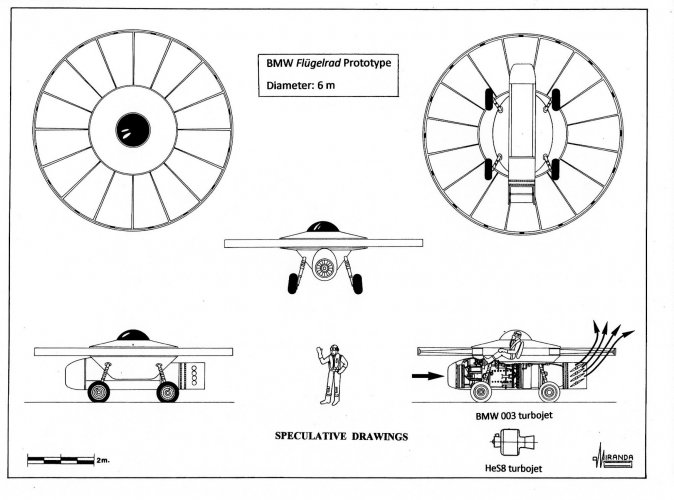
In my opinion, a prototype with 6 m of diameter could have been built in the Avia-Cakowitz workshop during the autumn of 1944, performing a few taxiing trials across the Prague-Gbely airfield in February 1945 and was destroyed by the SS on May 6 to 9.
Although several sources indicate that the prototype was powered by one BMW 003 turbojet, it is unlikely that the builder would use such a valuable engine during the first trials.
In my opinion, the initial power plant could have been a small Heinkel HeS 8 turbojet with 700 kp static thrust. The HeS 8 production was abandoned by the spring of 1943 following the cancellation of the Heinkel He 280 jet fighter, but thirty prototypes were available.
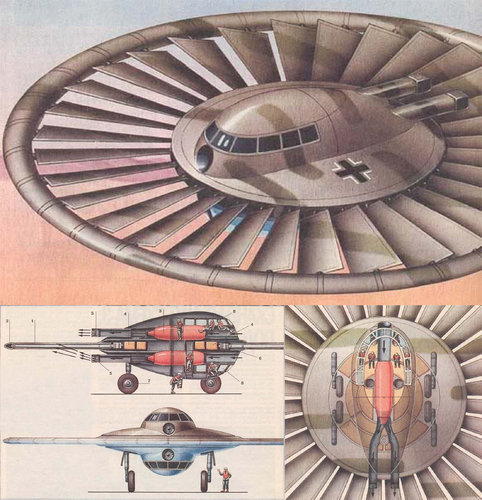
The
Flügelrad was a jet-powered gyroplane with the rotor blades mounted so close to each other that they formed a disc. The operation principle was the deflection of turbojet exhaust gases upwards to start the rotor spin, after achieving 1,800 rpm the exhaust was redirected backwards, the blades pitch was changed from -3 to +3 degrees and the machine jumped upwards. When reaching cruising height, the blades were positioned in negative pitch and the gyroplane flew like a kite, with a small angle of attack.
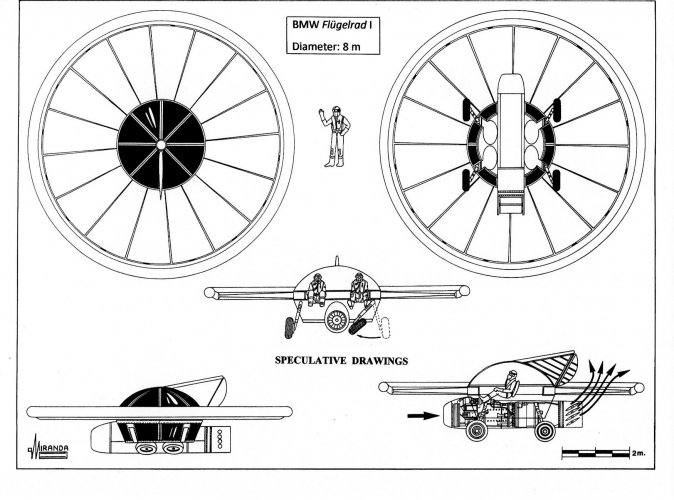
Flight tests carried out at Marienehe had shown that flight control was impossible by redirecting the engine exhaust and it was considered the construction of a second gyroplane with 8 m diameter (
Flügelrad I) fitted with a conventional tailfin and rudder assembly. But the wind tunnel tests performed with a scale model revealed that, at high angles of attack, the turbulent boundary airflow rendered the control surface useless.
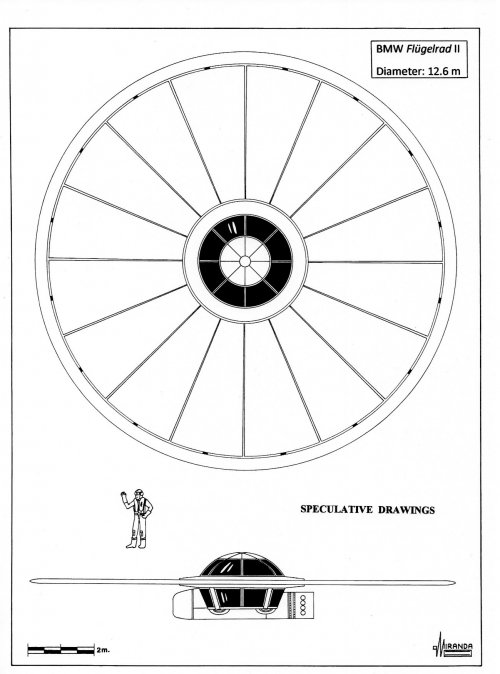
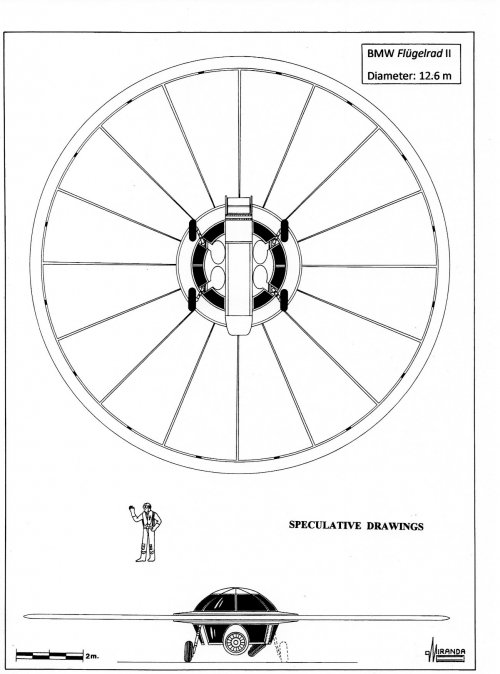
Same thing happened with the projected
Flügelrad II with which it was attempted to solve the problem by extending the rotor diameter to 12.6 m. For the future production version
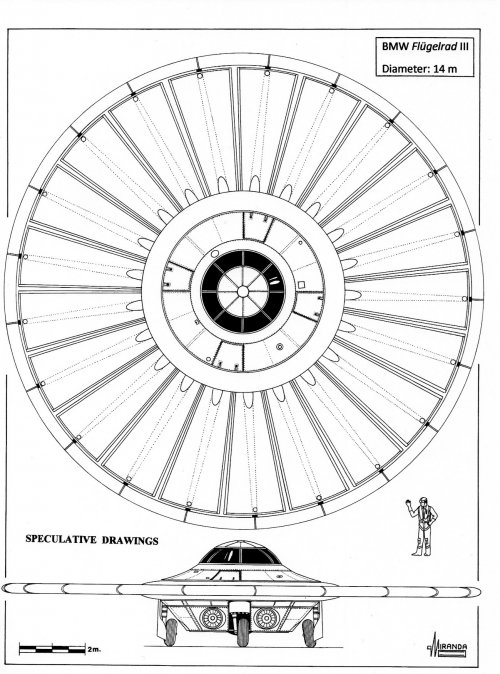
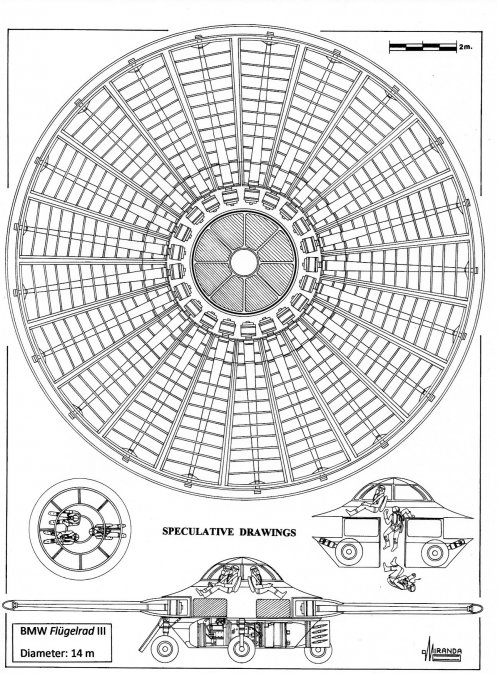
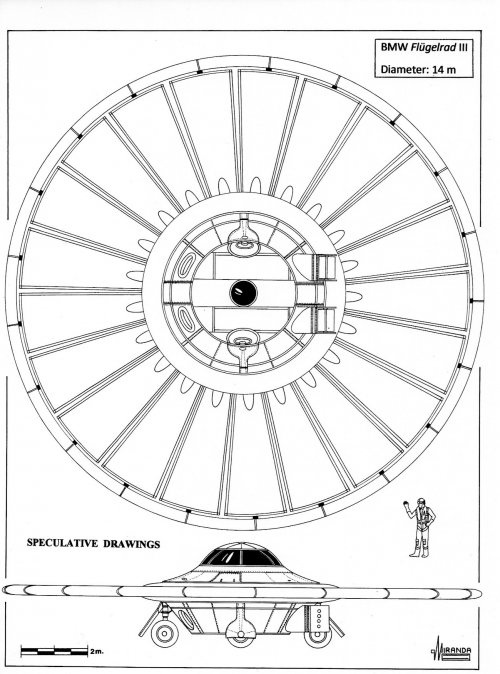
Flügelrad III it was decided to use two turbojets and a rotor of 14 m of diameter and 21 blades, to prevent ground resonance phenomena.
Theoretically, the pilot of the
Flügelrad III could obtain yaw control by varying the power of one of the turbojets, pitch control by redirecting upwards or downwards simultaneously the exhaust flow of both engines and roll control by alternating the flow upwards and downwards. The flow was directed by means of the new NOTAR thrust system, and the exhaust automatic control for continuous variable operation patented by Heinrich Focke in June 1944 under the title:
Hubshrauber mit Einrichtung zum Ausgleich des Rückdrehmomentes.
By 1940 BMW started the design of the turbojet model 018, a 116 per cent scaled-up version of the BMW 003 with 450 per cent increased power. The new engine was too big and heavy to be installed in a fighter and was therefore intended to see operational service through the jet bomber force planned for 1947.
In the summer of 1944 BMW designed the advanced jet bomber
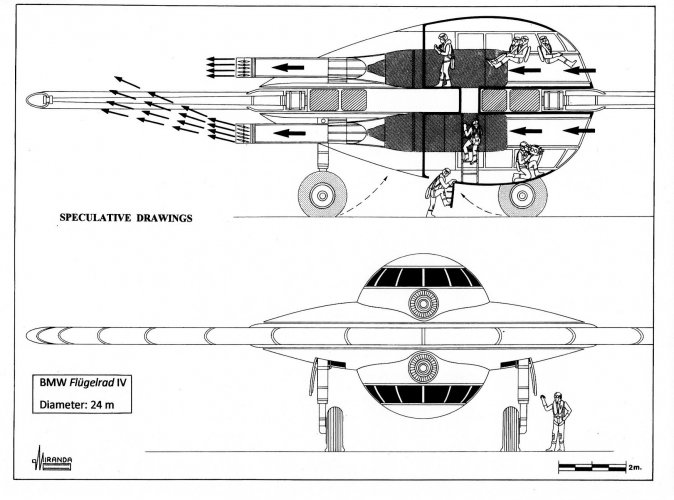
Strahlbomber II powered by four BMW 018 turbojets. When all bomber projects were cancelled by the RLM early 1945 the use of two 018 was considered to propel the
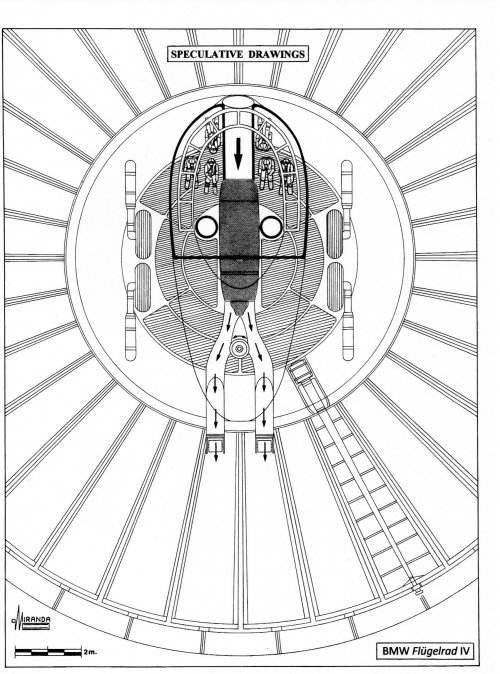
Flügelrad IV, with 24 m of diameter. These engines were located one above the other separated by the rotor plate. The nozzles were diverted in two
Strahlrohr pipes fitted with Focke jet shutters made of
Sicromal 10 heat-resistant steel.
Official development of the BMW 018 was stopped in late 1944 but BMW managed to build a prototype in Oberwiesenfeld. The tests were to be done at Dresden and Oberhausen, but the engine was destroyed at Stassfurt in 1945 to avoid its capture.
In 1995, after the publication of my book
Die Geheimen Wunderwaffen des III Reiches, Herr Manfred Franzke, editor of
Flugzeug Publikations GmbH, asked me to perform a design analysis of the
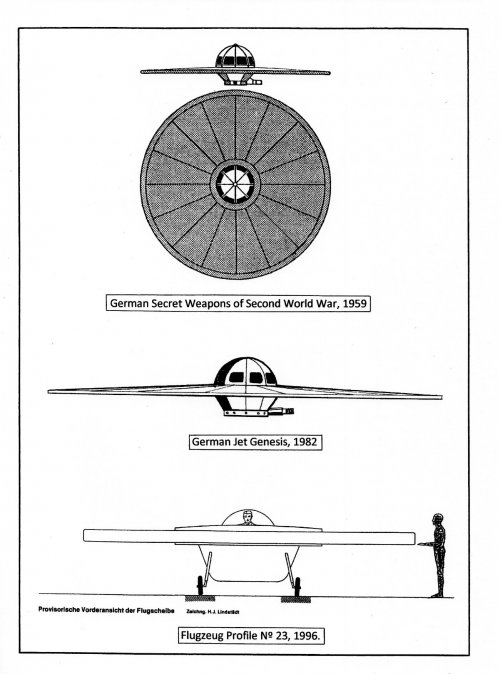
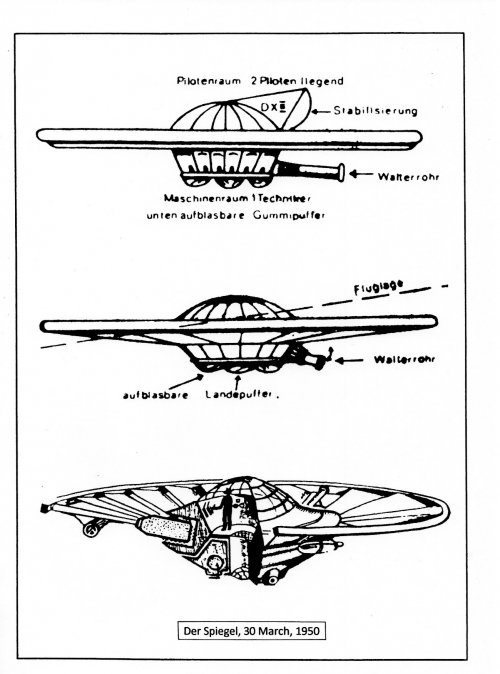
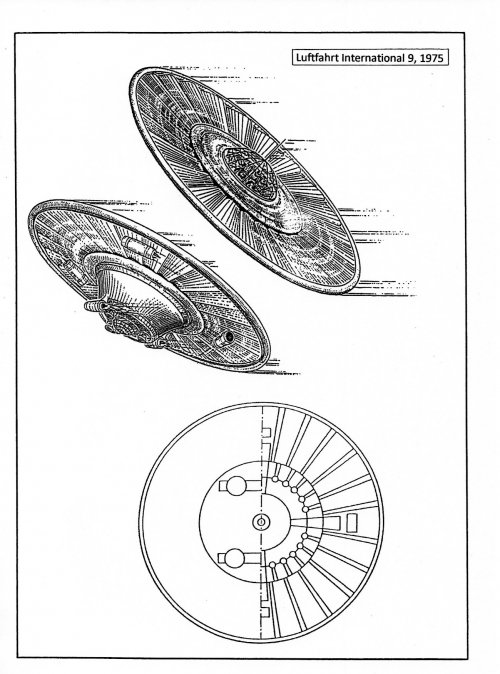
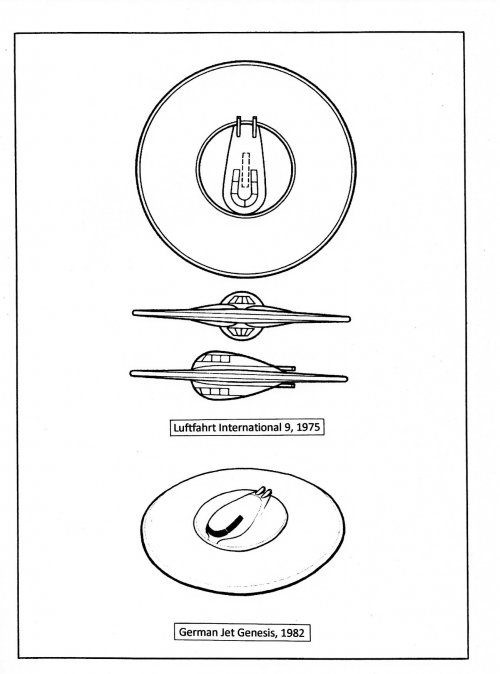
Flügelrad concept based on the drawings published between 1950 and 1982 in
Der Spiegel,
German Secret Weapons of the Second World War,
Luftfhart International and
German Jet Genesis. I sent him twelve pages of speculative drawings showing the
Flügelrad principle of operation in August 1996. My work was published in
Flugzeug Profile Nº 23 under the title
Deutsche Kreisflügelflugzeuge, together with an article by Hans Justus Meier and a sketch by H.J. Lindstädt, without any indication that warned the reader of its speculative nature.
Bibliography
‘
Die Realität der Flugscheiben’ by Andreas Epp, Michaels Vertrieb editor, 2002.
‘
Flugscheiben-Realität oder Mythos: Gespräche mit dem Flugscheiben-Erfinder’, by Andreas Epp, Michaels Vertrieb editor, 2005.
‘
Die deutschen Waffen und Geheimwaffen des 2. Weltkrieges und ihre Weiterentwicklung’ by Rudolf Lusar, J. F. Lehmann; Edition: 4., stark überarb. u. erw. Aufl. (1962).
Epp, Joseph Andreas, ‘U.S. Army Intelligence, Record Group 319, Box 186, File Number GE013347’. The National Archives at College Park, College Park, Maryland. -
http://www.archives.gov/iwg/declassified-records/rg-319-army-staff/personal-name-files-new.html
‘Evaluation Reports (ER), Final Reports (FR) und Overall Reports der British Intelligence Subcommittee, Reports der Combined Intelligence Objectives Subcommittee (C.I.O.S.) und Field Intelligence Agency (F.I.A.T.)’.
‘Hitler’s Flying Saucers: A guide to German Flying Discs of the Second World War’ by Henry Stevens, Adventure Unlimited, 2013.
‘Flying Saucer Technology’ by Bill Rose, Midland, 2011.
‘Secret Projects- Flying Saucer Aircraft’, by Bill Rose & Tony Buttler, Midland, 2006.
‘Jet Planes of the Third Reich -The Secret projects -Volume One’, by Manfred Griehl, Monogram, 1998.
‘Secret Weapons of the Third Reich’ by Leslie E. Simon, WE, INC., Publishers, 1971.
‘Messerschmitt Me 328
Bordjäger’, by Paul Malmassari, Wingmasters Nº 2.
‘
Der Fliegende Bierdeckel’, by Arthur Sack, Die Deutsche Sportflieger, November 1939.
‘
Der Kreisflüger AS6 V1’, by Hans Justus Meier, Luftfahrt International 4/79.
‘
Aktennotizen und Niederschriftender der ATG-Maschinenbau GmbH.’, Leipzig, von 4.2, 3.2, 17.4 und 18.5, 1944.
‘
Veröffentlichungen zuden Modellen von Arthur Sack’,
Der Flieger 11-12/1940.
‘
Hochwertige Motorflugmodelle’, Der Deutsche Sportflieger, 9/1940.
‘
Das Buch der Deutschen Luftfahrttechnik’, Bidteil, Mainz, 1970.
Der Flieger 4/1944.
Air International, March 1979.
‘
Neue formen des Starrflügel-Flugzeuges’, by W. Zuerl,
Der Flieger 1/1944.
‘
Dreikomponentenmessungen an einem Kreisflügel mi zwei klappen’, by E. Hildenbrand, Aerodynamische Versuchsanstalt Göttingen, Beritche Nr.40/14/40 vom 3.8.1940 und 41/14/5 vom 21.2.1941.
‘
Deutsche Kreisflügelflugzeuge’,
Flugzeug Profile Nr.23.
‘
Fliegender Bierdeckel’, by Volker Koos,
Flug Revue 3/1994.
‘
Kreisflügler Arthur Sack AS6’, by Volker Koos,
Flug Revue 11/1998.
‘Saucers, Swastikas and Psyops’, by Joseph T. Farrell, Adventures Unlimited, 2011.
France Soir, June 27, 1952.
‘
Erste Flugscheibe flog 1945 in Prag enthullt speers beauftragter’, by Georg Klein,
Welt am Sonntag, April 25, 1953.
‘German Discs: UFO in the Third Reich’, Los Angeles Mirror, 24 March 1950.
Dortmund Newspaper, Westphalian Overview, 9 July 1947.
‘
Deutsche Flugkreisel, Gab’s die?’ Luftfahrt International May/June 1975.
‘
Projekt Flugkreisel’, by Rudolph Schriever,
Bremerhavener Zeit entstanden.
‘
Untertassen-Flieger Combination’,
Der Spiegel, 30 March 1950.
‘
Flugkreisel Irdisch’, Helm & Welt Nr.14, 2 April 1950.
‘
Fliegende Untertassen’,
Die 7 Tage Nr.26, June 1952.
‘
Fliegende Untertasse’, Farb Illustrierte Nr.18, September 1952.
‘
Fliegende Untertasse in Deutschland erfunden’, Deutsche Illustrierte, S.1350/51.
‘Secret Wings of WWII: Nazi Technology and the Allied Arms Race’, by Lance Cole, Pen & Sword Aviation, 2015.
‘
Das gab’s die fliegende untertasse der deutschen Luftwaffe’, ZB Illustrierte für menschen in atomzeitalter Nr.25, December 1953.
‘
Wunderwaffen 1945’, Bild am Sonntag, 17 February 1957.
‘
Die UFOs, eine deutsche Erfindung’, Das neue Zeitalter Nr.41, October 1957.
‘
Deutsche Kreisflügelflugzeuge’, by Hans Justus Meier,
Flugzeug 2/89.
‘
Deutsche Geheimwaffen und Wunderwaffen des II. Weltkrieges’, by Christof Friedrich, Samisdat Publishers, Canada.
‘Aeronautical Research in Germany: From Lilienthal until Today’, by Ernst Heinrich Hirschel, Springer 2012.
Henry Coanda Propelling Device Patents 2,157,281/2,131,472/2,108,653 (10 January 1936).
‘Applications of the
Coanda Effect’, by Imants Reba, Scientific American, June 1966.
‘The Coanda Effect’, by R.S. Sproule and S.T. Robinson. CIOS Reports. File Nº IX (1), 1944.
‘The Vanishing Paperclips’ by Hans H. Amtmann, Monogram, 1988.
‘
Ich flog als erster eine untertasse’, Kristall Nr.2, 1956.
‘Intercept but don’t shoot’, by Renato Vesco, Adventures Unlimited Press, 1994.
‘Interceptarlos sin disparar’, by Renato Vesco, Ediciones 29, 1968.
‘Intercept UFO’, by Renato Vesco, Pinnacle Books, 1976.
‘Man-Made UFOS 1944-1994’, by Renato Vesco & David Hatcher, Adventures Unlimited Press, 1994.
‘German Secret Weapons of World War 2’, by Rudolph Lusar, (Review by Reuters in the Washington Post, 18 February 1957.
‘German Secret Weapons of World War 2’, by Rudolph Lusar, Neville Spearman, 1959.
‘
Die Deutschen Waffen und Geheimwaffen des 2. Weltkrieges und ihre Weiterentwicklung’, by Rudolph Lusar, J.F. Lehmans Verlag, 1962.
‘
Fliegende Untertassen, eine Deutsche Erfingdung’, by Rudolph Lusar
, Das Neue Zeitalter Nr.9, 1958.
NASM microfilms R 2750 F 268 and R 3216 F 75.
‘Messerschmitt Me 328
Bordjäger’, Wingmasters Nº2.
‘
Flugscheiben über Peenemunde?’ by Leonhard Eckardt & Heiner Gehring, AMUN-Verlag, 2001.
‘
Die deutschen Flugscheiben-Konstrukteure, by Andreas Epp,
Sternentorverlag, DVD, May 1999.
‘
Die Realität der Flugscheiben’, by Andreas Epp, Michaels Verlag, January 2002.
‘
Geheimprojekte der Luftwaffe-Band III’, by Dieter Herwig & Heinz Rode, Motorbuch Verlag Stuttgart 2002.
‘
Die Luftwaffe Projekte der Deutschen Luftrüstung -Band 1‘, by Ingolf Meyer, Kissing 2004.
‘German Explosive Ordnance TM9-1985-2’, Departments of the Army and the Air Force, March 1953.
‘Aircraft Vibration and Flutter Research in Germany’, US Naval Technical Mission in Europe. BIOS Miscelaneous Report 61. 1945.
‘
Die Deutsche Luftrüstung 1933-1945 -Band 1 to 4’, by Heinz J. Nowarra, Bernard & Graefe Verlag 1993.
‘German Jet Genesis ‘, by David Masters, Jane´s 1982.
‘Jet Planes of the Third Reich, the Secret projects Volume One’, by Manfred Griehl, Monogram Aviation Publications 1998.
‘Jet Planes of the Third Reich, the Secret projects Volume Two’, by Manfred Griehl, Monogram Aviation Publications 2004.
‘German Jet Engine and Gas Turbine Development 1930-1945’, by Antony L. Kay, Airlife 2002.
‘Paper Planes of the Third Reich’, Toros Publications 1988.
‘German Aircraft New and Projected Type, A.I.2 (G) Report Nº 2383’ by H.F. King, January 1946.
‘Dragonfly, The Luftwaffe Experimental
Triebflügeljäger project’, by David Myhra, Schiffer 2003.
‘Luftwaffe Secret Jets of the Third Reich, by Dan Sharp’, Mortons Media Group Ltd. 2015.
‘Secret Messerschmitt Projects by Willy Radinger & Walter Schick’, Schiffer 1996.
Luftfhart International Nº 9, 10 and 17.
‘
Flugzeugfahrwerke ‘, by Günter Sengfelder, Motorbuch Verlag Stuttgart 1979.
‘
Die Deutschen Raketenflugzeuge 1935-1945’, by Joachim Dressel & Manfred Griehl, Motorbuch Verlag Stuttgart 1989.
Die Deutsche Illustrierte, 1953.
Welt am Sonntag, 26 April 1953.
Flieger Welt Deutscher Aero-Digest, Heft 1/1951.
Flugzeug 1/2000.
Flugzeug 2/94.
‘German Helicopters’ by Heinz J. Nowarra, Schiffer, 1980.
‘Helicopters of the Third Reich’, by Steve Coates, Classics Publications Nº 10, 2003.
‘Rotorcraft of the Third Reich’ by Ryszard Witkowski, MMP Books, 2007.
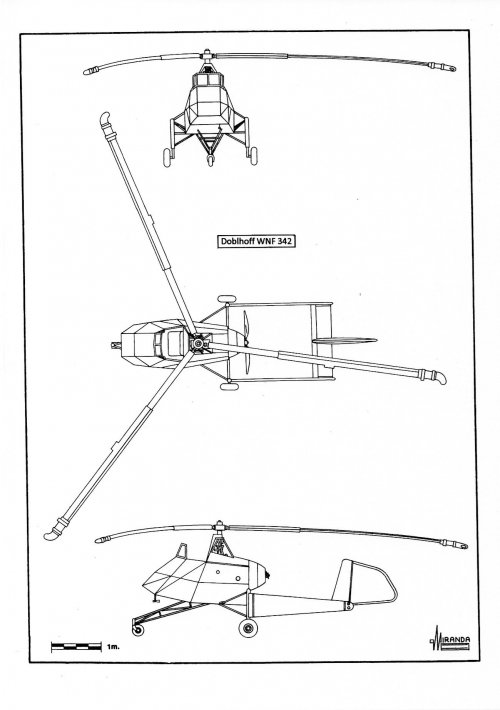
‘Doblhoff WNF 342’, by Paul Lambermont, Le Fanatique de l’Aviation Nº 120.
‘Corona and Induced Current Effects’, Tri-Valley Project PEA, SFO/992220016/November 1999.
‘The Coanda Story’, by Martin Caidin, Flying Magazine, May 1956.
‘Romanian Inventions and Priorities in Aviation’, by Constantin C. Gheorghiu, Ed., Albatros, 1979.
‘The hunt for zero point’, by Nick Cook, Century, 2001.
‘
Le dossier des soucoupes volantes’ by Jacques Lob, Dargaud Ed, 1972.
‘Gas Turbine Development-BMW, Junkers, Daimler Benz’, by P. Lloyd, CIOS Report. File Nº XXIV (6). C. 1945.
‘Gas Turbine Development by BMW’, by P.R. Price. CIOS Report. File Nº XXIV (30). C. 1945.
‘German Submarine Rotary Wing Kite’, by B. Kelley and H.J. Mulvey. CIOS Report. File Nº XXVIII (21). C. 1945.
‘Ceskoslovenska Letadla 1918-1945’, by Václav Nemecek, Nase Vojsko Praha, 1983.
‘
Les étranges creations d’Otto Kauba’, by Otakar Saffek, le Fanatique de l’Aviation Nº 272.
‘
Skoda-Kauba Flugzeugbau’, by Walter Schroeder, Öfh nachrichten, Sonderheft Nr.23, 1998.
‘German Gas Turbine Development During the Period 1939-1945’, by J.W. Adderley, British Intelligence Objectives Sub-Committee Report Nº. 12, 1949.
‘Centrifugal Compressors’, by L.J. Cheshire, George Newnes Ltd, 1955.
http://www.aerospaceweb.org/question/helicopters/q0141.shtml
https://en.wikipedia.org/wiki/Hiller_YH-32_Hornet
https://www.quora.com/Could-a-helicopter-utilize-a-jet-engine