A
AAAdrone
Guest
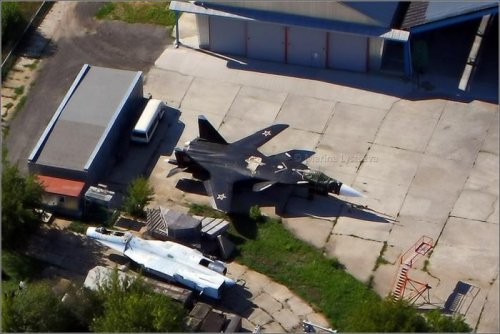
It's almost sad to see that thing like that. I wonder what happened to the Su-47. Is that thing parked on display like that too?


the same...it wil barely fly again...AAAdrone said:I wonder what happened to the Su-47.

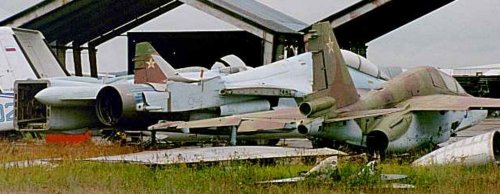
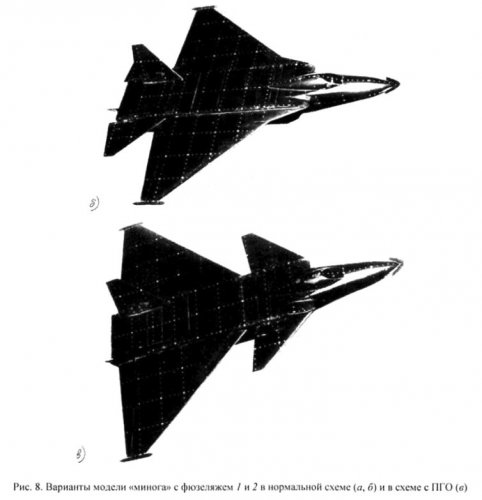
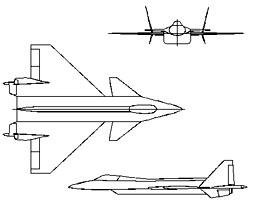
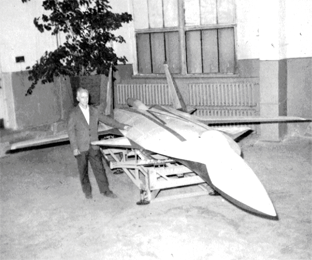
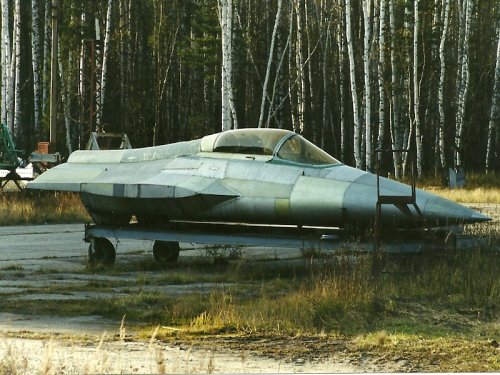
overscan said:These pictures (from Paralay's site) appear to show the TsAGI test model which was seen by visiting French engineers and others in the early 90s and which generated the first speculative 3 views of S-32.

Matej said:And Yak MFI? In other words, why not to move the cockpit a bit forward, at least by half meter? As you can see, the WT model of the KFX has the meaningful shape, so I am trying to figure out, if it is the same case as with the Yak MFI model (because currently it is the only available source of the information about Yakovlev MFI entry).
overscan said:Matej said:And Yak MFI? In other words, why not to move the cockpit a bit forward, at least by half meter? As you can see, the WT model of the KFX has the meaningful shape, so I am trying to figure out, if it is the same case as with the Yak MFI model (because currently it is the only available source of the information about Yakovlev MFI entry).
The answer to this question:
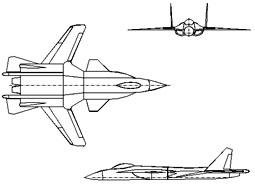
this Yak design had an additional lift engine in front on the cockpit and behind the radar, and a tilting rear nozzle, for ultra-STOL. It is not certain if it really is MFI timeframe or later, in the 1990s.
http://www.paralay.com/lfsyak.html


In 1987-1988, we received an order from the OKB. PO Dry for the development and construction of such a model to dynamically flying fighter of the 5th generation, which then did not have another name. Our model of this aircraft called SLM-22. According to the recommendations of experts and TsAGI OKB. PO Dry model should have a scale 1/4 of the future of the aircraft, forward-swept wing, similar to the control system. Mass model increased to 900 kg. It was necessary to revise the method of landing such a heavy model and the way to start, as we apply methods before landing and launch from an aircraft carrier for such weight model and its dimensions were not good.
During 1987, was built two models of SLM-22 and executed on these three flights. These models do not have a motor. Running the models was carried out with the help of a helicopter, which is raised to a height of model 6 ... 8 km. The model was suspended from a helicopter on the cable length of 40m. After separation from the suspension of the helicopter model was part of a nose dive and as a required rate of transition to an investigational flight mode. Landing models used the following scheme: after the end of the planned research while reducing to a dangerous height automatically produced from the tail section of a torus of synchrotron-parachute. After slowing down a flight or fall pattern to the desired values produced main landing parachute. Model landed horizontally on three shock absorber. Delivery model after flight experiments on the so-called technical position or, more simply, the base was carried out also on the suspension of the helicopter. Received the materials testing, OKB. PO Sukhoi has made significant changes in the external forms of the created aircraft.
before us was given the task - to quickly develop and build a new model for the aircraft and install it on a jet engine. Subject to change almost all of the external contour. Practically had to build a new flying dynamically similar model.
At the end of 1991, this model was built. It was called we SLM-32. It was a model of the future fighter P-37. Model made eight flights was obtained extensive data on the characteristics of the simulated aircraft. According to the results of flight tests of the model have been made significant adjustments to the design of future aircraft.
During these years, OKB. AI Mikoyan began working on the fifth generation fighter. We also received an order to build a flying dynamically similar model designed aircraft, which had the name "5.12". Future aircraft had scheme "duck" with a front driven horizontal tail. According to the technical task of the model must have a scale 1/4 of the future aircraft and weight 900 kg.
For OKB AI Mikoyan work was carried out in 1979 - 1989 years. Models in this series are designed for the MiG-29, MiG-29UB, MiG-29S. Just tested 13 variants of models with different variants of the geometry of the aircraft, avionics, controls, external suspension, mass and center of gravity. Models were carried out following the program experi-mental studies:
study of stability, controllability, corkscrew, inference methods of spin, in particular by the "swing";
research on the effectiveness of controls, including vortex generators;
research new methods for improving the stability and councils-lyaemosti at high angles of attack (mode "super maneuverability").
We have built two model airplane 5.12 which we called DM 5.12. Models do not have the motor. Way to start a flight and landing were similar to flying model SLM-32. Unlike the SLM-32 - on the number of modes used not one parachute large area, and three conventional rescue parachute. So it was cheaper. First as shock absorbers used inflatable bags. Research for flying model aircraft for 5.12 took place in the period 1987-1992. Was performed 10 operations of this model. Worked out the layout of the future aircraft control laws, and most importantly - the flights were investigated at high angles of attack at stall and a corkscrew. The results obtained make it possible-poured to make substantial modifications to the aircraft of the future.
flateric said:it's was "Lamprey" made by TsAGI
it's relationship to T-45/T-50 line is _highly_ questionable as Lamprey dates back to early 90s
http://www.secretprojects.co.uk/forum/index.php/topic,2832.msg203528.html#msg203528

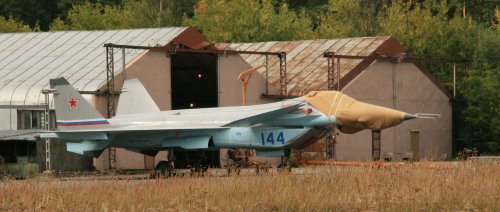
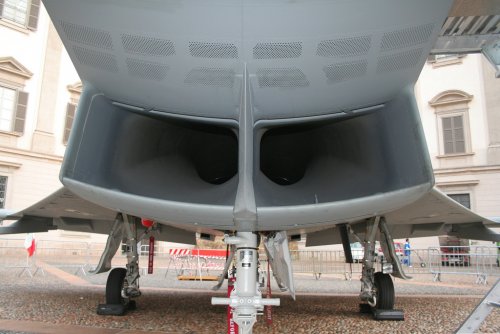
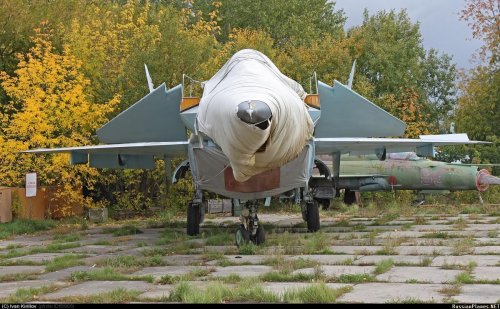
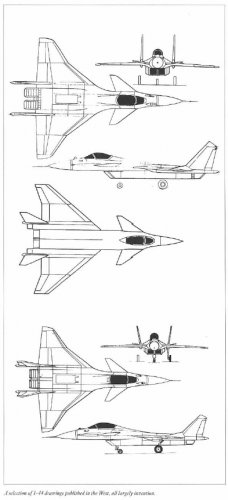
Empire said:In regards to the wedged air intake featured on drawings of the 1-42 design wouldn't it have been easier to add euro-fighter stealthy smiley face air intake features on the final fighter. To test the square intakes on the 1-44 and than have to re-test wedge shaped intakes later seems strange. Adding the euro-fighter style intake doesn't seem like that radical of a change to the original design. Below is a euro-fighter intake and the 1-44 intake covered with tarps the tarps make an optical illusion to the intake making it look like a stealthy smiley face design.
Empire said:I think they were interested in a low RCS in the front hemisphere why else cant the vertical stabilizers. To me the 1-44/42 would have been a souped up euro-fighter like design. If they had gone ahead with the project. Here is my take on the 1-42 design. Give the air intake a stealthy smiley face modification, RAM for the leading edges of the wings, vertical stabilizers, canards, and the intake edges plus interior. Internal weapons carriage. Stealthy radome design cant the dish. They probably could have got the front RCS down to a little better than the euro-fighter just because of the internal weapons bay.
N014 was the intended radar, a passive phased array design. Never built, but would have been something like the N011M Bars.Empire said:Hi Sundog,What modifications do you think the soviets would have had to make to the 1-44 to get a fighter that could tangle with the f-22? Also have you heard what radar they were planning to use in the 1-42 ?
N014
OKB: Tikhomirov NIIP
Associated with the Mikoyan 1-42/1-44 project, the passive phased array N014 radar project from NIIP was abandoned. Supposed to track 40 targets. Range up to 420km. Used in conjunction with the N012 tail radar. The antenna was scanned electronically and mechanically to increase angular coverage.
Some elements or techniques from it were applied to the N011M.
NIIP have experimented with bistatic radar techniques, which were probably intended for N014.