US/UK ASTOVL - McDonnell Douglas MFVT

Antonio

Moderator
Staff member
Senior Member
Joined
22 January 2006
Messages
4,434
Reaction score
2,796
AW&ST. April 23 1990

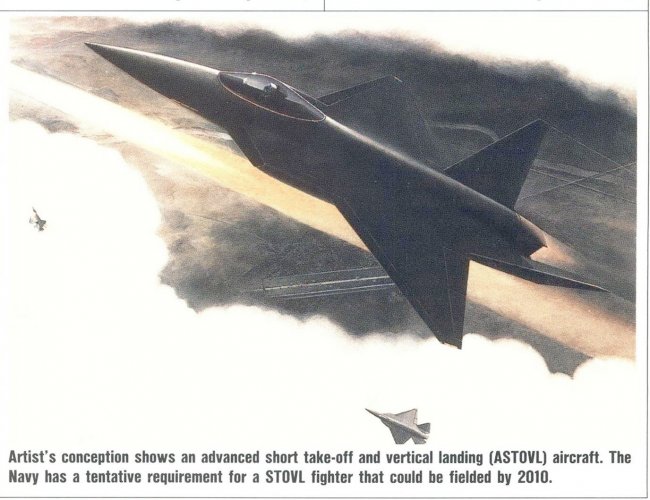
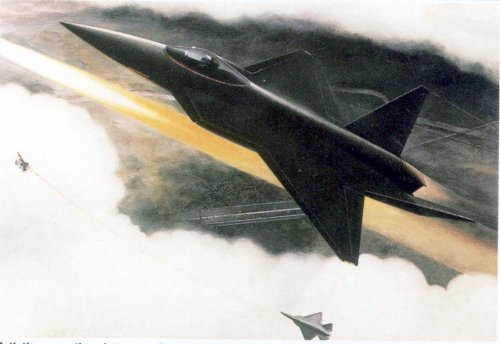
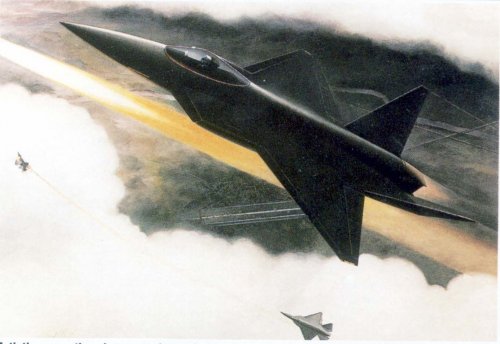
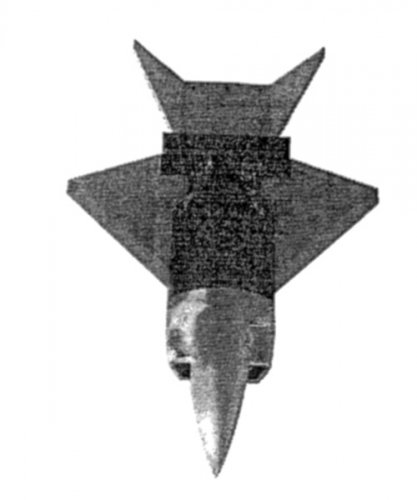
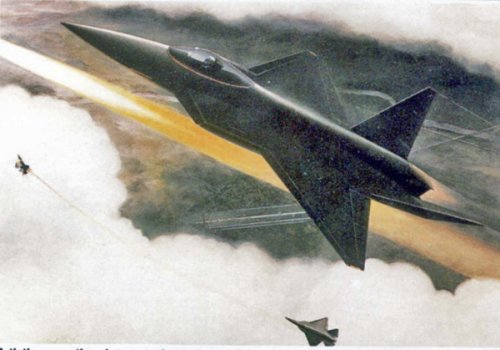
Concept for an advanced STOVL fighter. "The Navy has a tentative requirement for such an aircraft that could be fielded by 2010"

[wrongly identified as Lockheed by poster - Admin]
 

Attachments

  • Lockheed ASTOVL concept.jpg
    Lockheed ASTOVL concept.jpg
    123.6 KB · Views: 1,514
Last edited by a moderator:
Re: Newark Air Museum RCS models on display - P.1216 and McDonnell/BAe ASTOVL

Kelly Bushings said:
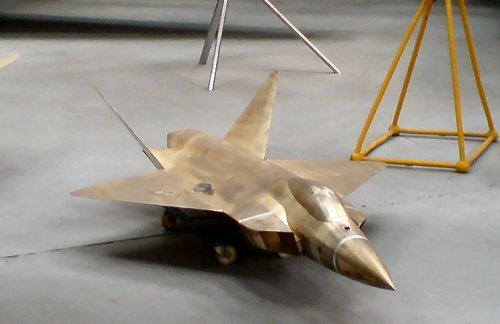
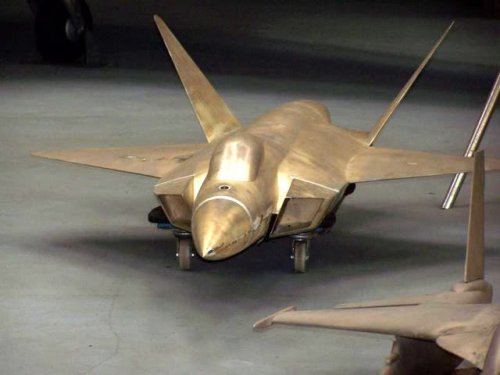
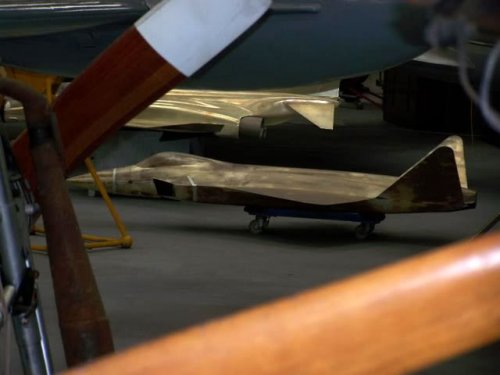
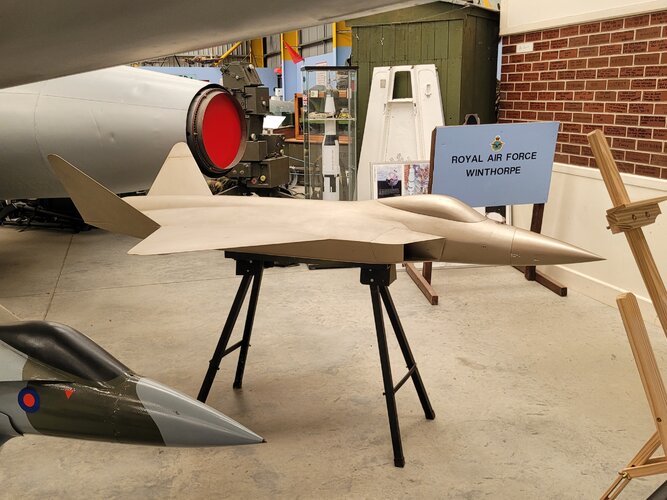
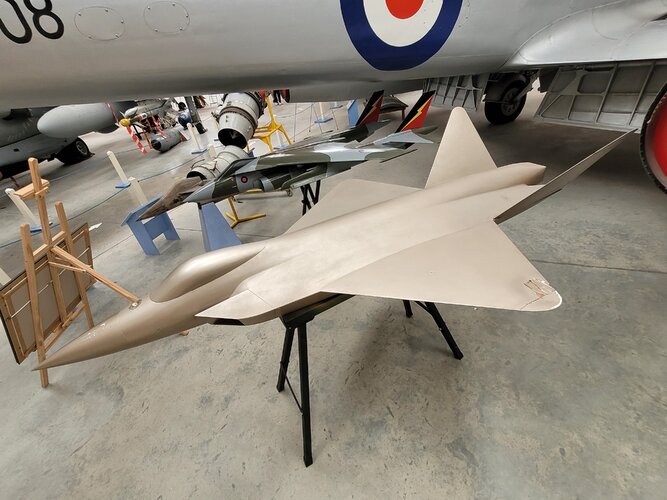
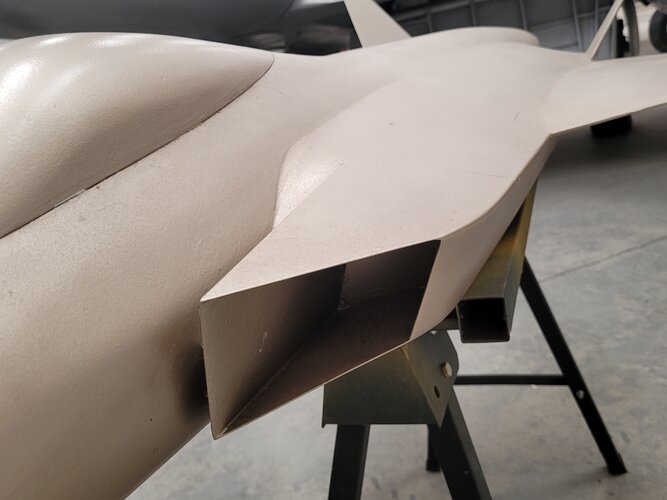
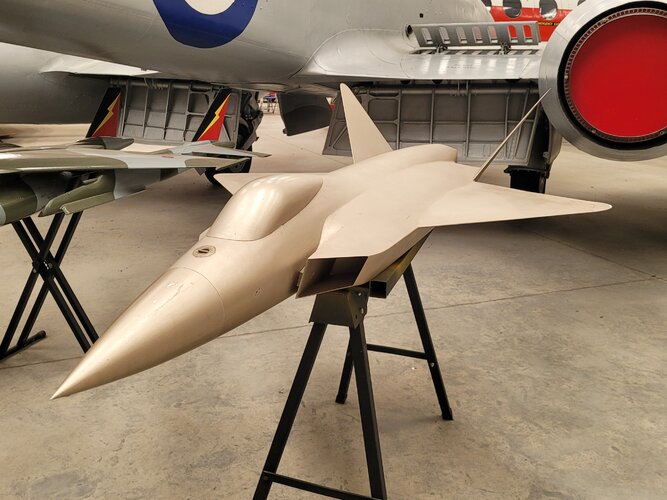
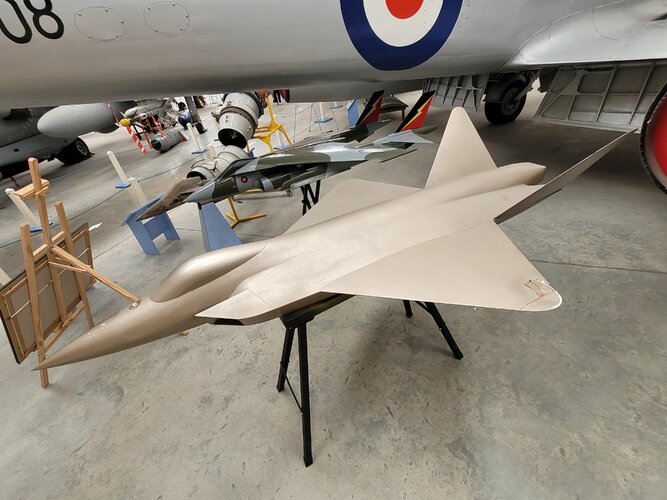
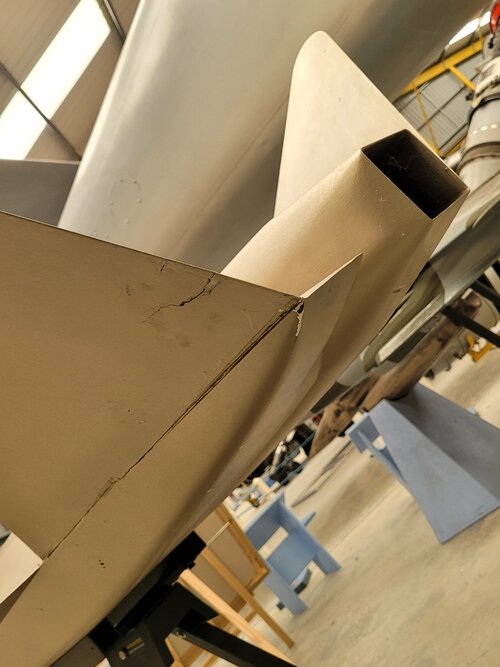
.....but what is the canted-fin job next to it? The fins have rounded tips and it lacks tailplanes. Only had my phone with me, so 'scuse the pics.

The tailplane arrangement resembles Replica, or even the failed MD-NG JSF competior.

However, this is a single engine design, unlike Replica or the 1995 FOAS design study.

In addition, the wing planform doesn't resemble the MD-NG JSF.

This appears to be a model of a JSF size aircraft, much smaller than Replica, although I might be wrong about even that.

Very odd.
 
Re: Newark Air Museum RCS models on display - P.1216 and McDonnell/BAe ASTOVL

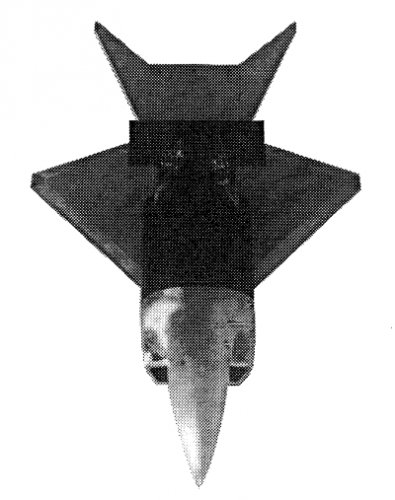
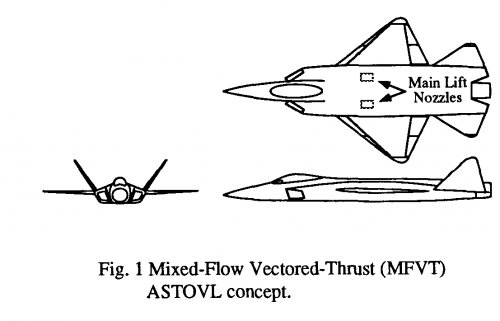
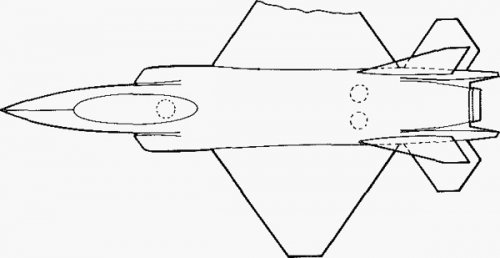
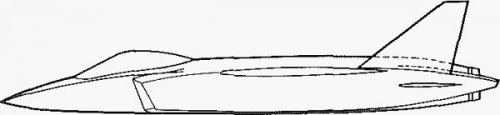
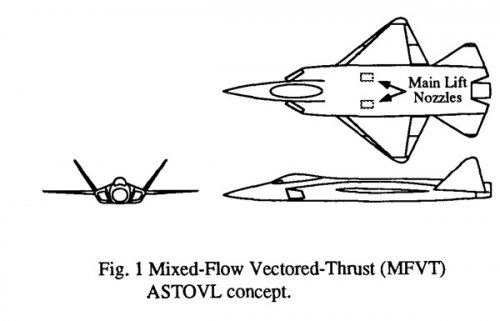
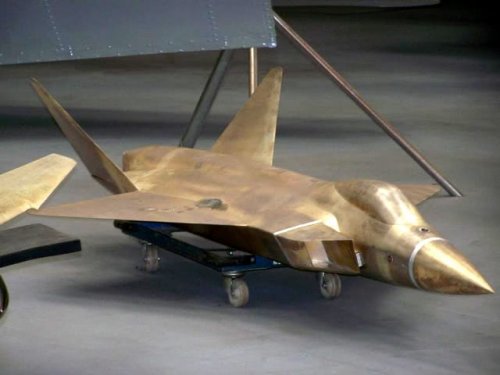
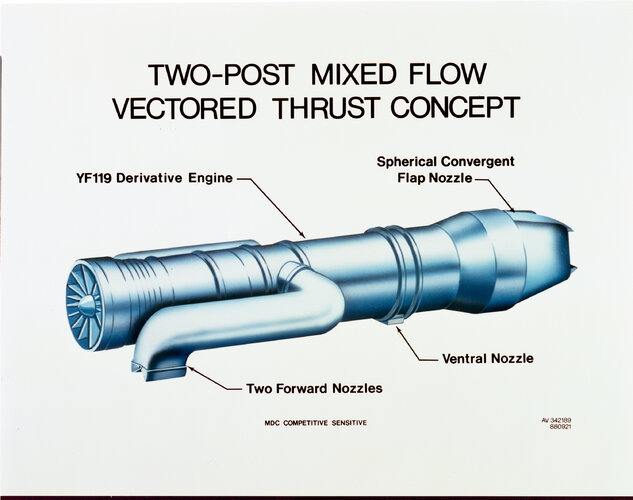
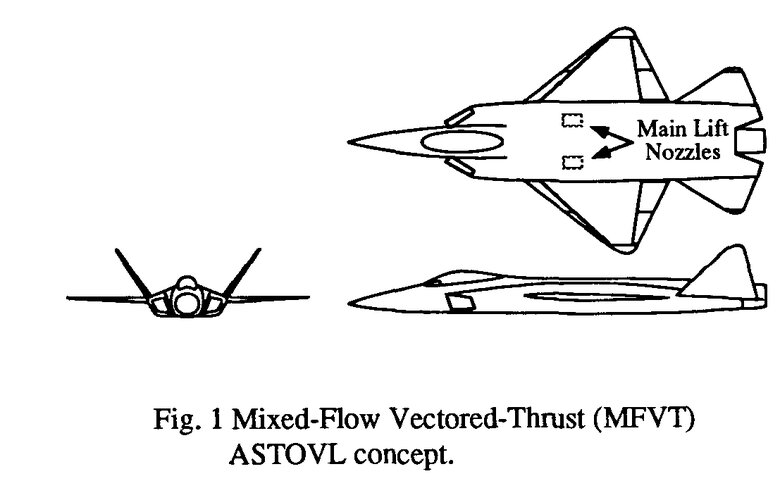
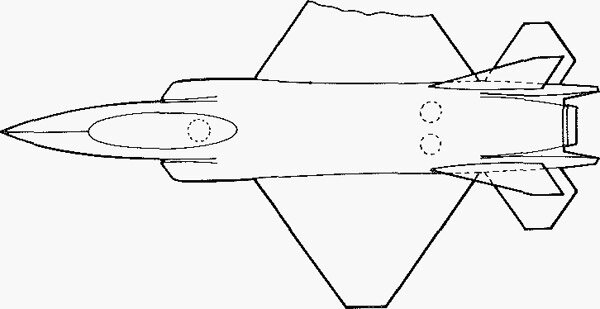
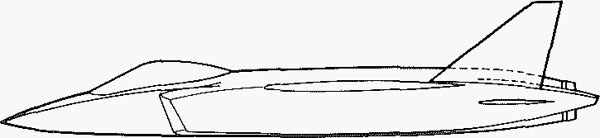
McDonnell and Northrop design roots are obvious - remember that before 'final' MDa-BAe-NG JAST submission were plenty of the others designs, WT-tested at UK. Think this one is ca. late 1993 - MDC 1993 MFVT (mixed flow vectored thrust) ASTOVL.

Kelly, great find, thanks!
 

Attachments

  • Clipboard01.jpg
    Clipboard01.jpg
    68.8 KB · Views: 1,083
  • Clipboard02.jpg
    Clipboard02.jpg
    115.2 KB · Views: 1,051
  • Clipboard10.jpg
    Clipboard10.jpg
    66.6 KB · Views: 536
Re: Newark Air Museum RCS models on display - P.1216 and McDonnell/BAe ASTOVL

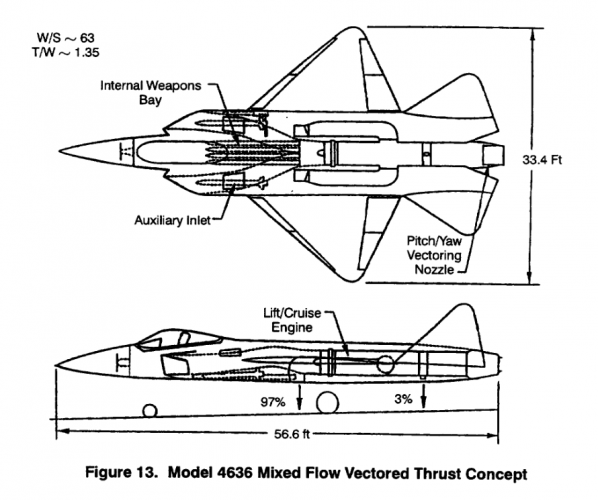
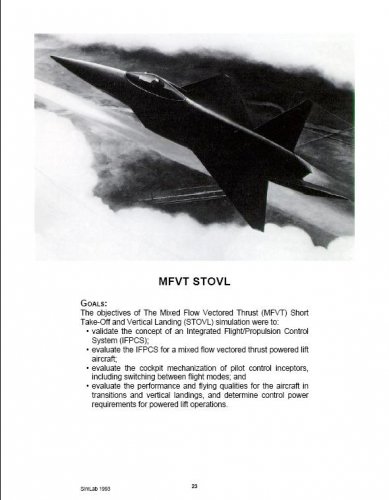
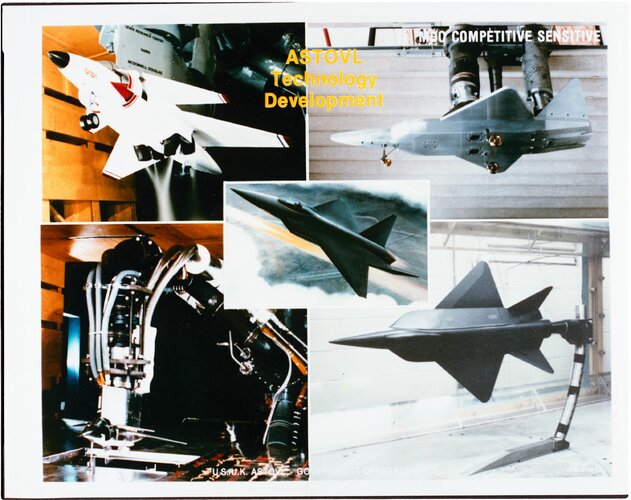
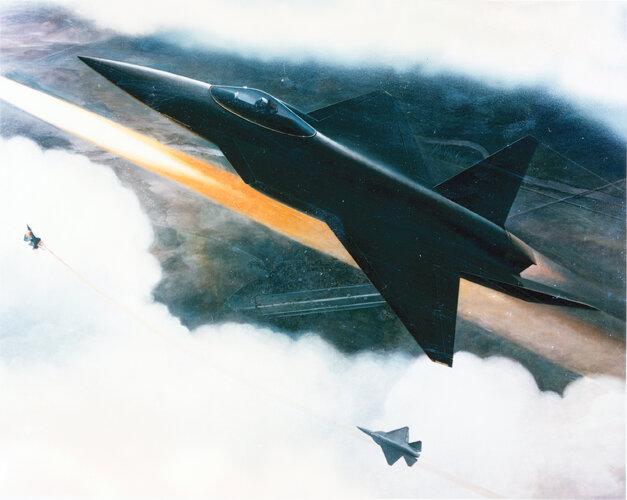
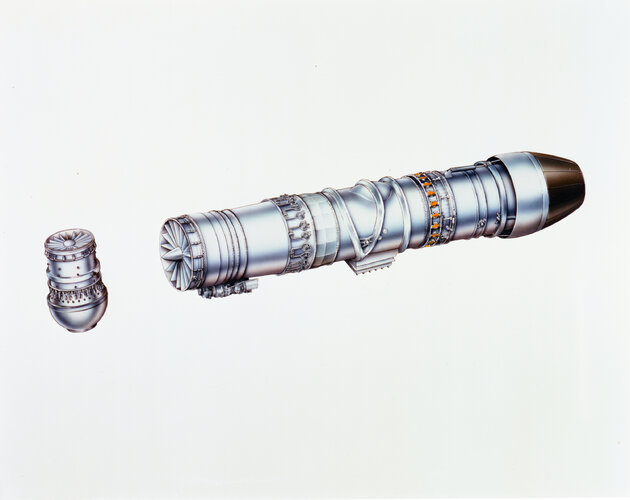
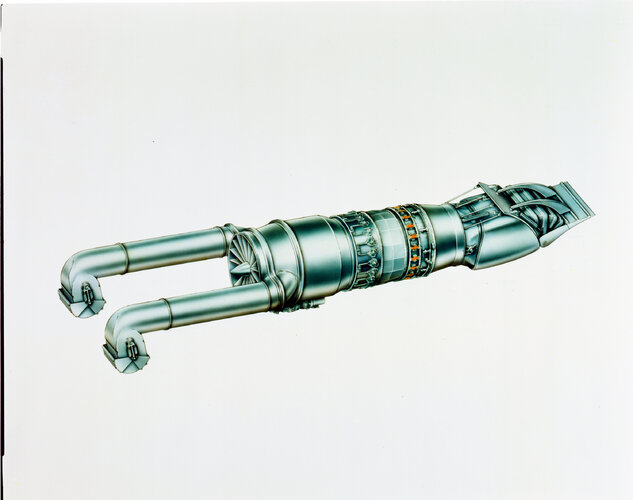
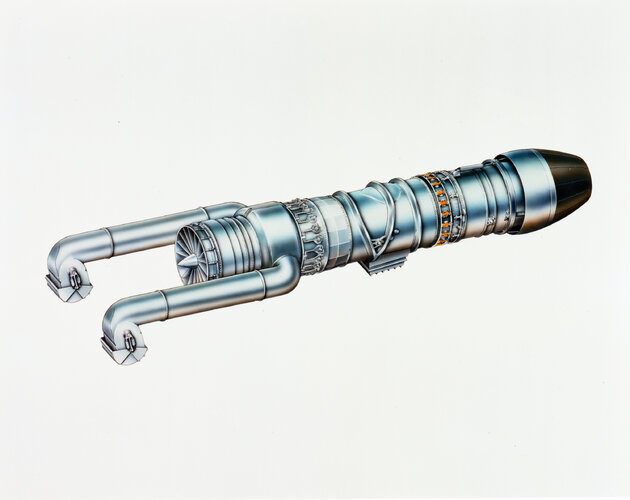
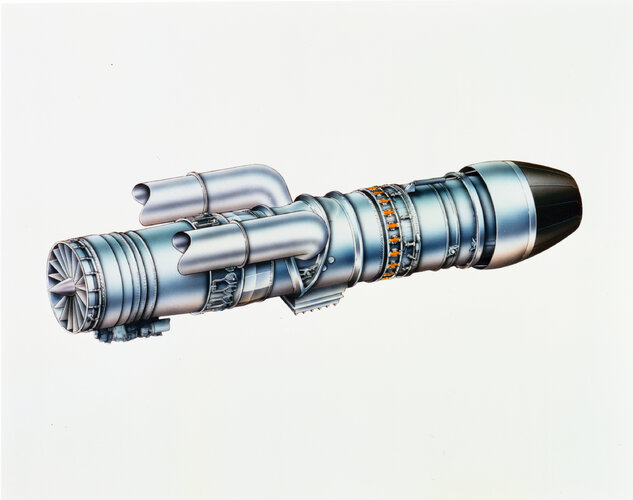
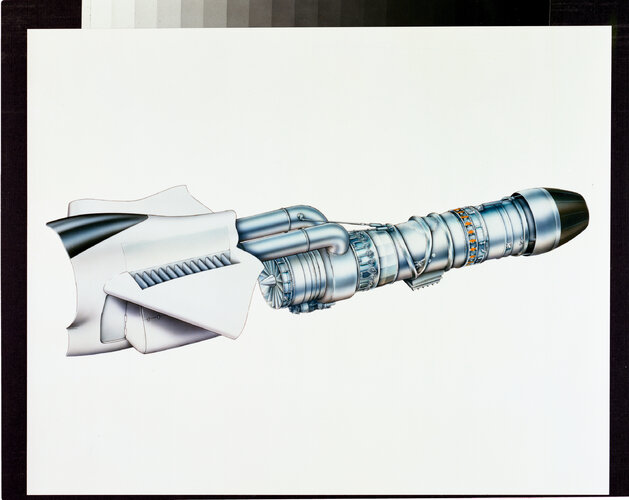
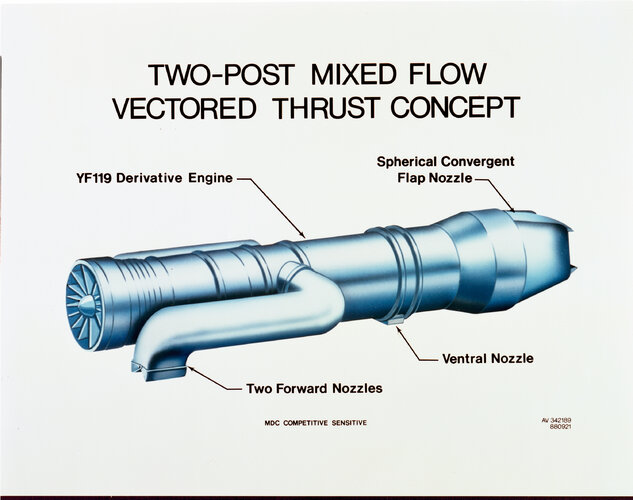
This is McDonnell Douglas's entry for the UK/US ASTOVL studies of 1986-1988, using 'mixed flow vectored thrust', also known as 'cactus', propulsion. Seems to be 'semi-stealth', which would explain the RCS model.

A picture of it is already on the site, in the US V/STOL thread, mis-identified as a Lockheed design:

http://www.secretprojects.co.uk/forum/index.php?action=dlattach;topic=2140.0;attach=1956

This model and the P.1216 one seem to have come from the Thales (former EMI) test range at Wells in Somerset, where the 1216 at least was tested in the mid-1980s.
 

Attachments

  • McDonnell Douglas's entry for the UK-US ASTOVL studies of 1986-1988.jpg
    McDonnell Douglas's entry for the UK-US ASTOVL studies of 1986-1988.jpg
    340.2 KB · Views: 494
Re: Newark Air Museum RCS models on display - P.1216 and McDonnell/BAe ASTOVL

BAe ASTOVL from 1991 AIAA paper 91-3183. Similar layout but with 4 tails not 2, a bit less stealthy.
 

Attachments

  • BAe-ASTOVLa.jpg
    BAe-ASTOVLa.jpg
    25.1 KB · Views: 399
  • BAe-ASTOVL.jpg
    BAe-ASTOVL.jpg
    16.1 KB · Views: 398
Re: Newark Air Museum RCS models on display - P.1216 and McDonnell/BAe ASTOVL

This ASTOVL was intended to use RULS - RALS without the front burner - as mentioned on the 'what happened to RALS?' thread.

Overscan - this thread is now moving off topic - maybe move this post into one of the STOVL ones? And how about a V/STOL section - it is a popular topic.
 
Note that the model at Newark is of a McDonnell Douglas only concept - BAe were 'in competition' with this and offered the P.112/P.116 etc. that are already on the site in other threads.
 
Yep. Here are some pics. This design seems to date back to joint UK-US ASTOVL studies in the late 1980s. RCS model is from Newark, photographed by Chris Gibson.
 

Attachments

  • MFVT-2.jpg
    MFVT-2.jpg
    52.7 KB · Views: 1,665
  • MFVT.jpg
    MFVT.jpg
    32.7 KB · Views: 1,537
  • mixedflowvectoredthrust.jpg
    mixedflowvectoredthrust.jpg
    35.5 KB · Views: 1,691
  • Newark_Mystery.jpg
    Newark_Mystery.jpg
    65.9 KB · Views: 1,945
  • McDonnell-Douglas's-entry-for-the-UK-US-ASTOVL-studies-of-1986-1988.jpg
    McDonnell-Douglas's-entry-for-the-UK-US-ASTOVL-studies-of-1986-1988.jpg
    80.5 KB · Views: 2,071
Last edited:
Found by Hesham - aircraft reffered in NASA Ames SimLab 1993 Annual Report as The Mixed Flow Vectored Thrust (MFVT) Short Take-Off and Vertical Landing (STOVL) concept study
http://www.iasa.com.au/folders/Publications/pdf_library/ospreypdfs/ar93.pdf
 

Attachments

  • MVFT.jpg
    MVFT.jpg
    48.5 KB · Views: 341
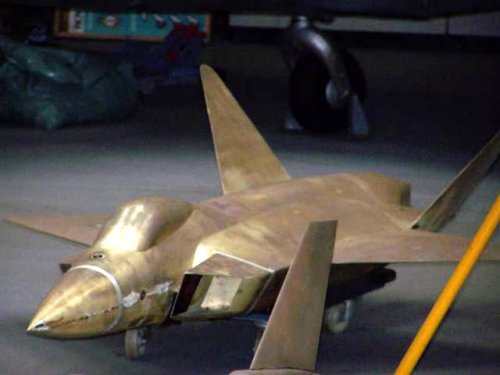
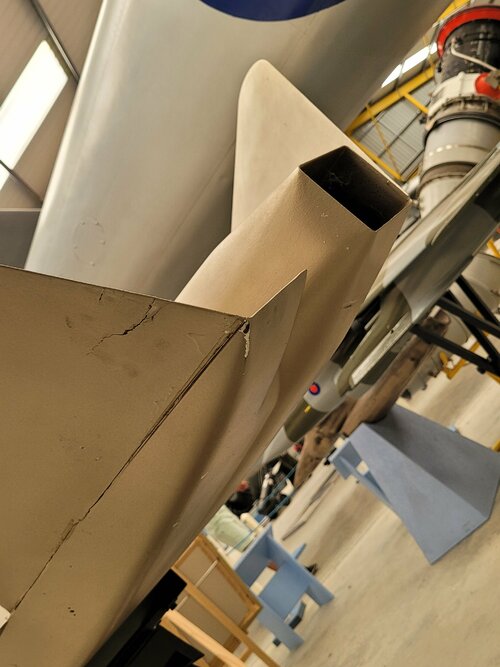
Additional photographs of the McDonnell Douglas Mixed Flow Vectored Thrust (MFVT) Short Take-Off and Vertical Landing (STOVL) radar cross-section test model located at the Newark Air Museum. Identified as a wind tunnel model at the museum.
 

Attachments

  • Picture209.jpg
    Picture209.jpg
    36 KB · Views: 312
  • Picture184.jpg
    Picture184.jpg
    34.4 KB · Views: 296
  • Picture207.jpg
    Picture207.jpg
    36.6 KB · Views: 289
  • Picture201.jpg
    Picture201.jpg
    33.2 KB · Views: 316
ASTOVL. model, Newark Air Museum ...
 

Attachments

  • 20240830_120831.jpg
    20240830_120831.jpg
    2.2 MB · Views: 164
  • 20240830_120941.jpg
    20240830_120941.jpg
    2.5 MB · Views: 114
  • 20240830_120929.jpg
    20240830_120929.jpg
    1.2 MB · Views: 107
  • 20240830_120916.jpg
    20240830_120916.jpg
    1.3 MB · Views: 100
  • 20240830_120905.jpg
    20240830_120905.jpg
    2.3 MB · Views: 101
  • 20240830_120858.jpg
    20240830_120858.jpg
    2.2 MB · Views: 104
Last edited:
I have a feeling that ASTOVL model may have come from Northwest Aerodynamic Models.
 

Attachments

  • 255-GRC-1989-C-02424 2.jpg
    255-GRC-1989-C-02424 2.jpg
    3.3 MB · Views: 323
  • 20240830_120941.jpg
    20240830_120941.jpg
    2.5 MB · Views: 291
  • Clipboard10.jpg
    Clipboard10.jpg
    66.6 KB · Views: 284
  • Clipboard02.jpg
    Clipboard02.jpg
    115.2 KB · Views: 263
stever_sl - Thanks again for your efforts to give us more information on the Harrier 21.

Dew and TsrJoe posted several pictures of a MD/BAe ASTOVL model in the linked thread. Could they be closely related to the Harrier 21 proposal?

https://www.secretprojects.co.uk/th...-mcdonnell-bae-astovl-entry.2219/#post-716905
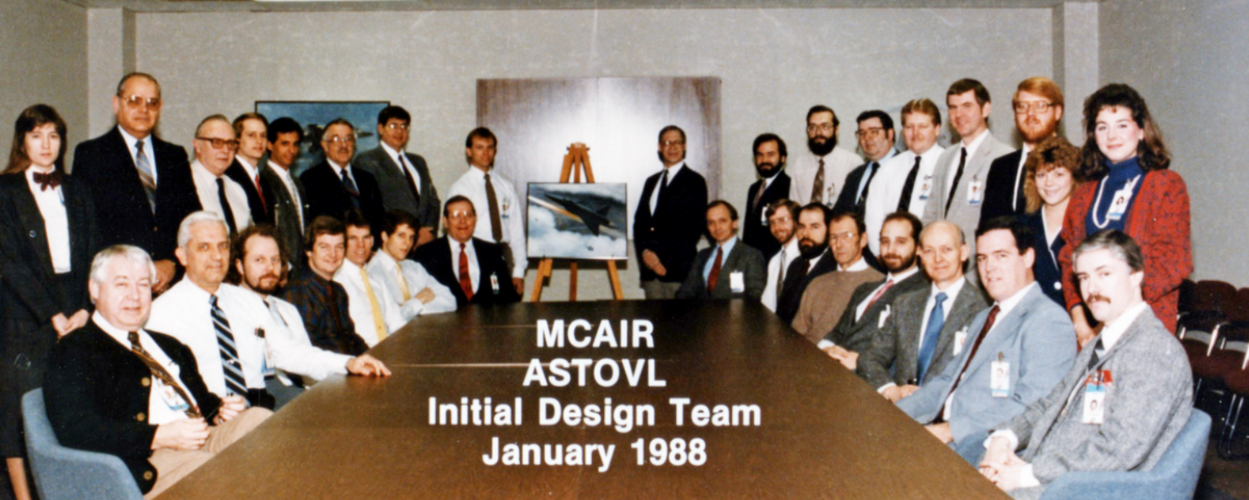
This looks to be the Model 4629 (as I recall it) which was what the Model 279-3 allegedly evolved into, although in fact the latter was just abandoned. I remember being amused at the traditional "evolution tree" that the ASTOVL group had put together, with top view sketches showing how the Model 279 had been gradually modified and refined in minor ways until suddenly the completely different 4629 was just tacked on at the end. The message I got was "we spent a lot of time and money trying to make the canard/delta configuration work, then realized that a traditional wing/tail design was better, so that's what we have now, at the last minute and representing relatively minimal analysis and risk reduction." Somewhere I have a photo of part of the ASTOVL engineering and design team in St Louis sitting around our big conference table. I'll see if I can find it, it has a painting of that airplane on an easel behind us.
 
This looks to be the Model 4629 (as I recall it) which was what the Model 279-3 allegedly evolved into, although in fact the latter was just abandoned. I remember being amused at the traditional "evolution tree" that the ASTOVL group had put together, with top view sketches showing how the Model 279 had been gradually modified and refined in minor ways until suddenly the completely different 4629 was just tacked on at the end. The message I got was "we spent a lot of time and money trying to make the canard/delta configuration work, then realized that a traditional wing/tail design was better, so that's what we have now, at the last minute and representing relatively minimal analysis and risk reduction." Somewhere I have a photo of part of the ASTOVL engineering and design team in St Louis sitting around our big conference table. I'll see if I can find it, it has a painting of that airplane on an easel behind us.
I looked everywhere but couldn't find that photo, then today, out of the clear blue, a former coworker sent me an email and attached that exact photo to it. The resolution isn't great here, but this is the photo of our ASTOVL study team at one moment in time, with the Model 4629 on the easel. I'm the 3rd standing guy to the right of the painting, the one with the beard. :) 37 years ago - good heavens!

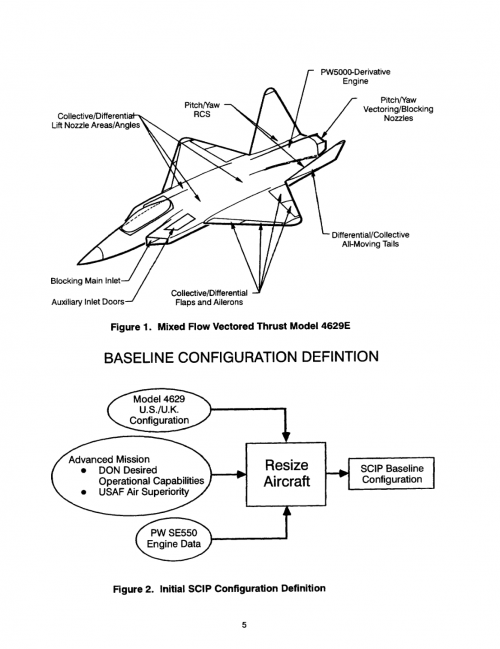
1737902619705.png
 
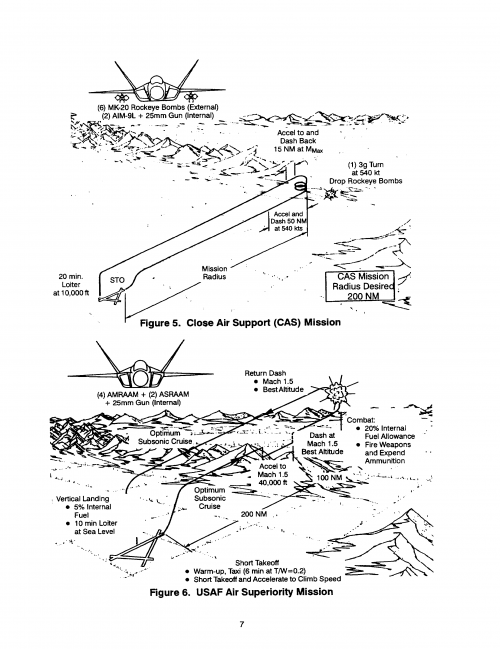
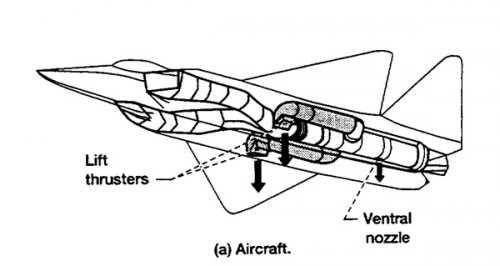
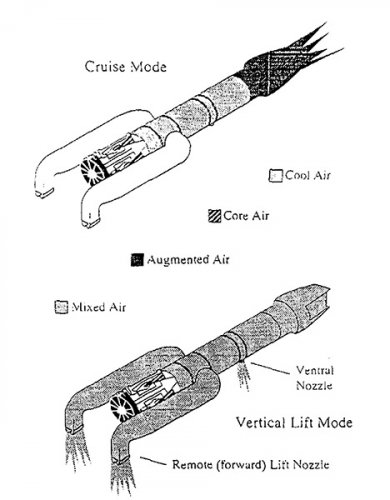
Admin, delete or move if necessary. This is the McDonnell Douglas Model 4629E with mixed-flow vectored thrust.

From the following NASA paper:

SA Contractor Report 195358

STOVL Control Integration Program

C. Weiss
Pratt & Whitney
West Palm Beach, Florida

P. McDowell, McDonnell Douglas Aerospace East, St. Louis, Missouri

and S. Watts Pratt & Whitney
West Palm Beach, Florida
I
July 1994

Prepared for
Lewis Research Center
Under Contract NAS3-25194

https://ntrs.nasa.gov/api/citations/19950005074/downloads/19950005074.pdf
 
Last edited by a moderator:
AW&ST. April 23 1990

Concept for an advanced STOVL fighter. "The Navy has a tentative requirement for such an aircraft that could be fielded by 2010"

[wrongly identified as Lockheed by poster - Admin]
Navy Issues Tentative Requirement
For STOVL Fighter Sought by 2010

PATRICIA A. GlLMARTlN/WASHINGTON

The U. S. Navy is circulating a tentative
operational requirement for a short
take-off/vertical landing aircraft that
could become Operational by 2010.
The tentative operational requirement,
which has been sent to fleet commanders
for review and comment, is virtually iden-
tical to one drafted by the Marine Corps,
according to a Navy Official.
Senior Navy officials have advanced
the short take-off and vertical landing
(STOVL) aircraft as an option to replace
the F/A-l8 and AV-8B as the next-gener-
ation fighter (AW&ST Mar. 26, p. 21).
A decision by the Navy on whether to
pursue this idea is expected within two
years and will be influenced heavily by a
technology demonstration planned in the
mid—19908 by the Defense Advanced Re-
search Projects Agency.
Navy officials concede that this tech-
nology has evolved slowly but claim there
have been advances that may make it pos-
sible to bring along a STOVL fighter in
the 2010 time frame.
Engine and flight control technologies
have matured to a point where “we think
there is an opportunity,” according to Lt.
Chris Sprinkle, a Navy research, develop-
ment test and evaluation analyst and
STOVL program manager.
BASING OPTIONS
A decision has not been made on whether
to include funds in the five-year spending
plans the Navy must submit by the end of
April. The earliest opportunity to apply
funds for this type of project would be in
1993, a defense official said.
The increased buy of aircraft afforded
by a Navy/Marine Corps decision to go
ahead with a next-generation STOVL
fighter would reduce unit cost and simpli—
fy logistics.
The STOVL aircraft would Operate
from big—deck carriers as well as those
used by helicopters. It also could operate
from austere land bases to support Ma-
rine Corps missions.
The paperwork recently set in motion
by the Navy and the Marine Corps repre-
sents a first step in establishing a STOVL
strike fighter program, Sprinkle said.
If it appears that technology can be de-
veloped to meet the requirements for an
F/A-18 and AV-BB replacement, the ser-
vice would establish a program office and
formulate an operational requirement.
“The proof of the pudding
is to get
something airborne,“ a Defense official
said. "There are presently a lot of nay-
sayers who doubt the STOVL propulsion
system concepts are mature enough
to meet the requirements.”
The DARPA technology demonstra-
tion effort is specifically aimed at a next-
generation STOVL strike fighter. The
project is to culminate in a flight demon-
stration around 1995. Total cost was esti-
mated to be about $500 million.
The Navy‘s requirements are more
stringent than those of the Marine Corps,
a defense official said. “The aircraft
would support the A—12 (advanced tacti-
cal aircraft) mission and assist in the anti—
air warfare regime," he said.
“To meet our requirements, we will
need an aircraft that performs as well as
the F/A-18 and gives us STOVL capabili-
ties," a Navy official said. The service
also is looking for improved range, pay-
load and performance.
U. S. officials have said that costs as-
sociated with a STOVL fighter aircraft
development program point to a collab-
orative effort. There is speculation that
it would be ajoint effort between NASA
and the Defense Dept. and probably
would involve international participa-
tion.
The British Royal Navy has a hard re-
quirement to replace its Sea Harrier, a
defense official said. The Royal Air Force
is ”still on the fence” but is studying fu-
ture requirements and changes that may
be needed as threats diminish.
Added military interest in STOVL air-
craft comes at a critical point in a related
U. S./U. K. program involving the ex-
change of data on technology for an ad-
vanced STOVL aircraft.
An executive steering committee of Of-
ficials from both countries will meet this
week in Washington to review progress in
the ASTOVL program, which began in
1986. A memorandum of understanding
governing participation in the program
expires in January.
This meeting will lay the foundation
for a decision on whether to continue or
stop the program, Jack Levine, a senior
NASA aeronautics Official, said.
Specifically, the group will determine
whether collaboration between the two na-
tions has been fruitful and if the resources
are available to continue the ASTOVL
program, Levine said.
Under this effort, each country pre-
pared studies on the most promising con-
figurations for an ASTOVL combat
aircraft. Propulsion candidates have been
narrowed to remote augmented
lift systems and ejector augmenters
(AW&ST Mar. 6, 1989, p. 25).
The U. K. studies were performed by
British Aerospace and Rolls-Royce. Oth-
ers were conducted by McDonnell Doug-
las in association with Pratt & Whitney,
Grumman with General Electric, General
Dynamics with General Electric, and
Lockheed with Pratt & Whitney and
Rolls-Royce.
NASA officials, meanwhile, are hope-
ful that progress in the ASTOVL pro-
gram could lead to funding to accelerate
critical technology work.
Plans at NASA Ames over the next
two years include efforts to develop crite-
ria for integrated control of the propul-
sion and flight control systems.
This work would focus on hover and
transition using simulators and flight vali-
dation using the V/STOL Research Air-
craft (VSRA), a YAV-SB Harrier, provid-
ed by the U. S. Marine Corps and Navy,
according to NASA officials.
The E-7A full—scale model is scheduled
to be tested to determine augmenter per-
formance in the Ames Outdoor Aerody-
namic Research Facility.
Additionally, NASA Ames plans to
conduct hover research using small-scale
and large-scale rigs to look at sound pres-
sure energy, temperature, and the effect of
exhaust gases, ground erosion, engine hot
gas ingestion and structural loading.
The large rig will use a J79 engine with
dual jets capable of being evaluated at
spacings from 15-10 diameters and for
varying heights above the ground plane.
At the same time, NASA Lewis plans to
conduct small-scale wind tunnel research
on inlet hot gas ingestion characteristics
for various STOVL configurations, to
look at engine control and evaluate large-
scale ejector augmenter hot gas and tran-
sieiit performance.
Research also is planned on gas flow
control and transfer using approximately
half—scale rigs, which include cactus-
shaped ducts with valves, offtakes and
vectoring ventral nozzles associated with
STOVL propulsion system concepts.
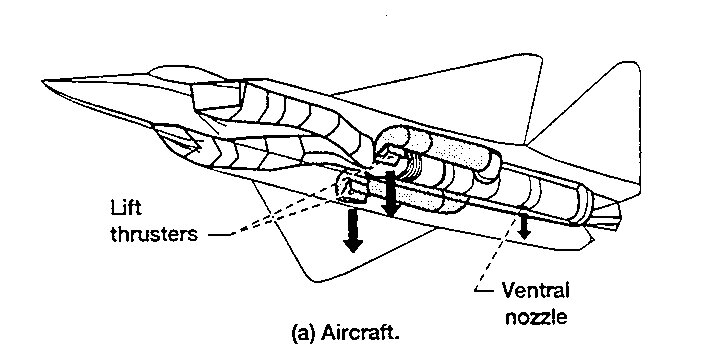
mfvt.jpg
Source: AWST. April 23 1990
 
Last edited:
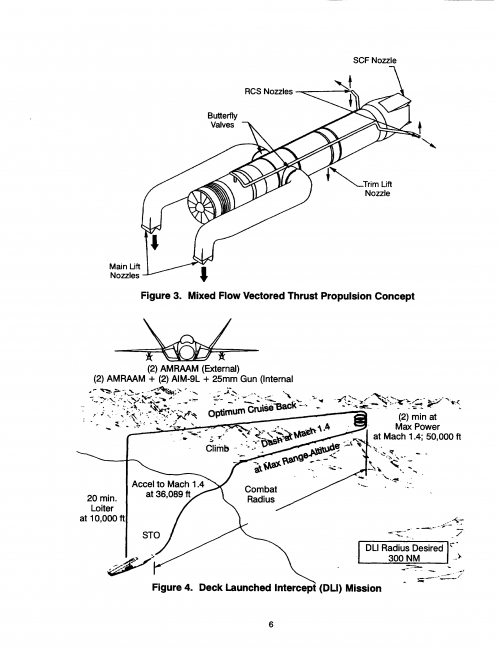
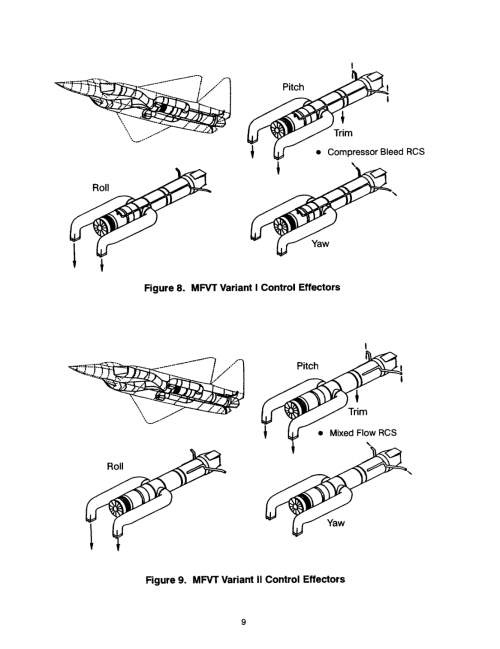
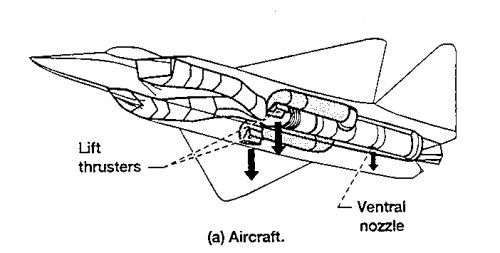
During the course of the studies it became apparent that one AVT concept -the Mixed Flow Vectored Thrust (MFVT) was sufficiently different to merit treatment as a separate propulsive lift concept. It is shown at the lower left of Figure7. The MFVT concept was developed by McAir supported by Pratt-Whitney. A schematic of the propulsion system is shown in Figure 8. The design features side mounted inlets and V-tails.with the weapons carried internally. For cruise and maneuver flight, the entire engine flow exhausts through an aft nozzle which has pitch and yaw vectoring capability. During vertical flight, essentially the entire mixed engine flow exits through two ducts located just forward of the aircraft center of gravity. These ducts have vectoring capability. A small downstream trimmer nozzle provides balance.
https://arc.aiaa.org/doi/10.2514/6.1989-2039
 
With respect, trying to gang every post on a related item into one gargantuan master post makes it much harder for people to find things, not easier. Sorting through a dozen or more pages of posts takes forever and it's easy to overlook the one post you need. Or at least that was my reaction when I couldn't find my own very active new post about Harrier III / Harrier 21 yesterday because it had been shoved over onto the end of an earlier long-string post on the general topic of AV-8B follow-ons.
 
With respect, trying to gang every post on a related item into one gargantuan master post makes it much harder for people to find things, not easier. Sorting through a dozen or more pages of posts takes forever and it's easy to overlook the one post you need. Or at least that was my reaction when I couldn't find my own very active new post about Harrier III / Harrier 21 yesterday because it had been shoved over onto the end of an earlier long-string post on the general topic of AV-8B follow-ons.
I don't follow - the only posts of yours I moved were the two related to Model 4629 above, both historic posts not new ones.
 
I see flateric did some work on merging two Harrier topics -

McDonnell-Douglas Harrier III High End / Harrier 21
and
Harrier 21 / Harrier III High End Supersonic STOVL

So possibly that was what caused you issues? it certainly wasn't me making this topic that did.

The forum has always had a rule that we try to maintain one thread per secret project - its in the rules - so it has always been the case that threads on the same topic generally get merged together eventually. Its not just a discussion forum, each thread is intended to be a database of everything we've found about the specific design. Normally I leave a redirect behind from the old topic to the new merged topic - if that wasn't done, then apologies.
 
Last edited:
I see flateric did some work on merging two Harrier topics -

McDonnell-Douglas Harrier III High End / Harrier 21
and
Harrier 21 / Harrier III High End Supersonic STOVL

So possibly that was what caused you issues? it certainly wasn't me making this topic that did.
Aha, you're right! Sorry!
 

Similar threads

Back
Top Bottom