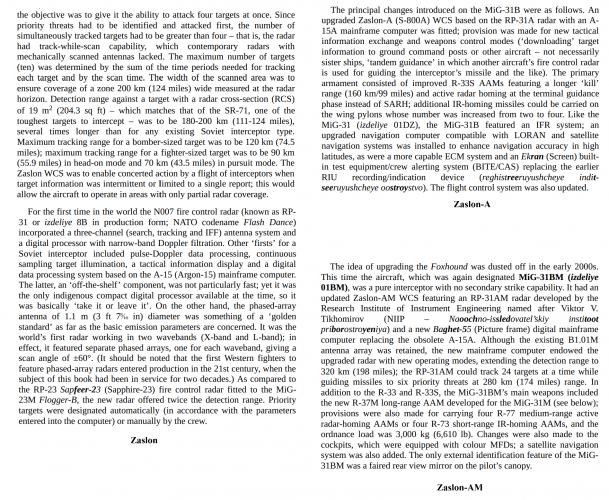
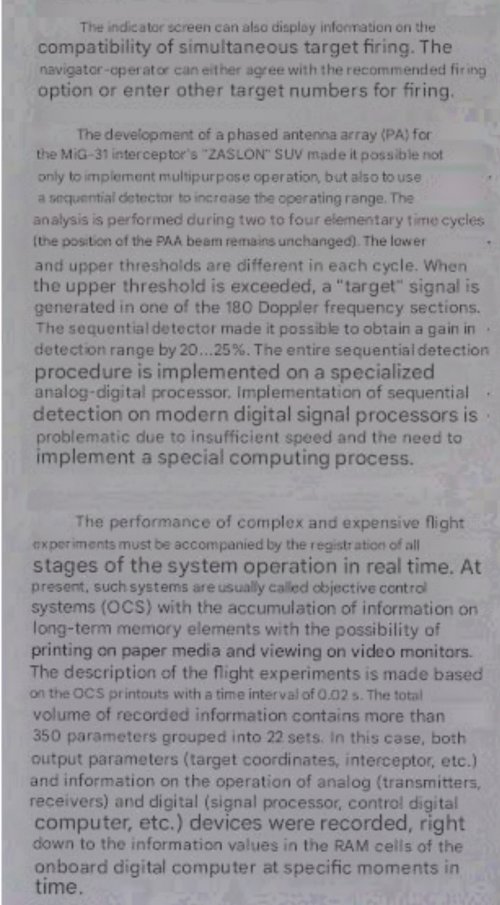
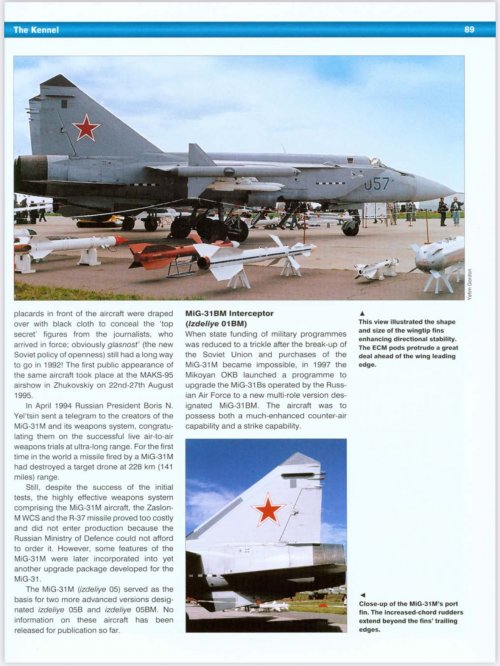
Sorry for the double post but since I found could be the most comprehensive work in any language on the topic ( after looking for it for long time ) using the latest AI technology to translate it and to educate our western friends on what is really the MiG-31 or at least in search of the answer this is an originally several part story on MiG-31 posted on the Since and technology magazine website in 2018 ( it's defunct now ) by Alexey Mironov and Sergey Moroz to my knowledge it wasn't published in any magazine and it was almost lost but thanks to the way back machine the information is still there thought not many people knew about this from the looks of it
MiG-31. On the Distant Frontiers. Part 1
Author: Sergey Moroz March 19, 2018,
What Class Are You In, Old Man? Reflections on the MiG-31 Aircraft. Part 1 What Class Are You In,Old Man? Reflections on the MiG-31 Aircraft. Part 2 What Class Are You In,Old Man? Reflections on the MiG-31 Aircraft. Part 3
---
Awaiting the Strike
In 1972, America made its last attempt to destroy the Democratic Republic of Vietnam by launching a massive air offensive known as Operation Linebacker II. But Soviet air defense weapons thwarted the aggressor's plans and forced the US to withdraw from the war in disgrace. It was a triumph, but in the USSR, it was understood that in the event of aggression, all components of the nuclear triad would be used simultaneously, and strategic and tactical bombers would be employed on a much larger scale.
Our air defense system in the 60s consisted of narrow belts covered by anti-aircraft missiles, between which fighters operated: it could be compared to fences between which angry dogs run. The "fences" played the main role, and the "dogs" played a secondary one.
The modernization of US aviation at that time proceeded by improving aircraft flight performance, their electronic protection, and reducing visibility. A special role was assigned to strategic cruise missiles, and B-52G/H bombers received 12-20 compact AGM-69 missiles with nuclear warheads. They were supposed to "punch holes in the fences," destroying air defense missile systems and ensuring the passage of the entire formation. With their appearance, interceptors became the decisive factor in defense.
When preparing the article, materials from the expositions of the A.I. Mikoyan Design Bureau Museum and the Gorky Aviation Plant "Sokol" (in the 80s - the Sergo Ordzhonikidze Gorky Aviation Production Association) were used.
Our air defense had more than ten types of aircraft, but only the Yak-28P and Tu-128 could patrol in the zone for more than an hour. The interception range exceeded 1000 km only for the Tu-128, but even at the Tupolev Design Bureau, this large and heavy machine was not called a fighter. And yet, in the vast Far North, such an aircraft was indispensable. The Arctic was the "front" where the first air offensive of a new world war was to unfold, because only this way could one penetrate the industrial regions of the Volga region, the Urals, and Siberia: whoever controls it wins the battle. In light of all this, the need to modernize air defense aircraft was obvious to everyone in the leadership of the USSR and our Armed Forces; the only disagreement was on what exactly needed to be done.
What Is To Be Done?
The first to answer this question was to be the Central Research Institute No. 30 of Aerospace Technology of the USSR Ministry of Defense - the organization formulating the tactical and technical requirements (TTR) for all new combat aircraft. Usually, the TTR far exceeded the actual capabilities of technology and the needs of the troops, for which this respected institution received not very flattering nicknames both at the Air Force headquarters and especially in the aviation industry, but regarding the new interceptor, the situation was the opposite. Planning the modernization of air defense aviation, TsNII-30 planned to order a new long-range interceptor from Tupolev to replace the Tu-128, and from Mikoyan - a modification of the MiG-25 as the main medium-range fighter, improving climb rate and maneuverability, reducing reaction time, and ensuring the destruction of single small-sized maneuvering targets against the ground. But the Research Institute of Aviation Systems of the Ministry of Aviation Industry (Minaviaprom), the main ideologist of guided weapon systems, strongly recommended creating a fundamentally new machine, although it had not only recently participated in creating the concept of the MiG-25-40 interception complex but was also its ardent supporter.
The head of NII AS A.E. Fedosov was supported by the scientific director of NII-5 of ground-based air defense systems, Professor Livshits, who stated that the existing ground infrastructure of Northern air defense was insufficient to repel a massive strike on a broad front, and the planned modernization did not increase the MiG-25's range. The head of the fighter aviation sector at NII-2 Air Defense, Colonel Dolzhenko, took the same position, and together they managed to prove that the new main figure of air defense aviation should not be a mass-produced medium-class fighter, but a long-range, all-weather interceptor capable of covering a large section of the border.
The new aircraft was conceived as a flying anti-aircraft battery. This is how the Tu-128 interceptor worked, but with a speed of 1200-1650 km/h, a radar acquisition range in the forward hemisphere of 50 km, and a launch range of R-4RM/TM missiles of 25/15 km, it could intercept even a subsonic target only with ground guidance. And to intercept a supersonic bomber, it was necessary to "cross" the Tu-128 and the MiG-25, making it autonomous.
The first version of the long-range interceptor project E-155MP was a "hybrid" of the MiG-25 and MiG-23. Top variant with the Smerch-100 radar and K-100 missiles, bottom - with Zaslon and K-33
The chief designer of the aircraft was appointed G.E. Lozino-Lozinsky, his deputy - V.A. Arkhipov, general management was carried out by General Designer A.I. Mikoyan and his deputy A.A. Chumachenko. They well remembered the times of Khrushchev, when new aircraft projects were not funded, and therefore were forced to disguise them as modifications of serial machines. Thus, the project received the index E-155MP as a variant of the MiG-25, or E-155P.
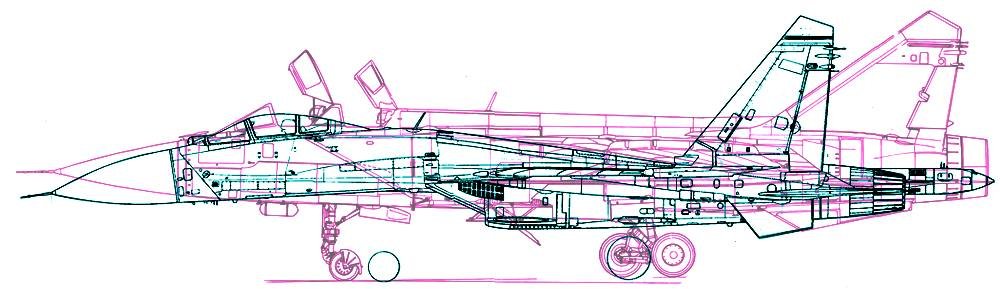
In the 60s, the best means of resolving the "speed/endurance" contradiction was considered to be a variable-sweep wing: by changing the position of the consoles, it was possible to adapt to various flight regimes. Mikoyan used VG on the frontline fighter MiG-23, and the new long-range interceptor was to become a "hybrid" of this aircraft and the MiG-25.
---
Comparing the options of suspending K-100 missiles under the wing and in a fuselage bay with a jettisonable cover and K-33 close to the fuselage, the latter was chosen
The layout became single-fin, the wing mechanization changed. To improve aerodynamic quality and maneuverability, static stability was reduced. The RD36-41 engines were 1.5 times more powerful than the old R15-300. Two K-100 missiles designed by MKB "Fakel" were to be suspended under the wing and two in a bay in the fuselage. Combat mission execution was highly automated, a worldwide navigation complex was being created for the aircraft, but for flights in the Arctic, the military wished to have a navigator on board, as on the Tu-128.
The "Smerch-100" radar was a development of the RPS-A station of the MiG-25 aircraft. The antenna diameter increased to 2 m, and behind it, they tried to place the pilot and navigator side by side, which was convenient, but the resulting aircraft cross-section had too much drag. With a tandem cockpit, the cross-section decreased, and range and speed increased; an even better performance was promised by a tailless scheme. To test such a layout for the supersonic passenger Tu-144, the experimental MiG-21I was built, but the head of the control systems department, Sukhov, was categorically against its use on an interceptor. He was also supported by R.A. Belyakov, who began working in the control brigade, and at that time was already the Deputy General: given the tight development deadlines, the risk of failing the task was considered too high.
At the same time, at the Research Institute of Instrument Engineering under the leadership of V.K. Grishin, a fundamentally new "Zaslon" station with a fixed phased array antenna was being created, which provided simultaneous tracking of up to 10 targets on the pass and engagement of any four with a salvo or series of K-33 missiles, which were designed by MKB "Vympel" under the leadership of A.L. Lyapin. The radar detected a target at a distance of up to 400 km, the onboard computer predicted its trajectory - and the missile launched into this area, gaining altitude along the optimal ballistic trajectory; if necessary, the operator corrected its flight. Once above the target, the missile activated its active radar seeker, acquired the target, and, accelerating in descent, headed towards it, engaging at a range of up to 200 km.
We will not dwell here on the features of the MiG-31's avionics, leaving the floor to a specialist in the next issue of "NiT", we will only note that now the interceptor could not only work completely autonomously but was also capable of controlling a group of aircraft using an automated data exchange system.
The first experimental long-range interceptor "831" during final assembly in the workshop of MMZ "Zenit", 1975.
Photo: ANPK "MiG"
The defense of the E-155MP preliminary design took place in the spring of 1968, and on May 24, a Resolution of the Council of Ministers was issued, obligating MMZ "Zenit" to transfer the first experimental interceptor for testing in the IV quarter of 1971. In parallel, Tupolev was designing the long-range interceptors "138" and "148", Yakovlev - the "33" aircraft, and Sukhoi - the I-6 interceptor based on the T-6 bomber (Su-24).
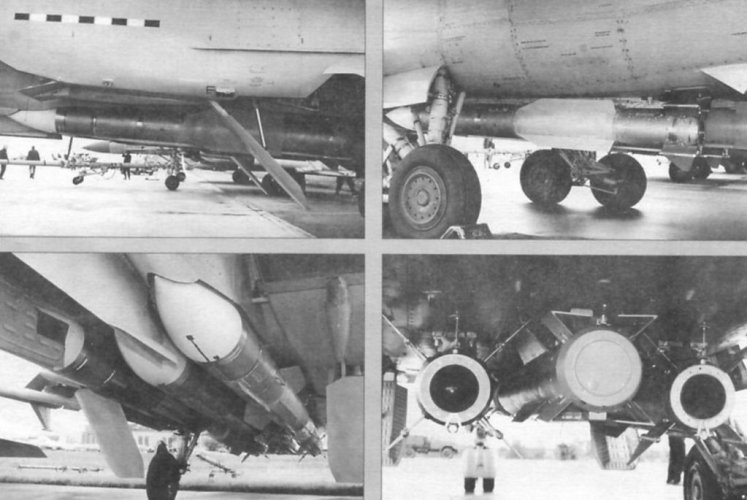
The 2nd variant of the E-155MP was chosen for further development, but the issue of missile placement had not yet been resolved. Only two fit under the fixed part of the wing, and during prolonged supersonic flight, the seeker head fairings overheated; a bay for 2 missiles was poorly arranged in the narrowed fuselage, and after jettisoning its cover for launch, the aircraft's drag jumped. Then designer A.A. Yefimov proposed suspending four K-33s under the fuselage - the first such layout was signed on July 1, 1968, and sent to MKB "Vympel" to coordinate the aircraft and missiles.
Meanwhile, tests of Mikoyan's first variable-geometry aircraft, the MiG-23, were difficult: the wing had to be constantly strengthened. The speed and weight of the E-155MP were greater, and the weight of the VG became too high. On the other hand, the Minister of Aviation Industry P.V. Dementiev insisted on maximum technological continuity with the MiG-25 aircraft. It was not about using its units - it was required to preserve the equipment, tooling, and standard technological processes, the implementation of which at the Sergo Ordzhonikidze Gorky Aviation Plant (GAZISО) had cost enormous sums.
The first experimental long-range interceptor "831" during final assembly in the workshop of MMZ "Zenit", 1975.
Photo: ANPK "MiG"
Through Hardships - to the Stars!
The first general view of the new interceptor was made in the MiG-25 layout under the index "515" by A.F. Pavlov on July 29, 1969. The aviation industry was on the rise, new materials and technologies, and computing were being mastered. The contours
Lozino-Lozinsky sought to incorporate the maximum number of innovations into the aircraft, while the chief designer of the MiG-25, N.Z. Matyuk, like the Ministry of Aviation Industry, was a supporter of proven solutions.
The Central Aerohydrodynamic Institute (TsAGI), based on experience with the supersonic passenger Tu-144, developed an S-shaped wing, which promised to sharply improve range. A series of layouts was made with it under the general index "518", but calculations showed that the supersonic addition was less than TsAGI promised, and at cruise mode at M=0.9, the aerodynamic quality decreased and the fuel reserve had to be increased. Such a wing was also heavier and more complex to produce.
When an aircraft crosses the supersonic barrier, its airflow changes, the focus (the center of application of the increment of aerodynamic forces with an increase in the angle of attack) shifts backward - and the horizontal tail is no longer enough to keep the machine from being pulled into a dive. In addition, such an aircraft is not damped in unsteady maneuvers. On the MiG-25, this was compensated by the lift on the intake wedges, but would it be enough for a heavier and lengthened multi-mode machine with reduced static stability? A wing with a leading-edge extension (LEX), as in the "515" project, could help cope with the problem, but at M>2 its drag increased sharply. Then, in the "515-31" layout, the LEX was made to fold downward; there were variants of a small fixed LEX with a folding canard, or an extendable one, like on the American F-14, but the loads on the hinge assemblies and gaps in the leading edges at M=3 were too great. A LEX was still made, but a small one, approximately like on the F-15, and flat.
Another "fashion" of that time was the spaced engine installation: the fuselage between them "degenerated" into an additional wing section. This solution was successfully implemented on the F-14 and MiG-29, but for a heavy interceptor, it offered no advantages. One of the projects also provided for an armored cockpit, however, the Customer considered it excessive, and other extravagant proposals also fell away.
The lead organization responsible for the entire new interception complex was the Mikoyan Design Bureau, but enterprises of the Ministry of Radio Industry, as well as NII AS, TsAGI, VIAM (All-Union Institute of Aviation Materials), and other institutes of MAP played a prominent role in the work. The development of the phased array radar and the Zaslon weapon control system became the most difficult test, turning into a whole epic. Before the station worked, 4 variants of the antenna had to be made, which was an extremely complex complex of fixed emitting and receiving elements with electronic beam control. This worked in ground-based radars, but not on an aircraft. The failures of the NIIP designers were compounded by the position of the Minister of Radio Industry, Kalmykov, who believed that a phased array radar (Phased Array Radar - PAR) was fundamentally unsuitable for a fighter. At his insistence, a backup variant of the interceptor with the Smerch station was worked on, but the likely adversary helped fight the retrogrades.
Lead serial MiG-31 aircraft №0101, built by the Sergo Ordzhonikidze Gorky Aviation Production Association.
Photo: ANPK "MiG"
In 1970, the development of strategic cruise missiles AGM-86 and AGM-109 began in the USA; their B-52 could carry up to 20, and the B-1A - a whole 24. They had low visibility and flew at altitudes from 30 to 9000 m. The MiG-25 would not have been able to intercept even one such missile, let alone twenty: the multi-channel Zaslon station and the K-33 missile were needed. The "515-55" layout with them was approved back in 1969 and later became the basis for the working project "83".
Based on the experience of local wars, the military demanded the introduction of short and medium-range heat-seeking missiles, as well as a cannon, into the interceptor's armament. Lozino-Lozinsky was categorically against the latter; during a heated discussion, one colonel from the ordering department died right in his office from a heart attack. But they had to meet the Customer halfway, and a GSh-23L, the same as on the MiG-23, was installed under the right engine nacelle.
At that time, the health of General Designer A.I. Mikoyan deteriorated, and on December 9, 1970, he passed away. The post of General Designer was taken by R.A. Belyakov, and the "competition" between N.Z. Matyuk and G.E. Lozino-Lozinsky ended in a compromise. The aircraft was made to look as much like the MiG-25 as possible, for example, the wing profile was kept the same as on the R-4 - the reconnaissance version of this machine. But to compensate for the weight increase, a third spar had to be added - the new consoles became not only stronger but also stiffer, and the massive anti-flutter weights were removed. The degree of static stability of the aircraft remained less than that of the MiG-25, but this difference decreased due to a change in the center of gravity and the removal of the "last" (wingtip pods?), therefore it was possible to manage without an electronic stability augmentation system (SAS - Sistema Uvelicheniya Ustoichivosti), but the aircraft control systems still differed.
202
MiG-31 № 0202 at the flight station of the Gorky Aviation Plant near the hangar, which protects not only from the winter cold but also from enemy radio intelligence. Photo: ANPK "MiG" - NGAZ "Sokol"
The patrol duration on internal fuel still turned out to be insufficient, and a under-fuselage tank - like on the MiG-25 - did not combine with the missile suspension, so two underwing tanks were made: fuel from them is used first.
The RD36-41M engines designed by the Rybinsk Design Bureau of Engine Building under P. Kolesov were tested on a Tu-16 flying laboratory, and in 1972 the T-4 bomber, designed for long-range flights at M=3, made its first flight with them. But the seemingly simple single-shaft turbofan could not be brought to series production, and the project had to be redesigned for the D-3006 twin-spool engines designed by the "Aviadvigatel" Design Bureau under P. Solovyov.
The military D-3006 differed from the civilian D-30KU not only in the afterburner but also in the gas generator, a 4 times reduced bypass ratio, an electro-mechanical control system, and a modular design that facilitated assembly and repair. At takeoff, the engine produced 15,500 kgf thrust with afterburner, and 9,500 kgf without it. At high altitude at M=2.83, the thrust was also 15,500 kgf with an hourly fuel consumption of 29,450 kg, but at subsonic speed this figure decreased by about 10 times. And yet this was not enough; subsequently, an in-flight refueling system was introduced.
Film sequence of a test launch of the long-range K-33 missile from the MiG-31 № 0302.
Photo: ANPK "MiG"
The lag behind the planned deadlines was 3 years, and to make up for lost time, the first experimental aircraft "83/1" was built by MMZ "Zenit" without combat avionics systems and a cannon, with a wing from a serial MiG-25RB - without leading-edge flaps and with KM-1M ejector seats instead of the not yet ready K-36DM. In the summer of 1975, it was transferred to the flight test and development base.
The first flight on the new interceptor was performed on September 16, 1975, by the senior test pilot of MMZ "Zenit" A.V. Fedotov. In the spring of 1976, flights with a navigator began - V.S. Zaitsev was appointed to this position. The test results of MiG-25 modifications with D-3006 engines and with a refueling probe were also useful for improving the "83" product, on which a three-spar wing with a leading-edge flap and LEX, designed for a larger fuel supply, soon appeared.
In 1976, "83/2" entered testing, other pilots were involved - P. Ostapenko, B. Orlov, A. Fastovets, V. Menitsky, T. Aubakirov, as well as navigator L. Popov. The "number two" had a full set of weapons, including a cannon, however, the GSh-23L, which worked perfectly on the MiG-21 and MiG-23, failed on the test stand simulating the thermal and acoustic loads of the E-155MP. It seemed that Lozino-Lozinsky's gloomy prophecies were coming true, but the Customer's position remained principled, and the problem was solved by increasing effectiveness, installing the ultra-rapid-fire "six-barrel" GSh-6-23 with linkless feed.
Although not everything went smoothly, already in 1975 it was decided to start preparing production of the aircraft at GAZISО, and the third copy of the aircraft was built with the participation of the serial plant.
(to be continued)
https://web.archive.org/web/20190104043744/http://naukatehnika.com/na-dalnix-rubezhax.html
MiG-31. On the distant frontiers. Part 2
Author: Sergey Moroz
Continuation What class are you in,old man? Reflections on the MiG-31 aircraft. Part 1 What class are you in,old man? Reflections on the MiG-31 aircraft. Part 2 What class are you in,old man? Reflections on the MiG-31 aircraft. Part 3
From the factory to the regiment
The Gorky branch of the Zenit Design Bureau, the design and technological departments of GAZISO immediately began working on and launching into production drawings and other documentation.The aircraft changed its name again and was now called "izdeliye 01" (Product 01). This was related to the secrecy regime,but the differences from the experimental "83" machines were also significant.
In 1977, at the height of the tests, Lozino-Lozinsky moved to the position of General Designer of the NPO Molniya,leading the development of the Buran spaceplane, and K.K.Vasilchenko became the Chief Designer of the E-155MP.
Most of the MiG-31s were stationed in areas with harsh climates — in the Arctic, Siberia, Kazakhstan, and the Far East. Photo:Archive of S.G. Moroz
A large group of problems was purely technological. The designers intended to sharply increase the proportion of titanium alloys, which are light and strong. But their stamping and welding were not yet mastered, and it was necessary to switch some parts to steel, which was well mastered on the MiG-25. Sacrificing weight, it was possible to preserve tooling such as a huge, area-occupying automatic welding-riveting machine for assembling the central fuselage section — more than 15 m long. The operation of this unit was impressive: after the bustle and din of the areas where dozens of workers were doing manual riveting — silence and emptiness: the entire process of setting hundreds of thousands of rivets, weld points and seams was automated — and it was controlled by one person! The machine worked quickly and with high quality.
Quality deserves special mention. GAZISO created the so-called KanARSI system — Kachestvo, Nadezhnost, Resurs S Pervogo Izdeliya (Quality, Reliability, Service Life From the First Product), better known in the Aviation Industry under the name "Gorkovskaya" (Gorky system). It is based on thorough design and technological development of the product, "prototyping" all difficult points of the cycle on trial batches, and strict operational control. This requires large initial costs and is not liked by everyone, as it provides for the financial responsibility of the defective work producer and his supervisor, but ultimately reduces the price of serial production, which is higher the more defects there are, and guarantees trouble-free operation of the aircraft.
The serial technology was tested on the lead series machines No. 0101 and 0102 (the first two digits indicated the series, and the last ones the machine number in it), built in the summer of 1977. Whereas at other plants the initial series of the MiG-29 and Su-27 consisted of dozens of units, for the much more structurally complex and equipment-rich "izdeliye 01", they managed with two copies at the first stage. On these, the structure was strengthened, the flap span was increased, and the stabilizer was reduced by removing the adjustable "knives" on the trailing edges, its deflections were reduced, and the hinge axis positions were changed. Directional stability was improved by fins shifted backward. The cannon had to be moved from the lower panel of the right engine bay to the side. The design of the nozzle shrouds was changed.
Problems with the placement of numerous equipment were difficult to solve, and the launch preparation system for the medium-range R-40TD missiles had to be suspended in a container in place of one of the R-33 missiles. There was no refueling probe and K-36 ejection seats yet, but the Customer agreed to accept the aircraft for joint State tests. At stage "A", the plant and LII MAP crews confirmed the stated characteristics, and at stage "B", military testers from the Air Force Research Institute checked them independently.
View from the pilot's cockpit of the MiG-31 aircraft.
Photo:
http://www.pardlay.com
The MiG-31 tests were particularly intense. There was every reason to hurry: in 1976, pilot Belenko of the 530th Air Defense Regiment hijacked a MiG-25P to Japan. Although the consequences of the betrayal were minimized by creating the MiG-25PD modification with new weapons and avionics, it was obvious that it would now be easier for a potential adversary to find ways to counter it as well. In December 1981, the "83" interceptor was adopted under the designation MiG-31 as part of the MiG-31-33 complex.
The aircraft began to be mastered by line units, but the testers still had much to do. Things went faster when the 2nd series MiG-31 — machines 0201 and 0202 — arrived at the Air Force Research Institute base in Vladimirovka (Akhtubinsk, Lower Volga), but soon a tragedy occurred: on April 4, 1984, pilot Fedotov was preparing to land, "board 201" smoothly raised its nose, gaining the required angle of attack, and suddenly dropped down. Fedotov and navigator Zaitsev did not have time to eject...
The investigation found that the cause was a failure of the fuel gauge: based on its incorrect readings, A.V. Fedotov chose the wrong angle of attack, exceeding the critical value for the actual weight and balance values. The disaster showed the need to compensate for the increased complexity of piloting by installing automation that ensures safe flight both in normal conditions and in critical situations. And such equipment appeared on the MiG-31.
The Customer also demanded to accelerate the introduction of the K-36DM series 2 ejection seats developed by the Zvezda Design Bureau of the "0-0" class, which provided ejection even if an emergency occurred while parked, at speed and altitude 0, which was a very difficult task. It was now safer and faster to leave a distressed machine both at high altitude and high speed. Such seats appeared on the last aircraft of the 3rd series MiG-31, machine "0305", produced in 1979.
An important stage was the aircraft "0401". It had changes to the cockpit glazing, fore fins, and brake parachute container. The first stage of modifications was completed with machine 0503, after which the aircraft acquired a stable appearance, and the series size was set at four machines.
Basic armament variant of the MiG-31 — long-range radar-guided R-33 missiles under the fuselage and medium-range heat-seeking R-40TD missiles under the wing
Photo:
http://www.paralay.com
The military demanded in-flight refueling capability, and the first to receive it was one MiG-31DZ No. 3603. Although this system was tested on experimental MiG-25s, it was introduced into series only at the end of the 80s starting with machine No. 8302.
The modernization of the MiG-31 had to be accelerated when in 1986 the KGB arrested an employee of one of the defense enterprises, A. Tolkachev. The investigation established that he had managed to transfer a lot of secret information to the West, including on "izdeliye 01". The new MiG-31B (izdeliye "01B") received the Zaslon-A weapon control system (SUW), which enabled the launch of R-33S missiles from a greater distance, as well as an improved APD-518 tactical information exchange complex with operating modes "Sbros" (Dump - transmission of information from the onboard SUW to the ground or to another aircraft, including of another type), "Tandem" (transfer of missile control to another MiG-31) and others. The upgraded onboard computer complex allowed the installation of a new long-range radio navigation system.
MiG-31 interceptor with long-range R-33 and short-range R-60M missiles, behind the right main landing gear niche –
MiG-31 interceptor with long-range R-33 and short-range R-60M missiles, behind the right main landing gear niche — cannon
Photo:
http://www.parday.com
Aircraft No. 5902 was modified in the shortest possible time, and after its comprehensive testing in 1990, starting with machine No. 9203, the plant began delivering serial MiG-31Bs. The lead aircraft of the new modification, for clear organization of production, received the index "izdeliye 12" and a new serial number 0101. Gradually, most of the early series MiG-31s were also refitted — the modified aircraft received the designation MiG-31BS (initially izdeliye "01BS", then "12S").
The MiG-31 became the first Soviet 4th generation aircraft and the first of our aircraft to surpass Western counterparts in avionics. Thousands of people, hundreds of enterprises from dozens of ministries participated in its creation. A special, leading role was played by the leaders and designers of the Mikoyan Design Bureau R.A. Belyakov, V.A. Arkhipov, G.E. Lozino-Lozinsky, K.K. Vasilchenko, A.A. Belosvet, E.K. Kostrubsky, test engineers B.A. Korolev and S.G. Polyakov, test pilot A.V. Fedotov and navigator V.S. Zaitsev, radar developers A.I. Fedotchenko, V.K. Grishin and B.I. Sapsovich, R-33 missile developers A.L. Lyapin and Yu.K. Zakharov, 8TP heat seeker developer D.M. Khorol, D-30F6 engine developer P.A. Solovyev, K-36 ejection seat developer G.I. Severin, as well as the head of the Research Institute of Aviation Systems (NII AS) E.A. Fedosov. However, according to former employees of the Zenit Design Bureau, the death of the "firm's" founder A.I. Mikoyan was a loss that literally turned out to be impossible to compensate for. The new General Designer R.A. Belyakov, in the difficult times that came at the end of the 80s, failed to fully preserve the team and protect the future of such a unique machine as the MiG-31. We will tell you why this happened in a separate article devoted to the life of the aircraft in the post-perestroika period, as well as the fate of its modifications created at that time.
Before refueling from an Il-78 — the MiG-31 became the first domestic serial fighter with such a system
Photo:
http://www.paralay.com
Guarding the Motherland
In 1981, the line unit of the country's Air Defense Forces - the 786th IAP (Fighter Aviation Regiment) - received the MiG-31 aircraft. The choice was not accidental: the regiment was based not far from the manufacturer's plant at the Pravdinsk airfield, which was convenient for the prompt elimination of defects — inevitable companions of mastering any new aircraft. But there was another argument: in its time, this regiment was the first in the Air Defense to receive the MiG-19, and received the MiG-21 even earlier than the Air Force pilots. It was also among the leaders in mastering the MiG-25. And now its pilots and engineering staff brilliantly coped with the task — by the final exercises of 1983, all personnel were certified to operate the MiG-31 and assumed combat duty. By the end of the 80s, the regiment had 31 MiG-31 interceptors and 5 MiG-25PU two-seaters. The unit was part of the Moscow Air Defense District, covering the capital from the southeast, as well as the Lower Volga, including the major industrial centers of Gorky, Kuibyshev, and Volgograd. Southeast of Moscow, in Morshansk, Tambov Region, the 153rd IAP Air Defense was based. Until 1991, it managed to receive 18 new MiGs and four MiG-25PUs, but "perestroika" delayed further rearmament, and the unit retained about a dozen Su-15s. Northeast of the capital, in Khotilovo, Kalinin (Tver) Region, the 790th Order of Kutuzov IAP Air Defense was located: 38 new interceptors replaced the not yet old MiG-25s. So, out of nine fighter regiments covering Moscow, three received the MiG-31.
The industrial Urals were protected by the 4th United Air Defense Army (OA PVO), which included missile units and three fighter regiments. The 764th IAP Air Defense was based at Bolshoye Savino, Perm Region, which at the turn of the 90s exchanged its MiG-25PDs for 31 new Mikoyan interceptors (3 old two-seaters remained in the regiment). The coverage of Leningrad, Karelia, and the Baltics was carried out by the 6th Red Banner United Air Defense Army, which included ten aviation regiments. At the Karelian airfield Gromovo (village Sakkola) was based the 180th Guards Red Banner Stalingrad IAP Air Defense, which in the mid-80s began replacing Su-15TMs with MiG-31s, finally parting with the old equipment by 1988. At the beginning of 1991, the regiment had 31 MiG-31 aircraft.
The master of the Arctic sky was the 10th United Air Defense Army; of its eleven aviation regiments, four received the MiG-31. The 72nd Polotsk Order of Suvorov Guards IAP Air Defense, which became famous in the Patriotic War, shot down 13 American aircraft over Korea. Returning from China to Amderma on the coast of the Kara Sea, the regiment flew the MiG-15, Yak-25, Tu-128, and in December 1986 completed rearmament with the MiG-31; by 1991 it had 31 of them. The no less deserving 174th Pechenga Red Banner Guards IAP Air Defense named after Safonov from Monchegorsk (Murmansk Region) flew MiG-15/17 and MiG-19, then Yak-25 and Yak-28, then Su-15, and on April 20, 1982, received its first MiG-31.
The long-range interceptor MiG-31B with an improved equipment and armament complex returned from a flight.
Photo: A. Melikhov // airliners.net
The unit was considered exemplary, was awarded the Ministry of Defense Pennant, rotating banners, etc. In Kotlas (Arkhangelsk Region), heavy Tu-128s from the 445th AP Air Defense were based, which regained its fighter status in the late 80s by receiving the MiG-31 (by 1991 it had 41 such aircraft). Finally, in Talagi, the 518th Berlin Order of Suvorov IAP Air Defense was stationed, which also replaced its Tu-128s with thirty-one MiG-31s. The Far Eastern frontiers from southern Primorye, the Kuril Islands, Sakhalin to Kamchatka and Chukotka were defended by the 11th Air Defense Army. Of its nine fighter regiments, four received the MiG-31. In Dolinsk (Sokol airfield, Sakhalin), the 365th and 777th regiments were based — both were rearming from the Su-15 and both repeatedly distinguished themselves in intercepting intruders. The 530th IAP from Chuguyevka near Vladivostok, mentioned in connection with the drowned MiG-25, also received the latest equipment. On the northern flank, in the Kamchatka town of Yelizovo, military pilots of the Air Force, Navy, and Air Defense were neighbors with the civilian airport — the 865th IAP received the MiG-31 in the late 80s. Periodically, one of the MiG-31 regiments was based further north, in Anadyr.
Siberia and Northern Kazakhstan were the responsibility zone of the 14th United Air Defense Army, half of whose eight aviation regiments received the MiG-31. Pilots of the 64th Regiment from Omsk, the 350th from Bratsk, the 356th from Semipalatinsk swapped their Tu-128s for the new MiG, and the 712th IAP Air Defense from Kansk, which flew "light" interceptors and covered the Kansk-Achinsk fuel and energy complex and the city of Krasnoyarsk, also received the same aircraft.
In the south of the USSR, the only one of the ten aviation regiments of the 19th United Air Defense Army to begin rearmament with the MiG-31 was the 83rd IAP Air Defense in Rostov.
The process of mastering such an aircraft required a significant improvement in the skills of all personnel, and especially flight personnel. Many officers were sent to military academies, and practical skills were provided by the 148th Combat Training Center of Air Defense Aviation. Symbolically, the regiment that became the "forge" of personnel for MiG-31 crews — the 594th UIAP Air Defense (Training Fighter Aviation Regiment) — was also located in the Gorky Region at the Savostleyka airfield.
New aircraft — new capabilities
Despite superficial similarities, the MiG-31 was head and shoulders above the MiG-25P in everything. It had the same speed at altitude, but could fly at M=2.0…2.83 noticeably longer and farther, and could now also loiter at "subsonic" speed. The range during supersonic interception with drop tanks used during takeoff and climb increased from 1250 to 2800 km plus in-flight refueling, and the supersonic interception line reached 720 km, and now the aircraft fired a salvo in a frontal attack against a group of targets, while the MiG-25 had to get on the tail of each one. The altitude capability was preserved, and the speed at ground level increased from 1200 to 1500 km/h. The weight increased, but maneuverability improved, and some reduction in rate of climb was more than compensated for by the energy of the R-33 missile.
In piloting, for those who had mastered the MiG-25, the new aircraft posed no problems, and after the Tu-128 it was even simpler, and most importantly — safer. But even those transitioning from the Su-15, which in the troops was called the "airliner" for its reliability and docile nature, did not complain about the new machine.
Complex combat application modes required constant training. Although the degree of automation of interception, navigation, and landing was extremely high, it was mandatory to "use your head" while flying the MiG-31. The navigator in the crew turned out to be not superfluous, and much depended on the interaction between him and the pilot.
Loading R-33 missiles onto the MiG-31 aircraft Photo:
http://www.parday.com
The very first firing tests showed that the long struggle with the radar and the R-33 missile was not in vain. They moved from simple targets based on the MiG-17, MiG-21, and Tu-16 to firing at supersonic KRM-5 [target missiles] at low and high altitude, and then at simulators of stealth cruise missiles, confirming the possibility of repelling a massive attack by AGM-86 ALCM and BGM/MGM-109 Tomahawk cruise missiles. And yet, it was not possible to achieve the stated target acquisition and launch range characteristics on the first series.
In the 80s, new radio jamming systems appeared, against which even the Zaslon radar with its computer signal cleaning system was powerless. But the MiG-31 had an optical and thermal target detection channel, which could be destroyed by two medium-range R-40TD missiles or four short-range R-60M missiles with infrared homing and false target rejection, as well as by the cannon. The Customer's foresight, who insisted on this weapon, was demonstrated at the "ministerial" exercises in 1986, when a MiG-31 intercepted a Tu-95MS outside the launch zone, and a tactical launch of an R-33 was foiled by the bomber's ECM system operator. Then the MiG caught up with it and brought back successful footage from the photo-control device: the target was conditionally shot down by the cannon!
A loose combat formation (razomknutyy peleng) of four MiG-31s covered an area that previously required an entire regiment to protect. Good results were achieved by single and group guidance of MiG-31s from the board of the A-50 radar picket aircraft. Unfortunately, we had too few of them, but the MiG-31 is "its own AWACS". And the MiG-31B not only for itself: in the second half of the 80s, interaction between the MiG-31 and Su-27 interceptors with the TKS-02 data link equipment, which provided automatic exchange of tactical information, was worked out. Soon similar exercises began to be conducted jointly with the MiG-23P, and a program for their modernization was outlined with the aim of automating joint application with the MiG-31. Thus, the appearance of the MiG-31
sharply increased the combat capabilities of the ENTIRE Air Defense grouping.
The Su-27P interceptor appeared in the Air Force simultaneously with the MiG-31, surpassing it in maneuverability, range, and number of missiles. But the ability to detect a group target at a distance of 400 km and engage it with a salvo from a range of 160 km still determined the higher efficiency of the MiG in repelling an attack by cruise missile carriers. The MiG-31 was also better adapted for flights in the Arctic, although Sukhoi made the Su-27PU with a navigator and in-flight refueling. Thanks to preliminary testing of refueling on experimental MiG-25s, this unit on the MiG-31 worked reliably, and soon many line pilots mastered refueling both from standard Il-78 tankers and from Su-24 bombers, with a UPAZ refueling pod suspended under their fuselage.
The appearance of the MiG-31 over neutral waters caused a stir. Estimating the flight range, Western experts concluded that the speed of the new MiG was at least 20% lower than that of the MiG-25, but they miscalculated. There was impatience to test the strength of the updated Soviet air defense. In 1983, in the Pacific sector alone, American aircraft violated our airspace 14 times. The successful destruction of the Boeing-747, which in September 1983 under the flag of the South Korean airline KAL was "looking for trouble" in closed flight zones over Kamchatka and Sakhalin, did not cool the ardor.
The most difficult target was the SR-71A "Blackbird" strategic reconnaissance aircraft, capable of flying at speeds over 3000 km/h at altitudes up to 25,000 m. The Americans believed it was impossible to intercept, and indeed, at first, up to a dozen MiG-31s had to be scrambled for an interception, of which only one or two achieved radar lock-on. But they learned to deal with this threat as well.
Cadets study the MiG-31 aircraft. Photo: Archive of S.G. Moroz
On the holiday of March 8, 1984, the radar detected an SR-71A approaching Sakhalin. A pair of MiG-31s from the 365th IAP Air Defense was scrambled from the Sokol airfield, which not only managed to achieve stable radar lock-on of the reconnaissance aircraft from long range but also closed in on it: if the American tried to break through at speed, he might not have enough fuel even to reach the nearest base in Japan, and he hastily turned away.
On May 27, 1987, another "Blackbird" attempted to penetrate our sector of the Arctic in the area of the Kara Sea but was met worthily by Guards Captains pilot Yu.N. Moiseev and navigator O.A. Krasnov from the 72nd Guards IAP Air Defense. The American tried to break away from pursuit, but the MiG-31 not only pushed him into neutral waters but continued the pursuit there as well.
By the end of 1991, the country's Air Defense Forces had received about 500 MiG-31 interceptors, and the A.I. Mikoyan Zenit Design Bureau was preparing to launch modifications of the MiG-31 into series, which we will soon discuss. It seemed that the future of the aircraft was clearly and precisely defined, but the fate of the machine and the people associated with it awaited unexpected and very difficult trials...
(to be continued)
https://web.archive.org/web/2019011...ka.com/mig-31-na-dalnix-rubezhax-chast-2.html
What Class Are You In, Old Man? Reflections on the MiG-31 Aircraft. Part 1
Author: Alexey Mironov
Features of Equipment and Armament
As is known, function gives birth to organ: evolution leads to the creation of a material object with the ability to perform certain tasks, and redundant, unclaimed capabilities inevitably atrophy.
Most often, the uniqueness of a machine is expressed in a clear formulation of its purpose. The purpose indicates the class of tasks to be solved. The uniqueness of tasks leads to the uniqueness of the machine. For example, the MiG-25 is a high-altitude interceptor, the MiG-23 is a low-altitude fighter, the MiG-29 is a frontline fighter according to Air Force classification. But with defining the "thirty-first" [MiG-31], things always somehow "didn't work out". A heavy fighter? But the Su-27 is also in the heavy class, and the difference between them is huge. In 1984, the Combat Regulations formalized the division of Air Defense fighters into general-purpose fighters and long-range fighters. The MiG-31, possessing the best capabilities for operating beyond the zone of action of ground-based air defense infrastructure, was classified into the second category. However, its actual combat range with payload, even with drop tanks (before the installation of the aerial refueling system), was significantly less than that of the general-purpose Su-27 fighter (approximately 3000 km vs. 4000 km). Unfortunately, a precise definition of the MiG-31's class could not be found; the documentation states that it is intended for destroying all types of air targets, in conditions of natural and organized interference. But one would like to see as concise a definition as for other machines.
To understand what tasks the MiG-31 solves, how it was born and developed, we need to look a bit into the history of the US-USSR arms race - in the 60s and 70s of the last century - and try to delve deeper into its original purpose.
At that time, humanity lived in an atmosphere of harsh nuclear confrontation between the powers. Moreover, the composition of the strategic "triad" was not the same: the Americans had a more developed aviation component, while we had a stronger naval one; the ground-based component was in approximate parity. Given the enormous length of the borders and the vast territory, the task of covering the USSR with a continuous air defense was extremely complex and costly. The northern and Far Eastern directions were always particularly vulnerable in this regard. The probable enemy created means of attack across the North Pole and from the Pacific Ocean. First, the SR-71 strategic reconnaissance aircraft, which, possessing outstanding altitude and speed characteristics, was practically invulnerable to existing air defense systems. Secondly, a strike using B-52 strategic bombers was planned from these directions; up to 20 AGM-86 cruise missiles, created under the ALCM (Air-Launched Cruise Missile) program, with a nuclear warhead yield of up to 150 kilotons, could be loaded onto them. Later, it was planned to install up to 30 such "toys" on B-1 strategic bombers (but this program was not implemented). After launch, the cruise missiles (CR) descend to extremely low altitudes (ELA) of 60...100 meters. From this moment, intercepting them becomes an extremely difficult task.
The concept of overcoming air defense at ELA, despite high fuel consumption and the relatively low speed of the vehicle in dense layers of the atmosphere, is based on the following factors.
[Image Caption]: The long-range autonomous interceptor MiG-31 with its main armament - R-33 and R-40TD missiles. Photo: M. Bryansky // airliners.net
Modern ground-based radars are designed such that, due to the influence of reflection of the probing signal from the ground and surrounding objects, as well as the curvature of the Earth, the target's presence in the antenna beam pattern is very limited in time. Detection ranges for such aircraft are small. In air defense systems like the S-300, for example, a separate remote antenna, raised high above the ground, is used to work against low-flying targets. This increases the detection and attack ranges (distances) but significantly increases the vulnerability of the complex.
A fighter's pulse radar cannot, without special devices and specific operating modes, distinguish the target signal against the background of the underlying surface. For example, the minimum height of a target attacked from above for the MiG-25P was limited to 1.5 km. This circumstance led to the introduction of a pulse-Doppler radar on board, which allows using the Doppler effect to distinguish the signal of a moving target against the background of land or water. In the West, and later in the USSR, developments began on systems with a quasi-continuous emission (QCE) mode. This is essentially also pulse emission (PE), but with a specific (very high) pulse repetition frequency and a special scheme for modulating the emitted and processing the reflected signal. A disadvantage of such radars is a "blind" zone for closing speeds equal to the fighter's speed. This technical solution is used to "cut out" slow-moving objects creating interference, such as "hanging" dipole
reflectors. But targets moving perpendicular to the fighter's velocity vector are also "cut out".
Flight at ELA creates another difficult-to-overcome obstacle. A highly reflective surface creates an antipode of the target due to signal re-reflection. Thus, at long ranges, both the target and its mirror reflection fall into the homing head's beam pattern of the air-to-air missile (AAM) - and it guides towards the midpoint. But as it approaches the attack object, at short ranges, it is necessary to timely and correctly select the real target, otherwise the miss will be unacceptably large or the proximity fuze will trigger from the ground.
Detection of small-sized targets at ELA using optical means, primarily in the infrared range, is difficult due to their own weak contrast, especially against the background of radiation from the underlying surface.
Homing heads (HG) of air-to-air guided missiles are divided into three classes. Passive HGs receive a signal emanating from the enemy object, for example, infrared radiation from the engine and airframe, noise jamming, etc. Active HGs include an optical or radar station, meaning they themselves illuminate the enemy and receive the reflected signal. This option is heavier and more expensive, and due to the low power of such a station, it is characterized by a short target acquisition range. This led to the emergence of semi-active HGs on board AAMs. Target illumination is performed by the fighter's radar; the missile's seeker receives and processes the reflected signal. Air-to-air missiles of III-IV generation fighters mostly use semi-active mode for radar HGs and passive mode for infrared ones.
The closest analogue of our MiG-31, the American F-14 "Tomcat", has many differences caused by the specifics of its use as a carrier-based interceptor. Photo:defenselmagery.mil [sic, likely defenseimagery.mil]
The extreme complexity of detecting and destroying cruise missiles at ELA determined the necessity to destroy their carriers before the launch line. At that time, ALCMs were not yet equipped with satellite navigation systems, and correction of the inertial system's coordinate drift was carried out by comparing the terrain relief matrix from the radio altimeter with the values entered into the missile guidance system's memory. Relief measurements were made in special correction areas, the distance between which was not to exceed 700 km. That is, the maximum distance of the launch line was 700 km from the coastline of the USSR.
The SR-71 was also a considerable nuisance, regularly cruising along our borders. This machine, which has no analogues in the world, was too tough a nut to crack even for the specialized high-altitude interceptor
MiG-25PD. With an altitude of up to 30 km and speeds of 3200-3500 km/h, the "Blackbird" could not be tailed along the borders by the "MiG" on pursuit courses. The interceptor in this situation was limited by several factors. Maximum speed - 3000 km/h (M=2.83), less than the target's; missile launch is limited to M=2.35 (the dynamic pressure is such that the missiles simply won't leave the launchers); flight time at maximum speed, despite the presence of a system cooling the R-40 missile compartments with freon, may be limited due to overheating of the units. And on head-on courses, attacking the SR-71 with the "twenty-fifth" [MiG-25] is complicated by the fact that the detection range of the radar and the launch range of the medium-range R-40 missiles are insufficient for reliable interception. The time the maneuvering reconnaissance aircraft spends in the zone of possible attacks is extremely short.
Thus, by the early 70s, the situation urgently required replacing the Tu-128 and Su-15 and supplementing the MiG-25 to cover the Urals, Siberia, and the Far East. Moreover, along with the main task of intercepting cruise missiles at ELA and their carriers at medium altitudes, the prospective fighter had to be able to destroy the SR-71 at altitudes up to 30 km. But if you list the main target types for the assigned task - strategic bombers, strategic cruise missiles, strategic reconnaissance aircraft - one common keyword is obvious.
The Tupolev and Mikoyan design bureaus proposed their carrier variants; work on air-to-air missiles with a launch range of over 100 km and a radar capable of providing guidance for such missiles against multiple targets simultaneously proceeded in parallel, developments which were first started in the USA in 1960. The unwillingness to lag behind in such an important area led to the start of similar developments in the USSR. The S-800 "Zaslon" (Barrier) system was supposed to become a kind of adequate technological development, a response to the enemy's challenge.
Strategically important targets like the supersonic high-altitude SR-71 reconnaissance aircraft or stealthy cruise missiles can only be effectively intercepted by the MiG-31. Photo: defenseimagery.mil
By that time, the concept of the ARKP (Aviation Rocket Interception Complex) was being formed, which included the fighter, its armament (missiles), and ground systems ensuring interception (primarily, guidance). Hence the corresponding names - MiG-25-40 - a complex based on the MiG-25 interceptor with R-40 missiles. Thus, the S-800 "Zaslon" system, which includes the radar, data processing and display systems, was to become the main link within the MiG-31-33 ARKP. It must be taken into account that the actual interception task includes guiding the fighter to the target, acquiring it with on-board targeting systems, attacking, breaking off the attack, and returning to the airfield. That is, a successful attack on a low-maneuverability target is assumed, excluding close combat.
For operation in radio jamming conditions in case of radar failure, as well as to ensure a covert attack, according to Customer requirements, it was necessary to install weapons using the optical range. The STK retractable infrared search and track (IRST) system, the R-40T medium-range missiles tested on the MiG-25P, and R-60 short-range maneuvering combat missiles were included in the aviation armament complex (KAV). On the first series aircraft, the equipment for preparing and launching R-40TD missiles (article 46TD) - APP-46TD - was not provided in the standard configuration, and it was temporarily installed as a container on the second suspension point under the fuselage (the container resembled the R-33 missile in shape). Therefore, when using "fortieth" [R-40] missiles under the wing, the fuselage R-33 payload was three units. On subsequent series, the APP-46TD was immediately installed in the behind-the-cockpit compartment. Later, all first-series aircraft were also modified, and the container version of the equipment was no longer used.
Unlike the R-40, R-60 missiles could be used by any aircraft without additional equipment, as almost all necessary units were located in the launch devices. On the MiG-25 and -31, two R-60s could be mounted on each APU-62-II, attached to the underwing pylons APU-84-46D-01 (Aviation Launch Device for article "84", i.e., MiG-25, for article 46D - R-40D missile, adapted for article 01 - MiG-31) via a special transition beam. Thus, the MiG-31 could carry either two R-40TDs or two R-60Ms. The end pair of pylons was used for drop tanks. The full load is 4xR-33 + 2xR-40TD or 4xR-60M.
The altitude and speed characteristics of the MiG-31 required conditioning of the equipment compartments and R-33 missiles. The weapon transportation control system even included electrical circuits for switching on the supply of cooling air. But the designers managed to solve the task of creating a scheme for sufficiently effective passive thermal protection of the missiles and their successful (in terms of protection from heating) placement on the pylons.
The cannon is a very serious weapon on board a fighter. The damaging effect of a shell can often exceed that of a close-combat missile's warhead because the shell pierces the airframe skin and explodes inside the compartments. The re-reflected shock wave enhances the impact on the target's elements. Since the MiG-31 is a high-speed and low-maneuverability machine, the cannon was chosen to maximize the rate of fire, as the fighter might be in the firing zone for fractions of a second when closing with the target. The serial MiG-31 was equipped with the GSh-6-23 cannon designed by Gryazev and Shipunov, caliber 23 mm, with an ammunition load of 260 rounds. One design feature is the linkless feed: the rounds are in a special drum, from which they are fed directly into the cannon. At a rate of fire of 9000 rounds per minute (7200 under heavy conditions), a belt would simply break at the moment of opening fire. The drum mechanisms are rotated by the barrel block, and the round fed into the cannon is accelerated gradually. The firing mode is set by the pilot - "auto" or "burst limiter". In "auto", he himself regulates the burst length by the duration of pressing a separate combat button for controlling artillery weapons, and in "burst limiter", the fire control system divides the ammunition load in proportions of 100/100/60 rounds. But the total number of firing initiations cannot exceed 10; that is the number of pyrotechnic cartridges, which spin up the barrel block upon activation, provided for by the design. It was amusing to compare the "music" of the GSh-301 (single-barrel, 30-mm caliber) installed on the MiG-29, and the GSh-6-23. At the factory, it is required to perform a live firing test of the cannon with a burst of 30 rounds. The single-barrel delivers a rate of fire of 1500...1800 rounds per minute, i.e., about 25-30 per second. The six-barrel is about 5 times higher, except that it takes longer to reach the design mode. So, from a distance of several kilometers, the sound from the second [GSh-6-23] came out roughly like this: "Woo-sh-sh!". The first [GSh-301] emitted a clear and short, forgive me, imitation of tearing pants.
"The main caliber" of the strategic interceptor - long-range missiles with an active radar-command guidance system - on the right R-33S of the MiG-31B aircraft, on the left R-33 of a standard MiG-31. Photo pilot.strzhi.info
Unlike all other armament of the MiG-31, the R-33 missile was initially developed as part of a unified complex. And if other missiles and cannons "wander" across various brands of military aircraft, the "thirty-third" [R-33] remained an integral part of the S-800. Although it was planned
for use on the Su-27 and now the possibility of modifying systems, for example the Su-35, for it is proclaimed, the connection between the R-33 and its modifications with the powerful Type 8B radar is so complex and tight that, most likely, this pairing will remain unique to the MiG-31. For the first time in the world, a phased array antenna was installed on a serial fighter, whose main feature was the ability to electronically control the beam's position in space. The time to redirect it from an arbitrary current position to any other within the scan zone (±70 deg in the horizontal plane, in azimuth, and -60...+70 in the vertical, in elevation) is 1.3 milliseconds. As a result, the interceptor became capable of tracking up to 10 targets and simultaneously guiding R-33 missiles against 4 targets. A mechanical antenna has fundamental limitations on this parameter. Since moving from one tracked or attacked target to another takes significantly more time than with a phased array, this leads to a significant deterioration in the quality of the target parameters obtained, and when guiding missiles - to a narrowing of the zone of simultaneous guidance in space. If the semi-active homing head receives information at an interval greater than specified, the target may leave the antenna beam pattern or guidance stability may be lost. For example, when a MiG guides missiles against 4 targets, acquisition and tracking of the others is impossible.
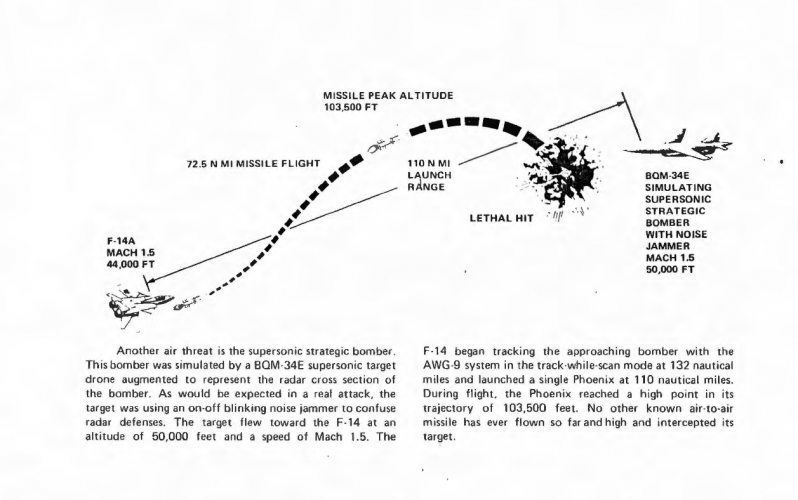
The American long-range missile AIM-54 Phoenix is inferior to the Soviet R-33 in all parameters while being more expensive. Photo:defenseimagery.mil
The S-800 weapon control system provides, via the APD-518 data link equipment, exchange of information about targets, mutual position of fighters, and allows transmission of control commands and parameters from the leader to wingmen in a group, between leaders of other groups, and to ground C2 systems. In fact, the MiG-31 received on board the combined functions of an interceptor and an AWACS (Airborne Warning and Control System - AEW&C) aircraft. Initially, like the Tu-128, the machine was even called a ship (airborne, of course), and the pilot - the ship's commander, but this name did not catch on. The MiG-31's equipment allows it to guide fighters with less powerful radars - Su-27, MiG-29, MiG-25, and MiG-23 - onto targets. Thus, when operating mixed groups of fighters, the developers recommend placing the "thirty-first" [MiG-31] as the commander of the combined group.
Another feature bestowed upon the MiG-31 by its designers, which added to its right to be called a long-range fighter, lies in its ability to reach a remote interception line in minimal time.
A natural question arising when analyzing the MiG's capabilities is which American machine is its "antipode" and which one is "cooler"? It is known that in the conditions of the arms race there are quite a few examples of developments that essentially became a response to some technological breakthrough by the enemy. In my opinion, in the aviation of the 60s-70s, the USSR mostly
responded to the enemy's challenge. This is probably strongly connected with the "Khrushchev" blow to aviation, when both ready aircraft and developments were cut, literally and figuratively. And if the USA "caught up and overtook" us in the space race, then in the air the priority for the first step clearly belonged to the Americans. Soviet aircraft were the younger ones in many analogue pairs: F-15 - Su-27, F-16 - MiG-29, and B-1 - Tu-160. There were, of course, also "unpaired" ones, for example, theirs - SR-71, ours - MiG-25. At first glance, the MiG-31 is a direct opponent of the F-14 "Tomcat" interceptor (Tomcat in English is simply "Cat", "Tomcat"). But upon deeper examination, it turns out that the differences are much greater than, for example, between the Su-27 and F-15.
The medium-range missile with an infrared homing head R-40TD was inherited by the MiG-31 from the previous generation interceptor MiG-25PD. Photo paralay.com
The F-14 aircraft was created for the US Navy as a carrier-based fighter performing air defense tasks for naval groups. The main target types are Soviet Tu-22Ms, anti-ship cruise missiles Kh-22, P-35, P-500, etc. A wing with variable geometry, a mass 10 tons less than the MiG-31. If we briefly talk about comparing the flight-tactical characteristics of the MiG-31 and F-14, we can note the following. The "Cat" [F-14] at subsonic speeds, due to the variable geometry wing, has better characteristics in almost all parameters and in close combat would have a complete maneuverability advantage, only the probability of such an encounter is low. At "supersonic" speeds, the MiG is ahead in maximum speed, sustained turn rate, time to reach the interception line, although it somewhat loses in fuel consumption. Simply put, the "fourteenth" [F-14] is more maneuverable, and the "thirty-first" [MiG-31] is faster. The airframes and power plants of these aircraft are very different, but comparing the aviation armament complex will be much more interesting, because the requirements for it at the start of development were almost identical.
(to be continued)
https://web.archive.org/web/2018032...-starik-razmyishleniya-o-samolete-mig-31.html
What Class Are You In, Old Man? Reflections on the MiG-31 Aircraft. Part 2
Author: Alexey Mironov
In the 80s, it was still quite difficult to "get" open information on weapon control systems; I had to go to the library for official use to get at least something on the F-14. What I saw really upset me. All the stated characteristics surpassed the parameters of the MiG-31 known to me. Firstly, it was indicated that its radar could operate both in CW (Continuous Wave) mode and in Pulse mode, while the S-800 [Zaslon radar system] operated only in CW mode, and for Pulse mode, the target detection and tracking ranges somewhat exceeded the CW ranges. All these parameters were well over 200 km, while the MiG-31's 8B radar detects a Tu-16 type target at 180 km and acquires it at 160 km. For the F-14's optical systems, it was stated that an infrared sensor was used for the lower hemisphere and an ultraviolet one for the upper hemisphere, with a target detection range of 180 km, whereas our 8TK IRST detects an afterburning fighter at 50 km. The AWG-9 system can track up to 24 targets and simultaneously guide missiles against 6, while the S-800, I remind you, handles 10 and 4 respectively.
The R-60M heat-seeking missiles are an excellent addition to the MiG-31's heavy armament
The R-60M heat-seeking missiles are an excellent addition to the MiG-31's heavy armament when it's necessary to destroy a target like a berserk bomber, cruise missile, or escort fighter. Photo: M. Bryansky // airliners.net
The comparison was even worse for missiles. The American AIM-54 Phoenix had a launch range of up to 160-180 km, was lighter than the R-33, and, most importantly, was equipped with a semi-active/active radar seeker, with a target acquisition range in active mode on the terminal guidance segment of 16...20 km. A brief comparison table of the main parameters is provided.
This amazed me so much that I went to my scientific supervisor with a question on this topic. He replied: "If they state an acquisition range of, say, 280 km, it means the radar can acquire a target, drop it — and not just once. And for us — if it's stated as 180, it means the radar will firmly lock onto the target and won't let go!" And he told a story that happened when he was training officers from Arab countries on the operation of our air defense fighters at the Krasnovodsk testing ground. At that time, the USSR was selling MiG-23s and MiG-25s to those states. The new MiG-31 and Su-27 interceptors were just entering service and were not sold to anyone. But the officers from the purchasing countries had special booklets-memos that detailed the characteristics, including those of our new aircraft. An Arab asked: "Why don't you sell us the new fighters?" Mikhail Azarovich wasn't in charge of party and government policy, but he had to say something, and with his characteristic charisma, he said: "If you don't want to buy ours, buy from the Americans!" To which he heard: "No, the Americans inflate their performance numbers. If a parameter is given, it's either calculated mathematically or can only be achieved by an ace pilot. But what's indicated in your documentation can be achieved by an average qualified pilot." Time has shown the correctness of this viewpoint. The characteristics, which have now become advertising data for export products of Soviet-designed equipment, started creeping up after the Iron Curtain fell, and upon closer study of American models, it turns out that there are many conditions where limitations on the stated parameters "crawl out." The F-14's weapon control system (WCS) was no exception.
Phased array antenna of the N007 radar of the S-800 Zaslon system
Zaslon, the main component of the MiG-31-33 interception complex equipment. Photo:
Flug Revue
Phased array antenna of the N007 radar of the S-800 Zaslon system, the main component of the MiG-31-33 interception complex equipment.
Photo: Flug Revue
Yes, indeed, the AWG-9 radar surpasses the S-800 in terms of power characteristics, number of channels, and mass. This is obviously mainly determined by the component base of the radar itself and the digital computer used. Yes, the target detection and tracking ranges are somewhat higher than those of the MiG. But the mechanical antenna allows tracking many targets in a "scanning" [or "bar scan"] mode. This means that while space and one target are being scanned, other targets "rest" during the time spent on their sequential illumination, which can be measured in seconds. Between parameter measurement sessions, the "victim" is tracked in a predictive mode, the onboard computer calculates its predicted current position. And if target tracking "on the scan" can be performed even within the entire field of view, then when guiding missiles with a semi-active seeker — especially on the final leg, when the angular rates of the line of sight to the target increase — the illumination period must be very short (for the S-800, for the R-33, the period is 20 milliseconds). Then the volume of space possible for multi-target engagement involving a radar with a mechanical antenna is reduced several times. As indicated in some sources, for the F-14 this figure drops from ±60 deg to ±20 deg or less, depending on the number of targets. An antenna based on a Phased Array Radar (PAR/Phased Array Antenna - PAA) is fundamentally free of such a disadvantage. One of the top specialists on the S-800 system argued in his dissertation (according to officers' stories) that the modernization capabilities of the 8B type radar reach the following indicators: up to 50 targets tracked, over 20 simultaneously engaged. Modern data on the F-14's WCS states that the infrared channel is coupled with a television one (nothing is said about the ultraviolet range anymore), the radar uses only CW mode. Some sources indicate that the F-14A, just like the MiG-31, could track 10 targets and attack 4 simultaneously, and only the F-14D reached the stated figures — 24 and 6 respectively.
Six-barrel 23-mm GSh-6-23 cannon of the MiG-31 interceptor
The six-barrel 23-mm GSh-6-23 cannon of the MiG-31 interceptor does not lag behind the similar 20-mm Vulcan cannon of the F-14 Tomcat in terms of rate of fire, surpassing it in projectile ballistics.
Photo: paralay.com
Barrels of the GSh-6-23M cannon on the MiG-31 fighter in stowed position
The barrels of the GSh-6-23M cannon on the MiG-31 fighter in stowed position are covered by a sliding fairing.
Photo:
www.paralay.com
Once, at the parking area for training exhibits at the school, I saw a strange MiG-31. What caught my attention was the complete absence of "optical armament" — the IRST, pylons for wing missiles, there was no cannon. Knowing about the tradition of transferring aircraft that had exhausted themselves in testing as prototypes to educational institutions, I climbed into the rear cockpit with anticipation of something unusual. Indeed, the fighter was clearly a testbed for working out the communication between the S-800 and the R-33. Tactical control organs were missing, and missile preparation and application were performed manually. But then I froze in puzzlement: on the radar control panel was installed a button switch "CW-Pulse". That is, just like in the F-14 system, our designers also tried to implement a pulse emission mode, but in both complexes it was abandoned, leaving only quasi-continuous wave.
Besides the radar, another important difference between these "guys" is that the MiG is autonomous and has onboard group control means itself, while the F-14 always had to use the services of the E-2C Hawkeye AWACS aircraft.
The MiG-31 aircraft has a passive channel for detecting air targets, the 8TK IRST (in retracted
position)
The MiG-31 aircraft has a passive channel for detecting air targets, the 8TK IRST (in the photo in the retracted position)
Photo:
www.paralay.com
As for the price of the AIM-54 Phoenix characteristics, it probably predetermined the further fate of the F-14 as an aviation complex as a whole — $980,000 apiece! The cost-effectiveness ratio for the Phoenix most likely became unacceptable. Therefore, at one time even the main armament option for the "Cats" was the medium-range AIM-7.
So, the class of the F-14 is generally clear — a naval air defense interceptor.
And the MiG? And yet, once I managed to hear from the first mouth its actual original purpose. In the second half of the 90s, an interview with one of the chief designers of the aircraft, A.A. Belosvet, was broadcast on TV. After talking about the fighter, he concluded with a key phrase: "This is what 'strategic interceptor' means in our understanding." This definition most clearly puts the dots over the "i". This fact, on the one hand, indicates a not entirely correct approach to comparing the F-14 and MiG-31, without considering the differences in purpose, and on the other hand, explains the initial appearance, many design features and usage techniques, as well as the further evolution of the fighter.
And another funny coincidence. Americans love to give accurate and capacious names to samples of
weaponry. The MiG-31 according to their classification is Foxhound, "English hound". And the F-14 is "Tomcat". Comments are unnecessary, it just happened that way.
Since Soviet military science always paid close attention to the vulnerability of targets, the quality of missile warheads was also very high. The main armament of the MiG-31 — the R-33 and R-40TD — has high-explosive fragmentation (HE-Frag) warheads, which are best suited against low-maneuverability aircraft with increased survivability. The R-60M missile is more of a self-defense weapon in case of close combat. Shooting them at a strategic bomber is like using a slingshot against an eagle. Maybe you'll hit it in the eye. Rod warheads (continuous rod - CR) are intended more for destroying maneuverable aircraft by cutting impact on the airframe's structural elements, which are destroyed by aerodynamic and inertial loads during intense maneuvering. For example, the R-27 and R-73 missiles, which arm the MiG-29 and Su-27, are equipped precisely with CR warheads (and the AIM-54A, strangely enough, too). The AIM-9 close-combat missile has an HE-Frag warhead because when it was designed, others didn't exist yet.
The strategic interceptor MiG-31 does not have powerful onboard electronic countermeasures (ECM) means. Active jamming stations were not fitted to MiGs until the "M" modification, and passive jam dispensing equipment began to be installed only from the MiG-31B, and even then not immediately. A standard Radar Warning Receiver (RWR) for 4th generation aircraft was installed — the "Bereza-LM" [Birch]. It indicates the type of radar-range emitter, direction, and range to the presumed attacking means. Actually, this system really allows effective information recognition in duel combat conditions. But the function of electronic intelligence (ELINT) in group action conditions remains problematic for implementation on board an interceptor even now. It requires highly sensitive and precise emission measurement sensors, as well as serious computational resources for data processing. Obviously, it will only be truly solved on 5th generation fighters. An officer who served in one of the regiments in the Far East told how this was handled in the 4th generation. By the start of exercises involving a pair of fighter regiments and a long-range aviation regiment, the Americans had pulled two aircraft carriers and other naval forces into the area. As a result, at "H-hour" a real carousel was spinning in the air, not for the faint of heart. In these conditions, the pilots simply turned off the "Bereza" because it was flashing like a New Year's garland and "screaming" with its audio signal non-stop. It was already impossible to extract reliable information from this stream, and it was very distracting from other tasks.
Sight and flight indicator in the MiG-31 cockpit
The MiG-31 pilot's cockpit is equipped with a sight and flight indicator, allowing the use of cannon and missiles, as well as director instruments for guiding the interceptor to the target
Photo:
www.paralay.com
Another anecdote was associated with this kind of exercise. A general came to inspect the work of the aviation regiment; his characteristic trait was the floridness of the material he delivered in front of the personnel. At the formation, he gave a "dressing down" to the "slackers" and "loafers". To which a senior lieutenant from the ranks suggested that he be present at the command post during such a carousel. The general answered the officer, as was his custom, with a four-story tirade, interspersed with words like "arrest", "guardhouse", etc. But at "H-hour" he did come to the CP. After a few hours, those around saw the following picture. A red, sweaty general bursts out, smokes a cigarette in one drag, jumps into a "UAZ" [jeep] and disappears over the horizon. After that, no one saw him on the unit's premises.
Modern air combat is a "game" at the limit and beyond human capabilities, but autonomous long-range interception somewhere over the Arctic Ocean is its extreme case. As on many heavy all-weather interceptors before it, the MiG-31 and F-14 crew consists of a pilot and a navigator/weapons systems officer (WSO). The MiG's designers helped him solve navigational tasks as well as possible — for example, the scrolling map tablet, on which the aircraft's spatial position was marked with a light vector, turned out to be very informative. Thanks to the perfect and convenient equipment, the navigator is always ready to move on to the second part of his tasks — weapon employment.
Main elements of the MiG-31B WSO cockpit interior — three indicators of the Zaslon WCS
Main elements of the MiG-31B WSO cockpit interior — three indicators of the Zaslon WCS
Photo:
www.paralay.com
Many believe that a serious contradiction crept into the specialty "WSO of the MiG-31". His position status and salary are those of a navigator, i.e., lower than the aircraft commander's, but his tasks are really no less complex than the pilot's. One pilot, a flight commander, when retraining from the MiG-25 to the MiG-31, complained: "They've turned me into a chauffeur!" Indeed, battle management in a group is carried out by the WSO. On his tactical situation display, all available information about targets and fighters is shown, received both from onboard targeting systems and from wingmen, ground control means, and AWACS aircraft. He performs target allocation for attack, can indicate the position in the formation to wingmen, chooses the type of missile weapon (wing/fuselage) for his fighter. If the WSO doesn't set the attack order for enemy aircraft, the central computer of the "Argon-15" WCS does it itself. Actually, the aircraft commander executes tactical guidance and targeting commands using missile weapons, generated by ground ACS [Automated Control Systems], AWACS operators, the WSO, and the S-800. At the same time, he pilots, makes the decision to open fire, fully "manages" the artillery armament and the use of missiles with thermal seekers in the "Phi-zero" mode (controlling the aircraft to align a visually visible target with the longitudinal axis of the fighter and, accordingly, the missiles for target acquisition, if obtaining target designation from the radar or 8TK IRST is impossible). Only on the MiG-31M (BM) modification did the pilot get a reduced tactical situation indicator (TSI), but this rather solves the issue of his awareness of the situation than full-scale battle management.
Display of weapon status (top left), flight information (top right), and tactical
situation on the indicators of the MiG-31 WSO and pilot
Display of weapon status (top left), flight information (top right), and tactical situation on the indicators of the MiG-31 WSO and pilot
Photo:
www.paralay.com
Based on the capabilities of the weapons control operator, it follows that it is the commander (of a flight, squadron) who should be at this "workstation" and develop and implement battle tactics. Probably, this contradiction will only be resolved on 5th-6th generation fighters by installing an expert system, and all leading aviation powers are working on this problem, as it is considered one of the highest priority.
The MiG-31 is the first 4th generation fighter to enter service with the Air Defense Aviation. And for the new machines, the customer (the military department) set two additional requirements, to which our hero, perhaps, did not quite measure up: minimal time for installation/removal of internal units and the possibility of use from unpaved airfields.
Inheriting the layout from the MiG-25 in many ways, it did not fully meet the first requirement. The same APP-46TD [Aircraft Preparation Panel], located in the compartment behind the cockpit, was hardly more accessible than on the prototype. Or, for example, to give engine specialists access to some units, the weapon technicians had to remove the rear ejection mechanism of the missile, and during several months of operation in Kazakhstan, our group had to try to do this at temperatures of both +40 and -30 degrees Celsius.
To adapt to the second requirement, and in general to reduce pressure on the runway, the MiG-31 received a new design of the main landing gear strut with two tires. Moreover, it was tested for operation from ice airfields. Test takeoffs and landings showed that such a possibility exists. But it, unlike the MiG-29 and Su-27, does not have intake covers for takeoff and landing. Despite the high location of the power plant, foreign object damage (FOD) on unpaved runways is very likely. Often, during engine run-up on the ground, a whitish cord of condensation formed in the stream of "swallowed" air stretches from the engine compressor to the surface. The prohibited area for personnel in front of the intakes is 15 meters. Unfortunately, failure to comply with this rule led to a tragedy. In Semipalatinsk, an interceptor on combat alert was parked with engines running. The aircraft technician tried to move under the fuselage, but not under the suspended missiles, and miscalculated the dangerous position. The person was completely sucked into the air intake…
It must be said that the R-33 is probably the only "air-to-air" class missile that was not manually hung on the aircraft during alerts. Even the R-40TD, approximately the same mass — 467 kg, crews of 12…15 people could carefully install on the launch rail lugs. There's nothing to say about the R-60 — two people can "hook" it onto the APU [Aircraft Launch Unit] without problems. But the R-33, with its large mass, impressive diameter, and relatively short length (4.1 m), and most importantly, located low under the fuselage, where a person stands in a semi-bent position, physically cannot be installed manually. Therefore, as indicated in the documentation, it has to be hung together with a technological trolley, using a winch and special lugs on the fuselage. But the complexity of the process under time constraints sometimes led to the ceramic seeker radome being broken. To replace it, the head of the servicing group had to pay with alcohol in a quantity equal to the volume of the radome.
MiG-31 interceptor returning from combat duty
MiG-31 interceptor returning from combat duty.
Photo: R. Gabidullin // airliners.net
Overall, the MiG-31 proved to be a complex but sufficiently reliable aircraft during operation. Certainly, there were accidents and incidents, but the fighter's endurance remained high. According to technicians' stories, when particularly severe frosts came to Novaya Zemlya, there were cases of handing over combat duty from a Su-27 regiment to the MiG-31 (increasing the composition of duty forces), as the "Migari" [MiG guys] tolerated such cold somewhat better than the "Sukhari" [Su guys].
Initially born as a "strategic interceptor", the MiG-31, like any successful machine, began to evolve. Firstly, its power as an air defense fighter was increased, and secondly, the reduction in state funding for work and purchases led to the emergence of a concept to turn each aircraft into a multi-functional one. In the project of the "BF" modification, "air-to-ground" class weapons appeared on board.
The first leap in the MiG-31's combat capabilities through modernization occurred with the appearance of the "B" modification; NiT [Nauka i Tekhnika - Science and Technology magazine] talked about it in the first article dedicated to the MiG-31. I will add that an important feature of the R-33S missile that appeared on this aircraft was increased jamming immunity when attacking cruise missiles and the ability to выделять [emit/discriminate? Context suggests a special coded illumination signal] a specially coded target illumination signal when fighters operate in a group. This last feature allowed handing over guidance to another fighter. The result — the possibility for the lead fighter to launch a missile at the enemy with a subsequent immediate breakaway (exit from the attack), while guidance is performed by the trailing fighter, located, thanks to the long ranges of the radar, far beyond the enemy's attack zone. The second novelty allowed the appearance of a third — equipping with a special (nuclear) warhead, low yield, similar to surface-to-air missiles. On the panel for removing the blocking for the use of the special warhead in the cockpit, there were digital buttons, and as is known, there are ten Arabic numerals. Therefore, the yet non-existent service group for the corresponding equipment, which would be burdened with responsibility but not the volume of work, was promptly nicknamed the "ten-button operators" in the regiments.
Obviously, the capabilities of a fighter with such an arsenal qualitatively change the balance of forces in battle, especially when a group of interceptors acts against a group of strategic bombers covered by fighters and jammers. Knowing, in turn, the peculiarity of a contract army, or simply — the hired military of a potential adversary, one can assert that even big money would hardly overcome the fear of evaporating in the epicenter of a nuclear explosion over the North Pole in a head-on battle with MiGs. But at that time, politicians reasoned differently than the military. While the former were retreating (E. Shevardnadze, then the USSR Minister of Foreign Affairs, signed a treaty limiting the number of aircraft in Europe), the latter were thinking about how to cover the north. As a result, two regiments, the Zaporizhzhia and Petrozavodsk ones, were withdrawn beyond the Urals, to Sary-Shagan (an air defense forces testing ground in Kazakhstan) and Norilsk respectively, and began rearmament with the MiG-31B. Subsequently, they were supposed to "settle" at the airfields of Tiksi and Dikson, on the coast of the Arctic Ocean. But history took a different path. Even the existing air defense assets there began to be taken off duty, not to mention the arrival of new ones.
(to be continued…)
https://web.archive.org/web/2018033...razmyishleniya-o-samolete-mig-31-chast-2.html
What Class Are You In, Old Man? Reflections on the MiG-31 Aircraft. Part 3
Author: Alexey Mironov
Combat employment and combat effectiveness
Combat employment is a set of technical and tactical rules for using the AIRC [Aviation Rocket Complex? Likely means the interceptor weapon system] to increase the effectiveness and safety of the complex when performing tasks of destroying aerial targets. It consists of both theoretical research and practical checks at testing grounds, during the current operation of the equipment.
Combat employment should not be confused with participation in military (combat) actions — the MiG-31 has not fought yet. Nevertheless, it can already be said that it has lived an active, fruitful, and quite creative life. And it has successfully handled its tasks, because the main task of defensive weapons is to prevent offensive weapons from being used.
For example, many experts recognize that the MiG-31's contribution to the cessation of SR-71 operations is very significant. Previously, the "Blackbird" easily and with impunity crossed any small countries, but the closest attention was, of course, paid to surveying Soviet air defense assets. To intercept the reconnaissance aircraft during its long movements along the borders, it was sometimes necessary to scramble several fighters sequentially. The interceptor was typically vectored by ground ACS [Automated Control Systems] onto a head-on course against the target and performed a target search with its onboard radar at maximum range. After acquisition and tracking, information about the SR-71 was constantly transmitted to a second fighter following it at a distance of several tens of kilometers. Before the first fighter diverged from the target, the second one had to already acquire and track the reconnaissance aircraft — and, "keeping it in sight," close in. Then the reconnaissance aircraft was handed over to the next interceptor. Sometimes up to a dozen MiG-31s were in the air, but any attempt by the SR-71 to cross the border would have been immediately cracked by an attack with long-range missiles. Of course, such collective efforts to push out the reconnaissance aircraft were "costly," but it must be considered that its operation was also a very, very expensive "pleasure." Thus ended the era of confrontation between these two "strategists" — the SR-71 was mothballed.
The task of intercepting a strategic bomber, even if not covered by fighters, is no less complex. Usually, the ECM means of a heavy aircraft are so developed that the processes of guidance, obtaining target coordinates, and the attack itself become problematic. It is difficult to deceive the laws of nature, and the range at which the direct signal from the target is detected is calculated using the square root, while the reflected one uses the fourth root. All other things being equal, it is fundamentally less costly to deploy jamming than to use active detection means.
An officer who served as an advisor in Libya during the period of strained relations with the USA told how he "filtered" jamming set by a B-52 on an old ground-based radar. According to the instructions, the bearing to the jammer is calculated by the maximum brightening on the screen when the antenna is rotated at different angles relative to the enemy. But, according to him, within an angle of [several] degrees the screen brightening was complete, or, as they say in such cases, "milk." So a real fighter vs. bomber battle is a very complex process, and one can only say that the MiG-31, due to the high power level of its radar and the presence of a Phased Array Antenna (PAA), does this better than other 4th generation interceptors. This same quality gives it advantages in combat with a fighter as well.
One fine morning on a flying day, the pilots of our regiment, based in Kazakhstan, according to the plan of the army commander, were to participate in working out an exercise — a battle between Su-27s, from Andizhan airfield, and our MiG-31Bs. The engagement "format" was 6x6. The "Sushki" [Su-27s] were already shining at airshows — naturally, this was reflected in the pilots' moods, and the excitement must have been considerable. I installed dummy plugs simulating R-33 missiles and approached the WSO [Weapons Systems Officer]. "Well, Yura, shall we fight?" He waved his hand in annoyance: "What fight! We're meeting the commander's favorite regiment. He said if we don't let them work — he'll skin us, so today we're just offering our rear end... And their radar in a head-on fight drops our lock. They are 'pussies' against us." The high power characteristics of the "Zaslon" led to the creation of powerful jamming for weaker radars, which caused the enemy to lose track of the MiG. It must be said that excessive briefing of pilots always led to an underestimation and poor realization of the combat capabilities of the aircraft.
MiG-31
MiG-31
Although the MiG-31 is inferior in maneuverability, rate of climb, and interception radius to the Su-27P aircraft, its complex of onboard equipment gives it undeniable advantages in solving many air defense tasks.
Photo: P. Gorbunov // airliners.net, V. Dmitrenko // jetphotos.net
But still, the MiG-31's "favorite" targets are cruise missiles. The R-33 air-to-air missile was constantly modified to increase jamming immunity, including when attacking low-flying CRs. The methodology for their attack by an interceptor is as follows. Radar acquisition must be performed at maximum range for this type of target, about 50 km. Flight is performed at an altitude of 10 km. Launch is performed immediately upon reaching the permitted range, and a break is executed to the maximum angle allowing illumination of the missile until the end of guidance. After warhead detonation or the expiration of the calculated guidance time — execute a break away from the target with maximum G-load. This preserves the carrier's safety and achieves the required effectiveness of destroying the CR.
According to some unofficial data, immediately after the complex was adopted for service, the real picture when working against CRs was not particularly joyful — a very large expenditure of R-33s was required, up to 19…20 pieces per one Tu-22M3 [Backfire] CR carrier in complex conditions. Gradual refinement of the system — from the radar to the seeker of the R-33S — led to the current claim: the MiG-31 destroys CRs on the PMV [presumably a mission profile] on the first pass. Moreover, the advertising assertion that it is the only fighter in the world capable of doing this clearly has grounds.
The MiG-31 regularly performs combat training launches against all classes of aerial targets with R-33 missiles, unlike the F-14 with its AIM-54. Unfortunately, there have also been incidents of weapons being used against friendly forces. During planned combat training launches at the Sary-Shagan testing ground, while guiding fighters onto various radio-controlled targets, a MiG-31 aircraft was hit by another fighter from the same regiment. The version of the incident close to official states that the cause was the retargeting of launched R-33 missiles from the
target. According to a version far from official, the crew reported readiness to launch, but the target was identified as having the "friendly" IFF signature. According to officers' stories, a high-ranking official was present at the command post who gave the command to destroy the target. The crew reported again that the target was "friendly," and again received an order to destroy. Having removed the lock on launching missiles against "friendlies," the pilot performed the launch (of 2 or 3) R-33 missiles, the first one hit the target. From a technological point of view, the second version seems much more plausible to me. The aircraft commander was killed, the WSO's fingers were severed, but he managed to eject. Eyewitnesses said the pilot's ejection seat was literally riddled with fragments. The only circumstance on which the versions of the causes agree is that the stated characteristics of the MiG-31's weapon system were exceeded, but no guidance errors or crew actions were found.
The "Cats" were much less fortunate with combat launches of their "long arm" — the Phoenix missile. Mainly, launches were performed by the most experienced test crews during the system's acceptance into service. During a test launch of AIM-54s against six targets, one missile veered off course "for technical reasons," and another launch was deemed unsuccessful due to a target malfunction.
The MiG-31 successfully handled its four radio-controlled targets in August 1978, and in 1994, four specially prepared remotely piloted MiG-21s were destroyed by simultaneous guidance. In total, about 20 Phoenix launches were made from the F-14, with approximately 88% deemed successful. But real statistics of AIM-54 use by line pilots are absent, and based on modeling are estimated at a level of 0.5 [Pk?], which given such high cost is hardly sufficient even in combat actions of limited scale.
Moreover, in both incidents where F-14s shot down Libyan Su-22 and MiG-23 aircraft, "standard" AIM-7 and AIM-9 missiles were used. At the moment of the clash with Iranian F-4s in 1987, the "Cats" for unknown reasons let the opponent through the Phoenix engagement range, and a Sparrow launch was not successful. The impression is created that there was an unspoken ban on the use of the AIM-54, probably due to its excessive cost and insufficient effectiveness. Probably, this circumstance, coupled with the relatively high accident rate of the F-14 itself, led to the decision not to modernize the aircraft, as was done for example with the F-15, but to replace it with new modifications of the F-18.
MiG-31
To all the advantages of the MiG-31, it's worth adding its ability to operate in any, even the most severe climates.
Photo: // airliners.net
In conclusion, let's consider several hypothetical typical combat situations for the MiG-31 when engaging various types of targets. It must be said that discussions of this kind are usually very, very conditional, because modern air combat is an extremely complex task, saturated with a huge number of conditions. Since people's lives are at stake (and in the case of intercepting a strategic bomber — entire cities), tens of millions of monetary units of "hard currency" (and considering the potential damage that one aircraft can inflict over several combat sorties — billions), then in general, the meeting of each type of machine in the air is preceded, like a fight between professional boxers, by the most thorough modeling, analysis of capabilities, and ends with the development of tactics for each specific upcoming engagement. A modern fighter is a hostage of a huge air combat support system. Therefore, analyzing a meeting in a 1x1 format is as effective as comparing the left glove of boxer A with the right glove of boxer B — the ratio of punch force and speed, as well as the sturdiness of each head. But public opinion requires simplification and certainty, so often even developers are forced to report by direct comparison of characteristics. So, let's talk about some hypothetical meetings of combat aircraft in the air.
So, one F-14 against one MiG-31. A non-modernized MiG would have a rather hard time in this case. On head-on courses, due to the greater power of the AWG-9 radar, there is a risk of unstable tracking of the enemy (as indicated above, often the weaker station loses lock on the stronger one), the PAA might compensate for this risk, but the launch range of the Phoenix missiles increases the danger for the "thirty-first." Getting drawn into close combat also remains extremely unfavorable for the MiG. The developers recommended attacking the F-14 — a high-altitude target — in a covert mode with support from ground ACS using P-40TD missiles. Guidance commands are received via data link, and the interceptor is vectored into the target's rear hemisphere (RHS). The WSO switches the S-800 to "TK-leader" mode, while the radar is not turned on for emission (the OFF-STBY-FULL switch on the RP-31 in the STBY position). Selection of P-40TD missiles for use is performed by the KR-33 switch ("wing" — "thirty-thirds"). Forced switching of the missile to PREP mode is performed by the PREP "Off-Man-Auto" switch in the "Man" position. After acquiring the F-14 for tracking with the IRST, target designation is automatically issued to the seekers — and they should acquire the target for tracking. As data is received from the GCI [Ground Controlled Intercept], including range to the enemy aircraft, the computer calculates the maximum permitted missile launch range and compares it with the currently received one. Upon reaching the missile engagement zone, the WCS generates the "Launch Permitted" (LP) command. The pilot presses the combat button and after missile separation performs a tactical break.
Combat aircraft crew — pilot and WSO of the MiG-31 in flight must work in maximum coordination. Photo:
http://www.russianplanes.net
In this scenario, the key point is the interaction of the MiG-31 with the GCI, but the support of the F-14 by the E-2C Hawkeye AWACS aircraft is left "off-screen." Therefore, a more interesting option seems to be a group attack by MiG-31s on an AWACS aircraft covered by two F-14s. A pair of MiGs must be allocated to each covering fighter, which, closing with the "cat," separate to a distance along the front of up to 200 km, where stable communication via APD-518 [data link] is ensured. The MiG-31 crews can occupy different altitudes — the F-14 aircraft can engage up to six targets simultaneously with Phoenix missiles, but only if they are at the same altitudes. Such a formation ensures the exclusion of simultaneous Phoenix engagement of both the leader and the wingman. And they, respectively, both perform a coordinated attack on the F-14 with R-33 missiles. A third pair of MiG-31s breaks through to the E-2C (or E-3A).
Interception by a group of MiG-31s of an AWACS aircraft covered by fighters
Interception by a group of MiG-31s of an AWACS aircraft covered by fighters
The capabilities in a head-on fight for the MiG-31B with R-33S missiles are significantly higher, and Russia has a majority of such aircraft today. Obviously, the best option here would be for a pair of MiGs to implement the described "tandem" mode against the "Cats," i.e., target acquisition, transmission of its parameters to the wingman via APD-518, launch of R-33S by the lead fighter, and guidance by the wingman (trailing), who does not enter the enemy's engagement zone. But, as can be seen, working in a group or at least a pair is essential here.
But the appearance of the "(B)M" modification on the "battlefield" brings the MiG-31 into the undisputed leaders at long distances. Most likely, even fifth-generation fighters will not possess such a powerful radar and, especially, such "long-range" missiles as the R-37, meaning in a long-range missile battle against any fourth-generation fighters, the MiG-31 gains undeniable advantages. Even the F-14 has no advantages left for attacks on head-on courses. But, as the experience of local conflicts has shown, meetings at long distances do not always end with effective attacks. Approximately two-thirds of encounters escalated into close maneuvering combat. This is related to the complication of the jamming environment (e.g., impossibility of acquiring and tracking the target or missiles losing the target on trajectory), improvement in the use of various tactical techniques in a group, etc. Any attempt by fighters (F-15, F-16, F-18) to transition the battle to short distances can be countered by the MiG-31 through effective group combat formation, an example of which is given below.
A pair of MiG-31s proceeds towards the enemy in the first echelon, usually at medium altitudes, performing space surveillance, target search across the front, and long-range radar detection. In the rear echelon, at a distance of several tens of kilometers (tested at 60 km), flies a pair of Su-27 or MiG-31 fighters. The front echelon performs acquisition and tracking, target allocation, engages the enemy at long range, and transmits information about him to the rear echelon. The second pair performs search and target acquisition based on target designation from the lead MiG-31s and maneuvers, reinforcing potentially dangerous directions. If enemy fighters still break through the front echelon and are able to continue the battle, they immediately come under attack from the second one. The interaction of the MiG-31 with the Su-27 in the considered case is very convenient for initiating close combat precisely by the maneuverable "Sushki" with an enemy trying to get on the tail of the lead pair, but complicates group control during the guidance and search phase due to differences in the altitude-speed characteristics of these fighter types. To hinder the detection process of the rear echelon, the aircraft can fly lowered, against the ground background, and upon receiving information about targets, in afterburner mode, take up position to protect the tail of the first group, i.e., reduce the distance to the first pair while gaining speed and altitude.
Such a tactical technique can also be applied when breaking through the escort group protecting bombers. In this case, the MiG-31s' first salvo is against the enemy fighters — and they continue closing with the strike aircraft. The maneuvering F-15s or similar fighters evading the attack and surviving are tied up by the "Sushki" of the second echelon, and the MiGs engage the bombers with the remaining part of their ammunition load.
This variant of combat formations of one or several groups of similar or different types of Russian fighters based on leading MiG-31s is proposed to be used as one of the most effective in modern group air combat. When several flights (flight — 4 fighters) are operating, one MiG-31 can be allocated as the commander of the combined group, who collects information from the leaders and coordinates the actions of subordinates. In this case, he is located between the interacting groups at a sufficiently safe distance from the areas where combat is initiated, but if necessary can provide fire support to his forces.
A separate point should be the consideration of an attack by a MiG on a bomber, whose main form of counteraction will not be maneuver, but jamming across the entire available spectral range of electromagnetic waves. Therefore, the necessity of maximum covert engagement again comes to the fore, so that the enemy cannot fully realize its jamming capabilities. The actions of the fighter during a covert attack using R-40TD with information support from external sources were shown using the example for the F-14. The MiG-31 can also perform a sufficiently covert effective engagement with R-33 missiles. It is done like this. The operator switches the S-800 to "TK-leader" mode, the radar is switched to operate without emission to external sources ("STBY"). The aircraft is vectored into the zone of best conditions for acquiring the bomber with the IRST (e.g., into the RHS), the target is designated for attack, the radar slews the beam according to target designation from the 8TK [IRST]. Selection of R-33 missiles for use is done with the "KR-33" switch. Missile preparation is enabled in manual mode. After performing automatic checks of all R-33 systems in the launch rails by acquiring a control (dummy) target with the seekers, the ready lamps (green triangles on the weapon control panels) light up on the pilot's and WSO's displays. The pilot presses and holds the combat button. The WSO turns on the radar emission against the target ("FULL"). The S-800 calculates the range to the enemy aircraft, closure rate, and feeds combat target designation to the missiles. As soon as the R-33 seekers process them, the weapon control system issues launch commands to the missiles ready for launch. Depending on the launch mode "Po1-Po2" [Single-Pair], one or two missiles are launched (against bombers "Po2" is recommended). The order of polling the fuselage hardpoints: 1-4-2-3 (front left — rear right — front right — rear left) to maintain aircraft balance. The missile is catapulted from the AKU-410 [launch rail] and within 2 seconds stabilizes and moves away from the carrier to a safe distance, target illumination by the radar begins. The seeker begins searching for its target. For all missiles acquiring the target on trajectory, this moment is very vulnerable during guidance, as the enemy begins maneuvering and electronic countermeasures. The R-33 is quite seriously protected against receiving a "foreign" signal — the seeker's head antenna allows processing of the received signal only after the "friendly" illumination is registered by the tail antenna. The rest of the time the seeker is "locked." If the equipment cannot extract the useful signal from the target from the jamming, then it switches to angle tracking mode, i.e., guides on the source of radiation, like a heat-seeking missile, but with less accuracy. But the preparation and separation phase of the missile must be completed, so the covertness of the attack is very important.
B-1B and B-52 bombers are carriers of the most advanced jamming means. And if there is no data on the range to the enemy aircraft (e.g., from GCI or from other interceptors), then the MiG-31 must use onboard algorithms allowing operation under these conditions. The minimum necessary information is the bearing to the jammer. Given the bearing, the S-800 "knows how" to calculate the range to the target using one of two methods — triangulation (by a pair) and kinematic (by a single interceptor).
Tech crew taxiing the MiG-31 to parking after flights
Photo:
http://www.paralay.com
The essence of the triangulation option is that, given the known mutual position of a pair of MiG-31s (this is handled by the "Radikal-OVK" equipment — determination of mutual coordinates), the spatial segment between the fighters is known, and the bearings of each on the target should form a triangle in space. The leader, transmitting the target bearing angles, also transmits the command "triangulation," i.e., a requirement to "solve the triangle." The S-800 of the wingman checks if the bearing rays — its own and the leader's — intersect in space. If yes, it means they are "looking" at the same target, the sine theorem is solved, and information on the range to the target appears on board both aircraft. Solving this problem again after a certain interval allows easy calculation of the closure rate with the target (range change over time). If applying this kind of measurement several times is not possible, then the hypothesis of straight-line uniform target motion allows predicting the closure rate with the enemy mathematically, using the change in bearing angles.
Performing scheduled maintenance on the power plant of the MiG-31
Performing scheduled maintenance on the power plant of the MiG-31
Photo:
http://www.paralay.com
The kinematic method of determining range is used by a single interceptor or in the absence of data on the mutual position of aircraft in a group. It consists of building the aforementioned triangle by maneuvering the interceptor. Measurements are performed with a certain time interval at the beginning and end of the maneuver. Relative to the target — the same hypothesis of straight-line uniform motion.
The ability to refuel from a Su-24M bomber equipped with a UPAZ refueling pod significantly increases the capabilities of the MiG-31 interceptor Photo:
http://www.paralay.com
Having data on range and closure rate allows preparing both the R-33 and the R-40TD(1) for launch. The difference is only that the "forties" must acquire the target during preparation, and the "thirty-thirds" — after separation, with the possibility of retargeting onto the jammer.
Performing scheduled maintenance on the power plant of the MiG-31 Photo:
http://www.paralay.com
Thus, when attacking a bomber and a jammer — bearing, bearing again, to prepare the missiles. If it was not possible to obtain these "ill-fated" angles or the missiles still could not be launched, then the MiG-31 has one more option for attacking a low-maneuverability target with "heat-seeking" missiles — the "Phi-zero" mode. It is used when the enemy is visually visible. The seekers are uncaged along the longitudinal axis of the fighter. To create favorable aiming conditions, it is better to vector the fighter into the target's RHS for the following reasons. Firstly, the most radiating unit of a jet aircraft is the engine nozzle exit, R-60(M) cannot acquire the target in the forward hemisphere (FHS), for R-40TD acquisition is also difficult, though possible. Secondly, the angular rates of the line of sight when attacking the enemy in the RHS are lower than on head-on courses, which is favorable for aiming and guiding the R-40. The pilot flies to align the axes. For example, he aligns directions in the vertical plane, and in the horizontal plane "steers," "yaws," "wiggling" the control pedals. As a rule, acquisition of the enemy's "heat spot" in this mode is unstable because misalignment of the indicated axes constantly appears and the seeker "loses" the target. Aiming can be performed with the combat button pressed; at the moment of seeker readiness, the automation uncages them, and, if other launch conditions are met (aircraft angles of attack, G-load, dynamic pressure, etc.), the missiles should separate from the APU [Aircraft Launch Unit] rails in the standard manner. It should be noted that such responsible combat operations as determining missile engagement range and IFF ("friend/foe") in this mode fall on the pilot, since visual contact with the enemy is implied.
Combat duty during the polar night is a common thing for the MiG-31
Photo:
http://www.testpilot.ru
Well, and finally, the last standard combat mode of weapon employment, especially relevant for the MiG-31 when attacking a bomber — cannon fire. The B-52H during modernization lost its defensive armament, so only covering fighters can create danger during aiming (the Tu-95MS, for example, retained onboard guns for defense, and the Tu-22M — too). But this requires precise and complete information about the target's motion parameters — range, closure rate, angular rates, and bearing angles. If the radar and "Argon-15" cannot output the results of the aiming parameter calculation (as already indicated, the modes are "Pavtomat" [Auto mode?] and "Potesechka" [manual mode?]), then the pilot has only two options. The first — calculating the required angles mentally and setting corrections on the PPI-70V [Sight and Flight Indicator] in the vertical "deltaV" and horizontal "deltaG" planes. Pilots of the Second World War trained their "computer" regularly; modern ones are unlikely to have access to this mathematics. The second option — firing instinctively; for this, the ammunition load includes tracer rounds at a certain interval (e.g., every tenth), of the OFZT type — high-explosive fragmentation incendiary tracer. Low aiming accuracy is partially compensated by the cloud of projectiles created by the GSh-6-23(M). It should be noted that the standard mode of employing artillery weapons on the MiG-29 and Su-27 is provided by the optoelectronic station, which includes a laser rangefinder and provides the necessary measurement accuracy. Such a station appeared only on the MiG-31M, but the cannon was removed from it. So far, the use of artillery weapons during combat training events involving line aircraft has not been recorded.
Currently, the MiG-31 is in service with Russia and Kazakhstan. There were press reports about the sale of 24 aircraft to China and even about setting up licensed production of the MiG on Chinese territory. But, as indicated in sources close to official ones, the deal did not take place. Isn't it time for you, MiG-31, to retire, like your "opponent," the F-14, was sent there in 2006? As practice shows,all modern air-space operations were conducted with the massive use of cruise missiles, and strategic bombers of all stripes also did not "sleep through" these wars. And interest in unmanned attack systems is growing worldwide. Apparently, there will be plenty of work for "strategic interceptors" for a long time to come.
The MiG-31 — a unique machine, developed exclusively as a defensive weapon, still evokes admiration in me. What feeling can a person preparing for flight a fighter capable of destroying an enemy, on each board of which nuclear death for twenty small cities is prepared, experience? The answer is simple — awe and respect.
https://web.archive.org/web/2019011...razmyishleniya-o-samolete-mig-31-chast-3.html