exclaimedleech8
ACCESS: Top Secret
- Joined
- 30 September 2024
- Messages
- 826
- Reaction score
- 1,001
This is an alternate history I've been wanting to write for a long time.
Most combustible fuels burn at 3600-3800 degrees Fahrenheit (~2000 degrees celsius). That will easily melt all but the most exotic metals. For piston engines, this isn't a problem; combustion is intermittant giving time to cool and the shape of the engine lends itself to liquid cooling. For turbine engines, however, this is a problem because combustion is continuous and the turbine blades will be exposed to this extreme heat constantly and there is no practical way of liquid cooling a turbine wheel that is spinning at 60,000 RPM. The only way to prevent turbine engines from destroying themselves is to run at very lean air-fuel mixtures, reducing combustion temperatures. The problem with this is that the extra air requires a bigger compressor which imposes a parasitic load that hurts fuel consumption.


As inlet temperatures increase, a turbine engine produces more power for a given size and fuel consumption. Today, aircraft and power station turbine can run at 2600 degrees with help from cooling channels in the blades as well as thermal barrier coatings. But this is not a satisfactory solution given the high cost.
OTOH ceramics are able to withstand extremely high temperatures and are easy and cheap to manufacture. As an added bonus, they have a low coefficient of thermal expansion, allowing for smaller clearances. But ceramics are too brittle to be practical, at least the ones on the market are. In recent years, ductile ceramics have been proven in laboratories. But what if somehow these discoveries were made all the way back in the 1950s, perhaps by some scientists trying to make a material for missile nosecones?
Such a material would have dramatic impacts for all things from coffee mugs to the space shuttle and even the construction of highways and buildings. But let's focus solely on turbine engines.
In the Air:
Let's imagine this new ceramic manufacturing process was discovered in 1951. After a bit of refinement, it could be incorporated into jet engine manufacturing by 1955. Mig-21s, B-52s, and 707s would be able to fly farther with less weight, but it would be a while before aircraft design could be optimized around the benefits of these lighter and more compact engines.

By the mid-1960s, airplanes designed to take advantage of the new turbines would be hitting the market. One of the more exciting prospects would be for aircraft that could take off and land vertically. In civilian application, this has been dismissed as adding too much weight and cost. That would no longer be an issue. Airports could be located directly in the middle of cities, especially as their smaller exhaust gas volume will reduce noise. Intercity and and many commuter railroads, with their high capital costs, could be replaced by airplanes, with the right of way freed up for other uses.
I'm conservatively assuming that civilian air travel will remain subsonic. The difficulty of developing airplanes that can survive supersonic speeds and produce acceptably low sonic booms would still put Concorde out of reach of all but the very rich. But with better fuel economy, Concorde could carry more payload. It's also possible that ceramic fuselages could greatly simplify construction but that's beyond the scope of this post.
On the ground:

George Huebner, an engineer at Chrysler, realized that the gas turbine had a lot of good qualities for passenger car power: it was lightweight, compact, extremely smooth, had few moving parts, needed no cooling system, needed no oil changes, could easily start up in the cold, and could run on anything flammable. Early problems came from poor throttle response and part load fuel consumption. Those were solved by variable nozzles and regenerators. The only problem, and the real reason your car isn't powered by a turbine engine, was the expensive superalloys used to make the turbine blades. With that problem licked by ceramics, limited test runs could start by 1958 to tease out any bugs, and then Mopar would move over to turbine engines as quickly as it could retool its factories.
Ford and GM were not as enthusiastic about the prospect of turbine powered passenger cars but they did see potential for trucks and buses and they each brought their own novel ideas.

GM incorporated what they called a "power transfer" that could connect the power turbine and the compressor turbine. At part load, the power turbine could send some of its torque to the compressor, increasing its speed and thermal efficiency. This same principle of having the power turbine drive the gasifier would also provide an engine braking effect, and going the other way, it would prevent the gasifier from overspeeding.

Ford's ideas were quite a lot more complex. They added a second compressor stage, an intercooler and a second combustion chamber. The resulting engine, called 704, offered high part load efficiency and produced 300 horsepower in a package that could fit in a Ford automobile despite being aimed at trucks.
So, how are cars and trucks different in this timeline? The small size of the turbine means the engine compartment can be made shorter. Chrysler would be going for the "cab forward" design 30 years earlier. The lightness means weight distribution is less of an issue. Front wheel drive would probably catch on a lot sooner, getting rid of the driveshaft hump and allowing designers to make rooflines lower. On sportier models, mid-engined layouts would be more practical to implement. GM was hoping the Wankel engine would allow a mid engine Corvette in the 70s, with turbines, it would happen in the 60s. The Mustang could also be mid engined, accomplished by taking a Falcon and putting a new body on backwards. There'd also be positive environmental impacts: gas turbine engines don't like leaded gasoline and their continuous combustion takes care of virtually all carbon monoxide and hydrocarbon emissions, all of this before the environmental movement became a real thing.


In the 1960s, an engineer at Volvo named Sven Kronogard realized that adding a third "auxiliary" turbine would offer numerous advantages. It could be used to power the accessories even when the power turbine was stopped. This meant no torque converter was needed. In fact, by being able to provide additional power to either the gasifier or the output shaft through planetary gearing, the engine would produce so much stall torque that no dedicated transmission was needed, saving further weight, space, and cost.
The first turbine powered Volvos could roll off the line by 1968 and the Kronogard layout would become the norm.
At this point, the broader impacts of the turbine engine would become apparent. Trucks and buses would be quieter and, more importantly, have fewer problems going up hills. That means highways could be designed with steeper grades, lowering costs. Motorists in Alaska could be sure their cars would reliably start in winter while those in Arizona would not have to worry about overheating even in Summer. Oil leaks and changes would be a thing of the past.


But the real impact would come in terms of fuel consumption. Studies by NASA indicated that gas turbines running at 2500 degrees would offer better fuel consumption than a diesel. And there's more: with turbines able to run on simple fuels, the waste of petroleum in the refining of high octane gasoline would be eliminated. In 1975, Texaco estimated they could get 6% more fuel from each barrel. All of this means the world's oil supplies would last much longer and reliance on OPEC would be reduced. Also, with oil refining becoming greatly simplified, a decentralization of the industry could result, perhaps with oil being refined very close to the well, as is the case with natural gas. That means we'd no longer worry about gasoline supplies being disrupted by hurricanes hitting Texas and Louisiana.
As for what impacts this would have on the auto industry; British and Italian cars would become a lot more appealing if they had engines that never overheated or leaked oil. And economy cars made by General Motors wouldn't vibrate like overloaded washing machines. Japanese cars otoh would look less enticing.
Finally, the ceramic turbine could revolutionize micromobility. Compared to the 2 stroke engines that powered motorcycles, microcars, scooters, and motorized bicycles at the time, ceramic turbines would be smoother, quieter, produce less smoke, more efficient, longer lasting, and probably cheaper. Such devices would provide those who live in crowded cities or who can't afford a full sized car a superior alternative to the bus, essentially the same niche that today is being filled by e-bikes and e-scooters.
Most combustible fuels burn at 3600-3800 degrees Fahrenheit (~2000 degrees celsius). That will easily melt all but the most exotic metals. For piston engines, this isn't a problem; combustion is intermittant giving time to cool and the shape of the engine lends itself to liquid cooling. For turbine engines, however, this is a problem because combustion is continuous and the turbine blades will be exposed to this extreme heat constantly and there is no practical way of liquid cooling a turbine wheel that is spinning at 60,000 RPM. The only way to prevent turbine engines from destroying themselves is to run at very lean air-fuel mixtures, reducing combustion temperatures. The problem with this is that the extra air requires a bigger compressor which imposes a parasitic load that hurts fuel consumption.
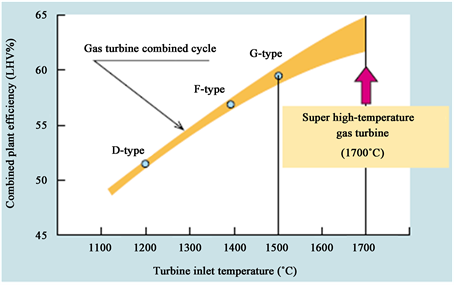
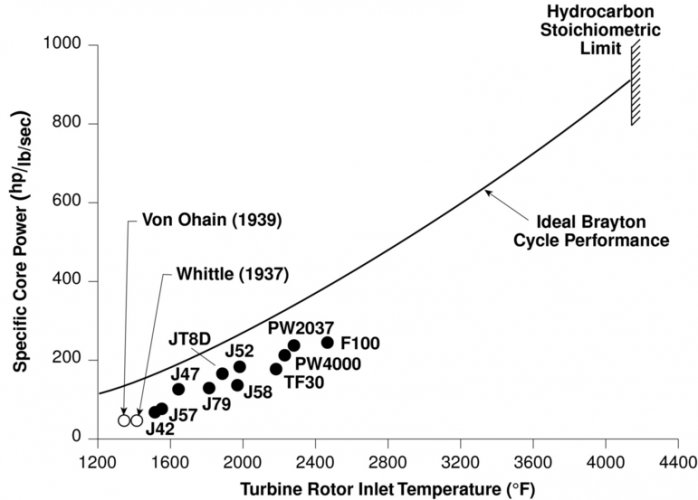
As inlet temperatures increase, a turbine engine produces more power for a given size and fuel consumption. Today, aircraft and power station turbine can run at 2600 degrees with help from cooling channels in the blades as well as thermal barrier coatings. But this is not a satisfactory solution given the high cost.
OTOH ceramics are able to withstand extremely high temperatures and are easy and cheap to manufacture. As an added bonus, they have a low coefficient of thermal expansion, allowing for smaller clearances. But ceramics are too brittle to be practical, at least the ones on the market are. In recent years, ductile ceramics have been proven in laboratories. But what if somehow these discoveries were made all the way back in the 1950s, perhaps by some scientists trying to make a material for missile nosecones?
Such a material would have dramatic impacts for all things from coffee mugs to the space shuttle and even the construction of highways and buildings. But let's focus solely on turbine engines.
In the Air:
Let's imagine this new ceramic manufacturing process was discovered in 1951. After a bit of refinement, it could be incorporated into jet engine manufacturing by 1955. Mig-21s, B-52s, and 707s would be able to fly farther with less weight, but it would be a while before aircraft design could be optimized around the benefits of these lighter and more compact engines.
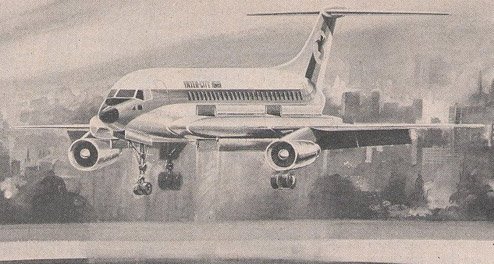
By the mid-1960s, airplanes designed to take advantage of the new turbines would be hitting the market. One of the more exciting prospects would be for aircraft that could take off and land vertically. In civilian application, this has been dismissed as adding too much weight and cost. That would no longer be an issue. Airports could be located directly in the middle of cities, especially as their smaller exhaust gas volume will reduce noise. Intercity and and many commuter railroads, with their high capital costs, could be replaced by airplanes, with the right of way freed up for other uses.
I'm conservatively assuming that civilian air travel will remain subsonic. The difficulty of developing airplanes that can survive supersonic speeds and produce acceptably low sonic booms would still put Concorde out of reach of all but the very rich. But with better fuel economy, Concorde could carry more payload. It's also possible that ceramic fuselages could greatly simplify construction but that's beyond the scope of this post.
On the ground:
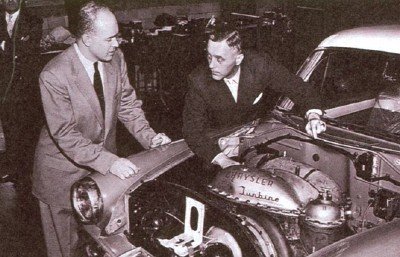
George Huebner, an engineer at Chrysler, realized that the gas turbine had a lot of good qualities for passenger car power: it was lightweight, compact, extremely smooth, had few moving parts, needed no cooling system, needed no oil changes, could easily start up in the cold, and could run on anything flammable. Early problems came from poor throttle response and part load fuel consumption. Those were solved by variable nozzles and regenerators. The only problem, and the real reason your car isn't powered by a turbine engine, was the expensive superalloys used to make the turbine blades. With that problem licked by ceramics, limited test runs could start by 1958 to tease out any bugs, and then Mopar would move over to turbine engines as quickly as it could retool its factories.
Ford and GM were not as enthusiastic about the prospect of turbine powered passenger cars but they did see potential for trucks and buses and they each brought their own novel ideas.
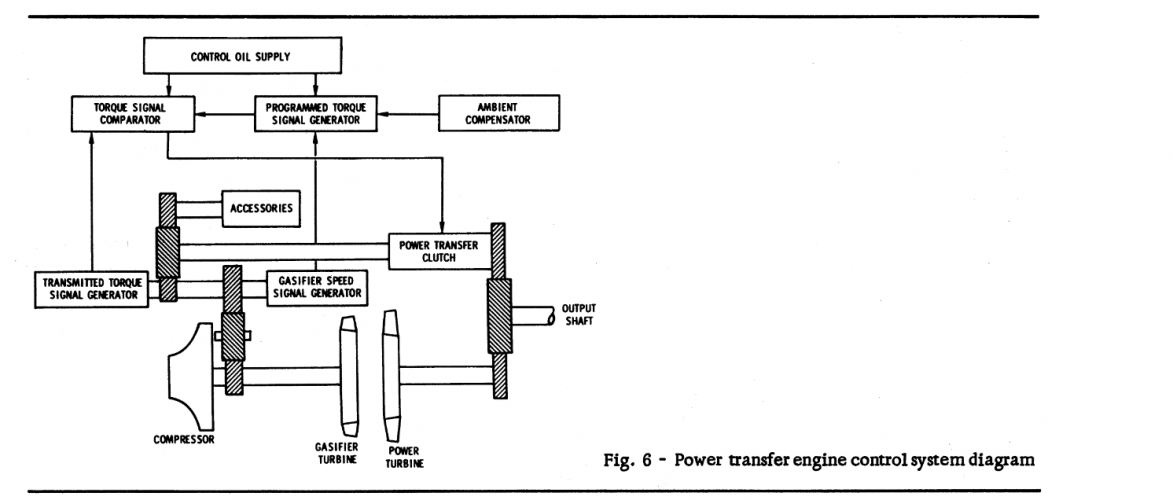
GM incorporated what they called a "power transfer" that could connect the power turbine and the compressor turbine. At part load, the power turbine could send some of its torque to the compressor, increasing its speed and thermal efficiency. This same principle of having the power turbine drive the gasifier would also provide an engine braking effect, and going the other way, it would prevent the gasifier from overspeeding.
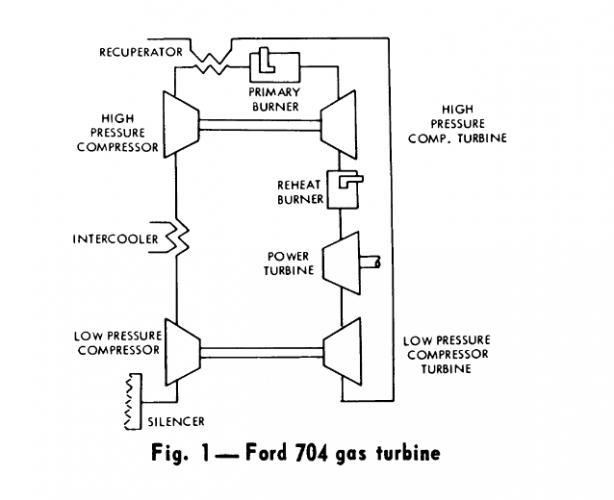
Ford's ideas were quite a lot more complex. They added a second compressor stage, an intercooler and a second combustion chamber. The resulting engine, called 704, offered high part load efficiency and produced 300 horsepower in a package that could fit in a Ford automobile despite being aimed at trucks.
So, how are cars and trucks different in this timeline? The small size of the turbine means the engine compartment can be made shorter. Chrysler would be going for the "cab forward" design 30 years earlier. The lightness means weight distribution is less of an issue. Front wheel drive would probably catch on a lot sooner, getting rid of the driveshaft hump and allowing designers to make rooflines lower. On sportier models, mid-engined layouts would be more practical to implement. GM was hoping the Wankel engine would allow a mid engine Corvette in the 70s, with turbines, it would happen in the 60s. The Mustang could also be mid engined, accomplished by taking a Falcon and putting a new body on backwards. There'd also be positive environmental impacts: gas turbine engines don't like leaded gasoline and their continuous combustion takes care of virtually all carbon monoxide and hydrocarbon emissions, all of this before the environmental movement became a real thing.
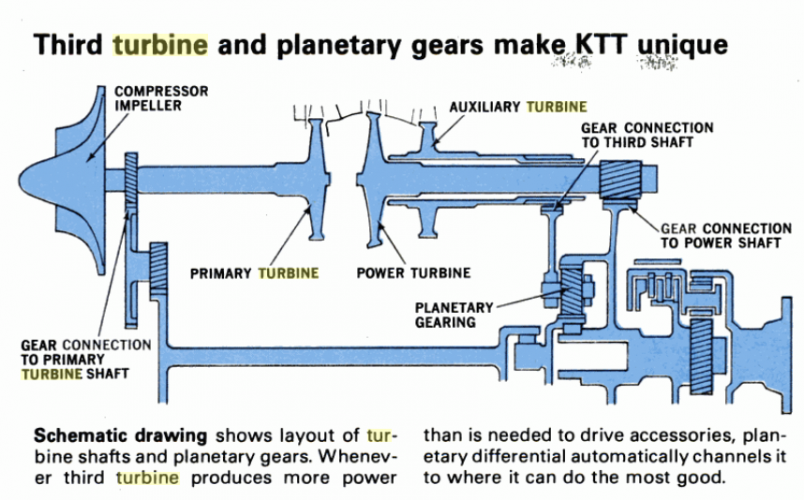
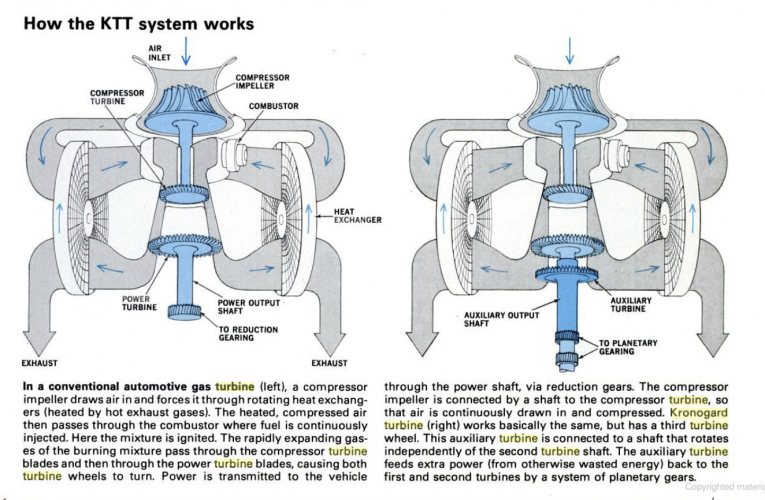
In the 1960s, an engineer at Volvo named Sven Kronogard realized that adding a third "auxiliary" turbine would offer numerous advantages. It could be used to power the accessories even when the power turbine was stopped. This meant no torque converter was needed. In fact, by being able to provide additional power to either the gasifier or the output shaft through planetary gearing, the engine would produce so much stall torque that no dedicated transmission was needed, saving further weight, space, and cost.
The first turbine powered Volvos could roll off the line by 1968 and the Kronogard layout would become the norm.
At this point, the broader impacts of the turbine engine would become apparent. Trucks and buses would be quieter and, more importantly, have fewer problems going up hills. That means highways could be designed with steeper grades, lowering costs. Motorists in Alaska could be sure their cars would reliably start in winter while those in Arizona would not have to worry about overheating even in Summer. Oil leaks and changes would be a thing of the past.
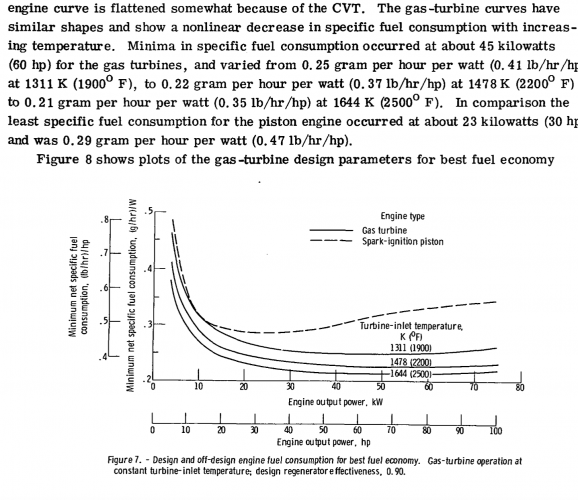
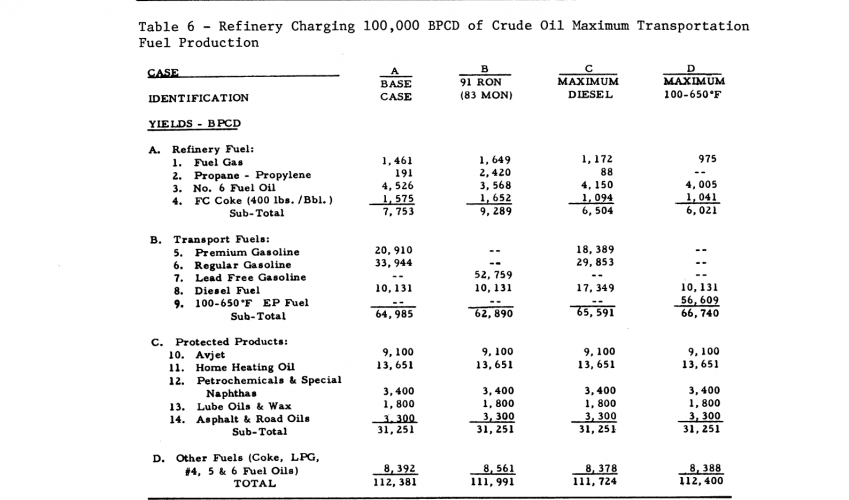
But the real impact would come in terms of fuel consumption. Studies by NASA indicated that gas turbines running at 2500 degrees would offer better fuel consumption than a diesel. And there's more: with turbines able to run on simple fuels, the waste of petroleum in the refining of high octane gasoline would be eliminated. In 1975, Texaco estimated they could get 6% more fuel from each barrel. All of this means the world's oil supplies would last much longer and reliance on OPEC would be reduced. Also, with oil refining becoming greatly simplified, a decentralization of the industry could result, perhaps with oil being refined very close to the well, as is the case with natural gas. That means we'd no longer worry about gasoline supplies being disrupted by hurricanes hitting Texas and Louisiana.
As for what impacts this would have on the auto industry; British and Italian cars would become a lot more appealing if they had engines that never overheated or leaked oil. And economy cars made by General Motors wouldn't vibrate like overloaded washing machines. Japanese cars otoh would look less enticing.
Finally, the ceramic turbine could revolutionize micromobility. Compared to the 2 stroke engines that powered motorcycles, microcars, scooters, and motorized bicycles at the time, ceramic turbines would be smoother, quieter, produce less smoke, more efficient, longer lasting, and probably cheaper. Such devices would provide those who live in crowded cities or who can't afford a full sized car a superior alternative to the bus, essentially the same niche that today is being filled by e-bikes and e-scooters.
Last edited: