What if ultra high temperature gas turbines were available in the 1950s?

exclaimedleech8

ACCESS: Top Secret
Joined
30 September 2024
Messages
586
Reaction score
641
This is an alternate history I've been wanting to write for a long time.

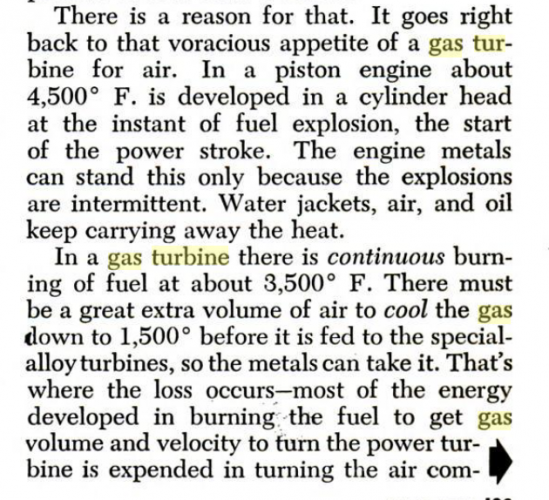
Most combustible fuels burn at 3600-3800 degrees Fahrenheit (~2000 degrees celsius). That will easily melt all but the most exotic metals. For piston engines, this isn't a problem; combustion is intermittant giving time to cool and the shape of the engine lends itself to liquid cooling. For turbine engines, however, this is a problem because combustion is continuous and the turbine blades will be exposed to this extreme heat constantly and there is no practical way of liquid cooling a turbine wheel that is spinning at 60,000 RPM. The only way to prevent turbine engines from destroying themselves is to run at very lean air-fuel mixtures, reducing combustion temperatures. The problem with this is that the extra air requires a bigger compressor which imposes a parasitic load that hurts fuel consumption.

1-2650157x18.png fig3TITTrends_web.jpg
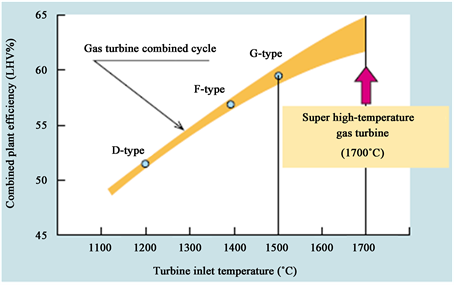
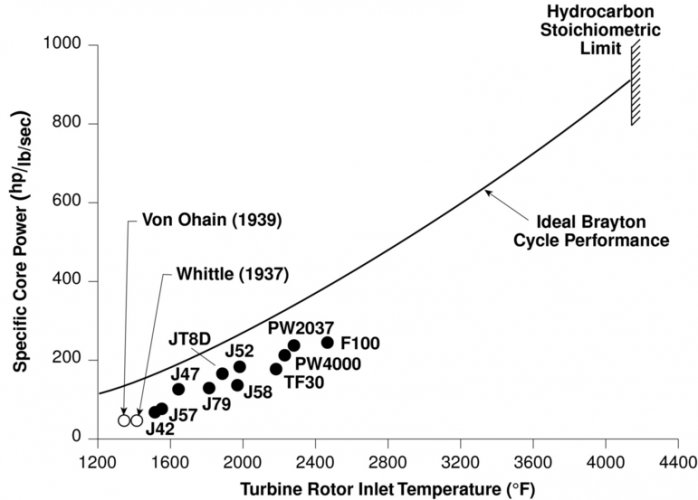
As inlet temperatures increase, a turbine engine produces more power for a given size and fuel consumption. Today, aircraft and power station turbine can run at 2600 degrees with help from cooling channels in the blades as well as thermal barrier coatings. But this is not a satisfactory solution given the high cost.

OTOH ceramics are able to withstand extremely high temperatures and are easy and cheap to manufacture. As an added bonus, they have a low coefficient of thermal expansion, allowing for smaller clearances. But ceramics are too brittle to be practical, at least the ones on the market are. In recent years, ductile ceramics have been proven in laboratories. But what if somehow these discoveries were made all the way back in the 1950s, perhaps by some scientists trying to make a material for missile nosecones?

Such a material would have dramatic impacts for all things from coffee mugs to the space shuttle and even the construction of highways and buildings. But let's focus solely on turbine engines.

In the Air:

Let's imagine this new ceramic manufacturing process was discovered in 1951. After a bit of refinement, it could be incorporated into jet engine manufacturing by 1955. Mig-21s, B-52s, and 707s would be able to fly farther with less weight, but it would be a while before aircraft design could be optimized around the benefits of these lighter and more compact engines.


34866-da655b0d4830712f499fdbb0412f816b.jpg

By the mid-1960s, airplanes designed to take advantage of the new turbines would be hitting the market. One of the more exciting prospects would be for aircraft that could take off and land vertically. In civilian application, this has been dismissed as adding too much weight and cost. That would no longer be an issue. Airports could be located directly in the middle of cities, especially as their smaller exhaust gas volume will reduce noise. Intercity and and many commuter railroads, with their high capital costs, could be replaced by airplanes, with the right of way freed up for other uses.

I'm conservatively assuming that civilian air travel will remain subsonic. The difficulty of developing airplanes that can survive supersonic speeds and produce acceptably low sonic booms would still put Concorde out of reach of all but the very rich. But with better fuel economy, Concorde could carry more payload. It's also possible that ceramic fuselages could greatly simplify construction but that's beyond the scope of this post.


On the ground:


chrysler-turbine-concept-cars-3.jpg
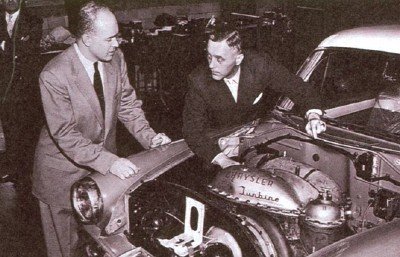
George Huebner, an engineer at Chrysler, realized that the gas turbine had a lot of good qualities for passenger car power: it was lightweight, compact, extremely smooth, had few moving parts, needed no cooling system, needed no oil changes, could easily start up in the cold, and could run on anything flammable. Early problems came from poor throttle response and part load fuel consumption. Those were solved by variable nozzles and regenerators. The only problem, and the real reason your car isn't powered by a turbine engine, was the expensive superalloys used to make the turbine blades. With that problem licked by ceramics, limited test runs could start by 1958 to tease out any bugs, and then Mopar would move over to turbine engines as quickly as it could retool its factories.

Ford and GM were not as enthusiastic about the prospect of turbine powered passenger cars but they did see potential for trucks and buses and they each brought their own novel ideas.
Screenshot 2025-07-17 at 11.14.34 PM.png
GM incorporated what they called a "power transfer" that could connect the power turbine and the compressor turbine. At part load, the power turbine could send some of its torque to the compressor, increasing its speed and thermal efficiency. This same principle of having the power turbine drive the gasifier would also provide an engine braking effect, and going the other way, it would prevent the gasifier from overspeeding.
Screenshot 2025-07-17 at 11.23.55 PM.png
Ford's ideas were quite a lot more complex. They added a second compressor stage, an intercooler and a second combustion chamber. The resulting engine, called 704, offered high part load efficiency and produced 300 horsepower in a package that could fit in a Ford automobile despite being aimed at trucks.

So, how are cars and trucks different in this timeline? The small size of the turbine means the engine compartment can be made shorter. Chrysler would be going for the "cab forward" design 30 years earlier. The lightness means weight distribution is less of an issue. Front wheel drive would probably catch on a lot sooner, getting rid of the driveshaft hump and allowing designers to make rooflines lower. On sportier models, mid-engined layouts would be more practical to implement. GM was hoping the Wankel engine would allow a mid engine Corvette in the 70s, with turbines, it would happen in the 60s. The Mustang could also be mid engined, accomplished by taking a Falcon and putting a new body on backwards. There'd also be positive environmental impacts: gas turbine engines don't like leaded gasoline and their continuous combustion takes care of virtually all carbon monoxide and hydrocarbon emissions, all of this before the environmental movement became a real thing.

Screenshot 2025-07-18 at 12.44.25 PM.png

Screenshot 2025-07-18 at 12.44.19 PM.png
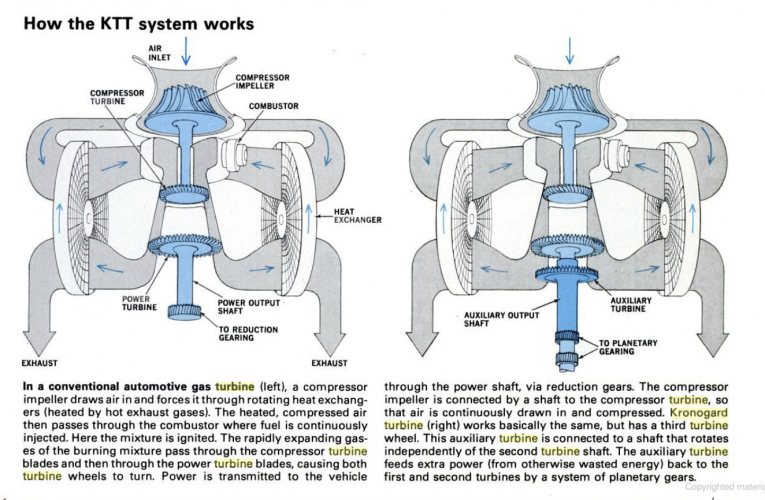
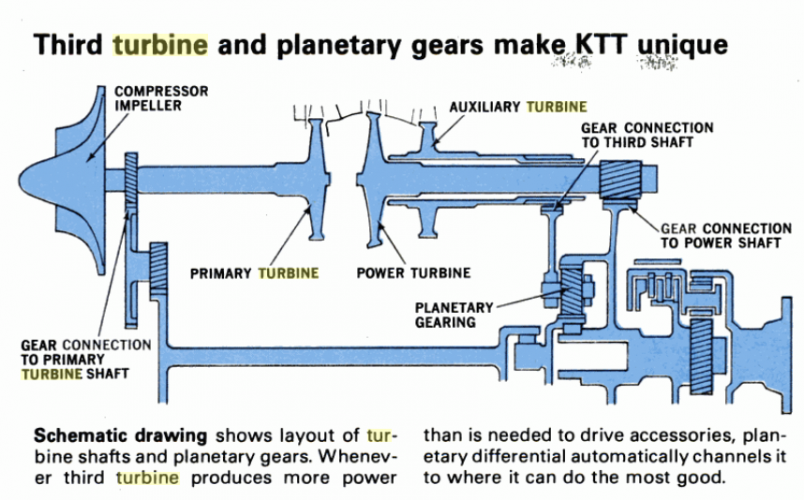
In the 1960s, an engineer at Volvo named Sven Kronogard realized that adding a third "auxiliary" turbine would offer numerous advantages. It could be used to power the accessories even when the power turbine was stopped. This meant no torque converter was needed. In fact, by being able to provide additional power to either the gasifier or the output shaft through planetary gearing, the engine would produce so much stall torque that no dedicated transmission was needed, saving further weight, space, and cost.

The first turbine powered Volvos could roll off the line by 1968 and the Kronogard layout would become the norm.

At this point, the broader impacts of the turbine engine would become apparent. Trucks and buses would be quieter and, more importantly, have fewer problems going up hills. That means highways could be designed with steeper grades, lowering costs. Motorists in Alaska could be sure their cars would reliably start in winter while those in Arizona would not have to worry about overheating even in Summer. Oil leaks and changes would be a thing of the past.

Screenshot 2025-07-18 at 1.26.20 PM.png Screenshot 2025-07-18 at 3.24.10 PM.png
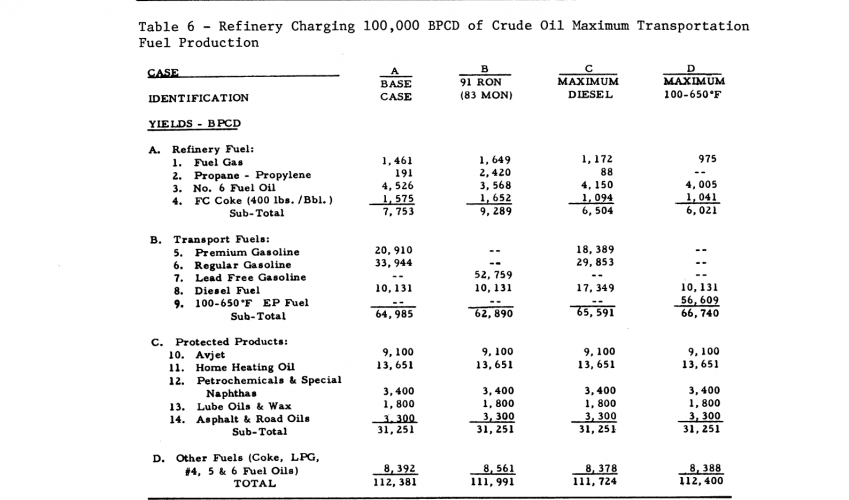
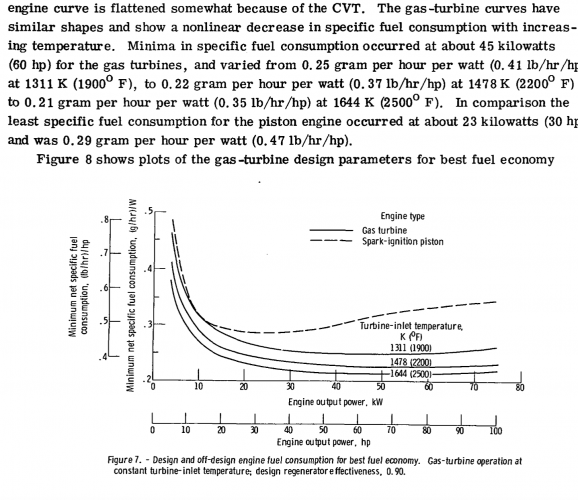
But the real impact would come in terms of fuel consumption. Studies by NASA indicated that gas turbines running at 2500 degrees would offer better fuel consumption than a diesel. And there's more: with turbines able to run on simple fuels, the waste of petroleum in the refining of high octane gasoline would be eliminated. In 1975, Texaco estimated they could get 6% more fuel from each barrel. All of this means the world's oil supplies would last much longer and reliance on OPEC would be reduced. Also, with oil refining becoming greatly simplified, a decentralization of the industry could result, perhaps with oil being refined very close to the well, as is the case with natural gas. That means we'd no longer worry about gasoline supplies being disrupted by hurricanes hitting Texas and Louisiana.

As for what impacts this would have on the auto industry; British and Italian cars would become a lot more appealing if they had engines that never overheated or leaked oil. And economy cars made by General Motors wouldn't vibrate like overloaded washing machines. Japanese cars otoh would look less enticing.


Finally, the ceramic turbine could revolutionize micromobility. Compared to the 2 stroke engines that powered motorcycles, microcars, scooters, and motorized bicycles at the time, ceramic turbines would be smoother, quieter, produce less smoke, more efficient, longer lasting, and probably cheaper. Such devices would provide those who live in crowded cities or who can't afford a full sized car a superior alternative to the bus, essentially the same niche that today is being filled by e-bikes and e-scooters.
 
Last edited:
[...]

By the mid-1960s, airplanes designed to take advantage of the new turbines would be hitting the market. One of the more exciting prospects would be for aircraft that could take off and land vertically. In civilian application, this has been dismissed as adding too much weight and cost. That would no longer be an issue. Airports could be located directly in the middle of cities, especially as their smaller exhaust gas volume will reduce noise. Intercity and and many commuter railroads, with their high capital costs, could be replaced by airplanes, with the right of way freed up for other uses.
No. That's not how the major noise of a jet engine occurs.

Jet exhaust noise comes from the interface between the hot exhaust and the cold air around it, and the velocity differences between the two air flows. The greater the thermal or velocity differences between the two, the more noise generated. Also, the shorter the circumference of the hot/fast air, the greater the noise (for the same thrust). IIRC that is due to how hard it is for the hot gasses to radiate heat and cool down, but don't quote me on that.

So you see a JT8D getting fitted with an interesting "mixer" that massively increases the surface area between the bypass air and the core flow. This promotes mixing of the two flows on the inside and significantly cools the exhaust as well.

1024px-Boeing_737-2B7-Adv%2C_Dasab_Airlines_AN0992824.jpg

This is looking up the kilt of a JT8D fitted with a hush kit. The mixer is obvious, though the extended tailpipe with acoustic treatments (the fabric-looking sections closest to the camera) is not as obvious here. Another detail that is not at all obvious is just how long the mixer actually is, it's something over 2 feet longer than a non-mixing tailpipe.

Installed a few of those on 727s back in the day.

Weight per engine is on the order of 250-275lbs, the full hush kit added 900lbs to the airframe including reinforcements and ballast.

IIRC the primary advantage was getting the initial mixing of the exhaust streams to take place inside the extended tailpipes, plus it dropped the exhaust temperatures after the tailpipe so that part of the noise-cause was reduced.


On the ground:


View attachment 778176
George Huebner, an engineer at Chrysler, realized that the gas turbine had a lot of good qualities for passenger car power: it was lightweight, compact, extremely smooth, had few moving parts, needed no cooling system, needed no oil changes, could easily start up in the cold, and could run on anything flammable. Early problems came from poor throttle response and part load fuel consumption. Those were solved by variable nozzles and regenerators. The only problem, and the real reason your car isn't powered by a turbine engine, was the expensive superalloys used to make the turbine blades. With that problem licked by ceramics, limited test runs could start by 1958 to tease out any bugs, and then Mopar would move over to turbine engines as quickly as it could retool its factories.

Ford and GM were not as enthusiastic about the prospect of turbine powered passenger cars but they did see potential for trucks and buses and they each brought their own novel ideas.
View attachment 778177
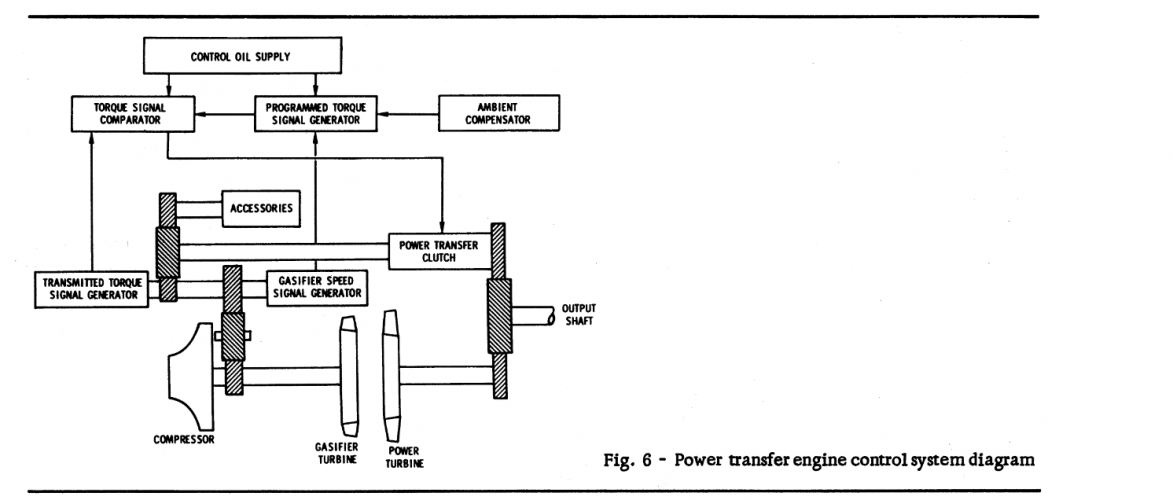
GM incorporated what they called a "power transfer" that could connect the power turbine and the compressor turbine. At part load, the power turbine could send some of its torque to the compressor, increasing its speed and thermal efficiency. This same principle of having the power turbine drive the gasifier would also provide an engine braking effect, and going the other way, it would prevent the gasifier from overspeeding.
View attachment 778178
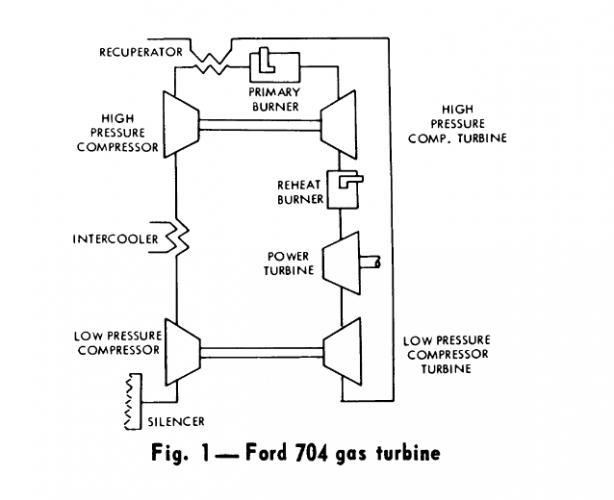
Ford's ideas were quite a lot more complex. They added a second compressor stage, an intercooler and a second combustion chamber. The resulting engine, called 704, offered high part load efficiency and produced 300 horsepower in a package that could fit in a Ford automobile despite being aimed at trucks.

[...]

View attachment 778247

View attachment 778248
Several interesting points in here. The GM design that adds the ability to engine-brake is likely to stick around, long-haul trucks really need that to save their brakes from frying when trying to stop 80,000lbs from moving!

Applying the Ford 704 design to industrial and maritime engines would do interesting things, more or less giving us WR21s 20+ years sooner.

And I suspect that as soon as the Kronogard patents expired everyone's automotive engines would incorporate that.


So, how are cars and trucks different in this timeline? The small size of the turbine means the engine compartment can be made shorter. Chrysler would be going for the "cab forward" design 30 years earlier.
Disagree. In the 1960s, the people who remembered that "long hood = powerful car" were still buying cars. I don't believe cab-forward would have sold until the people who had bought cars before WW2 were no longer market impactors (so probably 1970s).


The lightness means weight distribution is less of an issue. Front wheel drive would probably catch on a lot sooner, getting rid of the driveshaft hump and allowing designers to make rooflines lower.
You do know that the "driveshaft hump" is a strength component in unibody cars, right?


There'd also be positive environmental impacts: gas turbine engines don't like leaded gasoline and their continuous combustion takes care of virtually all carbon monoxide and hydrocarbon emissions, all of this before the environmental movement became a real thing.
Leaded gas would still stick around for anyone still using piston engines, but if most cars were turbines there'd be a lot less leaded gas in use.


At this point, the broader impacts of the turbine engine would become apparent. Trucks and buses would be quieter and, more importantly, have fewer problems going up hills. That means highways could be designed with steeper grades, lowering costs. Motorists in Alaska could be sure their cars would reliably start in winter while those in Arizona would not have to worry about overheating even in Summer.
There's already a lot of 7% grades were I live, how much steeper are you asking for?


Oil leaks and changes would be a thing of the past.
Nope. You'd still have oil leaks, and if you were lucky the oil wouldn't need to be changed.

Technically, what wears out in oil is the additives, not the lubricating qualities of the oil itself.


View attachment 778252View attachment 778260
But the real impact would come in terms of fuel consumption. Studies by NASA indicated that gas turbines running at 2500 degrees would offer better fuel consumption than a diesel. And there's more: with turbines able to run on simple fuels, the waste of petroleum in the refining of high octane gasoline would be eliminated. In 1975, Texaco estimated they could get 6% more fuel from each barrel. All of this means the world's oil supplies would last much longer and reliance on OPEC would be reduced. Also, with oil refining becoming greatly simplified, a decentralization of the industry could result, perhaps with oil being refined very close to the well, as is the case with natural gas. That means we'd no longer worry about gasoline supplies being disrupted by hurricanes hitting Texas and Louisiana.
There's still advantages in scale in terms of larger refineries being more efficient than smaller ones.
 
First I really appreciate you taking the time to respond. Now to your points

Jet exhaust noise comes from the interface between the hot exhaust and the cold air around it, and the velocity differences between the two air flows. The greater the thermal or velocity differences between the two, the more noise generated. Also, the shorter the circumference of the hot/fast air, the greater the noise (for the same thrust). IIRC that is due to how hard it is for the hot gasses to radiate heat and cool down, but don't quote me on that.
Oh well, can't win 'em all.
Several interesting points in here. The GM design that adds the ability to engine-brake is likely to stick around, long-haul trucks really need that to save their brakes from frying when trying to stop 80,000lbs from moving!
Engine braking can be added with much less complexity through variable turbine nozzles. The GM design's real advantage is improved part load efficiency and throttle response.

And I suspect that as soon as the Kronogard patents expired everyone's automotive engines would incorporate that.
They wouldn't wait, they'd pay patent fees.

You do know that the "driveshaft hump" is a strength component in unibody cars, right?
Conveniently, most big American cars at the time were body-on-frame
There's already a lot of 7% grades were I live, how much steeper are you asking for?
Maybe 10%. And when I say "highways" I mean big freeways. Today, engineers will go to incredible lengths to make roads as flat as possible to avoid trucks slowing down and creating traffic flow and safety issues.

Nope. You'd still have oil leaks, and if you were lucky the oil wouldn't need to be changed.
An automotive gas turbine would be a sealed unit, there wouldn't be any place for oil to leak. And the oil wouldn't be exposed to combustion, which is the main reason why oil has to be changed. It's also possible that ceramics would create so little friction they wouldn't need any lubricant at all.
There's still advantages in scale in terms of larger refineries being more efficient than smaller ones.
But disadvantages in terms of shipping costs.
 
Higher temperatures means that you'll have higher specific thrust engines i.e. greater thrust per unit mass flow. This results in smaller, lighter engines for the same thrust.

But operating at these increased temperatures also increases fuel burn. You need to add more energy in, i.e. fuel, to get a higher temperature increase. Lowering fuel this has largely come from increasing overall pressure ratio and bypass ratio, which higher temperature tuevine materials don't help with. (NB. Temperature for optimum efficiency also varies with OPR.

So the aircraft impact is more likely to be higher performance aircraft that stay in the air for shorter periods of time.

Impact on VTOL is interesting. I think these higher specific thrust turbojets will still be quite a bit lower thrust/weight than the likes of Pegasus or RB189 turbofans. And definitely higher ground erosion and noise.
 
But operating at these increased temperatures also increases fuel burn. You need to add more energy in, i.e. fuel, to get a higher temperature increase. Lowering fuel this has largely come from increasing overall pressure ratio and bypass ratio, which higher temperature tuevine materials don't help with. (NB. Temperature for optimum efficiency also varies with OPR.
That's not true. Jet engines today are run with lots of excess air just for the purpose of cooling. If they could survive higher temperatures, they could keep fuel burn the same while putting in less air
Impact on VTOL is interesting. I think these higher specific thrust turbojets will still be quite a bit lower thrust/weight than the likes of Pegasus or RB189 turbofans. And definitely higher ground erosion and noise.
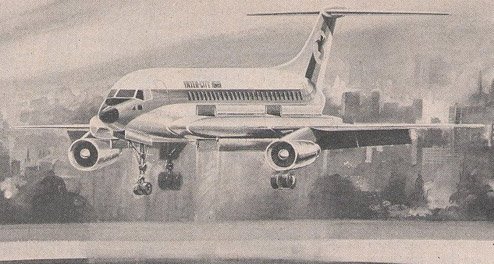
The aircraft in that drawing is the stillborn Hawker Siddeley HS.141. It was planned to use turbofans for lift jets.
 
Last edited:
That's not true. Jet engines today are run with lots of excess air just for the purpose of cooling. If they could survive higher temperatures, they could keep fuel burn the same while putting in less air
If we had to count all the air that goes through the radiator with the air a piston engine burns, I suspect we'd be at about the same amount of total air consumed per unit of power.
 
If we had to count all the air that goes through the radiator with the air a piston engine burns, I suspect we'd be at about the same amount of total air consumed per unit of power.
And? the energy wasted in piston engines to coolant is enormous. The low melting point of commonly used materials is a real PITA.
 
And? the energy wasted in piston engines to coolant is enormous. The low melting point of commonly used materials is a real PITA.
Most piston engines run either well rich of stoichiometric for extra cooling under high power demands, or run well lean of stoich for low fuel burn at cruise power.

So yeah, you could run at stoich at high power if you had an engine able to take the heat. But IIRC you're only gaining about 100degC in EGT when you do that.
 
Its seems like you’re immune to learning and still predicting the higher efficiency for small gas turbines than for Diesel engines. This is complete nonsense, there is a reason why gas turbines failed in commercial shipping, it’s their much lower efficiency combines with with more expensive fuel. Other than you stated, the large Diesel engines can run with “residual” “bunker C” oil whereas the gas turbines need more refined marine oil.

The only gas turbines which can really match the efficiency of the Diesel are those in large airplanes and they only can do so, because they ingest extremely cold air. Gas turbines need a high temperature spread between turbine entrance temperature and intake temperature, that's why -50 ° hepls so much with efficiency.

You posted a link to a Japanese gas turbine development for cars which achieved an efficiency of 35.6 % after a long development program in the 90 th. As said, gasoline engines achieved 37 % efficiency more than 10 years prior! Not to mention Diesel engines which archieve about 44 % efficiency (e.g. the 3L/94 mpg Lupo from 2002 with ).

Even regenerative gas turbines tend to have much higher efficiency losses at part load than piston engines, if turbine driven truck engines would have had more power for steeper gradients, it would mean an even higher fuel penalty for the gas turbine in average operation compared to the Diesel engine.

@Scott Kenny: More than 90 % of all gasoline engines run stoichiometric these days, because it allows a simple and highly efficient after treatment system. The Mazda Skytec is one of those exemptions, which implies the same amount of effort for exhaust after treatment as for a Diesel engine. The situation for high temperature gas turbines is even more severe, they produce more NOx raw emissions than any Diesel engine and are burning lean. Lean burn means, you need an SCR system for NOx reduction like in a EURO stage 6 Diesel. The NOx emissions finally killed the Chrysler gas turbine program, in combination with many other drawbacks. High temperature gas turbines for cars, are already to expensive for cars, and nowadays you would have to add up the cost of a complex after treatment system which killed the Diesel engine for small and medium cars. On the other hand, you don’t even have the gain of an higher efficiency. A modern gas turbine driven car would be less efficient than a gasoline car and more expensive than a Diesel car, with a lower novelty factor than an electric car. Nobody would by it!

What Huebner said about gas turbines should be taken with the same amount of salt, with what Jack Northorp said about his flying wings.

The best evidence against the gas turbine for road engines and ships, is the lack of them in the real world. Despite all attempts, there has never been a gas turbine which was superior to the contemporary engines. Sure, you can find some papers, were a fictional ceramic gas turbine with VGT and ultra-high combustion temperature is more efficient than a mass contemporary produced V8 engine. It’s like comparing a NASA research plane for high efficiency with back than a 20 year old Cessna 152. It’s not, that nobody really tried it, it’s just that everybody failed. There is no point, in what if, the Japanese turbine of the 90 ths would have been available in the 50 th (when fuel cost really didn’t matter in the US). Chrysler already had the electronic fuel injection in 1958 in road cars (Chrysler 300 D) which surly could have been optimized for a lower fuel consumption than every gas turbine. Instead of working out the quirks of the electronic system, they gave it up and Bosch bought the patents from Bendix. This became the basis for all modern port fuel injection.
 
As said, gasoline engines achieved 37 % efficiency more than 10 years prior!
And as I said, that's a bunch of BS.
Even regenerative gas turbines tend to have much higher efficiency losses at part load than piston engines, if turbine driven truck engines would have had more power for steeper gradients, it would mean an even higher fuel penalty for the gas turbine in average operation compared to the Diesel engine.
It's not power that matters for climbing hills, it's torque.
The NOx emissions finally killed the Chrysler gas turbine program, in combination with many other drawbacks.
No, what killed the turbine program was Chrysler's financial problems in the late 70s. Means of reducing NOX emissions were being devised. One of them was to have a rich primary combustion zone followed by a lean one.
What Huebner said about gas turbines should be taken with the same amount of salt, with what Jack Northorp said about his flying wings.
Good thing then that I looked into sources besides Huebner. Unlike the flying wing, the automotive turbine was thought to have potential by multiple automakers.
? I think you need to recheck your thermodynamics
I explained all this in the beginning. Leaner operation means that you need a bigger compressor for a given amount of power which sucks up much of the engine's gross output.
 
the automotive turbine was thought to have potential by multiple automakers.
So was the wankel rotary.


I explained all this in the beginning. Leaner operation means that you need a bigger compressor for a given amount of power which sucks up much of the engine's gross output.
A gas turbine already ingests 3-4x more air than it actually needs for combustion.
 
I explained all this in the beginning. Leaner operation means that you need a bigger compressor for a given amount of power which sucks up much of the engine's gross output.
This impacts specific thrust i.e. per mass flow rate and engine thrust / weight and engine size.

Getting to those higher temperatures requires more heat addition which requires burning more fuel at a higher rate.
 
Another important characteristic of ceramics is their resistance to corrosion and abrasion. That means they can handle a wider variety of fuels without wear. Methanol for instance would work well.
 
Another important characteristic of ceramics is their resistance to corrosion and abrasion. That means they can handle a wider variety of fuels without wear. Methanol for instance would work well.
Nope. Hell no you do NOT want to work with methanol for cars. Methanol burns WITH INVISIBLE FLAMES!!!

There's videos of pit crews "dancing around" because the methanol fuel caught on fire.
 
@exclaimedleech8 You totally ignored to commit that your wrong even when clear evidence is there, that’s clearly a sign of (…)!

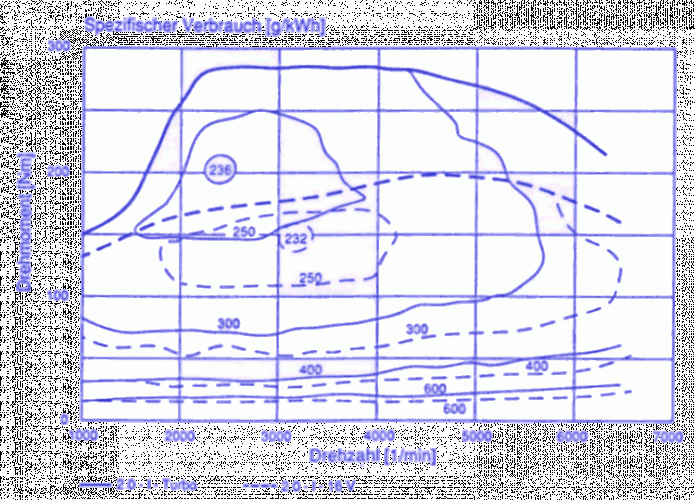
Here you can see the fuel map of the C20XE and its turbocharged variant C20LET
verbrauch-let-16v.gif


Something about the former Opel Chief engineer

https://www.economyaustria.at/leben/die-kunst-dinge-einfach-zu-machen


“Er konstruierte die ersten Ecotec-Motoren mit, darunter den C20XE, der zum Zeitpunkt seiner Einführung mit 37 Prozent als der Benzinmotor mit dem höchsten Wirkungsgrad galt.“

"Darunter so Meilensteine der Motorentechnik wie den „C20XE“ für Opel, der mit einem Wirkungsgrad von 37 % als der effizienteste Ottomotor seiner Zeit gilt."


Talking about torque and power as if these would have nothing to do with each other is for people with a technical interest without technical understanding. Let’s see if you can solve this simple task

Let’s compare two different trucks, one with a turbine and one a Diesel engine. Both climb up a gradient with the optimal gear ratio (for simplification, I don’t take the losses of a CVT transmission into account).


The turbine will produce:

60 Nm @50.000 rpm

The Diesel will produce:

2000 Nm @ 1500 rpm

Which one will climp faster?
 
Last edited:
No, what killed the turbine program was Chrysler's financial problems in the late 70s. Means of reducing NOX emissions were being devised. One of them was to have a rich primary combustion zone followed by a lean one.

Good thing then that I looked into sources besides Huebner. Unlike the flying wing, the automotive turbine was thought to have potential by multiple automakers.

I explained all this in the beginning. Leaner operation means that you need a bigger compressor for a given amount of power which sucks up much of the engine's gross output.

I do have the SAE papers at home (now I'm in China) which clearly shows, that the emission complient turbine cars from Chrysler had much worse fuel consumption than the before, effectivly killing the program.

Of course there is a rich and a lean combustion zone in a turbine, just like in a Diesel engine, this will produce less NOx than a stoichometric gazoline engine but the surplus oxygen in the exhaust make them very hard to eliminate. Unlike in a gazoline engine, this can't be done simply by bringing the reaction to en end. Here, a catalyst will burn the the CO and HC with NOx. This doesn't work in lean exhaust gases, since the CO and HC will react with the remaining oxygen instead of the NOx. That's why you need a SCR system with ammonia as beeing the reaction partner for the NOx. This is used in modern Diesel vehicles and stationary power plants, but not in jet engines which are emitting incredibel large amount of NOx.

BTW: can you please explain what is meant with that? "I explained all this in the beginning. Leaner operation means that you need a bigger compressor for a given amount of power which sucks up much of the engine's gross output."
 
Again, total nonsense, these engines were very reliable and capable of much more horsepower (see the turbocharged variant). Some are tuned for more than 500 hp, that's why these engines are kind of our LS pendant. Swaping these in older Opel models can often easiely be done (in the past...).
 
Again, total nonsense, these engines were very reliable and capable of much more horsepower (see the turbocharged variant). Some are tuned for more than 500 hp, that's why these engines are kind of our LS pendant. Swaping these in older Opel models can often easiely be done (in the past...).
Then why did GM not even put it in its other models?
 
Who said they didn't??? Of course they did, they were used in the Calibra, Ascona, Astra as well.

Here is a series of the very similar turbo variant and the way on how to bring it up to 500 hp:

View: https://www.youtube.com/watch?v=9Df6NKMDA-k

So, which truck is faster in my example, the turbine driven truck, or the Diesel truck?
 
Last edited:
Who said they didn't??? Of course they did, they were used in the Calibra, Ascona, Astra as well.

Here is a serios of the very similar turbo variant and the way on how to bring it up to 500 hp:

View: https://www.youtube.com/watch?v=9Df6NKMDA-k

So, which truck is faster in my example, the turbine driven truck, or the Diesel truck?
Why didn't they put it in the other cars they sell around the world? And I'm not answering a loaded question.
 
Please read:
"Who said they didn't??? Of course they did, they were used in the Calibra, Ascona, Astra as well."

You could also try to use youre brain a little and look which other cars (e.g. a Lada) had the engine inside, there is something like Google which can help!
 
edit: this is an aswer to a deleted posting which demanded that I should search for evidance for the C20XE beeing used internationally:

Why should I?

Maybe we make a deal, you answer my question which truck will drive faster uphill and I will explain you how to use Google.

The answer, which cars have been equiped with the C20SXE is totally offtopic, why should I do the effort for you?
 
Last edited:
Feel free to continue to read later on in that paper or in textbooks that make my point rather than quoting a single line.

Gas turbine thermal efficiency depends on combustion temperature and pressure ratio, but the two are interlinked. There is an optimum temperature for different pressure ratios. (Also depends on other factors in real life away from theory)

As well as thermal efficiency we also care about propulsive efficiency.
 
Feel free to continue to read later on in that paper or in textbooks that make my point rather than quoting a single line.

Gas turbine thermal efficiency depends on combustion temperature and pressure ratio, but the two are interlinked. There is an optimum temperature for different pressure ratios. (Also depends on other factors in real life away from theory)

As well as thermal efficiency we also care about propulsive efficiency.
Screenshot 2025-07-19 at 11.03.26 PM.png Screenshot 2025-07-19 at 11.04.00 PM.png
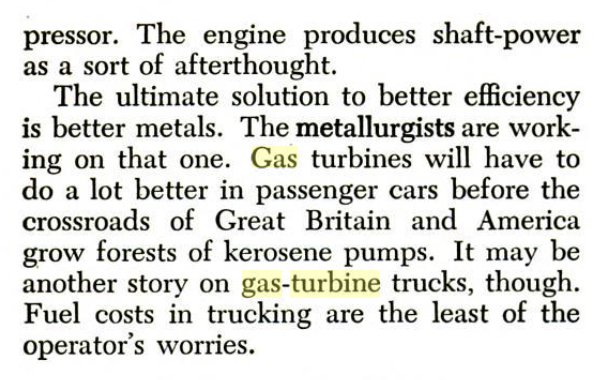
Here's the explanation from Popular Science June 1950
 
This seems an excellent example of an entirely implausible wish fulfilment scenario which only generates arguments, not interesting discussion, with the original poster unhappy with anyone taking issue or finding flaws with their implausible concept.

It differs only in minor degree from "What if ultra high temperature gas turbines were available in the 1850s?" or "What if Rome developed Gatling guns?".
 
Let’s compare two different trucks, one with a turbine and one a Diesel engine. Both climb up a gradient with the optimal gear ratio (for simplification, I don’t take the losses of a CVT transmission into account).


The turbine will produce:

60 Nm @50.000 rpm

The Diesel will produce:

2000 Nm @ 1500 rpm

Which one will climp faster?
Considering that the turbine will be geared down by a factor of ~33 to make the transmission happy...

The turbine would be making about 2000Nm at the transmission input shaft.
 
I choosed the parameters so, that both have the same power and so, they willl have the same speed. This should make clear, that torque alone says nothing,
 

Similar threads

Back
Top Bottom