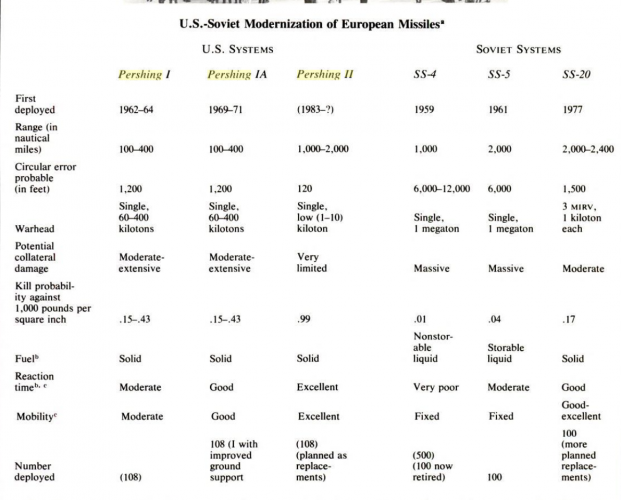
This tirade against the Pershing II seems based on erroneous Soviet assessments of the weapon, as well as a misunderstanding of the purpose of both Pershing II and RDS-10 Pioneer/SS-20 Saber (the missile that sparked its reaction).
Neither Pershing II nor RDS-10 were intended for "decapitation strikes" against US or Soviet government centers, though they could certainly be used against European NATO or WarPac capitals if their owners were so inclined. They were both efforts to avoid a European war going intercontinental by giving (first USSR, then US) long-range theatre nuclear response options without them immediately going after either Continental US or Urals/Central Asian/Siberian USSR with the ICBMs.
If there was any "first strike" potential in them, it was for neutralizing each other's known tactical nuclear weapon bases within the first minutes. For the Soviets, RDS-10 being used in this way would hopefully knock out most NATO tactical nuclear weapons as far afield as the UK and Low Countries, allowing them to be free to use other tactical nuclear weapons - Frontal Aviation fighter bombers, shorter-range ballistic missiles like OTR-21 Tochka/SS-21 Scarab and OTR-23 Oka/SS-23 Spider, the short-range SLBMs of the Baltic Fleet's SSBs, and assorted 152mm, 203mm and 240mm nuke rounds - to facilitate their "dash to the Channel" mechanized war plans. Or perhaps allow them to try a purely conventional variant of said plans and prevail using their numerical and firepower advantage.
For the US, Pershing II aimed precisely at denying the Soviets this option, while giving them something of a counter-capability against Soviet theatre nuclear forces, which they clearly lacked at the time, because...
Advantages? The US had 6,000 tactical nuclear warheads in Western Europe ready to be used on the first day of World War III.
Prior to the deployment of Pershing II and GLCM, US (and NATO) tactical warheads of the 70s were primarily based on:
1) gravity bombs delivered by fixed-wing fighter-bombers of USAF Tactical Air Command, RAF and the other Dual-Key partner air forces, so, very vulnerable to first strike by knocking them down at their airfields and were likely among RDS-10's priority targets, and even if they could fly, Soviet Frontal Aviation and the SAM networks would pose major challenges in getting weapons through;
2) mobile tactical ballistic missiles of the MGM-52 Lance or French Pluton class, which were just battlefield weapons with range under 130km, insufficient for retaliating even against OTR-21 and OTR-23, nevermind RDS-10; and
3) 203mm and 155mm atomic artillery shells on M109 and M110 SPHs, whose ranges didn't go beyond 40km - practically knife fight range for nuclear warfare.
Simply put, these tactical nuclear weapons were no feasible counter to the capabilities of RDS-10, or even OTR-21 and OTR-23.
Also, the supposed logic of the Pershing II, to launch a decapitating strike on Moscow the second Russian tanks pass through the Fulda Gap, is nonsense. Even if the Soviets didn't start such an invasion with attacks on the bases where the Pershings were, their leadership would not be sitting in the Kremlin waiting patiently for the missiles to arrive, they would have long since evacuated to safety.
At the published range of 1770km, Pershing II could not reach Moscow from Western German bases (one of their known bases, Mutlangen in Baden-Wurttemburg, is about 2024km away from Moscow). It could bring the Baltics and large portions of Belarus and Ukraine under fire from those bases, but they'd need at least 2100km range to reliably reach Moscow. The Soviets thought it had such ranges though, presumably because they mirror-imaged the capabilities of RDS-10 onto Pershing.
You also didn't answer yeetmaiboi's main point: without an equivalent capability, what would the US/NATO have to offer to get the USSR to give up the fantastic capability of RDS-10? Negotiations require compromises of equivalent value to both parties, and the US/NATO alliance at the time did not have much worth trading equivalent to RDS-10 and the other MRBMs, that was not already being discussed at SALT and START.