What if NATO never deployed Pershing II?

Given that without a proper immediate long range strike component to base leverage upon, why should the Soviets follow on with INF? What kind of face a leader surrenders when they come to the enemy and say, here, I have all this advantages I'll absolve myself of, danke. Smells more than an unwashed armpit fetish doll.
 
Given that without a proper immediate long range strike component to base leverage upon, why should the Soviets follow on with INF? What kind of face a leader surrenders when they come to the enemy and say, here, I have all this advantages I'll absolve myself of, danke. Smells more than an unwashed armpit fetish doll.
Advantages? The US had 6,000 tactical nuclear warheads in Western Europe ready to be used on the first day of World War III.

Also, the supposed logic of the Pershing II, to launch a decapitating strike on Moscow the second Russian tanks pass through the Fulda Gap, is nonsense. Even if the Soviets didn't start such an invasion with attacks on the bases where the Pershings were, their leadership would not be sitting in the Kremlin waiting patiently for the missiles to arrive, they would have long since evacuated to safety.
 
Last edited:
Also, the supposed logic of the Pershing II, to launch a decapitating strike on Moscow the second Russian tanks pass through the Fulda Gap, is nonsense.

Was that the actual logic, or what the opponents of the system said? IIRC the Soviets said the big danger of the system was it could destroy buried bunkers after something like a 7 or 8-minute flight, but its stated range fell short of that scenario.

Even if the Soviets didn't start such an invasion with attacks on the bases where the Pershings were, their leadership would not be sitting in the Kremlin waiting patiently for the missiles to arrive, they would have long since evacuated to safety.

Wouldn't the Pershings be moved out of their bases in a crisis, and thus not be so vulnerable to a first strike?
 
Wouldn't the Pershings be moved out of their bases in a crisis, and thus not be so vulnerable to a first strike?
That's having it both ways. Supporters said they were needed for a surprise attack where they would still be at their bases.
 
That's having it both ways. Supporters said they were needed for a surprise attack where they would still be at their bases.

Whose surprise are you talking about? Were they needed to ride out a Soviet surprise attack, or were they needed to conduct a US/NATO surprise attack? In the former their extreme accuracy isn't needed, they just need to be mobile to be survivable, in the latter their mobility isn't as important as their accuracy and destructive power.
 
Whose surprise are you talking about? Were they needed to ride out a Soviet surprise attack, or were they needed to conduct a US/NATO surprise attack? In the former their extreme accuracy isn't needed, they just need to be mobile to be survivable, in the latter their mobility isn't as important as their accuracy and destructive power.
So you admit that the protesters were right and that Pershing II was a destabilizing first strike weapon?
 
So you admit that the protesters were right and that Pershing II was a destabilizing first strike weapon?

What?

I'm clarifying what you mean by 'surprise', not stating a position on the issue.

In any case, everything the US/NATO did could be considered "first strike" by virtue of their superior technology and the advantages that bestowed. Was the Tornado a first strike weapon as it was difficult for the Soviets to shoot down? Was the Chevaline-Polaris a first strike weapon because it could penetrate Moscow's ABM defences?
 
In any case, everything the US/NATO did could be considered "first strike" by virtue of their superior technology and the advantages that bestowed. Was the Tornado a first strike weapon as it was difficult for the Soviets to shoot down? Was the Chevaline-Polaris a first strike weapon because it could penetrate Moscow's ABM defences?
What made Pershing II unique was its speed and accuracy. It could be launched from West Germany and in barely 5 minutes (not enough time for the Soviets to respond) hit the Kremlin, ideal for a decapitating first strike.

What?

I'm clarifying what you mean by 'surprise', not stating a position on the issue.
The definition of "surprise" at the time seemed to be whatever the military-industrial complex could justify for the procurement of more expensive armaments.

For example, a group called the Committee on the Present Danger claimed that the Soviets could destroy 90% of our minuteman missiles and B-52 bombers in a "surprise" attack with enough left over to destroy our cities if the US didn't surrender. They simply ignored the fact that most of our nukes were on submarines that were almost impossible to target and used this as an excuse to call for the development of MX.

Similarly, the same actors claimed that in a "surprise" attack, the Soviet Army could push through Western Europe like a hot knife through butter before American reinforcements arrived. They simply ignored the fact that NATO had 6,000 tactical nuclear weapons ready for such a scenario and that the Russian troops were a bunch of malnourished, poorly trained alcoholics and used this as an excuse to call for Pershing II.
 
Personally, I don't put much stock in the complaints of the Soviet Union, or their fellow travellers in the West. SS20s would be used as a first strike weapon, but you don't see the West's whinging or pro-Western demonstrators in the Soviet Union having any influence.

What the Soviet Union did understand was how vulnerable their system was to something like the Pershing II, regardless of its stated purpose. I think without the general updating of US/NATO nuclear missiles in the 80s the INF Treaty wouldn't have occurred.
 
Personally, I don't put much stock in the complaints of the Soviet Union, or their fellow travellers in the West. SS20s would be used as a first strike weapon, but you don't see the West's whinging or pro-Western demonstrators in the Soviet Union having any influence.
Actually, the SS20 was an ideal *second* strike weapon. Being solid fuel powered, it could be launched in a matter of minutes instead of hours and being road mobile made it more likely to survive a first strike. Compared to the Soviet ICBMs that came before it, it arguably had a stabilizing effect on MAD, reducing the use-it-or-lose-it incentive
 
This tirade against the Pershing II seems based on erroneous Soviet assessments of the weapon, as well as a misunderstanding of the purpose of both Pershing II and RDS-10 Pioneer/SS-20 Saber (the missile that sparked its reaction).

Neither Pershing II nor RDS-10 were intended for "decapitation strikes" against US or Soviet government centers, though they could certainly be used against European NATO or WarPac capitals if their owners were so inclined. They were both efforts to avoid a European war going intercontinental by giving (first USSR, then US) long-range theatre nuclear response options without them immediately going after either Continental US or Urals/Central Asian/Siberian USSR with the ICBMs.

If there was any "first strike" potential in them, it was for neutralizing each other's known tactical nuclear weapon bases within the first minutes. For the Soviets, RDS-10 being used in this way would hopefully knock out most NATO tactical nuclear weapons as far afield as the UK and Low Countries, allowing them to be free to use other tactical nuclear weapons - Frontal Aviation fighter bombers, shorter-range ballistic missiles like OTR-21 Tochka/SS-21 Scarab and OTR-23 Oka/SS-23 Spider, the short-range SLBMs of the Baltic Fleet's SSBs, and assorted 152mm, 203mm and 240mm nuke rounds - to facilitate their "dash to the Channel" mechanized war plans. Or perhaps allow them to try a purely conventional variant of said plans and prevail using their numerical and firepower advantage.

For the US, Pershing II aimed precisely at denying the Soviets this option, while giving them something of a counter-capability against Soviet theatre nuclear forces, which they clearly lacked at the time, because...

Advantages? The US had 6,000 tactical nuclear warheads in Western Europe ready to be used on the first day of World War III.

Prior to the deployment of Pershing II and GLCM, US (and NATO) tactical warheads of the 70s were primarily based on:
1) gravity bombs delivered by fixed-wing fighter-bombers of USAF Tactical Air Command, RAF and the other Dual-Key partner air forces, so, very vulnerable to first strike by knocking them down at their airfields and were likely among RDS-10's priority targets, and even if they could fly, Soviet Frontal Aviation and the SAM networks would pose major challenges in getting weapons through;
2) mobile tactical ballistic missiles of the MGM-52 Lance or French Pluton class, which were just battlefield weapons with range under 130km, insufficient for retaliating even against OTR-21 and OTR-23, nevermind RDS-10; and
3) 203mm and 155mm atomic artillery shells on M109 and M110 SPHs, whose ranges didn't go beyond 40km - practically knife fight range for nuclear warfare.

Simply put, these tactical nuclear weapons were no feasible counter to the capabilities of RDS-10, or even OTR-21 and OTR-23.

Also, the supposed logic of the Pershing II, to launch a decapitating strike on Moscow the second Russian tanks pass through the Fulda Gap, is nonsense. Even if the Soviets didn't start such an invasion with attacks on the bases where the Pershings were, their leadership would not be sitting in the Kremlin waiting patiently for the missiles to arrive, they would have long since evacuated to safety.

At the published range of 1770km, Pershing II could not reach Moscow from Western German bases (one of their known bases, Mutlangen in Baden-Wurttemburg, is about 2024km away from Moscow). It could bring the Baltics and large portions of Belarus and Ukraine under fire from those bases, but they'd need at least 2100km range to reliably reach Moscow. The Soviets thought it had such ranges though, presumably because they mirror-imaged the capabilities of RDS-10 onto Pershing.

You also didn't answer yeetmaiboi's main point: without an equivalent capability, what would the US/NATO have to offer to get the USSR to give up the fantastic capability of RDS-10? Negotiations require compromises of equivalent value to both parties, and the US/NATO alliance at the time did not have much worth trading equivalent to RDS-10 and the other MRBMs, that was not already being discussed at SALT and START.

 
This tirade against the Pershing II seems based on erroneous Soviet assessments of the weapon, as well as a misunderstanding of the purpose of both Pershing II and RDS-10 Pioneer/SS-20 Saber (the missile that sparked its reaction).

Neither Pershing II nor RDS-10 were intended for "decapitation strikes" against US or Soviet government centers, though they could certainly be used against European NATO or WarPac capitals if their owners were so inclined. They were both efforts to avoid a European war going intercontinental by giving (first USSR, then US) long-range theatre nuclear response options without them immediately going after either Continental US or Urals/Central Asian/Siberian USSR with the ICBMs.

If there was any "first strike" potential in them, it was for neutralizing each other's known tactical nuclear weapon bases within the first minutes. For the Soviets, RDS-10 being used in this way would hopefully knock out most NATO tactical nuclear weapons as far afield as the UK and Low Countries, allowing them to be free to use other tactical nuclear weapons - Frontal Aviation fighter bombers, shorter-range ballistic missiles like OTR-21 Tochka/SS-21 Scarab and OTR-23 Oka/SS-23 Spider, the short-range SLBMs of the Baltic Fleet's SSBs, and assorted 152mm, 203mm and 240mm nuke rounds - to facilitate their "dash to the Channel" mechanized war plans. Or perhaps allow them to try a purely conventional variant of said plans and prevail using their numerical and firepower advantage.

For the US, Pershing II aimed precisely at denying the Soviets this option, while giving them something of a counter-capability against Soviet theatre nuclear forces, which they clearly lacked at the time, because...


Prior to the deployment of Pershing II and GLCM, US (and NATO) tactical warheads of the 70s were primarily based on:
1) gravity bombs delivered by fixed-wing fighter-bombers of USAF Tactical Air Command, RAF and the other Dual-Key partner air forces, so, very vulnerable to first strike by knocking them down at their airfields and were likely among RDS-10's priority targets, and even if they could fly, Soviet Frontal Aviation and the SAM networks would pose major challenges in getting weapons through;
2) mobile tactical ballistic missiles of the MGM-52 Lance or French Pluton class, which were just battlefield weapons with range under 130km, insufficient for retaliating even against OTR-21 and OTR-23, nevermind RDS-10; and
3) 203mm and 155mm atomic artillery shells on M109 and M110 SPHs, whose ranges didn't go beyond 40km - practically knife fight range for nuclear warfare.

Simply put, these tactical nuclear weapons were no feasible counter to the capabilities of RDS-10, or even OTR-21 and OTR-23.


At the published range of 1770km, Pershing II could not reach Moscow from Western German bases (one of their known bases, Mutlangen in Baden-Wurttemburg, is about 2024km away from Moscow). It could bring the Baltics and large portions of Belarus and Ukraine under fire from those bases, but they'd need at least 2100km range to reliably reach Moscow. The Soviets thought it had such ranges though, presumably because they mirror-imaged the capabilities of RDS-10 onto Pershing.

You also didn't answer yeetmaiboi's main point: without an equivalent capability, what would the US/NATO have to offer to get the USSR to give up the fantastic capability of RDS-10? Negotiations require compromises of equivalent value to both parties, and the US/NATO alliance at the time did not have much worth trading equivalent to RDS-10 and the other MRBMs, that was not already being discussed at SALT and START.
Couldn't they have developed a missile with a shorter range like 1000 KM? That would be enough to completely destroy the Warsaw Pact's forward operating bases and supply lines but not enough to reach the Russian SSR.

As for the necessity of Pershing II, many people, including George Kennan and Robert McNamara, hardly communist fellow travelers, saw them as unnecessary and destabilizing. Even Ronald Reagan in his diaries admitted in November 1983 that he had scared Moscow more than necessary.

https://dukespace.lib.duke.edu/serv.../2060cdf8-9aaa-4271-aab4-1c28e490f1ae/content
Reagan speaks more to the mood of the ColdWar in the mid-1980s than to any specific incident, confiding in his diary in mid-November that “the Soviets … [were] so paranoid about being attacked that … we ought to tell them no one here has any intention of doing anything like that.” (He went on to wonder, “What the [hell] have they got that anyone would want?”)36 Again without specific reference to Able Archer 83, Reagan later recalled in his memoirs how he “began to realize that many Soviet officials feared us not only as adversaries but as potential aggressors who might hurl nuclear weapons at them in a first strike” in the autumn of 1983.
 
Couldn't they have developed a missile with a shorter range like 1000 KM? That would be enough to completely destroy the Warsaw Pact's forward operating bases and supply lines but not enough to reach the Russian SSR.
1000km range band would just reach until Eastern Poland from the Pershing bases at Mutlangen, Neu-Ulm, and Neckarsulm.

The 1770km range band of Pershing II allowed them to target, among other things, the RSD-10/SS-20 bases in:

- Belarus (10 bases) - Mozyr, Petrikov, Polotsk, Postavy, Lida, Slonim, Slutsk, Smorgon, Zasimovichi and Ruzhany
- Ukraine (8 bases) - Brody, Chervonograd (modern-day Sheptyskyi), Glukhov (modern-day Hlukhiv), Belokorovichi, Korosten, Slavuta, Lutsk and Lebedyn

The RSD-10 base at Akhtyrka (modern-day Okhtyrka), also in Ukraine, is just a few tens of km outside that absolute range figure, and would probably need a drive closer to the front.

For a full list of the bases that hosted these weapons, see here: https://www.globalsecurity.org/wmd/world/russia/facility-inf.htm

As for the necessity of Pershing II, many people, including George Kennan and Robert McNamara, hardly communist fellow travelers, saw them as unnecessary and destabilizing. Even Ronald Reagan in his diaries admitted in November 1983 that he had scared Moscow more than necessary.

Kennan and McNamara were entitled to their own opinions, especially since by that time they're already out of the Pentagon.

Reagan's observations are noted, although the quotation you put does say it was not any particular incident that made him think the Soviets were paranoid - though indeed they were. In my view, that same paranoia was going to be there regardless of Pershing 2's existence due to the institutionalized nature of that paranoia in the Soviet apparatus.

It should also be noted that whatever concerns he had of "overspooking" the Soviets with Pershing II, if he had them at all, it apparently did not stop him with moving forward with SDI - arguably a more "destabilizing" thing, formally standing up the SDIO in 1984.
 
Couldn't they have developed a missile with a shorter range like 1000 KM? That would be enough to completely destroy the Warsaw Pact's forward operating bases and supply lines but not enough to reach the Russian SSR.
Except Pershing II isn't a theater strike weapon, it's an operational strike weapon, just a step below the strategic use threshold.
In any case, if it's capable of reaching the Russian border (where the steel horde would be pouring out of) why step down? Did the Soviet field SS-20 or nah?

Also, the supposed logic of the Pershing II, to launch a decapitating strike on Moscow the second Russian tanks pass through the Fulda Gap, is nonsense. Even if the Soviets didn't start such an invasion with attacks on the bases where the Pershings were, their leadership would not be sitting in the Kremlin waiting patiently for the missiles to arrive, they would have long since evacuated to safety.
What supposed logic? AFAIK Per2 published range falls quite short of what's needed to hit Moscow. Is it "nonsense" or your own projected "nonsense" to support your logic?

Either the Soviet leadership is dumb enough to sit in the Kremlin hall whilst an attack is underway or the American leadership is more than capable of realizing that they'd be shuffling seats in Metro-2 when the red alert is due. Pick one. It's binary enough.

Advantages? The US had 6,000 tactical nuclear warheads in Western Europe ready to be used on the first day of World War III.
6000 of many flavors of gravity bombs, Lance missiles and a 8 in artillery comparing to an order of magnitude greater warheads deployed on orders of magnitude more diverse and capable delivery platforms in the Soviet inventory.
 
Last edited by a moderator:
In my view, that same paranoia was going to be there regardless of Pershing 2's existence due to the institutionalized nature of that paranoia in the Soviet apparatus.
The entirety of the Cold War arms race is both sides thinking they're the one going to get nuked. Every nuclear accident almost leading to WW3 points toward this unobjectable fact. First strike is anti war/armament BS. None's comfy in their seat sipping top class wine isn't going around nuking another superpower. Even Hitler or the IJA generals didn't bring chemical weapons to bear.
 
FWIW I just learned that the Pershing II's deep penetrating W86 warhead was cancelled in 1980. I've never really looked into it before, but I thought this penetrating warhead was what all the fuss was about, apparently it could reach deep bunkers and if the stated range was actually an understatement the it could be used as a decapitating strike weapon against bunkers near Moscow.

Without his deep penetrating warhead the Pershing II is just an accurate theatre missile rather than anything particularly special.

Was the W86 cancellation publicly known at the time?
 
Either the Soviet leadership is dumb enough to sit in the Kremlin hall whilst an attack is underway or the American leadership is more than capable of realizing that they'd be shuffling seats in Metro-2 when the red alert is due.
I think it's more likely they'd be depart for bunkers deep in Siberia
 
Pershing and Cruise were deployed in Europe because after the Soviet Union introduced a new generation of missiles (SS20) which like the earlier SS4 and 5.could only hit targets in Europe not the USA.
Some European nations, notably Germany, doubted publicly whether the US or UK would use the Poseidon and Polaris missiles they allocated to SACEUR for use in response to these Soviet weapons.
Frankly the whole INF episode was unnecessary and it is no accident that these weapons were the first to be scrapped.
 
Where does the Pershing 1b come into this? Apparently, it was the II with the upper stage removed for shorter range and was to be adopted by the West German Luftwaffe to replace their 1a force.

Further, a study was undertaken that showed the Pershing 1a could be fitted with the W85 warhead of the Pershing II. I don't know what the purpose of this would be, whether it was for the West Germans and their 1a fleet or to re-arm the US Army's 1a fleet to keep it in service.
 
Some European nations, notably Germany, doubted publicly whether the US or UK would use the Poseidon and Polaris missiles they allocated to SACEUR for use in response to these Soviet weapons.

IIUC the idea was called 'decoupling'.

In addition, Polaris and Poseidon aren't exactly suitable for 'tactical sniping' targets in Europe.
 
The key point about Pershing 2 and Cruise was that like the earlier Thor and Jupiter missiles they could hit targets in the Soviet Union.
Pershing 1 based with US and Bundeswehr units could only hit targets in E Europe.
 
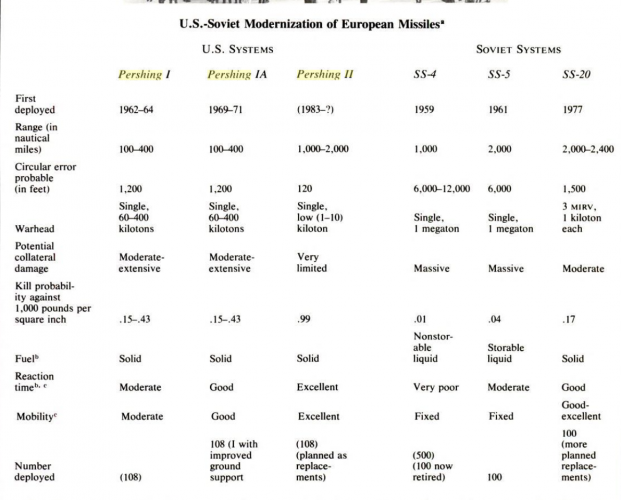
Screenshot 2026-03-05 at 1.47.48 PM.png
From the Bulletin of Atomic Scientists in October 1980. Note how much more accurate Pershing II was compared to SS-20.
 
Paradoxically it was the accuracy and low yield of Pershing and Cruise which led to fears both in and outside the Soviet Union that they were intended to fight a limited nuclear war rather than deter one.
Poseidon and Polaris on the other hand (like SS4, 5 and 20) could not be used to fight a nuclear war only deter one. If used they would inevitably lead to mutual assured destruction.
 
In my view, that same paranoia was going to be there regardless of Pershing 2's existence due to the institutionalized nature of that paranoia in the Soviet apparatus.
Most of the Soviet leadership lived through Operation Barbarossa, and some of them lived through World War I. Can you blame them for being paranoid about a surprise attack from the West?

That's the thing. In both World Wars, America never was attacked on its home soil while Russia lost a good chunk of its population. The fact that Reagan was so stunned that Moscow was taking his bellicose rhetoric seriously illustrates the different mindsets prevailing on each side.
 
Most of the Soviet leadership lived through Operation Barbarossa, and some of them lived through World War I. Can you blame them for being paranoid about a surprise attack from the West?

That's the thing. In both World Wars, America never was attacked on its home soil while Russia lost a good chunk of its population. The fact that Reagan was so stunned that Moscow was taking his bellicose rhetoric seriously illustrates the different mindsets prevailing on each side.

The response to Soviet paranoia isn't unilateral nuclear disarmament. The Soviets didn't lack agency; they are responsible for their own paranoia and could have taken steps to reduce it that didn't involve building hundreds of SS20s.
 
The response to Soviet paranoia isn't unilateral nuclear disarmament. The Soviets didn't lack agency; they are responsible for their own paranoia and could have taken steps to reduce it that didn't involve building hundreds of SS20s.
I was not suggesting unilateral disarmament, I was saying that the Pershing II was a uniquely destabilizing and dangerous weapon.
 
I was not suggesting unilateral disarmament, I was saying that the Pershing II was a uniquely destabilizing and dangerous weapon.

What course of action do you suggest? The Pershing 1a with its up to 400kt warhead wasn't really suitable as a tactical nuclear weapon and was well into its service life so something was required to replace it.

I'd suggest that once the penetrating W86 warhead was cancelled in 1980 a 1 for 1 replacement of the 108 US Army Pershing 1a isn't particularly destabilising. The real new thing of the 80s was the 464 GLCMs.
 
What course of action do you suggest? The Pershing 1a with its up to 400kt warhead wasn't really suitable as a tactical nuclear weapon and was well into its service life so something was required to replace it.

I'd suggest that once the penetrating W86 warhead was cancelled in 1980 a 1 for 1 replacement of the 108 US Army Pershing 1a isn't particularly destabilising. The real new thing of the 80s was the 464 GLCMs.
I think a missile with a shorter range, like the proposed Pershing 1b, would've been a better idea. Gravity dropped nuclear bombs could also have been replaced with cruise missiles.
 
Last edited:
What course of action do you suggest? The Pershing 1a with its up to 400kt warhead wasn't really suitable as a tactical nuclear weapon and was well into its service life so something was required to replace it.

I'd suggest that once the penetrating W86 warhead was cancelled in 1980 a 1 for 1 replacement of the 108 US Army Pershing 1a isn't particularly destabilising. The real new thing of the 80s was the 464 GLCMs.
The fact the US Army only had 108 launchers total, and 275 production missiles tells me they were meant largely as counterforce for the RSD-10s. Having the range to hit the 18-19 Belorussian and Ukrainian RSD-10 bases I mentioned in my previous post, each base would probably be allotted 3-6 P2s each (or one salvo of 3 followed by a reload and follow-up strike). While very accurate, the low yield relative to their contemporaries tells me that 3-6 P2s would be just sufficient for the task of neutralizing those sites and their environs where the launchers may be.

The GLCMs could indeed strike Moscow from West Germany, though since many of them were also based in the UK and Netherlands I presume the intent was still largely counterforce against Belorussian and Ukrainian theatre weapons. There were also a number of Russian SSR RSD-10 bases in either Bryansk or Kursk Oblast and near the Caucasus that would have been valid targets for GLCM in West Germany.

But I do think GLCM was, if not destabilizing, the more superfluous weapon since it didn't bring anything new to the table compared to, say AGM-86 or the USN's Tomahawks. It didn't even help the US Army, since they were under USAF control and this is still the pre-Goldwater Nichols era where joint operations was more a buzzword than actual doctrine. It seems to have been bought mainly so USAF can have a piece of the theatre counterforce action apart from TAC F-111s and F-4s with gravity bombs. I suppose it also helped bulk up the US intermediate range inventory so that it would make the USSR's concession to the INF treaty look much less lopsided.

Without his deep penetrating warhead the Pershing II is just an accurate theatre missile rather than anything particularly special.

Was the W86 cancellation publicly known at the time?
I don't think the cancellation of W86 was particularly secret, and I'm sure the relevant budget documents or Soviet espionage would've found out. But that being said I don't think it would matter and the Soviets would just think the US made it a black program (for an example: the public cancellation of AIM-95 Agile supposedly didn't stop the Soviets from thinking that the program went black, which made them invest in what would become R-73/AA-11 Archer).
 
The more I think about it the more I think the P2 deployment wasn't particularly special. I think the missile itself is pretty impressive with its range and accuracy, although not as impressive as I thought it was with the W86 penatration warhead. The P1a to P2 meant the US Army was going from ~2 reload missiles to only 1 reload. I don't think a range increase is all that much to get worked up about politically, weapons gain range with each generation.

I can see GLCM causing political issues, as it was an entirely new capability, being deployed for the first time. Perhaps the P2 was just lumped together with the GLCM politically.
 
The more I think about it the more I think the P2 deployment wasn't particularly special. I think the missile itself is pretty impressive with its range and accuracy, although not as impressive as I thought it was with the W86 penatration warhead. The P1a to P2 meant the US Army was going from ~2 reload missiles to only 1 reload. I don't think a range increase is all that much to get worked up about politically, weapons gain range with each generation.
The Soviets were worked up because they overestimated Pershing II's range to be 2400km, which was enough to hit Moscow from the West German bases. How that mistake happened is unknown; could be they believed the US were downplaying their capabilities, or they knew the actual figure and chose to hype Pershing II up to justify their more belligerent policies, or they mirror-imaged on the Americans, based on what they would do if they had a capability to hit, say, Washington DC from Cuba.

I can see GLCM causing political issues, as it was an entirely new capability, being deployed for the first time. Perhaps the P2 was just lumped together with the GLCM politically.

They were lumped together by the various disarmament movements that protested against their deployment. While the grassroots movements near or at the bases were probably understandable as just garden-variety NIMBYism, the fact they all sprouted together at the same time and said things aligned with Soviet agitprop against the systems does make me think they were "useful idiots" propped up by Soviet active measures.
 
The Soviets were worked up because they overestimated Pershing II's range to be 2400km, which was enough to hit Moscow from the West German bases. How that mistake happened is unknown; could be they believed the US were downplaying their capabilities, or they knew the actual figure and chose to hype Pershing II up to justify their more belligerent policies, or they mirror-imaged on the Americans, based on what they would do if they had a capability to hit, say, Washington DC from Cuba.
In fairness, the US also regularly overestimated the capability of Russia. Remember the "bomber gap", the "missile gap", the "window of vulnerability", and the "titanium" Mig-25?
 
the fact they all sprouted together at the same time and said things aligned with Soviet agitprop against the systems does make me think they were "useful idiots" propped up by Soviet active measures.
The problem with your theory is that another one that popped up at the same time was opposition to the MX missile basing in the American west. That was led by dyed-in-the-wool conservative locals in rural Nevada and Utah, the Mormon church, and Sen. Paul Laxalt (R-NV).
 
Back
Top Bottom