
You are using an out of date browser. It may not display this or other websites correctly.
You should upgrade or use an alternative browser.
You should upgrade or use an alternative browser.
US Navy/USMC/US Army Sea Basing Concepts
- Thread starter RyanC
- Start date
Any talk of partially sinking JMOB atop guyots (sea-mounts) or shallows?
China builds their own islands…
https://amti.csis.org/island-tracker/china/
China builds their own islands…
https://amti.csis.org/island-tracker/china/
Right, well seeing as I was researching JMOB, MPF(F), and other associated seabasing programs yesterday I might as well post something about it. I've attached the document which I've got much of my information from, other documents such as the RAND report on seabase logistics have been posted before. I'll try to limit my own commentary because there are still a lot of gaps for which I can't find answers that I believe makes commentary difficult at this time. I will say upfront that I do not like the MOB design from a practical standpoint.
First, let me break down JMOB and MPF(F) conceptually. When compared to the Maritime Prepositioning Force, JMOB primarily (almost entirely) focuses on airlift throughput for sustaining forces ashore.

Kvaerner Maritime's MOB helps illustrate this idea. The internal capacity isn't actually all that great despite the massive platform size. The focus is airlift and supporting an airlift campaign comparable to that which sustained coalition efforts in Afghanistan. This is an extremely ambitious goal and hence requires extremely ambitious platforms. MPF(F) is somewhat more toned down. MPF(F) focuses entirely on vertical lift and sealift throughput. This pushed the development of new systems, such as the Bell-Boeing quad tiltrotor, however overall was much simpler as it used broadly proven technology. Two groups, NAVSEA-AME and BLA produced designs for MPF(F) ships. They both make allowance for larger vertical lift platforms and V/STOL JSF, with NAVSEA-AME prioritizing sealift for sustainment and BLA prioritizing large vertical lift platforms for sustainment. Some of these programs went ahead in some form, hence we see the development of the ESDs but even the Lewis B Puller class ESBs have not integrated the vertical lift platforms discussed in MPF(F) and indeed these large scale vertical lift platforms never materialized.

The MPF(F) AoA study had 5 CONOPS in which CONOPS 'E' was directly addressing JMOB type structures and the others addressed more conventional seabasing scenarios. Below is an explainer of these CONOPS as per the 2004 CSC report on MPF(F):
"CONOPS ‘A’ represented the current MPF concept of operation. The MAGTF deploys in order to reinforce an ATF already operating in the Amphibious Operations Area (AOA). MAGTF personnel fly into a host nation supported airport. The MPSRON deploys from a prepositioning site to a host nation supported seaport, with a staging area and nearby airfield. The ships are unloaded and MAGTF personnel “marry up” with their equipment. In this scenario, all aircraft are based at a host nation supported air base. CONOPS ‘A’ had no sea base and was only used to establish a base scenario for the MAA study.
In CONOPS ‘B-’ and ‘B’... the MPSRON deploys from a prepositioning site and meets the MAGTF personnel at an ISEP. In CONOPS ‘B-’,only portions of the CE, GCE, and CSSE meet the sea base, while the others deploy to the site of the ACE Land Base. In CONOPS ‘B’, all of the CE, GCE, and CSSE personnel board the sea base at the ISEP and sail to a MPF Operations Area (OPAREA) near the ATF. The sea base would provide support to forces engaged ashore, and to the CE, and CSSE, which would remain onboard the sea base indefinitely. The entire ACE, consisting of 62 rotary aircraft, is located at a host nation supported ACE land base located close to the AOA. The sea base would only have the capability to refuel the rotary aircraft. CONOPS ‘B-’ requires 4,600 Marines, while the sea base in CONOPS ‘B’ requires 10,600 Marines.
In CONOPS ‘C’... the rotary-wing component of the ACE is based, operated, and maintained on the sea base. The fixed-wing component requires an ACE land base for deployment. These ships interface and refuel air-cushioned landing craft (LCACs) and the ship-to-shore lighters. CONOPS ‘C’ ships have berths for 13,500 MAGTF personnel. The CE, GCE, CSSE and all rotary aircraft embark on the sea base at a host nation supported ISEP.CONOPS ‘C+’ is identical to CONOPS ‘C’ with the exception of the stationing of fixed-wing aircraft. Navy carrier-based aircraft perform the functions of the fixed-wing component of the ACE. The aircraft carrier eliminates the requirement for an ACE land base and reduces dependence on host nation support bases. However, the aircraft carrier does not service C-130 Hercules aircraft, which requires longer runways than those provided on aircraft carriers. The ships in this concept of operation require a host nation supported ISEP for the embarkation of CONUS-based troops. The seabase in this concept of operations can project the force ashore and then provide sustained logistics and close air support.
In CONOPS ‘D’, which supports the ships of Alternative ‘D’, the sea base has the material and supporting structure to base the MAGTF, and all V/STOL and rotary-wing aircraft of the ACE. The MAGTF flies into a host nation supported ISEP, where it meets and boards the MPSRON sea base ships. The sea base transits from the ISEP to the AOA. During the transit, the equipment is configured for the performance of the tactical mission. The sea base has the ability to house 16,400Marines. In this scenario, only the MAGTF strategic lift aircraft are based ashore. The sea base in this concept of operations can project the force ashore and then provide sustained logistics and close air support.
In CONOPS ‘E’, the MOB is the sea base. MOB single base units (SBU) transit from its homeport to the AOA. Five SBUs assemble into a fully functional MOB once located adjacent to the AOA. The MAGTF deploys directly from its home base, inside the U.S., directly to the MOB in theater and forms a combat MAGTF on the MOB. Strategic lift aircraft are able to land on the 5,000 foot length of the MOB. The MOB would have the storage capability to handle the total MAGTF lift of vehicles, dry cargo, and cargo fuel; accommodate a total of 17,000 MAGTF personnel; house, maintain, and operate all MAGTF rotary and fixed-wing aircraft; and operate strategic lift aircraft. The sea base in this concept of operations requires neither an ISEP nor an ACE land base."
I believe it is helpful in understanding why certain decisions were made, especially for JMOB type designs. Do note that CONOPS 'E' is the only CONOPS with no partner nation reliance and hence JMOB is the only platform which allows total independence from partner nations. Recall that in the context of the post Cold War era this was seen as a serious potential future where the lack of a coherent enemy would reduce willingness to work with American forces. Ultimately this happened to a far lesser degree than was predicted which further sidelines JMOB as an operational concept (that is, of course, the benefit of hindsight).
CONOPS 'B' through 'D' address MPF(F) fleet architectures. They similarly lessen the reliance on partner nations but do not entirely remove their necessity.
Finally, I'll provide a summary of the platforms. I will primarily focus on the McDermott MOB design when discussing MOB as this is what the 2004 CSC report used as the focus.
BLA started with a base hull from which 3 different designs were derived. The BLA base design featured cranes to move cargo onto piers or lighterage alongside. The design also features a RoRo ramp at the stern. All these features allow interface with a RoRo Discharge Facility (RRDF). However the CNA was not optimistic in their assessment. They stated that this type of transfer “is very sea-state dependent, and transfer of vehicles via the RRDF can be safely undertaken in seas up to about sea state 1 to 2.” No BLA design featured a well deck. BLA's LCAC integration was through the Integrated Landing Platform (ILP) which I understand was rigged alongside the ship. The three derivative designs are the ACE Supply Ship, the Minimum Air Capable Ship, and the Fully Air Capable Ship.
The Minimum Air Capable Ship had a full flight deck but did not have hangar facilities. It was designed to carry seabase lighterage and had extensive garage space for embarked equipment. It was also able to maintain vehicles and other systems.
The Fully Air Capable Ship was designed to operate much like an LHA and an aircraft maintenance ship with V/STOL JSF integration. Indeed it would supplement TAVB operations as part of the seabase. The aircraft maintenance was provided post arrival on station by a USMC Fly In Support Package (FISP).
Finally the ACE Supply ship was similar to a LMSR.
The fleet composition was dependent on the CONOPS with some featuring more Fully Air Capable Ships and no ACE Supply Ships while others included the ACE Supply Ship to support air operations ashore.
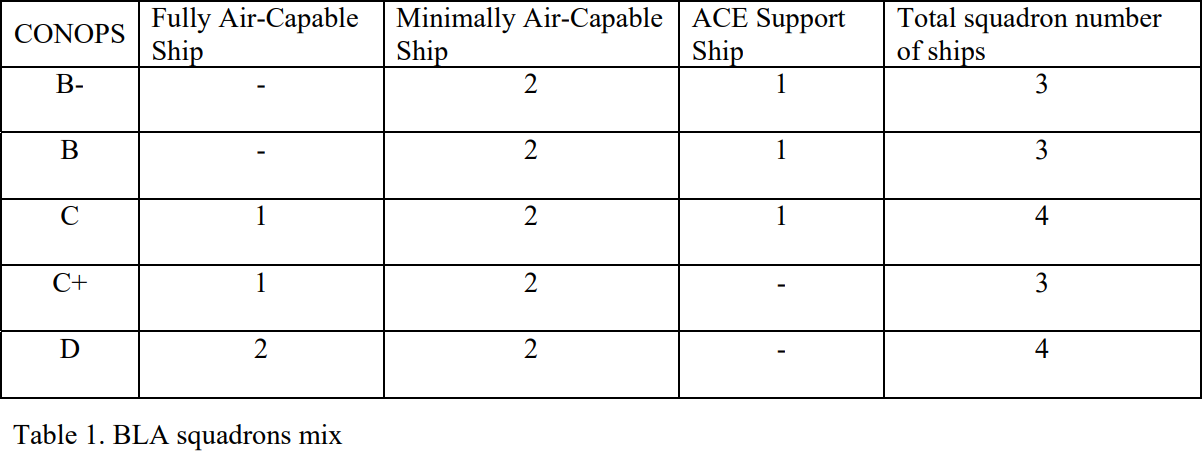
I have attached a table below which demonstrates how BLA was to distribute their ships dependent on CONOPS:

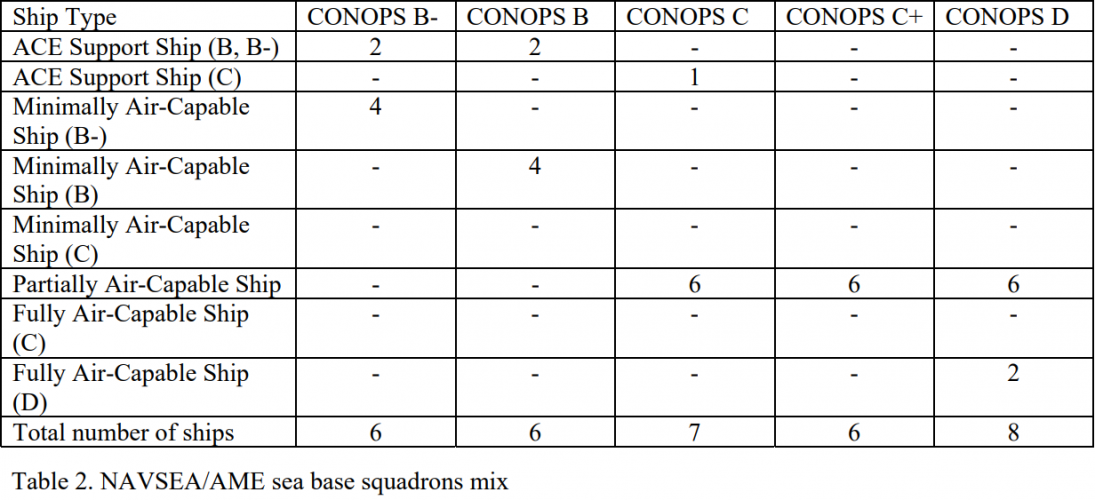
NAVSEA-AME also began with a generic ship hull. To quote the 2004 CSC report, "NAVSEA-AME developed designs for eight discrete ships types for MPF(F), including three Minimally Air Capable Ships, two Fully Air Capable Ships, two ACE Support Ships, and a Partially Air Capable Ship." These variations were to address specific CONOPS (a different approach to BLA). The base hull design had 7 decks to store vehicles, supplies, and equipment. They also had cranes to lift on and lift off equipment similar to BLA's design. A major point of difference between the two is that NAVSEA-AME provided every ship with a well deck to allow for LCAC operations in a wider variety of conditions.
The Minimally Air Capable Ships all featured 3 deck spots for aircraft as well as fuel, equipment, and supplies storage. They were each designed to carry 10 folded helicopters, as well as have space for 2 additional helicopters. The difference between the ships mostly lay in the amount of Marines that could be accommodated.
The Partially Air Capable Ship was similar, although it removed a deck spot and some fuel capacity and could accommodate a greater number of Marines.
The ACE Support Ships were designed around a slightly enlarged hull to maximize internal stores capacity. They had only one deck spot. The variation stems from the cranes used, with the CONOPS 'C' ship using two dual pedestal cranes and the CONOPS 'B' and 'B-' designs using two single pedestal cranes.
The Fully Air Capable Ships feature the most difference between the designs. They both feature a crane for replenishment from vessels alongside
The CONOPS 'C' design is similar to an LHA with 6 spots for aircraft and storage for 34 rotary wing aircraft. This design removed both the well deck and the RoRo features.
The CONOPS 'D' design can operate 30 aircraft including V/STOL JSF. However it retains both the RoRo capability and well deck, albeit with a lesser focus.
I have attached a table below which demonstrates how NAVSEA-AME was to distribute their ships dependent on CONOPS:

Both NAVSEA-AME and BLA's designs would've both been constructed in similar timelines to other naval and civil ships at the time.
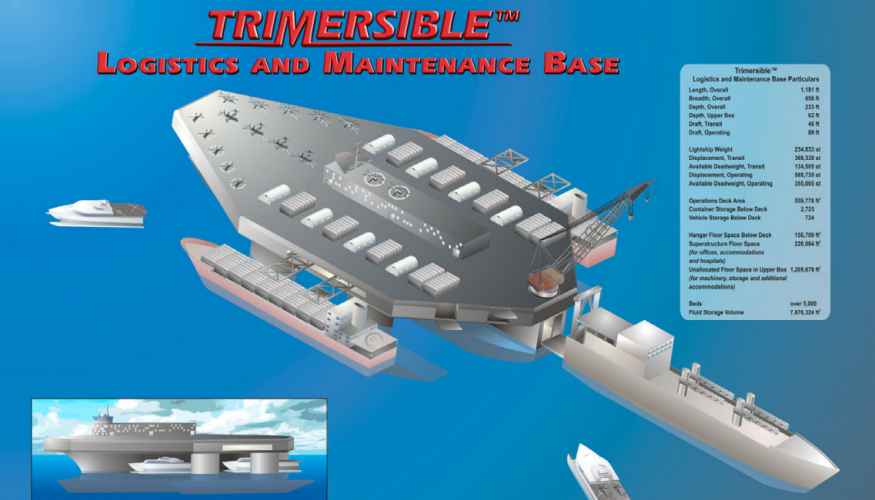
The MOB would have been the largest floating structure every built. Each segment would've been 300m long, 150 meters wide, and would've risen 37 meters into the air. The MOB is configurable in multiple ways, not just the traditional long runway layout often depicted. Each segment is also fully capable of independent operations and so can be deployed at a claimed speed of 15 knots (realistically this is about 10 knots according to further study) to support operations that don't require the entire seabase. At least 5 of these modules could come together to create a runway that could accommodate C-130s and C-17s and the runway can be at least 2kms long when fully formed. Roll when ballasted is less than 1 degree either way providing an extremely stable platform, especially when compared to conventional ships which could roll as much as 10 degrees in the same conditions. The MOB provides much internal reconfigurable space and fuel storage however it has a lesser capacity for Marines and seabase personnel than other designs, a result of the focus on airlift.
JMOB operations can truly be better compared to terrestrial base operations than traditional seabasing. Internal road networks and marshalling areas greatly simplify vehicle and material movement.
JMOB's ability to accommodate sealift is certainly nothing to scoff at but ultimately is greatly affected by external factors, particularly sea state. JMOB cannot dock at any port facilities and no serious suggestion was made that these facilities should be constructed. This creates a point of weakness where a damaged Single Base Unit (SBU) can greatly degrade MOB throughput. The JMOB may be practically indestructible by conventional means but can still be mission killed, and repairs can be hard to effect. McDermott stated it would take about 3 years per SBU and 13 years for the entire seabase to be constructed. This seemed optimistic as this exceeded contemporary rates of production for offshore semi submersible platforms at the time.
So I hope that's a decent summary of what we know about MPF(F) and MOB programs from the late 90s and early 2000s. I will be submitting a FOIA request to find out more soon. I welcome any corrections or additional information as understanding MPF(F) isn't exactly easy.
First, let me break down JMOB and MPF(F) conceptually. When compared to the Maritime Prepositioning Force, JMOB primarily (almost entirely) focuses on airlift throughput for sustaining forces ashore.
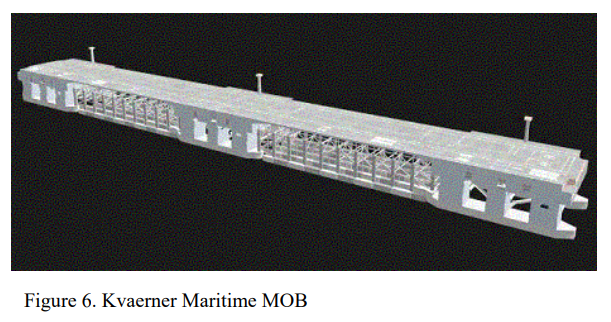
Kvaerner Maritime's MOB helps illustrate this idea. The internal capacity isn't actually all that great despite the massive platform size. The focus is airlift and supporting an airlift campaign comparable to that which sustained coalition efforts in Afghanistan. This is an extremely ambitious goal and hence requires extremely ambitious platforms. MPF(F) is somewhat more toned down. MPF(F) focuses entirely on vertical lift and sealift throughput. This pushed the development of new systems, such as the Bell-Boeing quad tiltrotor, however overall was much simpler as it used broadly proven technology. Two groups, NAVSEA-AME and BLA produced designs for MPF(F) ships. They both make allowance for larger vertical lift platforms and V/STOL JSF, with NAVSEA-AME prioritizing sealift for sustainment and BLA prioritizing large vertical lift platforms for sustainment. Some of these programs went ahead in some form, hence we see the development of the ESDs but even the Lewis B Puller class ESBs have not integrated the vertical lift platforms discussed in MPF(F) and indeed these large scale vertical lift platforms never materialized.
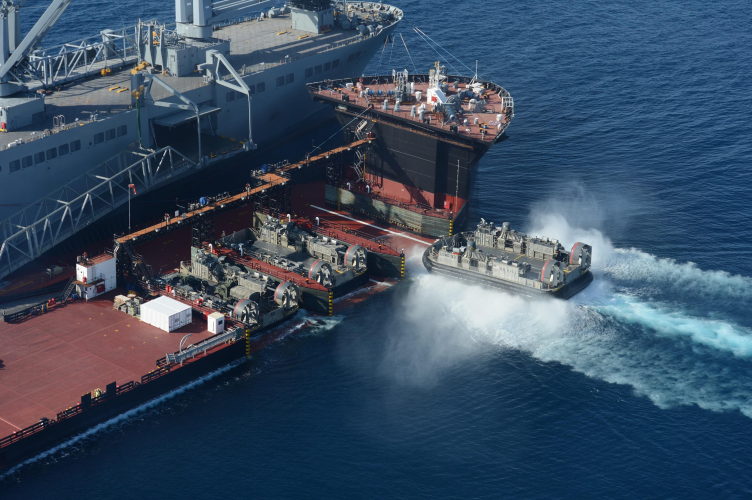
The MPF(F) AoA study had 5 CONOPS in which CONOPS 'E' was directly addressing JMOB type structures and the others addressed more conventional seabasing scenarios. Below is an explainer of these CONOPS as per the 2004 CSC report on MPF(F):
"CONOPS ‘A’ represented the current MPF concept of operation. The MAGTF deploys in order to reinforce an ATF already operating in the Amphibious Operations Area (AOA). MAGTF personnel fly into a host nation supported airport. The MPSRON deploys from a prepositioning site to a host nation supported seaport, with a staging area and nearby airfield. The ships are unloaded and MAGTF personnel “marry up” with their equipment. In this scenario, all aircraft are based at a host nation supported air base. CONOPS ‘A’ had no sea base and was only used to establish a base scenario for the MAA study.
In CONOPS ‘B-’ and ‘B’... the MPSRON deploys from a prepositioning site and meets the MAGTF personnel at an ISEP. In CONOPS ‘B-’,only portions of the CE, GCE, and CSSE meet the sea base, while the others deploy to the site of the ACE Land Base. In CONOPS ‘B’, all of the CE, GCE, and CSSE personnel board the sea base at the ISEP and sail to a MPF Operations Area (OPAREA) near the ATF. The sea base would provide support to forces engaged ashore, and to the CE, and CSSE, which would remain onboard the sea base indefinitely. The entire ACE, consisting of 62 rotary aircraft, is located at a host nation supported ACE land base located close to the AOA. The sea base would only have the capability to refuel the rotary aircraft. CONOPS ‘B-’ requires 4,600 Marines, while the sea base in CONOPS ‘B’ requires 10,600 Marines.
In CONOPS ‘C’... the rotary-wing component of the ACE is based, operated, and maintained on the sea base. The fixed-wing component requires an ACE land base for deployment. These ships interface and refuel air-cushioned landing craft (LCACs) and the ship-to-shore lighters. CONOPS ‘C’ ships have berths for 13,500 MAGTF personnel. The CE, GCE, CSSE and all rotary aircraft embark on the sea base at a host nation supported ISEP.CONOPS ‘C+’ is identical to CONOPS ‘C’ with the exception of the stationing of fixed-wing aircraft. Navy carrier-based aircraft perform the functions of the fixed-wing component of the ACE. The aircraft carrier eliminates the requirement for an ACE land base and reduces dependence on host nation support bases. However, the aircraft carrier does not service C-130 Hercules aircraft, which requires longer runways than those provided on aircraft carriers. The ships in this concept of operation require a host nation supported ISEP for the embarkation of CONUS-based troops. The seabase in this concept of operations can project the force ashore and then provide sustained logistics and close air support.
In CONOPS ‘D’, which supports the ships of Alternative ‘D’, the sea base has the material and supporting structure to base the MAGTF, and all V/STOL and rotary-wing aircraft of the ACE. The MAGTF flies into a host nation supported ISEP, where it meets and boards the MPSRON sea base ships. The sea base transits from the ISEP to the AOA. During the transit, the equipment is configured for the performance of the tactical mission. The sea base has the ability to house 16,400Marines. In this scenario, only the MAGTF strategic lift aircraft are based ashore. The sea base in this concept of operations can project the force ashore and then provide sustained logistics and close air support.
In CONOPS ‘E’, the MOB is the sea base. MOB single base units (SBU) transit from its homeport to the AOA. Five SBUs assemble into a fully functional MOB once located adjacent to the AOA. The MAGTF deploys directly from its home base, inside the U.S., directly to the MOB in theater and forms a combat MAGTF on the MOB. Strategic lift aircraft are able to land on the 5,000 foot length of the MOB. The MOB would have the storage capability to handle the total MAGTF lift of vehicles, dry cargo, and cargo fuel; accommodate a total of 17,000 MAGTF personnel; house, maintain, and operate all MAGTF rotary and fixed-wing aircraft; and operate strategic lift aircraft. The sea base in this concept of operations requires neither an ISEP nor an ACE land base."
I believe it is helpful in understanding why certain decisions were made, especially for JMOB type designs. Do note that CONOPS 'E' is the only CONOPS with no partner nation reliance and hence JMOB is the only platform which allows total independence from partner nations. Recall that in the context of the post Cold War era this was seen as a serious potential future where the lack of a coherent enemy would reduce willingness to work with American forces. Ultimately this happened to a far lesser degree than was predicted which further sidelines JMOB as an operational concept (that is, of course, the benefit of hindsight).
CONOPS 'B' through 'D' address MPF(F) fleet architectures. They similarly lessen the reliance on partner nations but do not entirely remove their necessity.
Finally, I'll provide a summary of the platforms. I will primarily focus on the McDermott MOB design when discussing MOB as this is what the 2004 CSC report used as the focus.
BLA started with a base hull from which 3 different designs were derived. The BLA base design featured cranes to move cargo onto piers or lighterage alongside. The design also features a RoRo ramp at the stern. All these features allow interface with a RoRo Discharge Facility (RRDF). However the CNA was not optimistic in their assessment. They stated that this type of transfer “is very sea-state dependent, and transfer of vehicles via the RRDF can be safely undertaken in seas up to about sea state 1 to 2.” No BLA design featured a well deck. BLA's LCAC integration was through the Integrated Landing Platform (ILP) which I understand was rigged alongside the ship. The three derivative designs are the ACE Supply Ship, the Minimum Air Capable Ship, and the Fully Air Capable Ship.
The Minimum Air Capable Ship had a full flight deck but did not have hangar facilities. It was designed to carry seabase lighterage and had extensive garage space for embarked equipment. It was also able to maintain vehicles and other systems.
The Fully Air Capable Ship was designed to operate much like an LHA and an aircraft maintenance ship with V/STOL JSF integration. Indeed it would supplement TAVB operations as part of the seabase. The aircraft maintenance was provided post arrival on station by a USMC Fly In Support Package (FISP).
Finally the ACE Supply ship was similar to a LMSR.
The fleet composition was dependent on the CONOPS with some featuring more Fully Air Capable Ships and no ACE Supply Ships while others included the ACE Supply Ship to support air operations ashore.
I have attached a table below which demonstrates how BLA was to distribute their ships dependent on CONOPS:
NAVSEA-AME also began with a generic ship hull. To quote the 2004 CSC report, "NAVSEA-AME developed designs for eight discrete ships types for MPF(F), including three Minimally Air Capable Ships, two Fully Air Capable Ships, two ACE Support Ships, and a Partially Air Capable Ship." These variations were to address specific CONOPS (a different approach to BLA). The base hull design had 7 decks to store vehicles, supplies, and equipment. They also had cranes to lift on and lift off equipment similar to BLA's design. A major point of difference between the two is that NAVSEA-AME provided every ship with a well deck to allow for LCAC operations in a wider variety of conditions.
The Minimally Air Capable Ships all featured 3 deck spots for aircraft as well as fuel, equipment, and supplies storage. They were each designed to carry 10 folded helicopters, as well as have space for 2 additional helicopters. The difference between the ships mostly lay in the amount of Marines that could be accommodated.
The Partially Air Capable Ship was similar, although it removed a deck spot and some fuel capacity and could accommodate a greater number of Marines.
The ACE Support Ships were designed around a slightly enlarged hull to maximize internal stores capacity. They had only one deck spot. The variation stems from the cranes used, with the CONOPS 'C' ship using two dual pedestal cranes and the CONOPS 'B' and 'B-' designs using two single pedestal cranes.
The Fully Air Capable Ships feature the most difference between the designs. They both feature a crane for replenishment from vessels alongside
The CONOPS 'C' design is similar to an LHA with 6 spots for aircraft and storage for 34 rotary wing aircraft. This design removed both the well deck and the RoRo features.
The CONOPS 'D' design can operate 30 aircraft including V/STOL JSF. However it retains both the RoRo capability and well deck, albeit with a lesser focus.
I have attached a table below which demonstrates how NAVSEA-AME was to distribute their ships dependent on CONOPS:
Both NAVSEA-AME and BLA's designs would've both been constructed in similar timelines to other naval and civil ships at the time.
The MOB would have been the largest floating structure every built. Each segment would've been 300m long, 150 meters wide, and would've risen 37 meters into the air. The MOB is configurable in multiple ways, not just the traditional long runway layout often depicted. Each segment is also fully capable of independent operations and so can be deployed at a claimed speed of 15 knots (realistically this is about 10 knots according to further study) to support operations that don't require the entire seabase. At least 5 of these modules could come together to create a runway that could accommodate C-130s and C-17s and the runway can be at least 2kms long when fully formed. Roll when ballasted is less than 1 degree either way providing an extremely stable platform, especially when compared to conventional ships which could roll as much as 10 degrees in the same conditions. The MOB provides much internal reconfigurable space and fuel storage however it has a lesser capacity for Marines and seabase personnel than other designs, a result of the focus on airlift.
JMOB operations can truly be better compared to terrestrial base operations than traditional seabasing. Internal road networks and marshalling areas greatly simplify vehicle and material movement.
JMOB's ability to accommodate sealift is certainly nothing to scoff at but ultimately is greatly affected by external factors, particularly sea state. JMOB cannot dock at any port facilities and no serious suggestion was made that these facilities should be constructed. This creates a point of weakness where a damaged Single Base Unit (SBU) can greatly degrade MOB throughput. The JMOB may be practically indestructible by conventional means but can still be mission killed, and repairs can be hard to effect. McDermott stated it would take about 3 years per SBU and 13 years for the entire seabase to be constructed. This seemed optimistic as this exceeded contemporary rates of production for offshore semi submersible platforms at the time.
To answer this question, this would essentially negate the greatest advantage of the MOB. You entirely lose the mobility of the MOB and the independence of the SBUs. This would be no better than land bases in Asia, Europe, the Middle East, etc. and arguably the immobilized MOB would be worse because they would be harder to supply and defend.Any talk of partially sinking JMOB atop guyots (sea-mounts) or shallows?
So I hope that's a decent summary of what we know about MPF(F) and MOB programs from the late 90s and early 2000s. I will be submitting a FOIA request to find out more soon. I welcome any corrections or additional information as understanding MPF(F) isn't exactly easy.
Attachments
Last edited:
Jack-up rigs aren't the most mobile things in the world either. I was thinking that a more spartan JMOB would start off by being a working ship.
Between the pontoon large amounts of rock could be carried, with the square floats similar to the parbuckling of Costa Concordia left.
The JMOB as you envision would be a middle structure with inert clones to either side that would be left behind.
This way, you can add capability over time, with high value elements coming last.
Troll-A is far more impressive to me than a gussied up Spruance with a laser pointer on its bow, or whatever.
Having non-Navy assets at home in the Pacific is worth it.
If the economy bounces back, having a line of JMOBs across the Pacific would be nice.
Between the pontoon large amounts of rock could be carried, with the square floats similar to the parbuckling of Costa Concordia left.
The JMOB as you envision would be a middle structure with inert clones to either side that would be left behind.
This way, you can add capability over time, with high value elements coming last.
Troll-A is far more impressive to me than a gussied up Spruance with a laser pointer on its bow, or whatever.
Having non-Navy assets at home in the Pacific is worth it.
If the economy bounces back, having a line of JMOBs across the Pacific would be nice.
Last edited:
All JMOB designs are semi submersible. Jack up platforms would not be able to take the weight and would not work in the variety of conditions needed. Also, JMOB is fairly spartan. It’s made from concrete, it’s about as spartan as you can get. It still takes more than 13 years to build the thing in full and more than 3.3 years per SBU.Jack-up rigs aren't the most mobile things in the world either. I was thinking that a more spartan JMOB would start off by being a working ship.
What you’re describing if not a JMOB because an inherent requirements of any MOB is to be mobile. The designs to which you refer are less useful for the US Military than a theoretical JMOB. Fixed installations are nessecary but hard to defend. This is an identified weakness of the Chinese artificial islands too. While they extend the reach of China in peacetime and exert pressure on neighbours, they are hard to supply and have limited utility in wartime
I thought Kvaerner's were just metal pontoon craft craft linked up.
A line of bases could be used perhaps for space launch. One idea is for first stages to not have to do RTLS gymnastics and just land at the next base over to the east.
The USN might get some USSF and tech-bro money for this. The pad would be on one structure a bit farther over.
Ford class ships have no other mixed use options.
I never liked bases on land in other countries. If the United States must keep it's WWII/Cold War logistical nightmare alive, I'd rather it be where truck bombs can't reach.
A line of bases could be used perhaps for space launch. One idea is for first stages to not have to do RTLS gymnastics and just land at the next base over to the east.
The USN might get some USSF and tech-bro money for this. The pad would be on one structure a bit farther over.
Ford class ships have no other mixed use options.
I never liked bases on land in other countries. If the United States must keep it's WWII/Cold War logistical nightmare alive, I'd rather it be where truck bombs can't reach.
Last edited:
Indeed Kvaerner's design was metal semi submersibles with a flexible bridge between them. McDermott's design was seen as the most practicalI thought Kvaerner's were just metal pontoon craft craft linked up.
You don't need JMOB for that, a single semisub platform would be more than capable of handling that.A line of bases could be used perhaps for space launch. One idea is for first stages to not have to do RTLS gymnastics and just land at the next base over to the east.
For what fight? JMOB is not useful in a peer conflict due to the mass concentration of resources into one platform and rocket mail is not particularly economical for LICThe USN might get some USSF and tech-bro money for this. The pad would be on one structure a bit farther over.
Fords and CVNs in general fill a completely separate roleFord class ships have no other mixed use options.
Fairly bad argument tbh, the rationale for JMOB only makes sense if land bases are no longer available, as I explained when discussing CONOPS 'E'. Land based logistics is much simpler and defense of land bases is certainly not as hard as you make outI never liked bases on land in other countries. If the United States must keep it's WWII/Cold War logistical nightmare alive, I'd rather it be where truck bombs can't reach.
Scott Kenny
ACCESS: USAP
- Joined
- 15 May 2023
- Messages
- 19,686
- Reaction score
- 28,170
It's a lot better to have a war in someone else's country than it is in your own country.I never liked bases on land in other countries. If the United States must keep it's WWII/Cold War logistical nightmare alive, I'd rather it be where truck bombs can't reach.
Also, in terms of speed of response to an invasion the US absolutely needs those bases overseas. Look at how long it took to do the buildup in 1991 for Desert Storm. If your ally cannot provide mechanized ground troops until 6 months after the invasion happens, are they actually capable of saving you, or are they just going to avenge you?
There they had every advantage of a perfect battlefield with instant access to petroleum:
https://apps.dtic.mil/sti/tr/pdf/ADA263676.pdf
Yes, more than any JMOB.
Baghdad had the best Inman Embassy but no stealth.
Over the horizon, out to sea means no planespotting... perhaps less likelihood of this too
https://www.washingtonpost.com/archive/politics/1992/12/09/hitting-the-beach-in-glare-of-the-night
With Desert Storm, had I been Hussein, I would have told my guys to race South, steal every car I could...all soldiers in sedans and empty tanks left in place to draw fire. Who couldn't see the god of all pincers/flanking maneuvers coming?
If you are in an Apache, how do you spot my Republican Guard if they are in every other car in Saudi Arabia?
If you are a third world dictator, you should know what's coming and megaforce things.
Tanks are for running over civilians, and civilian rides your un-APC. About 50 cars storm a base---I hope you have your .50s out.
But I digress.
I'm simple. I don't trust anyone.
Big platform that shoots at anything not USN.
No more truck bombs, no more spooks waving insurgents through my checkpoints or CNN watching me wade ashore.
Starship perhaps a better end run than JMOB.
https://apps.dtic.mil/sti/tr/pdf/ADA263676.pdf
Yes, more than any JMOB.
Baghdad had the best Inman Embassy but no stealth.
Over the horizon, out to sea means no planespotting... perhaps less likelihood of this too
https://www.washingtonpost.com/archive/politics/1992/12/09/hitting-the-beach-in-glare-of-the-night
With Desert Storm, had I been Hussein, I would have told my guys to race South, steal every car I could...all soldiers in sedans and empty tanks left in place to draw fire. Who couldn't see the god of all pincers/flanking maneuvers coming?
If you are in an Apache, how do you spot my Republican Guard if they are in every other car in Saudi Arabia?
If you are a third world dictator, you should know what's coming and megaforce things.
Tanks are for running over civilians, and civilian rides your un-APC. About 50 cars storm a base---I hope you have your .50s out.
But I digress.
I'm simple. I don't trust anyone.
Big platform that shoots at anything not USN.
No more truck bombs, no more spooks waving insurgents through my checkpoints or CNN watching me wade ashore.
Starship perhaps a better end run than JMOB.
Last edited:
I can honestly say that I have no idea what you’re talking about. Not even CONOPS ‘E’ is this derangedThere they had every advantage of a perfect battlefield with instant access to petroleum:
https://apps.dtic.mil/sti/tr/pdf/ADA263676.pdf
Yes, more than any JMOB.
Baghdad had the best Inman Embassy but no stealth.
Over the horizon, out to sea means no planespotting... perhaps less likelihood of this too
https://www.washingtonpost.com/archive/politics/1992/12/09/hitting-the-beach-in-glare-of-the-night
With Desert Storm, had I been Hussein, I would have told my guys to race South, steal every car I could...all soldiers in sedans and empty tanks left in place to draw fire. Who couldn't see the god of all pincers/flanking maneuvers coming?
If you are in an Apache, how do you spot my Republican Guard if they are in every other car in Saudi Arabia?
If you are a third world dictator, you should know what's coming and megaforce things.
Tanks are for running over civilians, and civilian rides your un-APC. About 50 cars storm a base---I hope you have your .50s out.
But I digress.
I'm simple. I don't trust anyone.
Big platform that shoots at anything not USN.
No more truck bombs, no more spooks waving insurgents through my checkpoints or CNN watching me wade ashore.
Starship perhaps a better end run than JMOB.
I understand that but empirically the evidence doesn’t quite stack up.Just some memories of the Beirut barracks bombing...a sore subject
Do you have any thoughts on the role of high-speed sealift vs LMSRs vs Starship for inter-theater connectors?
Algol is about as large as the big diesels, but is maybe only a dozen knots faster. SWATH was what you were thinking about?
Keep the LMSRs of course
Starship itself won't be useful for a long while if at all. Hot Eagle too small.
SuperHeavy needs to launch some version of this:
https://ntrs.nasa.gov/api/citations/19900016736/downloads/19900016736.pdf
Like this but larger (the image from Mark Wade mind you--the people here just used the image
https://tmp2.fandom.com/wiki/Surface_Shuttle_Vehicles?file=KlipperCEVBiconics.jpgThis would be a one way insertion...as soon as the aeroshell goes subsonic the cocoon splits, the stores deploy.
MSFC needs to design the craft. SuperHeavy seems fine, but you don't want a showy landing burn, so Starship needs to be replaced for military cargo.
The goal should be to find ways to leverage First World assets without Third World hassles that come from basing entanglements.
If space assets can strike the surface, that might decrease the need to have bases all over the planet. That I think might upset those in logistics, so I fully expect them to pooh-pooh things.
Insert men with subs, but they could control aerobrake assets remotely via laser comm. (once things go subsonic)
I guess I am an extremist. Make surface assets as large as you can make them--or not use them at all.
Keep the LMSRs of course
Starship itself won't be useful for a long while if at all. Hot Eagle too small.
SuperHeavy needs to launch some version of this:
https://ntrs.nasa.gov/api/citations/19900016736/downloads/19900016736.pdf
Like this but larger (the image from Mark Wade mind you--the people here just used the image
https://tmp2.fandom.com/wiki/Surface_Shuttle_Vehicles?file=KlipperCEVBiconics.jpgThis would be a one way insertion...as soon as the aeroshell goes subsonic the cocoon splits, the stores deploy.
MSFC needs to design the craft. SuperHeavy seems fine, but you don't want a showy landing burn, so Starship needs to be replaced for military cargo.
The goal should be to find ways to leverage First World assets without Third World hassles that come from basing entanglements.
If space assets can strike the surface, that might decrease the need to have bases all over the planet. That I think might upset those in logistics, so I fully expect them to pooh-pooh things.
Insert men with subs, but they could control aerobrake assets remotely via laser comm. (once things go subsonic)
I guess I am an extremist. Make surface assets as large as you can make them--or not use them at all.
Last edited:
InterestingAlgol is about as large as the big diesels, but is maybe only a dozen knots faster. SWATH was what you were thinking about?
Keep the LMSRs of course
Starship itself won't be useful for a long while if at all. Hot Eagle too small.
SuperHeavy needs to launch some version of this:
https://ntrs.nasa.gov/api/citations/19900016736/downloads/19900016736.pdf
Like this but larger (the image from Mark Wade mind you--the people here just used the image
https://tmp2.fandom.com/wiki/Surface_Shuttle_Vehicles?file=KlipperCEVBiconics.jpgThis would be a one way insertion...as soon as the aeroshell goes subsonic the cocoon splits, the stores deploy.
MSFC needs to design the craft. SuperHeavy seems fine, but you don't want a showy landing burn, so Starship needs to be replaced for military cargo.
The goal should be to find ways to leverage First World assets without Third World hassles that come from basing entanglements.
If space assets can strike the surface, that might decrease the need to have bases all over the planet. That I think might upset those in logistics, so I fully expect them to pooh-pooh things.
Insert men with subs, but they could control aerobrake assets remotely via laser comm. (once things go subsonic)
I guess I am an extremist. Make surface assets as large as you can make them--or not use them at all.
ford_tempo
ACCESS: Confidential
- Joined
- 31 January 2011
- Messages
- 80
- Reaction score
- 18
https://apps.dtic.mil/sti/tr/pdf/ADA387250.pdf
Another interesting paper on MOB. Notice the comparison with a large monohull (larger than LMSR and CVN at 1200 feet length, 370 beam) presented on page 48-49
F_T
Another interesting paper on MOB. Notice the comparison with a large monohull (larger than LMSR and CVN at 1200 feet length, 370 beam) presented on page 48-49
F_T
Launch complex
View: https://x.com/SpaceIntel101/status/2036013308000567733
Related technology
https://techxplore.com/news/2026-02-ports-technology-faster.html
Power for same:
https://techxplore.com/news/2026-02-power-motion-ocean-energy-harvesting.html
Maybe we can see this one day at Titan...to harvest hydrocarbons.
View: https://x.com/SpaceIntel101/status/2036013308000567733
Related technology
https://techxplore.com/news/2026-02-ports-technology-faster.html
Power for same:
https://techxplore.com/news/2026-02-power-motion-ocean-energy-harvesting.html
Maybe we can see this one day at Titan...to harvest hydrocarbons.
Last edited:
Broad callout for help: I am having some trouble reconciling what seems to be a number of seemingly diametrically opposed concepts and believe this falls within either the MPF(F) Squadron architecture or different phases of the MPF(F) program. Would anyone have either papers outlining proposed squadron architecture or a timeline of MPF(F) concepts?
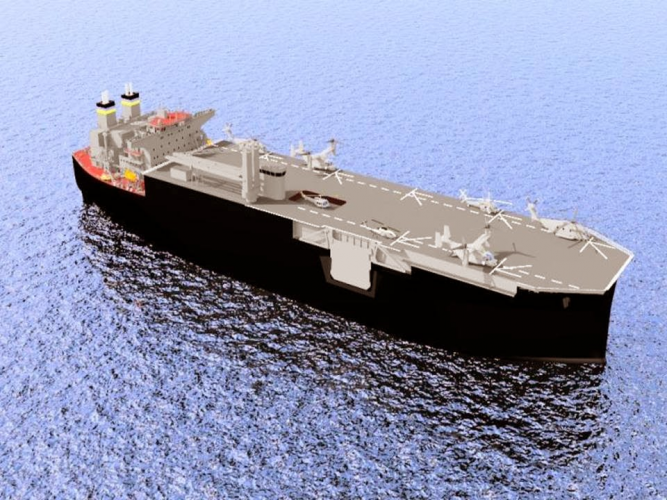
The circumstances from which NASSCO proposed the ESD meant that they explored doing just about anything conceivable with an Alaska class. See below for one of the more interesting ideas and one of the few I've found for which there is a visual representation in the public domain.
This concept is very similar to some of the large transports proposed under MPF(F), which tracks as we know the ESD is a manifestation of the MLP from MPF(F).
Some other examples of Alaska class/ESD derived vessels studied (and the years of said studies) include:
2024-Typhon Conversion of ESD
2023-SBX ESD Variant
2023-ESD T-AGM Supplement
2022-AO capable ESB Variant
2021-ESD AS-Support Drydock Capable Subtender
2018-ESB Based T-AVB concept
2018-Enhanced Self Defense capable ESB
2017-ESD Hospital Barge Concept Design
2014-Through Flight Deck ESB
2014-ESD Global Fleet Station Drydocking Capable Tender
2014-BMD ESD Variant
This concept is very similar to some of the large transports proposed under MPF(F), which tracks as we know the ESD is a manifestation of the MLP from MPF(F).
Some other examples of Alaska class/ESD derived vessels studied (and the years of said studies) include:
2024-Typhon Conversion of ESD
2023-SBX ESD Variant
2023-ESD T-AGM Supplement
2022-AO capable ESB Variant
2021-ESD AS-Support Drydock Capable Subtender
2018-ESB Based T-AVB concept
2018-Enhanced Self Defense capable ESB
2017-ESD Hospital Barge Concept Design
2014-Through Flight Deck ESB
2014-ESD Global Fleet Station Drydocking Capable Tender
2014-BMD ESD Variant
Attachments
Firefinder
ACCESS: Top Secret
- Joined
- 5 October 2019
- Messages
- 1,261
- Reaction score
- 2,387
2021-ESD AS-Support Drydock Capable Subtender
These two have my complete interest.2014-ESD Global Fleet Station Drydocking Capable Tender
Is there any more on them or an easy way to look them up?
Sadly not, I would be very interested to know more. The only real interesting note on any of them I've found is that ESB-4 (Hershel "Woody" Williams) was at some point reportedly to be built as a through deck ESB.These two have my complete interest.
Is there any more on them or an easy way to look them up?
At first I assumed that the AS study would eventuate as NASSCO's AS(X) but they went with a volume driven hull closer to a PCTC.
Similar threads
-

-
-
Sea-based Anti-Ballastic Missile Intercept System (SABMIS)
- Started by Triton
- Replies: 74
-

-