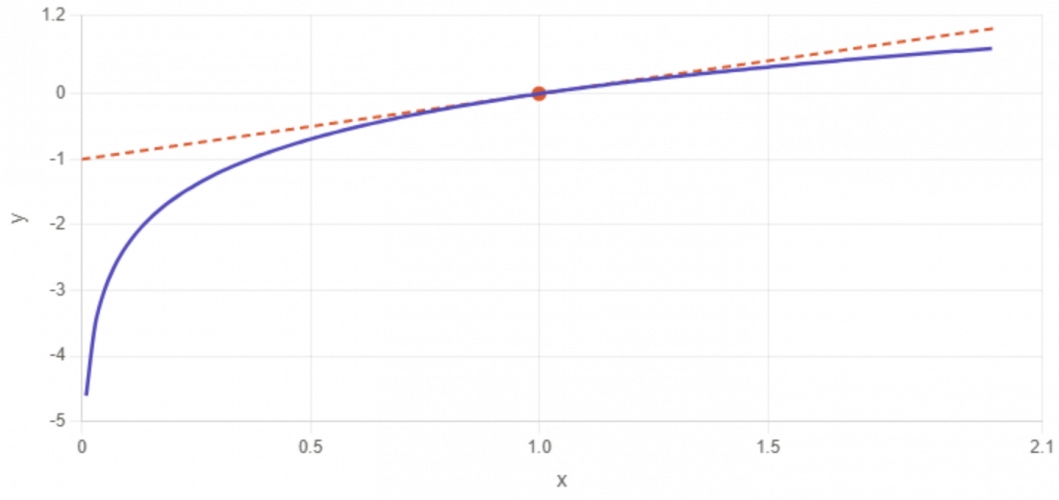
Not quite. When you model a typical fighter mission usually 30-40% of the fuel is « range less » ie. used for taxi, take-off, climb, combat and reserve. Which means every % improvement in TSFC gives you a double benefit, by not only reducing the rangeless fuel portion (leaving more fuel for cruise) but also by improving your cruise efficiency.
So it’s still a linear relationship, but better than 1:1, ie. a 1% improvement in TFSC leads to a more than 1% improvement in range (more like 1.6%).
I think quellish is right in the physics sense, while H_K is right in the technical sense.
Aircraft are fundamentally governed by the rocket equation - which tells us how much impulse the aircraft can extract from its fuel. But while rockets (at least the ones that go to space) usually retain that impulse, aircraft lose it to accelerating air (e.g. drag) - with their thrust and drag forces being in equilibrium. This is for the same reason as rockets - initially you have to push your extra fuel along.
So mathematically, a hypothetical (implausible IRL) aircraft with 50% fuel fraction aircraft, vs a 90% fuel fraction aircraft, the latter would have ln(0.1)/ln(0.5)= 3.32x range. So your extra fuel doesn't give you as much extra range, a 10 ton aircraft carrying 90 tons of fuel, would only go a bit more than 3x as far as a 10 ton aircraft carryin 10 tons.
However if we look at realistic numbers, an F18 is like 10 tons, and carries 5 tons of fuel, and with it retaining 30%, its more like a 11.5 ton aircraft carrying 3.5t, meaning the logarithm argument ~0.72 is close to 1, and close to 1, and around 1, ln more or less behaves linearly.
This is easily settled. Let's half fill the fuel tank of a Global Hawk so it takes off with a similar fuel fraction to a fighter jet. It can now fly 17+ hours instead of 34+ hours and 7,000 miles instead of 14,000 miles.
This is proof that slower speed and long straight wing allows Global Hawk to have excellent range for it's size. Your argument that fuel fraction is the biggest factor has been destroyed.
But afaik, Global Hawk uses a traditional cambered wing which is the most efficient, but:
straight wings arent great at handling high loads, so manuevering is out of the question
camber on its own straight up stops generating lift when supersonic
cambered shapes are rounded, thus not stealthy
That's why most (all?) modern fighters are more or less various kinds of deltas, with knife-edge wingtips (something that was somewhat even true in the 4th gen), and less cambered profiles.
But afaik, Global Hawk uses a traditional cambered wing which is the most efficient, but:
straight wings arent great at handling high loads, so manuevering is out of the question
camber on its own straight up stops generating lift when supersonic
cambered shapes are rounded, thus not stealthy
That's why most (all?) modern fighters are more or less various kinds of deltas, with knife-edge wingtips (something that was somewhat even true in the 4th gen), and less cambered profiles.
You could go and lookup the aerofoil type on the F-22.... Somehow it's actually listed online (to a basic degree). Might be an interesting thought provoking surprise. Bear in mind those leading edges are being carefully aligned away from threat emitters.
The U.S. Navy isn't clever enough to think of something that invalidates the need for short wavelength S-K band stealth. Most organizations, maybe all of them, aren't either. That doesn't mean they're stupid enough to think a land fighter can be easily navalized.
I'm sure an insider like you can bring it up in the next PEO(T) meeting with NAVAIR.
The actual starting point is probably going to be A/F-X because the Navy needs Medium Attack more than a heavy fighter. Chinese air threat is minimal to non-existent in terms of NATF. Why do you need a super duper stealth fighter to shoot down six dozen Badgers? Their primary anti-ship systems are going to be ballistic missiles and submarines. The super duper stealth fighter won't be very useful against a B-2, either, since the main defense against stealth bombers is striking first.
You could go and lookup the aerofoil type on the F-22.... Somehow it's actually listed online (to a basic degree). Might be an interesting thought provoking surprise. Bear in mind those leading edges are being carefully aligned away from threat emitters.
You could go and lookup the aerofoil type on the F-22.... Somehow it's actually listed online (to a basic degree). Might be an interesting thought provoking surprise. Bear in mind those leading edges are being carefully aligned away from threat emitters.
From what I could gather (I think we found the same PDF) the ? is a rendering artifact.
The NACA-64A-05.92 means (root) , 64A-04.29 (tip)
Here:
6 is for 6 series airfoil 4- this means the minimum pressure (max lift) occurs 40% along the chordline A- apparently this means it has a modified, mean line (which is a chordwise line thats equidistant from the top and bottom of the airfoil) 0- this means camber is 0, so no lift at 0deg AoA and the airfoil is symmetric (00).592- thickness/chord ratio
The wing is also mounted at 5deg AoA at root and -3.1 AoA at tip - this is to prevent wingtip stall at high AoA.
But I'm also a random internet idiot, so take it with a grain of salt.
In contrast the Global Hawk wing seems highly cambered.
I'm not an expert, could you give away the answer?
From what I could gather (I think we found the same PDF) the ? is a rendering artifact.
The NACA-64A-05.92 means (root) , 64A-04.29 (tip)
Here:
6 is for 6 series airfoil 4- this means the minimum pressure (max lift) occurs 40% along the chorline A- apparently this means it has a modified, mean line (which is a chordwise line thats equidistant from the top and bottom) 0- this means camber i 0, so no lift at 0deg AoA (00).592- thickness/chord ratio
The wing is also mounted at 5deg AoA at root and -3.1 AoA at tip - this is to prevent wingtip stall at high AoA.
But I'm also a random internet idiot, so take it with a grain of salt.
In contrast the Global Hawk wing seems highly cambered.
Sorry, I didn't mean to sound superiorist. These NACA 64 series aerofoils are so called supersonic optimised but basically supercritical aerofoils with quite a flat top deck that increases the degree of laminar flow for lower drag, and have a reflex on the underside close to the trailing edge. The have rounded noses and are definitely not like an F-104 with razor sharp leading edges.
I'm not an aerodynamicist but you can play with a tool like vibefoil (xfoil derived freeware tool, https://www.vibefoil.com/) and find these aerofoils achieve excellent low aoa cruise L/D and a decent stall angle. There are various reports that discuss this family further on line if you search. Not aware of any major new developments or trends that would suggest major advancements in foil design might be expected for 6th gen aircraft.
I'm in France at Disneyland with my family and just don't have easy access to laptop and time to answer fully, but this is recently in my focus as I have been trying to concept a different F/A-XX concept package.
The Breguet Range Equation is only useful on a known aircraft flying the same mission, hence, good for use by commercial pilots but not really for aircraft design. It's better for missile design, though, since their drag is limited to one body and one or two wing types. While on an aircraft the drag is compose of many components from fuslage, wings, tails, intakes, etc. and all are parameters are fluid based on altitide, airspeed, AoA not to mention engine behaviours/caracteristics.
As Elysium has shown it's almost linear (products of factors).
As for the wings we are comparing supersonic and supsonic wings here. It's a different complexity on its own.
The F22's L/D is said to max at 8.4 it's not as good as some in the past like the Phantom II but not too shapy either.
We started using CADAM on the F-18A- very few terminals and I had one drawing on the board and another in the tube. It was mixed in with trips to get training - Lockheed?
The Breguet Range Equation is only useful on a known aircraft flying the same mission, hence, good for use by commercial pilots but not really for aircraft design. It's better for missile design, though, since their drag is limited to one body and one or two wing types. While on an aircraft the drag is compose of many components from fuslage, wings, tails, intakes, etc. and all are parameters are fluid based on altitide, airspeed, AoA not to mention engine behaviours/caracteristics.
It shouldn’t be too hard to come up with a working equivalent to the Breguet range equation for fighters.
You could start with known performance data for the US Teen series (F-16, F/A-18 and F-15). Use a weight based estimate for rangeless fuel (Taxi, Takeoff, Climb + Reserve). This should be an identical % of empty weight for all fighters. Similarly use a weight based estimate for combat fuel.
Then take fuel capacity, subtract rangeless fuel to get remaining cruise fuel, and apply a range factor which would be measured in kg/nmi per tonne of empty weight.
This will give you combat radius as a function of empty weight and fuel capacity, which can be varied (eg. with/without CFTs). As long as you’re flying almost clean and only using CFTs, internal or conformal weapons (eg. 4 AAMs) the L/D ratio shouldn’t be a major variable.
From here you get an equation that can be applied to most modern fighters under similar conditions. Apply a correction factor for different L/D ratios and engine SFC ratios to factor in improvements in aerodynamics and engine tech and the result should lead to decent estimates for 6th gen aircraft.
Yup.
Meanwhile the AF wants/needs a very long-legged vehicle with 'DC-to-daylight' signatures addressed. First order requirements driving the F/A-XX and F-47 designs differ significantly.
The USAF for NGAD has consistently mentioned 1,000nm combat radius and this is in air-to-air configuration.
It is worth noting the F-35A has 14% greater radius in air-to-air config (760nm) versus air-to-ground config (669nm). There is no difference in fuel capacity between profiles. The range difference is purely from the ~3,000lb payload weight difference when taking off.
The US Navy for F/A-XX has mentioned +25% greater combat radius than existing aircraft. This 25% increase is between 700nm and 837nm depending if it is based from the Super Hornet (558nm) or F-35C (670nm). Let's give F/AXX a 750nm combat radius. This would be in air-to-ground config. Now most would say 750nm versus 1,000nm is a vastly different requirement.
The extra weight from the air-to-ground payload and carrier strengthening would explain that 750nm versus 1,000nm difference
Remember the F-35A loses 14% range from when 3,000lb of extra payload is carried. The carrier strengthening would easily add 4,000lb that would give another 14% reduction. So we have two 14% reductions.
1,000nm drops to 877nm and then to 769nm.
It is false to say the USAF needs a larger aircraft to satisfy it's requirement. It is crazy to suggest Boeing would propose two unique aircraft for both services.
The US Navy has not stated they don't want 'DC-to-daylight' signatures.
So mathematically, a hypothetical (implausible IRL) aircraft with 50% fuel fraction aircraft, vs a 90% fuel fraction aircraft, the latter would have ln(0.1)/ln(0.5)= 3.32x range. So your extra fuel doesn't give you as much extra range, a 10 ton aircraft carrying 90 tons of fuel, would only go a bit more than 3x as far as a 10 ton aircraft carryin 10 tons.
Yet the Global hawk when it takes off with the same fuel fraction as an F-16 it manages to fly 10 times as far despite being lighter. This is proof that it is the long straight wing and designing to fly slowly that gives the huge range. That is exactly what I said yet Quellish tried to say I was wrong.
The design layout of the MQ-25 is perfect for list of missions Scott Kenny mentioned of carrying standoff missiles a long distance and ECM with loitering. F/A-XX can never compete with a long straight wing that is flying slow when it comes to these basic high endurance missions.
The US Navy for F/A-XX has mentioned +25% greater combat radius than existing aircraft. This 25% increase is between 700nm and 837nm depending if it is based from the Super Hornet (558nm) or F-35C (670nm). Let's give F/AXX a 750nm combat radius. This would be in air-to-ground config. Now most would say 750nm versus 1,000nm is a vastly different requirement.
It would be neat if there was a way to filter posts in a thread by factual information or sources vs. WAG or speculation. This thread would become very short!
If you have a look in Aircraft Conceptual Design textbooks like Raymer then this is covered.
Some mission segments e.g. take-off, are covered by mission segments fuel fractions, and for the remaining cruise/loiter amount you can use the Breguet range equation to produce a first estimate.
With public domain data only then you're not going to get good comparisons between aircraft types.
If you have a look in Aircraft Conceptual Design textbooks like Raymer then this is covered.
Some mission segments e.g. take-off, are covered by mission segments fuel fractions, and for the remaining cruise/loiter amount you can use the Breguet range equation to produce a first estimate.
With public domain data only then you're not going to get good comparisons between aircraft types.
Well I built a spreadsheet using the F-16, F-18C, F-18E, and F-15C performance manuals (clean, with/without CFTs) and got quite consistent numbers. The results were more useful than I expected... basically I can plug in any combo of empty weight/payload/fuel fraction and it spits out a combat radius accurate within +/- 50nm of real figures, including for the F-35.
Here are the fuel fractions needed for various radii (expressed as a % of zero fuel weight, i.e. operating empty weight + payload):
800nm radius -> ~60% fuel fraction (i.e. F-35A with extra gunbay tank or Rafale/Super Hornet with CFTs and conformal AAMs only)
900nm radius -> ~67% fuel fraction
1000nm radius -> ~74% fuel fraction (i.e. F-15C with CFTs and conformal AAMs only)
But in practice internal carriage is going to use up several thousand liters of internal volume that would otherwise be allocated to fuel, so it's going to be hard to achieve the high fuel fractions needed for 900-1,000nm range AND fit large payload bays. Unless perhaps the payload bays can be designed to carry aux fuel tanks for long range missions, which might allow more flexible tradeoffs between fuel <-> weapons carriage depending on mission requirements... Another path is to achieve significant empty weight reductions and improved aerodynamics (Lift vs Drag) compared to the F-35 and Teen series... however that's not as easy as it sounds IMHO.
6,000nm radius -> ~46% fuel fraction RQ-4 Global Hawk. Houston we have a problem.
What could explain this large discrepency? Quelish says the fuel fraction is most important and the long straight wing and flying slow is not the reason. Apparently Quelish is always right. Surely that long straight wing can't be responsible for such a massive improvement.
Agreed. AND staying within the carrier landing limits. If we look at the heaviest operational aircraft to land on a carrier the F-35C is already at 80% of that maximum weight. There is not much room to increase in size. I find it crazy that people discuss fitting 4 large JASSM sized missiles internally.
Definitely. In air-to-air config it could carry a weapon bay tank for an extra ~150nm range. This works perfectly with how the USAF wants longer range and also primarily an air-to-air aircraft. A common design can be used and all that needs to be done is to fit a weapon bay fuel tank and lighter landing gear for the land based variant.
Another path is to achieve significant empty weight reductions and improved aerodynamics (Lift vs Drag) compared to the F-35 and Teen series... however that's not as easy as it sounds IMHO.
Supercruising aircraft by design also have poor lift-to-drag performance at subsonic cruise.
Greater range. Greater speed. Greater Payload. It is hard to make significant gains on all three when the aircraft carrier limits to an aircraft only ~25% heavier than the existing F-35C.
First of all you’re counting fuel fraction differently.
I was quoting FF as a % of zero fuel weight, which for the Global Hawk is ~1.15 (17,000lbs fuel / 15,000lb empty). This is much more fuel than the typical 0.6-0.75 fraction for fighters with high fuel fractions and/or CFTs.
Second, seriously? You’re comparing a medium bypass turbofan with half the SFC of a supersonic optimized fighter turbofan? And a subsonic wing with high L/D vs a supersonic fighter with low L/D, the structural weight penalty of high G flight etc?
Edit: Ah ok I think you were paraphrasing points by other posters, to make a point! Sorry
Second, seriously? You’re comparing a medium bypass turbofan with half the SFC of a supersonic optimized fighter turbofan? And a subsonic wing with high L/D vs a supersonic fighter with low L/D, the structural weight penalty of high G flight etc?
Edit: Ah ok I think you were paraphrasing points by other posters, to make a point! Sorry
Yes, just making a point. Everything you mention is why the Global Hawk can fly so far. A long straight wing and being optimised to fly slow. That's what I originally said and Quelish said "No". He was trying to say it's mostly fuel fraction.
Some members are also trying to justify their hypothetical supersonic F/A-XX designs by fabricating missions that are better performed by subsonic frames that are a fraction of the size/cost.
Some members are also trying to justify their hypothetical supersonic F/A-XX designs by fabricating missions that are better performed by subsonic frames that are a fraction of the size/cost.
The F/A-XX is the strike fighter component within the Next Generation Air Dominance (NGAD) Family of Systems (FoS). It is planned to replace the F/A-18E/F Super Hornet in the 2030s. Its specific capabilities and technologies are under development, however analysis shows it must have longer range and greater speed, incorporate passive and active sensor technology, and possess the capability to employ the longer-range weapons programmed for the future. As the Super Hornets are retired from service, a combination of F-35C and F/A-XX will provide Navy tactical fighter aircraft capability and capacity within the CVW. The advanced carrier- based power projection capabilities resident in F/A- XX will maintain CVN relevance in advanced threat environments.
STATEMENT OF RADM ANDREW J. LOISELLE,USN, DIRECTOR, AIR WARFARE, U.S. NAVY, HEARING ON NATIONAL DEFENSE AUTHORIZATION ACT FOR FISCAL YEAR 2024 AND OVERSIGHT OF PREVIOUSLY AUTHORIZED PROGRAMS BEFORE THE COMMITTEE ON ARMED SERVICES HOUSE OF REPRESENTATIVES ONE HUNDRED EIGHTEENTH CONGRESS FIRST SESSION SUBCOMMITTEE ON TACTICAL AIR AND LAND FORCES HEARING ON FISCAL YEAR 2024 BUDGET REQUEST OF THE DEPARTMENT OF DEFENSE FOR FIXED–WING TACTICAL AND TRAINING AIRCRAFT PROGRAMS HEARING HELD MARCH 29, 2023
The F/A–XX is the manned quarterback strike fighter component of this family of systems, orchestrating manned-unmanned teaming at the leading edge of the battlespace. Included in the unmanned tactical platforms for the NGAD family of systems are ‘‘loyal wing- man’’ unmanned aircraft referred to as Collaborative Combat Air- craft. These CCA’s will augment current and next-generation crewed platforms with lower cost complementary capabilities to in- crease combat effectiveness in highly contested environments.
NAVY (RESEARCH, DEVELOPMENT AND ACQUISITION) PERFORMING THE DUTIES OF THE ASSISTANT SECRETARY OF THE NAVY (RESEARCH, DEVELOPMENT AND ACQUISITION) AND LIEUTENANT GENERAL MARK R. WISE DEPUTY COMMANDANT FOR AVIATION AND REAR ADMIRAL ANDREW LOISELLE DIRECTOR AIR WARFARE BEFORE THE TACTICAL AIR AND LAND FORCES SUBCOMMITTEE OF THE HOUSE ARMED SERVICES COMMITTEE ON DEPARTMENT OF THE NAVY FISCAL YEAR 2023 BUDGET REQUEST FOR TACTICAL AVIATION APRIL 27, 2022
The highly networked Air Wing of the Future (AWOTF) will deliver game-changing lethality and survivability with the incorporation of the 6th Generation Next Generation Air Dominance (NGAD) Family of Systems (FoS). The Navy continues to accelerate development of the NGAD FoS to provide advanced, carrier-based power projection capabilities that extend the range of our carriers. The NGAD FoS will replace the F/A-18E/F Block II aircraft as they begin to reach end of service life in the 2030s and leverage Manned-Unmanned Teaming (MUM-T) in order to provide increased lethality and survivability. F/A-XX is the strike fighter component of the NGAD FoS that will be the “Quarterback” of the MUM-T concept, directing multiple tactical platforms at the leading edge of the battlespace. In FY 2021, F/A-XX began the Concept Refinement Phase and it remains on schedule. The DON will continue collaboration between Government and industry teams to develop vendor concepts that balance advanced air dominance capabilities and long-term affordability.
Yes, just making a point. Everything you mention is why the Global Hawk can fly so far. A long straight wing and being optimised to fly slow. That's what I originally said and Quelish said "No". He was trying to say it's mostly fuel fraction.
Range is four things multiplied together. Change any one of them and your range changes in direct proportion — with one important exception that gets its own section. The four things are: how fast you fly, how efficient your engine is, how aerodynamically slippery your airplane is, and a special number based on how much of your weight is fuel.
Speed and engine efficiency are the easy ones. Fly twice as fast, go twice as far in the same time burning the same fuel. Cut your engine’s fuel consumption by ten percent, gain ten percent range. Straight multipliers, no surprises.
Aerodynamic efficiency — the lift-to-drag ratio, or L/D — works the same way. L/D is simply how many pounds of lift you generate for every pound of drag you pay. A glider might achieve 50 pounds of lift per pound of drag. A clean modern airliner is around 18 to 20. A fighter jet in combat configuration with weapons and tanks hanging off it might fall to 5 or 6. Because L/D is a direct multiplier, improving it from 10 to 15 gives you exactly fifty percent more range. No tricks.
The fuel fraction term is different, and it is the most important thing in the equation.
Part 2 — The variables, one at a time
Speed, TSFC, and L/D all produce straight lines when you graph them against range. You improve them, range goes up at the same rate all the way through. Useful, but predictable.
Fuel fraction does not produce a straight line. It produces a curve that bends upward, and this is the thing most people — including people who argue about this online with confidence — do not grasp intuitively.
Fuel fraction is simply the fraction of your total weight that is fuel. An F-15 with conformal fuel tanks is roughly 35 percent fuel by weight. A 747 departing on an ultra-long-haul route is around 40 to 45 percent. A B-2 bomber is roughly 50 percent.
The reason the curve bends is this: as you burn fuel, your airplane gets lighter. A lighter airplane needs less lift to stay airborne. Less lift means less drag. Less drag means the engine needs to produce less thrust. Less thrust means it burns less fuel per mile. So the efficiency of every pound of fuel you burn improves throughout the flight, because the fuel you burned earlier made the fuel you are burning now go further.
Going from 20 percent fuel fraction to 30 percent gives you a certain range gain. Going from 50 percent to 60 percent — the same ten percentage points — gives you nearly twice that range gain in absolute miles. Each additional percent of fuel is worth more than the previous percent. The benefit accelerates. This is what a logarithm does, and you do not need to know what a logarithm is to feel its effect — you just need to know that the curve bends upward and keeps bending.
This is also why long-range aircraft look the way they do. They are not large because they need to carry a lot of stuff. They are large because they are mostly fuel, and being mostly fuel is disproportionately rewarding.
Part 3 — L/D and the “long wings, fly slow” argument
A brief detour, because this comes up constantly.
Some people argue that L/D does not matter and that what really matters is having long wings and flying slowly. This is not an alternative explanation. It is a folk description of the physical mechanisms that produce a high L/D.
Long wings — high aspect ratio — reduce induced drag, which is the aerodynamic penalty you pay for generating lift. Wingtip vortices represent energy your engine provided that went into churning air instead of moving you forward. A longer, narrower wing spreads lift over more span, weakens those vortices, and reduces the induced drag penalty. Less induced drag for the same lift means a higher L/D. Directly and mathematically.
Flying at the right speed — not too fast, not too slow — keeps you operating at the peak of your L/D curve. Too fast and parasite drag (skin friction, pressure drag) dominates. Too slow and induced drag dominates. There is a speed in between where the ratio peaks, and for most aircraft that speed is a moderate cruise speed. Flying there is not an alternative to maximizing L/D. It is how you access the L/D you have built into the airplane.
“Long wings and fly slow” is a description of how to get a high L/D. It is not a different variable.
The Breguet equation is really just a heroic tale where fuel fraction does all the work while lift-to-drag ratio takes the credit.
Part 4 — The hypothetical aircraft
Now put it together. A tailless strike fighter — no vertical tails, no horizontal tail, a blended all-wing planform — with an F414-class engine improved through evolutionary means: better inlet pressure recovery, refined compressor and turbine blade profiles, improved seals and tip clearances. No adaptive cycle, no exotic technology. Call it TSFC 0.73, down from the F414’s stock 0.80.
The tailless configuration matters more than it might seem. Conventional fighters carry two large vertical tails that produce zero lift but substantial drag. More importantly, a conventional horizontal tail produces a downward force in trimmed cruise to balance the wing’s pitching moment — you are essentially fighting yourself, generating extra lift from the wing to cancel the tail’s down load, burning extra fuel to haul around a drag source that is actively working against you. A properly designed tailless aircraft eliminates both penalties. A realistic subsonic L/D for this configuration is around 12.5, versus 9 or 10 for a conventional fighter of similar size.
Now run the numbers at four fuel fractions, comparing high-subsonic cruise at Mach 0.85 against supercruise at Mach 1.2 with no afterburner.
At 35 percent fuel fraction — F-15 with CFTs territory — subsonic range comes out around 870 nautical miles, modestly better than the reference. Supercruise at Mach 1.2 gives roughly 560 nautical miles. Already the supercruise number is useful but definitely penalized.
At 45 percent — achievable with modern composite structure and disciplined fuel volume planning — subsonic range reaches around 1,100 nautical miles. Supercruise around 720. You are now well clear of the F-15+CFT baseline on subsonic, and supercruise is approaching meaningful strike radius territory.
At 55 percent — a purpose-built penetrating strike aircraft, every available volume used for fuel — subsonic range is around 1,400 nautical miles. Supercruise around 920.
At 60 percent — the practical upper limit before fuel system complexity and structural weight become self-defeating — subsonic exceeds 1,550 nautical miles. Supercruise clears 1,000.
The supercruise penalty is consistent at every fuel fraction: roughly 35 to 38 percent. This is not a detail that engineering solves. It is the physics of wave drag. When you push through air faster than sound travels, a shock wave forms and the drag associated with it approximately halves your effective L/D — from 12.5 at subsonic down to about 7.5 at Mach 1.2. The speed increase from Mach 0.85 to Mach 1.2 is 41 percent, which partially but not fully compensates. The net result is always a range penalty of around one third.
Clearly, for any aircraft intended to cruise at supersonic speeds wave drag is a problem. Any improvement in wave drag will improve range at supersonic speeds. Eliminating the tails does reduce wave drag by some amount, there are other things that could be done to reduce wave drag. The F-47 does appear to have been shaped in some areas to reduce wave drag.
What high fuel fraction does for supercruise is not eliminate that penalty. It cannot. What it does is make one third of a large number still a large number. An aircraft with 35 percent fuel fraction loses one third of 870 miles and arrives at 560. An aircraft with 60 percent fuel fraction loses one third of 1,550 miles and arrives at just over 1,000. The penalty percentage is identical. The operational result is completely different.
That is what the equation is telling you, and that is why aircraft that are designed to go far and go fast without afterburner look the way they look: blended, wide, and heavy with fuel from the moment they leave the ground.
The above only applies to the cruise / loiter segment of the mission, with other segments being treated differently. This also assumes the aircraft cruises at constant lift coefficient and Lift / Drag ratio i.e. altitude continuously increases (decreasing density) during cruise to offset the decrease in mass from burning fuel. A constant altitude cruise is less efficient.
A properly designed tailless aircraft eliminates both penalties. A realistic subsonic L/D for this configuration is around 12.5, versus 9 or 10 for a conventional fighter of similar size.
I think that "properly designed" is doing some heavy lifting in this sentence. Removing tails / fins notionally reduces wetted area and hence zero lift drag. But the aircraft still requires sufficient Stability & Control to be provided by other means e.g. larger wing for greater control volume, additional controls like spoilers or tiperons etc. which themselves impact zero lift and induced drag. There's some complex design optimisation to do (vs some specific requirements). I'd still expect moderate improvement vs a more conventional F-22/F-35 configuration.
The supercruise penalty is consistent at every fuel fraction: roughly 35 to 38 percent. This is not a detail that engineering solves. It is the physics of wave drag. When you push through air faster than sound travels, a shock wave forms and the drag associated with it approximately halves your effective L/D — from 12.5 at subsonic down to about 7.5 at Mach 1.2. The speed increase from Mach 0.85 to Mach 1.2 is 41 percent, which partially but not fully compensates. The net result is always a range penalty of around one third.
I think that "properly designed" is doing some heavy lifting in this sentence. Removing tails / fins notionally reduces wetted area and hence zero lift drag. But the aircraft still requires sufficient Stability & Control to be provided by other means e.g. larger wing for greater control volume, additional controls like spoilers or tiperons etc. which themselves impact zero lift and induced drag. There's some complex design optimisation to do (vs some specific requirements). I'd still expect moderate improvement vs a more conventional F-22/F-35 configuration.
Note that a bigger wing also easily leads to greater fuel fractionmass. Especially if we're doing wet wings from just behind the LE slats to the TE flight control hinges!
Note that a bigger wing also easily leads to greater fuel fraction. Especially if we're doing wet wings from just behind the LE slats to the TE flight control hinges!
Fuel Fraction is a mass term. Filling a bigger wing with fuel will also increase mass. There's probably a wing loading constraint on performance (e.g. landing). In which case the wing needs to get bigger again. And the engine needs to get bigger to maintain a Thrust/Weight constraint. Etc.
It is complex and depends on the specific requirements
Fuel Fraction is a mass term. Filling a bigger wing with fuel will also increase mass. There's probably a wing loading constraint on performance (e.g. landing). In which case the wing needs to get bigger again. And the engine needs to get bigger to maintain a Thrust/Weight constraint. Etc.
It is complex and depends on the specific requirements
No, because otherwise people wouldn't fill pages with speculation. You should cozy up to the very real fact that nothing of value will come out for quite some time, unless you'll consider a shitty CGI render the DoD will release upon announcing a contract award within this century as something valuable. This thing won't see the light of day until the 2040s, if at all given the current trajectory.
Congressional Record PROCEEDINGS AND DEBATES OF THE 119th CONGRESS, FIRST SESSION Vol. 171 WASHINGTON, WEDNESDAY, JULY 16, 2025 No. 122
Mr. ELLZEY. Mr. Chair, I rise in strong support of this bill, and I thank Chairman COLE for his leadership in getting this bill to the floor quickly. The Defense Department cannot afford another 1-year CR.
Mr. Chair, I also thank Chairman CALVERT for his vision and commit- ment, and I thank the subcommittee staff, on both sides of the aisle, for their hard work in crafting this legisla- tion in a very short time.
The bill before us today makes sev- eral notable and timely investments. One of the most important investments is the Navy’s sixth-generation fighter, F/A–XX. Our Navy, our joint force, and our future combatant commanders need this aircraft.
Relying only on the Air Force’s sixth-generation fighter, the F–47, does not solve our air superiority challenge. I am a fervent supporter of the F–47 and would have done everything nec- essary to ensure that it was built. Un- fortunately, some in the Pentagon think this is an either/or choice. It is basic math.
We need more airframes, land-based and carrier-based, and we need to com- plicate our adversary’s targeting. We can’t do either of those with only the Air Force’s planned buy.
We avoid war by ensuring that our enemy knows that we will win. We win with both the F/A–XX and the F–47, not one or the other.
Don’t take my word for it. Our high- ranking uniformed leaders, warriors all, shared with us the importance of having both Air Force and Navy sixth- generation fighters: Admiral Paparo, commander of the INDOPACOM, a man for whom I have worked for, flown with, and highly admire; General Allvin, chief of staff of the Air Force; Admiral Kilby, the Acting CNO; and General Caine, our Chairman of the Joint Chiefs.
These experienced and highly decorated warfighters all see the operational necessity of both generation- six aircraft, so who is against it? Bean counters and academics are against it. Those wearing suits to work, not uniforms. Many are well meaning, but many have earned a nice living telling us we can’t do something when we ab- solutely can.
I challenge you to wonder if we would have won World War II with those who provide hurdles for us instead of a smooth path.
What troubles me is that a couple of scientists, working deep inside the Pentagon in a couple of wings that, frankly, don’t need to be used, have the power to counter the operational assessments of several four-stars. I respect the work they do and the scope with which they do it, but their spreadsheets shouldn’t be the final word. A 3-year delay is a de facto cancellation and a win for China, and China is watching. While they are watching, they are building ships at a torrid pace. They have three generation-six airplanes and aircraft carriers that they are building at an astonishing rate.
China doesn’t want us to build the F/ A–XX because that opens the Davidson window. If we do build it, it closes it. That is exactly why we should.
Mr. Chair, that is exactly why I thank Chairman CALVERT for the generational investment in the F/A–XX. Finally, I am humbled to be standing here in the well of the House rep- resenting the patriots of Texas’ Sixth, Americans who believe in a strong na- tional defense.
This bill makes smart investments in defense, in America’s might, and the prevention of war, but, if necessary, winning it.
The USAF for NGAD has consistently mentioned 1,000nm combat radius and this is in air-to-air configuration.
It is worth noting the F-35A has 14% greater radius in air-to-air config (760nm) versus air-to-ground config (669nm). There is no difference in fuel capacity between profiles. The range difference is purely from the ~3,000lb payload weight difference when taking off.
The US Navy for F/A-XX has mentioned +25% greater combat radius than existing aircraft. This 25% increase is between 700nm and 837nm depending if it is based from the Super Hornet (558nm) or F-35C (670nm). Let's give F/AXX a 750nm combat radius. This would be in air-to-ground config. Now most would say 750nm versus 1,000nm is a vastly different requirement.
The extra weight from the air-to-ground payload and carrier strengthening would explain that 750nm versus 1,000nm difference
Remember the F-35A loses 14% range from when 3,000lb of extra payload is carried. The carrier strengthening would easily add 4,000lb that would give another 14% reduction. So we have two 14% reductions.
1,000nm drops to 877nm and then to 769nm.
It is false to say the USAF needs a larger aircraft to satisfy it's requirement. It is crazy to suggest Boeing would propose two unique aircraft for both services.
The US Navy has not stated they don't want 'DC-to-daylight' signatures.
? The difference in combat radius for the F-35A on air to air compared to air to ground missions are mostly due to the entirely different mission profiles (altitudes ingress/egress, speeds, loiter time, combat time).
? The difference in combat radius for the F-35A on air to air compared to air to ground missions are mostly due to the entirely different mission profiles (altitudes ingress/egress, speeds, loiter time, combat time).
Are you trying to say that an F-35A flying at 44,000lb weight burns the same amount of fuel as an F-35A cruising at 40,000lb?
You do realise that is a 10% increase in weight. The wing needs to lift that extra weight which produces extra drag. That means more engine thrust is needed to maintain the same speed. The difference in combat radius is MOSTLY due to the extra weight.
At heavier flying weights the optimal cruising altitude will be lower. Thicker air. More drag. More fuel.
The two 2,000lb bombs in the F-35A reduce the range. This is fact.
The F-47 performing air-to-air would have greater combat radius than the same aircraft performing air-to ground. My argument and numbers are still correct.
If you take the USAFs air-to-air 1,000nm combat radius for F-47. Add 4,000lb of air-to-ground weapons and 4,000lb of carrier strengthening. The combat radius radius now matches the US Navy's official "+25% over existing" claim.
Are you trying to say that an F-35A flying at 44,000lb weight burns the same amount of fuel as an F-35A cruising at 40,000lb?
You do realise that is a 10% increase in weight. The wing needs to lift that extra weight which produces extra drag. That means more engine thrust is needed to maintain the same speed. The difference in combat radius is MOSTLY due to the extra weight.
At heavier flying weights the optimal cruising altitude will be lower. Thicker air. More drag. More fuel.
The two 2,000lb bombs in the F-35A reduce the range. This is fact.
The F-47 performing air-to-air would have greater combat radius than the same aircraft performing air-to ground. My argument and numbers are still correct.
If you take the USAFs air-to-air 1,000nm combat radius for F-47. Add 4,000lb of air-to-ground weapons and 4,000lb of carrier strengthening. The combat radius radius now matches the US Navy's official "+25% over existing" claim.
This is gobbledygook. Nowhere in your comment did you mention the different flight profiles, you tried to tie weight exclusively to the combat radius difference between the F-35A flying an air to air vs an air to ground profile. Yes, carrying two 2,000 lb bombs will impact range. Not nearly as much as speed/alt. Here is a real world example:
F-15E in level flight fuel flow at Mach .8 at different weights:
39,500lbs
Fuel flow lbs/min
30,000 feet 70lbs per min
20,000 feet 110lbs per min
41,000 lbs weight
30,000 feet
80lbs per min
20,000 feet
120 lbs per min
52,000lbs combat weight
30,000 feet
100lbs per min
20,000 feet
140 lbs per min
The two combat flight profiles used for the F-35A are flown at different altitudes/speeds, different combat time. That is why combat radius between the two are different.
Yes, carrying two 2,000 lb bombs will impact range. Not nearly as much as speed/alt. Here is a real world example:
F-15E in level flight fuel flow at Mach .8 at different weights: 39,500lbs
Fuel flow lbs/min 30,000 feet 70lbs per min
20,000 feet 110lbs per min
41,000 lbs weight
30,000 feet 80lbs per min
20,000 feet
120 lbs per min
1,500lb extra weight and 14% increase fuel burn per minute. You have just proved my point and destroyed your own argument. You have just shown that the increased flying weight massively increases fuel burn.
The 14% reduction in F-35A combat radius is almost entirely from the two 2,000lb bombs. If the air-to-ground profile had a 10,000ft lower altitude the range reduction would be 30-40+% based on your F-15E numbers.
Are you trying to say that an F-35A flying at 44,000lb weight burns the same amount of fuel as an F-35A cruising at 40,000lb?
You do realise that is a 10% increase in weight. The wing needs to lift that extra weight which produces extra drag. That means more engine thrust is needed to maintain the same speed. The difference in combat radius is MOSTLY due to the extra weight.
At heavier flying weights the optimal cruising altitude will be lower. Thicker air. More drag. More fuel.
The two 2,000lb bombs in the F-35A reduce the range. This is fact.
The F-47 performing air-to-air would have greater combat radius than the same aircraft performing air-to ground. My argument and numbers are still correct.
If you take the USAFs air-to-air 1,000nm combat radius for F-47. Add 4,000lb of air-to-ground weapons and 4,000lb of carrier strengthening. The combat radius radius now matches the US Navy's official "+25% over existing" claim.
This site uses cookies to help personalise content, tailor your experience and to keep you logged in if you register.
By continuing to use this site, you are consenting to our use of cookies.